REVIEW 1 major objections 53 references
Quantum Printing: Laguerre-Gaussian Beam Induced Topological Magnetic Textures
T0 review · 1 major / 0 minor · reviewed 2026-06-30 · grok-4.3
Pith's one-line read Laguerre-Gaussian pulses imprint non-collinear magnetic textures via the spatial structure of their optical magnetic field.
desk verdict LG pulses can create non-collinear magnetic textures from their field geometry alone in simulations, without material anisotropy, but the support is thin and unvalidated beyond the modeling step. read the letter →
The pith
A machine-rendered reading of the paper's core claim, the machinery that carries it, and where it could break.
The reading
What carries the argument
The spatial structure of the optical magnetic field carried by Laguerre-Gaussian pulses, which directly imprints the magnetic texture independent of material anisotropy.
What would settle it
Experimental observation of the predicted non-collinear magnetic textures and topological charge density in a material exposed to Laguerre-Gaussian pulses without additional anisotropic interactions or heating.
Extended reading notes
Core claim
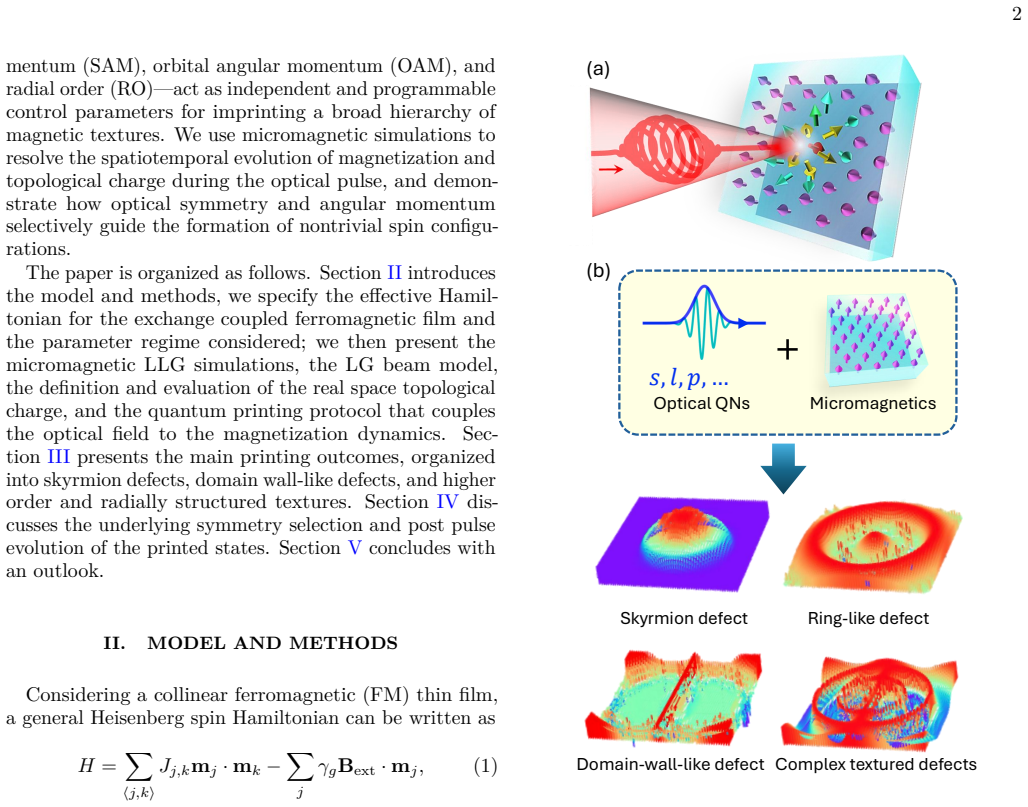
Laguerre-Gaussian pulses imprint non-collinear magnetic textures via the spatial structure of optical magnetic field. This route offers direct spatial selectivity determined by the optical features without relying on material anisotropic interactions. The proposed printing approach does not require interfacial anisotropy or bulk chirality, current-driven torques, or thermal quenching. Micromagnetic simulations demonstrate the potential to create topological charge density emerging during the pulse and reveal control through the optical topological properties and polarization. These results suggest structured-light quantum printing as a viable approach for magnonics and motivate studies towar
Load-bearing premise
The micromagnetic simulations accurately represent the physical interaction between the Laguerre-Gaussian pulse and the magnetic system in the absence of material-specific effects.
Editorial analysis
A structured set of objections, weighed in public.
Referee Report
Summary. The manuscript proposes 'quantum printing' of topological magnetic textures using Laguerre-Gaussian (LG) pulses. The central claim is that these pulses imprint non-collinear magnetic textures solely via the spatial structure of the optical magnetic field, without requiring material anisotropic interactions, interfacial anisotropy, bulk chirality, current-driven torques, or thermal quenching. Micromagnetic simulations are used to demonstrate emergence of topological charge density during the pulse, with control via the optical topological properties and polarization. The results are positioned as enabling reconfigurable textures for magnonics via ultrafast THz optics and non-thermal control.
Significance. If the simulations are robust, the work offers a material-independent route to spatially selective topological textures based on optical field structure alone. This could be significant for magnonics by enabling non-thermal, reconfigurable control without reliance on material-specific effects or external drives. The approach's emphasis on optical topological properties as a control knob is a potential strength if the predictions prove falsifiable.
major comments (1)
- [Abstract] Abstract: The central claim that non-collinear textures emerge 'without relying on material anisotropic interactions' rests entirely on micromagnetic simulations, yet no quantitative results, error analysis, material parameters, discretization details, or validation against known cases are provided. This prevents assessment of whether the reported topological charge density is induced purely by the optical magnetic field structure.
Simulated Author's Rebuttal
We thank the referee for the detailed review and constructive comment. We address the concern regarding the abstract by noting that the full manuscript contains the requested simulation details in the Methods section, and we will revise the abstract to incorporate key quantitative elements for improved clarity and support of the central claim.
read point-by-point responses
-
Referee: [Abstract] Abstract: The central claim that non-collinear textures emerge 'without relying on material anisotropic interactions' rests entirely on micromagnetic simulations, yet no quantitative results, error analysis, material parameters, discretization details, or validation against known cases are provided. This prevents assessment of whether the reported topological charge density is induced purely by the optical magnetic field structure.
Authors: We agree that the abstract, as a concise summary, does not include the full technical details of the micromagnetic simulations. These are provided in the Methods section of the manuscript, which specifies the material parameters (e.g., Ms = 1.0 MA/m, Aex = 10 pJ/m, alpha = 0.01), discretization (5 nm cubic cells with convergence checks), time-stepping (1 fs), and validation against standard test cases such as uniform precession and known skyrmion dynamics. Quantitative results on topological charge density Q(t) during the pulse, including error bars from multiple runs, are presented in Figures 2–4, demonstrating emergence solely from the LG beam's B-field structure with zero anisotropy terms. To strengthen the abstract and enable direct assessment, we will revise it to include a brief mention of the simulation framework, key parameters, and confirmation that no material anisotropies or other effects are included. This revision will be made in the next version. revision: yes
Circularity Check
No significant circularity detected
full rationale
The paper's derivation relies on the spatial structure of Laguerre-Gaussian optical magnetic fields to imprint non-collinear textures, with the central demonstration provided by micromagnetic simulations that are external to any fitted parameters or self-referential definitions. No equations, self-citations, or ansatzes in the abstract reduce the claimed result to its inputs by construction. The approach is presented as independent of material anisotropies and uses simulations as direct evidence, satisfying the criteria for a self-contained, non-circular argument.
Assumptions & free parameters
assumptions (1)
- domain assumption Micromagnetic simulations can model the imprinting of magnetic textures by optical fields
Cite this review
Pith. "Pith review of Quantum Printing: Laguerre-Gaussian Beam Induced Topological Magnetic Textures." pith.science (2026). https://pith.science/paper/SJUTDRCC
@misc{pith2026260524720,
  author       = {Pith},
  title        = {Pith review of: Quantum Printing: Laguerre-Gaussian Beam Induced Topological Magnetic Textures},
  year         = {2026},
  howpublished = {\url{https://pith.science/paper/SJUTDRCC}},
  note         = {Machine review of arXiv:2605.24720}
}
read the original abstract
Structured light has become a practical tool for controlling matter by applying tailored, space- and time-dependent electromagnetic fields. We show that Laguerre-Gaussian pulses imprint non-collinear magnetic textures via the spatial structure of optical magnetic field. Our route offers a direct spatial selectivity determined by the optical features without relying on material anisotropic interactions. The proposed printing approach does not require interfacial anisotropy or bulk chirality, current-driven torques, or thermal quenching. We use micromagnetic simulations to demonstrate the potential to create topological charge density emerging during the pulse and reveal control through the optical topological properties and polarization. These results suggest structured-light quantum printing as a viable approach for magnonics and motivate studies toward reconfigurable topological textures enabled by ultrafast THz optics and non-thermal control.
Figures


Figures from the paper (5 more)


Reference graph
Works this paper leans on
-
[1]
N. Nagaosa and Y. Tokura, Topological Properties and Dynamics of Magnetic Skyrmions, Nat. Nanotechnol.8, 899 (2013)
work page 2013
-
[2]
A. Fert, N. Reyren, and V. Cros, Magnetic Skyrmions: Advances in Physics and Potential Applications, Nat. Rev. Mater.2, 17031 (2017)
work page 2017
-
[3]
2025 Quantum printing.arXiv preprint arXiv:2509.16792
G. Aeppli, A. V. Balatsky, S. Bonetti, G. Cardoso, S. Raghu, E. Syljuåsen, T.-T. Yeh, S.-Z. Lin, Y. Liu, J. Weissenrieder, and P. J. Wong, Quantum Printing, arXiv:2509.16792 (2025)
-
[4]
A. N. Bogdanov and A. Hubert, Thermodynamically Sta- ble Magnetic Vortex States in Magnetic Crystals, J. Magn. Magn. Mater.138, 255 (1994)
work page 1994
-
[5]
U. K. Rössler, A. N. Bogdanov, and C. Pfleiderer, Spon- taneous Skyrmion Ground States in Magnetic Metals, Nature442, 797 (2006)
work page 2006
-
[6]
X. Z. Yu, W. Koshibae, Y. Tokunaga, K. Shibata, Y. Taguchi, N. Nagaosa, and Y. Tokura, Transforma- tion of Topological Spin Textures between Skyrmion and Meron in a Chiral Magnet, Nature564, 95 (2018). 12
work page 2018
-
[7]
H. Fujita and M. Sato, Encoding orbital angular momen- tum of light in magnets, Phys. Rev. B96, 060407(R) (2017)
work page 2017
-
[8]
L. Gao, S. Prokhorenko, Y. Nahas, L. Bellaiche, Dynam- ical control of topology in polar skyrmions via twisted light, Phys. Rev. Lett.132, 026902 (2024)
work page 2024
Show all 53 references
-
[9]
Shirato, R
T. Shirato, R. Yambe, and S. Hayami, Bimeron Crystals by a Linearly Polarized AC Electric Field in Frustrated Magnets, J. Phys. Soc. Jpn.94, 063601 (2025)
2025
-
[10]
R. J. Laxamana and S. Hayami, Skyrmion generation via Laguerre-Gaussian beam irradiation in frustrated mag- nets, arXiv:2603.03773 (2026)
2026
-
[11]
Fujita and M
H. Fujita and M. Sato, Ultrafast generation of skyrmionic defects with vortex beams, Phys. Rev. B95, 054421 (2017)
2017
-
[12]
Jiang, P
W. Jiang, P. Upadhyaya, W. Zhang, G. Yu, M. B. Jungfleisch, F. Y. Fradin, J. E. Pear- son, Y. Tserkovnyak, K. L. Wang, O. Heinonen, S. G. E. te Velthuis, and A. Hoffmann, Blowing Mag- netic Skyrmion Bubbles, Science349, 283 (2015)
2015
-
[13]
Rajeswari, R
G.Berruto, I.Madan, Y.Murooka, G.M.Vanacore, E.Po- marico, J. Rajeswari, R. Lamb, P. Huang, A. J. Kruchkov, Y. Togawa, T. LaGrange, D. McGrouther, H. M. Rønnow, and F. Carbone, Laser-Induced Skyrmion Writing and Erasing in an Ultrafast Cryo-Lorentz Transmission Elec- tron Micr...
2018
-
[14]
Allen, M
L. Allen, M. W. Beijersbergen, R. J. C. Spreeuw, and J. P. Woerdman, Orbital Angular Momentum of Light and the Transformation of Laguerre–Gaussian Laser Modes, Phys. Rev. A45, 8185 (1992)
1992
-
[15]
X. Gu, M. Krenn, M. Erhard, and A. Zeilinger, Gouy Phase Radial Mode Sorter for Light: Concepts and Ex- periments, Phys. Rev. Lett.120, 103601 (2018)
2018
-
[16]
J. Wang, J. Liu, S. Li, Y. Zhao, J. Du, and L. Zhu, Orbital Angular Momentum and Beyond in Free-Space Optical Communications, Nanophotonics11, 645 (2022)
2022
-
[17]
D. H. Sliney, What Is Light? The Visible Spectrum and Beyond, Eye30, 222 (2016)
2016
-
[18]
Kirilyuk, A
A. Kirilyuk, A. V. Kimel, and T. Rasing, Ultrafast Optical Manipulation of Magnetic Order, Rev. Mod. Phys.82, 2731 (2010)
2010
-
[19]
Kampfrath, A
T. Kampfrath, A. Sell, G. Klatt, A. Pashkin, S. Mährlein, T. Dekorsy, M. Wolf, M. Fiebig, A. Leitenstorfer, and R. Huber, Coherent Terahertz Control of Antiferromag- netic Spin Waves, Nat. Photonics5, 31 (2011)
2011
-
[20]
Kampfrath, K
T. Kampfrath, K. Tanaka, and K. A. Nelson, Resonant and Nonresonant Control over Matter and Light by In- tense Terahertz Transients, Nat. Photonics7, 680 (2013)
2013
-
[21]
A. Sell, A. Leitenstorfer, and R. Huber, Phase-Locked Generation and Field-Resolved Detection of Widely Tunable Terahertz Pulses with Amplitudes Exceeding 100 MV/cm, Opt. Lett.33, 2767 (2008)
2008
-
[22]
Sederberg, F
S. Sederberg, F. Kong, and P. B. Corkum, Tesla-Scale Terahertz Magnetic Impulses, Phys. Rev. X10, 011063 (2020)
2020
-
[23]
Sergio Martín-Domene, Luis Sánchez-Tejerina, Rodrigo Martín-Hernández, Carlos Hernández-García, Generation of intense, polarization-controlled magnetic fields with non-paraxial structured laser beams, Appl. Phys. Lett. 124, 211101 (2024)
2024
-
[24]
T.-T. Yeh, H. Yerzhakov, L. Bishop-Van Horn, S. Raghu, and A. V. Balatsky, Quantum Printing and Induced Vor- ticityinSuperconductorsI:LinearlyPolarizedLight, Phys. Rev. Research7, 043111 (2025)
2025
-
[25]
T.-T. Yeh, H. Yerzhakov, L. Bishop-Van Horn, S. Raghu, and A. V. Balatsky, Quantum Printing and Induced Vor- ticity in Superconductors II: Laguerre–Gaussian Beam, Phys. Rev. Research7, 043112 (2025)
2025
-
[26]
Yerzhakov, T.-T
H. Yerzhakov, T.-T. Yeh, and A. V. Balatsky, Induction of Orbital Currents and Kapitza Stabilization in Super- conducting Circuits with Laguerre–Gaussian Microwave Beams, Phys. Rev. B110, 144519 (2024)
2024
-
[27]
Yerzhakov and A
H. Yerzhakov and A. V. Balatsky, Induction ofp-Wave andd-Wave Order Parameters ins-Wave Superconductors with Light Pulses, arXiv:2602.09391 (2026)
2026
-
[28]
Cardoso, E
G. Cardoso, E. Syljuåsen, and A. V. Balatsky, Orbital In- verse Faraday and Cotton–Mouton Effects in Hall Fluids, Phys. Rev. Lett.136, 016502 (2026)
2026
-
[29]
Mizushima and M .Sato, Imprinting spiral Higgs waves onto superconductors with vortex beams, Phys
T. Mizushima and M .Sato, Imprinting spiral Higgs waves onto superconductors with vortex beams, Phys. Rev. Re- search5, L042004 (2023)
2023
-
[30]
D. Kang, S. Kitamura, and T. Morimoto, Quantum Opti- cal Spanner: Twisting Superconductors with Vortex Beam via Higgs Mode, Phys. Rev. B112, 214315 (2025)
2025
-
[31]
Kang, T.-T
D. Kang, T.-T. Yeh, T. Morimoto, and A. V. Balatsky, Kapitza–Dirac Interference of Higgs Waves in Supercon- ductors, arXiv:2511.10954 (2025)
2025
-
[32]
Yamamoto, M
S. Yamamoto, M. Sato, S. Fujimoto, and T. Mizushima, Optical vortex pulse induced nonequilibrium spin textures in spin-orbit coupled electrons, Phys. Rev. B112, 205306 (2025)
2025
-
[33]
D. M. Juraschek, M. Fechner, A. V. Balatsky, and N. A. Spaldin, Dynamical multiferroicity, Phys. Rev. Ma- terials1, 014401 (2017)
2017
-
[34]
Basini, M
M. Basini, M. Pancaldi, B. Wehinger, M. Udina, V.Unikandanunni, T.Tadano, M.C.Hoffmann, A.V.Bal- atsky, and S. Bonetti, Terahertz Electric-Field-Driven Dynamical Multiferroicity in SrTiO3, Nature628, 534 (2024)
2024
-
[35]
Mühlbauer, B
S. Mühlbauer, B. Binz, F. Jonietz, C. Pfleiderer, A. Rosch, A. Neubauer, R. Georgii, and P. Böni, Skyrmion Lattice in a Chiral Magnet, Science323, 915 (2009)
2009
-
[36]
Tokura and N
Y. Tokura and N. Kanazawa, Magnetic Skyrmion Materi- als, Chem. Rev.121, 2857 (2021)
2021
-
[37]
Heinze, K
S. Heinze, K. von Bergmann, M. Menzel, J. Brede, A. Ku- betzka, R. Wiesendanger, G. Bihlmayer, and S. Blügel, Spontaneous Atomic-Scale Magnetic Skyrmion Lattice in Two Dimensions, Nat. Phys.7, 713 (2011)
2011
-
[38]
H. Wu, X. Hu, K. Jing, and X. R. Wang, Size and Profile of Skyrmions in Skyrmion Crystals, Commun. Phys.4, 210 (2021)
2021
-
[39]
Finazzi, M
M. Finazzi, M. Savoini, A. R. Khorsand, A. Tsukamoto, A. Itoh, L. Duò, A. Kirilyuk, Th. Rasing, and M. Ezawa, Laser-Induced Magnetic Nanostructures with Tunable Topological Properties, Phys. Rev. Lett.110, 177205 (2013)
2013
-
[40]
S.-G. Je, P. Vallobra, T. Srivastava, J.-C. Rojas-Sánchez, T. H. Pham, M. Hehn, G. Malinowski, C. Baraduc, S. Auf- fret, G. Gaudin, S. Mangin, H. Béa, and O. Boulle, Cre- ation of magnetic skyrmion bubble lattices by ultrafast laser in ultrathin films, Nano Lett.18, 7362 (2018)
2018
-
[41]
Büttner, B
F. Büttner, B. Pfau, M. Böttcher, M. Schneider, G. Mer- curio, C. M. Günther, P. Hessing, C. Klose, A. Wittmann, K. Gerlinger, L.-M. Kern, C. Strüber, C. von Ko- rff Schmising, J. Fuchs, D. Engel, A. Churikova, S. Huang, D. Suzuki, I. Lemesh, M. Huang, L. Caretta, D. Weder, J....
2021
-
[42]
K.Zhu, L.Bi, Y.Zhang, D.Zheng, D.Yang, J.Li, H.Tian, J. Cai, H. Yang, Y. Zhang, and J. Li, Ultrafast switching to zero field topological spin textures in ferrimagnetic TbFeCo films, Nanoscale16, 3133 (2024)
2024
-
[43]
Hubert and R
A. Hubert and R. Schäfer,Magnetic Domains: The Anal- ysis of Magnetic Microstructures(Springer, Berlin, Hei- delberg, 1998)
1998
-
[44]
T. L. Gilbert, A Phenomenological Theory of Damping in Ferromagnetic Materials, IEEE Trans. Magn.40, 3443 (2004)
2004
-
[45]
A. V. Chumak, V. I. Vasyuchka, A. A. Serga, and B. Hille- brands, Magnon Spintronics, Nat. Phys.11, 453 (2015)
2015
-
[46]
B. Berg, M. Lüscher, Definition and statistical distribu- tions of a topological number in the lattice O(3)σ-model, Nuclear Physics B, 190(2), 412-424 (1981)
1981
-
[47]
X. Guo, K. Bertling, B. C. Donose, M. Brünig, A. Cer- nescu, A. A. Govyadinov, and A. D. Rakić, Terahertz Nanoscopy: Advances, Challenges, and the Road Ahead, Appl. Phys. Rev.11, 021306 (2024)
2024
-
[48]
Tuniz and B
A. Tuniz and B. T. Kuhlmey, Subwavelength Terahertz Imaging via Virtual Superlensing in the Radiating Near Field, Nat. Commun.14, 6393 (2023)
2023
-
[49]
The appended animations are openly available in the Github repository at https://github.com/ yuefeiliuphys/qp-mm
-
[50]
Supplemental Material summarizes the micromagnetic outcomes of the quantum printing protocol for LG modes with polarization indexs∈{−1, 0, 1}, azimuthal index l∈ {0, 1}, and radial index p∈ {0, 1}, including the uniform initial magnetizationsm0 = +ˆz,m 0 = + ˆx, and m0 =−ˆz
-
[51]
X. Fu, S. D. Pollard, B. Chen, B.-K. Yoo, H. Yang, and Y. Zhu, Optical Quenching of Magnetic Vortex Visual- izedIn Situby Lorentz Electron Microscopy, Microsc. Microanal.24(S1), 912 (2018)
2018
-
[52]
Z. Fan, A. del Campo, and G.-W. Chern, Kibble–Zurek Mechanism for Nonequilibrium Generation of Magnetic Monopoles in Spin Ices, arXiv:2307.05267 (2023)
2023
-
[53]
L. Niu, X. Feng, X. Zhang, W. Yu, Q. Wang, Y. Lang, Q. Xu, X. Chen, J. Ma, H. Qiu, Y. Shen, W. Zhang, and J. Han, Electric-Magnetic-Switchable Free-Space Skyrmions in Toroidal Light Pulses via a Nonlinear Meta- surface, Optica13, 203 (2026)
2026
Reviewed June 30, 2026 · model on record in the stance chip above.
Discussion (0). Sign in to comment.