"It Felt a Bit Eerie": Exploring Humanlike Interactions During Collaborative Writing with an Artificial Agent
Pith reviewed 2026-06-30 12:06 UTC · model grok-4.3
The pith
Synchronous AI suggestions speed up writing but produce contextual misalignment, while a visible cursor improves intent understanding yet creates feelings of surveillance.
A machine-rendered reading of the paper's core claim, the machinery that carries it, and where it could break.
Core claim
By placing three AI text editor variants along a spectrum from synchronous suggestions with a visual cursor to asynchronous suggestions without one, the study finds that the humanlike features increase efficiency and intent understanding yet also produce contextual misalignment and surveillance sensations, creating social expectations without the mutual alignment found in human collaboration.
What carries the argument
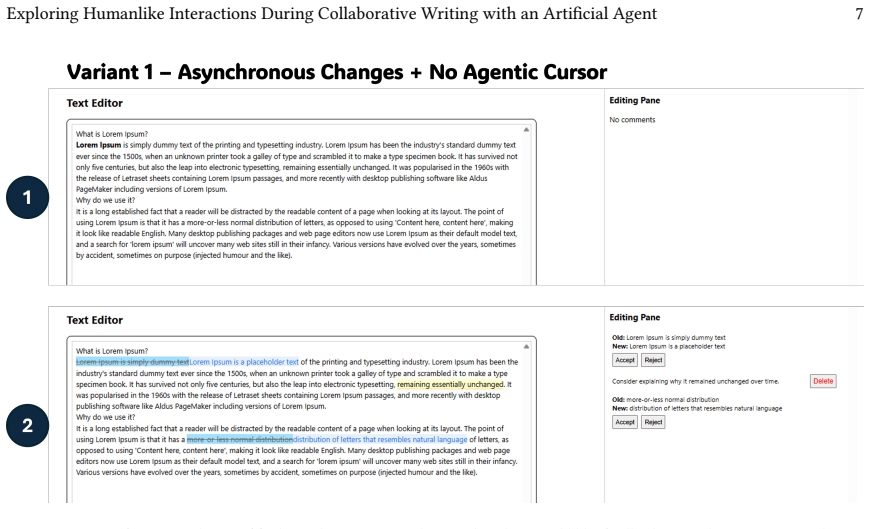
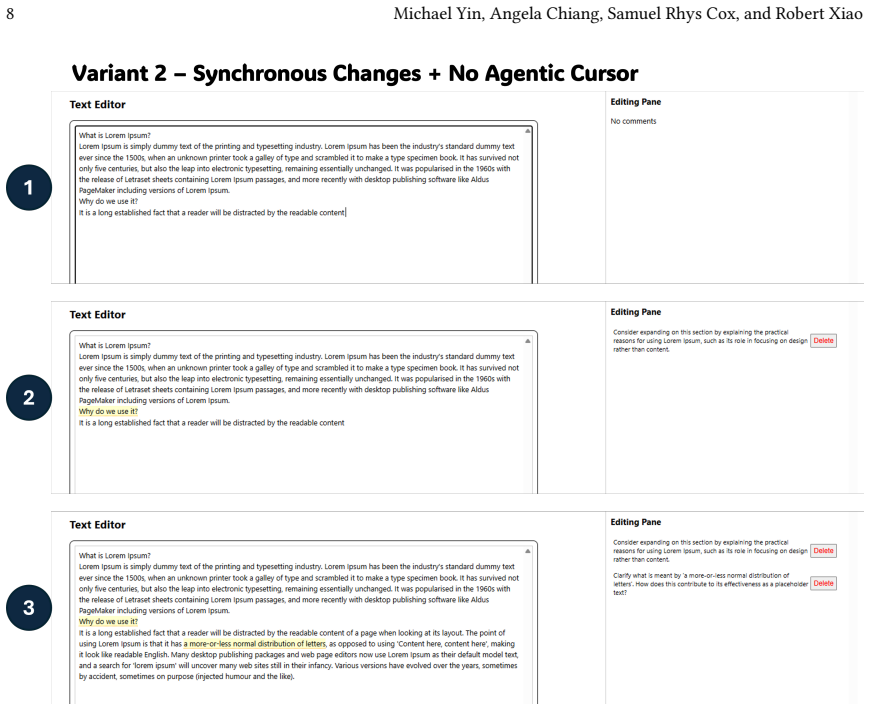
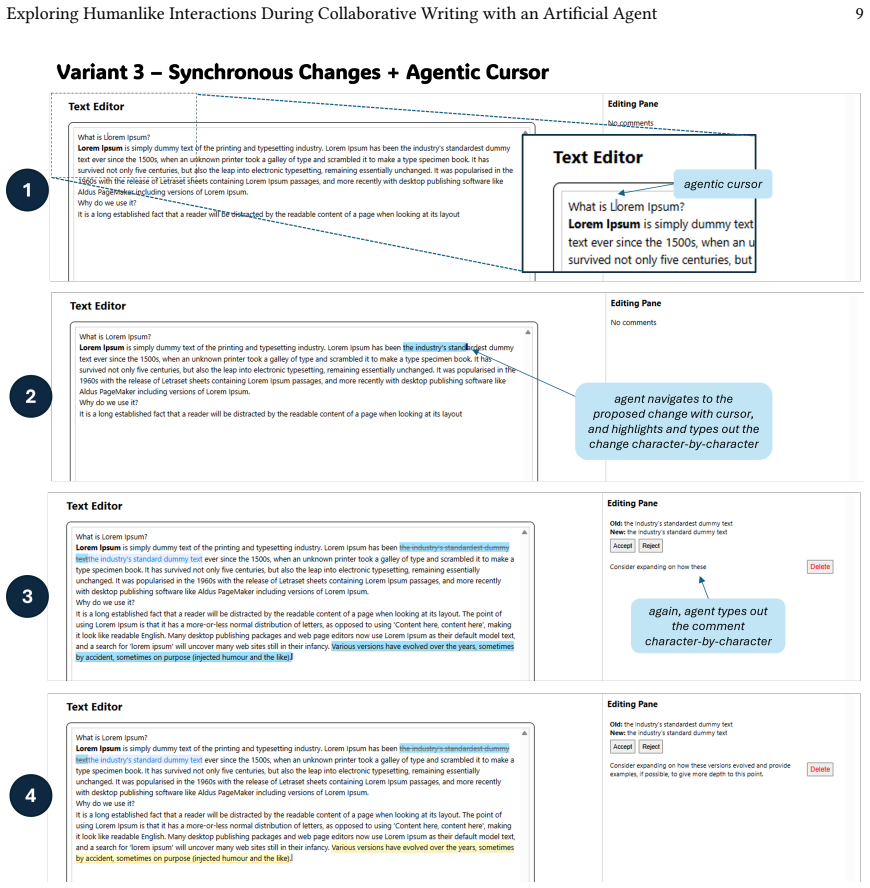
Three variants of an AI-assisted text editor that vary along temporal (synchronous vs asynchronous suggestions) and visual (cursor present vs absent) dimensions to simulate humanlike versus machinelike interaction.
If this is right
- Synchronous suggestions raise writing speed but increase the chance that suggestions fall out of context.
- A visible cursor makes the AI's intended edits easier for users to follow.
- The visible cursor also triggers feelings that the AI is watching the user.
- Humanlike interaction designs in AI systems can generate social expectations that the agent cannot fully meet.
- Designers of collaborative AI tools must weigh efficiency and clarity gains against these social costs.
Where Pith is reading between the lines
- Adding explicit controls for cursor visibility might reduce the surveillance feeling while preserving the intent-understanding benefit.
- Real-time suggestion systems could incorporate context-checking steps to reduce misalignment without losing speed advantages.
- The same temporal and visual trade-offs may appear in AI tools for tasks other than writing, such as code or image editing.
- Longer sessions might show whether users learn to ignore or adapt to the eerie sensation over time.
Load-bearing premise
The three editor versions differ only in suggestion timing and cursor visibility, with no other differences in suggestion quality or interface design that could produce the reported effects.
What would settle it
A controlled replication in which suggestion quality, phrasing, and all other interface elements are held identical across the three variants, after which the differences in efficiency, misalignment, understanding, and surveillance feelings are no longer observed.
Figures
read the original abstract
While human-AI collaboration systems have increasingly been built to increase efficiency or support creativity, little work has examined how the design of interactions shapes the social connection between human and artificial agent. We examine how the temporal and visual dimensions of collaboration shape the experience of a writing task. Specifically, we built three variants of an AI-assisted text editor along a spectrum of simulated humanlike interaction (synchronous and with a cursor) to machinelike interaction (asynchronous and without a cursor), and conducted a comparative user study (n=48). Our exploratory findings suggest that synchronous suggestions increased efficiency but led to contextual misalignment, while a visual cursor increased intent understanding but evoked feelings of surveillance. Taken together, humanlike design of artificial agents can create positive social expectations but also elicit social costs, especially without the alignment present in human-human collaboration. We extend our findings into design implications and ethical considerations when building human-AI collaboration systems.
Editorial analysis
A structured set of objections, weighed in public.
Referee Report
Summary. The paper reports an exploratory comparative user study (n=48) of three AI-assisted text editor variants spanning a spectrum from humanlike (synchronous suggestions with visual cursor) to machinelike (asynchronous without cursor). The central claims are that synchronous suggestions increase task efficiency but produce contextual misalignment, while the visual cursor improves understanding of AI intent but evokes surveillance feelings; overall, humanlike designs create positive social expectations alongside social costs absent in human-human alignment. The authors derive design implications and ethical considerations for human-AI collaboration systems.
Significance. If the isolation of temporal and visual factors holds, the work adds empirical grounding to HCI discussions of social connection in human-AI writing tools. The controlled between-subjects design and mixed-methods exploration of both efficiency and experiential costs provide a concrete basis for future interface guidelines, particularly as generative writing assistants proliferate.
major comments (2)
- [Methods] Methods, Study Design and Procedure sections: The manuscript must report quantitative metrics (e.g., suggestion frequency, average length, relevance scores, or generation latency) demonstrating that suggestion content and quality were statistically equivalent across the three editor variants. The skeptic concern is load-bearing because any systematic difference in backend prompting or caching between synchronous and asynchronous modes would provide an alternative explanation for the reported efficiency and misalignment effects, undermining attribution to the temporal dimension alone.
- [Results] Results section: The abstract states directional effects (efficiency increase, misalignment, intent understanding, surveillance) without accompanying statistical details, effect sizes, or exclusion criteria. The full paper must include the exact analysis methods (quantitative tests, qualitative coding scheme, inter-rater reliability) and report whether the n=48 sample was powered or whether any participants were excluded, as these details are required to evaluate whether the data support the stated claims.
minor comments (2)
- [Abstract] Abstract: Replace the vague phrase 'increased efficiency' with the concrete operationalization used in the study (e.g., 'reduced task completion time' or 'higher words-per-minute output').
- Figure captions and interface descriptions: Ensure that screenshots or diagrams of the three variants clearly label the presence/absence of the cursor and the timing of suggestion delivery so readers can visually verify the intended manipulations.
Simulated Author's Rebuttal
We thank the referee for the constructive and detailed feedback on our exploratory study. We address each major comment below, clarifying our approach and indicating planned revisions where appropriate.
read point-by-point responses
-
Referee: [Methods] Methods, Study Design and Procedure sections: The manuscript must report quantitative metrics (e.g., suggestion frequency, average length, relevance scores, or generation latency) demonstrating that suggestion content and quality were statistically equivalent across the three editor variants. The skeptic concern is load-bearing because any systematic difference in backend prompting or caching between synchronous and asynchronous modes would provide an alternative explanation for the reported efficiency and misalignment effects, undermining attribution to the temporal dimension alone.
Authors: We agree that equivalence of suggestion content is necessary to isolate the effects of the temporal and visual manipulations. All three variants were implemented with the identical backend model, prompt template, and generation parameters; the only differences were in the timing of when suggestions appeared to the user and whether a cursor visualization was shown. We did not collect post-hoc metrics on suggestion frequency, length, or relevance because the experimental focus was on interface factors rather than model output variation. In revision we will add an explicit Methods subsection describing the shared backend implementation and confirming that no condition-specific prompting or caching was used, thereby strengthening the attribution to the manipulated dimensions. revision: partial
-
Referee: [Results] Results section: The abstract states directional effects (efficiency increase, misalignment, intent understanding, surveillance) without accompanying statistical details, effect sizes, or exclusion criteria. The full paper must include the exact analysis methods (quantitative tests, qualitative coding scheme, inter-rater reliability) and report whether the n=48 sample was powered or whether any participants were excluded, as these details are required to evaluate whether the data support the stated claims.
Authors: The study is framed as exploratory, so we reported directional patterns supported by mixed-methods data rather than formal hypothesis tests. In the revised manuscript we will expand the Results section to include: the precise quantitative analysis procedures and any statistical tests applied (with effect sizes where computed); a full description of the qualitative coding scheme together with example codes; inter-rater reliability statistics; explicit confirmation that no participants were excluded; and a note that sample size was chosen to align with comparable prior HCI studies rather than an a-priori power calculation. These additions will increase transparency while remaining consistent with the exploratory design. revision: yes
Circularity Check
Empirical user study with no derivation chain or fitted predictions
full rationale
The paper reports results from a comparative user study (n=48) on three AI text editor variants. No equations, parameters, or derivations appear anywhere in the manuscript. Claims rest on direct participant observations and qualitative/quantitative measures from the experiment. No self-citations are used to justify uniqueness theorems or ansatzes, and no fitted inputs are relabeled as predictions. The design choices (synchronous vs asynchronous, cursor presence) are described as experimental manipulations without reducing to self-referential definitions. This is a standard empirical HCI study whose central claims do not reduce to their own inputs by construction.
Axiom & Free-Parameter Ledger
Reference graph
Works this paper leans on
-
[1]
Canfer Akbulut, Laura Weidinger, Arianna Manzini, Iason Gabriel, and Verena Rieser. 2024. All Too Human? Mapping and Mitigating the Risk from Anthropomorphic AI.Proceedings of the AAAI/ACM Conference on AI, Ethics, and Society7, 1 (Oct. 2024), 13–26. doi:10.1609/aies.v7i1.31613
-
[2]
Deepali Aneja, Rens Hoegen, Daniel McDuff, and Mary Czerwinski. 2021. Understanding Conversational and Expressive Style in a Multimodal Embodied Conversational Agent. InProceedings of the 2021 CHI Conference on Human Factors in Computing Systems (CHI ’21). Association for Computing Machinery, New York, NY, USA, 1–10. doi:10.1145/3411764.3445708
-
[3]
ChatGPT Seems Too Good to Be True
Clare Baek, Tamara Tate, and Mark Warschauer. 2024. “ChatGPT Seems Too Good to Be True”: College Students’ Use and Perceptions of Generative AI.Computers and Education: Artificial Intelligence7 (Dec. 2024), 100294. doi:10.1016/j.caeai.2024.100294
-
[4]
Baseman, Masum Hasan, Nathaniel Swinger, Sheila A
Cynthia M. Baseman, Masum Hasan, Nathaniel Swinger, Sheila A. M. Rauch, Ehsan Hoque, and Rosa I. Arriaga. 2025. ’Poker with Play Money’: Exploring Psychotherapist Training with Virtual Patients.Proc. ACM Hum.-Comput. Interact.9, 7 (Oct. 2025), CSCW269:1–CSCW269:29. doi:10.1145/3757450
-
[5]
Jeffrey Basoah, Daniel Chechelnitsky, Tao Long, Katharina Reinecke, Chrysoula Zerva, Kaitlyn Zhou, Mark Díaz, and Maarten Sap. 2025. Not Like Us, Hunty: Measuring Perceptions and Behavioral Effects of Minoritized Anthropomorphic Cues in LLMs. InProceedings of the 2025 ACM Conference on Fairness, Accountability, and Transparency (FAccT ’25). Association fo...
-
[6]
Charles R. Berger. 1986. Uncertain Outcome Values in Predicted Relationships: Uncertainty Reduction Theory Then and Now.Human Communication Research13, 1 (Sept. 1986), 34–38. doi:10.1111/j.1468-2958.1986.tb00093.x
-
[7]
Charles R Berger and Richard J Calabrese. 1974. Some explorations in initial interaction and beyond: Toward a developmental theory of interpersonal communication.Human communication research1, 2 (1974), 99–112. https://doi.org/10.1111/j.1468-2958.1975.tb00258.x
-
[8]
Advait Bhat, Marianne Aubin Le Quéré, Mor Naaman, and Maurice Jakesch. 2026. Reactive Writers: How Co-Writing with AI Changes How We Engage with Ideas. InProceedings of the 2026 CHI Conference on Human Factors in Computing Systems (CHI ’26). Association for Computing Machinery, New York, NY, USA, Article 732, 21 pages. doi:10.1145/3772318.3791529
-
[9]
Jeremy Birnholtz and Steven Ibara. 2012. Tracking Changes in Collaborative Writing: Edits, Visibility and Group Maintenance. InProceedings of the ACM 2012 Conference on Computer Supported Cooperative Work (CSCW ’12). Association for Computing Machinery, New York, NY, USA, 809–818. doi:10.1145/2145204.2145325
-
[10]
Kerstin Bongard-Blanchy, Arianna Rossi, Salvador Rivas, Sophie Doublet, Vincent Koenig, and Gabriele Lenzini. 2021. ”I Am Definitely Manipulated, Even When I Am Aware of It. It’s Ridiculous!” - Dark Patterns from the End-User Perspective. InProceedings of the 2021 ACM Designing Interactive Systems Conference (DIS ’21). Association for Computing Machinery,...
-
[11]
2021.Thematic analysis: A Practical Guide
Virginia Braun and Victoria Clarke. 2021.Thematic analysis: A Practical Guide. Sage Publications, Thousand Oaks, California, United States. 57–71 pages
2021
-
[12]
Zana Buçinca, Maja Barbara Malaya, and Krzysztof Z. Gajos. 2021. To Trust or to Think: Cognitive Forcing Functions Can Reduce Overreliance on AI in AI-assisted Decision-making.Proc. ACM Hum.-Comput. Interact.5, CSCW1 (April 2021), 188:1–188:21. doi:10.1145/3449287
work page internal anchor Pith review doi:10.1145/3449287 2021
-
[13]
Weichen Joe Chang, Katie Seaborn, and Andrew A. Adams. 2024. Theorizing Deception: A Scoping Review of Theory in Research on Dark Patterns and Deceptive Design. InExtended Abstracts of the CHI Conference on Human Factors in Computing Systems (CHI EA ’24). Association for Computing Machinery, New York, NY, USA, 1–7. doi:10.1145/3613905.3650997
-
[14]
Rijul Chaturvedi, Sanjeev Verma, Vartika Srivastava, and Shailesh Sampat Khot. 2025. Exploring the Frontier of Anthropomorphism in AI Agents: Trends and Way Forward.Business and Society Review130, 1 (2025), 42–80. doi:10.1111/basr.70002
-
[15]
Allison Chen, Sunnie S. Y. Kim, Amaya Dharmasiri, Olga Russakovsky, and Judith E. Fan. 2025. Portraying Large Language Models as Machines, Tools, or Companions Affects What Mental Capacities Humans Attribute to Them. InProceedings of the Extended Abstracts of the CHI Conference on Human Factors in Computing Systems (CHI EA ’25). Association for Computing ...
-
[16]
Jiahao Chen, Mingming Li, and Jaap Ham. 2024. Different Dimensions of Anthropomorphic Design Cues: How Visual Appearance and Conversational Style Influence Users’ Information Disclosure Tendency towards Chatbots.International Journal of Human-Computer Studies190 (Oct. 2024), 103320. doi:10.1016/j.ijhcs.2024.103320
-
[17]
Victoria Clarke and Virginia Braun. 2017. Thematic Analysis.The Journal of Positive Psychology12, 3 (May 2017), 297–298. doi:10.1080/17439760. 2016.1262613
-
[18]
Clara Colombatto, Jonathan Birch, and Stephen M. Fleming. 2025. The Influence of Mental State Attributions on Trust in Large Language Models. Communications Psychology3, 1 (May 2025), 84. doi:10.1038/s44271-025-00262-1
-
[19]
Anna L. Cox, Sandy J.J. Gould, Marta E. Cecchinato, Ioanna Iacovides, and Ian Renfree. 2016. Design Frictions for Mindful Interactions: The Case for Microboundaries. InProceedings of the 2016 CHI Conference Extended Abstracts on Human Factors in Computing Systems (CHI EA ’16). Association for Computing Machinery, New York, NY, USA, 1389–1397. doi:10.1145/...
-
[20]
Samuel Rhys Cox, Helena Bøjer Djernæs, and Niels van Berkel. 2025. Beyond Productivity: Rethinking the Impact of Creativity Support Tools. In Proceedings of the 2025 Conference on Creativity and Cognition (C&C ’25). Association for Computing Machinery, New York, NY, USA, 735–749. doi:10.1145/3698061.3726924
-
[21]
Samuel Rhys Cox, Jade Martin-Lise, Simo Hosio, and Niels van Berkel. 2026. Watching AI Think: User Perceptions of Visible Thinking in Chatbots. arXiv preprint arXiv:2601.16720(2026). doi:10.48550/arXiv.2601.16720
-
[22]
Edward L Deci and Richard M Ryan. 2012. Self-determination theory.Handbook of theories of social psychology1, 20 (2012), 416–436
2012
-
[23]
Vivek Dhakal, Anna Maria Feit, Per Ola Kristensson, and Antti Oulasvirta. 2018. Observations on Typing from 136 Million Keystrokes. InProceedings of the 2018 CHI Conference on Human Factors in Computing Systems (CHI ’18). Association for Computing Machinery, New York, NY, USA, 1–12. doi:10.1145/3173574.3174220
-
[24]
Dhillon, Somayeh Molaei, Jiaqi Li, Maximilian Golub, Shaochun Zheng, and Lionel Peter Robert
Paramveer S. Dhillon, Somayeh Molaei, Jiaqi Li, Maximilian Golub, Shaochun Zheng, and Lionel Peter Robert. 2024. Shaping Human-AI Collaboration: Varied Scaffolding Levels in Co-writing with Language Models. InProceedings of the 2024 CHI Conference on Human Factors in Computing Systems (CHI ’24). Association for Computing Machinery, New York, NY, USA, 1–18...
-
[25]
Paul Dourish and Victoria Bellotti. 1992. Awareness and coordination in shared workspaces. InProceedings of the 1992 ACM Conference on Computer-Supported Cooperative Work(Toronto, Ontario, Canada)(CSCW ’92). Association for Computing Machinery, New York, NY, USA, 107–114. doi:10.1145/143457.143468
-
[26]
Philip R. Doyle, Iona Gessinger, Justin Edwards, Leigh Clark, Odile Dumbleton, Diego Garaialde, Daniel Rough, Anna Bleakley, Holly P. Branigan, and Benjamin R. Cowan. 2025. The Partner Modelling Questionnaire: A Validated Self-Report Measure of Perceptions toward Machines as Dialogue Partners.ACM Trans. Comput.-Hum. Interact.32, 4 (Aug. 2025), 39:1–39:33....
-
[27]
Wen Duan, Shiwen Zhou, Matthew J Scalia, Xiaoyun Yin, Nan Weng, Ruihao Zhang, Guo Freeman, Nathan McNeese, Jamie Gorman, and Michael Tolston. 2024. Understanding the Evolvement of Trust Over Time within Human-AI Teams.Proc. ACM Hum.-Comput. Interact.8, CSCW2 (Nov. 2024), 521:1–521:31. doi:10.1145/3687060
-
[28]
Hey Genie, You Got Me Thinking about My Menu Choices!
Mateusz Dubiel, Luis A. Leiva, Kerstin Bongard-Blanchy, and Anastasia Sergeeva. 2024. “Hey Genie, You Got Me Thinking about My Menu Choices!” Impact of Proactive Feedback on User Perception and Reflection in Decision-making Tasks.ACM Trans. Comput.-Hum. Interact.31, 5 (Nov. 2024), 56:1–56:30. doi:10.1145/3685274
-
[29]
Jane L. E, Yu-Chun Grace Yen, Isabelle Yan Pan, Grace Lin, Mingyi Li, Hyoungwook Jin, Mengyi Chen, Haijun Xia, and Steven P. Dow. 2024. When to Give Feedback: Exploring Tradeoffs in the Timing of Design Feedback. InProceedings of the 16th Conference on Creativity & Cognition(Chicago, IL, USA)(C&C ’24). Association for Computing Machinery, New York, NY, US...
-
[30]
Saman Ebadi and Masoud Rahimi. 2017. Exploring the Impact of Online Peer-Editing Using Google Docs on EFL Learners’ Academic Writing Skills: A Mixed Methods Study.Computer Assisted Language Learning30, 8 (Nov. 2017), 787–815. doi:10.1080/09588221.2017.1363056
-
[31]
Siska Fitrianie, Merijn Bruijnes, Fengxiang Li, Amal Abdulrahman, and Willem-Paul Brinkman. 2022. The Artificial-Social-Agent Questionnaire: Establishing the Long and Short Questionnaire Versions. InProceedings of the 22nd ACM International Conference on Intelligent Virtual Agents (IV A ’22). Association for Computing Machinery, New York, NY, USA, 1–8. do...
-
[32]
George Fragiadakis, Christos Diou, George Kousiouris, and Mara Nikolaidou. 2025. Evaluating Human-AI Collaboration: A Review and Method- ological Framework. doi:10.48550/arXiv.2407.19098 arXiv:2407.19098 [cs] Manuscript submitted to ACM Exploring Humanlike Interactions During Collaborative Writing with an Artificial Agent 23
-
[33]
Fiona Fui-Hoon Nah, Ruilin Zheng, Jingyuan Cai, Keng Siau, and Langtao Chen. 2023. Generative AI and ChatGPT: Applications, Challenges, and AI- human Collaboration.Journal of Information Technology Case and Application Research25, 3 (July 2023), 277–304. doi:10.1080/15228053.2023.2233814
-
[34]
Andrew Gambino, Jesse Fox, and Rabindra A. Ratan. 2020. Building a Stronger CASA: Extending the Computers Are Social Actors Paradigm. Human-Machine Communication1 (Jan. 2020), 71–85. doi:10.3316/INFORMIT.097034846749023
-
[35]
Jie Gao, Simret Araya Gebreegziabher, Kenny Tsu Wei Choo, Toby Jia-Jun Li, Simon Tangi Perrault, and Thomas W Malone. 2024. A Taxonomy for Human-LLM Interaction Modes: An Initial Exploration. InExtended Abstracts of the CHI Conference on Human Factors in Computing Systems (CHI EA ’24). Association for Computing Machinery, New York, NY, USA, 1–11. doi:10.1...
-
[36]
When We’re Looking at the Robot, We See Each Other
Serena Ge Guo, Qi Yang, Jenny J Yu, Wenqian Niu, Yunting Yan, Guy Hoffman, Gilly Leshed, and Keith Evan Green. 2026. "When We’re Looking at the Robot, We See Each Other": A Comparison of Robotic, Mirror-Based, and Hybrid Interventions for Stranger Interaction. InProceedings of the 2026 CHI Conference on Human Factors in Computing Systems (CHI ’26). Associ...
-
[37]
Louie Giray. 2025. Cases of Using ChatGPT as a Mental Health and Psychological Support Tool.Journal of Consumer Health on the Internet29, 1 (Jan. 2025), 29–48. doi:10.1080/15398285.2024.2442374
-
[38]
Ella Glikson and Anita Williams Woolley. 2020. Human Trust in Artificial Intelligence: Review of Empirical Research.Academy of Management Annals14, 2 (July 2020), 627–660. doi:10.5465/annals.2018.0057
-
[39]
Ulrich Gnewuch, Stefan Morana, Marc Adam, and Alexander Maedche. 2018. Faster Is Not Always Better: Understanding the Effect of Dynamic Response Delays in Human-Chatbot Interaction.Research Papers(Nov. 2018)
2018
-
[40]
Google. 2010. A rebuilt, more real time Google documents.Google Drive Blog(15th April 2010). https://drive.googleblog.com/2010/04/a-rebuilt- more-real-time-google.html
2010
-
[41]
Gray, Yubo Kou, Bryan Battles, Joseph Hoggatt, and Austin L
Colin M. Gray, Yubo Kou, Bryan Battles, Joseph Hoggatt, and Austin L. Toombs. 2018. The Dark (Patterns) Side of UX Design. InProceedings of the 2018 CHI Conference on Human Factors in Computing Systems (CHI ’18). Association for Computing Machinery, New York, NY, USA, 1–14. doi:10.1145/3173574.3174108
-
[42]
Kurt Gray and Daniel M. Wegner. 2012. Feeling Robots and Human Zombies: Mind Perception and the Uncanny Valley.Cognition125, 1 (Oct. 2012), 125–130. doi:10.1016/j.cognition.2012.06.007
-
[43]
Angela Greilich, Kerstin Bremser, and Kirsten Wüst. 2025. Consumer Response to Anthropomorphism of Text-Based AI Chatbots: A Systematic Literature Review and Future Research Directions.International Journal of Consumer Studies49, 5 (2025), e70108. doi:10.1111/ijcs.70108
-
[44]
Yuanning Han, Ziyi Qiu, Jiale Cheng, and RAY LC. 2024. When Teams Embrace AI: Human Collaboration Strategies in Generative Prompting in a Creative Design Task. InProceedings of the 2024 CHI Conference on Human Factors in Computing Systems (CHI ’24). Association for Computing Machinery, New York, NY, USA, 1–14. doi:10.1145/3613904.3642133
-
[45]
Amal Hashky and Eric Ragan. 2026. A Systematic Review on Human Roles, Solutions, and Methodological Approaches to Address Bias in AI.ACM Comput. Surv.58, 9 (Feb. 2026), 231:1–231:37. doi:10.1145/3793667
-
[46]
Xi Hu, Yiwen Xing, Xudong Cai, Yihang Zhao, Michael Cook, Rita Borgo, and Timothy Neate. 2025. Designing Interactions with Generative AI for Art and Creativity: A Systematic Review and Taxonomy. InProceedings of the 2025 ACM Designing Interactive Systems Conference (DIS ’25). Association for Computing Machinery, New York, NY, USA, 1126–1155. doi:10.1145/3...
-
[47]
Tae Hyun Baek and Minseong Kim. 2023. Is ChatGPT Scary Good? How User Motivations Affect Creepiness and Trust in Generative Artificial Intelligence.Telematics and Informatics83 (Sept. 2023), 102030. doi:10.1016/j.tele.2023.102030
-
[48]
Fawzi Fayez Ishtaiwa and Ibtehal Mahmoud Aburezeq. 2015. The Impact of Google Docs on Student Collaboration: A UAE Case Study.Learning, Culture and Social Interaction7 (Dec. 2015), 85–96. doi:10.1016/j.lcsi.2015.07.004
-
[49]
Khalil Israfılzade. 2023. The Role of Generative AI and Anthropomorphism in Shaping Conversational Marketing: Creating a Matrix for Future Research.The Eurasia Proceedings of Educational and Social Sciences32 (Nov. 2023), 132–142. doi:10.55549/epess.1412832
-
[50]
Was There Bias in Your Response?
Neel Iyer and Alisha Pradhan. 2025. "Was There Bias in Your Response?": LLM Anthropomorphic Traits in Context of Ability Bias Questioning. In Companion Publication of the 2025 Conference on Computer-Supported Cooperative Work and Social Computing (CSCW Companion ’25). Association for Computing Machinery, New York, NY, USA, 471–476. doi:10.1145/3715070.3749272
-
[51]
Tora Jarsve, Barbara Sienkiewicz, Meagan B. Loerakker, Paweł W. Woźniak, and Jasmin Niess. 2026. The Nuances of Creepiness: A Systematic Literature Review of Creepy Technology. InProceedings of the 2026 CHI Conference on Human Factors in Computing Systems (CHI ’26). Association for Computing Machinery, New York, NY, USA, Article 189, 28 pages. doi:10.1145...
-
[52]
Junyi (Joey) Ji. 2024. Demystify ChatGPT: Anthropomorphism around Generative AI.GRACE: Global Review of AI Community Ethics2, 1 (Jan. 2024). doi:10.60690/cee03e53
-
[53]
Zhihan Jiang, Qianhui Chen, Chu Zhang, Yanheng Li, and RAY LC. 2026. Hear You in Silence: Designing for Active Listening in Human Interaction with Conversational Agents Using Context-Aware Pacing. InProceedings of the 2026 CHI Conference on Human Factors in Computing Systems (CHI ’26). Association for Computing Machinery, New York, NY, USA, 1–29. doi:10.1...
-
[54]
Ji-Youn Jung, Sihang Qiu, Alessandro Bozzon, and Ujwal Gadiraju. 2022. Great Chain of Agents: The Role of Metaphorical Representation of Agents in Conversational Crowdsourcing. InProceedings of the 2022 CHI Conference on Human Factors in Computing Systems (CHI ’22). Association for Computing Machinery, New York, NY, USA, 1–22. doi:10.1145/3491102.3517653
-
[55]
Kyuha Jung, Gyuho Lee, Yuanhui Huang, and Yunan Chen. 2025. ’I’ve Talked to ChatGPT about My Issues Last Night. ’: Examining Mental Health Conversations with Large Language Models through Reddit Analysis.Proc. ACM Hum.-Comput. Interact.9, 7 (Oct. 2025), CSCW356:1–CSCW356:25. Manuscript submitted to ACM 24 Michael Yin, Angela Chiang, Samuel Rhys Cox, and R...
-
[56]
Young-Wook Jung, Youn-kyung Lim, and Myung-suk Kim. 2017. Possibilities and Limitations of Online Document Tools for Design Collaboration: The Case of Google Docs. InProceedings of the 2017 ACM Conference on Computer Supported Cooperative Work and Social Computing (CSCW ’17). Association for Computing Machinery, New York, NY, USA, 1096–1108. doi:10.1145/2...
-
[57]
Taewan Kim, Donghoon Shin, Young-Ho Kim, and Hwajung Hong. 2024. DiaryMate: Understanding User Perceptions and Experience in Human-AI Collaboration for Personal Journaling. InProceedings of the 2024 CHI Conference on Human Factors in Computing Systems (CHI ’24). Association for Computing Machinery, New York, NY, USA, 1–15. doi:10.1145/3613904.3642693
-
[58]
Takanori Komatsu and Seiji Yamada. 2011. How Does the Agents’ Appearance Affect Users’ Interpretation of the Agents’ Attitudes: Experimental Investigation on Expressing the Same Artificial Sounds From Agents With Different Appearances.International Journal of Human–Computer Interaction27, 3 (Feb. 2011), 260–279. doi:10.1080/10447318.2011.537209
-
[59]
Michael W. Kramer. 1999. Motivation to Reduce Uncertainty: A Reconceptualization of Uncertainty Reduction Theory.Management Communication Quarterly13, 2 (Nov. 1999), 305–316. doi:10.1177/0893318999132007
-
[60]
Krämer, Ivana Lamia, Hanne Siegert, Florian Wenda, and Lovis Suchmann
Nicole C. Krämer, Ivana Lamia, Hanne Siegert, Florian Wenda, and Lovis Suchmann. 2025. Tricking into Trusting? The Influence of Social Cues of a Generative AI on Perceived Trust.ACM Trans. Interact. Intell. Syst.15, 4 (Dec. 2025), 27:1–27:17. doi:10.1145/3771844
-
[61]
Karel Kreijns, Kate Xu, and Joshua Weidlich. 2022. Social Presence: Conceptualization and Measurement.Educational Psychology Review34, 1 (March 2022), 139–170. doi:10.1007/s10648-021-09623-8
-
[62]
Aman Kumar, Amit Shankar, Abhishek Behl, Debarun Chakraborty, and Raghava R. Gundala. 2025. Anthropomorphic Generative AI Chatbots for Enhancing Customer Engagement, Experience and Recommendation.Journal of Consumer Marketing42, 4 (Feb. 2025), 472–483. doi:10.1108/JCM- 06-2024-6922
-
[63]
Helmut Lang, Melina Klepsch, Florian Nothdurft, Tina Seufert, and Wolfgang Minker. 2013. Are Computers Still Social Actors?. InCHI ’13 Extended Abstracts on Human Factors in Computing Systems (CHI EA ’13). Association for Computing Machinery, New York, NY, USA, 859–864. doi:10.1145/2468356.2468510
-
[64]
Hui Min Lee, Davis Yadav, Sangwook Lee, Keerthana Govindarazan, Cheng Chen, and S. Shyam Sundar. 2025. While We Wait... How Users Perceive Waiting Times and Generation Cues during AI Image Generation. InProceedings of the Extended Abstracts of the CHI Conference on Human Factors in Computing Systems (CHI EA ’25). Association for Computing Machinery, New Y...
-
[65]
Kwan Min Lee and Clifford Nass. 2003. Designing Social Presence of Social Actors in Human Computer Interaction. InProceedings of the SIGCHI Conference on Human Factors in Computing Systems (CHI ’03). Association for Computing Machinery, New York, NY, USA, 289–296. doi:10.1145/642611.642662
-
[66]
Patrick Yung Kang Lee, Jessica Y. Bo, Zixin Zhao, Paula Akemi Aoyagui, Matthew Varona, Ashton Anderson, Anastasia Kuzminykh, Fanny Chevalier, and Carolina Nobre. 2026. Negotiating Relationships with ChatGPT: Perceptions, External Influences, and Strategies for AI Companionship. doi:10.48550/arXiv.2601.13188 arXiv:2601.13188 [cs]
work page internal anchor Pith review Pith/arXiv arXiv doi:10.48550/arxiv.2601.13188 2026
-
[67]
Sunnyoung Lee and Yung Kyun Choi. 2025. When Personality Meets Platform: The Moderating Role of Human-Likeness in AI User Evaluations. International Journal of Human–Computer Interaction0, 0 (Dec. 2025), 1–26. doi:10.1080/10447318.2025.2604629
-
[68]
Florian Lehmann, Krystsina Shauchenka, and Daniel Buschek. 2026. Collaborative Document Editing with Multiple Users and AI Agents. In Proceedings of the 2026 CHI Conference on Human Factors in Computing Systems (CHI ’26). Association for Computing Machinery, New York, NY, USA, 1–27. doi:10.1145/3772318.3790648
-
[69]
Jiachen Li, Amanda K Hall, Ruican Zhong, Selin S. Everett, Alyssa Unell, Hanwen Xu, Matthias Blondeel, Jonathan Carlson, Katie Claveau, Thulasee Jose, Tristan Naumann, David C. Rhew, Naiteek Sangani, Frank Tuan, James Weinstein, Varun Mishra, Elizabeth D Mynatt, Scott Saponas, Hao Qiu, Leonardo Schettini, Joseph Samuel Preston, Aiden Gu, Naoto Usuyama, Ze...
-
[70]
Jiaan Li, Yulu Hu, Shihan Fu, Zhiqing Wu, Pan Hui, Hailiang Wang, and Mingming Fan. 2025. ’It’s like Having a Friend’: Exploring the Opportunity of Large Language Models (LLMs) in Assisting Retirees In Their Daily Lives. InProceedings of the Twelfth International Symposium of Chinese CHI (CHCHI ’24). Association for Computing Machinery, New York, NY, USA,...
-
[71]
Junjun Li, Ning Wang, and Yuzhuo Wang. 2025. The Double-Edged Sword Effect of Generative AI Anthropomorphism on Users’ Emotional Attachment: The Moderating Role of Task Types.Aslib Journal of Information Management(Dec. 2025), 1–24. doi:10.1108/AJIM-03-2025-0125
-
[72]
Jingshu Li, Zicheng Zhu, Renwen Zhang, and Yi-Chieh Lee. 2025. Exploring the Effects of Chatbot Anthropomorphism and Human Empathy on Human Prosocial Behavior Toward Chatbots.Proc. ACM Hum.-Comput. Interact.9, 7 (Oct. 2025), CSCW415:1–CSCW415:29. doi:10.1145/3757596
-
[73]
Lingyao Li, Xiaoshan Huang, Renkai Ma, Ben Zefeng Zhang, Haolun Wu, Fan Yang, and Chen Chen. 2026. LLM Use for Mental Health: Crowdsourcing Users’ Sentiment-based Perspectives and Values from Social Discussions. InProceedings of the ACM Web Conference 2026 (WWW ’26). Association for Computing Machinery, New York, NY, USA, 9687–9698. doi:10.1145/3774904.3793025
-
[74]
Mengjun Li and Ayoung Suh. 2021. Machinelike or Humanlike? A Literature Review of Anthropomorphism in AI-Enabled Technology: 54th Hawaii International Conference on System Sciences (HICSS 2021).Proceedings of the 54th Hawaii International Conference on System Sciences(Jan. 2021), 4053–4062. doi:10.24251/HICSS.2021.493 Manuscript submitted to ACM Exploring...
-
[75]
Xinge Li and Yongjun Sung. 2021. Anthropomorphism Brings Us Closer: The Mediating Role of Psychological Distance in User–AI Assistant Interactions.Computers in Human Behavior118 (May 2021), 106680. doi:10.1016/j.chb.2021.106680
-
[76]
Lasse Lipponen and Jiri Lallimo. 2004. Assessing Collaboratively Usable Applications to Collaborative Technology.British Journal of Educational Technology35, 4 (July 2004), 433–442
2004
-
[77]
Jiaxi Liu. 2024. ChatGPT: Perspectives from Human–Computer Interaction and Psychology.Frontiers in Artificial Intelligence7 (June 2024). doi:10.3389/frai.2024.1418869
-
[78]
Sarah Hsueh-Jui Liu and Yu-Ju Lan. 2016. Social Constructivist Approach to Web-Based EFL Learning: Collaboration, Motivation, and Perception on the Use of Google Docs.Journal of Educational Technology & Society19, 1 (2016), 171–186. jstor:jeductechsoci.19.1.171
2016
-
[79]
Yiren Liu, Si Chen, Haocong Cheng, Mengxia Yu, Xiao Ran, Andrew Mo, Yiliu Tang, and Yun Huang. 2024. How AI Processing Delays Foster Creativity: Exploring Research Question Co-Creation with an LLM-based Agent. InProceedings of the 2024 CHI Conference on Human Factors in Computing Systems (CHI ’24). Association for Computing Machinery, New York, NY, USA, 1...
-
[80]
Rongjun Ma, Shijing He, Jose Luis Martin-Navarro, Xiao Zhan, and Jose Such. 2026. Privacy in Human-AI Romantic Relationships: Concerns, Boundaries, and Agency. InProceedings of the 2026 CHI Conference on Human Factors in Computing Systems (CHI ’26). Association for Computing Machinery, New York, NY, USA, 1–25. doi:10.1145/3772318.3791237
discussion (0)
Sign in with ORCID, Apple, or X to comment. Anyone can read and Pith papers without signing in.