Deep Learning-Enabled Prediction of Geoeffective CMEs Using SOHO and SDO Observations
Pith reviewed 2026-06-30 12:01 UTC · model grok-4.3
The pith
A fusion deep learning model predicts whether Earth-directed coronal mass ejections will cause geomagnetic storms from SOHO and SDO images.
A machine-rendered reading of the paper's core claim, the machinery that carries it, and where it could break.
Core claim
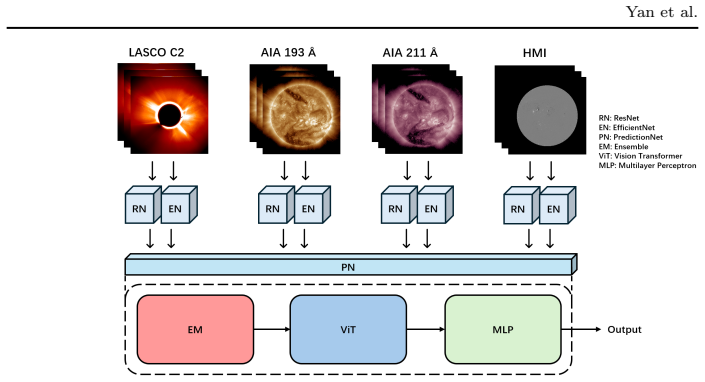
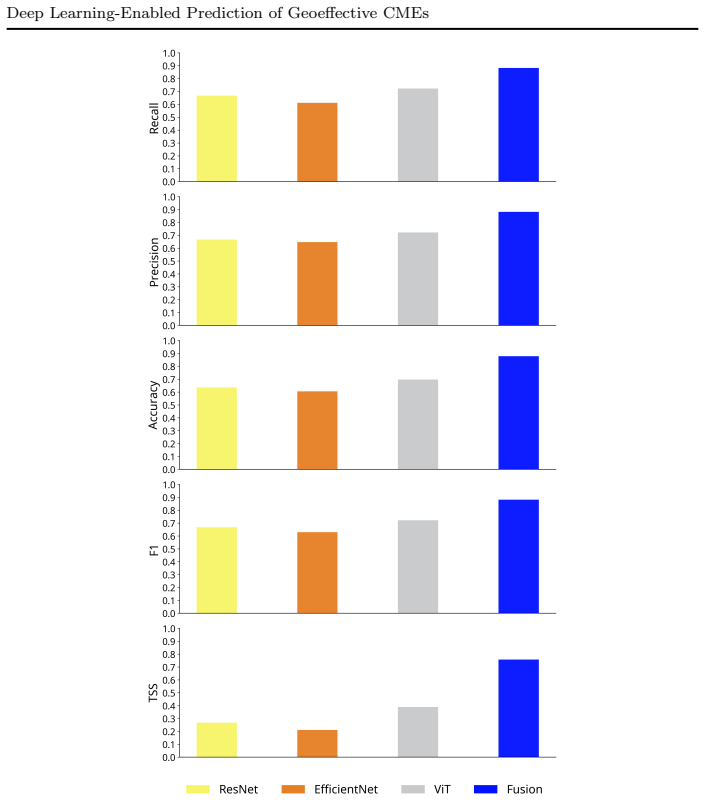
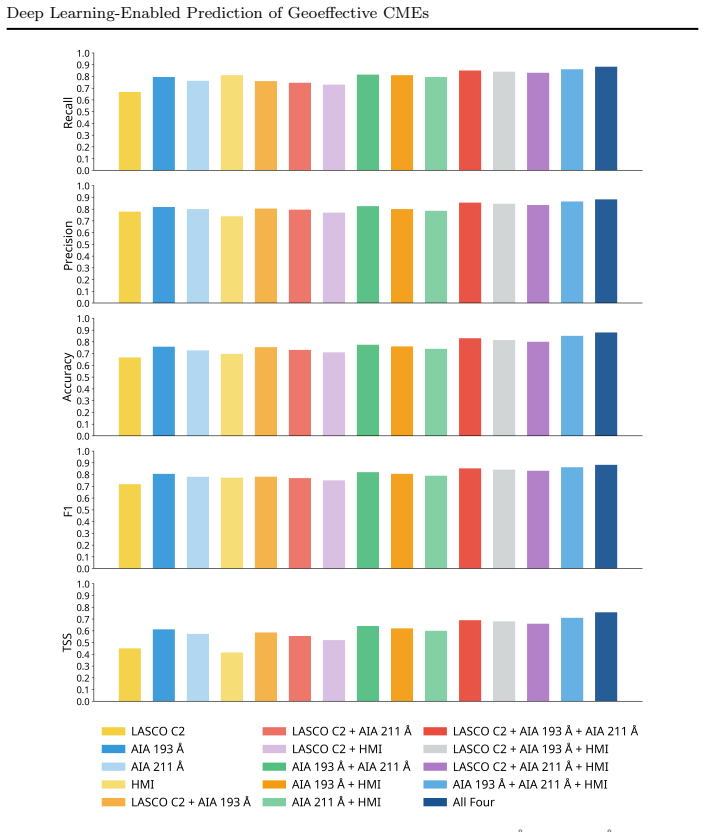
The fusion model integrates convolutional neural networks for learning features from multi-instrument solar observations with a prediction network that fuses the features and classifies whether an Earth-directed CME will produce a geomagnetic storm. Evaluated via five-fold cross validation on events observed by SOHO LASCO and SDO AIA/HMI, the model reaches a mean TSS of 0.703 when used deterministically and a mean Brier score of 0.095 when used probabilistically.
What carries the argument
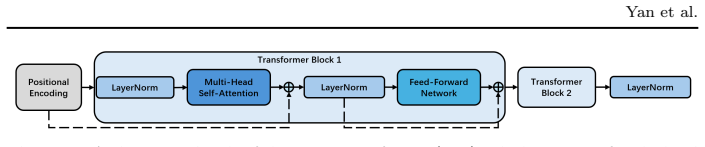
The fusion model that combines convolutional neural network feature extraction from LASCO, AIA, and HMI images with a prediction network for feature fusion and binary or probabilistic classification of geoeffectiveness.
If this is right
- The model supports both deterministic classification and probabilistic estimation of whether a CME will trigger a geomagnetic storm.
- Cross-validation results indicate the approach can forecast the causal connection between Earth-directed CMEs and geomagnetic storms.
- The reported TSS and Brier scores establish quantitative benchmarks for image-based geoeffectiveness prediction using SOHO and SDO data.
Where Pith is reading between the lines
- Operational deployment could shorten the warning time available for space weather impacts once real-time image pipelines are integrated.
- The same fusion architecture might extend to forecasting other solar eruptive events such as flares if suitable labeled image sets exist.
- Combining the model with in-situ solar wind measurements could test whether image-only skill improves when additional inputs are added.
Load-bearing premise
The geoeffectiveness labels assigned to the CME events are accurate and the selected events represent a typical distribution of Earth-directed CMEs.
What would settle it
Running the trained model on a fresh collection of Earth-directed CMEs whose geomagnetic storm outcomes have been independently verified and obtaining a TSS well below 0.7 would falsify the reported performance.
Figures
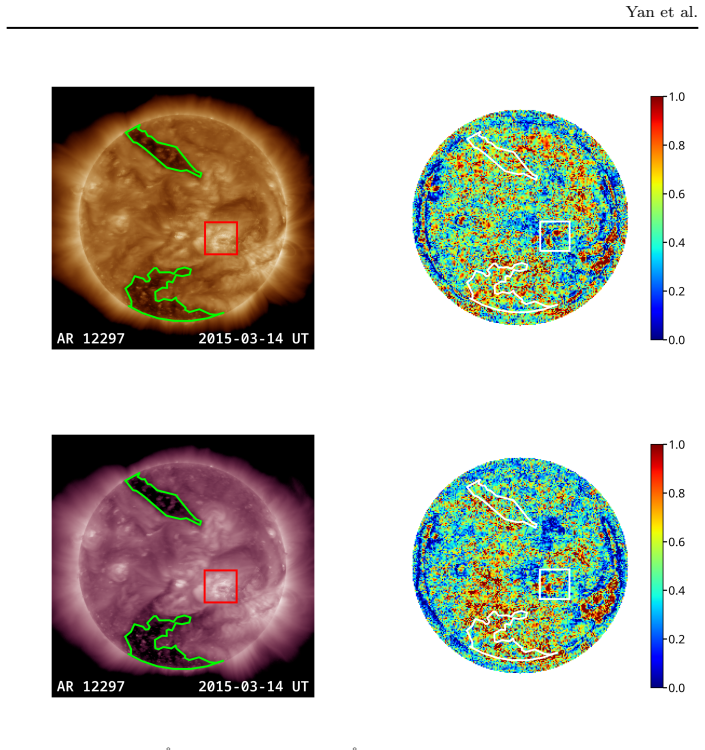
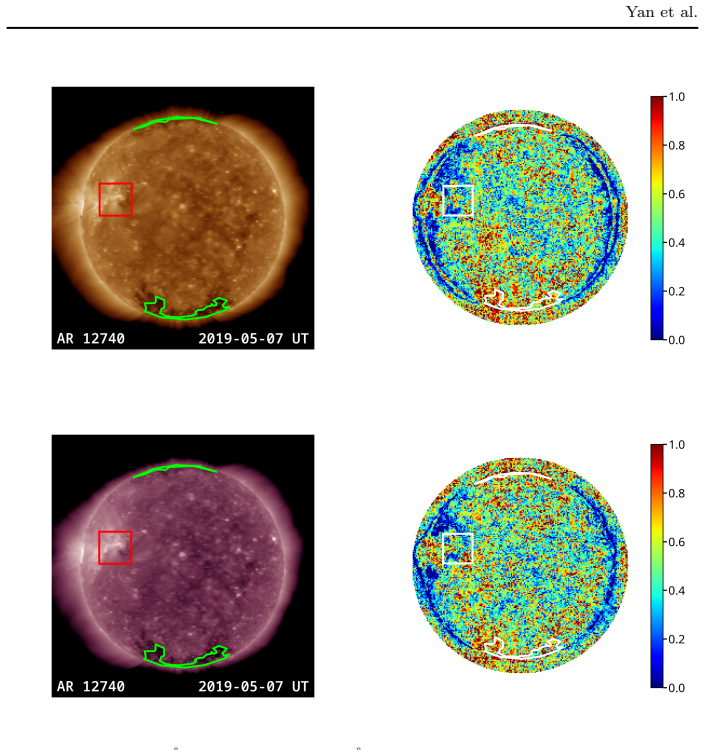
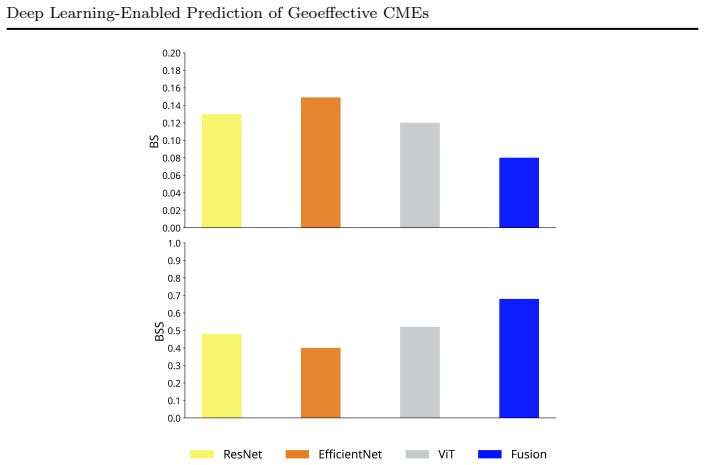
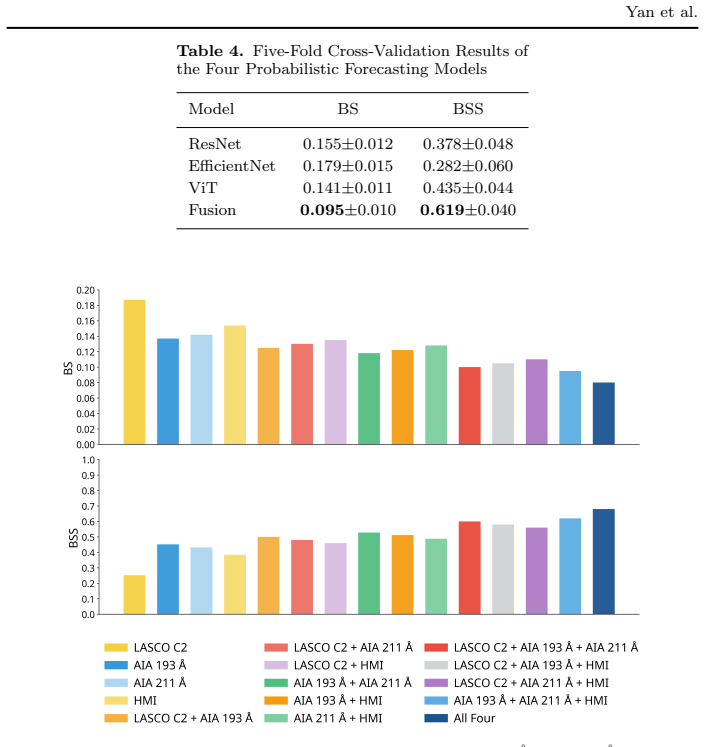
read the original abstract
Understanding and forecasting the geoeffectiveness of a coronal mass ejection (CME) is crucial for protecting infrastructure in the near-Earth space environment and on Earth. In this study, we present a novel fusion model to forecast the geoeffectiveness of CME events. Our model combines convolutional neural networks for feature learning and a prediction network for feature fusion and event classification. The model is trained by observations from instruments including the Large Angle Spectroscopic Coronagraph (LASCO) on board the Solar and Heliospheric Observatory (SOHO) and the Atmospheric Imaging Assembly (AIA) and Helioseismic and Magnetic Imager (HMI) on board the Solar Dynamics Observatory (SDO). The trained model is then used to predict whether an Earth-reaching CME will cause a geomagnetic storm and/or the probability that the CME will cause such a storm. Experimental results based on a five-fold cross validation scheme demonstrate the good performance of our fusion model, achieving a mean true skill statistic (TSS) score of 0.703 when the model is used as a deterministic prediction tool, and a mean Brier score of 0.095 when the model is used as a probabilistic forecasting tool, where a TSS score of 1 or a Brier score of 0 indicates perfect performance. This work contributes to forecasting the causal relationship between Earth-directed CMEs and geomagnetic storms in solar-terrestrial interactions.
Editorial analysis
A structured set of objections, weighed in public.
Referee Report
Summary. The paper introduces a fusion deep learning model combining CNNs on SOHO/LASCO, SDO/AIA and SDO/HMI observations to predict whether Earth-directed CMEs will produce geomagnetic storms. It reports a mean TSS of 0.703 for deterministic classification and a mean Brier score of 0.095 for probabilistic forecasting, both obtained from five-fold cross-validation on the observational data.
Significance. If the reported metrics are shown to be robust after supplying the missing dataset and labeling details, the work would provide a practical multi-instrument deep-learning pipeline for operational space-weather forecasting of CME geoeffectiveness.
major comments (2)
- [Abstract and Methods] Abstract and Methods section: the manuscript supplies no information on dataset size, number of events, class balance, CME selection criteria, the catalog or Dst threshold used to assign geoeffectiveness labels, or verification of label completeness. These omissions are load-bearing because the central claim (mean TSS 0.703, Brier score 0.095) cannot be evaluated without confirming that the binary and probabilistic labels are accurate and drawn from an unbiased sample of Earth-directed CMEs.
- [Methods] Cross-validation description (Methods): there is no statement on whether the five-fold CV respects temporal ordering of the solar observations. Without this, the reported scores may reflect temporal leakage rather than genuine predictive skill.
minor comments (1)
- [Abstract] The abstract could usefully state the time span of the observations used for training and testing.
Simulated Author's Rebuttal
We thank the referee for their constructive comments, which highlight important aspects of our work that require clarification. We address each major comment below and will revise the manuscript accordingly to strengthen the presentation of our methods and results.
read point-by-point responses
-
Referee: [Abstract and Methods] Abstract and Methods section: the manuscript supplies no information on dataset size, number of events, class balance, CME selection criteria, the catalog or Dst threshold used to assign geoeffectiveness labels, or verification of label completeness. These omissions are load-bearing because the central claim (mean TSS 0.703, Brier score 0.095) cannot be evaluated without confirming that the binary and probabilistic labels are accurate and drawn from an unbiased sample of Earth-directed CMEs.
Authors: We agree that these details are essential for proper evaluation of the reported metrics. The revised manuscript will include the dataset size, number of events, class balance, CME selection criteria, the specific catalog employed, the Dst threshold used for geoeffectiveness labeling, and verification steps for label completeness. revision: yes
-
Referee: [Methods] Cross-validation description (Methods): there is no statement on whether the five-fold CV respects temporal ordering of the solar observations. Without this, the reported scores may reflect temporal leakage rather than genuine predictive skill.
Authors: We recognize the critical need to address potential temporal leakage in cross-validation for time-ordered solar data. The revised manuscript will explicitly describe whether the five-fold CV respects temporal ordering and provide the rationale for the approach used, ensuring the metrics reflect genuine predictive skill. revision: yes
Circularity Check
No circularity: standard supervised ML training and CV evaluation on external labels
full rationale
The paper trains a CNN-based fusion model on SOHO/SDO image observations paired with external binary/probabilistic geoeffectiveness labels (geomagnetic storm occurrence), then reports TSS and Brier scores via 5-fold cross-validation on held-out events. No equations define model outputs or performance metrics in terms of themselves; the labels are not derived from the model; no self-citations, ansatzes, or uniqueness theorems are invoked to force the result; and the evaluation is a standard external benchmark. The derivation chain is therefore self-contained and does not reduce to its inputs by construction.
Axiom & Free-Parameter Ledger
free parameters (1)
- neural network weights and architecture hyperparameters
axioms (1)
- domain assumption Visual features extracted from LASCO, AIA, and HMI images contain sufficient information to determine whether an Earth-directed CME will produce a geomagnetic storm.
Reference graph
Works this paper leans on
-
[1]
barticle Alobaid , K.A. , Abduallah , Y. , Wang , J.T.L. , Wang , H. , Jiang , H. , Xu , Y. , Yurchyshyn , V. , Zhang , H. , Cavus , H. , Jing , J. : 2022 , Predicting CME arrival time through data integration and ensemble learning . Frontiers in Astronomy and Space Sciences 9 , 1013345 . https://doi.org/10.3389/fspas.2022.1013345 . barticle
-
[2]
barticle Alobaid , K.A. , Abduallah , Y. , Wang , J.T.L. , Wang , H. , Fan , S. , Li , J. , Cavus , H. , Yurchyshyn , V. : 2023 , Estimating coronal mass ejection mass and kinetic energy by fusion of multiple deep-learning models . 958 , L34 . https://doi.org/10.3847/2041-8213/ad0c4a . barticle
-
[3]
barticle Alobaid , K.A. , Wang , J.T.L. , Wang , H. , Jing , J. , Abduallah , Y. , Wang , Z. , Farooki , H. , Cavus , H. , Yurchyshyn , V. : 2024 , Prediction of geoeffective CMEs using SOHO images and deep learning . 299 , 159 . https://doi.org/10.1007/s11207-024-02385-w . barticle
-
[4]
barticle Amerstorfer , T. , Hinterreiter , J. , Reiss , M.A. , M \"o stl , C. , Davies , J.A. , Bailey , R.L. , Weiss , A.J. , Dumbovi \'c , M. , Bauer , M. , Amerstorfer , U.V. , Harrison , R.A. : 2021 , Evaluation of CME arrival prediction using ensemble modeling based on heliospheric imaging observations . Space Weather 19 , e02553 . https://doi.org/10...
-
[5]
barticle Baratashvili , T. , Verbeke , C. , Wijsen , N. , Poedts , S. : 2022 , Improving CME evolution and arrival predictions with AMR and grid stretching in Icarus . 667 , A133 . https://doi.org/10.1051/0004-6361/202244111 . barticle
-
[6]
barticle Besliu-Ionescu , D. , Talpeanu , D.-C. , Mierla , M. , Maris Muntean , G. : 2019 , On the prediction of geoeffectiveness of CMEs during the ascending phase of SC24 using a logistic regression method . J. Atmos. Solar-Terr. Phys. 193 , 105036 . https://doi.org/10.1016/j.jastp.2019.04.017 . barticle
-
[7]
barticle Bloomfield , D.S. , Higgins , P.A. , McAteer , R.T.J. , Gallagher , P.T. : 2012 , Toward reliable benchmarking of solar flare forecasting methods . 747 , L41 . https://doi.org/10.1088/2041-8205/747/2/L41 . barticle
-
[8]
: 1950 , Verification of forecasts expressed in terms of probability
barticle Brier , G.W. : 1950 , Verification of forecasts expressed in terms of probability . Monthly Weather Review 78 , 1 . https://doi.org/10.1175/1520-0493(1950)078<0001:VOFEIT>2.0.CO;2 . barticle
-
[9]
barticle Brueckner , G.E. , Howard , R.A. , Koomen , M.J. , Korendyke , C.M. , Michels , D.J. , Moses , J.D. , Socker , D.G. , Dere , K.P. , Lamy , P.L. , Llebaria , A. , Bout , M.V. , Schwenn , R. , Simnett , G.M. , Bedford , D.K. , Eyles , C.J. : 1995 , The Large Angle Spectroscopic Coronagraph (LASCO) . 162 , 357 . https://doi.org/10.1007/BF00733434 . barticle
-
[10]
barticle Chen , H. , Sachdeva , N. , Huang , Z. , Holst , B. , Manchester , W. , Jivani , A. , Zou , S. , Chen , Y. , Huan , X. , Toth , G. : 2025 , Decent estimate of CME arrival time from a data-assimilated ensemble in the Alfv \'e n Wave Solar atmosphere Model (DECADE-AWSoM) . Space Weather 23 , 2024SW004165 . https://doi.org/10.1029/2024SW004165 . barticle
-
[11]
barticle Chierichini , S. , Liu , J. , Kors \'o s , M.B. , Del Moro , D. , Erd \'e lyi , R. : 2024 , CME arrival modeling with machine learning . 963 , 121 . https://doi.org/10.3847/1538-4357/ad1cee . barticle
-
[12]
ImageNet: A Large- Scale Hierarchical Image Database
bchapter Deng , J. , Dong , W. , Socher , R. , Li , L.-J. , Li , K. , Fei-Fei , L. : 2009 , ImageNet: A large-scale hierarchical image database . In: Proceedings of the IEEE Conference on Computer Vision and Pattern Recognition , 248 . https://doi.org/10.1109/CVPR.2009.5206848 . bchapter
-
[13]
barticle Dissauer , K. , Veronig , A.M. , Temmer , M. , Podladchikova , T. , Vanninathan , K. : 2018 , Statistics of coronal dimmings associated with coronal mass ejections. I. Characteristic dimming properties and flare association . 863 , 169 . https://doi.org/10.3847/1538-4357/aad3c6 . barticle
-
[14]
barticle Dissauer , K. , Veronig , A.M. , Temmer , M. , Podladchikova , T. : 2019 , Statistics of coronal dimmings associated with coronal mass ejections. II. Relationship between coronal dimmings and their associated CMEs . 874 , 123 . https://doi.org/10.3847/1538-4357/ab0962 . barticle
-
[15]
barticle Domingo , V. , Fleck , B. , Poland , A.I. : 1995 , The SOHO mission: An overview . 162 , 1 . https://doi.org/10.1007/BF00733425 . barticle
-
[16]
, Beyer , L
bchapter Dosovitskiy , A. , Beyer , L. , Kolesnikov , A. , Weissenborn , D. , Zhai , X. , Unterthiner , T. , Dehghani , M. , Minderer , M. , Heigold , G. , Gelly , S. , Uszkoreit , J. , Houlsby , N. : 2021 , An image is worth 16x16 words: Transformers for image recognition at scale . In: Proceedings of the 9th International Conference on Learning Represen...
2021
-
[17]
barticle Dumbovi \'c , M. , C alogovi \'c , J. , Martini \'c , K. , Vr s nak , B. , Sudar , D. , Temmer , M. , Veronig , A. : 2021 , Drag-based model (DBM) tools for forecast of coronal mass ejection arrival time and speed . Front. Astron. Space Sci. 8 , 58 . https://doi.org/10.3389/fspas.2021.639986 . barticle
-
[18]
barticle Falconer , D.A. , Moore , R.L. , Gary , G.A. : 2006 , Magnetic causes of solar coronal mass ejections: Dominance of the free magnetic energy over the magnetic twist alone . 644 , 1258 . https://doi.org/10.1086/503699 . barticle
-
[19]
barticle Fu , H. , Zheng , Y. , Ye , Y. , Feng , X. , Liu , C. , Ma , H. : 2021 , Joint geoeffectiveness and arrival time prediction of CMEs by a unified deep learning framework . Remote Sens. 13 , 1738 . https://doi.org/10.3390/rs13091738 . barticle
-
[20]
barticle Gonzalez , W.D. , Joselyn , J.A. , Kamide , Y. , Kroehl , H.W. , Rostoker , G. , Tsurutani , B.T. , Vasyliunas , V.M. : 1994 , What is a geomagnetic storm? 99 , 5771 . https://doi.org/10.1029/93JA02867 . barticle
-
[21]
: 2009 , Halo coronal mass ejections and geomagnetic storms
barticle Gopalswamy , N. : 2009 , Halo coronal mass ejections and geomagnetic storms . Earth, Planets and Space 61 , 595 . https://doi.org/10.1186/BF03352930 . barticle
-
[22]
barticle Gopalswamy , N. , M \"a kel \"a , P. , Xie , H. , Akiyama , S. , Yashiro , S. : 2009 , CME interactions with coronal holes and their interplanetary consequences . Journal of Geophysical Research (Space Physics) 114 , A00A22 . https://doi.org/10.1029/2008JA013686 . barticle
-
[23]
barticle Guastavino , S. , Piana , M. , Massone , A.M. , Schwartz , R. , Benvenuto , F. : 2019 , Desaturating SDO/AIA observations of solar flaring storms . 882 , 109 . https://doi.org/10.3847/1538-4357/ab35d8 . barticle
-
[24]
barticle Guastavino , S. , Candiani , V. , Bemporad , A. , Marchetti , F. , Benvenuto , F. , Massone , A.M. , Mancuso , S. , Susino , R. , Telloni , D. , Fineschi , S. , Piana , M. : 2023 , Physics-driven machine learning for the prediction of coronal mass ejections' travel times . 954 , 151 . https://doi.org/10.3847/1538-4357/ace62d . barticle
-
[25]
barticle Guastavino , S. , Bahamazava , K. , Perracchione , E. , Camattari , F. , Audone , G. , Telloni , D. , Susino , R. , Nicolini , G. , Fineschi , S. , Piana , M. , Massone , A.M. : 2024 , Forecasting geoffective events from solar wind data and evaluating the most predictive features through machine learning approaches . 971 , 94 . https://doi.org/10...
-
[26]
Deep residual learning for image recognition
bchapter He , K. , Zhang , X. , Ren , S. , Sun , J. : 2016 , Deep residual learning for image recognition . In: Proceedings of the IEEE Conference on Computer Vision and Pattern Recognition , 770 . https://doi.org/10.1109/CVPR.2016.90 . bchapter
-
[27]
barticle Hu , A. , Camporeale , E. , Swiger , B. : 2023 , Multi‐hour‐ahead Dst index prediction using multi‐fidelity boosted neural networks . Space Weather 21 . https://doi.org/10.1029/2022sw003286 . barticle
-
[28]
barticle Hurlburt , N. , Cheung , M. , Schrijver , C. , Chang , L. , Freeland , S. , Green , S. , Heck , C. , Jaffey , A. , Kobashi , A. , Schiff , D. , Serafin , J. , Seguin , R. , Slater , G. , Somani , A. , Timmons , R. : 2012 , Heliophysics Event Knowledgebase for the Solar Dynamics Observatory (SDO) and beyond . 275 , 67 . https://doi.org/10.1007/s11...
-
[29]
barticle Kaportseva , K.B. , Shugay , Y.S. : 2021 , Use of the DBM model to the predict of arrival of coronal mass ejections to the Earth . Cosmic Res. 59 , 268 . https://doi.org/10.1134/S001095252104002X . barticle
-
[30]
The Atmospheric Imaging Assembly (AIA) on the Solar Dynamics Observatory (SDO).Sol
barticle Lemen , J.R. , Title , A.M. , Akin , D.J. , Boerner , P.F. , Chou , C. , Drake , J.F. , Duncan , D.W. , Edwards , C.G. , Friedlaender , F.M. , Heyman , G.F. , Hurlburt , N.E. , Katz , N.L. , Kushner , G.D. , Levay , M. , Lindgren , R.W. , Mathur , D.P. , McFeaters , E.L. , Mitchell , S. , Rehse , R.A. , Schrijver , C.J. , Springer , L.A. , Stern ...
-
[31]
barticle Liu , J. , Ye , Y. , Shen , C. , Wang , Y. , Erd \'e lyi , R. : 2018 , A new tool for CME arrival time prediction using machine learning algorithms: CAT-PUMA . 855 , 109 . https://doi.org/10.3847/1538-4357/aaae69 . barticle
-
[32]
barticle Liu , J. , Shen , C. , Wang , Y. , Xu , M. , Chi , Y. , Zhong , Z. , Mao , D. , Zhang , Z. , Wang , C. , Liu , J. , Wang , Y. : 2024 , Forecasting the Dst index with temporal convolutional network and integrated gradients . 299 , 98 . https://doi.org/10.1007/s11207-024-02340-9 . barticle
-
[33]
barticle Liu , Y. , Webb , D.F. , Zhao , X.P. : 2006 , Magnetic structures of solar active regions, full-halo coronal mass ejections, and geomagnetic storms . 646 , 1335 . https://doi.org/10.1086/505036 . barticle
-
[34]
bchapter Mayaud , P.N. : 1980 , What is a geomagnetic index? In: Derivation, Meaning, and Use of Geomagnetic Indices , American Geophysical Union . Chap. 2 . https://doi.org/10.1002/9781118663837.ch2 . bchapter
-
[35]
barticle Pan , S.J. , Yang , Q. : 2010 , A survey on transfer learning . IEEE Trans. Knowl. Data Eng. 22 , 1345 . https://doi.org/10.1109/TKDE.2009.191 . barticle
-
[36]
barticle Pattnaik , A. , Micha ek , G. , Ravishankar , A. : 2025 , Estimation of transit time of CMEs from the Sun to Earth . 982 , 35 . https://doi.org/10.3847/1538-4357/adb84b . barticle
-
[37]
barticle Pesnell , W.D. , Thompson , B.J. , Chamberlin , P.C. : 2012 , The Solar Dynamics Observatory (SDO) . 275 , 3 . https://doi.org/10.1007/s11207-011-9841-3 . barticle
-
[38]
barticle Pricopi , A.-C. , Paraschiv , A.R. , Besliu-Ionescu , D. , Marginean , A.-N. : 2022 , Predicting the geoeffectiveness of CMEs using machine learning . 934 , 176 . https://doi.org/10.3847/1538-4357/ac7962 . barticle
-
[39]
barticle Richardson , I.G. , Cane , H.V. : 2010 , Near- Earth interplanetary coronal mass ejections during solar cycle 23 (1996 - 2009): Catalog and summary of properties . 264 , 189 . https://doi.org/10.1007/s11207-010-9568-6 . barticle
-
[40]
barticle Scherrer , P.H. , Schou , J. , Bush , R.I. , Kosovichev , A.G. , Bogart , R.S. , Hoeksema , J.T. , Liu , Y. , Duvall , T.L. , Zhao , J. , Title , A.M. , Schrijver , C.J. , Tarbell , T.D. , Tomczyk , S. : 2012 , The Helioseismic and Magnetic Imager (HMI) investigation for the Solar Dynamics Observatory (SDO) . 275 , 207 . https://doi.org/10.1007/s...
-
[41]
barticle Schwartz , R.A. , Torre , G. , Piana , M. : 2014 , Systematic de-saturation of images from the Atmospheric Imaging Assembly in the Solar Dynamics Observatory . 793 , L23 . https://doi.org/10.1088/2041-8205/793/2/L23 . barticle
-
[42]
barticle Schwartz , R.A. , Torre , G. , Massone , A.M. , Piana , M. : 2015 , DESAT: A Solar SoftWare tool for image de-saturation in the Atmospheric Image Assembly onboard the Solar Dynamics Observatory . Astronomy and Computing 13 , 117 . https://doi.org/10.1016/j.ascom.2015.10.006 . barticle
-
[43]
barticle Sudar , D. , Vr s nak , B. , Dumbovi \'c , M. : 2016 , Predicting coronal mass ejections transit times to Earth with neural network . 456 , 1542 . https://doi.org/10.1093/mnras/stv2782 . barticle
-
[44]
, Taly , A
bchapter Sundararajan , M. , Taly , A. , Yan , Q. : 2017 , Axiomatic attribution for deep networks . In: Proceedings of the 34th International Conference on Machine Learning , 3319 . bchapter
2017
-
[45]
barticle SunPy Community , Mumford , S.J. , Christe , S. , P \'e rez-Su \'a rez , D. , Ireland , J. , Shih , A.Y. , Inglis , A.R. , Liedtke , S. , Hewett , R.J. , Mayer , F. , Hughitt , K. , Freij , N. , Meszaros , T. , Bennett , S.M. , Malocha , M. , Evans , J. , Agrawal , A. , Leonard , A.J. , Robitaille , T.P. , Mampaey , B. , Campos-Rozo , J.I. , Kirk...
-
[46]
, Le , Q.V
bchapter Tan , M. , Le , Q.V. : 2019 , EfficientNet: Rethinking model scaling for convolutional neural networks . In: Proceedings of the 36th International Conference on Machine Learning 97 , 6105 . bchapter
2019
-
[47]
: 2022 , Statistical methods applied to space weather science
barticle Telloni , D. : 2022 , Statistical methods applied to space weather science . Front. Astron. Space Sci. 9 , 865880 . https://doi.org/10.3389/fspas.2022.865880 . barticle
-
[48]
barticle Telloni , D. , Schiavo , M.L. , Magli , E. , Fineschi , S. , Guastavino , S. , Nicolini , G. , Susino , R. , Giordano , S. , Amadori , F. , Candiani , V. , Massone , A.M. , Piana , M. : 2023 , Prediction capability of geomagnetic events from solar wind data using neural networks . 952 , 111 . https://doi.org/10.3847/1538-4357/acdeea . barticle
-
[49]
barticle Toriumi , S. , Wang , H. : 2019 , Flare-productive active regions . Living Reviews in Solar Physics 16 , 3 . https://doi.org/10.1007/s41116-019-0019-7 . barticle
-
[50]
barticle Vourlidas , A. , Patsourakos , S. , Savani , N.P. : 2019 , Predicting the geoeffective properties of coronal mass ejections: current status, open issues and path forward . Philosophical Transactions of the Royal Society A 377 , 20180096 . https://doi.org/10.1098/rsta.2018.0096 . barticle
-
[51]
barticle Wang , Y. , Liu , J. , Jiang , Y. , Erd \'e lyi , R. : 2019 , CME arrival time prediction using convolutional neural network . 881 , 15 . https://doi.org/10.3847/1538-4357/ab2b3e . barticle
-
[52]
barticle Wanliss , J.A. , Showalter , K.M. : 2006 , High-resolution global storm index: Dst versus SYM-H . J. Geophys. Res. (Space Physics) 111 , A02202 . https://doi.org/10.1029/2005JA011034 . barticle
-
[53]
: 2010 , Forecast verification
bchapter Wilks , D.S. : 2010 , Forecast verification . In: Statistical Methods in the Atmospheric Sciences , 3 rd edn., Elsevier . Chap. 8 . https://doi.org/10.1016/B978-0-12-385022-5.00008-7 . bchapter
-
[54]
barticle Ye , D. , Li , H. , Guo , L. , Jiang , X. : 2025 , An improved halo coronal mass ejection geoeffectiveness prediction model using multiple coronal mass ejection features based on the DC-PCA-KNN method . 978 , 66 . https://doi.org/10.3847/1538-4357/ad98f0 . barticle
-
[55]
barticle Ye , Y. , Liu , J. , Hao , Y. , Cui , J. : 2024 , Evaluating the geoeffectiveness of interplanetary coronal mass ejections: Insights from a support vector machine approach with SHAP value analysis . 972 , 52 . https://doi.org/10.3847/1538-4357/ad61d7 . barticle
-
[56]
barticle Yu , X. , Xu , L. , Ren , Z. , Zhao , D. , Sun , W. : 2022 , Image desaturation for SDO/AIA using mixed convolution network . Research in Astronomy and Astrophysics 22 , 065009 . https://doi.org/10.1088/1674-4527/ac69b7 . barticle
-
[57]
barticle Zhang , H. , Jing , J. , Wang , J.T.L. , Wang , H. , Abduallah , Y. , Xu , Y. , Alobaid , K.A. , Farooki , H. , Yurchyshyn , V. : 2025 , Prediction of halo coronal mass ejections using SDO/HMI vector magnetic data products and a transformer model . 981 , 37 . https://doi.org/10.3847/1538-4357/adafa0 . barticle
discussion (0)
Sign in with ORCID, Apple, or X to comment. Anyone can read and Pith papers without signing in.