High-fidelity Modeling of Full-scale Pressurized Water Reactor Flow Fields for Machine Learning Applications
Pith reviewed 2026-06-30 13:52 UTC · model grok-4.3
The pith
High-fidelity CFD simulations of a full-scale PWR generate datasets that let spatially aware machine learning models reconstruct missing assembly flow rates and forecast short-term dynamics.
A machine-rendered reading of the paper's core claim, the machinery that carries it, and where it could break.
Core claim
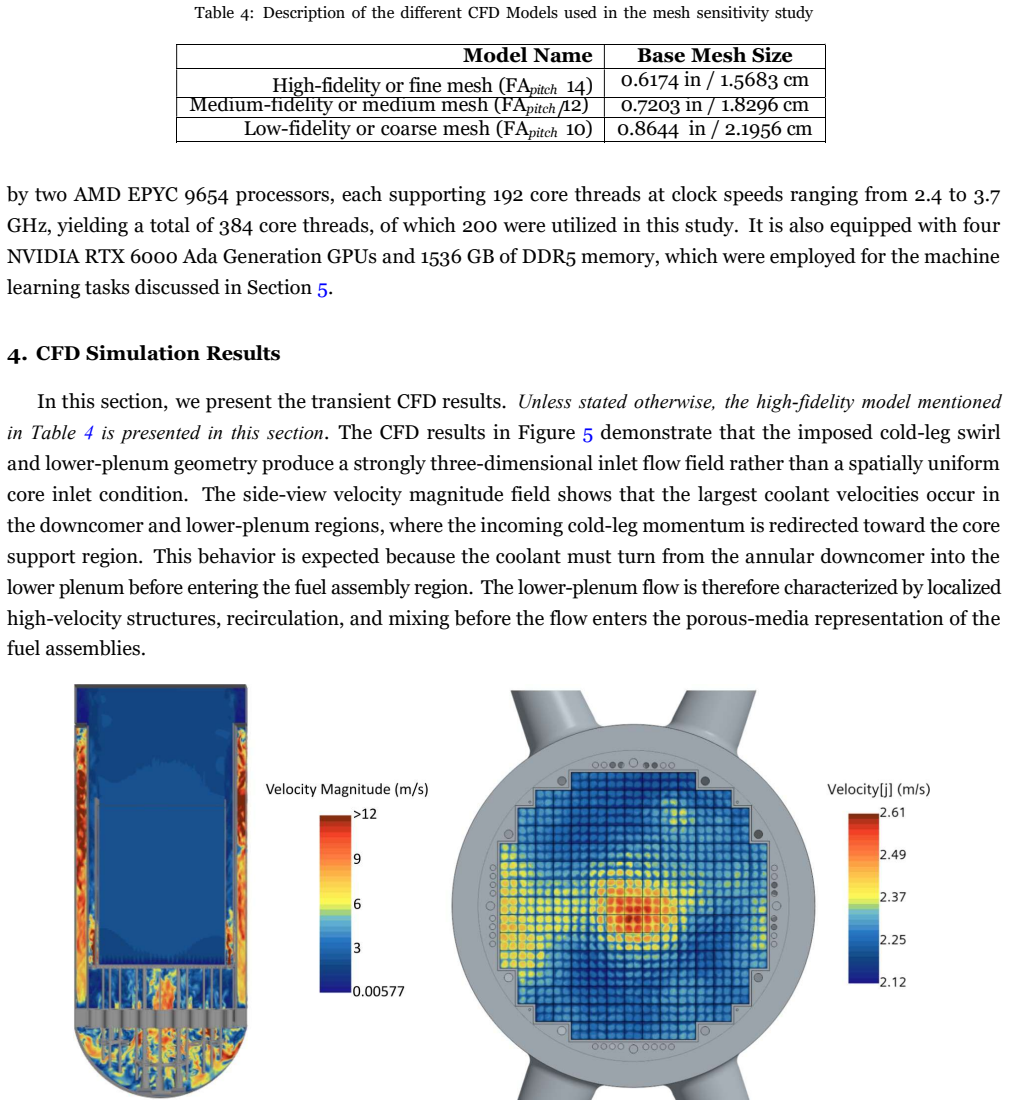
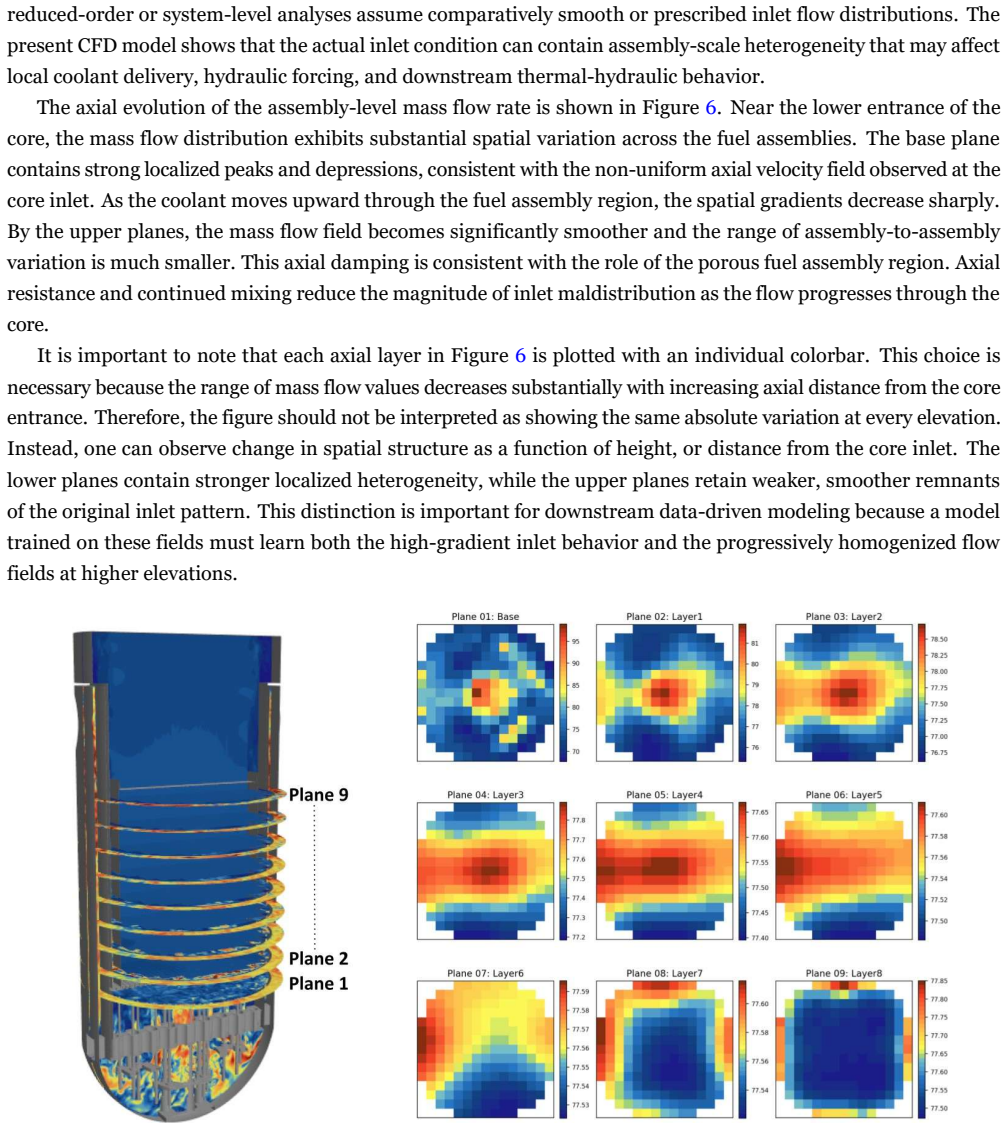
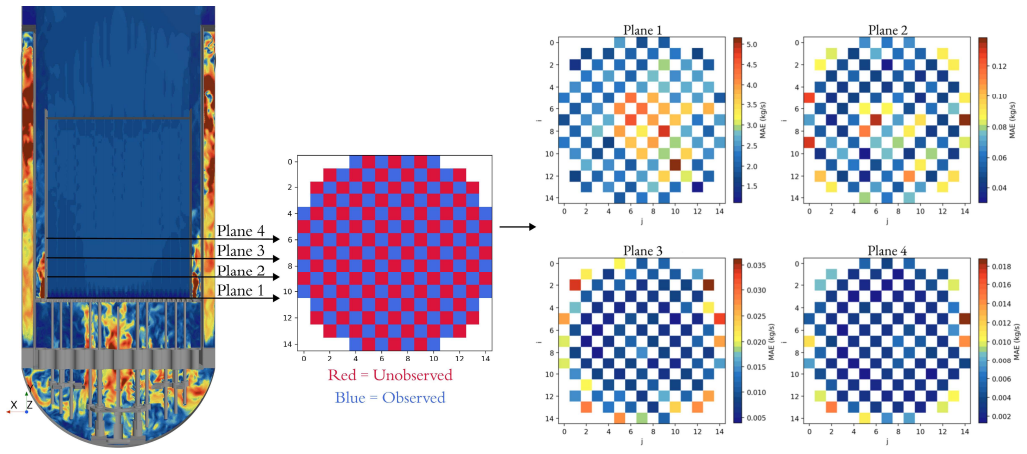
High-fidelity transient CFD on a publicly available full lower-plenum and core-inlet geometry produces assembly-wise inlet mass-flow distributions that vary sharply near the base due to cold-leg swirl and lower-plenum transport; axial resistance and mixing then reduce this variation at higher elevations. These physics-informed fields serve as training data for ML tasks, where a 3D convolutional inpainting model recovers missing assembly-level mass-flow rates with errors largest in the turbulent bottom layer and much smaller aloft, and where ConvLSTM models outperform sequence-only LSTM and operator-learning DeepONet models by better capturing the coupled spatio-temporal evolution.
What carries the argument
The high-fidelity CFD simulation framework that generates transient, swirl-driven flow fields on a full-scale PWR lower-plenum and core domain, supplying the spatially heterogeneous training data for the ML reconstruction and prediction tasks.
If this is right
- Spatially aware models such as ConvLSTM capture the coupled dynamics more accurately than purely sequential or operator-learning alternatives.
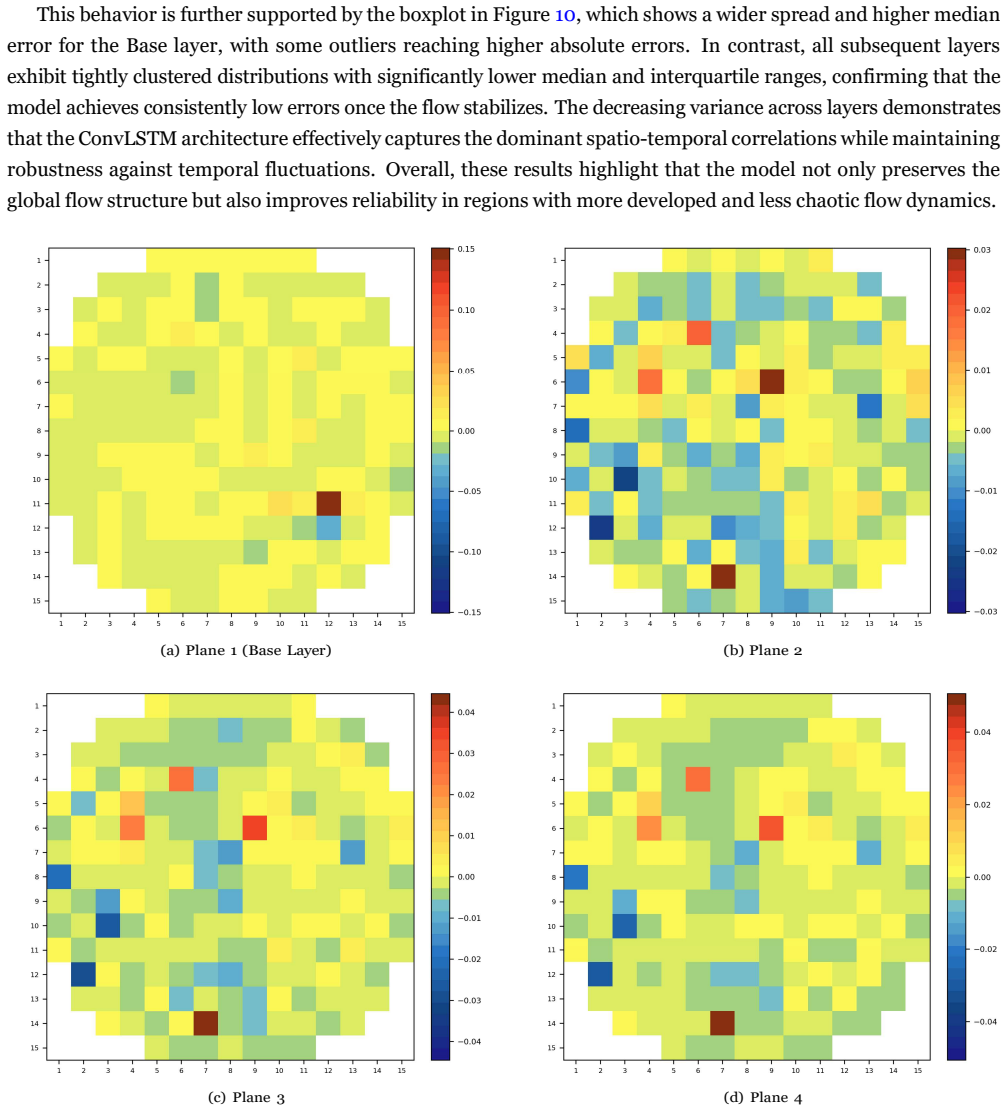
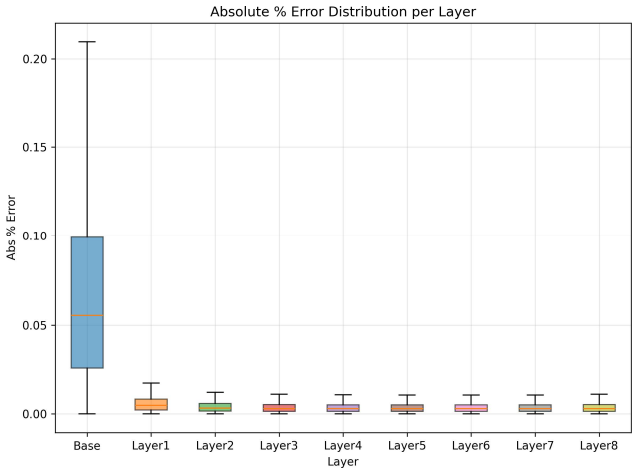
- Reconstruction errors remain concentrated in the turbulent base layer and decrease markedly with height as the flow homogenizes.
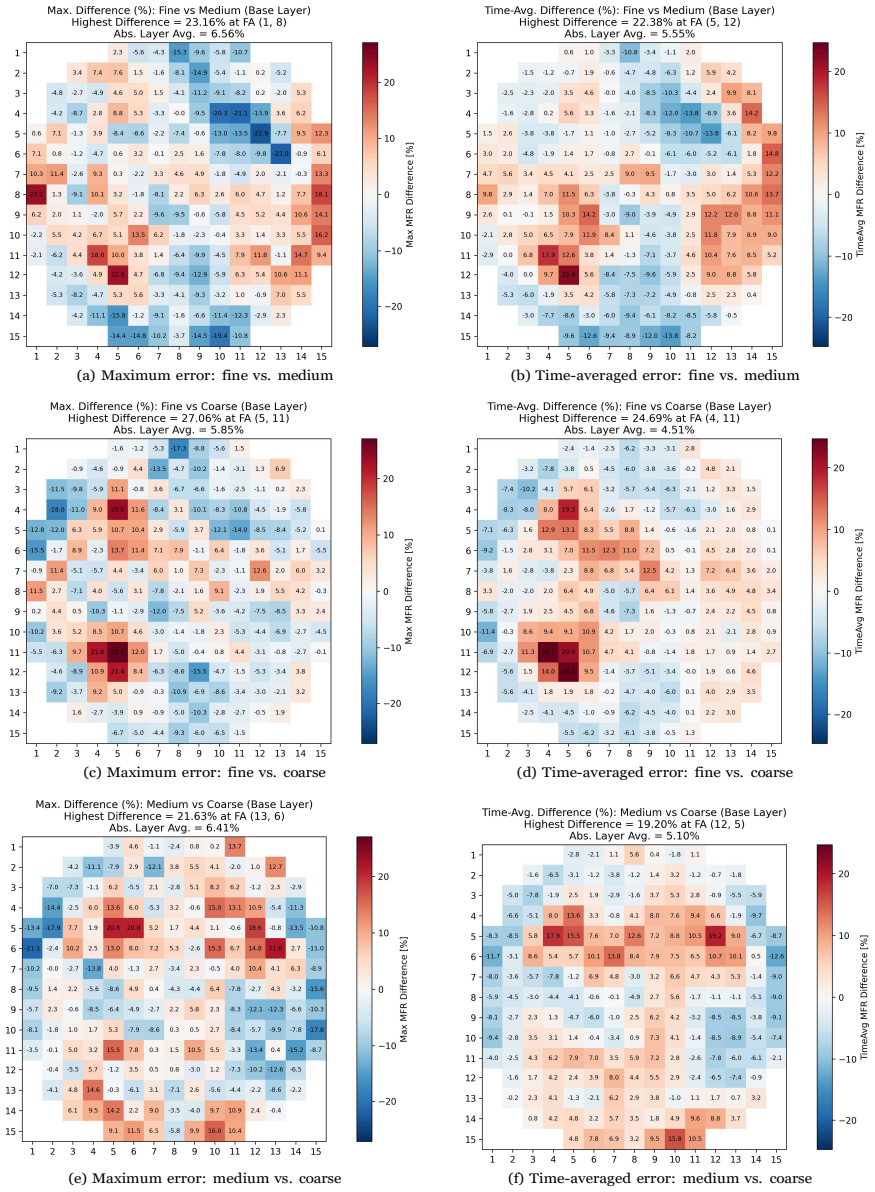
- Inlet flow predictions stay sensitive to choices of turbulence model and mesh resolution.
- The generated datasets can support future work on sparse sensing and multiphysics surrogate models.
Where Pith is reading between the lines
- The same CFD-to-ML pipeline could be adapted to test how additional sensor placements would reduce reconstruction uncertainty in the lower core.
- The observed vertical homogenization pattern suggests that monitoring effort could be concentrated near the inlet while relying on models for upper elevations.
- Similar high-fidelity CFD plus spatial ML workflows might transfer to other large-scale internal flows where full experimental access is limited.
Load-bearing premise
The CFD flow fields computed from public geometry and operating conditions without full-scale experimental validation data are representative enough of real reactor behavior to train and evaluate the ML models.
What would settle it
Direct comparison of the simulated assembly-wise mass-flow distributions at several core elevations against measurements taken in an operating PWR or a sufficiently scaled experimental facility.
Figures
read the original abstract
This work presents a high-fidelity computational fluid dynamics (CFD) and data-driven modeling framework for assembly-level flow characterization in a four-loop pressurized water reactor (PWR). A full lower-plenum and core-inlet domain was constructed using publicly available geometry and operating conditions, enabling transient simulations with pump-induced swirl boundary conditions. The results show that cold-leg swirl and lower-plenum transport generate strongly heterogeneous assembly-wise inlet flow distributions, particularly near the lower core region, while axial resistance and mixing progressively homogenize the flow at higher elevations. These physics-informed datasets were subsequently used to evaluate machine learning (ML) applications for partial field reconstruction and short-term autoregressive prediction. A 3D convolutional-based inpainting model successfully recon-structed missing assembly-level mass flow rates from partial observations, with errors concentrated in the highly turbulent base (bottom) layer and diminishing significantly in upper layers. Comparative analysis across multiple ML models demon-strates that spatially aware architectures, particularly ConvLSTM, significantly outperform sequence-based (LSTM) and operator-learning (DeepONet) approaches by effectively capturing coupled spatio-temporal dynamics. The study also high-lights key challenges, including the sensitivity of inlet flow predictions to turbulence and mesh resolution, as well as the absence of full-scale experimental validation data. Despite these limitations, the results remain consistent with expected physical behavior. Overall, this work establishes high-fidelity CFD as a critical foundation for developing data-driven surrogates, sparse sensing strategies, and future multiphysics coupling frameworks.
Editorial analysis
A structured set of objections, weighed in public.
Referee Report
Summary. The manuscript constructs a full lower-plenum and core-inlet domain for a four-loop PWR from publicly available geometry and operating conditions, performs transient CFD simulations incorporating pump-induced swirl boundary conditions, and reports strongly heterogeneous assembly-wise inlet mass-flow distributions near the core entrance that progressively homogenize with elevation due to axial resistance and mixing. These simulated fields are then used to train and evaluate ML models, including a 3D convolutional inpainting network that reconstructs missing assembly-level mass-flow rates (with errors largest in the turbulent base layer) and autoregressive predictors where ConvLSTM is shown to outperform LSTM and DeepONet on short-term spatio-temporal forecasting.
Significance. If the CFD fields are representative of real PWR behavior, the work supplies a reproducible, publicly grounded dataset for reactor-flow ML and provides concrete evidence that spatially aware architectures capture the coupled dynamics better than sequence or operator-learning baselines, supporting future surrogate and sparse-sensing applications in nuclear engineering.
major comments (1)
- [Abstract] Abstract: the central claims that ConvLSTM 'significantly outperform[s]' LSTM and DeepONet and that the inpainting model 'successfully reconstructed' missing flows rest entirely on the fidelity of the transient CFD fields; the manuscript explicitly states that full-scale experimental validation data are absent and that results are only 'consistent with expected physical behavior,' without any quantitative sensitivity study showing how changes in turbulence closure or mesh resolution (both flagged as influential) would alter the reported architecture ranking or error distributions.
minor comments (1)
- [Abstract] Abstract contains hyphenation artifacts ('recon-structed', 'demon-strates') that should be corrected in the final version.
Simulated Author's Rebuttal
We thank the referee for the thoughtful review and for highlighting the dependence of our ML claims on the underlying CFD fidelity. We address this point directly below and commit to strengthening the caveats in the revised manuscript.
read point-by-point responses
-
Referee: [Abstract] Abstract: the central claims that ConvLSTM 'significantly outperform[s]' LSTM and DeepONet and that the inpainting model 'successfully reconstructed' missing flows rest entirely on the fidelity of the transient CFD fields; the manuscript explicitly states that full-scale experimental validation data are absent and that results are only 'consistent with expected physical behavior,' without any quantitative sensitivity study showing how changes in turbulence closure or mesh resolution (both flagged as influential) would alter the reported architecture ranking or error distributions.
Authors: We agree that the reported performance differences and reconstruction accuracy are conditioned on the fidelity of the generated CFD fields. The manuscript already notes the lack of full-scale experimental data and the sensitivity of the flow fields to turbulence modeling and mesh resolution. The relative ranking of ConvLSTM over LSTM and DeepONet is demonstrated consistently on the same dataset; however, we acknowledge that a quantitative sensitivity study would be required to determine whether this ranking persists under variations in closure models or grid resolution. Such an analysis lies outside the present scope due to computational cost. We will revise the abstract and discussion to more explicitly qualify the claims as holding 'within the simulated dataset' and to list a dedicated sensitivity study as future work. revision: partial
Circularity Check
No circularity: ML results obtained from standard architectures applied to independently generated CFD data
full rationale
The paper constructs a CFD domain from public geometry and operating conditions, performs transient simulations to produce flow fields, and then applies off-the-shelf ML models (ConvLSTM, LSTM, DeepONet) plus a 3D convolutional inpainting network to those fields for autoregressive prediction and reconstruction tasks. No equations, fitted parameters, or self-citations are shown to reduce the reported performance rankings or error distributions to quantities defined by the paper's own inputs. The architecture comparisons and inpainting accuracy claims rest on empirical evaluation against held-out simulation data rather than any self-definitional, fitted-input, or self-citation load-bearing step. The absence of experimental validation is a limitation on external validity but does not create internal circularity in the reported derivation chain.
Axiom & Free-Parameter Ledger
axioms (1)
- domain assumption Publicly available geometry and operating conditions produce flow fields representative of an actual four-loop PWR lower plenum and core inlet.
Reference graph
Works this paper leans on
-
[1]
N. E. Todreas, M. S. Kazimi, Nuclear Systems Volume I: Thermal Hydraulic Fundamentals, CRC Press, 2021
2021
-
[2]
M. Wang, Y. Wang, W. Tian, S. Qiu, G. H. Su, Recent progress of CFD applications in PWR thermal hydraulics study and future directions, Annals of Nuclear Energy 150 (2021) 107836. doi:10.1016/j.anucene.2020. 107836
- [3]
-
[4]
R. Freile, M. Tano, P. Balestra, S. Schunert, M. Kimber, Improved natural convection heat transfer correlations for reactor cavity cooling systems of high-temperature gas-cooled reactors: From computational fluid dynamics to Pronghorn, Annals of Nuclear Energy 163 (2021) 108547. doi:10.1016/j.anucene.2021.108547
-
[5]
C. F. Boyd, D. M. Helton, K. Hardesty, CFD analysis of full-scale steam generator inlet plenum mixing during a PWR severe accident, Division of Systems Analysis and Regulatory Effectiveness, Office of Nuclear Regulatory Research, U.S. Nuclear Regulatory Commission, 2004
2004
-
[6]
M. Pham, G. Bois, F. Francois, E. Baglietto, Assessment of state-of-the-art multiphase CFD modeling for subcooled flow boiling in reactor applications, Nuclear Engineering and Design 411 (2023) 112379. doi: 10.1016/j.nucengdes.2023.112379
-
[7]
T. Wei, B. Zhang, S. Wang, S. Tan, D. Li, S. Qiao, Numerical analysis of passive safety injection driven by natural circulation in floating nuclear power plant, Energy 263 (2023) 126077. doi:10.1016/j.energy. 2022.126077
-
[8]
R. Hu, L. Zou, D. O’Grady, T. Mui, Z. J. Ooi, G. Hu, E. Cervi, G. Yang, D. Andrs, A. Lindsay, et al., SAM: A modern system code for advanced non-LWR safety analysis, Nuclear Technology 211 (9) (2025) 1883–1902
2025
-
[9]
R. Salko, A. Wysocki, T. Blyth, A. Toptan, J. Hu, V. Kumar, C. Dances, W. Dawn, Y. Sung, V. Kucukboyaci, et al., CTF: A modernized, production-level, thermal hydraulic solver for the solution of industry-relevant challenge problems in pressurized water reactors, Nuclear Engineering and Design 397 (2022) 111927. doi: 10.1016/j.nucengdes.2022.111927
-
[10]
C. Boyd, Perspectives on CFD analysis in nuclear reactor regulation, Nuclear Engineering and Design 299 (2016) 12–17. doi:10.1016/j.nucengdes.2015.11.033
-
[11]
Y. Liu, D. Wang, X. Sun, N. Dinh, R. Hu, Uncertainty quantification for multiphase-CFD simulations of bub- bly flows: A machine learning-based Bayesian approach supported by high-resolution experiments, Reliability Engineering & System Safety 212 (2021) 107636. doi:10.1016/j.ress.2021.107636
-
[12]
Liao, CFD modelling of flashing flows for nuclear safety analysis: Possibilities and challenges, Kerntechnik 89 (2) (2024) 169–184
Y. Liao, CFD modelling of flashing flows for nuclear safety analysis: Possibilities and challenges, Kerntechnik 89 (2) (2024) 169–184
2024
-
[13]
T. H¨ohne, E. Krepper, U. Rohde, Application of CFD codes in nuclear reactor safety analysis, Science and Technology of Nuclear Installations 2010 (1) (2010) 198758. doi:10.1155/2010/198758
-
[14]
V. Petrov, A. Manera, Effect of pump-induced cold-leg swirls on the flow field in the RPV of the EPR™: CFD investigations and comparison with experimental results, Nuclear Engineering and Design 241 (5) (2011) 1478–1485. doi:10.1016/j.nucengdes.2011.01.040
-
[15]
R. W. Johnson, R. R. Schultz, P. J. Roache, I. B. Celik, W. D. Pointer, Y. A. Hassan, Processes and procedures for application of CFD to nuclear reactor safety analysis, Tech. rep., Idaho National Laboratory, Idaho Falls, ID, United States (2006)
2006
-
[18]
B. Han, X. Zhu, B.-W. Yang, S. Liu, A. Liu, Verification and validation of CFD and its application in PWR fuel assembly, Progress in Nuclear Energy 154 (2022) 104485. doi:10.1016/j.pnucene.2022.104485
-
[19]
M. Wang, L. Wang, X. Wang, J. Ge, W. Tian, S. Qiu, G. H. Su, CFD simulation on the flow characteristics in the PWR lower plenum with different internal structures, Nuclear Engineering and Design 364 (2020) 110705. doi:10.1016/j.nucengdes.2020.110705
-
[20]
URL https://www.plm.automation.siemens.com/global/en/products/simcenter/ STAR-CCM.html
Siemens Digital Industries Software, Simcenter STAR-CCM+, version 2502.0001 (2025). URL https://www.plm.automation.siemens.com/global/en/products/simcenter/ STAR-CCM.html
-
[21]
M. Wang, H. Ju, J. Wu, H. Qiu, K. Liu, W. Tian, G. H. Su, A review of CFD studies on thermal hydraulic analysis of coolant flow through fuel rod bundles in nuclear reactor, Progress in Nuclear Energy 171 (2024) 105175. doi:10.1016/j.pnucene.2024.105175
-
[22]
J. Feng, L. Xu, E. Baglietto, Assessing the applicability of the Structure-Based Turbulence Resolution Ap- proach to nuclear safety-related issues, Journal of Nuclear Engineering 2 (1) (2021) 61–85. doi:10.3390/ jne2010005
2021
-
[23]
M. Pham, V. Petrov, A. Manera, E. Baglietto, Assessing the Structure-Based Turbulence Model performance for thermal striping applications using symmetric jet experiments, Nuclear Technology 210 (7) (2024) 1212–
2024
-
[24]
URL https://doi.org/10.1080/00295450.2023.2204989
doi:10.1080/00295450.2023.2204989. URL https://doi.org/10.1080/00295450.2023.2204989
-
[25]
L. Harbour, G. Giudicelli, A. D. Lindsay, P. German, J. Hansel, C. Icenhour, M. Li, J. M. Miller, R. H. Stogner, P. Behne, D. Yankura, Z. M. Prince, C. DeChant, D. Schwen, B. W. Spencer, M. Tano, N. Choi, Y. Wang, M. Nezdyur, Y. Miao, T. Hu, S. Kumar, C. Matthews, B. Langley, N. Nobre, A. Blair, C. MacMackin, H. B. Rocha, E. Palmer, J. Carter, J. Meier, A...
-
[26]
L. Zou, D. Nunez, R. Hu, Development and validation of SAM multi-dimensional flow model for thermal mixing and stratification modeling, Tech. rep., Argonne National Laboratory, Argonne, IL, United States (Jun. 2020). doi:10.2172/1671335. URL https://www.osti.gov/biblio/1671335
-
[27]
D. Price, N. Roskoff, M. I. Radaideh, B. Kochunas, Thermal modeling of an eVinci™-like heat pipe microreactor using OpenFOAM, Nuclear Engineering and Design 415 (2023) 112709. doi:10.1016/j.nucengdes.2023. 112709
-
[28]
Price, N
D. Price, N. Roskoff, M. I. Radaideh, B. Kochunas, Multiphysics modeling of heat pipe microreactor with critical control drum position search, Nuclear Science and Engineering (2024) 1–20
2024
-
[29]
P. Wang, W. Liang, H. Gong, J. Chen, Decoupling control of core power and axial power distribution for large pressurized water reactors based on reinforcement learning, Energy 313 (2024) 133967
2024
-
[30]
P. Wang, J. Zhang, J. Wan, S. Wu, A fault diagnosis method for small pressurized water reactors based on long short-term memory networks, Energy 239 (2022) 122298. 25
2022
-
[31]
R. Luo, Y. Li, H. Guo, Q. Wang, X. Wang, Cross-operating-condition fault diagnosis of a small module reactor based on cnn-lstm transfer learning with limited data, Energy 313 (2024) 133901
2024
-
[32]
X. Yuan, T. Bai, C. Peng, Hybrid modeling method for reactor coolant loop combining data-driven and physics-based constraints, Energy (2026) 140177
2026
-
[33]
X. Guo, W. Li, F. Iorio, Convolutional neural networks for steady flow approximation, in: Proceedings of the 22nd ACM SIGKDD International Conference on Knowledge Discovery and Data Mining, KDD ’16, Association for Computing Machinery, New York, NY, USA, 2016, pp. 481–490. doi:10.1145/2939672.2939738. URL https://doi.org/10.1145/2939672.2939738
-
[34]
Y. Liu, R. Hu, A. Kraus, P. Balaprakash, A. Obabko, Data-driven modeling of coarse mesh turbulence for reactor transient analysis using convolutional recurrent neural networks, Nuclear Engineering and Design 390 (2022) 111716. doi:10.1016/j.nucengdes.2022.111716. URL https://www.sciencedirect.com/science/article/pii/S002954932200070X
-
[35]
L. Guastoni, A. Gu¨emes, A. Ianiro, S. Discetti, P. Schlatter, H. Azizpour, R. Vinuesa, Convolutional-network models to predict wall-bounded turbulence from wall quantities, Journal of Fluid Mechanics 928 (2021) A27. doi:10.1017/jfm.2021.812
-
[36]
K. Stylianos, L. He, L. Jiao, O. Mehdizadeh, A. Garner, H. Dou, R. P. Taleyarkhan, J. Tan, Physics-informed neural network with transfer learning (TL-PINN) based on domain similarity measure for prediction of nuclear reactor transients, Scientific Reports 13 (1) (2023) 16840. doi:10.1038/s41598-023-43325-1
-
[37]
M. I. Radaideh, C. Pigg, T. Kozlowski, Y. Deng, A. Qu, Neural-based time series forecasting of loss of coolant accidents in nuclear power plants, Expert Systems with Applications 160 (2020) 113699. doi:10.1016/j. eswa.2020.113699
work page doi:10.1016/j 2020
-
[38]
M. I. Radaideh, T. Kozlowski, Combining simulations and data with deep learning and uncertainty quantifi- cation for advanced energy modeling, International Journal of Energy Research 43 (14) (2019) 7866–7890
2019
-
[39]
M. I. Radaideh, T. Kozlowski, Analyzing nuclear reactor simulation data and uncertainty with the group method of data handling, Nuclear Engineering and Technology 52 (2) (2020) 287–295
2020
-
[40]
M. I. Radaideh, T. Kozlowski, Surrogate modeling of advanced computer simulations using deep Gaussian pro- cesses, Reliability Engineering & System Safety 195 (2020) 106731. doi:10.1016/j.ress.2019.106731
-
[41]
R. A. Saleem, M. I. Radaideh, T. Kozlowski, Application of deep neural networks for high-dimensional large bwr core neutronics, Nuclear Engineering and Technology 52 (12) (2020) 2709–2716
2020
-
[42]
Eaheart, J
M. Eaheart, J. Cooper, M. Ross, N. See, M. I. Radaideh, Sensitivity analysis and uncertainty propagation of the time to onset of natural circulation in air ingress accidents, Nuclear Engineering and Design 445 (2025) 114510
2025
-
[43]
Price, M
D. Price, M. I. Radaideh, B. Kochunas, Multiobjective optimization of nuclear microreactor reactivity control system operation with swarm and evolutionary algorithms, Nuclear Engineering and Design 393 (2022) 111776
2022
-
[44]
M. I. Radaideh, L. Tunkle, D. Price, K. Abdulraheem, L. Lin, M. Elias, Multistep criticality search and power shaping in nuclear microreactors with deep reinforcement learning, Nuclear Science and Engineering 200 (sup1) (2026) S309–S321
2026
-
[45]
M. Eaheart, M. I. Radaideh, Multifidelity surrogate modeling of depressurized loss of forced cooling in high- temperature gas reactors, arXiv preprint arXiv:2603.14143
-
[46]
U. M. Nabila, L. Lin, X. Zhao, W. L. Gurecky, P. Ramuhalli, M. I. Radaideh, Data efficiency assessment of generative adversarial networks in energy applications, Energy and AI 20 (2025) 100501
2025
-
[47]
L. A. Burnett, U. M. Nabila, M. I. Radaideh, Variational digital twins, Energy and AI 24 (2026) 100756. 26
2026
-
[48]
U. M. Nabila, P. Seurin, L. Lin, M. I. Radaideh, Physics-informed digital twin development of thermal energy distribution systems with active learning, Applied Energy 416 (2026) 127903
2026
-
[49]
Horelik, B
N. Horelik, B. Herman, B. Forget, K. Smith, Benchmark for evaluation and validation of reactor simula- tions (BEAVRS), v1.0.1, in: Proceedings of the International Conference on Mathematics and Computational Methods Applied to Nuclear Science and Engineering, Vol. 7, 2013, pp. 63–68
2013
-
[50]
R. Ellis, System definition document: Reactor data necessary for modeling plutonium disposition in Catawba nuclear station units 1 and 2, Tech. rep., Oak Ridge National Laboratory (Nov. 2000). doi:10.2172/769301
-
[51]
United States Nuclear Regulatory Commission, Westinghouse technology systems manual (ML20057E160) (Jul. 2020). URL https://www.nrc.gov/docs/ML2005/ML20057E160.pdf
2020
-
[52]
R. Wiser, E. Baglietto, J. Schneider, M. H. Anderson, Validation of URANS and STRUCT-ε turbulence models for stratified sodium flow, Nuclear Engineering and Design 399 (2022) 112009. doi:10.1016/j.nucengdes. 2022.112009. URL https://www.sciencedirect.com/science/article/pii/S0029549322003600
-
[53]
Baglietto, H
E. Baglietto, H. Ninokata, Anisotropic eddy viscosity modeling for application to industrial engineering internal flows, International Journal of Transport Phenomena 8 (2) (2006) 109–122
2006
-
[54]
Lenci, E
G. Lenci, E. Baglietto, A structure-based approach for topological resolution of coherent turbulence: Overview and demonstration, 16th International Topical Meeting on Nuclear Reactor Thermal Hydraulics (2015) 1–14
2015
-
[55]
E. Baglietto, G. Lenci, D. Concu, STRUCT: A second-generation URANS approach for effective design of advanced systems, in: Proceedings of the Fluids Engineering Division Summer Meeting, Vol. Volume 1B of Fluids Engineering Division Summer Meeting, 2017, p. V01BT12A004. doi:10.1115/FEDSM2017-69241. URL https://doi.org/10.1115/FEDSM2017-69241
-
[56]
J. Feng, E. Baglietto, K. Tanimoto, Y. Kondo, Demonstration of the STRUCT turbulence model for mesh consistent resolution of unsteady thermal mixing in a T-junction, Nuclear Engineering and Design 361 (2020) 110572. doi:10.1016/j.nucengdes.2020.110572. URL https://www.sciencedirect.com/science/article/pii/S0029549320300674
-
[57]
L. Lu, P. Jin, G. Pang, Z. Zhang, G. E. Karniadakis, Learning nonlinear operators via DeepONet based on the universal approximation theorem of operators, Nature Machine Intelligence 3 (3) (2021) 218–229. doi: 10.1038/s42256-021-00302-5. URL https://doi.org/10.1038/s42256-021-00302-5
-
[58]
S. Hochreiter, J. Schmidhuber, Long short-term memory, Neural Computation 9 (8) (1997) 1735–1780. doi: 10.1162/neco.1997.9.8.1735
-
[59]
X. Shi, Z. Chen, H. Wang, D.-Y. Yeung, W.-K. Wong, W.-c. Woo, Convolutional LSTM network: A machine learning approach for precipitation nowcasting, in: Advances in Neural Information Processing Systems, 2015, pp. 802–810
2015
-
[60]
P. A. Myers, N. Panczyk, S. Chidige, C. Craig, J. Cooper, V. Joynt, M. I. Radaideh, pymaise: A python platform for automatic machine learning and accelerated development for nuclear power applications, Progress in Nuclear Energy 180 (2025) 105568
2025
-
[61]
N. R. Panczyk, O. F. Erdem, M. I. Radaideh, Opening the ai black-box: Symbolic regression with kolmogorov- arnold networks for advanced energy applications, Energy and AI (2025) 100595. 27 Appendix A. Flow Error Results for all axial layers The results presented in this appendix (Figures A.11–A.16) complement those in Figure 7, illustrating the max- imum ...
2025
discussion (0)
Sign in with ORCID, Apple, or X to comment. Anyone can read and Pith papers without signing in.