Charge dynamics at nitrogen impurities and nitrogen-vacancy centers in diamond
Pith reviewed 2026-06-30 12:39 UTC · model grok-4.3
The pith
First-principles calculations produce electron capture coefficients at nitrogen impurities in diamond that match experimental values and identify excited-state pathways for NV centers.
A machine-rendered reading of the paper's core claim, the machinery that carries it, and where it could break.
Core claim
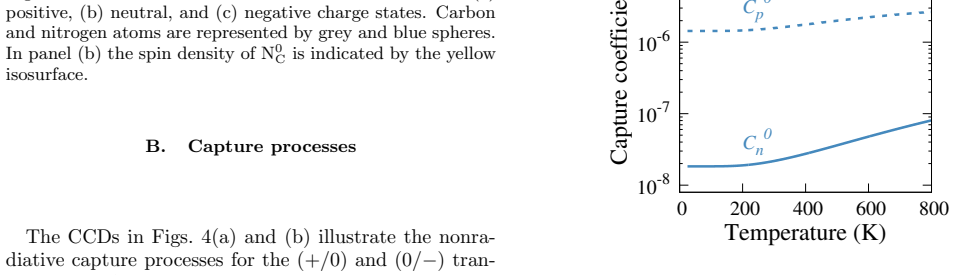
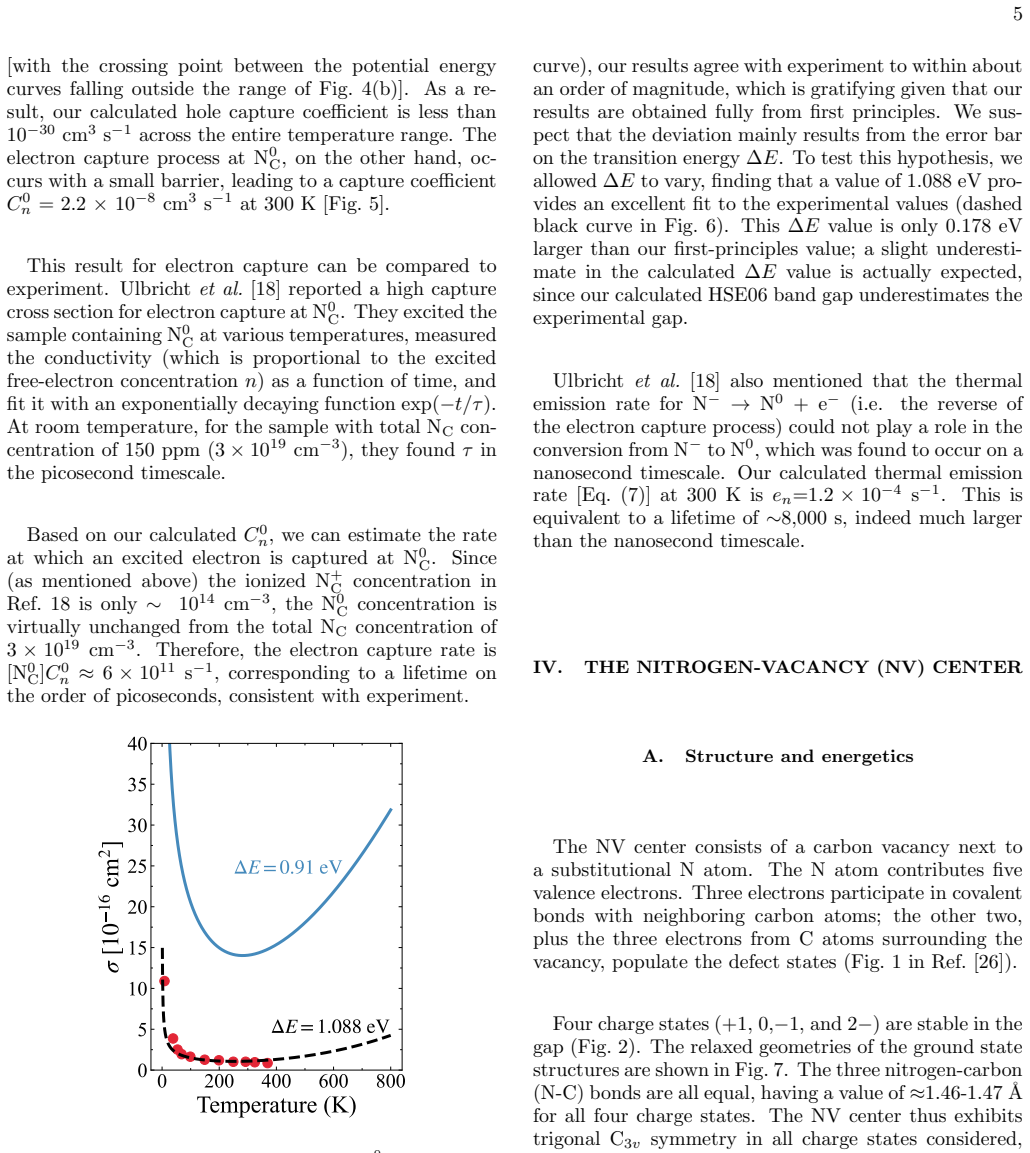
Density functional theory calculations of nonradiative capture via multiphonon emission yield an electron capture coefficient of 2.2 × 10^{-8} cm³ s^{-1} at 300 K for N_C^0 → N_C^-, in excellent agreement with experiment, and an even larger coefficient of 1.0 × 10^{-4} cm³ s^{-1} for capture at N_C^+. For the NV center, ground-state capture is negligible, but the hole capture coefficient for NV^- → NV^{0*} reaches 1.8 × 10^{-7} cm³ s^{-1} and is largely temperature-independent, establishing that charge-state changes occur via capture into excited states followed by radiative decay.
What carries the argument
Multiphonon emission model applied to DFT-computed defect levels, potential energy surfaces, and electron-phonon coupling strengths to obtain capture coefficients.
If this is right
- Electron capture at positively charged nitrogen occurs at 1.0 × 10^{-4} cm³ s^{-1} at 300 K.
- Hole capture at NV^- proceeds exclusively through the excited state NV^{0*} with a coefficient of 1.8 × 10^{-7} cm³ s^{-1}.
- Electron capture at NV^0 occurs via the pathway NV^0 → NV^{-*} → NV^- at a coefficient of 2.1 × 10^{-9} cm³ s^{-1}.
- The temperature dependence of all capture processes follows from the multiphonon emission rates and can be used in device modeling.
- Charge-state dynamics in diamond quantum devices are now quantifiable from the computed rates rather than treated phenomenologically.
Where Pith is reading between the lines
- Controlling the concentration of substitutional nitrogen could be used to tune the rate of charge-state fluctuations at nearby NV centers.
- Optical initialization and readout protocols for NV centers may need to account for rapid nonradiative capture into excited states.
- The same computational approach could be applied to other point defects in diamond to predict their capture behavior under operating conditions.
- Temperature-dependent measurements of capture cross sections above or below 300 K would provide an independent test of the multiphonon model predictions.
Load-bearing premise
The density functional theory setup and multiphonon emission model accurately reproduce the defect energy levels, phonon modes, and coupling strengths without large systematic errors from exchange-correlation approximations or finite-size effects.
What would settle it
An experimental measurement of the electron capture coefficient for N_C^0 to N_C^- at 300 K that differs by more than a factor of two from 2.2 × 10^{-8} cm³ s^{-1}.
Figures

read the original abstract
The nitrogen-vacancy (NV) center in diamond is the prototype quantum defect that enables a variety of diamond-based quantum technologies. However, charge-state instability and spectral diffusion, often induced by substitutional nitrogen impurities (N$_{\rm C}$), remain key challenges for device performance. Here, we employ first-principles density functional theory calculations to quantitatively investigate nonradiative carrier capture processes mediated by multiphonon emission at both the NV center and the N$_{\rm C}$ impurity. For relevant cases, we also compute the rates of radiative and thermal emission processes. For N$_{\rm C}^0$ $\to$ N$_{\rm C}^-$, we obtain an electron capture coefficient of $2.2 \times 10^{-8}$ cm$^3$s$^{-1}$ at 300 K. Both the magnitude and temperature dependence are in excellent agreement with experimentally measured capture cross sections. Electron capture at N$_{\rm C}^+$ is even faster, with a capture coefficient of $1.0 \times 10^{-4}$ cm$^3$s$^{-1}$ at 300 K. For the NV center, we find that carrier capture rates involving only the ground states of NV$^0$ and NV$^-$ are negligibly slow. However, capture into the excited states (NV$^{0*}$ and NV$^{-*}$) is significantly faster. In particular, the capture coefficient for the hole capture process NV$^-$ $\to$ NV$^{0*}$ is as large as $1.8 \times 10^{-7}$ cm$^3$s$^{-1}$ and largely temperature-independent. Hole capture at NV$^-$ will thus occur via nonradiative capture into an excited state of NV$^{0}$ followed by fast radiative decay to the NV$^0$ ground state. Similarly, electron capture at NV$^0$ will occur via the NV$^0$ $\to$ NV$^{-*}$ $\to$ NV$^-$ pathway, but with a lower nonradiative capture coefficient ($2.1 \times 10^{-9}$ cm$^3$s$^{-1}$ at 300 K). Our calculated capture coefficients and rates provide essential information for analyzing charge-state dynamics.
Editorial analysis
A structured set of objections, weighed in public.
Referee Report
Summary. The manuscript employs first-principles DFT calculations combined with the multiphonon emission model to compute nonradiative carrier capture rates at substitutional nitrogen (N_C) impurities and NV centers in diamond. It reports an electron capture coefficient of 2.2 × 10^{-8} cm³ s^{-1} at 300 K for N_C^0 → N_C^- that matches experimental magnitude and temperature dependence, a faster value of 1.0 × 10^{-4} cm³ s^{-1} for N_C^+ capture, and for the NV center finds negligible ground-state capture but significantly faster excited-state pathways, including a hole capture coefficient of 1.8 × 10^{-7} cm³ s^{-1} for NV^- → NV^{0*} that is largely temperature-independent. The work also computes selected radiative and thermal emission rates and concludes that charge-state transitions at NV proceed via excited states.
Significance. If the underlying computational parameters prove accurate, the quantitative capture coefficients supply directly usable input for device modeling of charge instability and spectral diffusion in diamond quantum sensors and qubits. The explicit experimental match for the N_C case and the identification of excited-state-mediated capture routes for NV constitute concrete, falsifiable predictions that advance the field beyond qualitative arguments. The absence of reported functional benchmarks or supercell convergence data, however, prevents the results from being treated as immediately reliable for the NV excited-state channels.
major comments (2)
- [Computational Methods] Computational Methods section: the manuscript provides no information on the exchange-correlation functional, plane-wave cutoff, supercell size, or electrostatic correction scheme employed for the charged-defect total energies and configuration-coordinate diagrams that parameterize the multiphonon emission rates quoted in the abstract. For charged defects in a wide-gap material these choices directly control the relaxation energies and electron-phonon couplings; without convergence tests or comparison to GW defect levels the claimed experimental agreement for N_C cannot be extrapolated to the NV excited-state pathways.
- [Results] Results section (capture coefficients for NV): the reported hole capture coefficient of 1.8 × 10^{-7} cm³ s^{-1} for NV^- → NV^{0*} rests on the 1D configuration-coordinate approximation and the DFT-derived Huang-Rhys factors for the excited state; no independent validation against measured vibronic spectra or larger-supercell phonon calculations is presented, making this the load-bearing step for the central claim that capture occurs via excited states rather than ground states.
minor comments (2)
- [Abstract] The abstract states numerical values to two significant figures but does not indicate the estimated uncertainty arising from the DFT setup; adding a brief statement on this point would improve clarity.
- [Figures] Figure captions for the configuration-coordinate diagrams should explicitly state the supercell size and k-point sampling used to generate the plotted energies.
Simulated Author's Rebuttal
We thank the referee for the thorough review and for highlighting both the potential impact of our quantitative capture coefficients and the need for greater methodological transparency. We address each major comment below and will revise the manuscript to incorporate additional details and discussion.
read point-by-point responses
-
Referee: [Computational Methods] Computational Methods section: the manuscript provides no information on the exchange-correlation functional, plane-wave cutoff, supercell size, or electrostatic correction scheme employed for the charged-defect total energies and configuration-coordinate diagrams that parameterize the multiphonon emission rates quoted in the abstract. For charged defects in a wide-gap material these choices directly control the relaxation energies and electron-phonon couplings; without convergence tests or comparison to GW defect levels the claimed experimental agreement for N_C cannot be extrapolated to the NV excited-state pathways.
Authors: We agree that the Computational Methods section omitted key technical parameters. In the revised manuscript we will add an expanded Methods subsection that specifies the PBE exchange-correlation functional, the plane-wave cutoff (400 eV), the supercell sizes employed (216- and 512-atom cells), and the electrostatic correction scheme (Freysoldt–Neugebauer–Van de Walle). Convergence tests for formation energies, relaxation energies, and Huang–Rhys factors with respect to supercell size will be included as supplementary figures. While GW calculations were not performed (owing to their prohibitive cost for the large supercells needed for phonon calculations), the quantitative match to experiment for both magnitude and temperature dependence of the N_C electron capture coefficient provides direct validation of the DFT-based multiphonon model for this defect. We will add a brief discussion acknowledging that the same level of theory is applied to the NV excited-state channels and noting that future GW benchmarks would be valuable, but we maintain that the experimental agreement for N_C supports the reliability of the reported trends. revision: yes
-
Referee: [Results] Results section (capture coefficients for NV): the reported hole capture coefficient of 1.8 × 10^{-7} cm³ s^{-1} for NV^- → NV^{0*} rests on the 1D configuration-coordinate approximation and the DFT-derived Huang-Rhys factors for the excited state; no independent validation against measured vibronic spectra or larger-supercell phonon calculations is presented, making this the load-bearing step for the central claim that capture occurs via excited states rather than ground states.
Authors: We acknowledge that the 1D configuration-coordinate model is an approximation and that the NV excited-state capture rates rely on DFT-derived parameters without new direct comparison to experimental vibronic spectra. In the revision we will expand the discussion of the 1D approximation, citing prior literature validations for similar defects, and will explicitly state the limitations of the Huang–Rhys factors obtained from the configuration-coordinate diagrams. We did not carry out additional larger-supercell phonon calculations beyond the 512-atom cells already used, as these represent a substantial computational effort. Nevertheless, the central qualitative result—that ground-state capture rates are orders of magnitude slower than the excited-state pathways—remains robust within the model. We will revise the text to emphasize this distinction and to frame the reported coefficient as a prediction that can be tested against future vibronic or time-resolved measurements. revision: partial
Circularity Check
No circularity: capture coefficients derived from independent DFT+MPE computations benchmarked externally
full rationale
The paper computes nonradiative capture coefficients via the multiphonon emission model using DFT-derived total energies, configuration-coordinate diagrams, and electron-phonon matrix elements. These quantities are obtained from first-principles calculations and inserted into the rate formula; the resulting coefficients for N_C are then compared to separate experimental data rather than fitted to it. No equations reduce a claimed prediction to a fitted parameter or self-citation by construction, and the central results remain falsifiable against external benchmarks.
Axiom & Free-Parameter Ledger
axioms (2)
- domain assumption Density functional theory with chosen functional and supercell size sufficiently captures the electronic structure and electron-phonon coupling for carrier capture rates.
- domain assumption The multiphonon emission model applies without significant corrections from other mechanisms.
Reference graph
Works this paper leans on
-
[1]
For NV0 ⇌NV −, the CCD shows high barriers, resulting in very low capture coefficients (<10 −28 cm3 s−1)
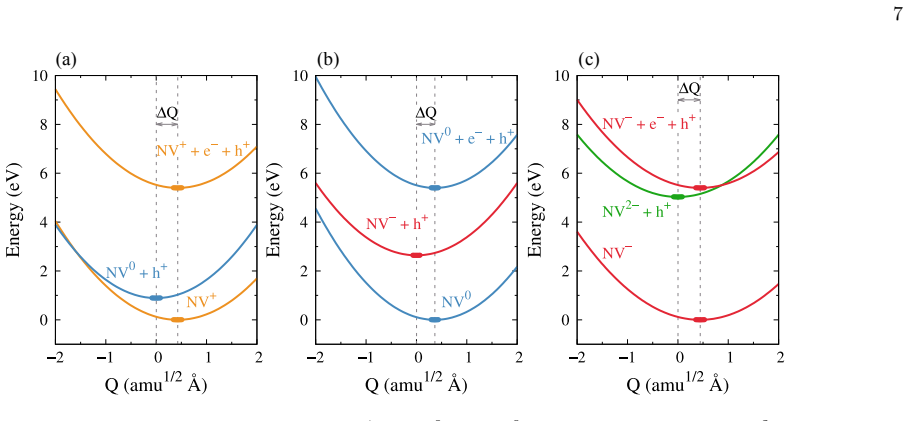
Capture into ground states Figure 8 shows the CCDs for the NV + ⇌NV 0, NV0 ⇌NV −, and NV − ⇌NV 2− transitions. For NV0 ⇌NV −, the CCD shows high barriers, resulting in very low capture coefficients (<10 −28 cm3 s−1). For NV+ ⇌NV 0, the electron capture at NV+ has a large en- ergy barrier and therefore a very low capture coefficient of∼10 −39 cm3 s−1, wher...
-
[2]
However, Fig
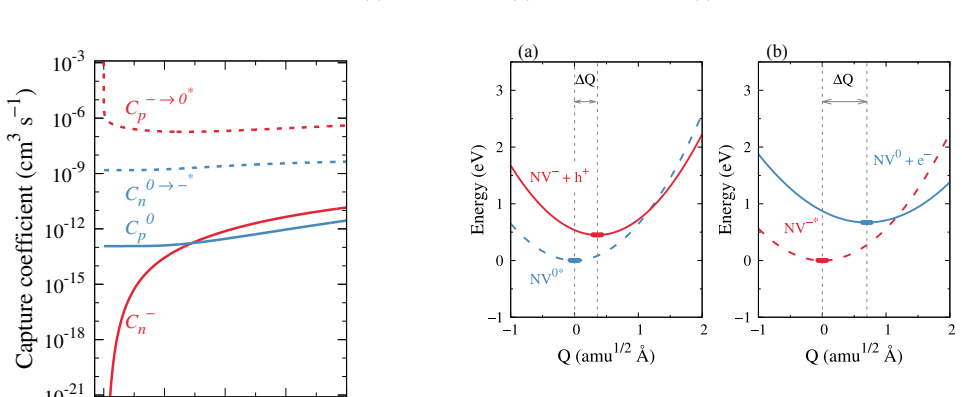
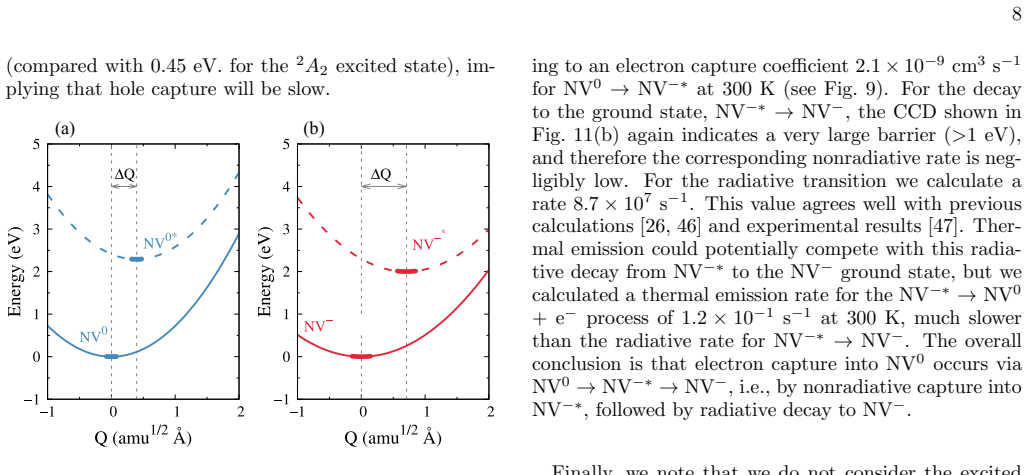
Capture into excited states As discussed in the previous section, nonradiative tran- sitions between NV − and NV0 are very slow, with cap- ture coefficients<10 −28 cm3 s−1. However, Fig. 2 sug- gests that the transition might be faster when medi- ated by the NV −∗ and NV0∗ excited states. Indeed, the charge-state transition level between the neutral charg...
-
[3]
J. R. Weber, W. F. Koehl, J. B. Varley, A. Janotti, B. B. Buckley, C. G. Van de Walle, and D. D. Awschalom, Quantum computing with defects, Proc. Natl. Acad. Sci. 107, 8513 (2010)
2010
-
[4]
L. C. Bassett, A. Alkauskas, A. L. Exarhos, and K.-M. C. Fu, Quantum defects by design, Nanophotonics8, 1867 (2019)
2019
-
[5]
M. E. Turiansky, K. Parto, G. Moody, and C. G. Van de Walle, Rational design of efficient defect-based quantum emitters, APL Photonics9, 066117 (2024)
2024
-
[6]
M. W. Doherty, N. B. Manson, P. Delaney, F. Jelezko, J. Wrachtrup, and L. C. Hollenberg, The nitrogen- vacancy colour centre in diamond, Phys. Rep.528, 1 (2013)
2013
-
[7]
D. D. Awschalom, R. Hanson, J. Wrachtrup, and B. B. Zhou, Quantum technologies with optically interfaced solid-state spins, Nat. Photonics12, 516 (2018)
2018
-
[8]
Gruber, A
A. Gruber, A. Dr¨ abenstedt, C. Tietz, L. Fleury, J. Wrachtrup, and C. von Borczyskowski, Scanning con- focal optical microscopy and magnetic resonance on sin- gle defect centers, Science276, 2012 (1997)
2012
-
[9]
Siyushev, M
P. Siyushev, M. Nesladek, E. Bourgeois, M. Gulka, J. Hruby, T. Yamamoto, M. Trupke, T. Teraji, J. Isoya, and F. Jelezko, Photoelectrical imaging and coherent spin-state readout of single nitrogen-vacancy centers in diamond, Science363, 728 (2019)
2019
-
[10]
Rovny, S
J. Rovny, S. Gopalakrishnan, A. C. B. Jayich, P. Maletinsky, E. Demler, and N. P. de Leon, Nanoscale diamond quantum sensors for many-body physics, Nat. Rev. Phys.6, 753 (2024)
2024
-
[11]
J. M. Smith, S. A. Meynell, A. C. B. Jayich, and J. Mei- jer, Colour centre generation in diamond for quantum technologies, Nanophotonics8, 1889 (2018)
2018
-
[12]
Lenef and S
A. Lenef and S. C. Rand, Electronic structure of the N- V center in diamond: Theory, Phys. Rev. B53, 13441 (1996)
1996
-
[13]
Farrer, On the substitutional nitrogen donor in dia- mond, Solid State Commun.7, 685 (1969)
R. Farrer, On the substitutional nitrogen donor in dia- mond, Solid State Commun.7, 685 (1969)
1969
-
[14]
Koppitz, O
J. Koppitz, O. F. Schirmer, and M. Seal, Pseudo-Jahn- Teller optical absorption of isolated nitrogen in diamond, J. Phys. C: Solid State Phys.19, 1123 (1986)
1986
-
[15]
N. B. Manson, M. Hedges, M. S. J. Barson, R. Ahlefeldt, M. W. Doherty, H. Abe, T. Ohshima, and M. J. Sellars, NV−-N+ pair centre in 1b diamond, New J. Phys.20, 113037 (2018)
2018
- [16]
-
[17]
Alkauskas, Q
A. Alkauskas, Q. Yan, and C. G. Van de Walle, First- principles theory of nonradiative carrier capture via mul- tiphonon emission, Phys. Rev. B90, 075202 (2014)
2014
-
[18]
M. E. Turiansky, A. Alkauskas, M. Engel, G. Kresse, D. Wickramaratne, J.-X. Shen, C. E. Dreyer, and C. G. Van de Walle, Nonrad: Computing nonradiative capture coefficients from first principles, Comput. Phys. Com- mun.267, 108056 (2021)
2021
-
[19]
Alkauskas, C
A. Alkauskas, C. E. Dreyer, J. L. Lyons, and C. G. Van de Walle, Role of excited states in Shockley-Read- Hall recombination in wide-band-gap semiconductors, Phys. Rev. B93, 201304 (2016)
2016
-
[20]
Ulbricht, S
R. Ulbricht, S. T. van der Post, J. P. Goss, P. R. Brid- don, R. Jones, R. U. A. Khan, and M. Bonn, Single sub- stitutional nitrogen defects revealed as electron accep- tor states in diamond using ultrafast spectroscopy, Phys. Rev. B84, 165202 (2011)
2011
-
[21]
Kresse and J
G. Kresse and J. Furthm¨ uller, Efficiency of ab-initio total energy calculations for metals and semiconductors using a plane-wave basis set, Comput. Mater. Sci.6, 15 (1996)
1996
-
[22]
Kresse and J
G. Kresse and J. Furthm¨ uller, Efficient iterative schemes for ab initio total-energy calculations using a plane-wave basis set, Phys. Rev. B54, 11169 (1996)
1996
-
[23]
P. E. Bl¨ ochl, Projector augmented-wave method, Phys. Rev. B50, 17953 (1994)
1994
-
[24]
J. Heyd, G. E. Scuseria, and M. Ernzerhof, Hybrid func- tionals based on a screened Coulomb potential, J. Chem. Phys.118, 8207 (2003)
2003
-
[25]
Hybrid functionals based on a screened Coulomb poten- tial
J. Heyd, G. E. Scuseria, and M. Ernzerhof, Erratum: “Hybrid functionals based on a screened Coulomb poten- tial” [J. Chem. Phys. 118, 8207 (2003)], J. Chem. Phys. 124, 219906 (2006)
2003
-
[26]
M. E. Straumanis and E. Z. Aka, Precision determination of lattice parameter, coefficient of thermal expansion and atomic weight of carbon in diamond1, J. Am. Chem. Soc. 73, 5643 (1951)
1951
-
[27]
Cardona, Electron–phonon interaction in tetrahedral semiconductors, Solid State Commun.133, 3 (2005)
M. Cardona, Electron–phonon interaction in tetrahedral semiconductors, Solid State Commun.133, 3 (2005)
2005
-
[28]
Thiering and A
G. Thiering and A. Gali, Photoexcitation and recombina- tion processes of the neutral nitrogen-vacancy center in diamond from first principles, J. Appl. Phys.136, 084401 (2024)
2024
-
[29]
Freysoldt, B
C. Freysoldt, B. Grabowski, T. Hickel, J. Neugebauer, G. Kresse, A. Janotti, and C. G. Van de Walle, First- 10 principles calculations for point defects in solids, Rev. Mod. Phys.86, 253 (2014)
2014
-
[30]
Freysoldt, J
C. Freysoldt, J. Neugebauer, and C. G. Van de Walle, Fully Ab Initio Finite-Size Corrections for Charged- Defect Supercell Calculations, Phys. Rev. Lett.102, 016402 (2009)
2009
-
[31]
R. O. Jones and O. Gunnarsson, The density functional formalism, its applications and prospects, Rev. Mod. Phys.61, 689 (1989)
1989
-
[32]
Mackoit-Sinkeviˇ cien˙ e, M
M. Mackoit-Sinkeviˇ cien˙ e, M. Maciaszek, C. G. Van de Walle, and A. Alkauskas, Carbon dimer defect as a source of the 4.1 eV luminescence in hexagonal boron nitride, Appl. Phys. Lett.115, 212101 (2019)
2019
-
[33]
A. V. Ivanov, Y. L. A. Schmerwitz, G. Levi, and H. J´ onsson, Electronic excitations of the charged nitrogen-vacancy center in diamond obtained using time- independent variational density functional calculations, SciPost Phys.15, 009 (2023)
2023
-
[34]
C. E. Dreyer, A. Alkauskas, J. L. Lyons, and C. G. Van de Walle, Radiative capture rates at deep defects from elec- tronic structure calculations, Phys. Rev. B102, 085305 (2020)
2020
-
[35]
Razinkovas, M
L. Razinkovas, M. Maciaszek, F. Reinhard, M. W. Do- herty, and A. Alkauskas, Photoionization of negatively charged NV centers in diamond: Theory and ab initio calculations, Phys. Rev. B104, 235301 (2021)
2021
-
[36]
D. V. Lang, Deep-level transient spectroscopy: A new method to characterize traps in semiconductors, J. Appl. Phys.45, 3023 (1974)
1974
-
[37]
Wickramaratne, C
D. Wickramaratne, C. E. Dreyer, B. Monserrat, J.-X. Shen, J. L. Lyons, A. Alkauskas, and C. G. Van de Walle, Defect identification based on first-principles calculations for deep level transient spectroscopy, App. Phys. Lett. 113, 192106 (2018)
2018
-
[38]
De´ ak, B
P. De´ ak, B. Aradi, M. Kaviani, T. Frauenheim, and A. Gali, Formation of NV centers in diamond: A theoret- ical study based on calculated transitions and migration of nitrogen and vacancy related defects, Phys. Rev. B89, 075203 (2014)
2014
-
[39]
von Barth, Local-density theory of multiplet structure, Phys
U. von Barth, Local-density theory of multiplet structure, Phys. Rev. A20, 1693 (1979)
1979
-
[40]
Davies, Dynamic Jahn-Teller distortions at trigonal optical centres in diamond, J
G. Davies, Dynamic Jahn-Teller distortions at trigonal optical centres in diamond, J. Phys. C: Solid State Phys. 12, 2551 (1979)
1979
-
[41]
Manson and J
N. Manson and J. Harrison, Photo-ionization of the nitrogen-vacancy center in diamond, Diamond Relat. Mater.14, 1705 (2005)
2005
-
[42]
M. E. Turiansky, A. Alkauskas, and C. G. Van de Walle, Dimensionality effects on trap-assisted recombination: the Sommerfeld parameter, J. Phys. Condens. Matter36, 195902 (2024)
2024
-
[43]
Mizuochi, T
N. Mizuochi, T. Makino, H. Kato, D. Takeuchi, M. Ogura, H. Okushi, M. Nothaft, P. Neumann, A. Gali, F. Jelezko, J. Wrachtrup, and S. Yamasaki, Electrically driven single-photon source at room temperature in dia- mond, Nat. Photonics6, 299 (2012)
2012
-
[44]
Gatto Monticone, F
D. Gatto Monticone, F. Quercioli, R. Mercatelli, S. So- ria, S. Borini, T. Poli, M. Vannoni, E. Vittone, and P. Olivero, Systematic study of defect-related quench- ing of NV luminescence in diamond with time-correlated single-photon counting spectroscopy, Phys. Rev. B88, 155201 (2013)
2013
-
[45]
Lozovoi, H
A. Lozovoi, H. Jayakumar, D. Daw, G. Vizkelethy, E. Bielejec, M. W. Doherty, J. Flick, and C. A. Mer- iles, Optical activation and detection of charge transport between individual colour centres in diamond, Nat. Elec- tron.4, 717 (2021)
2021
-
[46]
C. J. Rauch, inProc. Int. Conf. Phys. Semicond., edited by A. C. Stickland (Institute of Physics and the Physical Society of London, Exeter, UK, 1962) pp. 276–280
1962
- [47]
-
[48]
Gali, Ab initio theory of the nitrogen-vacancy center in diamond, Nanophotonics8, 1907 (2019)
´A. Gali, Ab initio theory of the nitrogen-vacancy center in diamond, Nanophotonics8, 1907 (2019)
1907
-
[49]
Batalov, C
A. Batalov, C. Zierl, T. Gaebel, P. Neumann, I.-Y. Chan, G. Balasubramanian, P. R. Hemmer, F. Jelezko, and J. Wrachtrup, Temporal Coherence of Photons Emitted by Single Nitrogen-Vacancy Defect Centers in Diamond Using Optical Rabi-Oscillations, Phys. Rev. Lett.100, 077401 (2008)
2008
-
[50]
Karim, I
A. Karim, I. Lyskov, S. P. Russo, and A. Peruzzo, Bright ab initio photoluminescence of NV+ in diamond, J. Appl. Phys.130, 234402 (2021)
2021
discussion (0)
Sign in with ORCID, Apple, or X to comment. Anyone can read and Pith papers without signing in.