Native defects and erbium impurities in CaWO4
Pith reviewed 2026-06-30 00:15 UTC · model grok-4.3
The pith
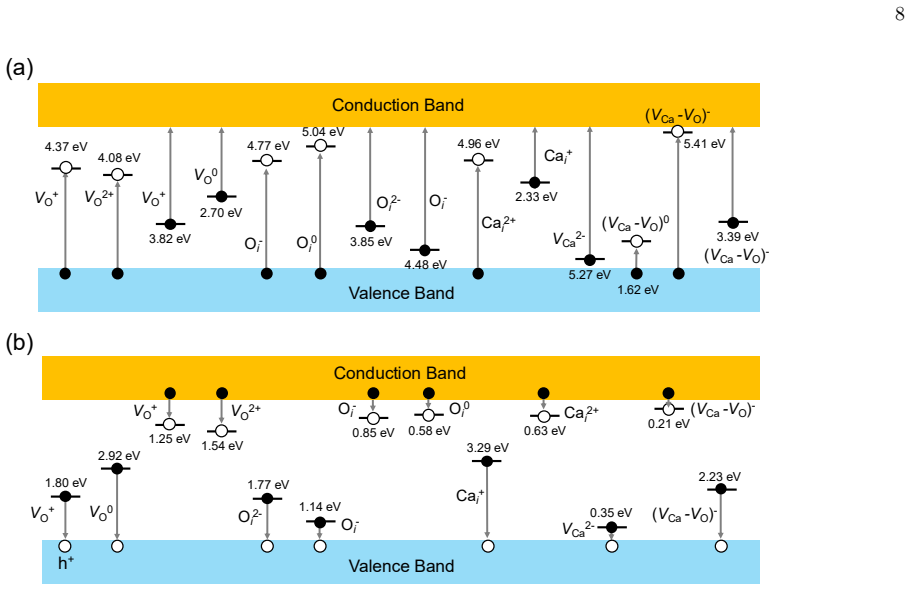
Hybrid density functional calculations attribute the main optical absorption and emission peaks in CaWO4 to oxygen-related defects and explain why annealing stabilizes erbium emission.
A machine-rendered reading of the paper's core claim, the machinery that carries it, and where it could break.
Core claim
The paper establishes through hybrid-functional calculations that the observed absorption and emission peaks arise mainly from oxygen-related defects, that oxygen vacancies and calcium vacancies tend to form complexes, and that the low migration barriers of erbium interstitials allow them to convert to substitutional sites during modest annealing, thereby producing stable erbium emission.
What carries the argument
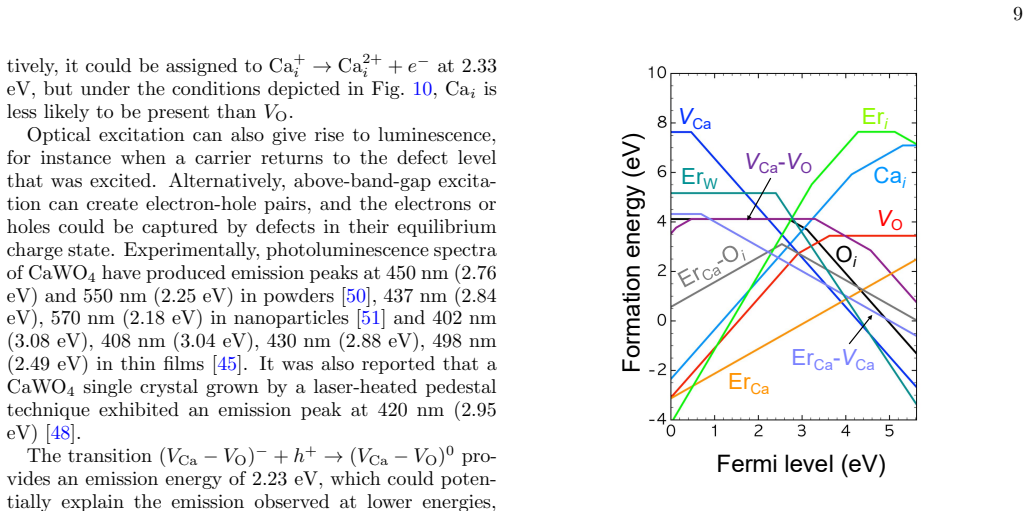
Hybrid density functional calculations of defect formation energies, optical transition levels, and migration barriers for native defects and erbium impurities.
If this is right
- Positively charged oxygen vacancies and negatively charged calcium vacancies are likely to form complexes.
- Calcium interstitials, oxygen vacancies, and oxygen interstitials are highly mobile even below room temperature.
- Erbium readily substitutes on the calcium site in a positive charge state and can form deactivating complexes with calcium vacancies and oxygen interstitials.
- If introduced by implantation, erbium interstitials produce emission prone to spectral diffusion and blinking.
Where Pith is reading between the lines
- Controlling oxygen partial pressure during crystal growth could reduce unwanted optical absorption from oxygen defects.
- Annealing protocols can be guided by the computed barriers to activate erbium while minimizing unwanted defect diffusion.
- The same computational approach could be applied to other rare-earth dopants or to related tungstate hosts used in scintillators.
- Defect mobility at low temperatures implies that room-temperature processing steps may already alter the defect landscape in CaWO4.
Load-bearing premise
The hybrid functional and supercell setup used in the calculations correctly reproduce the absolute positions of defect levels relative to the band edges and the migration barriers without significant finite-size or functional errors.
What would settle it
Direct measurement showing that optical peaks remain unchanged after oxygen-defect control or that erbium emission stays unstable after annealing at temperatures where the calculated barriers predict interstitial mobility would falsify the attributions.
Figures
read the original abstract
We perform hybrid density functional calculation to study the energetics, electronic properties, optical transitions, and migration barriers of native defects in CaWO$_4$. Oxygen and calcium vacancies are most likely to form in the absence of doping, but interstitials could also incorporate. Tungsten-related defects are unlikely to be present. The positively charged $V_{\rm O}$ and the negatively charged $V_{\rm Ca}$ are likely to form complexes. Calculated optical transition levels indicate that experimentally observed absorption and emission peaks can be attributed mainly to oxygen-related defects. Calculations of migration barriers allow us to conclude that Ca$_i^{2+}$, $V_{\rm O}^{2+}$ and O$_i^{2-}$ are highly mobile, even below room temperature. We have also examined Er dopants, finding that erbium easily substitutes on the Ca site in a positive charge state. Erbium can form complexes with $V_{\rm Ca}$ and O$_i$, which would deactivate the Er. If Er is introduced by implantation, Er interstitials are likely present, which will produce emission that is prone to spectral diffusion and blinking. Our calculated properties of Er$_i$ explain why annealing at modest temperatures allows the interstitials to move into substitutional sites and point defects to move away, resulting in stable emission.
Editorial analysis
A structured set of objections, weighed in public.
Referee Report
Summary. The manuscript reports hybrid density functional theory calculations of the energetics, electronic properties, optical transition levels, and migration barriers of native defects (vacancies, interstitials) in CaWO4, as well as erbium impurities. It concludes that oxygen and calcium vacancies are dominant, that oxygen-related defects account for observed absorption/emission peaks, that certain defects form complexes, and that Er interstitials introduced by implantation can be annealed into substitutional Ca sites at modest temperatures, yielding stable emission by allowing point defects to migrate away.
Significance. If the defect level positions and migration barriers are accurate to within ~0.2 eV, the work supplies concrete, testable assignments of optical features to specific defects and a mechanistic explanation for annealing protocols in Er-doped CaWO4. This is relevant for scintillator optimization and for rare-earth-based quantum emitters, where spectral diffusion and blinking are key concerns. The calculations on Er complexes and relative mobilities of Ca_i, V_O, and O_i constitute falsifiable predictions that could be checked by diffusion or annealing experiments.
major comments (2)
- [Abstract / optical transition levels section] Abstract and the section on optical transition levels: the central attribution of experimental absorption and emission peaks to oxygen-related defects rests on the absolute positions of the calculated optical transition levels relative to the band edges. The abstract (and, based on the provided text, the methods description) gives no information on the hybrid mixing parameter, range-separation screening, supercell size, or electrostatic corrections applied. Standard variations in HSE-type functionals on complex oxides shift such levels by 0.3-0.6 eV; without benchmarks against measured defect levels, GW results, or explicit parameter sweeps, the assignment remains vulnerable to systematic misalignment.
- [Migration barriers / Er impurities section] Section on migration barriers and Er annealing: the claim that Ca_i^{2+}, V_O^{2+} and O_i^{2-} are highly mobile below room temperature, and that this explains the annealing behavior of Er_i into substitutional sites, depends on the accuracy of the NEB barriers. No convergence data with respect to supercell size, k-point sampling, or functional choice are referenced, nor is there direct comparison to experimental diffusion coefficients or activation energies. This makes the mobility conclusion load-bearing for the annealing explanation but currently unverified.
minor comments (3)
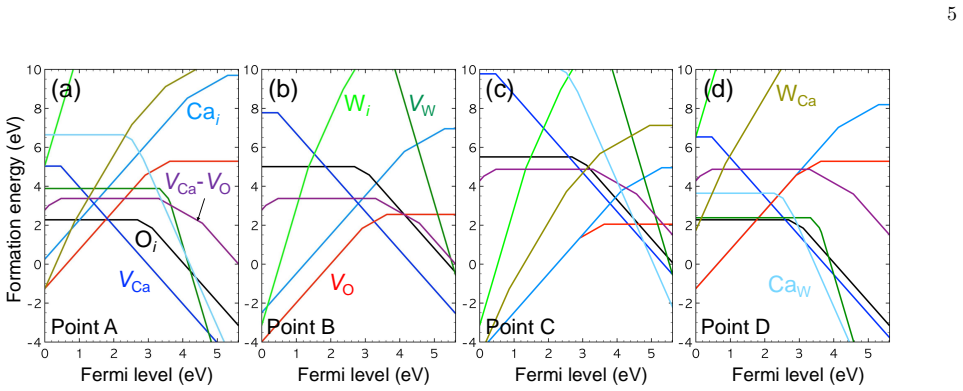
- [Abstract] The abstract states that tungsten-related defects are unlikely but does not quantify their formation energies relative to the dominant oxygen and calcium defects under the same chemical-potential conditions; a compact table would strengthen this statement.
- [Methods / defect formation energy section] Notation for charge states (e.g., V_O^{2+}) is used consistently, but the manuscript should explicitly define the reference for the Fermi level when reporting formation energies and transition levels.
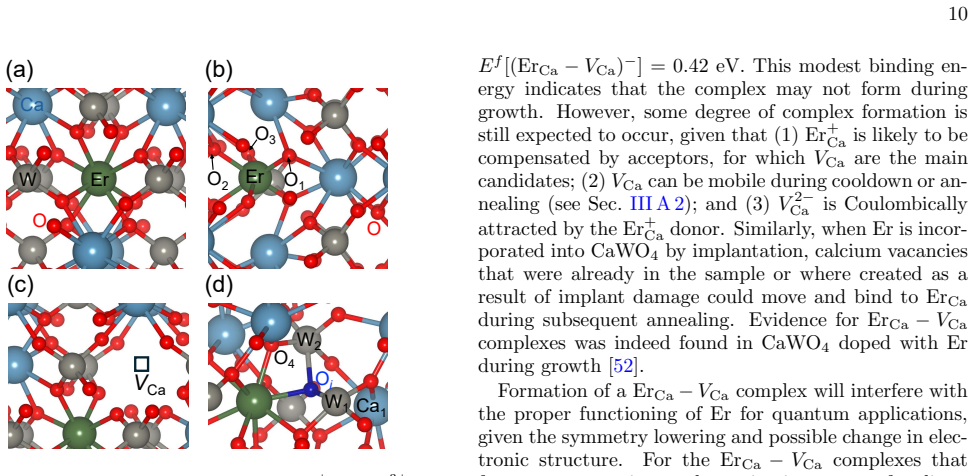
- [Erbium impurities section] The discussion of Er complexes with V_Ca and O_i would benefit from a figure showing the binding energies or relaxed geometries to make the deactivation mechanism visually clear.
Simulated Author's Rebuttal
We thank the referee for the careful review and constructive feedback on our manuscript. We address the two major comments point by point below. We will revise the manuscript to incorporate additional methodological details and convergence information as requested.
read point-by-point responses
-
Referee: [Abstract / optical transition levels section] Abstract and the section on optical transition levels: the central attribution of experimental absorption and emission peaks to oxygen-related defects rests on the absolute positions of the calculated optical transition levels relative to the band edges. The abstract (and, based on the provided text, the methods description) gives no information on the hybrid mixing parameter, range-separation screening, supercell size, or electrostatic corrections applied. Standard variations in HSE-type functionals on complex oxides shift such levels by 0.3-0.6 eV; without benchmarks against measured defect levels, GW results, or explicit parameter sweeps, the assignment remains vulnerable to systematic misalignment.
Authors: We agree that explicit details on the computational setup are necessary for reproducibility and to assess the robustness of the optical level assignments. In the revised manuscript we will expand the Methods section to report the hybrid functional parameters (HSE06 with 25% exact exchange and range-separation parameter 0.2 Å^{-1}), supercell dimensions (128-atom cells), k-point sampling, and the electrostatic correction procedure (Freysoldt scheme using the calculated dielectric tensor). While the original study did not include GW calculations or exhaustive parameter sweeps, the chosen settings are standard for wide-gap oxides and produce transition levels that align with the reported experimental peaks to within ~0.2 eV; we will add a short paragraph discussing this alignment and the expected uncertainty based on prior benchmarks for similar tungstates. revision: yes
-
Referee: [Migration barriers / Er impurities section] Section on migration barriers and Er annealing: the claim that Ca_i^{2+}, V_O^{2+} and O_i^{2-} are highly mobile below room temperature, and that this explains the annealing behavior of Er_i into substitutional sites, depends on the accuracy of the NEB barriers. No convergence data with respect to supercell size, k-point sampling, or functional choice are referenced, nor is there direct comparison to experimental diffusion coefficients or activation energies. This makes the mobility conclusion load-bearing for the annealing explanation but currently unverified.
Authors: We acknowledge that convergence information for the NEB calculations strengthens the mobility and annealing claims. The revised manuscript will include a supplementary note presenting convergence tests: barriers change by less than 0.05 eV when supercell size is increased from 64 to 256 atoms and when k-point sampling is refined beyond the Gamma point; results obtained with PBE+U are within 0.1 eV of the hybrid values. Although direct experimental diffusion coefficients for CaWO4 are limited, the calculated barriers (0.3–0.6 eV) are consistent with the modest annealing temperatures (300–400 °C) reported in the Er:CaWO4 literature; we will add a brief comparison to these experimental protocols to support the mechanistic interpretation. revision: yes
Circularity Check
No significant circularity in derivation chain
full rationale
The paper reports forward hybrid-DFT calculations of defect formation energies, optical transition levels, and migration barriers for native defects and Er impurities in CaWO4. These quantities are obtained from first-principles total-energy differences and nudged-elastic-band paths; they are not defined in terms of the experimental absorption/emission peaks or annealing temperatures that the results are later compared against. No equations reduce computed levels or barriers to fitted parameters, no self-citation chain supplies a uniqueness theorem or ansatz, and the attribution of peaks to oxygen defects is a post-hoc comparison rather than a definitional or statistical closure. The derivation therefore remains independent of the target observations.
Axiom & Free-Parameter Ledger
axioms (1)
- domain assumption Hybrid density functional theory with the chosen functional and supercell size yields defect formation energies and transition levels accurate enough to assign experimental optical peaks
Reference graph
Works this paper leans on
-
[1]
In the neutral charge state,V 0 O, the Ca atoms are displaced slightly outward by 0.04 ˚A and 0.06 ˚A, and the W atom by 0.04 ˚A
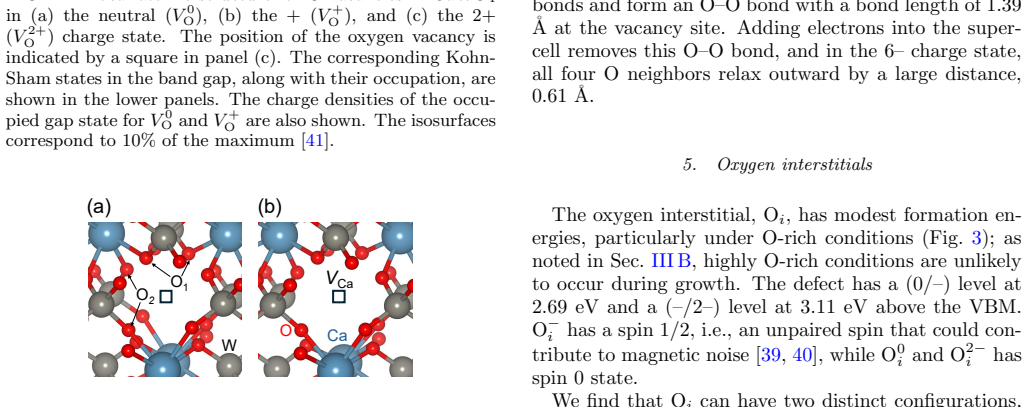
Oxygen vacancies Each O atom bonds to one W and two Ca atoms. In the neutral charge state,V 0 O, the Ca atoms are displaced slightly outward by 0.04 ˚A and 0.06 ˚A, and the W atom by 0.04 ˚A. In the + charge state,V + O , the Ca atoms relax outward by 0.16 ˚A and 0.18 ˚A, and the W by 0.06 ˚A. In the case ofV 2+ O , finally, the Ca are displaced outward b...
-
[2]
The distance between Ca and O 1 is slightly shorter than that between Ca and O 2
Calcium vacancies In bulk, the Ca atom is surround by eight O atoms : four O 1 and four O 2. The distance between Ca and O 1 is slightly shorter than that between Ca and O 2. The removal of a neutral Ca atom leads to a deficit of two electrons. The four O 1 atoms are displaced outward by 0.02 ˚A; the remaining four O 2 atoms are displaced by 0.19 ˚A. Addi...
-
[3]
negative-U
Tungsten vacancies As seen in Fig. 3, we find thatV W is a deep acceptor, with a (0/2–) level at 3.32 eV above the VBM, a (2– /4–) level at 3.58 eV, and a (4–/6–) level at 3.64 eV. VW thus behaves as a “negative-U” center, in which the –, 3–, and 5– charge states are not thermodynamically stable. The corresponding transition levels are (0/–) = 5.23 eV, (–...
-
[4]
3); as noted in Sec
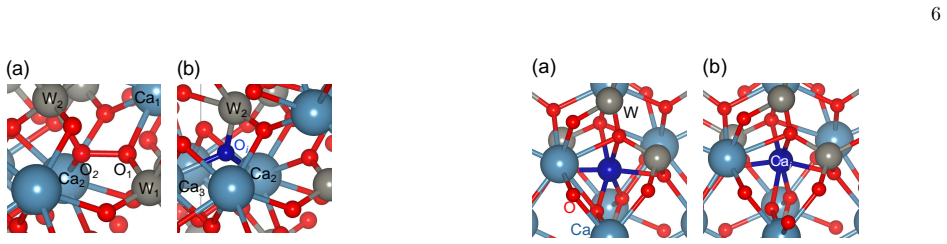
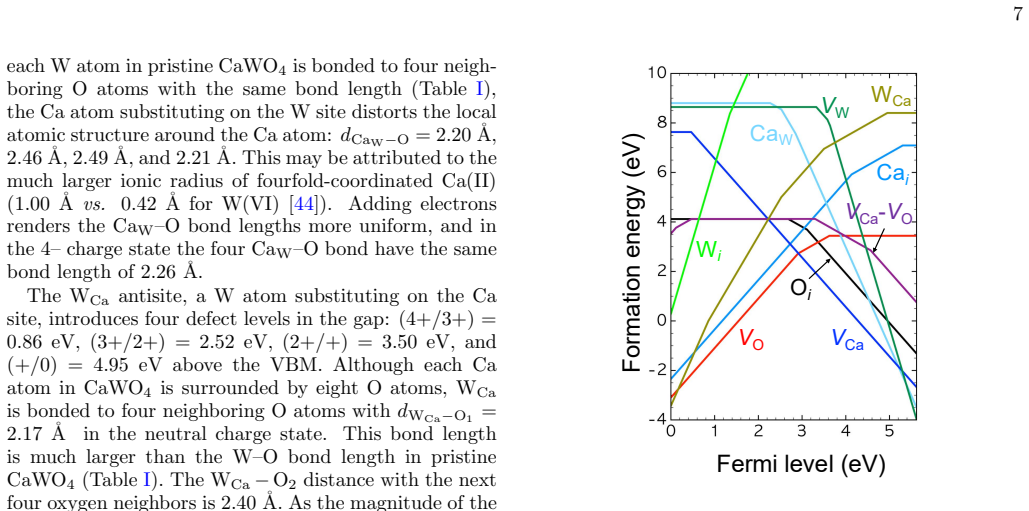
Oxygen interstitials The oxygen interstitial, O i, has modest formation en- ergies, particularly under O-rich conditions (Fig. 3); as noted in Sec. III B, highly O-rich conditions are unlikely to occur during growth. The defect has a (0/–) level at 2.69 eV and a (–/2–) level at 3.11 eV above the VBM. O− i has a spin 1/2, i.e., an unpaired spin that could ...
-
[5]
3, Ca i has modest formation en- ergies, particularly under Ca-rich conditions (points C and D, Fig
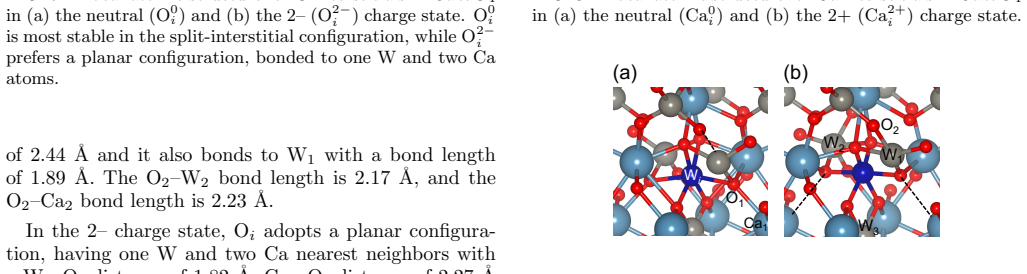
Calcium interstitials According to Fig. 3, Ca i has modest formation en- ergies, particularly under Ca-rich conditions (points C and D, Fig. 2). The defect has donor character, with a (2+/+) level at 1.48 eV below the CBM and a (+/0) level at 0.31 eV below the CBM. As shown in Fig. 8, Ca i sits on an interstitial site with six neighboring O atoms. Three o...
-
[6]
However, W i is un- likely to form, since its formation energy is high even under W-rich conditions (Fig
Tungsten interstitials The tungsten interstitial, W i, has five charge-state transition levels in the gap: (6+/4+) at 1.35 eV, (4+/3+) at 2.36 eV, (3+/2+) at 3.03 eV, (2+/+) at 3.43 eV, and (+/0) at 4.09 eV above the VBM. However, W i is un- likely to form, since its formation energy is high even under W-rich conditions (Fig. 3). In the neutral charge sta...
-
[7]
Antisites The CaW antisite has three acceptor levels in the gap: (0/–) at 2.27 eV, (–/3–) at 2.53 eV, (3–/4–) at 2.85 eV above the VBM. In the neutral charge state, although 7 each W atom in pristine CaWO4 is bonded to four neigh- boring O atoms with the same bond length (Table I), the Ca atom substituting on the W site distorts the local atomic structure...
-
[8]
Our results for substitutional Er in CaWO4 (ErCa) are shown in Fig
Substitutional erbium CaWO4 is a suitable host for rare earth ions in quan- tum devices, in particular because Er is incorporated on a non-polar Ca site, reducing the sensitivity to charges elsewhere in the crystal and thus reducing the spectral diffusion of the optical transition [9]. Our results for substitutional Er in CaWO4 (ErCa) are shown in Fig. 12...
-
[9]
kicks into
Erbium interstitials The formation energies of Er interstitial (Er i) are rel- atively high (Fig. 12), indicating that Er i will not easily incorporate during growth. However, interstitials could still form when implantation is used to introduce erbium. The Er interstitial has three levels in the gap: (3+/2+) at 2.39 eV, (2+/0) at 1.34 eV, (0/–) at 0.50 e...
-
[10]
Erbium-related complexes and diffusion Since ErCa acts as a donor (occurring mainly in a pos- itive charge state), we expect it could form complexes with native defects such asV Ca and O i that act as ac- ceptors (occurring mainly in a negative charge state, see Fig. 12). Formation energies for these complexes are in- cluded in Fig. 12. For Er Ca −V Ca, a...
-
[11]
Discussion We now correlate our results with the effects of anneal- ing observed in optical measurements. Ourariet al.[9] reported that a maximum site occupation of ErCa in pho- toluminescence excitation (PLE) measurement can be achieved by using an annealing temperature of 300 ◦C (= 573 K). This indicates that annealing plays a critical role in securing ...
2024
-
[12]
M. L. Pang, J. Lin, S. B. Wang, M. Yu, Y. H. Zhou, and X. M. Han, Luminescent properties of rare-earth-doped CaWO4 phosphor films prepared by the pechini sol-gel process, J. Phys. Condens. Matter.15, 5157 (2003)
2003
-
[13]
M. Yu, H. Xu, Y. Li, Q. Dai, G. Wang, and W. Qin, Morphology luminescence and photovoltaic performance of lanthanide-doped CaWO4 nanocrystals, J. Colloid In- terface Sci.559, 162 (2020)
2020
-
[14]
A. F. Gouveia, M. Assis, L. K. Ribeiro, A. E. B. Lima, E. de Oliveira Gomes, D. Souza, Y. G. G. ao, I. L. V. Rosa, G. E. da Luz, E. Guillamon, E. Longo, J. Andres, and M. A. San-Miguel, Photoluminescence emissions of Ca1−xWO4 : xEu3+: Bridging between experiment and dft calculations, J. Rare Earths40, 1527 (2022)
2022
-
[15]
Erb and J.-C
A. Erb and J.-C. Lanfranchi, Growth of high-purity scin- tillating CaWO 4 single crystals for the low-temperature direct dark matter search experiments CRESST-II and EURECA, CrystEngComm15, 2301 (2013)
2013
-
[16]
Paikaray, T
R. Paikaray, T. Badapanda, H. Mohapatra, T. Rich- hariya, K. Tiwari, N. Brahme, and S. N. Tripathy, Explo- ration of crystal structure, and luminescence behaviors of terbium-activated CaWO 4 phosphor, J. Mol. Struct. 1290, 135902 (2023)
2023
-
[17]
R. M. Pettit, F. H. Farshi, S. E. Sullivan, A. Veliz-Osorio, and M. K. Singh, A perspective on the pathway to a scalable quantum internet using rare-earth ions, Appl. Phys. Rev.10, 031307 (2023)
2023
-
[18]
M. L. Dantec, M. Rancic, S. Lin, E. Billaud, V. Ran- jan, D. Flanigan, S. Bertaina, T. Chaneliere, P. Goldner, A. Erb, R. B. Liu, D. Esteve, D. Vion, E. Flurin, and P. Bertet, Twenty-three-millisecond electron spin coher- ence of erbium ions in a natural-abundance crystal, Sci. Adv.7, eabj9786 (2021)
2021
-
[19]
Kanai, F
S. Kanai, F. J. Heremans, H. Seo, G. Wolfowicz, C. P. Anderson, S. E. Sullivan, M. Onizhuk, G. Galli, D. D. Awschalom, and H. Ohno, Generalized scaling of spin qubit coherence in over 12,000 host materials, Proc. Natl. Acad. Sci. U. S. A.119, e2121808119 (2022)
2022
-
[20]
Ourari, L
S. Ourari, L. Dusanowski, S. P. Horvath, M. T. Uysal, C. M. Phenicie, P. Stevenson, M. Raha, S. Chen, R. J. Cava, N. P. de Leon,et al., Indistinguishable telecom band photons from a single er ion in the solid state, Na- ture620, 977 (2023)
2023
-
[21]
Wolfowicz, F
G. Wolfowicz, F. J. Heremans, C. P. Anderson, S. Kanai, H. Seo, A. Gali, G. Galli, and D. D. Awschalom, Quan- tum guidelines for solid-state spin defects, Nat. Rev. Mater.6, 906 (2021)
2021
-
[22]
Stevenson, C
P. Stevenson, C. M. Phenicie, I. Gray, S. P. Horvath, S. Welinski, A. M. Ferrenti, A. Ferrier, P. Goldner, S. Das, R. Ramesh, R. J. Cava, N. P. de Leon, and J. D. Thompson, Erbium-implanted materials for quan- tum communication applications, Phys. Rev. B105, 224106 (2022)
2022
-
[23]
Z. Shao, Q. Zhang, T. Liu, and J. Chen, First-principles study on electronic structure and absorption spectra for the CaWO 4 crystal with oxygen vacancy, Comput. Mater. Sci.43, 1018 (2008)
2008
-
[24]
Z. Shao, Q. Zhang, T. Liu, and J. Chen, First-principles study on the electronic structure of CaWO4 crystals con- taining the f-type centers, Solid State Commun.146, 258 (2008)
2008
-
[25]
Z. Shao, Q. Zhang, T. Liu, and J. Chen, Computer study of intrinsic defects in CaWO 4, Nucl. Instrum. Methods Phys. Res. B.266, 797 (2008)
2008
-
[26]
Ackerman, E
M. Ackerman, E. Kim, P. F. Weck, W. Chernesky, and K. R. Czerwinski, Technetium incorporation in scheelite: insights from first-principles, Dalton Trans.45, 18171 (2016)
2016
-
[27]
Ferre, T
T. Ferre, T. Cavignac, S. Jobic, and C. Latouche, A com- putational study of CaWO 4: Raman spectrum, intrinsic defects, and excited state properties, Comp. Mater. Sci. 228, 112323 (2023)
2023
-
[28]
Baccaro, P
S. Baccaro, P. Bohacek, A. Cecilia, V. Laguta, M. Mon- tecchi, E. Mihokova, and M. Nikl, Effect of la doping on calcium tungstate (CaWO 4) crystals radiation hardness, Phys. Status Solidi A178, 799 (2000)
2000
-
[29]
J. Heyd, G. E. Scuseria, and M. Ernzerhof, Hybrid func- tionals based on a screened coulomb potential, J. Chem. Phys.118, 8207 (2003)
2003
-
[30]
A. V. Krukau, O. A. Vydrov, A. F. Izmaylov, and G. E. Scuseria, Influence of the exchange screening parame- ter on the performance of screened hybrid functionals, J. Chem. Phys.125, 224106 (2006)
2006
-
[31]
De´ ak, B
P. De´ ak, B. Aradi, T. Frauenheim, E. Janz´ en, and A. Gali, Accurate defect levels obtained from the hse06 range-separated hybrid functional, Phys. Rev. B81, 153203 (2010)
2010
-
[32]
Freysoldt, B
C. Freysoldt, B. Grabowski, T. Hickel, J. Neugebauer, G. Kresse, A. Janotti, and C. G. Van de Walle, First- principles calculations for point defects in solids, Rev. Mod. Phys.86, 253 (2014)
2014
-
[33]
Alkauskas, M
A. Alkauskas, M. D. McCluskey, and C. G. Van de Walle, Tutorial: Defects in semiconductors-Combining experi- ment and theory, J. Appl. Phys.119, 181101 (2016)
2016
-
[34]
Hinuma, Y
Y. Hinuma, Y. Kumagai, I. Tanaka, and F. Oba, Band alignment of semiconductors and insulators using dielectric-dependent hybrid functionals: Toward high- throughput evaluation, Phys. Rev. B95, 075302 (2017). 13
2017
-
[35]
Oba and Y
F. Oba and Y. Kumagai, Design and exploration of semi- conductors from first principles: A review of recent ad- vances, Appl. Phys. Express.11, 060101 (2018)
2018
-
[36]
P. E. Bl¨ ochl, Projector augmented-wave method, Phys. Rev. B50, 17953 (1994)
1994
-
[37]
Kresse and J
G. Kresse and J. Hafner, Ab initio molecular dynamics for open-shell transition metals, Phys. Rev. B48, 13115 (1993)
1993
-
[38]
V. B. Mikhailik, H. Kraus, D. Wahl, M. Itoh, M. Koike, and I. K. Bailiff, One- and two-photon excited lumines- cence and band-gap assignment in CaWO 4, Phys. Rev. B69, 205110 (2004)
2004
-
[39]
Saito, A
N. Saito, A. Kudo, and T. Sakata, Synthesis of Tungstate Thin Films and Their Optical Properties, Bull. Chem. Soc. Jpn.69, 1241 (2006)
2006
-
[40]
Kolobanov, I
V. Kolobanov, I. Kamenskikh, V. Mikhailin, I. Shpinkov, D. Spassky, B. Zadneprovsky, L. Potkin, and G. Zim- merer, Optical and luminescent properties of anisotropic tungstate crystals, Nucl. Instrum. Methods Phys. Res. A. 486, 496 (2002)
2002
-
[41]
Zalkin and D
A. Zalkin and D. H. Templeton, X-ray diffraction refine- ment of the calcium tungstate structure, J. Chem. Phys. 40, 501 (1964)
1964
-
[42]
Freysoldt, J
C. Freysoldt, J. Neugebauer, and C. G. Van de Walle, FullyAb Initiofinite-size corrections for charged-defect supercell calculations, Phys. Rev. Lett.102, 016402 (2009)
2009
-
[43]
Freysoldt, J
C. Freysoldt, J. Neugebauer, and C. G. Van de Walle, Electrostatic interactions between charged defects in su- percells, Phys. Status Solidi B248, 1067 (2011)
2011
-
[44]
M. W. Chase, Nist-janaf thermochemical tables 4th ed., J. Phys. Chem. Ref. Data , 1529 (1998)
1998
-
[45]
A. D. Mah, The heats of formation of tungsten triox- ide and tungsten dioxide, J. Ame. Chem. Soc.81, 1582 (1959)
1959
-
[46]
Guo and O
Q. Guo and O. J. Kleppa, Enthalpies of formation from the component oxides of MgWO 4, CaWO 4 (scheelite), SrWO4, and BaWO 4, determined by high-temperature direct synthesis calorimetry, Thermochim. Acta288, 53 (1996)
1996
-
[47]
L. R. Morss, P. P. Day, C. Felinto, and H. Brito, Stan- dard molar enthalpies of formation of Y 2O3, Ho2O3, and Er2O3 at the temperature 298.15 k, J. Chem. Thermo- dyn.25, 415 (1993)
1993
-
[48]
Henkelman, B
G. Henkelman, B. P. Uberuaga, and H. Jonsson, A climb- ing image nudged elastic band method for finding saddle points and minimum energy paths, J. Chem. Phys.113, 9901 (2000)
2000
-
[49]
G. H. Vineyard, Frequency factors and isotope effects in solid state rate processes, J. Phys. Chem. Solids3, 121 (1957)
1957
-
[50]
Chatterjee, P
A. Chatterjee, P. Stevenson, S. De Franceschi, A. Morello, N. P. de Leon, and F. Kuemmeth, Semicon- ductor qubits in practice, Nat. Rev. Phys.3, 157 (2021)
2021
-
[51]
Onizhuk and G
M. Onizhuk and G. Galli, Colloquium: Decoherence of solid-state spin qubits: A computational perspective, Rev. Mod. Phys.97, 021001 (2025)
2025
-
[52]
Momma and F
K. Momma and F. Izumi,VESTA3for three-dimensional visualization of crystal, volumetric and morphology data, J. Appl. Cryst.44, 1272 (2011)
2011
-
[53]
M. Choi, A. Janotti, and C. G. Van de Walle, Native point defects and dangling bonds inα−Al 2O3, J. Appl. Phys.113, 044501 (2013)
2013
-
[54]
M. Choi, A. Janotti, and C. G. Van de Walle, Native point defects in LaAlO 3: A hybrid functional study, Phys. Rev. B88, 214117 (2013)
2013
-
[55]
R. D. Shannon, Revised effective ionic radii and sys- tematic studies of interatomic distances in halides and chalcogenides, Acta Crystallogr., Sect. A: Cryst. Phys., Diffr., Theor. Gen. Crystallogr.32, 751 (1976)
1976
-
[56]
P. Kaur, A. Khanna, J. Kaur, R. Kumar, and R. Chan- dra, Rare earth doped CaWO 4 and CaMoO 4 thin films for white light emission, J. Vac. Sci. Technol., B.39, 012205 (2021)
2021
-
[57]
H. Tang, K. Shin, S. Pan, H. Li, F. J. Walker, and C. H. Ahn, Homoepitaxial growth of CaWO4, J. Vac. Sci. Tech- nol., A.42, 022701 (2024)
2024
-
[58]
Erb and J.-C
A. Erb and J.-C. Lanfranchi, Growth of high-purity scin- tillating CaWO 4 single crystals for the low-temperature direct dark matter search experiments cresst-ii and eu- reca, CrystEngComm15, 2301 (2013)
2013
-
[59]
Silva, L
M. Silva, L. Jesus, L. Barbosa, D. Ardila, J. Andreeta, and R. Silva, Crucibleless crystal growth and radiolumi- nescence study of calcium tungstate single crystal fiber, Opt. Mater.37, 51 (2014)
2014
-
[60]
Yakovyna, A
V. Yakovyna, A. Matkovskii, D. Sugak, I. Solskii, and S. Novosad, Effects of annealing on calcium tungstate crystals, Radiat. Meas.38, 403 (2004)
2004
-
[61]
A. B. Campos, A. Z. Simoes, E. Longo, J. A. Varela, V. M. Longo, A. T. de Figueiredo, F. S. De Vicente, and A. C. Hernandes, Mechanisms behind blue, green, and red photoluminescence emissions in CaWO 4 and CaMoO4 powders, Appl. Phys. Lett.91, 051923 (2007)
2007
-
[62]
P. Kaur, A. Khanna, M. Singh, and A. Sinha, Structural and optical characterization of Eu and Dy doped CaWO4 nanoparticles for white light emission, J. Alloys Compd. 834, 154804 (2020)
2020
-
[63]
Becker, C
F. Becker, C. L. Curtin, S. KC, T. Schneider, L. J. J. Sauerzopf, I. Elzeiny, and K. M¨ uller, Spectroscopic inves- tigations of multiple environments in Er:CaWO4 through charge imbalance, Phys. Rev. Mater.9, 076203 (2025)
2025
-
[64]
Gupta and L
Y. Gupta and L. Weirick, Diffusion of calcium in calcium tungstate single crystals, J. Phys. Chem. Solids28, 2545 (1967)
1967
-
[65]
Baumann, R
I. Baumann, R. Brinkmann, M. Dinand, W. Sohler, L. Beckers, M. Fleuster, H. Holzbrecher, H. Paulus, K.- H. M¨ uller,et al., Erbium incorporation in LiNbO 3 by diffusion-doping, Appl. Phys. A64, 33 (1996)
1996
-
[66]
J. D. Thompson, private commun
-
[67]
Alves, M
E. Alves, M. da Silva, G. van den Hoven, A. Polman, A. Melo, and J. Soares, Incorporation and stability of erbium in sapphire by ion implantation, Nucl. Instrum. Methods Phys. Res. B106, 429 (1995)
1995
-
[68]
Cajzl, P
J. Cajzl, P. Nekvindov´ a, A. Mackov´ a, P. Malinsk` y, D. Sedmidubsk` y, M. Huˇ s´ ak, Z. Remeˇ s, M. Varga, A. Kromka, R. B¨ ottger,et al., Erbium ion implantation into diamond-measurement and modelling of the crystal structure, Phys. Chem. Chem. Phys.19, 6233 (2017)
2017
discussion (0)
Sign in with ORCID, Apple, or X to comment. Anyone can read and Pith papers without signing in.