Controlled McKean--Vlasov Contagion with State-Dependent Killing
Pith reviewed 2026-06-30 00:14 UTC · model grok-4.3
The pith
Comparison principle holds for the two-population killed-particle HJB on decomposed alive-measure and cemetery state spaces.
A machine-rendered reading of the paper's core claim, the machinery that carries it, and where it could break.
Core claim
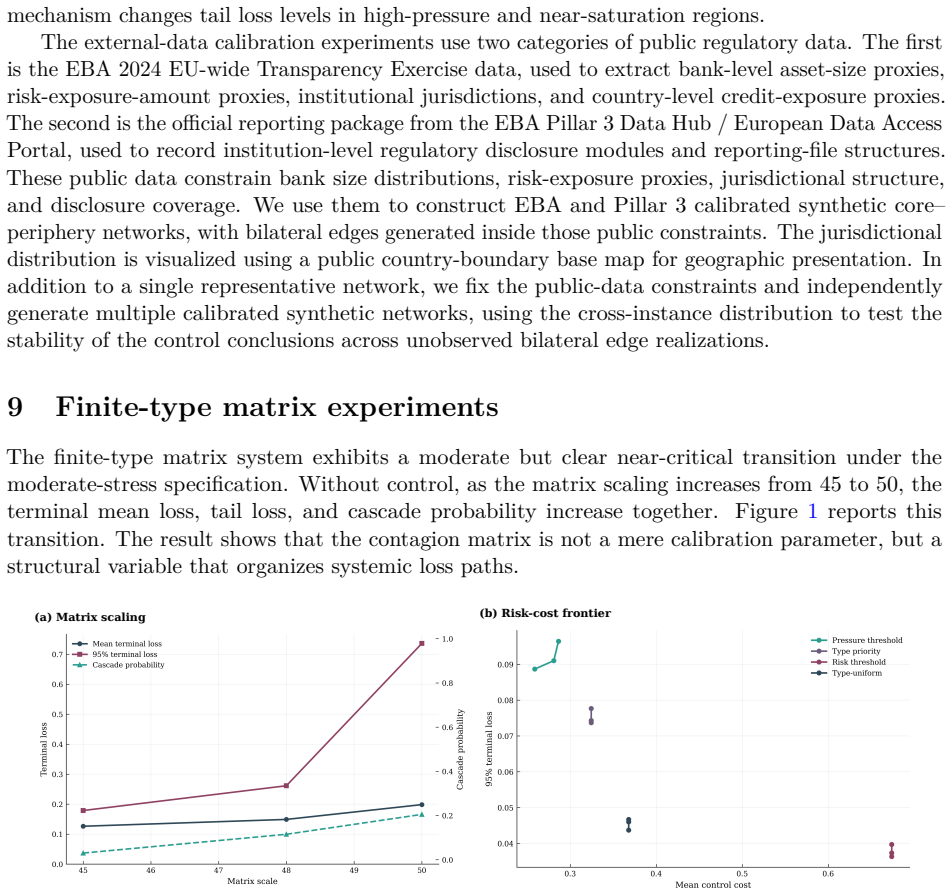
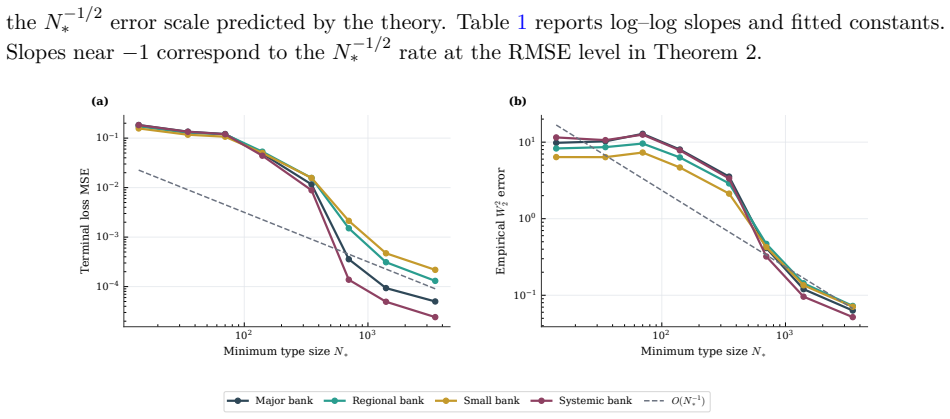
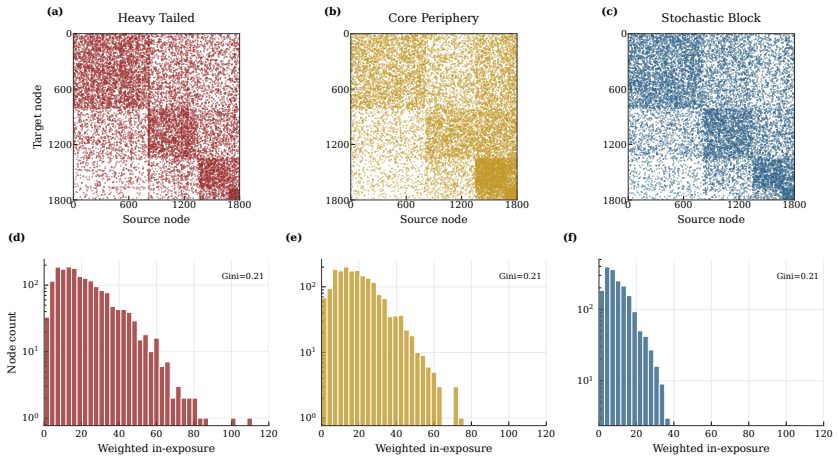
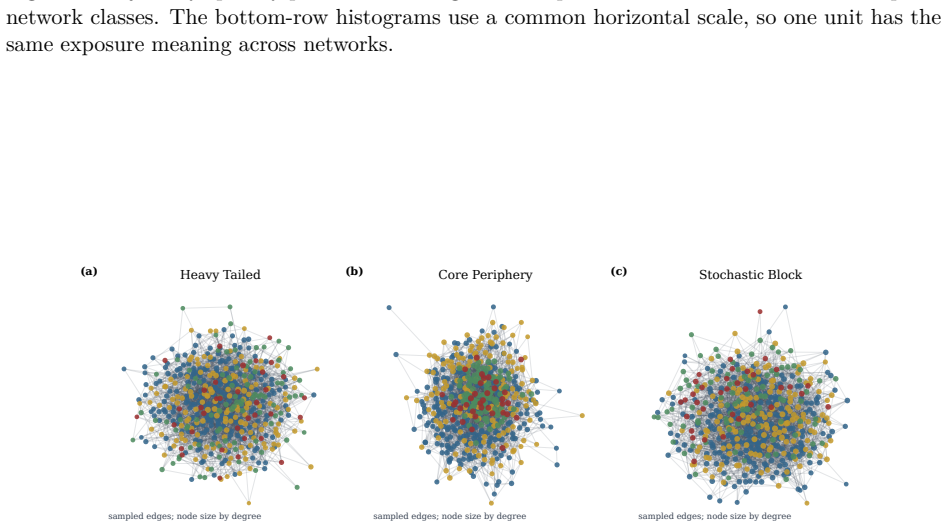
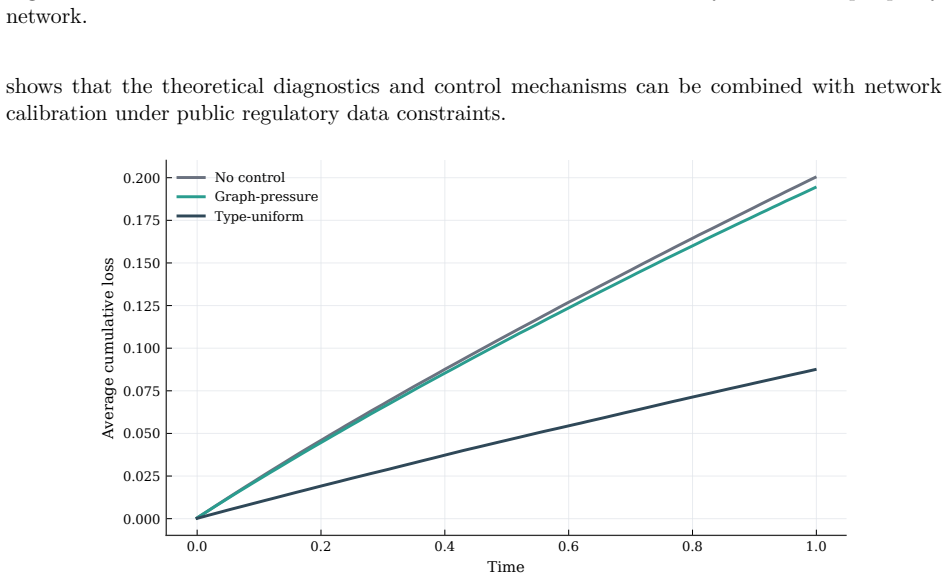
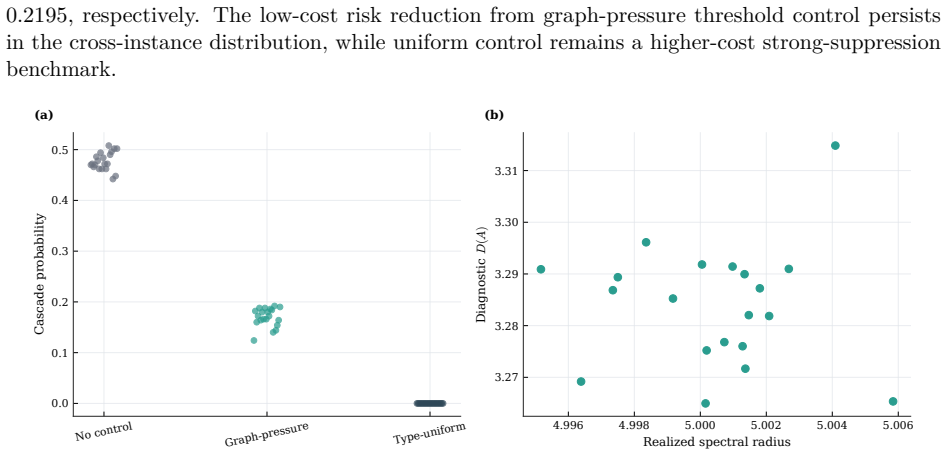
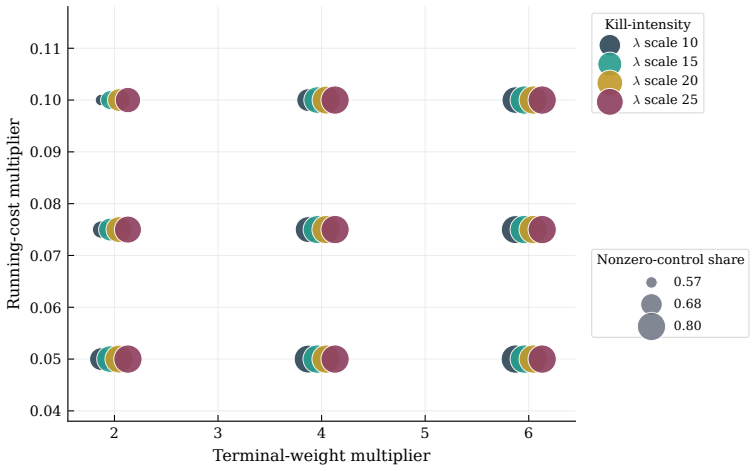
The central claim is that a comparison principle holds for the two-population killed-particle HJB on a decomposed state space of alive sub-probability measures and cemetery masses. The proof combines a Wasserstein smooth-gauge comparison argument with a killing-jump absorption estimate for mass transfer into the cemetery state. The paper also establishes a multi-population mean-field limit, an explicit first-order particle convergence rate, conditional propagation of chaos, controlled well-posedness, and a steep-killing bridge to absorbing-boundary default, with supporting finite-particle tests and a two-population HJB feedback experiment.
What carries the argument
The decomposed state space of alive sub-probability measures and cemetery masses together with the killing-jump absorption estimate that preserves comparison under mass transfer.
If this is right
- A multi-population mean-field limit exists for the controlled system.
- An explicit first-order particle convergence rate holds.
- Conditional propagation of chaos is valid.
- Controlled well-posedness follows for the interacting particle system.
- A steep-killing regime connects the model to absorbing-boundary default.
Where Pith is reading between the lines
- The comparison principle could support viscosity-solution existence results for related controlled jump equations.
- Similar absorption estimates might extend the method to models with additional jump types or non-constant killing intensities.
- The decomposed-space technique may inform numerical schemes that track cemetery mass separately in high-dimensional control problems.
- The mean-field and convergence results could apply to contagion settings in epidemiology or network failure models with removal states.
Load-bearing premise
The state space can be decomposed into alive sub-probability measures and cemetery masses such that the killing mechanism produces a well-defined jump absorption estimate preserving the comparison property.
What would settle it
An explicit counter-example or numerical test in which the comparison principle fails for a concrete killing rate that produces mass transfer violating the absorption estimate.
Figures

read the original abstract
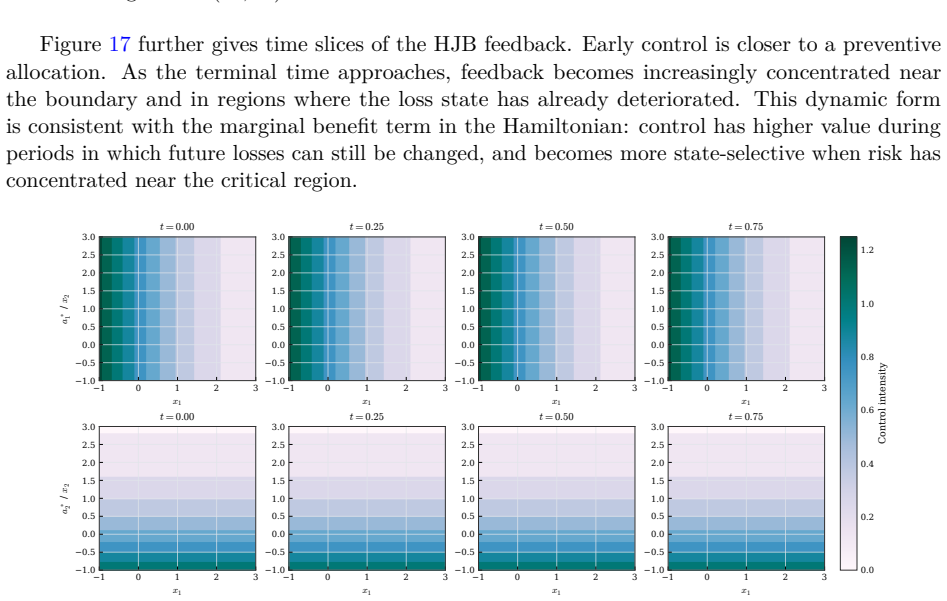
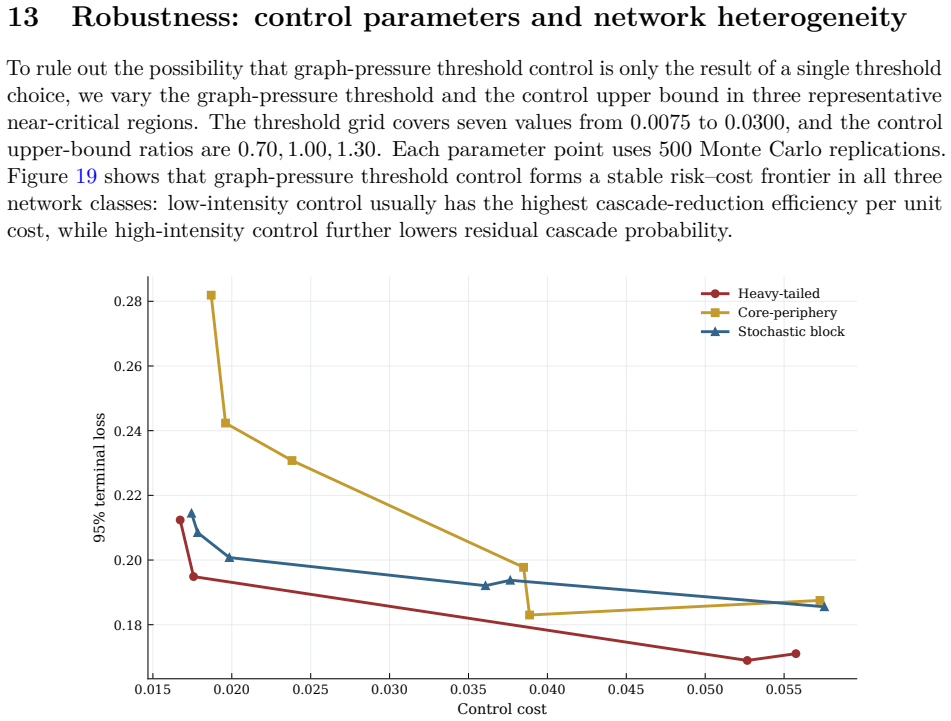
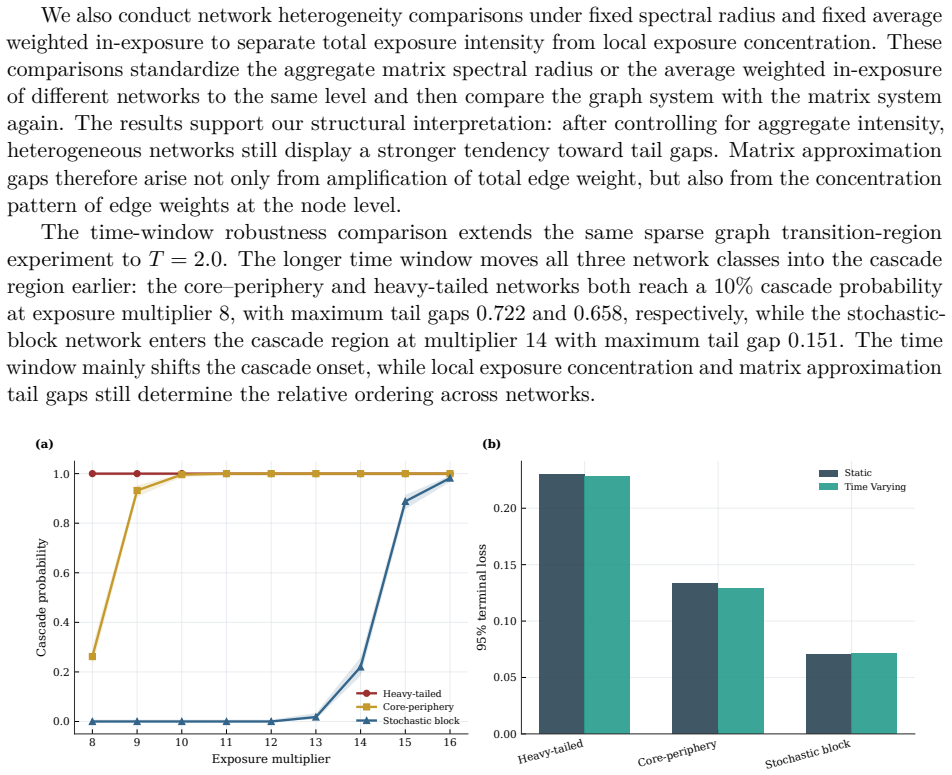
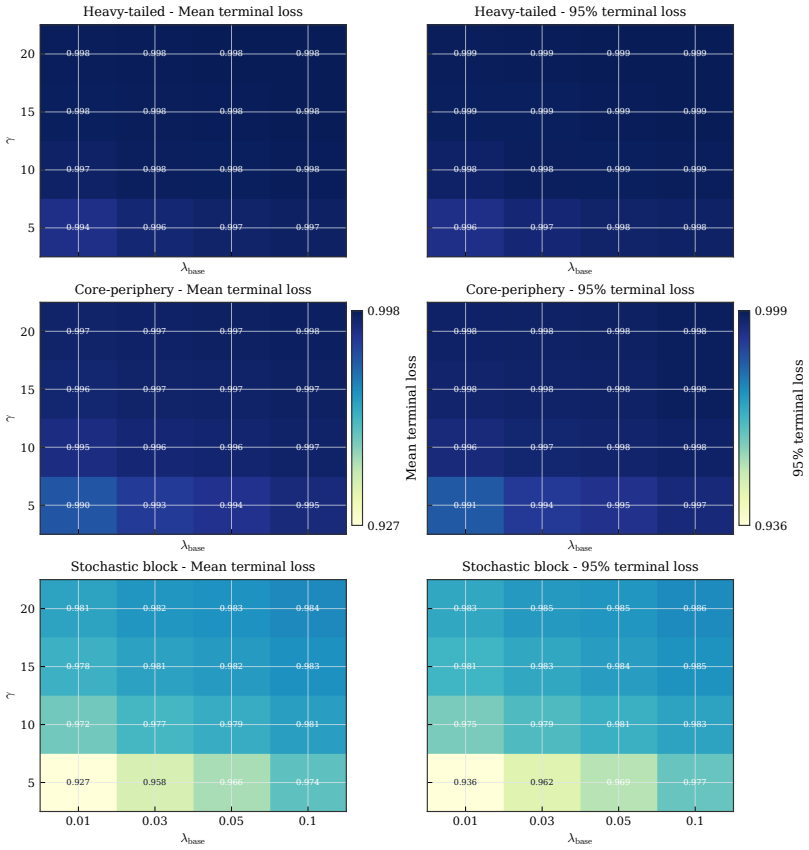
We study controlled McKean--Vlasov contagion with state-dependent killing, common noise, loss feedback, and interacting populations. The main result is a comparison principle for the two-population killed-particle HJB on a decomposed state space of alive sub-probability measures and cemetery masses. The proof combines a Wasserstein smooth-gauge comparison argument with a killing-jump absorption estimate for mass transfer into the cemetery state. We also establish a multi-population mean-field limit, an explicit first-order particle convergence rate, conditional propagation of chaos, controlled well-posedness, and a steep-killing bridge to absorbing-boundary default. Finite-particle convergence tests and a two-population HJB feedback experiment illustrate the theory.
Editorial analysis
A structured set of objections, weighed in public.
Referee Report
Summary. The manuscript develops a theory of controlled McKean-Vlasov contagion processes with state-dependent killing, common noise, loss feedback, and interacting populations. Its central claim is a comparison principle for the two-population killed-particle HJB equation posed on a decomposed state space consisting of alive sub-probability measures and cemetery masses; the proof combines a Wasserstein smooth-gauge comparison argument with a killing-jump absorption estimate. Additional results include a multi-population mean-field limit, an explicit first-order particle convergence rate, conditional propagation of chaos, controlled well-posedness, and a steep-killing bridge to absorbing-boundary default, illustrated by finite-particle convergence tests and a two-population HJB feedback experiment.
Significance. If the comparison principle holds under the stated assumptions, the work would supply a useful analytic tool for uniqueness and viscosity-solution approaches in mean-field control problems that incorporate killing and contagion. The explicit convergence rates, the propagation-of-chaos result, and the numerical experiments constitute concrete strengths that go beyond purely existential statements.
major comments (2)
- [Abstract / main result paragraph] Abstract / main result paragraph: the comparison principle is stated for the decomposed state space of alive sub-probability measures and cemetery masses, yet the manuscript supplies neither the precise functional form of the HJB operator nor the assumptions (e.g., regularity or growth conditions) imposed on the state-dependent killing rate that are required for the killing-jump absorption estimate to preserve the comparison property.
- [State-space decomposition (main result paragraph)] State-space decomposition (main result paragraph): the claim that the killing mechanism produces a well-defined jump absorption estimate that preserves comparison rests on the decomposition being compatible with the Wasserstein smooth-gauge metric; the text does not verify that the cemetery-mass coordinate does not introduce discontinuities or violate the gauge properties used in the comparison argument.
minor comments (2)
- [Numerical experiments] The numerical section mentions finite-particle convergence tests and a two-population HJB feedback experiment but does not report the discretization scheme, the number of particles, or the specific parameter values employed.
- [Notation] Notation for the cemetery mass and the alive sub-probability measures should be introduced once and used consistently throughout the statements of the mean-field limit and the convergence-rate theorems.
Simulated Author's Rebuttal
We thank the referee for the careful reading and constructive suggestions. The comments correctly identify points where additional explicit statements would strengthen the presentation of the main result. We address each major comment below and will revise the manuscript accordingly.
read point-by-point responses
-
Referee: [Abstract / main result paragraph] Abstract / main result paragraph: the comparison principle is stated for the decomposed state space of alive sub-probability measures and cemetery masses, yet the manuscript supplies neither the precise functional form of the HJB operator nor the assumptions (e.g., regularity or growth conditions) imposed on the state-dependent killing rate that are required for the killing-jump absorption estimate to preserve the comparison property.
Authors: We agree that the abstract and main-result paragraph would benefit from an explicit statement of the HJB operator and the precise regularity/growth conditions on the killing rate. These are given in Sections 2--3 (Lipschitz continuity in the measure variable with linear growth, uniform boundedness, and measurability with respect to the common noise), which guarantee the killing-jump absorption estimate. In the revision we will insert a concise description of the operator and the key assumptions into the abstract and the statement of the comparison principle. revision: yes
-
Referee: [State-space decomposition (main result paragraph)] State-space decomposition (main result paragraph): the claim that the killing mechanism produces a well-defined jump absorption estimate that preserves comparison rests on the decomposition being compatible with the Wasserstein smooth-gauge metric; the text does not verify that the cemetery-mass coordinate does not introduce discontinuities or violate the gauge properties used in the comparison argument.
Authors: The decomposition treats the cemetery mass as a deterministic, absolutely continuous coordinate driven by the integral of the killing rate; the Wasserstein smooth-gauge is extended by a Lipschitz term in this coordinate. The proof in Section 4 already uses this extension, but an explicit verification that the gauge inequalities and continuity properties are preserved is not isolated as a separate lemma. We will add a short remark or auxiliary lemma confirming that the cemetery coordinate introduces neither discontinuities nor violations of the gauge properties. revision: yes
Circularity Check
No significant circularity
full rationale
The paper states a comparison principle for the killed-particle HJB as its main result, proved by combining a Wasserstein smooth-gauge comparison argument with a killing-jump absorption estimate on the decomposed state space. No equations, parameters, or derivations are shown that reduce by construction to fitted inputs, self-definitions, or load-bearing self-citations. The result is presented as an independent theorem with supporting elements (mean-field limit, convergence rates) that do not exhibit the enumerated circularity patterns. The derivation chain is self-contained against external mathematical benchmarks.
Axiom & Free-Parameter Ledger
Reference graph
Works this paper leans on
-
[1]
L. Eisenberg and T. H. Noe,Systemic risk in financial systems, Manage. Sci., 47 (2001), pp. 236–249,https://doi.org/10.1287/mnsc.47.2.236.9835
-
[2]
F. Allen and D. Gale,Financial contagion, J. Polit. Econ., 108 (2000), pp. 1–33,https: //doi.org/10.1086/262109
-
[3]
P. Gai and S. Kapadia,Contagion in financial networks, Proc. R. Soc. A, 466 (2010), pp. 2401–2423,https://doi.org/10.1098/rspa.2009.0410
-
[4]
Acemoglu, A
D. Acemoglu, A. Ozdaglar, and A. Tahbaz-Salehi,Systemic risk and stability in financial networks, Amer. Econ. Rev., 105 (2015), pp. 564–608,https://doi.org/10.1257/ aer.20130456
2015
-
[5]
M. Elliott, B. Golub, and M. O. Jackson,Financial networks and contagion, Amer. Econ. Rev., 104 (2014), pp. 3115–3153,https://doi.org/10.1257/aer.104.10.3115
-
[6]
P. Glasserman and H. P. Young,Contagion in financial networks, J. Econ. Lit., 54 (2016), pp. 779–831,https://doi.org/10.1257/jel.20151228
-
[7]
Hambly, S
B. Hambly, S. Ledger, and A. Søjmark,A McKean–Vlasov equation with positive feedback and blow-ups, Ann. Appl. Probab., 29 (2019), pp. 2338–2373,https://doi.org/10.1214/ 18-AAP1455
2019
-
[8]
B. Hambly and A. Søjmark,An SPDE model for systemic risk with endogenous contagion, Finance Stoch., 23 (2019), pp. 535–594,https://doi.org/10.1007/s00780-019-00396-1
-
[9]
B. Hambly and P. Jettkant,Control of McKean–Vlasov SDEs with contagion through killing at a state-dependent intensity, Ann. Appl. Probab., 35 (2025), pp. 4381–4438,https: //doi.org/10.1214/25-AAP2226
-
[10]
V. V. Acharya, L. H. Pedersen, T. Philippon, and M. Richardson,Measuring systemic risk, Rev. Financ. Stud., 30 (2017), pp. 2–47,https://doi.org/10.1093/rfs/hhw088
-
[11]
T. Adrian and M. K. Brunnermeier,CoVaR, Amer. Econ. Rev., 106 (2016), pp. 1705–1741, https://doi.org/10.1257/aer.20120555
-
[12]
L. C. G. Rogers and L. A. M. Veraart,Failure and rescue in an interbank network, Manage. Sci., 59 (2013), pp. 882–898,https://doi.org/10.1287/mnsc.1120.1569. 115
-
[13]
R. Cifuentes, G. Ferrucci, and H. S. Shin,Liquidity risk and contagion, J. Eur. Econom. Assoc., 3 (2005), pp. 556–566,https://doi.org/10.1162/jeea.2005.3.2-3.556
-
[14]
P. Gai, A. Haldane, and S. Kapadia,Complexity, concentration and contagion, J. Monetary Econ., 58 (2011), pp. 453–470,https://doi.org/10.1016/j.jmoneco.2011.05.005
-
[15]
R. J. Caballero and A. Simsek,Fire sales in a model of complexity, J. Finance, 68 (2013), pp. 2549–2587,https://doi.org/10.1111/jofi.12087
-
[16]
R. M. May and N. Arinaminpathy,Systemic risk: The dynamics of model banking systems, J. R. Soc. Interface, 7 (2010), pp. 823–838,https://doi.org/10.1098/rsif.2009.0359
-
[17]
M. Boss, H. Elsinger, M. Summer, and S. Thurner,Network topology of the interbank market, Quant. Finance, 4 (2004), pp. 677–684, https://doi.org/10.1080/ 14697680400020325
2004
-
[18]
E. Nier, J. Yang, T. Yorulmazer, and A. Alentorn,Network models and financial stability, J. Econom. Dynam. Control, 31 (2007), pp. 2033–2060,https://doi.org/10.1016/ j.jedc.2007.01.014
2007
-
[19]
R. Cont, A. Moussa, and E. B. Santos,Network structure and systemic risk in banking systems, in Handbook on Systemic Risk, J.-P. Fouque and J. A. Langsam, eds., Cambridge University Press, 2013, pp. 327–368,https://doi.org/10.1017/CBO9781139151184.018
-
[20]
S. Battiston, D. Delli Gatti, M. Gallegati, B. Greenwald, and J. E. Stiglitz, Liaisons dangereuses: Increasing connectivity, risk sharing, and systemic risk, J. Econom. Dynam. Control, 36 (2012), pp. 1121–1141,https://doi.org/10.1016/j.jedc.2012.04.001
-
[21]
P. Glasserman and H. P. Young,How likely is contagion in financial networks?, J. Banking Finance, 50 (2015), pp. 383–399,https://doi.org/10.1016/j.jbankfin.2014.02.006
-
[22]
F. Caccioli, J. D. Farmer, N. Foti, and D. Rockmore,Overlapping portfolios, contagion, and financial stability, J. Econom. Dynam. Control, 51 (2015), pp. 50–63,https://doi.org/ 10.1016/j.jedc.2014.09.041
-
[23]
A. Capponi, P.-C. Chen, and D. D. Yao,Liability concentration and systemic losses in financial networks, Oper. Res., 64 (2016), pp. 1121–1134,https://doi.org/10.1287/opre. 2015.1402
-
[24]
A. Gandy and L. A. M. Veraart,A bayesian methodology for systemic risk assessment in financial networks, Manage. Sci., 63 (2017), pp. 4428–4446,https://doi.org/10.1287/mnsc. 2016.2546
-
[25]
M. Demirer, F. X. Diebold, L. Liu, and K. Yilmaz,Estimating global bank network connectedness, J. Appl. Econometrics, 33 (2018), pp. 1–15,https://doi.org/10.1002/jae. 2585
work page doi:10.1002/jae 2018
-
[26]
H. Amini, R. Cont, and A. Minca,Resilience to contagion in financial networks, Math. Finance, 26 (2016), pp. 329–365,https://doi.org/10.1111/mafi.12051
-
[27]
J. P. Gleeson,High-accuracy approximation of binary-state dynamics on networks, Phys. Rev. Lett., 107 (2011), p. 068701,https://doi.org/10.1103/PhysRevLett.107.068701. 116
-
[28]
T. R. Hurd, J. P. Gleeson, and S. Melnik,A framework for analyzing contagion in assortative banking networks, PLoS ONE, 12 (2017), p. e0170579,https://doi.org/10.1371/ journal.pone.0170579
2017
-
[29]
J.-P. Fouque and J. A. Langsam, eds.,Handbook on Systemic Risk, Cambridge University Press, 2013,https://doi.org/10.1017/CBO9781139151184
-
[30]
J.-P. Fouque and T. Ichiba,Stability in a model of interbank lending, SIAM J. Financial Math., 4 (2013), pp. 784–803,https://doi.org/10.1137/110841096
-
[31]
Garnier, G
J. Garnier, G. Papanicolaou, and T.-W. Yang,Large deviations for a mean field model of systemic risk, SIAM J. Financial Math., 4 (2013), pp. 151–184,https://doi.org/10.1137/ 12087387X
2013
-
[32]
Ledger and A
S. Ledger and A. Søjmark,Uniqueness for contagious McKean–Vlasov systems in the weak feedback regime, Bull. London Math. Soc., 52 (2020), pp. 448–463,https://doi.org/10.1112/ blms.12337
2020
-
[33]
F. Delarue, J. Inglis, S. Rubenthaler, and E. Tanré,Particle systems with a singular mean-field self-excitation. application to neuronal networks, Stochastic Process. Appl., 125 (2015), pp. 2451–2492,https://doi.org/10.1016/j.spa.2015.01.007
-
[34]
Sznitman,Topics in propagation of chaos, in École d’Été de Probabilités de Saint-Flour XIX—1989, vol
A.-S. Sznitman,Topics in propagation of chaos, in École d’Été de Probabilités de Saint-Flour XIX—1989, vol. 1464 of Lecture Notes in Mathematics, Springer, Berlin, 1991, pp. 165–251, https://doi.org/10.1007/BFb0085169
-
[35]
A. Budhiraja, P. Dupuis, and M. Fischer,Large deviation properties of weakly interacting processes via weak convergence methods, Ann. Probab., 40 (2012), pp. 74–102,https://doi. org/10.1214/10-AOP616
-
[36]
Z. Feinstein and A. Søjmark,Dynamic default contagion in heterogeneous interbank systems, SIAM J. Financial Math., 12 (2021), pp. SC83–SC97,https://doi.org/10.1137/20M1376765
-
[37]
Feinstein and A
Z. Feinstein and A. Søjmark,Contagious McKean–Vlasov systems with heterogeneous impact and exposure, Finance Stoch., 27 (2023), pp. 663–711,https://doi.org/10.1007/ s00780-023-00504-2
2023
-
[38]
M. Huang, R. P. Malhamé, and P. E. Caines,Large population stochastic dynamic games: Closed-loop McKean–Vlasov systems and the Nash certainty equivalence principle, Commun. Inf. Syst., 6 (2006), pp. 221–252,https://doi.org/10.4310/CIS.2006.v6.n3.a5
-
[39]
R. A. Carmona, J.-P. Fouque, and L.-H. Sun,Mean field games and systemic risk, Commun. Math. Sci., 13 (2015), pp. 911–933,https://doi.org/10.4310/CMS.2015.v13.n4. a4
-
[40]
Carmona and F
R. Carmona and F. Delarue,Probabilistic Theory of Mean Field Games with Applications I–II, Springer, 2018
2018
-
[41]
G. Fabbri, F. Gozzi, and A. Swiech,Stochastic Optimal Control in Infinite Dimension, Springer, 2017,https://doi.org/10.1007/978-3-319-53067-3
-
[42]
M. G. Crandall, H. Ishii, and P.-L. Lions,User’s guide to viscosity solutions of second order partial differential equations, Bull. Amer. Math. Soc., 27 (1992), pp. 1–67,https: //doi.org/10.1090/S0273-0979-1992-00266-5. 117
-
[43]
A. Cosso, F. Gozzi, I. Kharroubi, H. Pham, and M. Rosestolato,Master bellman equation in the Wasserstein space: Uniqueness of viscosity solutions, Trans. Amer. Math. Soc., 377 (2024), pp. 31–83,https://doi.org/10.1090/tran/8986
-
[44]
W. Gangbo, A. R. Mészáros, C. Mou, and J. Zhang,Mean field games master equations with nonseparable hamiltonians and displacement monotonicity, Ann. Probab., 50 (2022), pp. 2178–2217,https://doi.org/10.1214/22-AOP1580
-
[45]
Chassagneux, D
J.-F. Chassagneux, D. Crisan, and F. Delarue,Numerical method for FBSDEs of McKean–Vlasov type, Ann. Appl. Probab., 29 (2019), pp. 1640–1684,https://doi.org/10. 1214/18-AAP1429
2019
-
[46]
J. Han, A. Jentzen, and W. E,Solving high-dimensional partial differential equations using deep learning, Proc. Natl. Acad. Sci. USA, 115 (2018), pp. 8505–8510,https://doi.org/10. 1073/pnas.1718942115. [47]L. Lovasz,Large Networks and Graph Limits, American Mathematical Society, 2012
2018
-
[47]
I. Benjamini and O. Schramm,Recurrence of distributional limits of finite planar graphs, Electron. J. Probab., 6 (2001), pp. 1–13,https://doi.org/10.1214/EJP.v6-96
-
[48]
Borgs, J
C. Borgs, J. T. Chayes, H. Cohn, and N. Holden,Sparse exchangeable graphs and their limits via Graphon processes, J. Mach. Learn. Res., 18 (2018), pp. 1–71. JMLR article 210; available athttps://jmlr.org/papers/v18/16-421.html
2018
-
[49]
Delattre, G
S. Delattre, G. Giacomin, and E. Luçon,A note on dynamical models on random graphs and Fokker–Planck equations, J. Stat. Phys., 165 (2016), pp. 785–798,https://doi.org/10. 1007/s10955-016-1652-3
2016
-
[50]
R. I. Oliveira and G. H. Reis,Interacting diffusions on random graphs with diverging average degrees: Hydrodynamics and large deviations, J. Stat. Phys., 176 (2019), pp. 1057–1087, https://doi.org/10.1007/s10955-019-02332-1
-
[51]
R. I. Oliveira, G. H. Reis, and L. M. Stolerman,Interacting diffusions on sparse graphs: Hydrodynamics from local weak limits, Electron. J. Probab., 25 (2020), pp. 1–35, https://doi.org/10.1214/20-EJP505
-
[52]
F. Parise and A. Ozdaglar,Graphon games: A statistical framework for network games and interventions, Econometrica, 91 (2023), pp. 191–225,https://doi.org/10.3982/ECTA17564
-
[53]
P. E. Caines and M. Huang,Graphon mean field games and their equations, SIAM J. Control Optim., 59 (2021), pp. 4373–4399,https://doi.org/10.1137/20M136373X
-
[54]
R. Carmona, D. B. Cooney, C. V. Graves, and M. Laurière,Stochastic Graphon games: I. the static case, Math. Oper. Res., 47 (2022), pp. 750–778,https://doi.org/10. 1287/moor.2021.1148
-
[55]
Aurell, R
A. Aurell, R. Carmona, G. Dayanıklı, and M. Laurière,Finite state Graphon games with applications to epidemics, Dyn. Games Appl., 12 (2022), pp. 49–81,https://doi.org/10. 1007/s13235-021-00410-2
2022
-
[56]
E. Bayraktar, S. Chakraborty, and R. Wu,Graphon mean field systems, Ann. Appl. Probab., 33 (2023), pp. 3587–3619,https://doi.org/10.1214/22-AAP1901. 118
-
[57]
D. Lacker and A. Soret,A case study on stochastic games on large graphs in mean field and sparse regimes, Math. Oper. Res., 47 (2022), pp. 1530–1565,https://doi.org/10.1287/ moor.2021.1179
-
[58]
R. J. Bendel,Sharp transitions and systemic risk in sparse financial networks, arXiv preprint arXiv:2601.04096, (2026),https://doi.org/10.48550/arXiv.2601.04096
-
[59]
Pub- lic data release, https://www.eba.europa.eu/risk-and-data-analysis/risk-analysis/ eu-wide-transparency-exercise/2024-eu-wide-transparency-exercise
European Banking Authority,2024 eu-wide transparency exercise, 2024. Pub- lic data release, https://www.eba.europa.eu/risk-and-data-analysis/risk-analysis/ eu-wide-transparency-exercise/2024-eu-wide-transparency-exercise
2024
-
[60]
European Data Ac- cess Portal disclosure platform, https://www.eba.europa.eu/risk-and-data-analysis/ pillar-3-data-hub
European Banking Authority,Pillar 3 data hub, 2026. European Data Ac- cess Portal disclosure platform, https://www.eba.europa.eu/risk-and-data-analysis/ pillar-3-data-hub
2026
-
[61]
Public-domain map data,https: //www.naturalearthdata.com/
Natural Earth,Natural earth vector map data, 2024. Public-domain map data,https: //www.naturalearthdata.com/
2024
-
[62]
A. W. van der Vaart and J. A. Wellner,Weak Convergence and Empirical Processes: With Applications to Statistics, Springer Series in Statistics, Springer, New York, 1996,https: //doi.org/10.1007/978-1-4757-2545-2. 119
discussion (0)
Sign in with ORCID, Apple, or X to comment. Anyone can read and Pith papers without signing in.