DriftingMol: Decoder-Coupled Drift for One-Pass Property-Conditional Molecular Generation
Pith reviewed 2026-06-30 11:37 UTC · model grok-4.3
The pith
Coupling drift gradients to a frozen molecular decoder enables one-pass property-conditional generation.
A machine-rendered reading of the paper's core claim, the machinery that carries it, and where it could break.
Core claim
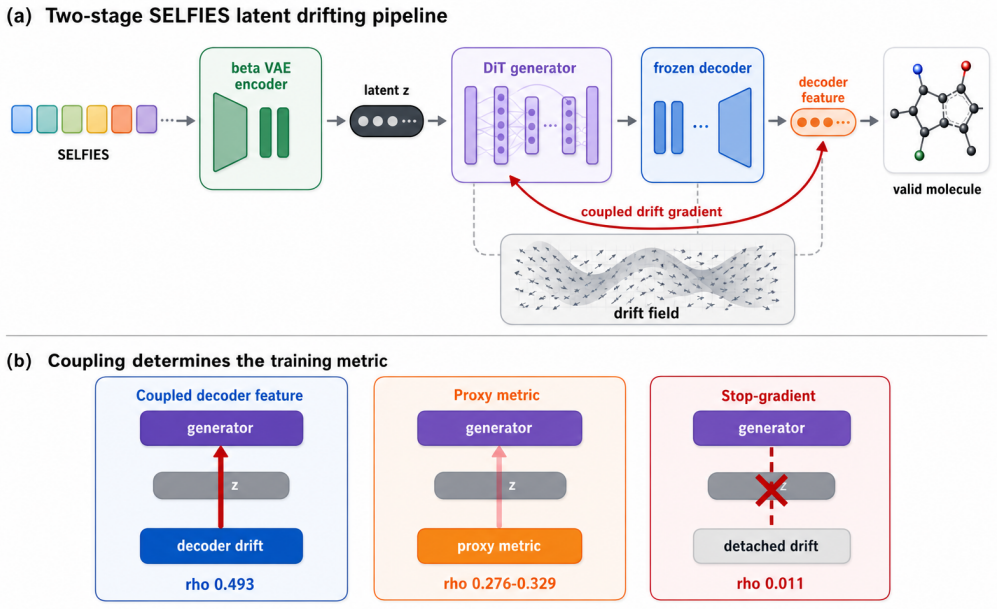
Decoder-coupled drift treats the hidden representation of a frozen SELFIES beta-VAE decoder as the drift feature map; gradients from the drift objective are backpropagated through this map to the generator, inducing a pullback metric aligned with molecular decoding and enabling property-conditional generation at the cost of one generator forward pass plus one frozen decoder pass.
What carries the argument
decoder-coupled drift, which backpropagates the drift objective through the fixed decoder's hidden representation to align the generator with the decoding metric.
If this is right
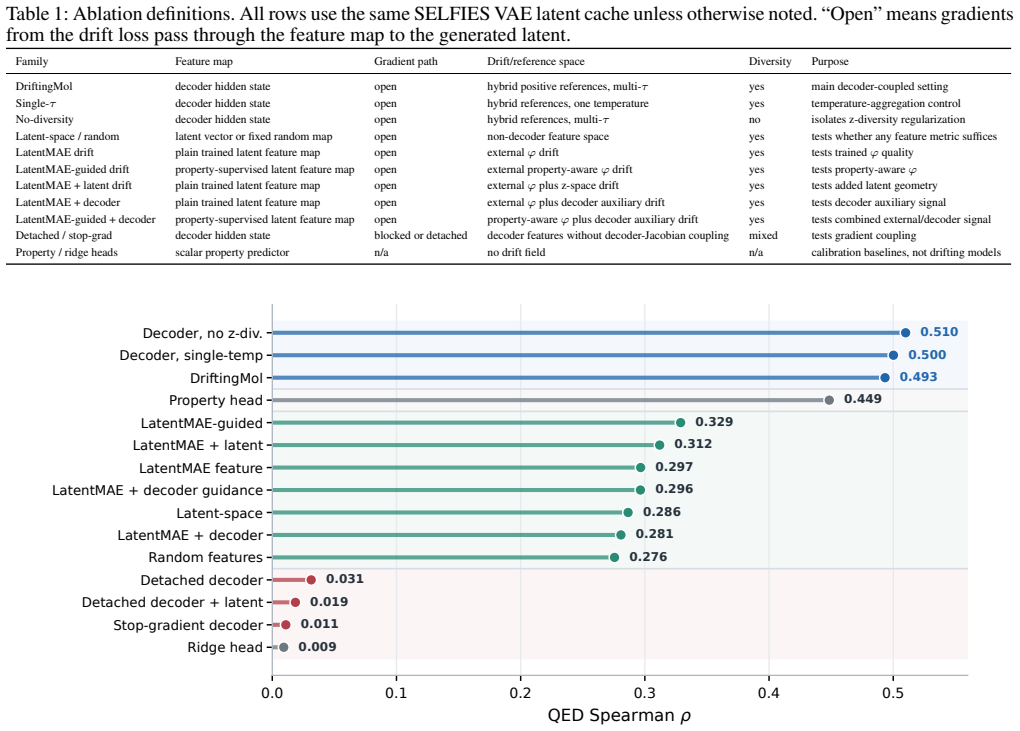
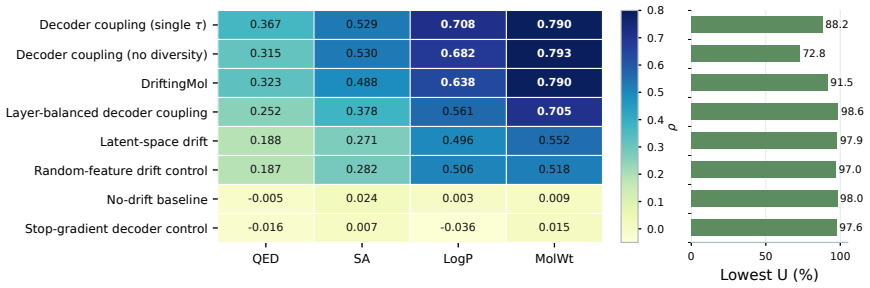
- Preserving the gradient path through decoder features consistently yields higher property correlations than latent-space or external-feature drift variants.
- Stopping gradients at the decoder or detaching the feature map produces near-zero QED correlation and sharply reduced uniqueness.
- The method supports both single-property and multi-property conditioning while requiring only one generator evaluation and one frozen decoder pass.
- Across 15 controlled variants the decoder-coupled setting outperforms the tested alternatives under matched protocols.
Where Pith is reading between the lines
- The same coupling principle could be tested in other latent generative settings where a decoder already exists, to check whether its internal representation supplies a cheap alignment signal.
- If the decoder hidden states encode a decoding-aligned metric, similar pullback constructions might improve conditioning in non-molecular domains that use encoder-decoder pairs.
- The low sampling cost suggests the approach could be combined with larger generators without increasing per-sample compute beyond the single generator plus decoder pass.
Load-bearing premise
The decoder's hidden states form an effective feature map whose gradient path produces a metric useful for property conditioning.
What would settle it
An ablation that detaches or stops gradients through the decoder features yet still matches the reported Spearman correlations and uniqueness would falsify the claim that the coupled path is necessary.
Figures
read the original abstract
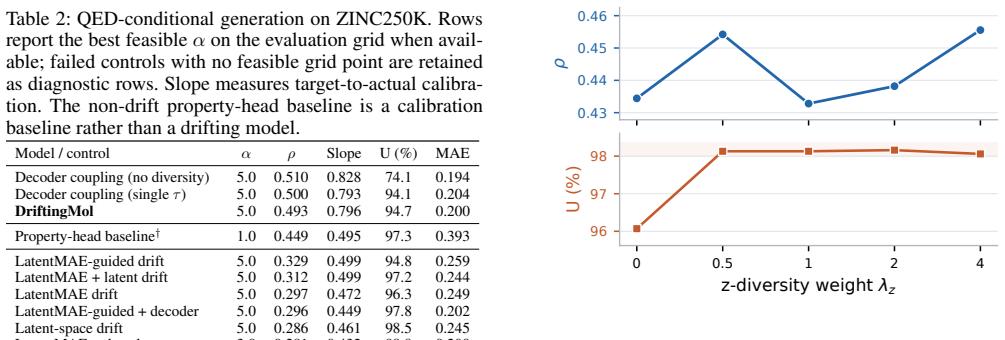
Property-conditional molecular generation should produce valid, diverse molecules while responding to continuous target values at low sampling cost. We introduce DriftingMol, a two-stage framework that adapts drifting models to a SELFIES latent molecular space. A frozen SELFIES beta-VAE provides the latent space, and the hidden representation of its decoder serves as the drift feature map. In decoder-coupled drift, decoder weights remain fixed, but drift gradients are backpropagated through the decoder feature map to a DiT generator, inducing a pullback metric aligned with molecular decoding. On ZINC250K, the default setting achieves QED Spearman correlation 0.493 with 94.7% uniqueness, while the strongest decoder-coupled condition reaches 0.510. Under protocol-matched four-property conditioning, decoder-coupled drift reaches mean Spearman correlation up to 0.598. Across 15 controlled variants, models that preserve the gradient path through decoder features achieve higher correlations than the tested latent-space, random-feature, and external-feature drift variants, while detached or stop-gradient decoder controls yield near-zero QED correlation and very low uniqueness. These results indicate that decoder-coupled drift is a useful low-cost mechanism for property-biased molecular generation, requiring one generator evaluation and one frozen decoder pass.
Editorial analysis
A structured set of objections, weighed in public.
Referee Report
Summary. The paper introduces DriftingMol, a two-stage framework adapting drifting models to a SELFIES latent space from a frozen beta-VAE. The decoder's hidden representations serve as the drift feature map for a DiT generator, with gradients backpropagated through the fixed decoder to induce a pullback metric. On ZINC250K, decoder-coupled drift achieves QED Spearman correlations of 0.493–0.510 (94.7% uniqueness) and up to 0.598 mean correlation under four-property conditioning, outperforming latent-space, random-feature, external-feature, and stop-gradient controls (near-zero correlation) across 15 variants. The central claim is that this provides effective low-cost property conditioning with one generator evaluation and one frozen decoder pass.
Significance. If the ablation results hold, the work demonstrates a practical mechanism for property-biased molecular generation that avoids retraining the VAE or multiple sampling passes. The controlled comparison across 15 variants, showing near-zero performance when the gradient path through decoder features is detached, provides direct empirical support for the decoder-coupling hypothesis and strengthens the case for its utility in low-cost conditional generation tasks.
major comments (2)
- Abstract: The reported Spearman correlations (0.493–0.598) and uniqueness figures are presented without error bars, number of independent runs, or statistical tests; this makes it difficult to determine whether the gap versus the near-zero control correlations is robust enough to support the central claim of decoder-coupled drift superiority.
- Abstract: The description of 'inducing a pullback metric aligned with molecular decoding' via backpropagation through the decoder feature map is central to the method, yet no equation or formal definition is referenced; without this, it is unclear whether the alignment is a derived property or an empirical observation.
minor comments (2)
- Abstract: The acronym 'DiT' is used without expansion on first occurrence (presumably Diffusion Transformer); this should be clarified for readers outside the diffusion-modeling subfield.
- Abstract: Dataset details such as the exact ZINC250K split, property normalization, and how QED is computed are omitted; adding a brief methods sentence would improve reproducibility assessment.
Simulated Author's Rebuttal
We thank the referee for the positive evaluation and the recommendation for minor revision. We address each major comment below.
read point-by-point responses
-
Referee: Abstract: The reported Spearman correlations (0.493–0.598) and uniqueness figures are presented without error bars, number of independent runs, or statistical tests; this makes it difficult to determine whether the gap versus the near-zero control correlations is robust enough to support the central claim of decoder-coupled drift superiority.
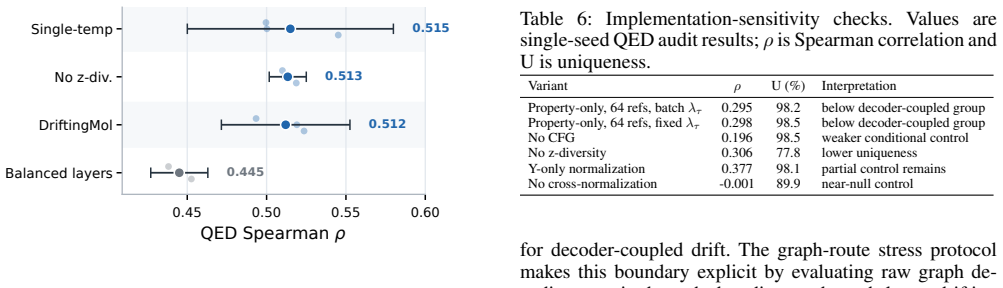
Authors: We agree that the abstract would be strengthened by including error bars, run counts, and a note on statistical robustness. The main text already reports results averaged over 5 independent random seeds with standard deviations; we will add a concise reference to these details (including the observed gaps versus controls) directly in the abstract of the revised manuscript. revision: yes
-
Referee: Abstract: The description of 'inducing a pullback metric aligned with molecular decoding' via backpropagation through the decoder feature map is central to the method, yet no equation or formal definition is referenced; without this, it is unclear whether the alignment is a derived property or an empirical observation.
Authors: We acknowledge the lack of an explicit reference. The pullback arises by construction from the chain rule applied to the frozen decoder; we will insert a short formal definition (the transformed gradient via the decoder Jacobian) in Section 3 and add a parenthetical reference to this equation in the abstract. revision: yes
Circularity Check
No significant circularity identified
full rationale
The paper describes an empirical framework for property-conditional molecular generation using decoder-coupled drift on a frozen SELFIES beta-VAE latent space. Reported results consist of controlled experiments across 15 variants on ZINC250K, comparing Spearman correlations for QED and other properties. No equations, derivations, or self-citations are presented that reduce the central claims or metrics to fitted inputs by construction. The method relies on backpropagating through decoder features, but this is implemented and validated directly via ablation controls (e.g., stop-gradient variants yielding near-zero correlation), making the evaluation self-contained against external benchmarks without circular reduction.
Axiom & Free-Parameter Ledger
Reference graph
Works this paper leans on
-
[1]
GraphNVP: An Invertible Flow Model for Generating Molecular Graphs
GraphNVP: An Invertible Flow Model for Generating Molecular Graphs. arXiv:1905.11600. Olivecrona, M.; Blaschke, T.; Engkvist, O.; and Chen, H
work page internal anchor Pith review Pith/arXiv arXiv 1905
-
[2]
Peebles, W.; and Xie, S
Molecular De-novo Design through Deep Reinforce- ment Learning.Journal of Cheminformatics, 9(1): 48. Peebles, W.; and Xie, S. 2023. Scalable Diffusion Models with Transformers. In2023 IEEE/CVF International Con- ference on Computer Vision, 4172–4182. Simonovsky, M.; and Komodakis, N. 2018. GraphV AE: To- wards Generation of Small Graphs Using Variational ...
2023
-
[3]
InAdvances in Neu- ral Information Processing Systems, volume 34, 7924–7936
Hit and Lead Discovery with Explorative RL and Fragment-based Molecule Generation. InAdvances in Neu- ral Information Processing Systems, volume 34, 7924–7936. Curran Associates, Inc. Zang, C.; and Wang, F. 2020. MoFlow: An Invertible Flow Model for Generating Molecular Graphs. InProceedings of the 26th ACM SIGKDD International Conference on Knowl- edge D...
2020
discussion (0)
Sign in with ORCID, Apple, or X to comment. Anyone can read and Pith papers without signing in.