Preliminary cosmological results using extreme accretors Quasar formalism
Pith reviewed 2026-06-30 00:00 UTC · model grok-4.3
The pith
Standardized extreme accretor quasars give H0 = 69.8 ± 2.2 km s^{-1} Mpc^{-1} from the sample alone.
A machine-rendered reading of the paper's core claim, the machinery that carries it, and where it could break.
Core claim
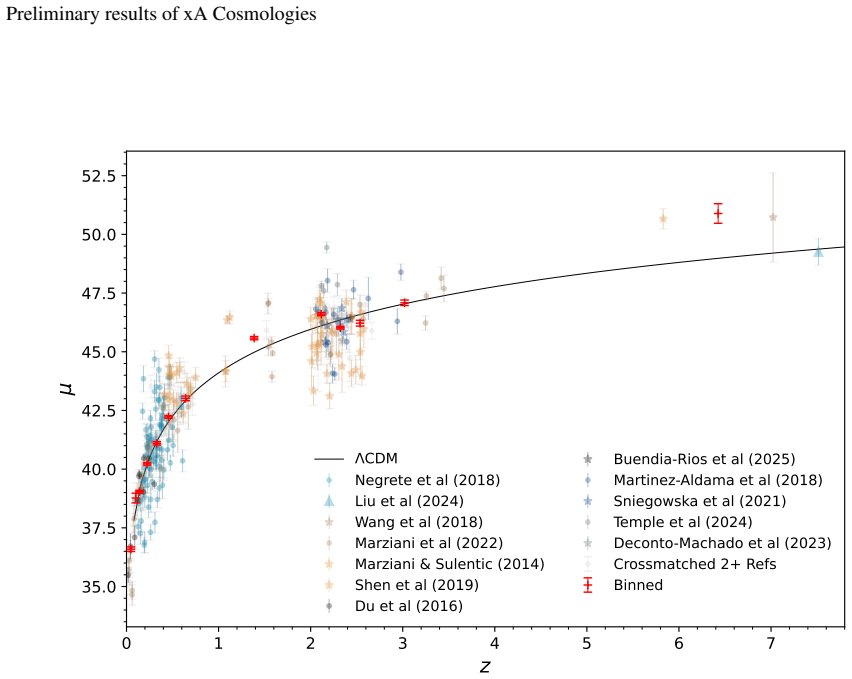
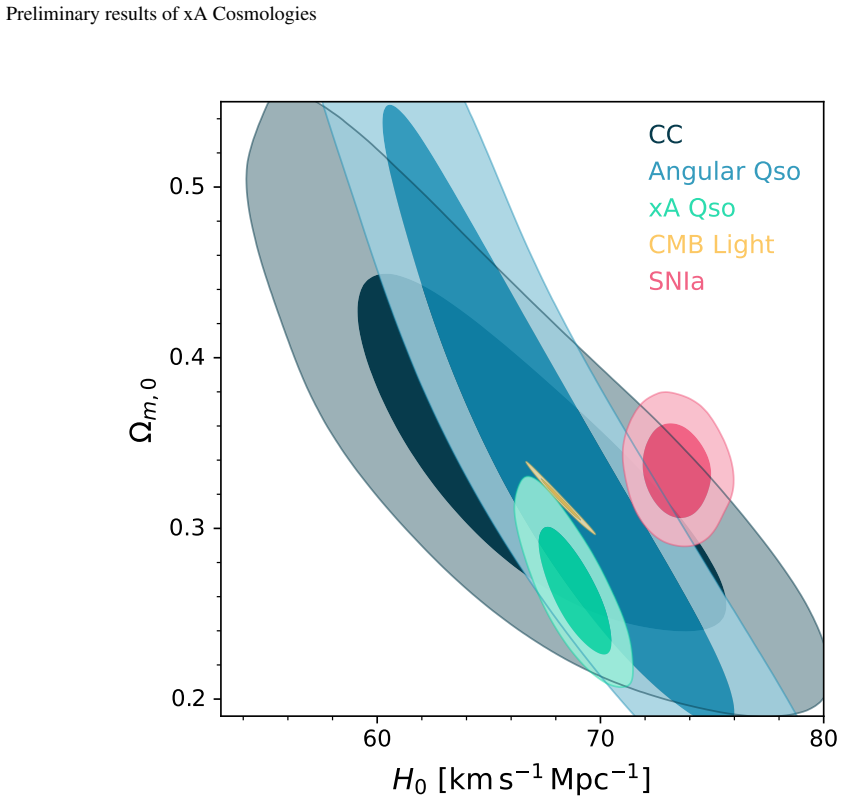
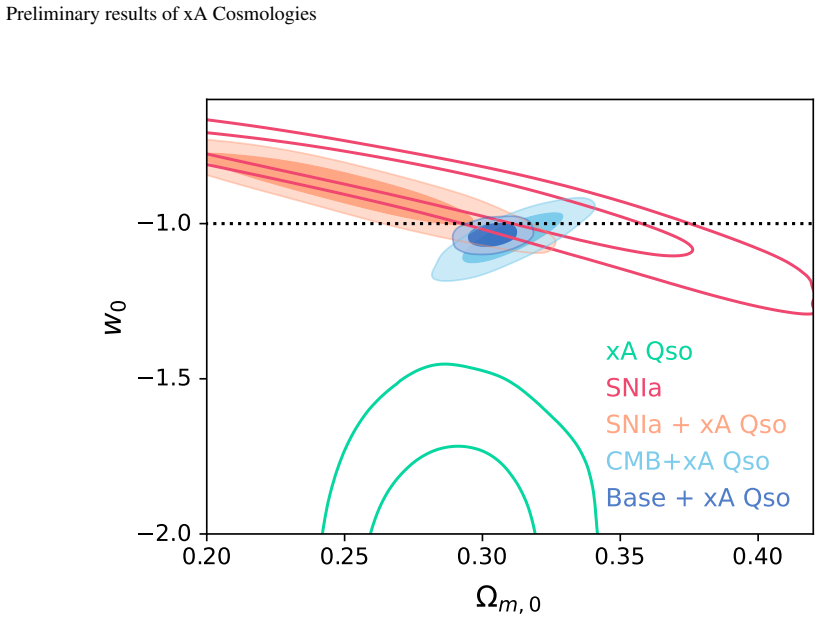
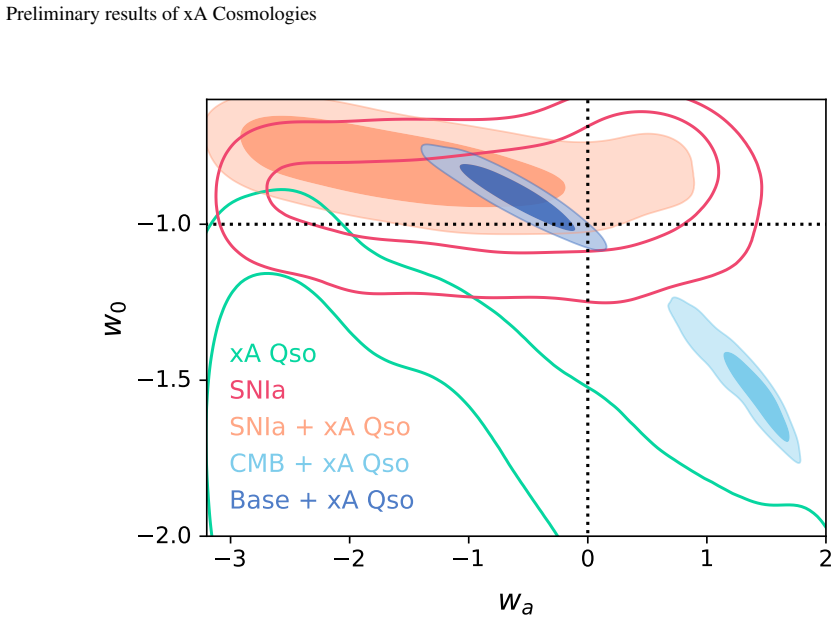
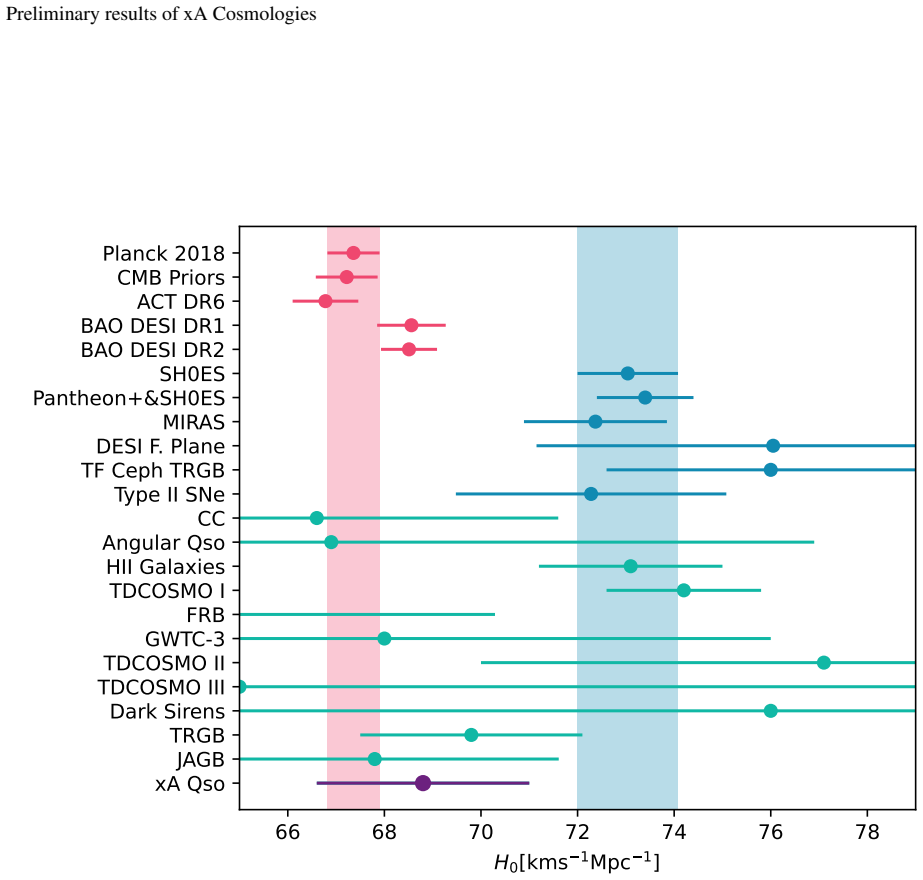
Using a completely cleaned and standardized sample of xA quasars compiled from literature, the xA formalism is applied to test LambdaCDM, wCDM and w0waCDM models. This results in H0 = 69.8 ± 2.2 km s^{-1} Mpc^{-1} for the quasar sample alone and H0 = 69.0 ± 0.9 km s^{-1} Mpc^{-1} in combination with SNIa, cosmic chronometers and CMB distance priors. Both wCDM and w0waCDM show a weak Bayesian preference over LambdaCDM. The analysis compares this to other AGN methods such as reverberation mapping and X-ray UV relations, concluding that intrinsic dispersion is the main unresolved issue across all such approaches.
What carries the argument
The xA Quasar formalism, which standardizes extreme accretor quasars as cosmological probes by reducing scatter in their distance indicators.
Load-bearing premise
The xA quasar sample can be cleaned and standardized enough that its remaining intrinsic dispersion does not limit the cosmological constraints.
What would settle it
Finding that the dispersion in the standardized xA sample prevents H0 constraints tighter than current values would show the method cannot yet compete as a robust probe.
Figures
read the original abstract
We revisited the xA Quasar formalism from the cosmological point of view, where a completely cleaned and standardized sample is compiled from different literature references. This allowed us to test three different cosmological models including $w$CDM and $w_0w_a$CDM and $\Lambda$CDM resulting in a Hubble constant estimation of $H_0 = 69.8 \pm 2.2$~$\mathrm{km\,s^{-1}\,Mpc^{-1}}$ for the compiled sample alone and $H_0=69.0 \pm 0.9$~$\mathrm{km\,s^{-1}\,Mpc^{-1}}$ when combined with Type I Supernovae (SNIa), Cosmic Chronometers and the Cosmic Microwave Background (CMB) distance priors. Using both the $w$CDM and $w_0w_a$CDM a weak Bayesian preference for the dynamical dark energy models over the $\Lambda$CDM model was found. A comparative analysis was performed with other AGN based methods in cosmology like the Reverberation Mapping, the X-Ray and UV non-linear relation and the Angular distance measurements. We conclude that the significant intrinsic dispersion is a key issue present in all samples. Overcoming this dispersion is key to establish xA and other AGN samples as robust and precise cosmological probes.
Editorial analysis
A structured set of objections, weighed in public.
Referee Report
Summary. The manuscript compiles a cleaned and standardized sample of extreme accretor (xA) quasars from the literature and applies the xA formalism to constrain cosmology. It reports H0 = 69.8 ± 2.2 km s^{-1} Mpc^{-1} from the quasar sample alone and H0 = 69.0 ± 0.9 km s^{-1} Mpc^{-1} when combined with SNIa, cosmic chronometers, and CMB distance priors. The analysis tests ΛCDM, wCDM, and w0waCDM, finding a weak Bayesian preference for dynamical dark energy models, compares results to other AGN methods, and concludes that significant intrinsic dispersion remains the key unresolved issue across all AGN samples.
Significance. If the xA quasar standardization can be shown to be independent of the cosmological fit and if the intrinsic dispersion can be demonstrated not to dominate the error budget, the work would add a high-redshift AGN-based distance indicator to the set of cosmological probes. The reported H0 values are broadly consistent with Planck but the weak model preference and the paper's own emphasis on dispersion as the central limitation suggest that the current constraints do not yet reach the precision required to resolve the Hubble tension or to provide decisive model discrimination.
major comments (3)
- [Abstract] Abstract and concluding paragraph: The central claim that a 'completely cleaned and standardized sample' yields reliable H0 values and a Bayesian preference for dynamical dark energy is directly undermined by the explicit statement that 'significant intrinsic dispersion is a key issue present in all samples' and that 'Overcoming this dispersion is key to establish xA and other AGN samples as robust and precise cosmological probes.' This admission indicates that the quoted uncertainties (e.g., ±2.2 and ±0.9) may not fully capture the dominant scatter, rendering the numerical results and model odds difficult to interpret as robust constraints.
- [Abstract] Abstract: The fitting procedure and whether the xA standardization parameters (e.g., any luminosity or accretion-rate corrections) were derived independently of the cosmological likelihood is not specified. Without this information it is impossible to assess potential circularity when the quasar sample is later combined with SNIa and CMB priors whose calibrations may share underlying assumptions.
- [Abstract] Abstract: The reported weak Bayesian preference for wCDM and w0waCDM over ΛCDM rests on the same sample whose intrinsic dispersion is flagged as the dominant limitation. No quantitative assessment is provided of how the dispersion propagates into the evidence ratios or whether the preference survives when the scatter is treated as an additional systematic.
Simulated Author's Rebuttal
We thank the referee for the careful reading of the manuscript and the constructive comments. We respond to each major comment below.
read point-by-point responses
-
Referee: [Abstract] Abstract and concluding paragraph: The central claim that a 'completely cleaned and standardized sample' yields reliable H0 values and a Bayesian preference for dynamical dark energy is directly undermined by the explicit statement that 'significant intrinsic dispersion is a key issue present in all samples' and that 'Overcoming this dispersion is key to establish xA and other AGN samples as robust and precise cosmological probes.' This admission indicates that the quoted uncertainties (e.g., ±2.2 and ±0.9) may not fully capture the dominant scatter, rendering the numerical results and model odds difficult to interpret as robust constraints.
Authors: We agree that the abstract and conclusion should be revised for better balance. The quoted uncertainties are the statistical errors obtained from the likelihood analysis of the compiled sample. The conclusion already identifies intrinsic dispersion as the dominant remaining limitation across AGN samples, including ours. We will revise the abstract and concluding paragraph to state more explicitly that the results are subject to this dispersion, which affects the precision and robustness of the constraints, while retaining the reported central values and errors. revision: yes
-
Referee: [Abstract] Abstract: The fitting procedure and whether the xA standardization parameters (e.g., any luminosity or accretion-rate corrections) were derived independently of the cosmological likelihood is not specified. Without this information it is impossible to assess potential circularity when the quasar sample is later combined with SNIa and CMB priors whose calibrations may share underlying assumptions.
Authors: The xA standardization parameters, including luminosity and accretion-rate corrections, are taken directly from the established xA formalism in the prior literature and are held fixed when fitting the cosmological models to the compiled sample. No re-derivation or optimization of these parameters occurs within the cosmological likelihood. We will add a clarifying statement in the methods section to make this independence explicit. revision: yes
-
Referee: [Abstract] Abstract: The reported weak Bayesian preference for wCDM and w0waCDM over ΛCDM rests on the same sample whose intrinsic dispersion is flagged as the dominant limitation. No quantitative assessment is provided of how the dispersion propagates into the evidence ratios or whether the preference survives when the scatter is treated as an additional systematic.
Authors: The Bayesian evidence ratios were computed using the reported measurement uncertainties. The manuscript already describes the preference as weak. A quantitative assessment of the effect of modeling the intrinsic dispersion as an extra systematic on the evidence ratios is not included, as this would require a more elaborate hierarchical error model. revision: partial
- Quantitative assessment of how intrinsic dispersion propagates into the Bayesian evidence ratios
Circularity Check
No circularity: derivation uses external standardization and independent cosmological fits
full rationale
The paper compiles an xA quasar sample from literature references, applies the existing xA formalism for standardization, and performs cosmological fits to obtain H0 values both from the sample alone and in combination with external datasets (SNIa, cosmic chronometers, CMB priors). No equations or steps in the abstract or described content reduce the reported H0 or model preferences to the inputs by construction, self-definition, or self-citation chains. The standardization parameters and cosmological constraints are treated as separable, with the intrinsic dispersion explicitly flagged as an unresolved external limitation rather than hidden in the fit. This satisfies the criteria for a self-contained derivation against external benchmarks.
Axiom & Free-Parameter Ledger
axioms (1)
- domain assumption The xA quasar sample can be cleaned and standardized sufficiently for cosmological use despite acknowledged intrinsic dispersion
Reference graph
Works this paper leans on
-
[1]
Abbott, R. et al. (2023). Constraints on the Cosmic Expansion History from GWTC–3. Astrophys. J., 949(2):76. Abdalla, E. et al. (2022). Cosmology intertwined: A review of the particle physics, astrophysics, and cosmology associated with the cosmological tensions and anomalies. JHEAp, 34:49–211. Adame, A. G. et al. (2025). DESI 2024 VI: cosmological constr...
-
[2]
Astron. Astrophys., 606:A15. Chaudhary, H., Capozziello, S., Praharaj, S., Pacif, S. K. J., and Mustafa, G. (2025). Is theΛCDM Model in Crisis? . Chávez, R., Terlevich, R., Terlevich, E., González-Morán, A. L., Fernández-Arenas, D., Bresolin, F., Plionis, M., Basilakos, S., Amorín, R., and Llerena, M. (2025). Mapping the Hubble flow from z∼0 to z∼7.5 with...
-
[3]
DESI DR2 Results II: Measurements of Baryon Acoustic Oscillations and Cosmological Constraints
Astrophys. J., 963(2):83. Karim, M. A., Aguilar, J., Ahlen, S., Alam, S., Allen, L., Prieto, C. A., Alves, O., Anand, A., Andrade, U., Armengaud, E., et al. (2025). Desi dr2 results ii: Measurements of baryon acoustic oscillations and cosmological constraints. arXiv preprint arXiv:2503.14738. Lange, J. U. (2023). nautilus: boosting Bayesian importance nes...
work page internal anchor Pith review Pith/arXiv arXiv 2025
-
[4]
Spectral monitoring of AGNs: Preliminary results for Ark 564 and Arp 102B
The Astrophysical Journal, 976(1):33. Louis, T. et al. (2025). The Atacama Cosmology Telescope: DR6 Power Spectra, Likelihoods and ΛCDM Parameters. FERMILAB-PUB-25-0071-PPD. Lusso, E. et al. (2020). Quasars as standard candles III. Validation of a new sample for cosmological studies. Astron. Astrophys., 642:A150. Lusso, E., Risaliti, G., and Nardini, E. (...
work page internal anchor Pith review Pith/arXiv arXiv 2025
-
[5]
APJs, 202(1):10. Shen, Y . et al. (2019). Gemini GNIRS Near-infrared Spectroscopy of 50 Quasars at z≳5.7. Astrophys. J., 873(1):35. ´Sniegowska, M., Marziani, P., Czerny, B., Panda, S., Martínez-Aldama, M. L., del Olmo, A., and D’Onofrio, M. (2021). High Metal Content of Highly Accreting Quasars. Astrophys. J., 910(2):115. Sulentic, J. W., Bachev, R., Mar...
2019
discussion (0)
Sign in with ORCID, Apple, or X to comment. Anyone can read and Pith papers without signing in.