Edge Dislocation Mediated Anomalous Charge Transfer in Face Centered Cubic High Entropy Alloys
Pith reviewed 2026-06-30 00:04 UTC · model grok-4.3
The pith
Edge dislocations in high-entropy alloys induce anomalous charge redistribution through collective electronegativity equalisation
A machine-rendered reading of the paper's core claim, the machinery that carries it, and where it could break.
Core claim
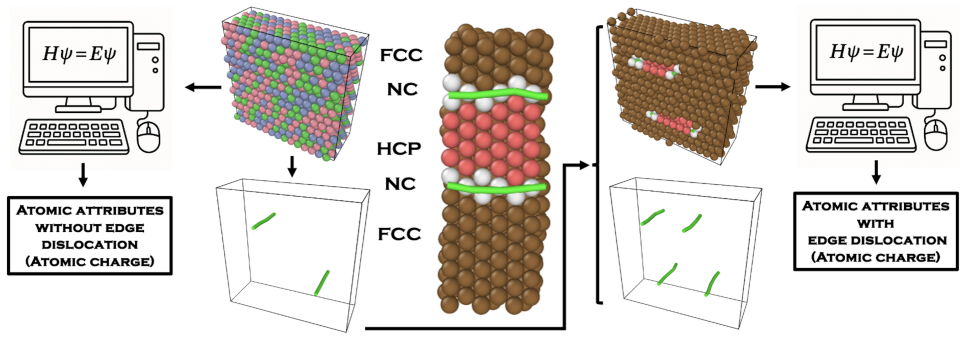
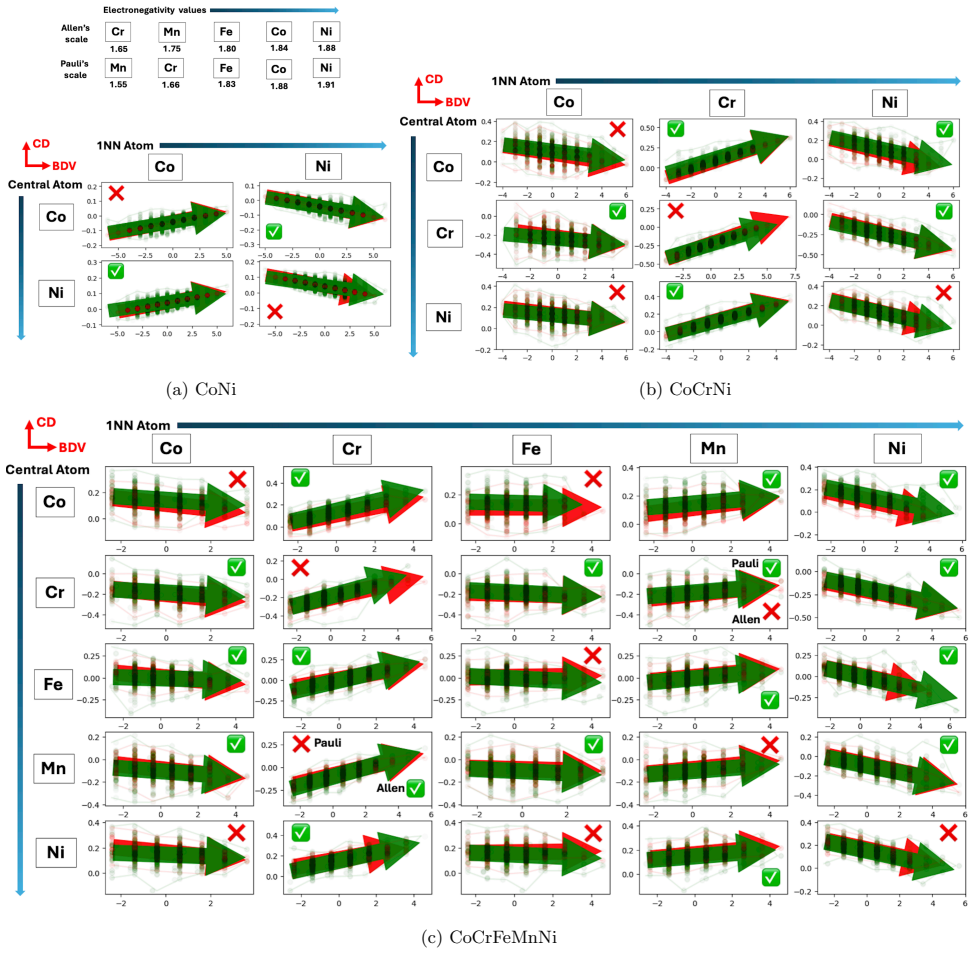
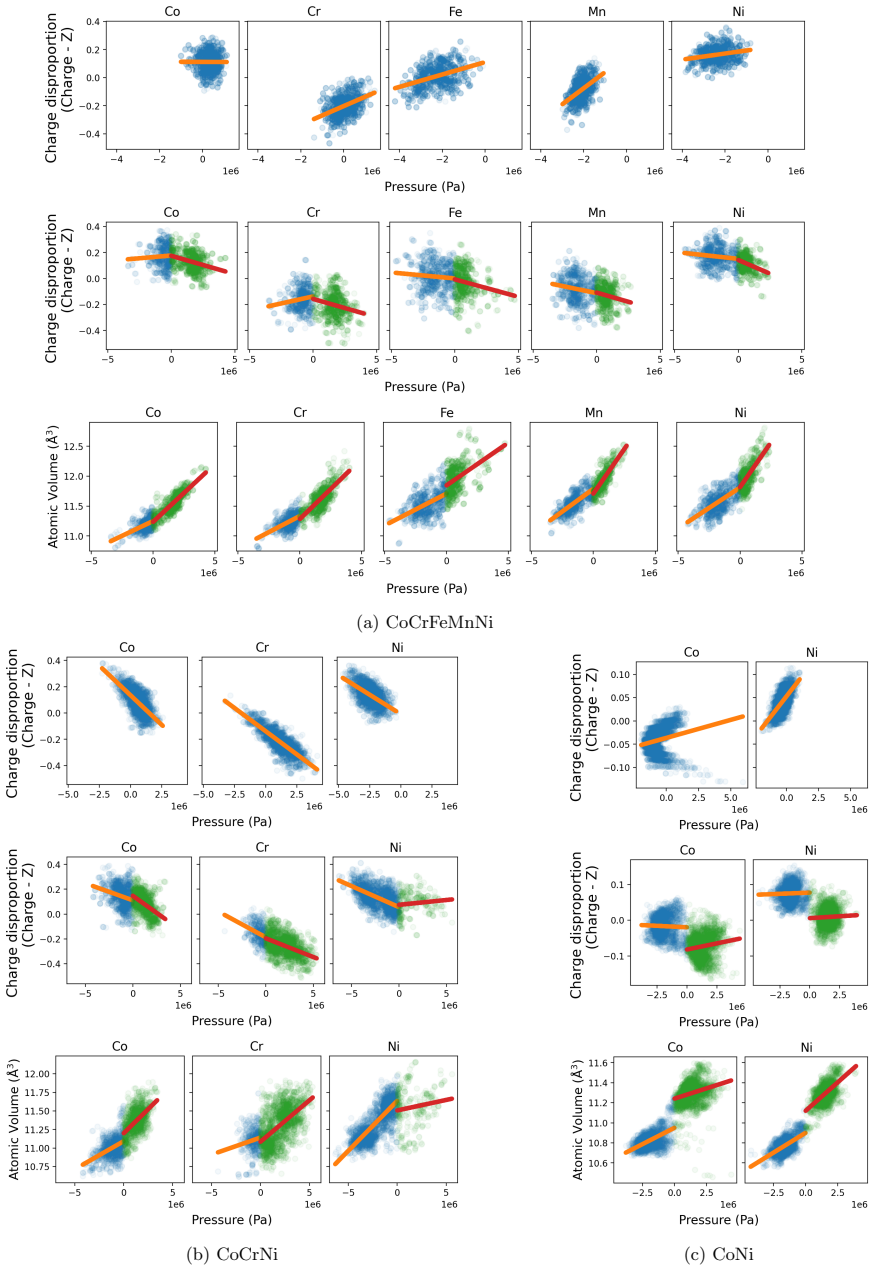
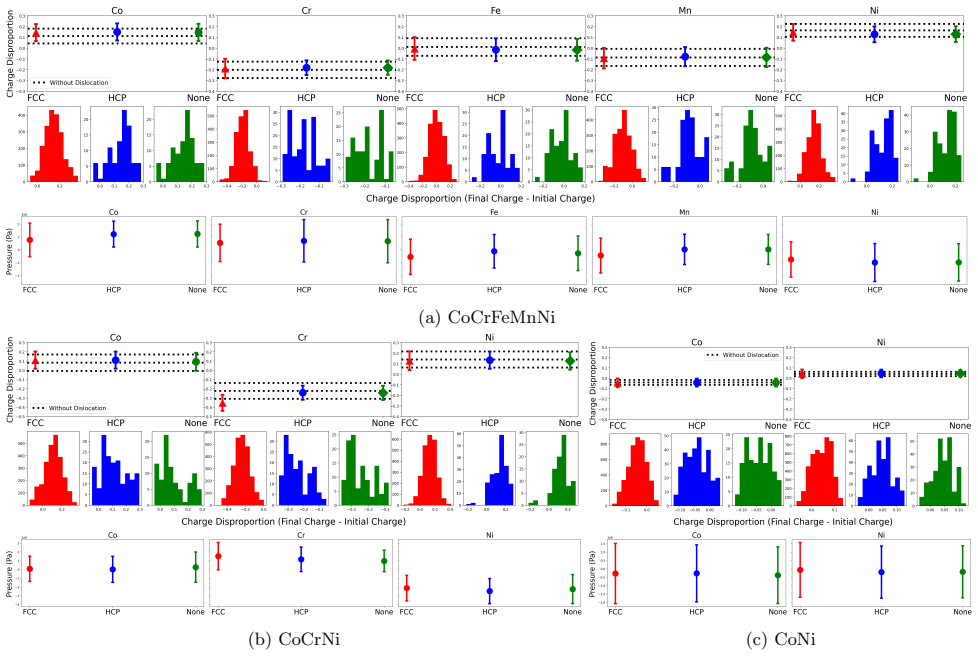
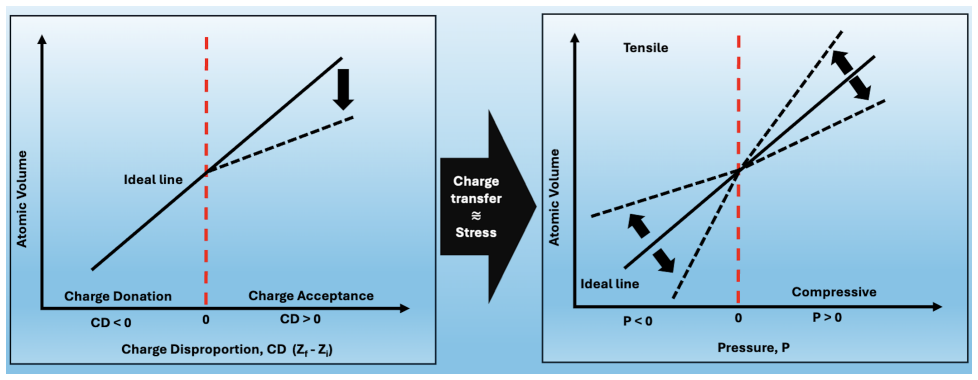
Large-scale ab initio calculations reveal an anomalous charge redistribution near edge dislocation cores, including deviation from the conventional electronegativity trend. The observed behavior originates from collective electronegativity equalisation effects rather than simple pairwise atomic interactions. The asymmetric atomic volume response within the compressive and tensile regions of the dislocation field is rationalised in terms of anomalous magneto-volume fluctuations. These results establish a direct coupling between dislocation-induced electronic redistribution and local volumetric response in chemically complex alloys.
What carries the argument
collective electronegativity equalisation effects at edge dislocation cores
If this is right
- Electronically informed solid-solution strengthening models become feasible for high-entropy alloys
- Local electronic redistribution near dislocation cores governs deformation behavior and defect energetics
- Defect-aware alloy design strategies can incorporate charge-transfer coupling to volumetric response
- The demonstrated link supplies a pathway to predict how chemical complexity modulates dislocation effects
Where Pith is reading between the lines
- Comparable collective equalisation may operate at other defects such as vacancies or grain boundaries in the same alloys
- Tuning local magnetism could provide an indirect handle on dislocation-mediated volume and charge behavior
- The coupling suggests testable predictions for how alloy composition alters the strength contribution of individual dislocations
Load-bearing premise
The large-scale ab initio calculations accurately capture the local electronic structure, charge transfer, and magneto-volume effects near dislocation cores without significant artifacts from the exchange-correlation functional, supercell size, boundary conditions, or other computational parameters.
What would settle it
Experimental charge-density maps or independent calculations near edge dislocation cores that show strict adherence to conventional electronegativity trends with no collective deviation or magneto-volume asymmetry.
Figures
read the original abstract
Charge transfer in concentrated alloys governs their structural stability and functional response, and can be strongly perturbed by lattice defects. In high-entropy alloys, the interaction between edge dislocations and volume misfit plays a central role in solid-solution strengthening models; however, the influence of dislocations on the local charge transfer has not been explicitly investigated. In this work, large-scale ab initio calculations are employed to examine the dislocation-mediated charge transfer in CoNi, CoCrNi and CoCrFeMnNi alloys. The calculations reveal an anomalous charge redistribution near edge dislocation cores, including deviation from the conventional electronegativity trend. The observed behavior is shown to originate from collective electronegativity equalisation effects rather than simple pairwise atomic interactions. Furthermore, the asymmetric atomic volume response within the compressive and tensile regions of the dislocation field is rationalised in terms of anomalous magneto-volume fluctuations. These results establish a direct coupling between dislocation-induced electronic redistribution and local volumetric response in chemically complex alloys. The demonstrated coupling between dislocation-mediated charge transfer and atomic volume fluctuations provides a pathway toward electronically informed solid-solutions strengthening models and defect-aware alloy design strategy for chemically complex alloys. These findings further suggest that local electronic redistribution near dislocation-cores can play a critical role in governing the deformation behavior and defect-enbergetics in high-entropy alloys.
Editorial analysis
A structured set of objections, weighed in public.
Referee Report
Summary. The manuscript employs large-scale ab initio calculations to study edge dislocation-mediated charge transfer in FCC alloys CoNi, CoCrNi, and CoCrFeMnNi. It reports anomalous charge redistribution near dislocation cores that deviates from conventional electronegativity trends, attributes this to collective electronegativity equalization rather than pairwise interactions, and rationalizes asymmetric compressive/tensile atomic volume responses via anomalous magneto-volume fluctuations. The work claims a direct coupling between dislocation-induced electronic redistribution and local volumetric response, with implications for electronically informed solid-solution strengthening models in high-entropy alloys.
Significance. If the computational results are robust, the paper identifies a previously unexamined electronic mechanism linking dislocations to local charge and volume fluctuations in chemically complex alloys. This could inform defect-aware design strategies and extend solid-solution strengthening models beyond volume-misfit considerations. The ab initio treatment of collective effects and magneto-volume coupling in multi-principal-element systems represents a potentially valuable contribution if supported by adequate validation.
major comments (2)
- [Computational Methods] Computational Methods (assumed §2 or equivalent): No convergence data, error bars, or sensitivity tests are reported for supercell size, periodic boundary conditions, exchange-correlation functional (critical for local magnetic moments in CoCrFeMnNi-type systems), or charge partitioning scheme. These parameters directly control whether the reported deviations from electronegativity trends and the magneto-volume asymmetry are physical or artifacts, making this a load-bearing gap for the central claims.
- [Results] Results on charge redistribution (assumed §3 or §4): The claim that the behavior originates from collective equalization rather than pairwise interactions requires explicit comparison or decomposition (e.g., via controlled binary vs. multi-component calculations or charge-density difference maps). Without such evidence or quantitative metrics, the distinction remains interpretive and does not yet support the stated origin.
minor comments (2)
- [Abstract] Abstract: Typo 'defect-enbergetics' should be 'defect-energetics'.
- [Abstract] Abstract and text: The term 'anomalous magneto-volume fluctuations' is introduced without a clear definition or reference to prior magneto-volume literature in the alloys studied; a brief clarification would improve readability.
Simulated Author's Rebuttal
We thank the referee for the constructive and detailed report. The comments highlight important aspects of validation and clarity that we address below. We provide point-by-point responses to the major comments.
read point-by-point responses
-
Referee: [Computational Methods] Computational Methods (assumed §2 or equivalent): No convergence data, error bars, or sensitivity tests are reported for supercell size, periodic boundary conditions, exchange-correlation functional (critical for local magnetic moments in CoCrFeMnNi-type systems), or charge partitioning scheme. These parameters directly control whether the reported deviations from electronegativity trends and the magneto-volume asymmetry are physical or artifacts, making this a load-bearing gap for the central claims.
Authors: We agree that explicit convergence and sensitivity information is necessary to confirm the robustness of the reported charge redistribution and magneto-volume effects. In the revised manuscript we will add a dedicated subsection in the Methods section reporting supercell-size convergence tests, k-point sampling checks, comparisons of exchange-correlation functionals (including effects on local moments in the quinary alloy), and cross-validation of the charge partitioning scheme. Quantitative error estimates derived from these tests will be included for the key quantities. revision: yes
-
Referee: [Results] Results on charge redistribution (assumed §3 or §4): The claim that the behavior originates from collective equalization rather than pairwise interactions requires explicit comparison or decomposition (e.g., via controlled binary vs. multi-component calculations or charge-density difference maps). Without such evidence or quantitative metrics, the distinction remains interpretive and does not yet support the stated origin.
Authors: The calculations already span binary (CoNi), ternary (CoCrNi) and quinary (CoCrFeMnNi) compositions, with the magnitude of deviation from electronegativity trends increasing systematically with the number of principal elements; this progression is difficult to reconcile with purely pairwise interactions. To make the collective character more explicit we will add charge-density difference maps across the three alloys and a quantitative metric (e.g., integrated deviation from expected pairwise charge transfer) in the revised Results section. revision: partial
Circularity Check
No circularity; results are direct ab initio outputs
full rationale
The paper reports outcomes from large-scale DFT calculations on edge dislocations in CoNi, CoCrNi, and CoCrFeMnNi alloys. Claims of anomalous charge redistribution, deviation from electronegativity trends, collective equalisation effects, and magneto-volume fluctuations are presented as direct computational observations and interpretations thereof, with no parameter fitting, self-referential definitions, or load-bearing self-citations that reduce the results to inputs by construction. The derivation chain consists of simulation setup followed by analysis of computed quantities, which is self-contained against external benchmarks.
Axiom & Free-Parameter Ledger
axioms (1)
- domain assumption Density functional theory accurately describes electronic structure and charge transfer in these metallic high-entropy alloys
Reference graph
Works this paper leans on
-
[1]
A new thermodynamic parameter to predict formation of solid solution or intermetallic phases in high entropy alloys.Journal of Alloys and Compounds, 658:603–607, 2016
ON Senkov and DB Miracle. A new thermodynamic parameter to predict formation of solid solution or intermetallic phases in high entropy alloys.Journal of Alloys and Compounds, 658:603–607, 2016
2016
-
[2]
A quantum-mechanical critique of the miedema rules for alloy formation
DG Pettifor. A quantum-mechanical critique of the miedema rules for alloy formation. InSolid State Physics, volume 40, pages 43–92. Elsevier, 1987
1987
-
[3]
Energy effects and charge transfer in metal physics; modelling in real space.Physica B: Condensed Matter, 182(1):1–17, 1992
AR Miedema. Energy effects and charge transfer in metal physics; modelling in real space.Physica B: Condensed Matter, 182(1):1–17, 1992
1992
-
[4]
Order and phase stability in alloys
Fran¸ cois Ducastelle. Order and phase stability in alloys. InInteratomic Potential and Structural Stability: Proceedings of the 15th Taniguchi Symposium, Kashikojima, Japan, October 19–23, 1992, pages 133–142. Springer, 1993
1992
-
[5]
Dissipation of radiation energy in concentrated solid-solution alloys: Unique defect properties and microstructural evolution.Mrs Bulletin, 44(10):798– 811, 2019
Yanwen Zhang, Takeshi Egami, and William J Weber. Dissipation of radiation energy in concentrated solid-solution alloys: Unique defect properties and microstructural evolution.Mrs Bulletin, 44(10):798– 811, 2019
2019
-
[6]
Severe local lattice distortion in zr-and/or hf-containing refractory multi-principal element alloys.Acta Materialia, 183:172–181, 2020
Yang Tong, Shijun Zhao, Hongbin Bei, Takeshi Egami, Yanwen Zhang, and Fuxiang Zhang. Severe local lattice distortion in zr-and/or hf-containing refractory multi-principal element alloys.Acta Materialia, 183:172–181, 2020
2020
-
[7]
Charge transfer effect on local lattice distortion in a hfnbtizr high entropy alloy.Scripta Materialia, 203:114104, 2021
Fanchao Meng, Wenyan Zhang, Zhukun Zhou, Ruixin Sheng, Andrew C-P Chuang, Chongchong Wu, Hailiang Huang, Shangzhou Zhang, Hua Zhang, Lilong Zhu, et al. Charge transfer effect on local lattice distortion in a hfnbtizr high entropy alloy.Scripta Materialia, 203:114104, 2021
2021
-
[8]
Element-resolved local lattice distortion in complex concentrated alloys: An observable signature of electronic effects.Acta Materialia, 216:117135, 2021
Hyun Seok Oh, Khorgolkhuu Odbadrakh, Yuji Ikeda, Sai Mu, Fritz K¨ ormann, Cheng-Jun Sun, Heh Sang Ahn, Kook Noh Yoon, Duancheng Ma, Cemal Cem Tasan, et al. Element-resolved local lattice distortion in complex concentrated alloys: An observable signature of electronic effects.Acta Materialia, 216:117135, 2021
2021
-
[9]
Elec- tronic structure and atomic level complexity in al0
Kh Odbadrakh, L Enkhtor, Ts Amartaivan, DM Nicholson, George M Stocks, and Takeshi Egami. Elec- tronic structure and atomic level complexity in al0. 5tizrpdcuni high-entropy alloy in glass phase.Journal of Applied Physics, 126(9), 2019
2019
-
[10]
Ab initio local-energy and local-stress cal- culations for materials science and engineering.Materials transactions, 62(1):1–15, 2021
Masanori Kohyama, Shingo Tanaka, and Yoshinori Shiihara. Ab initio local-energy and local-stress cal- culations for materials science and engineering.Materials transactions, 62(1):1–15, 2021. 12
2021
-
[11]
Violation of the cauchy–born rule in multi-principal element alloys.Applied Physics Letters, 124(17), 2024
Swarnava Ghosh. Violation of the cauchy–born rule in multi-principal element alloys.Applied Physics Letters, 124(17), 2024
2024
-
[12]
A bond-based model for accurate prediction of lattice parameters of bcc solid solution alloys.Materialia, 40:102410, 2025
Christopher Tandoc, Liang Qi, and Yong-Jie Hu. A bond-based model for accurate prediction of lattice parameters of bcc solid solution alloys.Materialia, 40:102410, 2025
2025
-
[13]
Qingxu Tian, Fuhui Chen, Peter K Liaw, Yang Tong, Shuying Chen, and Fanchao Meng. First-principles investigation of local atomic environment and its impact on properties in non-equiatomic cocrfeni high- entropy alloys.Journal of Materials Research and Technology, 34:2861–2871, 2025
2025
-
[14]
Zhengxiong Su, Sixin Lyu, Tan Shi, Ping Zhang, Jinxue Yang, Jianqiang Wang, Meiqing Chen, Rui Gao, Zhiming Li, Shaoqiang Guo, et al. Fluctuations in misfit volume by interstitial carbon atoms contribute to the unusual dislocation loop evolution in high-entropy alloys under irradiation.Journal of Nuclear Materials, page 155186, 2024
2024
-
[15]
Temperature-dependent mechanical properties of ni- based concentrated alloys: Insights from first-principles calculations.High Entropy Alloys & Materials, 3(2):307–321, 2025
Shun-Li Shang, Michael C Gao, and Zi-Kui Liu. Temperature-dependent mechanical properties of ni- based concentrated alloys: Insights from first-principles calculations.High Entropy Alloys & Materials, 3(2):307–321, 2025
2025
-
[16]
Mechanistic understanding of vacancy formation energies in fcc concentrated alloys from dft calculations.Acta Materialia, 289:120874, 2025
Nathan Linton and Dilpuneet S Aidhy. Mechanistic understanding of vacancy formation energies in fcc concentrated alloys from dft calculations.Acta Materialia, 289:120874, 2025
2025
-
[17]
Electron engineering via tensile-compressive effect in non-precious metal high-entropy alloy for ph-universal oxygen reduction.Chemical Engineering Journal, page 170070, 2025
Juan Li, Yinze Yang, Ning Zhang, Di Bao, Li Bing, Peitong Li, Yafei Zhao, Huishan Shang, and Bing Zhang. Electron engineering via tensile-compressive effect in non-precious metal high-entropy alloy for ph-universal oxygen reduction.Chemical Engineering Journal, page 170070, 2025
2025
-
[18]
Elastic strain-induced amorphization in high-entropy alloys.Nature Communications, 15(1):4599, 2024
Yeqiang Bu, Yuan Wu, Zhifeng Lei, Xiaoyuan Yuan, Leqing Liu, Peng Wang, Xiongjun Liu, Honghui Wu, Jiabin Liu, Hongtao Wang, et al. Elastic strain-induced amorphization in high-entropy alloys.Nature Communications, 15(1):4599, 2024
2024
-
[19]
Charge transfer effects in (hfnbtivzr) c—shown by ab initio calculations and x-ray photoelectron spectroscopy.Journal of the American Ceramic Society, 107(11):7562–7576, 2024
Barbara Osinger, Luis Casillas-Trujillo, Rebecka Lindblad, Bj¨ orn Alling, Weine Olovsson, Igor A Abrikosov, and Erik Lewin. Charge transfer effects in (hfnbtivzr) c—shown by ab initio calculations and x-ray photoelectron spectroscopy.Journal of the American Ceramic Society, 107(11):7562–7576, 2024
2024
-
[20]
Cantor, I
B. Cantor, I. T. H. Chang, P. Knight, and A. J. B. Vincent. Microstructural development in equiatomic multicomponent alloys.Materials Science and Engineering: A, 375-377:213–218, July 2004
2004
-
[21]
J.-W. Yeh, S.-K. Chen, S.-J. Lin, J.-Y. Gan, T.-S. Chin, T.-T. Shun, C.-H. Tsau, and S.- Y. Chang. Nanostructured High-Entropy Alloys with Multiple Principal Elements: Novel Alloy Design Concepts and Outcomes.Advanced Engineering Materials, 6(5):299–303, 2004. eprint: https://onlinelibrary.wiley.com/doi/pdf/10.1002/adem.200300567
-
[22]
George, Dierk Raabe, and Robert O
Easo P. George, Dierk Raabe, and Robert O. Ritchie. High-entropy alloys.Nature Reviews Materials, 4(8):515–534, August 2019. Number: 8 Publisher: Nature Publishing Group
2019
-
[23]
High entropy alloys: A focused review of mechanical properties and deformation mechanisms.Acta Materialia, 188:435–474, 2020
Easo P George, WA Curtin, and Cemal Cem Tasan. High entropy alloys: A focused review of mechanical properties and deformation mechanisms.Acta Materialia, 188:435–474, 2020
2020
-
[25]
High-entropy oxides: fundamental aspects and electrochemical properties.Advanced materials, 31(26):1806236, 2019
Abhishek Sarkar, Qingsong Wang, Alexander Schiele, Mohammed Reda Chellali, Subramshu S Bhat- tacharya, Di Wang, Torsten Brezesinski, Horst Hahn, Leonardo Velasco, and Ben Breitung. High-entropy oxides: fundamental aspects and electrochemical properties.Advanced materials, 31(26):1806236, 2019
2019
-
[26]
Understanding the role of entropy in high entropy oxides.Journal of the American Chemical Society, 145(11):5991–6006, 2023
Solveig S Aamlid, Mohamed Oudah, Jorg Rottler, and Alannah M Hallas. Understanding the role of entropy in high entropy oxides.Journal of the American Chemical Society, 145(11):5991–6006, 2023. 13
2023
-
[27]
High-entropy materials for catalysis: A new frontier.Science advances, 7(20):eabg1600, 2021
Yifan Sun and Sheng Dai. High-entropy materials for catalysis: A new frontier.Science advances, 7(20):eabg1600, 2021
2021
-
[28]
Phase stability and distortion in high-entropy oxides.Acta Materialia, 146:119–125, 2018
G Anand, Alex P Wynn, Christopher M Handley, and Colin L Freeman. Phase stability and distortion in high-entropy oxides.Acta Materialia, 146:119–125, 2018
2018
-
[29]
Role of configurational entropy in body-centred cubic or face-centred cubic phase formation in high entropy alloys.Scripta Materialia, 124:90–94, 2016
G Anand, R Goodall, and Colin L Freeman. Role of configurational entropy in body-centred cubic or face-centred cubic phase formation in high entropy alloys.Scripta Materialia, 124:90–94, 2016
2016
-
[30]
Influence of thermomechanical loads on the energetics of precipitation in magnesium aluminum alloys.Acta Materialia, 193:28–39, 2020
Swarnava Ghosh and Kaushik Bhattacharya. Influence of thermomechanical loads on the energetics of precipitation in magnesium aluminum alloys.Acta Materialia, 193:28–39, 2020
2020
-
[31]
Precipitation during creep in magnesium–aluminum alloys.Continuum Mechanics and Thermodynamics, 33(6):2363–2374, 2021
Swarnava Ghosh. Precipitation during creep in magnesium–aluminum alloys.Continuum Mechanics and Thermodynamics, 33(6):2363–2374, 2021
2021
-
[32]
Mauricio Ponga, Mohamed Hendy, Okan K Orhan, and Swarnava Ghosh. Effects of the local chemical environment on vacancy diffusion in multi-principal element alloys.arXiv preprint arXiv:2209.04010, 2022
-
[33]
Mahshad Fani, Oluwatimilehin Akinloye, Anvesh Nathani, Subah Mubassira, Iman Ghamarian, and Shuozhi Xu. Predicting vacancy formation energies in refractory non-dilute random alloys using im- proved graph-based machine learning models trained on density functional theory data.Journal of Applied Physics, 139(2):025107, 01 2026
2026
-
[34]
Strain-rate-dependent mechanical behavior of a non-equimolar cocrfemnni high entropy alloy with a seg- mented coarse grain structure.Materialia, 21:101271, 2022
Haoyang Li, Chenwei Shao, Okan K Orhan, David Funes Rojas, Mauricio Ponga, and James D Hogan. Strain-rate-dependent mechanical behavior of a non-equimolar cocrfemnni high entropy alloy with a seg- mented coarse grain structure.Materialia, 21:101271, 2022
2022
-
[35]
Deciphering the multiple deformation mechanisms responsible for sustained work hardening in a fecrconi medium entropy alloy.International Journal of Plasticity, 167:103663, 2023
Weicheng Zhong, Sho Hayakawa, Haixuan Xu, Ke An, Albina Y Borisevich, Joshua L Cicotte, Easo P George, and Ying Yang. Deciphering the multiple deformation mechanisms responsible for sustained work hardening in a fecrconi medium entropy alloy.International Journal of Plasticity, 167:103663, 2023
2023
-
[36]
Effects of lattice distortion and chemical short-range order on the mechanisms of deformation in medium entropy alloy cocrni.Acta Materialia, 199:352–369, 2020
Wu-Rong Jian, Zhuocheng Xie, Shuozhi Xu, Yanqing Su, Xiaohu Yao, and Irene J Beyerlein. Effects of lattice distortion and chemical short-range order on the mechanisms of deformation in medium entropy alloy cocrni.Acta Materialia, 199:352–369, 2020
2020
-
[37]
On the deformation behavior of cocrni medium entropy alloys: Unraveling mechanistic competition.International Journal of Plasticity, 159:103442, 2022
Ankit Gupta, Wu-Rong Jian, Shuozhi Xu, Irene J Beyerlein, and Garritt J Tucker. On the deformation behavior of cocrni medium entropy alloys: Unraveling mechanistic competition.International Journal of Plasticity, 159:103442, 2022
2022
-
[38]
Electronic effects on the radiation damage in high-entropy alloys.Acta materialia, 244:118511, 2023
Okan K Orhan, Mohamed Hendy, and Mauricio Ponga. Electronic effects on the radiation damage in high-entropy alloys.Acta materialia, 244:118511, 2023
2023
-
[39]
Koˇ zelj, S
P. Koˇ zelj, S. Vrtnik, A. Jelen, S. Jazbec, Z. Jagliˇ ci´ c, S. Maiti, M. Feuerbacher, W. Steurer, and J. Dolinˇ sek. Discovery of a superconducting high-entropy alloy.Phys. Rev. Lett., 113:107001, Sep 2014
2014
-
[40]
Ritchie, and Marc A
Zezhou Li, Shiteng Zhao, Robert O. Ritchie, and Marc A. Meyers. Mechanical properties of high-entropy alloys with emphasis on face-centered cubic alloys.Progress in Materials Science, 102:296–345, May 2019
2019
-
[41]
Haoran Zhou, Linwen Jiang, Shiqi Zhu, Lingling Wang, Yufang Hu, Xiaofeng Zhang, and Anhua Wu. Excellent electromagnetic-wave absorbing performances and great harsh-environment resistance of Fe- CoNiCrxMn high entropy alloys.Journal of Alloys and Compounds, 936:168282, March 2023
2023
-
[42]
Dislocation core structures and peierls stresses of the high-entropy alloy nicofecrmn and its subsystems.Materials & Design, 180:107955, 2019
Xianglin Liu, Zongrui Pei, and Markus Eisenbach. Dislocation core structures and peierls stresses of the high-entropy alloy nicofecrmn and its subsystems.Materials & Design, 180:107955, 2019
2019
-
[43]
High entropy oxides for reversible lithium-ion battery: a brief review.Materials Research Express, 11(7):072003, 2024
Soumyadeep Sur, Gautam Anand, and Shikhar Krishn Jha. High entropy oxides for reversible lithium-ion battery: a brief review.Materials Research Express, 11(7):072003, 2024. 14
2024
-
[44]
Synthesis and properties of rare-earth high-entropy perovskite.Applied Physics Letters, 124(21), 2024
Rubayet Tanveer, Dylan Windsor, Sean Drewry, Katharine Page, Haixuan Xu, Veerle Keppens, and William J Weber. Synthesis and properties of rare-earth high-entropy perovskite.Applied Physics Letters, 124(21), 2024
2024
-
[45]
High entropy alloys for aerospace applications
Modupeola Dada, Patricia Popoola, Samson Adeosun, and Ntombi Mathe. High entropy alloys for aerospace applications. In Mofid Gorji-Bandpy and Aly-Mousaad Aly, editors,Aerodynamics, chapter 7. IntechOpen, London, 2019
2019
-
[46]
Recent advances of high entropy alloys for aerospace applications: a review.World Journal of Engineering, 20(1):43–74, 2021
Modupeola Dada, Patricia Popoola, and Ntombi Mathe. Recent advances of high entropy alloys for aerospace applications: a review.World Journal of Engineering, 20(1):43–74, 2021
2021
-
[47]
Longchao Zhuo, Yixing Xie, and Bingqing Chen. A review on recent progress of refractory high en- tropy alloys: From fundamental research to engineering applications.Journal of Materials Research and Technology, 33:1097–1129, 2024
2024
-
[48]
High entropy alloys: Next-generation material for space exploration.Materials Chemistry and Physics, 329:130091, 2025
Akriti Menon, Dipen Kumar Rajak, and Dwesh Kumar Singh. High entropy alloys: Next-generation material for space exploration.Materials Chemistry and Physics, 329:130091, 2025
2025
-
[49]
Jones, Peter Buzby, Rashmi Dixit, Nicolas Argibay, Frank W
Satish Dixit, Sal Rodriguez, Morgan R. Jones, Peter Buzby, Rashmi Dixit, Nicolas Argibay, Frank W. DelRio, Hannah H. Lim, and Darryn Fleming. Refractory high-entropy alloy coatings for high-temperature aerospace and energy applications.Journal of Thermal Spray Technology, 31(4):1021–1031, Apr 2022
2022
-
[50]
Role of local chemical fluctuations in the shock dynamics of medium entropy alloy cocrni.Acta Materialia, 221:117380, 2021
Zhuocheng Xie, Wu-Rong Jian, Shuozhi Xu, Irene J Beyerlein, Xiaoqing Zhang, Zhihua Wang, and Xiaohu Yao. Role of local chemical fluctuations in the shock dynamics of medium entropy alloy cocrni.Acta Materialia, 221:117380, 2021
2021
-
[51]
Phase transition in medium entropy alloy cocrni under quasi-isentropic compression.International Journal of Plasticity, 157:103389, 2022
Zhuocheng Xie, Wu-Rong Jian, Shuozhi Xu, Irene J Beyerlein, Xiaoqing Zhang, Xiaohu Yao, and Run Zhang. Phase transition in medium entropy alloy cocrni under quasi-isentropic compression.International Journal of Plasticity, 157:103389, 2022
2022
-
[53]
Medical high-entropy alloy: Outstanding mechanical properties and superb biological compatibility.Front Bioeng Biotechnol, 10:952536, August 2022
Changxi Liu, Chengliang Yang, Jia Liu, Yujin Tang, Zhengjie Lin, Long Li, Hai Liang, Weijie Lu, and Liqiang Wang. Medical high-entropy alloy: Outstanding mechanical properties and superb biological compatibility.Front Bioeng Biotechnol, 10:952536, August 2022
2022
-
[54]
A review of biomaterials based on high-entropy alloys.Metals, 12(11), 2022
Thiago Gon¸ calves de Oliveira, Danilo Valim Fagundes, Patr´ ıcia Capellato, Daniela Sachs, and Antonio Augusto Ara´ ujo Pinto da Silva. A review of biomaterials based on high-entropy alloys.Metals, 12(11), 2022
2022
-
[55]
Medical high-entropy alloy: Outstanding mechanical properties and superb biological compatibility.Front
Changxi Liu, Chengliang Yang, Jia Liu, Yujin Tang, Zhengjie Lin, Long Li, Hai Liang, Weijie Lu, and Liqiang Wang. Medical high-entropy alloy: Outstanding mechanical properties and superb biological compatibility.Front. Bioeng. Biotechnol., 10:952536, August 2022
2022
-
[56]
Bio-high entropy alloys: Progress, challenges, and opportunities.Frontiers in Bioengineering and Biotechnology, Volume 10 - 2022, 2022
Junyi Feng, Yujin Tang, Jia Liu, Peilei Zhang, Changxi Liu, and Liqiang Wang. Bio-high entropy alloys: Progress, challenges, and opportunities.Frontiers in Bioengineering and Biotechnology, Volume 10 - 2022, 2022
2022
-
[57]
High entropy alloy coatings for biomedical applications: A review.Smart Materials in Manufacturing, 1:100009, 2023
Azin Rashidy Ahmady, Aryan Ekhlasi, Alireza Nouri, Masoumeh Haghbin Nazarpak, Pan Gong, and Atefeh Solouk. High entropy alloy coatings for biomedical applications: A review.Smart Materials in Manufacturing, 1:100009, 2023
2023
-
[58]
Advanced high-entropy materials for high- quality energy storage and conversion.Energy Storage Materials, 74:103954, 2025
Zengyuan Fan, Jiawei Wang, Yunpeng Wu, and Peng Zhang. Advanced high-entropy materials for high- quality energy storage and conversion.Energy Storage Materials, 74:103954, 2025
2025
-
[59]
The rise of high-entropy battery materials.Nature Communications, 15(1):973, Feb 2024
Bin Ouyang and Yan Zeng. The rise of high-entropy battery materials.Nature Communications, 15(1):973, Feb 2024. 15
2024
-
[60]
Buckingham, and David J
Jie Qu, Mark A. Buckingham, and David J. Lewis. High-entropy materials for electrochemical energy storage devices.Energy Adv., 2:1565–1590, 2023
2023
-
[61]
Elemental core level shift in high entropy alloy nanoparticles via x-ray photoelectron spectroscopy analysis and first-principles calculation.ACS nano, 14(12):17704–17712, 2020
Xiang Xu, Yang Guo, Brian P Bloom, Jianjun Wei, Haoyang Li, Hailong Li, Yankun Du, Zheng Zeng, Liqing Li, and David H Waldeck. Elemental core level shift in high entropy alloy nanoparticles via x-ray photoelectron spectroscopy analysis and first-principles calculation.ACS nano, 14(12):17704–17712, 2020
2020
-
[62]
The origin of anomalous hydrogen occupation in high entropy alloys
Jutao Hu, Jinjing Zhang, Menglu Li, Sa Zhang, Haiyan Xiao, Lei Xie, Guangai Sun, Huahai Shen, Xiaosong Zhou, Xiaoqing Li, et al. The origin of anomalous hydrogen occupation in high entropy alloys. Journal of Materials Chemistry A, 10(13):7228–7237, 2022
2022
-
[63]
Correlation of microdistortions with misfit volumes in high entropy alloys.Scripta Materialia, 168:119–123, 2019
Wolfram Georg N¨ ohring and WA Curtin. Correlation of microdistortions with misfit volumes in high entropy alloys.Scripta Materialia, 168:119–123, 2019
2019
-
[64]
Electronic structure and effective chemical and magnetic exchange interactions in bcc fe-cr alloys.Physical Review B—Condensed Matter and Materials Physics, 79(5):054202, 2009
Pavel A Korzhavyi, AV Ruban, J Odqvist, J-O Nilsson, and B¨ orje Johansson. Electronic structure and effective chemical and magnetic exchange interactions in bcc fe-cr alloys.Physical Review B—Condensed Matter and Materials Physics, 79(5):054202, 2009
2009
-
[65]
Ab initio approaches to high-entropy alloys: a comparison of cpa, sqs, and supercell methods.Journal of Materials Science, 57(23):10677–10690, 2022
Mariia Karabin, Wasim Raja Mondal, Andreas ¨Ostlin, Wai-Ga D Ho, Vladimir Dobrosavljevic, Ka-Ming Tam, Hanna Terletska, Liviu Chioncel, Yang Wang, and Markus Eisenbach. Ab initio approaches to high-entropy alloys: a comparison of cpa, sqs, and supercell methods.Journal of Materials Science, 57(23):10677–10690, 2022
2022
-
[66]
Wai-Ga D Ho, Wasim Raja Mondal, Swarnava Ghosh, Hanna Terletska, Ka-Ming Tam, Mariia Kara- bin, Markus Eisenbach, Yang Wang, and Vladimir Dobrosavljevic. Mechanism of charge transfer and electrostatic field fluctuations in complex metallic alloys.arXiv preprint arXiv:2311.14463, 2023
-
[67]
Local-environment dependence of stacking fault energies in concentrated solid-solution alloys.npj Computational Materials, 5(1):13, 2019
Shijun Zhao, Yuri Osetsky, G Malcolm Stocks, and Yanwen Zhang. Local-environment dependence of stacking fault energies in concentrated solid-solution alloys.npj Computational Materials, 5(1):13, 2019
2019
-
[68]
Spectral quadrature for the first principles study of crystal defects: Application to magnesium.Journal of Computational Physics, 456:111035, 2022
Swarnava Ghosh and Kaushik Bhattacharya. Spectral quadrature for the first principles study of crystal defects: Application to magnesium.Journal of Computational Physics, 456:111035, 2022
2022
-
[69]
Martin Rahm, Roberto Cammi, NW Ashcroft, and Roald Hoffmann. Squeezing all elements in the peri- odic table: electron configuration and electronegativity of the atoms under compression.Journal of the American Chemical Society, 141(26):10253–10271, 2019
2019
-
[70]
Electronegativity and chemical hardness of elements under pressure.Proceedings of the National Academy of Sciences, 119(10):e2117416119, 2022
Xiao Dong, Artem R Oganov, Haixu Cui, Xiang-Feng Zhou, and Hui-Tian Wang. Electronegativity and chemical hardness of elements under pressure.Proceedings of the National Academy of Sciences, 119(10):e2117416119, 2022
2022
-
[71]
Electronegativity equilibration.The Journal of Physical Chemistry A, 126(32):5472–5482, 2022
Francesco Sessa and Martin Rahm. Electronegativity equilibration.The Journal of Physical Chemistry A, 126(32):5472–5482, 2022
2022
-
[72]
Towards pareto optimal high entropy hydrides via data-driven materials discovery.Journal of Materials Chemistry A, 11(29):15878– 15888, 2023
Matthew D Witman, Sanliang Ling, Matthew Wadge, Anis Bouzidi, Nayely Pineda-Romero, Rebecca Clu- low, Gustav Ek, Jeffery M Chames, Emily J Allendorf, Sapan Agarwal, et al. Towards pareto optimal high entropy hydrides via data-driven materials discovery.Journal of Materials Chemistry A, 11(29):15878– 15888, 2023
2023
-
[73]
Ridha Zerdoumi, Alan Savan, Marshal Amalraj, Emmanuel Batsa Tetteh, Florian Lourens, Olga A Krysiak, Jo˜ ao RC Junqueira, Alfred Ludwig, and Wolfgang Schuhmann. Combinatorial screening of electronic and geometric effects in compositionally complex solid solutions toward a rational design of electrocatalysts.Advanced Energy Materials, 14(4):2302177, 2024
2024
-
[74]
Space group prediction of complex alloy systems by product-based neural networks.Intermetallics, 175:108489, 2024
Dingqi Zhao and Junwei Qiao. Space group prediction of complex alloy systems by product-based neural networks.Intermetallics, 175:108489, 2024
2024
-
[75]
A method to computationally screen for tunable properties of crystalline alloys.Patterns, 4(5), 2023
Rachel Woods-Robinson, Matthew K Horton, and Kristin A Persson. A method to computationally screen for tunable properties of crystalline alloys.Patterns, 4(5), 2023. 16
2023
-
[76]
Dramatically enhanced combination of ultimate tensile strength and electric conductivity of alloys via machine learning screening.Acta Materialia, 200:803–810, 2020
Hongtao Zhang, Huadong Fu, Xingqun He, Changsheng Wang, Lei Jiang, Long-Qing Chen, and Jianxin Xie. Dramatically enhanced combination of ultimate tensile strength and electric conductivity of alloys via machine learning screening.Acta Materialia, 200:803–810, 2020
2020
-
[77]
Role of electronegativity on the elemental diversity in high- entropy alloys.Journal of the American Chemical Society, 146(26):17995–18001, 2024
RA Oshiya, B Varghese, and Ayan Datta. Role of electronegativity on the elemental diversity in high- entropy alloys.Journal of the American Chemical Society, 146(26):17995–18001, 2024
2024
-
[78]
Electronic descriptors for designing high-entropy alloy electrocatalysts by leveraging local chemical environments.Nature Communications, 16(1):1251, 2025
Guolin Cao, Sha Yang, Ji-Chang Ren, and Wei Liu. Electronic descriptors for designing high-entropy alloy electrocatalysts by leveraging local chemical environments.Nature Communications, 16(1):1251, 2025
2025
-
[79]
Effects of dislocation on electron work function of metal surface.Materials science and technology, 18(9):1057–1060, 2002
W Li and DY Li. Effects of dislocation on electron work function of metal surface.Materials science and technology, 18(9):1057–1060, 2002
2002
-
[80]
Segregation-dislocation self-organized structures ductilize a work- hardened medium entropy alloy.Nature communications, 16(1):1475, 2025
Bojing Guo, Dingcong Cui, Qingfeng Wu, Yuemin Ma, Daixiu Wei, Kumara LS R, Yashan Zhang, Chenbo Xu, Zhijun Wang, Junjie Li, et al. Segregation-dislocation self-organized structures ductilize a work- hardened medium entropy alloy.Nature communications, 16(1):1475, 2025
2025
-
[81]
Edge dislocations in multicomponent solid solution alloys: Beyond traditional elastic depinning.Physical Review Research, 4(2):L022043, 2022
A Esfandiarpour, S Papanikolaou, and M Alava. Edge dislocations in multicomponent solid solution alloys: Beyond traditional elastic depinning.Physical Review Research, 4(2):L022043, 2022
2022
-
[82]
Wei Li, Shuang Lyu, Yue Chen, and Alfonso HW Ngan. Fluctuations in local shear-fault energy produce unique and dominating strengthening in metastable complex concentrated alloys.Proceedings of the National Academy of Sciences, 120(12):e2209188120, 2023
2023
discussion (0)
Sign in with ORCID, Apple, or X to comment. Anyone can read and Pith papers without signing in.