Quantifying the Impact of Translation Errors on Multilingual LLM Evaluation
Pith reviewed 2026-06-30 12:11 UTC · model grok-4.3
The pith
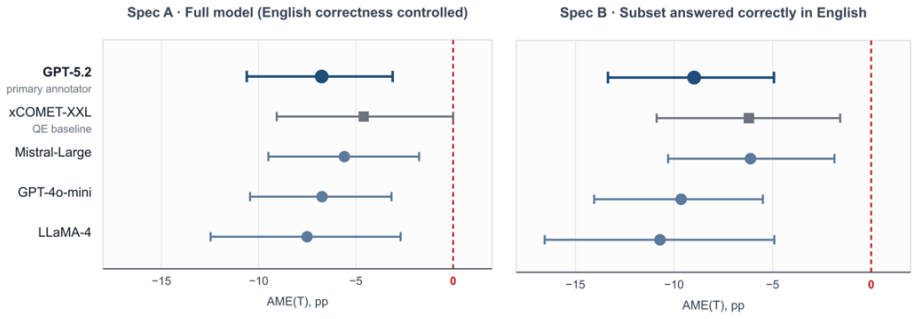
Target-side translation errors cause measurable percentage-point drops in multilingual LLM accuracy even after controls.
A machine-rendered reading of the paper's core claim, the machinery that carries it, and where it could break.
Core claim
Span agreement between automatic MQM-style error detection and human annotations is non-trivial on naturally occurring benchmark translations. Target-side translation errors are consistently associated with measurable percentage-point drops in translated accuracy even after controlling for English correctness and source-side anomalies.
What carries the argument
Analysis of target-side MQM-style error spans from automatic judges, isolated via controls for English correctness and source anomalies, to measure association with accuracy drops.
If this is right
- Multilingual benchmark accuracy scores are reduced by target translation errors in a quantifiable way.
- Automatic tools achieve non-trivial agreement with humans on error spans in benchmark translations.
- Benchmark reliability suffers without explicit accounting for translation quality.
- Accuracy drops can be measured in percentage points, enabling impact quantification.
Where Pith is reading between the lines
- Leaderboard comparisons across languages may carry bias from uneven translation quality.
- Benchmark pipelines could incorporate automatic error detection before release.
- Native or carefully post-edited test sets would sidestep translation artifacts entirely.
Load-bearing premise
The applied controls for English correctness and source-side anomalies are sufficient to isolate the specific effect of target-side translation errors.
What would settle it
A re-run of the accuracy analysis using alternative or stricter controls that eliminates the association between target-side errors and accuracy drops.
Figures
read the original abstract
Machine-translated benchmarks are widely used to assess the multilingual capabilities of large language models (LLMs), yet translation errors in these benchmarks remain underexplored, raising concerns about the reliability and comparability of multilingual evaluation. We address two practical gaps: (i) how well automatic MQM-style error spans from LLM judges and a span-aware QE baseline (xCOMET-XXL) match expert human span annotations on benchmark translations, and (ii) how strongly translation errors (as opposed to source-side issues in the English original) explain accuracy drops on translated benchmarks. We find that span agreement is non-trivial on naturally occurring benchmark translations, and that target-side translation errors are consistently associated with measurable, percentage-point drops in translated accuracy even after controlling for English correctness and source-side anomalies.
Editorial analysis
A structured set of objections, weighed in public.
Referee Report
Summary. The paper evaluates agreement between automatic MQM-style error span detectors (LLM judges and xCOMET-XXL) and human annotations on machine-translated benchmarks, and quantifies the association between target-side translation errors and drops in LLM accuracy on translated tasks, after controlling for English source correctness and source-side anomalies.
Significance. If the reported associations are robust to the controls and measurement choices, the work supplies concrete evidence that translation quality in benchmarks can systematically affect multilingual evaluation scores, which would be useful for benchmark curation and for interpreting cross-lingual performance gaps.
major comments (2)
- [§4] §4 (Results on error impact): the central claim that target-side errors produce measurable percentage-point drops 'even after controlling for English correctness and source-side anomalies' is load-bearing, yet the manuscript provides no description of the regression specification, the exact control variables, sample sizes per language/task, or any multicollinearity diagnostics between source and target error rates.
- [§3.2] §3.2 (Control implementation): the description of how English correctness and source-side anomalies are operationalized and validated does not address whether the error-span detector itself correlates with item difficulty or model-specific error patterns, leaving open the possibility that the reported drops partly reflect residual confounding rather than an isolated target-side effect.
minor comments (1)
- [Abstract, §2] The abstract and §2 would benefit from explicit citation of the benchmark datasets and languages used for the human annotation agreement study.
Simulated Author's Rebuttal
We thank the referee for the detailed and constructive feedback. We address each major comment below and will revise the manuscript to improve transparency and address potential concerns about confounding.
read point-by-point responses
-
Referee: [§4] §4 (Results on error impact): the central claim that target-side errors produce measurable percentage-point drops 'even after controlling for English correctness and source-side anomalies' is load-bearing, yet the manuscript provides no description of the regression specification, the exact control variables, sample sizes per language/task, or any multicollinearity diagnostics between source and target error rates.
Authors: We agree that the regression details were insufficiently described. In the revised manuscript we will add the full specification (linear regression with target-side error rate as the key predictor), the complete list of controls (source error rate, language fixed effects, task fixed effects), per-language and per-task sample sizes, and multicollinearity diagnostics including variance inflation factors. These additions will make the controls and robustness checks explicit. revision: yes
-
Referee: [§3.2] §3.2 (Control implementation): the description of how English correctness and source-side anomalies are operationalized and validated does not address whether the error-span detector itself correlates with item difficulty or model-specific error patterns, leaving open the possibility that the reported drops partly reflect residual confounding rather than an isolated target-side effect.
Authors: We will expand §3.2 to detail the operationalization of English correctness (via the same span detector applied to originals) and source-side anomaly detection. We will also add explicit checks for correlations between detector scores and item difficulty (average model accuracy) as well as model-specific patterns, and discuss any implications for residual confounding. revision: yes
Circularity Check
No circularity: empirical association study with external controls
full rationale
The paper conducts an empirical analysis of translation error spans and their correlation with accuracy drops on translated benchmarks, after applying controls for English correctness and source-side issues. No mathematical derivations, self-referential definitions, fitted parameters renamed as predictions, or load-bearing self-citations appear in the provided text. The central claim rests on observable data patterns and statistical conditioning that can be independently replicated or falsified on held-out data, making the result self-contained rather than tautological.
Axiom & Free-Parameter Ledger
Reference graph
Works this paper leans on
-
[1]
Training Verifiers to Solve Math Word Problems
Training Verifiers to Solve Math Word Prob- lems.Preprint, arXiv:2110.14168. Alexis Conneau, Ruty Rinott, Guillaume Lample, Adina Williams, Samuel Bowman, Holger Schwenk, and Veselin Stoyanov. 2018. XNLI: Evaluating cross- lingual sentence representations. InProceedings of the 2018 Conference on Empirical Methods in Nat- ural Language Processing, pages 24...
work page internal anchor Pith review Pith/arXiv arXiv 2018
-
[2]
Transactions of the Association for Computational Linguistics, 12:979–995
xCOMET: Transparent Machine Translation Evaluation through Fine-grained Error Detection. Transactions of the Association for Computational Linguistics, 12:979–995. Dan Hendrycks, Collin Burns, Steven Basart, Andy Zou, Mantas Mazeika, Dawn Song, and Jacob Steinhardt
-
[3]
InInternational Conference on Learning Representations
Measuring massive multitask language under- standing. InInternational Conference on Learning Representations. Xu Huang, Zhirui Zhang, Xiang Geng, Yichao Du, Ji- ajun Chen, and Shujian Huang. 2024. Lost in the source language: How large language models evalu- ate the quality of machine translation. InFindings of the Association for Computational Linguistic...
2024
-
[4]
In Proceedings of the Ninth Conference on Machine Translation, pages 1440–1453, Miami, Florida, USA
Error Span Annotation: A Balanced Approach for Human Evaluation of Machine Translation. In Proceedings of the Ninth Conference on Machine Translation, pages 1440–1453, Miami, Florida, USA. Association for Computational Linguistics. Klaus Krippendorff. 1995. On the reliability of unitizing continuous data.Sociological Methodology, 25:47– 76. Klaus Krippend...
1995
-
[5]
Okapi: Instruction-tuned Large Language Models in Multiple Languages with Reinforcement Learning from Human Feedback. InProceedings of the 2023 Conference on Empirical Methods in Nat- ural Language Processing: System Demonstrations, pages 318–327, Singapore. Association for Compu- tational Linguistics. Alon Lavie, Greg Hanneman, Sweta Agrawal, Diptesh Kan...
-
[6]
Global MMLU: Understanding and Address- ing Cultural and Linguistic Biases in Multilingual Evaluation.Preprint, arXiv:2412.03304v2. Ole Tange. 2024. GNU Parallel 20240722 (’assange’). Klaudia Thellmann, Bernhard Stadler, Michael Fromm, Jasper Schulze Buschhoff, Alex Jude, Fabio Barth, Jo- hannes Leveling, Nicolas Flores-Herr, Joachim Köh- ler, René Jäkel,...
-
[7]
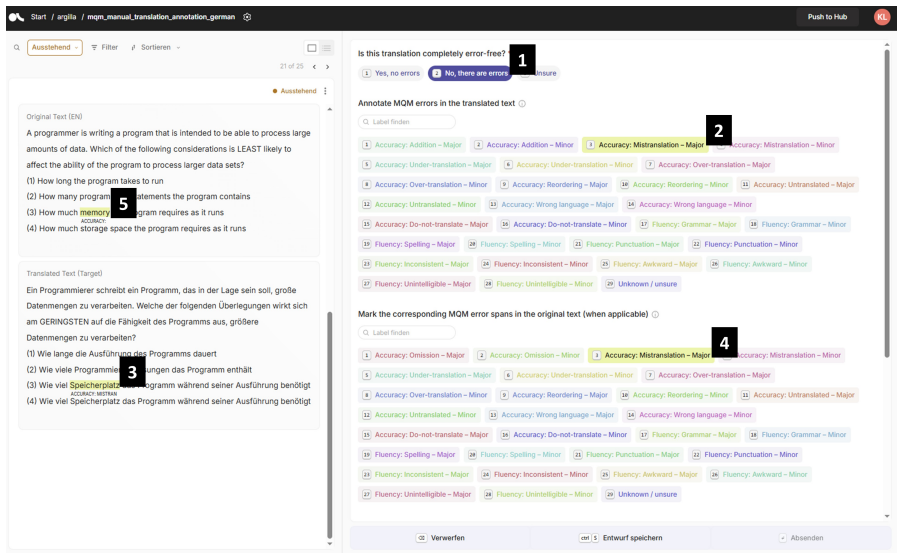
Decide whether the translation is error-free (Yes/No/Unsure)
-
[8]
If errors are present, mark erroneous target spans and assign an MQM label and severity
-
[9]
Mark corresponding source spans where appli- cable;Additionis annotated only on the target side, whereasOmissionis annotated only on the source side
-
[10]
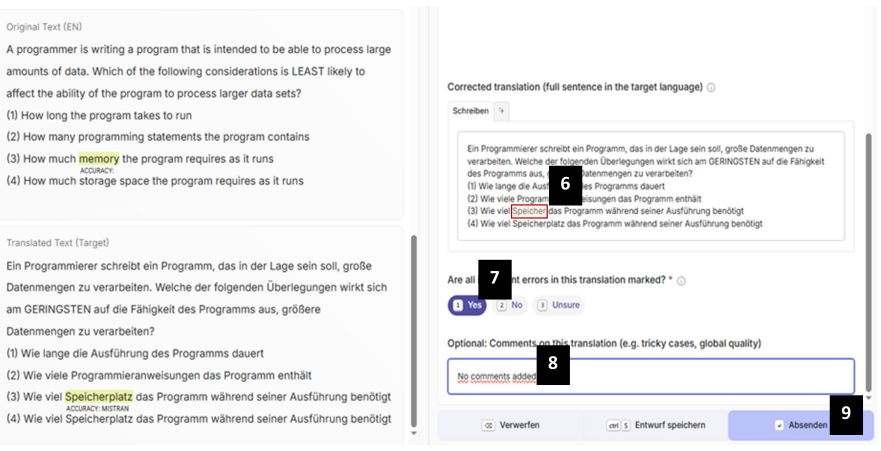
Provide a minimally post-edited corrected translation
-
[11]
Answer a control question indicating whether all important errors were captured
-
[12]
A 14-year-old boy . . . He is embarrassed because he has grown breasts . . . this patient’s condition
Optionally add comments for clarification. A.2 Metrics and Matching We compare span sets using (i) a position-based overlap coefficient (OC) computed from target char- acter offsets, and (ii) a string-based similarity met- ric (SIM) defined as raw character 3-gram Dice similarity, without text normalization. OC and SIM capture complementary notions of spa...
-
[13]
Start from a SPAN-ACES item consisting of a human reference, agoodtranslation, and an incorrecttranslation
-
[14]
Compute a case-sensitive token diff between the good and incorrect translations
-
[15]
Keep only items with a singlecontentful diff, i.e., one non-empty contiguous token-level edit that changes lexical content rather than only punctuation or formatting
-
[16]
Project this edit into the human reference by locating the corresponding reference-side to- ken sequence and use that projected span as the gold span
-
[17]
Discard items with multiple diffs, no reference-side match, or ambiguous repeated matches in the reference. This procedure is intentionally conservative:pro- jectionhere does not attempt full semantic align- ment, but a simple grounded transfer of the tar- geted edit into the human reference whenever the match is unique enough to support reliable span eva...
2053
discussion (0)
Sign in with ORCID, Apple, or X to comment. Anyone can read and Pith papers without signing in.