MVR-cache: Optimizing Semantic Caching via Multi-Vector Retrieval and Learned Prompt Segmentation
Pith reviewed 2026-06-29 23:59 UTC · model grok-4.3
The pith
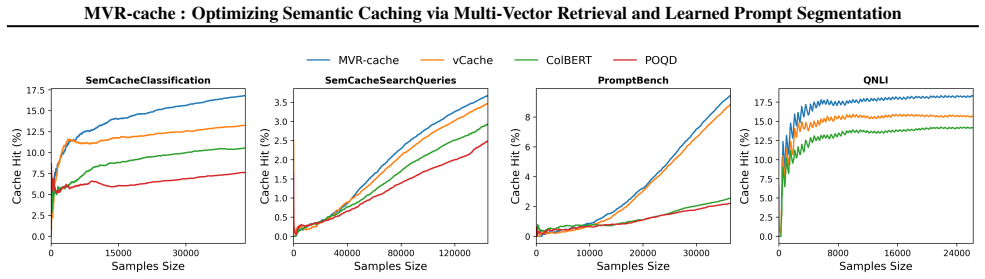
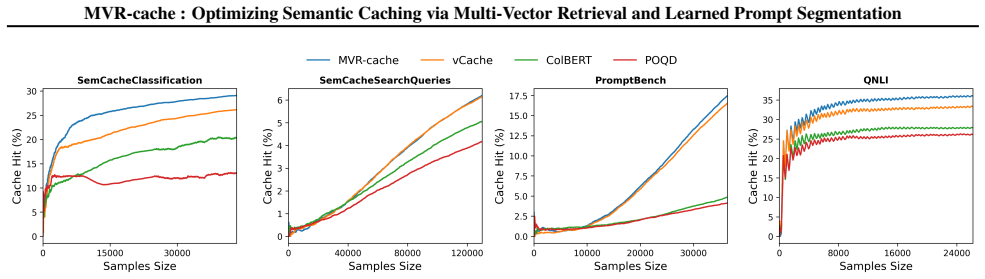
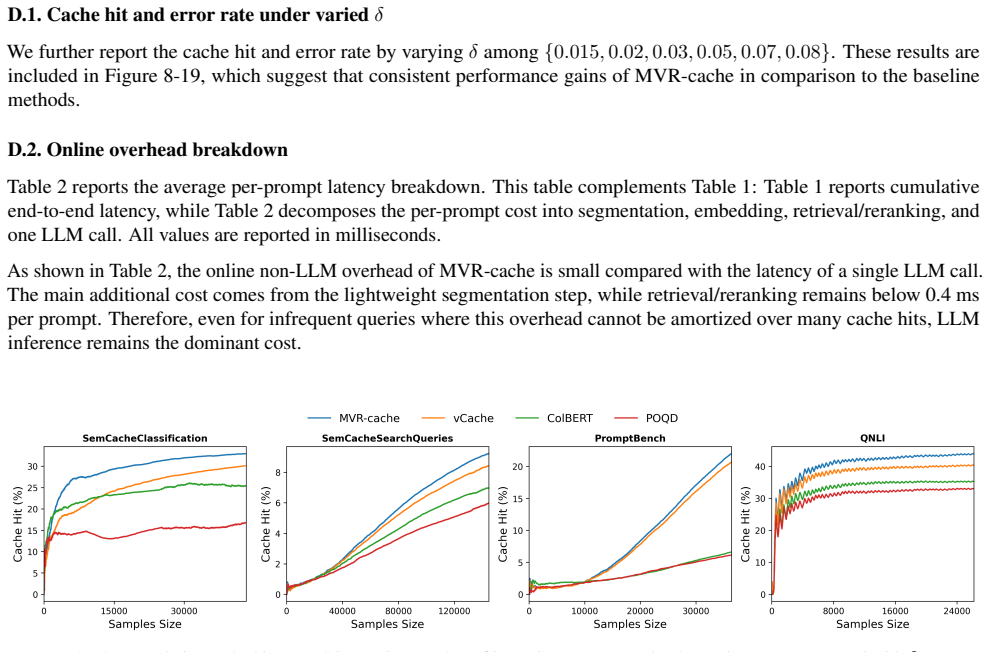
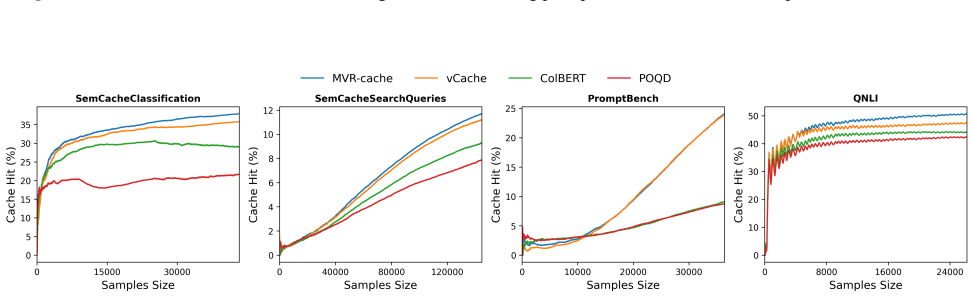
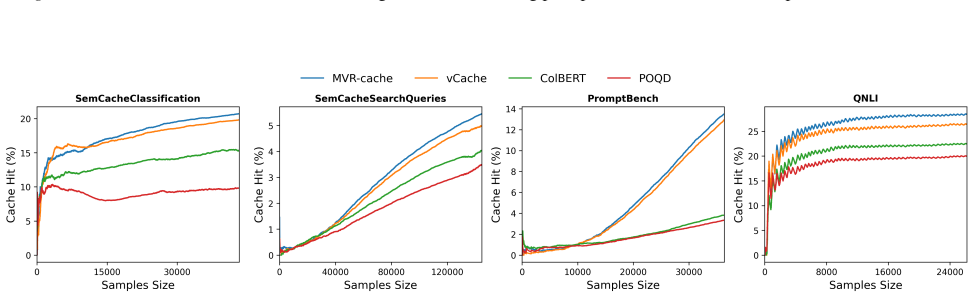
MVR-cache raises semantic cache hit rates up to 37% by using learned prompt segmentation and multi-vector retrieval.
A machine-rendered reading of the paper's core claim, the machinery that carries it, and where it could break.
Core claim
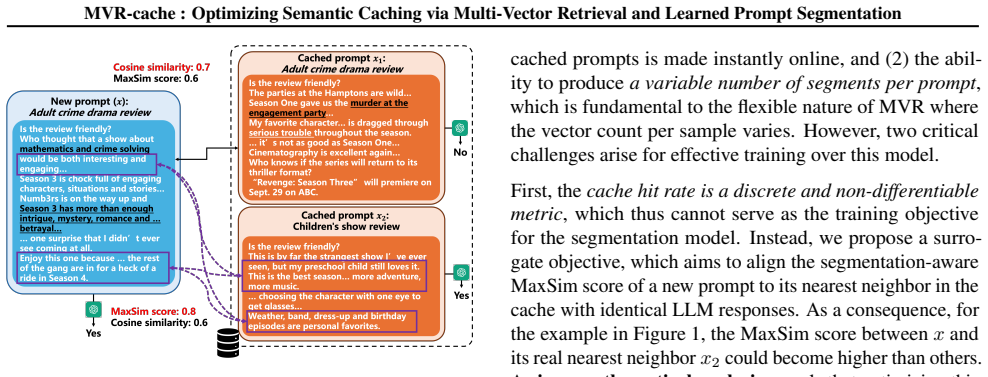
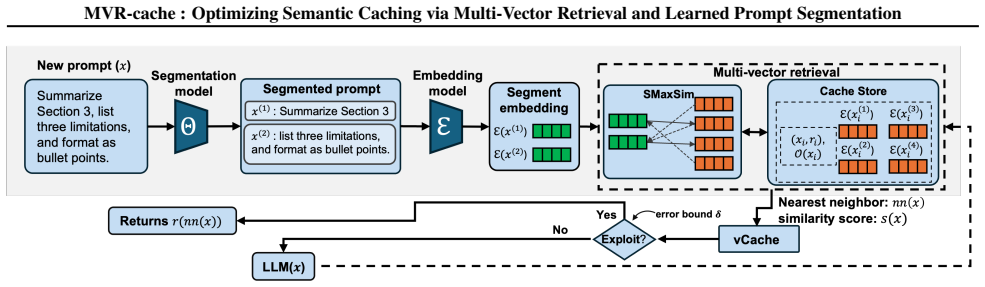
MVR-cache integrates Multi-Vector Retrieval with a learnable segmentation model that intelligently splits prompts, enabling fine-grained similarity comparisons via MaxSim. The model's training objective is derived from rigorous theoretical analysis to ensure that optimizing this objective directly maximizes cache hits under strict correctness constraints. To solve the resulting non-differentiable combinatorial optimization problem, a reinforcement learning-based training strategy is used with the theoretically grounded objectives as the reward, producing up to 37% higher cache hit rates than prior methods while maintaining the same correctness guarantees.
What carries the argument
Learnable prompt segmentation model enabling multi-vector retrieval with MaxSim comparisons, trained by reinforcement learning on a theoretically derived reward.
If this is right
- More incoming LLM prompts can be answered from cache rather than requiring fresh model inference.
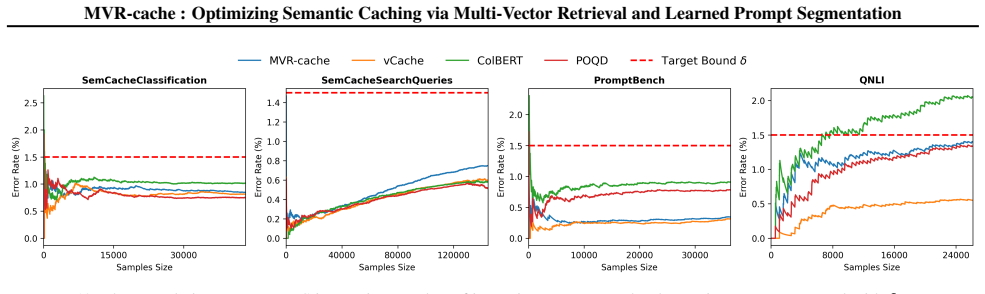
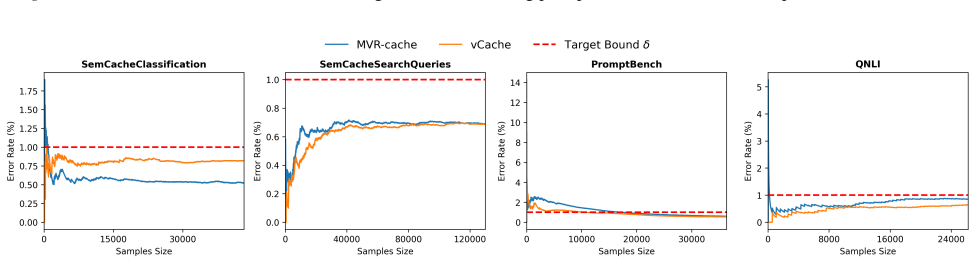
- Correctness guarantees stay unchanged, so the risk of serving incorrect responses remains the same as before.
- LLM serving costs and latency decrease because fewer prompts trigger full model computation.
- The approach applies across diverse tasks on established benchmarks.
Where Pith is reading between the lines
- The segmentation model might generalize to other prompt-based systems beyond caching.
- If the RL training scales, it could be applied to optimize other non-differentiable retrieval objectives.
- Potential for combining with other caching strategies like exact match first.
Load-bearing premise
The reinforcement learning procedure successfully optimizes the non-differentiable combinatorial problem defined by the theoretically derived objective to maximize cache hits under the correctness constraints.
What would settle it
A replication on the same benchmarks that finds no meaningful rise in hit rates or any violation of the correctness guarantees would falsify the central performance claim.
Figures

read the original abstract
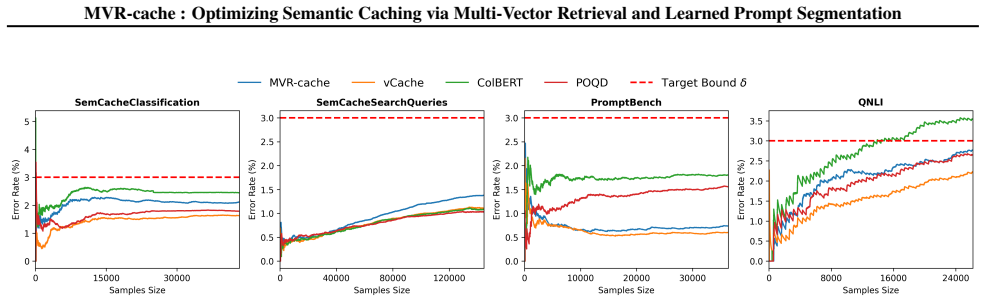
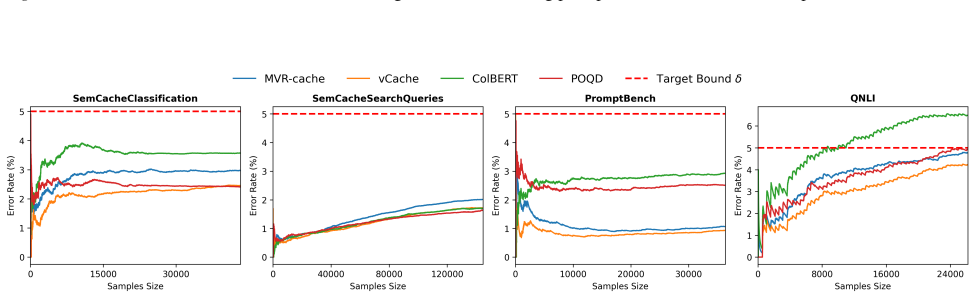
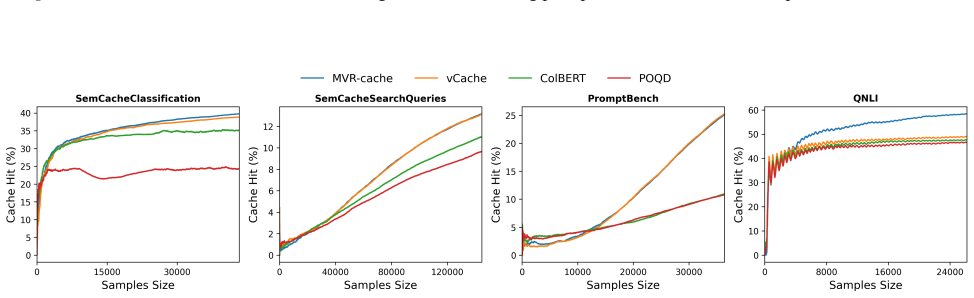
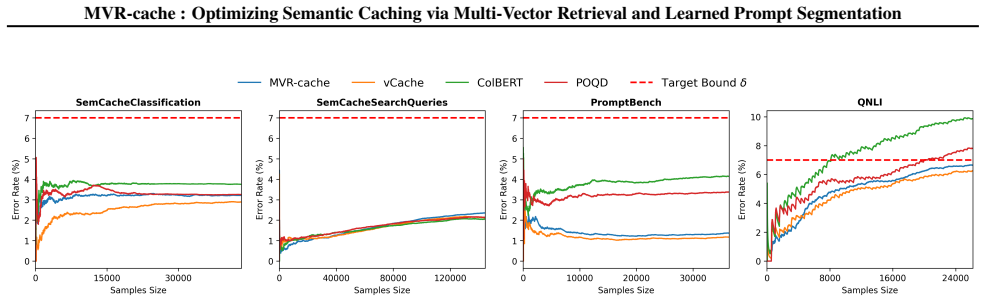
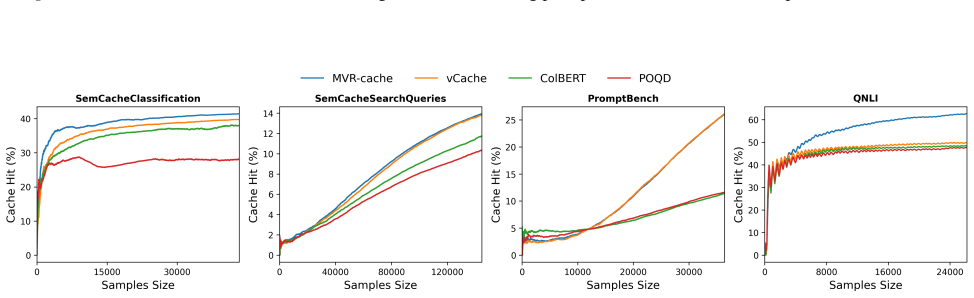
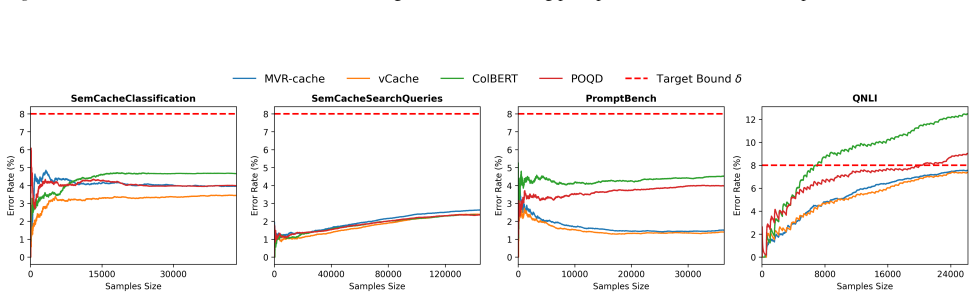
To reduce LLM costs and latency, semantic caching systems must accurately identify when a new prompt matches a cached one. Current methods often rely on simplistic similarity measures, which limit their effectiveness. We introduce MVR-cache, a novel semantic caching approach that significantly improves retrieval accuracy by integrating Multi-Vector Retrieval (MVR). MVR-cache is built upon a learnable segmentation model that intelligently splits prompts, enabling fine-grained similarity comparisons via MaxSim. We derive the model's training objective from a rigorous theoretical analysis. This can ensure that optimizing this objective directly maximizes cache hits under strict correctness constraints. To solve the resulting non-differentiable combinatorial optimization problem, we leverage a reinforcement learning-based training strategy with the theoretically grounded objectives as the reward. Experimental results on established benchmarks across diverse tasks confirm that in comparison to the state-of-the-art, MVR-cache consistently increases the cache hit rates by up to 37% while maintaining the same correctness guarantees. MVR-cache is available at https://github.com/PKU-SDS-lab/MVR-Cache
Editorial analysis
A structured set of objections, weighed in public.
Referee Report
Summary. The paper introduces MVR-cache, a semantic caching system for LLMs that combines multi-vector retrieval (MVR) with a learnable prompt segmentation model to perform fine-grained MaxSim comparisons. It claims to derive the training objective from a rigorous theoretical analysis such that optimizing the objective directly maximizes cache hits under strict correctness constraints (no incorrect hits). The resulting non-differentiable combinatorial problem is addressed via a reinforcement-learning procedure that uses the theoretical objective as reward. Experiments on established benchmarks across diverse tasks report up to 37% higher cache hit rates than state-of-the-art methods while preserving the same correctness guarantees. Code is released at https://github.com/PKU-SDS-lab/MVR-Cache.
Significance. If the claimed theoretical derivation is valid and the RL procedure reliably optimizes the objective without relaxing the correctness constraint, MVR-cache would supply a principled improvement to semantic caching that could meaningfully reduce LLM serving latency and cost. The open-source release supports reproducibility and is a strength.
major comments (3)
- [Abstract and §3] Abstract and §3 (theoretical analysis): the manuscript asserts that the training objective is derived from 'rigorous theoretical analysis' so that its optimization 'directly maximizes cache hits under strict correctness constraints,' yet supplies no equations, derivation steps, or proof sketch. Without these, it is impossible to verify whether the objective is non-circular or actually achieves the stated property.
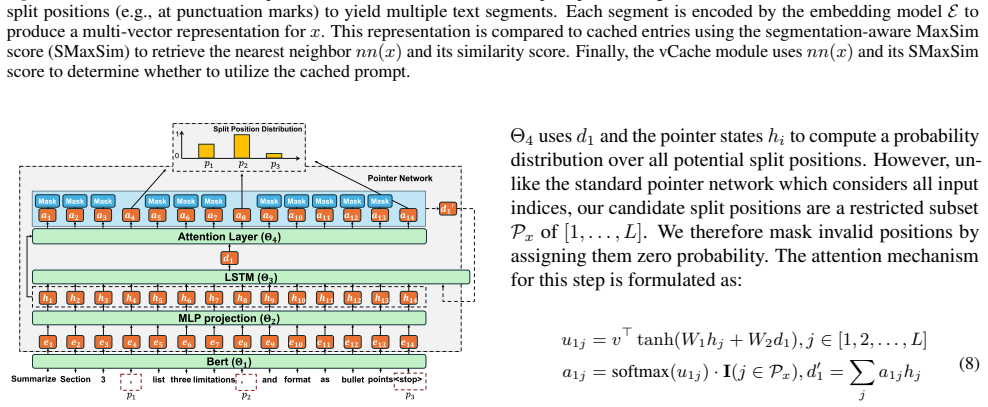
- [§4] §4 (RL training procedure): the paper substitutes an RL procedure whose reward is the theoretical objective to solve the non-differentiable combinatorial problem, but provides no description of the policy parameterization, reward shaping, convergence diagnostics, or any ablation/measurement showing that the learned policy preserves strict correctness (zero incorrect hits) or approaches the theoretical optimum. This assumption is load-bearing for the central claim.
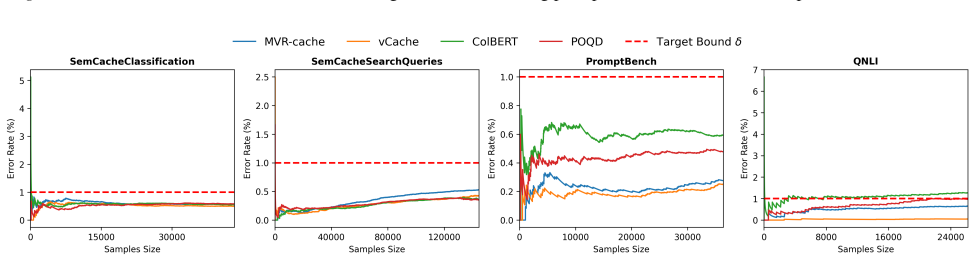
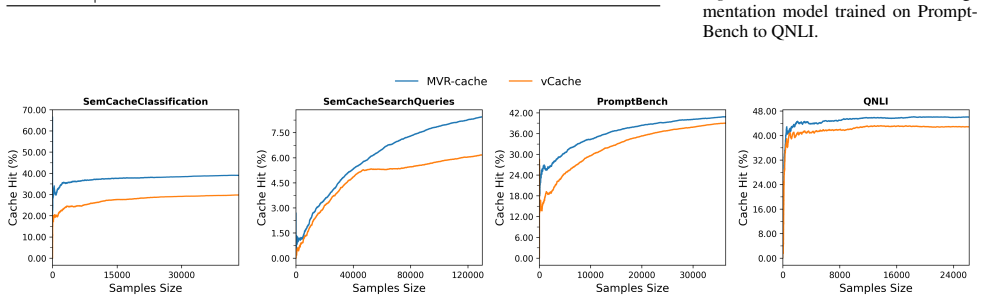
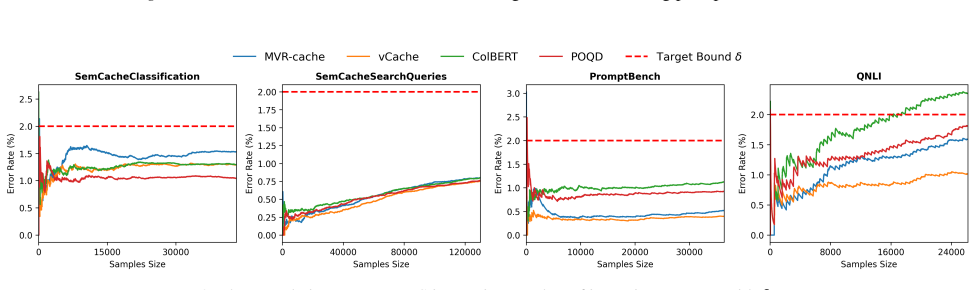
- [§5] §5 (experiments): the claim of 'up to 37% increase in cache hit rates' is presented without dataset specifications, baseline implementations, exact hit-rate definitions, or quantitative evidence that correctness guarantees were maintained in the reported runs. These omissions prevent evaluation of the experimental support for the central claim.
Simulated Author's Rebuttal
We thank the referee for the detailed and constructive feedback. We address each major comment below and will revise the manuscript accordingly to strengthen the presentation of the theoretical analysis, RL procedure, and experimental details.
read point-by-point responses
-
Referee: [Abstract and §3] Abstract and §3 (theoretical analysis): the manuscript asserts that the training objective is derived from 'rigorous theoretical analysis' so that its optimization 'directly maximizes cache hits under strict correctness constraints,' yet supplies no equations, derivation steps, or proof sketch. Without these, it is impossible to verify whether the objective is non-circular or actually achieves the stated property.
Authors: We agree that the submitted manuscript did not include the derivation steps or equations. In the revised version we will expand §3 with the full theoretical analysis, including the starting definitions of cache hits under strict correctness, the step-by-step derivation of the objective, and a proof sketch showing that optimization of this objective maximizes hits without violating the constraints. This addition will make the non-circular nature of the objective explicit. revision: yes
-
Referee: [§4] §4 (RL training procedure): the paper substitutes an RL procedure whose reward is the theoretical objective to solve the non-differentiable combinatorial problem, but provides no description of the policy parameterization, reward shaping, convergence diagnostics, or any ablation/measurement showing that the learned policy preserves strict correctness (zero incorrect hits) or approaches the theoretical optimum. This assumption is load-bearing for the central claim.
Authors: We acknowledge the need for these details. The revised §4 will describe the policy parameterization, reward shaping, convergence diagnostics, and will add ablations together with measurements confirming that the learned policy maintains zero incorrect hits while approaching the theoretical optimum. revision: yes
-
Referee: [§5] §5 (experiments): the claim of 'up to 37% increase in cache hit rates' is presented without dataset specifications, baseline implementations, exact hit-rate definitions, or quantitative evidence that correctness guarantees were maintained in the reported runs. These omissions prevent evaluation of the experimental support for the central claim.
Authors: We will revise §5 to supply the missing dataset specifications, baseline implementation details, exact hit-rate definitions, and quantitative evidence (including per-run correctness metrics) that zero incorrect hits were observed. These additions will directly support the reported improvements. revision: yes
Circularity Check
No circularity: derivation chain not reducible to inputs in provided text
full rationale
The abstract states that the training objective is derived from theoretical analysis such that its optimization maximizes cache hits under correctness constraints, with RL then used to optimize the non-differentiable problem. No equations, self-citations, fitted parameters renamed as predictions, or ansatzes are quoted or exhibited that would reduce any claimed result to its own inputs by construction. The central performance claim (up to 37% hit-rate increase) is presented as an experimental outcome rather than a definitional identity. Without the full derivation or equations, no specific reduction can be demonstrated, so the finding is no significant circularity.
Axiom & Free-Parameter Ledger
free parameters (1)
- segmentation model parameters
axioms (1)
- domain assumption Optimizing the derived objective directly maximizes cache hits under strict correctness constraints
Reference graph
Works this paper leans on
-
[1]
EMBER2024 - A Benchmark Dataset for Holistic Evaluation of Malware Classifiers,
doi: 10.1145/3711896.3737433. URL https: //github.com/ai4co/rl4co. Chen, J., Xiao, S., Zhang, P., Luo, K., Lian, D., and Liu, Z. Bge m3-embedding: Multi-lingual, multi- functionality, multi-granularity text embeddings through self-knowledge distillation.Annual Meeting of the Asso- ciation for Computational Linguistics, 4(5):2318–2335,
-
[2]
In: Findings of the Association for Computational Lin- guistics 2024
doi: 10.18653/v1/2024.findings-acl.137. Craswell, N., Campos, D., Mitra, B., Yilmaz, E., and Biller- beck, B. Orcas: 18 million clicked query-document pairs for analyzing search. InInternational Conference on In- formation and Knowledge Management, pp. 2983–2989. ACM, 2020. doi: 10.1145/3340531.3412779. Dasgupta, S., Wagh, A., Parsai, L., Gupta, B., Vudat...
-
[3]
Li, M., Lin, S.-C., Oguz, B., Ghoshal, A., Lin, J., Mehdad, Y ., Yih, W.-t., and Chen, X
doi: 10.1109/IWQoS61813.2024.10682957. Li, M., Lin, S.-C., Oguz, B., Ghoshal, A., Lin, J., Mehdad, Y ., Yih, W.-t., and Chen, X. Citadel: Conditional token interaction via dynamic lexical routing for efficient and effective multi-vector retrieval. InAnnual Meeting of the Association for Computational Linguistics, pp. 11891– 11907, 2022. doi: 10.48550/arXi...
-
[4]
doi: 10.18653/v1/P18-2124. Ren, Q., Dunham, M. H., and Kumar, V . Semantic caching and query processing.IEEE transactions on knowledge and data engineering, 15(1):192–210, 2003. doi: 10. 1109/TKDE.2003.1161590. Santhanam, K., Khattab, O., Saad-Falcon, J., Potts, C., and Zaharia, M. Colbertv2: Effective and efficient retrieval via lightweight late interact...
-
[5]
ZHANG, Q., Xu, L., Fang, J., Tang, Q., Wu, Y
doi: 10.1109/TSC.2024.3451185. ZHANG, Q., Xu, L., Fang, J., Tang, Q., Wu, Y . N., Tighe, J., and Xing, Y . Threshold-consistent margin loss for open- world deep metric learning. InInternational Conference on Learning Representations, 2023. Zhu, H., Zhu, B., and Jiao, J. Efficient prompt caching via embedding similarity.arXiv.org, 2024. doi: 10.48550/ arXi...
-
[6]
MLE(P 0, P1)depends on(P 0, P1)only through∆
-
[7]
MLE(P 0, P1)is strictly decreasing in∆for0<∆<1
-
[8]
u 1 + exp ∆ σ2 u # + 1 2σ2 EP0
Consequently, the global minimum of MLE(P 0, P1)over all feasible(P 0, P1)is attained at µ1 = 1, µ 0 = 0. Proof.Step 1: Explicit form of the riskSince the class prior is balanced, the population risk can be written as MLE(P0, P1) = 1 2 EP1 log(1 +e −γ(s−t)) + 1 2 EP0 log(1 +e γ(s−t)) . Substitutingγ= ∆/σ 2 andt= (µ 1 +µ 0)/2, we obtain MLE(P0, P1) = 1 2 E...
2020
-
[9]
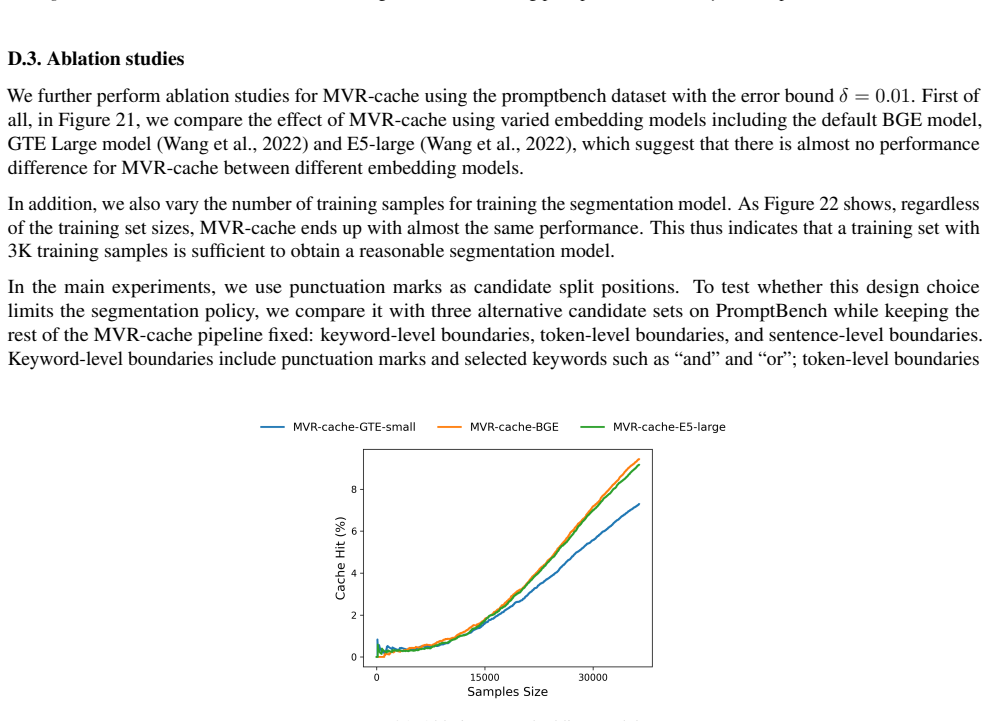
and” and “or
enable efficient retrieval directly over multi-vector data, our preliminary tests show that they introduce substantial computational overhead and do not meet our real-time inference requirements. C. Additional Discussion C.1. Additional Related Work on Query Reformulation A related line of retrieval work improves matching quality through query expansion (...
2017
discussion (0)
Sign in with ORCID, Apple, or X to comment. Anyone can read and Pith papers without signing in.