Efficient cooling by ferroelectric or ferromagnetic hysteresis loops
Pith reviewed 2026-06-29 23:54 UTC · model grok-4.3
The pith
External electric or magnetic fields produce efficient cooling when cycled along ferroelectric or ferromagnetic hysteresis loops.
A machine-rendered reading of the paper's core claim, the machinery that carries it, and where it could break.
Core claim
An efficient cooling effect is achieved by applying external electric or magnetic fields along hysteresis loops. The effect is illustrated with a simplified model obtained from a second-order expansion of the energy in powers of polarization and external field; the same model permits direct comparison with the electrocaloric effect.
What carries the argument
Hysteresis loop generated by the second-order energy expansion in polarization (or magnetization) and external field, which produces net cooling upon traversal.
If this is right
- Net cooling occurs each time the field completes a hysteresis loop traversal.
- The same mechanism applies equally to electric and magnetic cases.
- The cooling is presented as distinct from and potentially more efficient than the standard electrocaloric effect.
- Numerical results from the second-order model confirm a temperature reduction along the loop.
Where Pith is reading between the lines
- Device designs could exploit repeated loop cycling at fixed frequency to achieve continuous refrigeration.
- The approach might be tested in thin-film ferroelectrics where hysteresis is already well characterized.
- Higher-order terms omitted from the expansion could either enhance or reduce the predicted cooling depending on material parameters.
Load-bearing premise
The second-order expansion of the energy in powers of polarization and external field is sufficient to produce the net cooling observed along the hysteresis loop.
What would settle it
An experiment that cycles the external field through the hysteresis loop of a real ferroelectric or ferromagnetic sample and records no net temperature decrease after a full cycle would falsify the cooling claim.
Figures
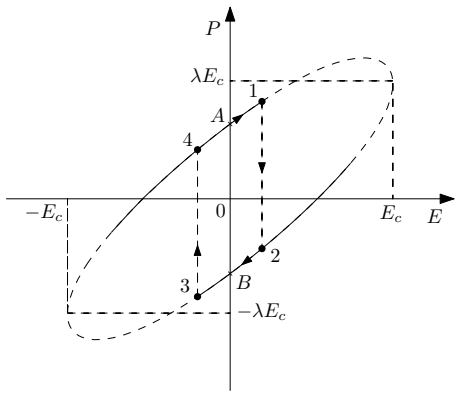
read the original abstract
An efficient cooling effect is put forward, by means of external electric or magnetic fields along hysteresis loops. A simplified model of hysteresis is used for numerical illustration. The model is based upon a second-order expansion of the energy in powers of polarization and external field. The electrocaloric effect along hysteresis loops is discussed for comparison.
Editorial analysis
A structured set of objections, weighed in public.
Referee Report
Summary. The manuscript claims that an efficient cooling effect can be realized by applying external electric or magnetic fields while traversing hysteresis loops in ferroelectric or ferromagnetic materials. It illustrates the idea numerically with a simplified model based on a second-order expansion of the energy in powers of polarization (or magnetization) and the external field, and compares the result to the electrocaloric effect along such loops.
Significance. A validated mechanism for net cooling via hysteresis traversal would be of interest for solid-state refrigeration. The manuscript supplies no first-principles derivation, parameter-free predictions, reproducible code, or experimental validation, so the significance remains speculative even if the central claim were corrected.
major comments (2)
- [Abstract] Abstract and model section: the stated second-order expansion of the energy in powers of polarization P and field E yields only the linear, single-valued relation P = χE with no spontaneous polarization, no bistability, and no closed loop of nonzero area. Consequently the numerical illustration cannot demonstrate cooling along a hysteresis loop.
- [Abstract] Abstract: the claim of 'net cooling' while traversing a hysteresis loop is load-bearing for the entire manuscript, yet the model supplies neither an explicit entropy-extraction term nor an accounting for the dissipative heat generated by real hysteresis; the thermodynamic balance is therefore not shown.
minor comments (1)
- The abstract does not specify the numerical values or functional form of the second-order coefficients used in the illustration.
Simulated Author's Rebuttal
We thank the referee for the detailed review and for identifying key issues in the presentation of our model. We provide point-by-point responses below and indicate where revisions will be made to address the concerns.
read point-by-point responses
-
Referee: [Abstract] Abstract and model section: the stated second-order expansion of the energy in powers of polarization P and field E yields only the linear, single-valued relation P = χE with no spontaneous polarization, no bistability, and no closed loop of nonzero area. Consequently the numerical illustration cannot demonstrate cooling along a hysteresis loop.
Authors: The referee correctly notes that a second-order energy expansion in P and E produces a linear response without hysteresis. The manuscript describes a 'simplified model of hysteresis' based on this expansion, but does not specify additional mechanisms (such as domain switching or higher-order terms) that would generate the loop. We will revise the model section to either clarify the intended implementation or adopt a more appropriate phenomenological model that incorporates bistability while retaining the energy expansion framework where possible. revision: yes
-
Referee: [Abstract] Abstract: the claim of 'net cooling' while traversing a hysteresis loop is load-bearing for the entire manuscript, yet the model supplies neither an explicit entropy-extraction term nor an accounting for the dissipative heat generated by real hysteresis; the thermodynamic balance is therefore not shown.
Authors: We agree that demonstrating net cooling requires a full thermodynamic analysis, including entropy changes during the cycle and the heat generated by hysteresis losses. The current manuscript compares to the electrocaloric effect but lacks this explicit balance. In the revised version, we will include calculations of the entropy extraction and discuss the dissipative contributions to ensure the thermodynamic consistency is demonstrated. revision: yes
Circularity Check
No significant circularity; model is explicit ansatz for illustration
full rationale
The paper introduces a simplified model based on a second-order energy expansion explicitly for numerical illustration of a proposed cooling effect along hysteresis loops. No load-bearing step reduces a prediction to its own inputs by construction, no self-citation chain supports the central premise, and no fitted parameter is relabeled as an independent prediction. The derivation is self-contained as a modeling proposal rather than a first-principles derivation that loops back on itself.
Axiom & Free-Parameter Ledger
axioms (1)
- domain assumption The energy admits a second-order expansion in powers of polarization (or magnetization) and external field.
Reference graph
Works this paper leans on
-
[1]
I. D. Mayergoyz, Mathematical models of hysteresis and their applica- tions, Elsevier, Amsterdam (2003)
2003
-
[2]
Bertotti, Hysteresis in magnetism: For physicists, materials scien- tists, and engineers , Academic Press (1998)
G. Bertotti, Hysteresis in magnetism: For physicists, materials scien- tists, and engineers , Academic Press (1998)
1998
-
[3]
Visintin, Differential models of hysteresis , Springer, Berlin (1994)
A. Visintin, Differential models of hysteresis , Springer, Berlin (1994)
1994
-
[4]
Über die magnetische Nachwirkung
F. Preisach, "Über die magnetische Nachwirkung", Zeit. Phys. 94 277– 302 (1935)
1935
-
[5]
Giant intrinsic electrocaloric effect in ferroel ectrics by local structural engineering
B. Wu, H. Tao, K. Chen, Z. Xing, Y.-Q. Wu, H.-C. Thong, L. Zh ao, C. Zhao, Z. Xu, Y.-X. Liu, F.-Z. Yao, T. Zhou, J. Ma, Y. Wei, K. Wan g, S. Zhang, "Giant intrinsic electrocaloric effect in ferroel ectrics by local structural engineering", Nature Commun. 16 7515 (2025)
2025
-
[6]
High cooling performance in a double- loop electrocaloric heat pump
J. Li, A. Torello, V. Kovacova, U. Prah, A. Aravindhan, T. Granzow, T. Usui, S. Hirose and E. Defay, "High cooling performance in a double- loop electrocaloric heat pump", Science 382 301-305 (2023) (Erratum 29 May 2025)
2023
-
[7]
Optimal ferrofluids for magnetic cooling dev ices
M. S. Pattanaik, V. B. Varma, S. K. Cheekati, V. Chaudhary and R. V. Ramanujan, "Optimal ferrofluids for magnetic cooling dev ices", Sci. Rep. 11 24167 (2021)
2021
-
[8]
Giant temperature span in elect rocaloric regenerator
A. Torello, P. Lheritier, T. Usui, Y. Nouchokgwe, M. Gera rd, O. Bou- ton, S. Hirose and E. Defay, "Giant temperature span in elect rocaloric regenerator", Science 370 124-129 (2020)
2020
-
[9]
Electrocaloric Materials, New Generation of Coolers , Engineering Mate- rials, vol. 34, eds. T. Correia and Q. Zhang, Springer, Berli n (2014)
2014
-
[10]
Applications of Modern Ferroelectrics (f or cooling)
J. F. Scott, "Applications of Modern Ferroelectrics (f or cooling)", Sci- ence 315 (5814), 954-959 (2007). 9
2007
-
[11]
DFT- based and exprimental study of Sr-doped BaT iO3 : Impacts on piezo- electric and ferroelectric performance
H. Kacimi-Naciri, M. Rguiti, A. Mabrouk, C. Courtois, M . A. Ben Achour, Y. Lorgouilloux, R. Amrousse. N. Faska and A. Bachar , "DFT- based and exprimental study of Sr-doped BaT iO3 : Impacts on piezo- electric and ferroelectric performance", Ceramics Int. 51 23801-23813 (2025)
2025
-
[12]
Landau and E
L. Landau and E. Lifshitz, Course of Theoretical Physics , vol. 5 ( Statis- tical Physics ), Elsevier, Oxford (1980)
1980
-
[13]
Ferroelectric switching and te mperature- dependent electrical properties of K0. 7N a0. 3N bO3 capacitor devices
M. de Oliveira Guimaraes, C. Richter, J. Schwarzkopf, M . Engl, S. Sle- sazeck and M. Schmidbauer, "Ferroelectric switching and te mperature- dependent electrical properties of K0. 7N a0. 3N bO3 capacitor devices", Phys. Rev. Mat. 10 014413 (2026)
2026
-
[14]
Temperature- dependent ferroelectric hysteresis properties of modified lead zirconate titanate ceramics
B. Wen, Y. Zhang, X. Liu, L. Ma and X. Wang, "Temperature- dependent ferroelectric hysteresis properties of modified lead zirconate titanate ceramics", J. Mater. Sci. 47 4299–4304 (2012)
2012
-
[15]
BaTiO3-based piezoelectrics: Fu ndamentals, current status, and perspectives
M. Acosta, N. Novak, V. Rojas, S. Patel, R. Vaish, J. Koru za, G. A. Rossetti, Jr., J. Rödel, "BaTiO3-based piezoelectrics: Fu ndamentals, current status, and perspectives", Appl. Phys. Rev. 4 (4) (2017)
2017
-
[16]
Damjanovic, Hysteresis in Piezoelectric and Ferroelectric Materials , in The Science of Hysteresis, vol
D. Damjanovic, Hysteresis in Piezoelectric and Ferroelectric Materials , in The Science of Hysteresis, vol. 3, eds. G. Bertotti and I. D. Mayergoyz, Elsevier (2005)
2005
-
[17]
Lines and A
M. Lines and A. Glass, Principles and applications of ferroelectrics and related materials, Clarendon Press, Oxford (1979)
1979
-
[18]
Känzig, Ferroelectrics and Antiferroelectrics, in Solid State Physics , vol
W. Känzig, Ferroelectrics and Antiferroelectrics, in Solid State Physics , vol. 4., eds. F. Seitz, T. P. Das, D. Turnbull and E. L. Hahn, Ac ademic Press. (1957)
1957
-
[19]
Frequency dependence on polar ization switching measurement in ferroelectric capacitors
Z. Gao, S. Lyu and H. Lyu, "Frequency dependence on polar ization switching measurement in ferroelectric capacitors", J. Se micond. 43 014102 ( (2022))
2022
-
[20]
Chikazumi, Physics of ferromagnetism , Oxford University Press, Ox- ford (2009)
S. Chikazumi, Physics of ferromagnetism , Oxford University Press, Ox- ford (2009)
2009
-
[21]
R. M. Bozorth, Ferromagnetism, IEEE Press, NY (1993)
1993
-
[22]
Theory of ferromagnetic hysteresis
D. C. Jiles and D. L. Atherton, "Theory of ferromagnetic hysteresis", J. Magn. Magn. Mat. 61 48-60 (1986). 10
1986
-
[23]
Theoretical aspec ts of the magnetocaloric effect
N. A. de Oliveira and P. J. von Ranke, "Theoretical aspec ts of the magnetocaloric effect", Phys. Rep. 489 89-159 (2010)
2010
-
[24]
Polarization dynamics and non-equilibrium switching pro cesses in fer- roelectrics
M. Vapsaroiu, P. M. Weaver, M. G. Cain, M. Reece and K. B. C hong, "Polarization dynamics and non-equilibrium switching pro cesses in fer- roelectrics", IEEE Trans. Ultrason. Ferroelectr. Freq. Co ntrol 58 1867- 1873 (2011)
2011
-
[25]
Switching time in ferroelectric BaT iO3 and its dependence on crystal thickness
W. J. Merz, "Switching time in ferroelectric BaT iO3 and its dependence on crystal thickness", J. Appl. Phys. 27 938–943 (1956)
1956
-
[26]
Heat los ses in ferroelec- tric ceramics due to switching processes
O. Malyshkina, A. Eliseev and R. Grechishkin, "Heat los ses in ferroelec- tric ceramics due to switching processes", Proc. Estonian A cad. Sci. 66 462–466 (2017)
2017
-
[27]
D ispersion of Switching Processes in Ferroelectric Ceramic
O. V. Malyshkina, A. Y. Eliseev and R. M. Grechishkin, "D ispersion of Switching Processes in Ferroelectric Ceramic", Adv. Cond. Matt. Phys. 2017 2507808 (2017). 11
2017
discussion (0)
Sign in with ORCID, Apple, or X to comment. Anyone can read and Pith papers without signing in.