Absorption and scattering spectra of massive scalar waves in charged regular black hole spacetimes
Pith reviewed 2026-06-29 23:44 UTC · model grok-4.3
The pith
The mass of the scalar field makes absorption and scattering spectra of charged regular black holes match those of Reissner-Nordström black holes for arbitrary frequencies and angles.
A machine-rendered reading of the paper's core claim, the machinery that carries it, and where it could break.
Core claim
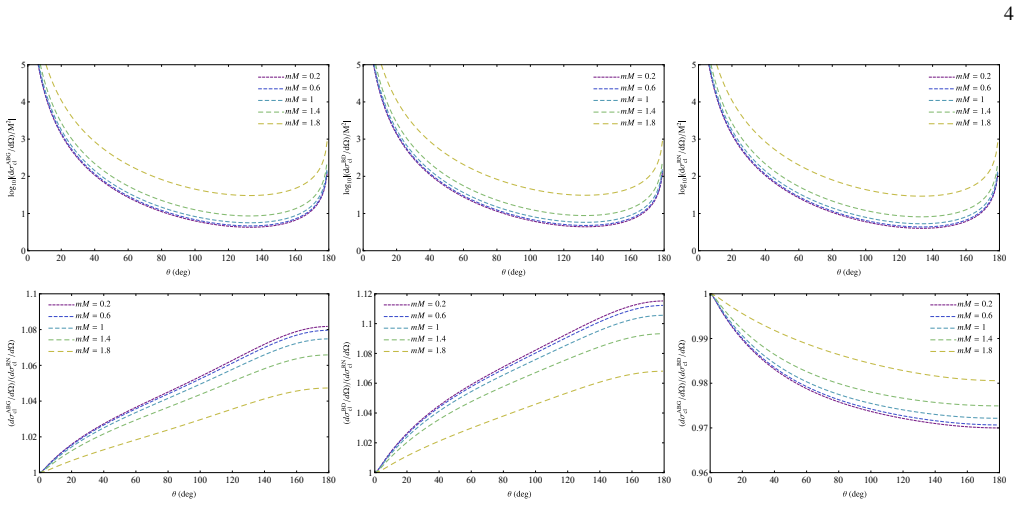
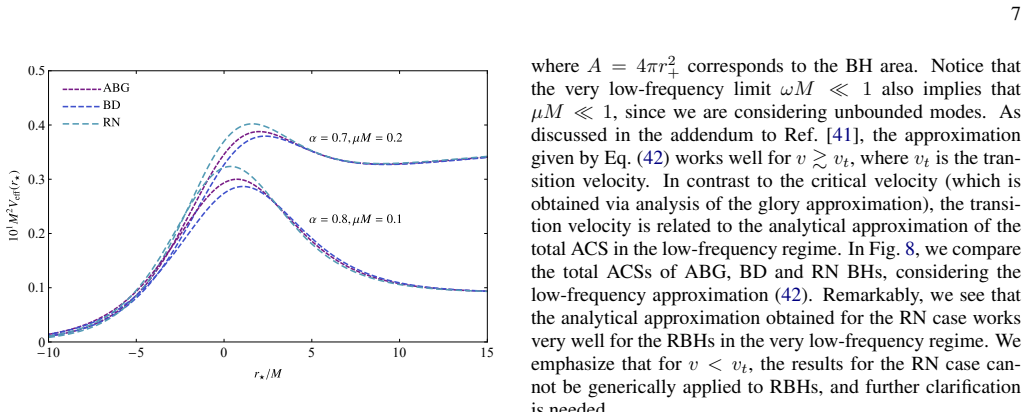
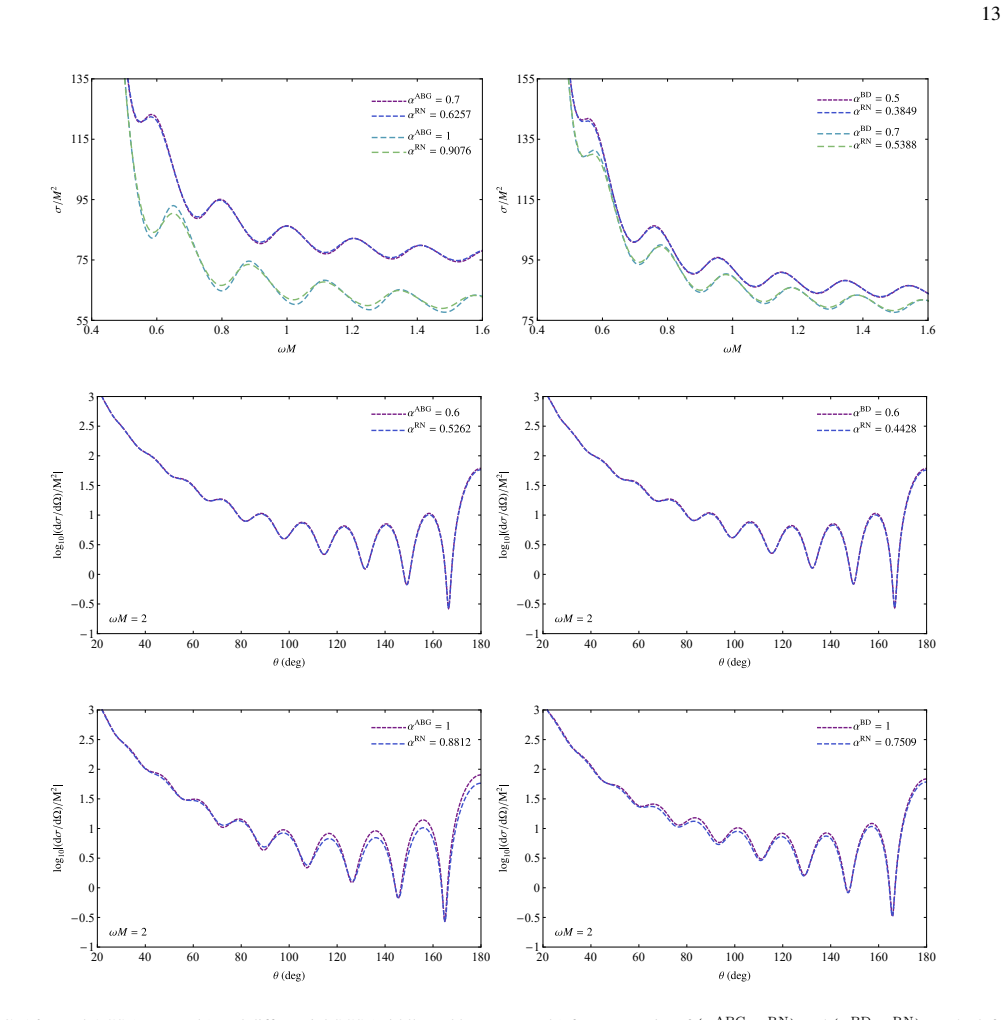
The mass of the field contributes to finding situations in which the absorption and scattering spectra of regular and standard black holes are similar for arbitrary values of the field frequency and scattering angle, considering low- to near-extreme black hole charges.
What carries the argument
Numerical integration of the radial wave equation for massive scalar fields on the regular black-hole backgrounds, yielding absorption and scattering cross sections.
If this is right
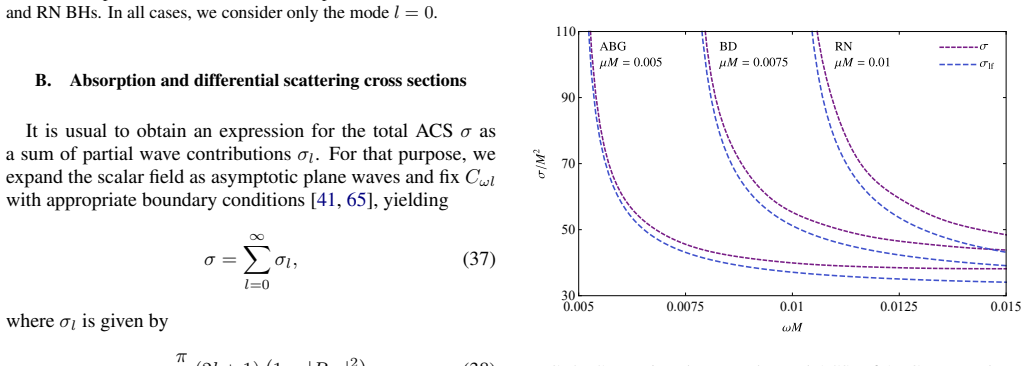
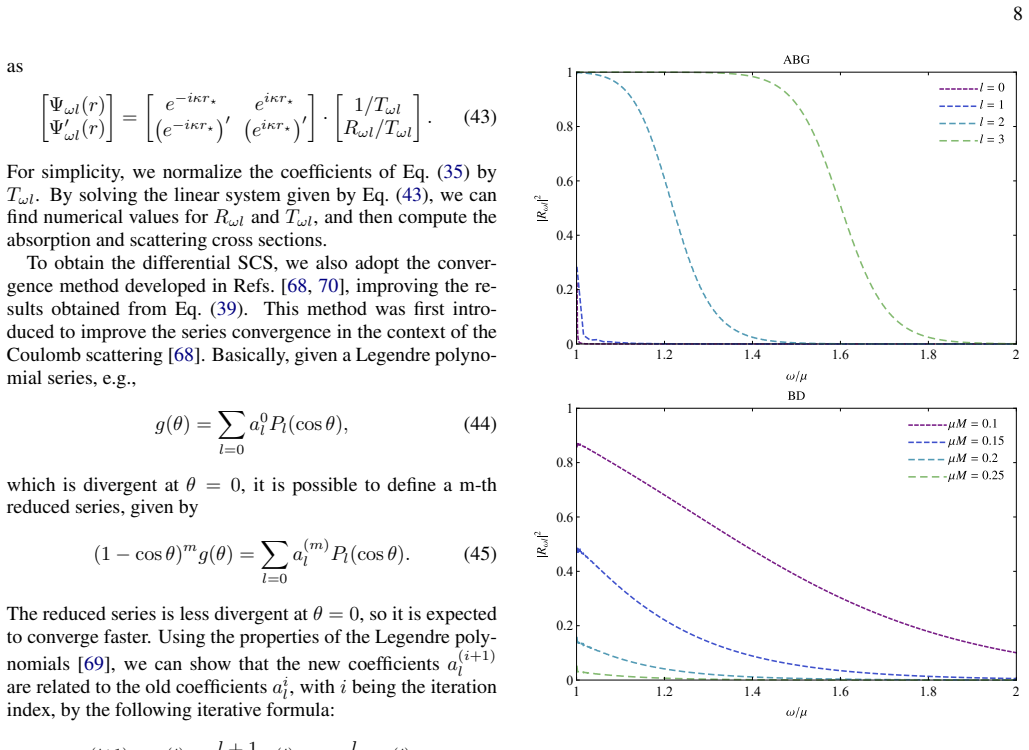
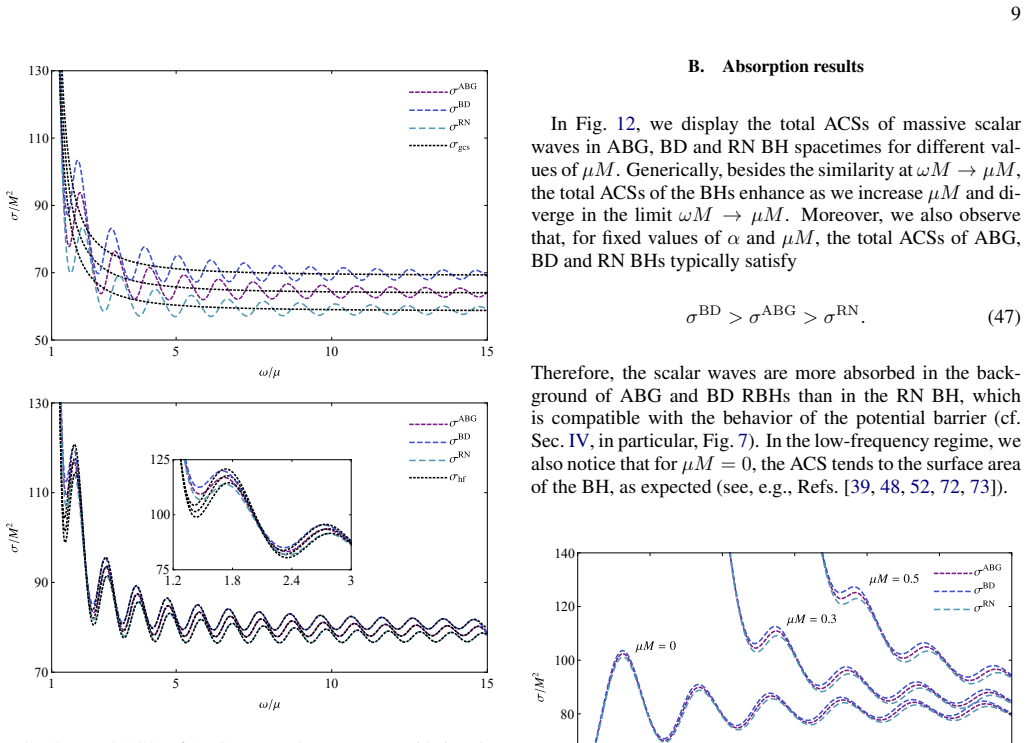
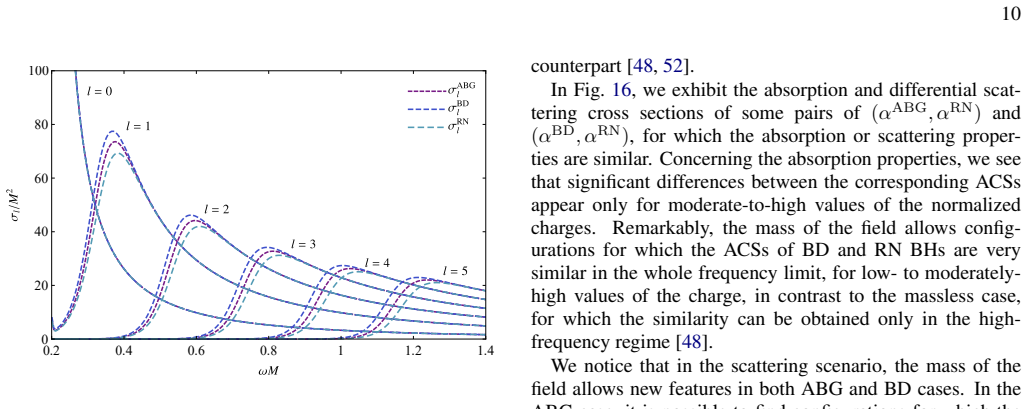
- The total absorption cross section decreases as the field's mass increases for fixed black-hole charge.
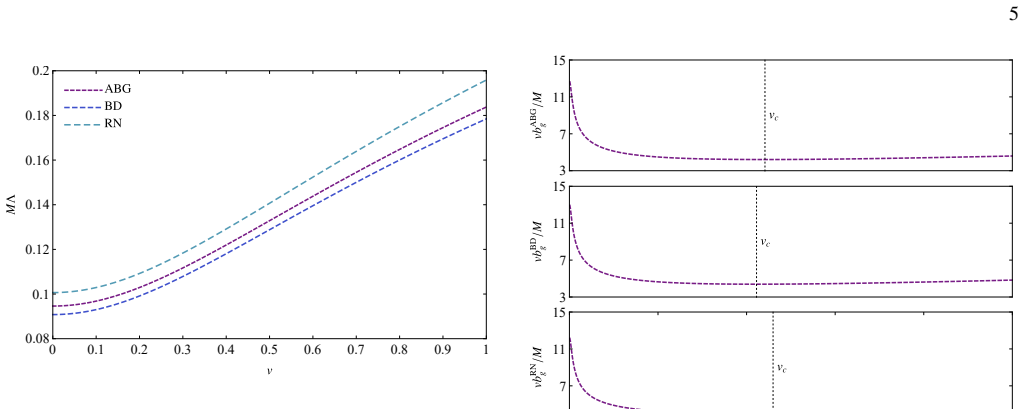
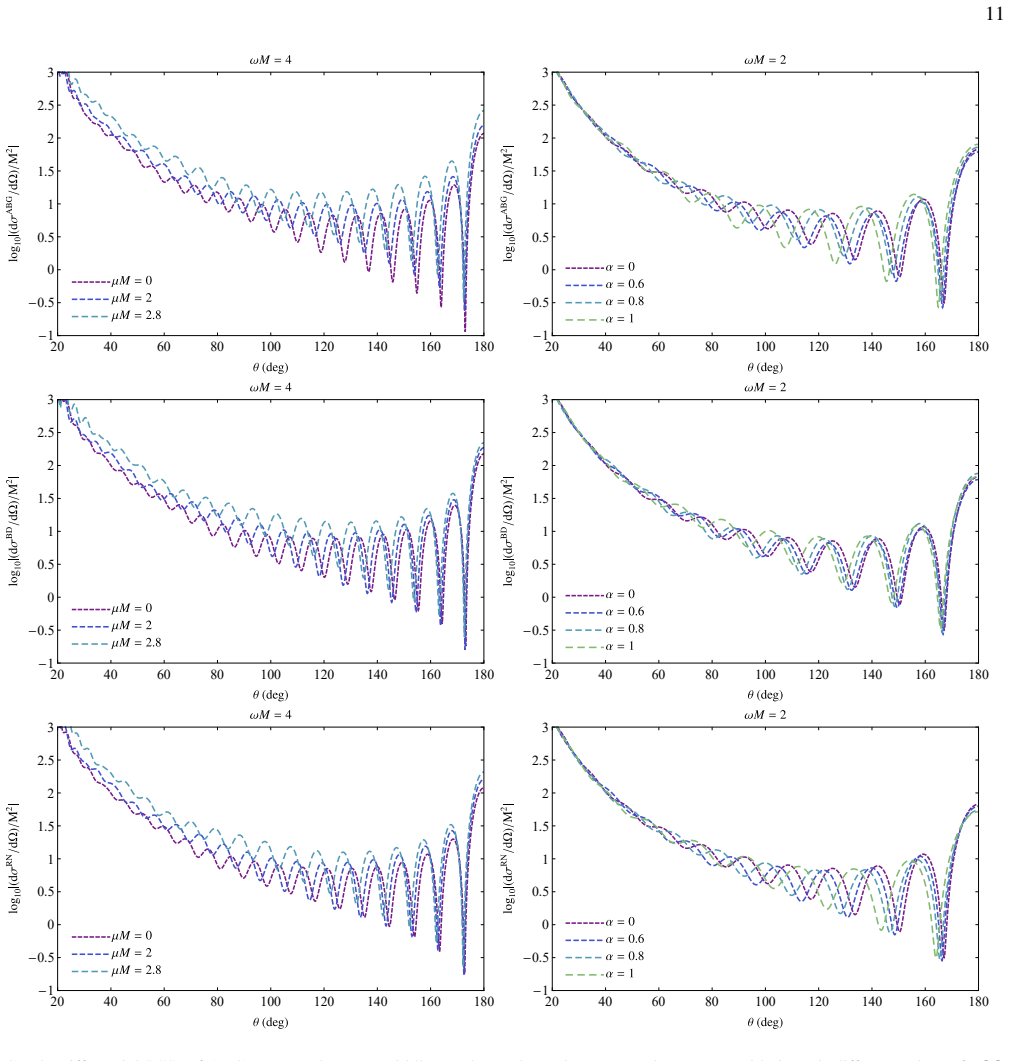
- Scattering spectra develop wider interference widths once the field velocity exceeds a critical value vc.
- Numerical results agree with classical and semiclassical approximations in the appropriate limits.
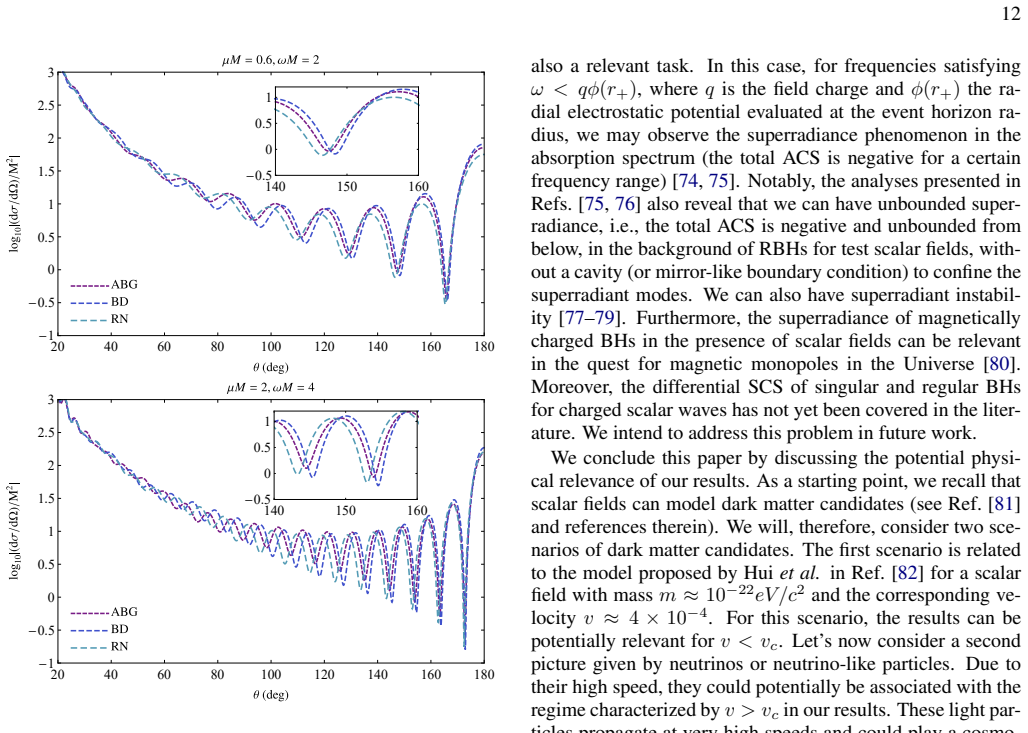
- Regular and Reissner-Nordström spectra can be made similar at arbitrary frequencies and angles when the field is massive.
Where Pith is reading between the lines
- Massive fields may reduce the observable difference between regular and singular geometries in wave scattering.
- Tests with other field spins or higher multipoles could show whether the similarity persists.
- If the similarity holds, it would affect attempts to use wave scattering to distinguish regular black holes from standard ones.
Load-bearing premise
The numerical integration of the radial wave equation on the regular black-hole backgrounds is accurate enough across the full frequency range that the reported similarity between regular and Reissner-Nordström spectra is not an artifact of discretization or boundary-condition choices.
What would settle it
A direct computation for a chosen field mass, frequency, scattering angle, and near-extreme charge showing that the absorption or scattering cross section of an Ayón-Beato-García or Bardeen black hole differs measurably from the Reissner-Nordström value.
Figures
read the original abstract
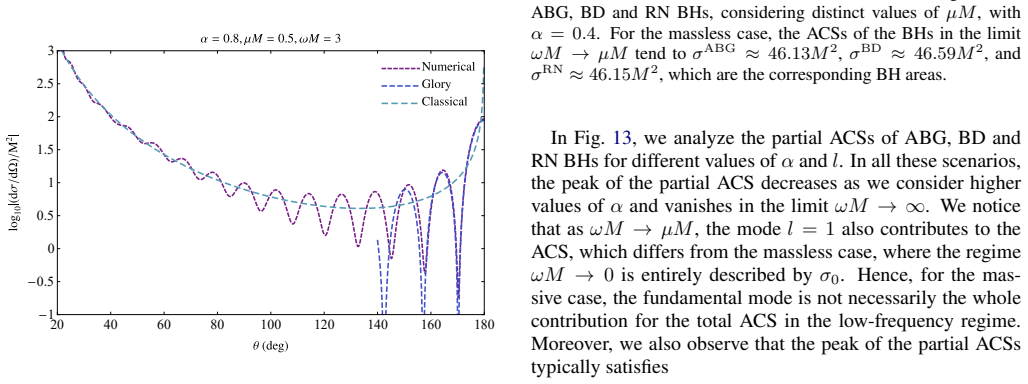
Regular black holes (RBHs) can be seen as possible alternatives to standard black holes (BHs), since these geometries do not have a curvature singularity. As a way of improving our knowledge of such geometries, we can investigate how the astrophysical environment interacts with RBHs and compare the results with those obtained in the framework of standard BHs. In this work, we aim to study the absorption and scattering cross sections of massive scalar waves impinging on Ay\'on-Beato-Garc\'ia and Bardeen charged RBH geometries, focusing on understanding the role played by the field's mass. Concerning the absorption spectrum, our numerical results show that the total absorption cross section decreases as we increase the field's mass for fixed values of the BH charge. In turn, in the scattering spectrum, an increase in the mass of the field leads to wider interference widths for field velocities larger than a critical value, $v_c$. Moreover, we also compare our numerical results with the classical and semiclassical approximations, showing that they agree very well within the appropriate limits. We also draw comparisons with the results of the Reissner-Nordstr\"om metric. In particular, we show that the mass of the field contributes to finding situations in which the absorption and scattering spectra of regular and standard BHs are similar for arbitrary values of the field frequency and scattering angle, considering low- to near-extreme BH charges.
Editorial analysis
A structured set of objections, weighed in public.
Referee Report
Summary. The manuscript numerically solves the radial Klein-Gordon equation for massive scalar waves on the Ayón-Beato-García and Bardeen charged regular black-hole backgrounds. It reports that increasing the scalar mass causes the total absorption cross section to decrease and produces wider interference fringes in the scattering cross section above a critical velocity; crucially, the mass term induces close similarity between the regular-BH absorption and scattering spectra and those of the Reissner-Nordström metric for arbitrary frequencies ω and scattering angles θ at low-to-near-extremal charges. The numerical results are stated to agree with classical and semiclassical limits in the appropriate regimes.
Significance. If the numerical accuracy is established, the result supplies a concrete mechanism by which the mass of a probing field can erase observable distinctions between regular and singular black holes in wave scattering, thereby sharpening the question of whether regular black holes can be distinguished from Reissner-Nordström black holes by astrophysical observations involving massive fields.
major comments (2)
- [Numerical Results] Numerical Results section (and abstract): the headline claim that scalar mass produces spectral similarity for arbitrary ω and θ rests on the numerical integration of the massive radial wave equation, yet the manuscript supplies neither convergence tests with respect to step size or integrator tolerance, nor checks of flux conservation, nor explicit verification that the asymptotic boundary condition at large r (matching to the massive-wave form with k=√(ω²-m²)) is insensitive to the matching radius. Without these controls the reported overlap could be a discretization artifact.
- [Comparison with limits] Comparison with limits paragraph: while agreement with classical and semiclassical approximations is asserted, no quantitative measure (e.g., relative error or frequency range of validity) is given, leaving the domain in which the numerics can be trusted unspecified and weakening the support for the similarity claim outside the low-frequency regime.
minor comments (2)
- [Scattering spectrum] The definition of the critical velocity v_c is introduced without an explicit formula or derivation; a short analytic expression would clarify the subsequent discussion of interference widths.
- [Figures] Figure captions should state the precise values of the scalar mass m, charge Q, and angular momentum l used in each panel to allow direct reproduction.
Simulated Author's Rebuttal
We thank the referee for the thorough review and constructive feedback on our manuscript. The comments highlight important aspects of numerical validation that will improve the clarity and robustness of the presented results. We address each major comment below and will incorporate the suggested enhancements in the revised version.
read point-by-point responses
-
Referee: Numerical Results section (and abstract): the headline claim that scalar mass produces spectral similarity for arbitrary ω and θ rests on the numerical integration of the massive radial wave equation, yet the manuscript supplies neither convergence tests with respect to step size or integrator tolerance, nor checks of flux conservation, nor explicit verification that the asymptotic boundary condition at large r (matching to the massive-wave form with k=√(ω²-m²)) is insensitive to the matching radius. Without these controls the reported overlap could be a discretization artifact.
Authors: We acknowledge that explicit documentation of these numerical controls is absent from the current manuscript, even though the underlying integration employs standard methods for the radial Klein-Gordon equation. Internally we verified convergence by varying the radial step size and integrator tolerance (Runge-Kutta order 4/5), confirmed flux conservation to relative accuracy better than 10^{-5} across the frequency range, and tested that the extracted absorption and scattering coefficients become insensitive to the matching radius once it exceeds 100M. In the revised manuscript we will add a dedicated paragraph (or short subsection) in the Numerical Results section that reports these tests, including representative convergence plots and tables of relative errors. This addition will directly address the concern and strengthen the support for the reported spectral similarity. revision: yes
-
Referee: Comparison with limits paragraph: while agreement with classical and semiclassical approximations is asserted, no quantitative measure (e.g., relative error or frequency range of validity) is given, leaving the domain in which the numerics can be trusted unspecified and weakening the support for the similarity claim outside the low-frequency regime.
Authors: We agree that quantitative error measures would better delineate the regime of validity. The manuscript already states qualitative agreement in the appropriate limits, but does not tabulate relative deviations. In the revision we will supplement the Comparison with limits paragraph with explicit relative-error curves (numerical versus classical geometric-optics and semiclassical WKB results) as functions of frequency, together with the frequency intervals where the discrepancy remains below 1 % and 5 %. These additions will specify the trustworthy domain and reinforce the similarity statements for the broader frequency range explored. revision: yes
Circularity Check
No circularity: direct numerical solution of wave equation on fixed metrics
full rationale
The work consists of numerical integration of the massive Klein-Gordon radial equation on the Ayón-Beato-García, Bardeen, and Reissner-Nordström backgrounds, followed by extraction of absorption and scattering cross sections and comparison to classical/semiclassical limits. No parameter is fitted to a subset of the output data and then re-used as a 'prediction'; no uniqueness theorem or ansatz is imported via self-citation to force the result; the reported similarity between regular and RN spectra for massive fields is an emergent numerical outcome rather than an identity by construction. The derivation chain is therefore self-contained against external benchmarks.
Axiom & Free-Parameter Ledger
axioms (2)
- domain assumption The Ayón-Beato-García and Bardeen metrics are exact solutions of the Einstein equations coupled to nonlinear electrodynamics.
- domain assumption The radial wave equation for a massive scalar field can be integrated numerically to sufficient accuracy to extract total absorption and differential scattering cross sections.
Reference graph
Works this paper leans on
-
[1]
S. W. Hawking and G. F. R. Ellis,The Large Scale Structure of Space-Time(Cambridge University Press, Cambridge, Eng- land, 1973). 13 0.4 0.6 0.8 1 1.2 1.4 1.655 75 95 115 135 0.4 0.6 0.8 1 1.2 1.4 1.675 95 115 135 155 20 40 60 80 100 120 140 160 180-1 -0.5 0 0.5 1 1.5 2 2.5 3 20 40 60 80 100 120 140 160 180-1 -0.5 0 0.5 1 1.5 2 2.5 3 20 40 60 80 100 120 1...
1973
-
[2]
F. J. Tipler, C. K. S. Clarke, and G. F. R. Ellis, Singularities and horizons: A review article, in General Relativity and Gravita- tion: One Hundred Years After the Birth of Albert Einstein, A. Held (eds.), Plenum Press, New York, 1980
1980
-
[3]
J. M. M. Senovilla, Singularity Theorems in General Relativ- ity: Achievements and Open Questions, Einstein Stud.12, 305 (2012)
2012
-
[4]
Wald,General Relativity(University of Chicago Press, Chicago, United States, 1984)
R. Wald,General Relativity(University of Chicago Press, Chicago, United States, 1984)
1984
-
[5]
D’Inverno and J
R. D’Inverno and J. Vickers,Introducing Einstein’s Relativ- ity: A Deeper Understanding(Oxford University Press, Oxford, 2022)
2022
-
[6]
Painlev´e, La m´ecanique classique et la th´eorie de la relativit´e, C
P. Painlev´e, La m´ecanique classique et la th´eorie de la relativit´e, C. R. Acad. Sci. Paris173, 677 (1921)
1921
-
[7]
Gullstrand, Allgemeine L ¨osung des statischen Eink¨orperproblems in der Einsteinschen Gravitationstheo- rie, Ark
A. Gullstrand, Allgemeine L ¨osung des statischen Eink¨orperproblems in der Einsteinschen Gravitationstheo- rie, Ark. Mat. Astron. Fys16, 8 (1922)
1922
-
[8]
Martel and E
K. Martel and E. Poisson, Regular coordinate systems for Schwarzschild and other spherical space-times, Am. J. Phys. 69, 476 (2001)
2001
-
[9]
Bardeen, Non-singular General Relativistic Gravitational Collapse, Proceedings of the International Conference GR5, 14 Tbilisi, U.S.S.R., 1968 (unpublished)
J. Bardeen, Non-singular General Relativistic Gravitational Collapse, Proceedings of the International Conference GR5, 14 Tbilisi, U.S.S.R., 1968 (unpublished)
1968
-
[10]
Ay ´on-Beato and A
E. Ay ´on-Beato and A. Garc ´ıa, Regular Black Hole in General Relativity Coupled to Nonlinear Electrodynamics, Phys. Rev. Lett.80, 5056-5059 (1998)
1998
-
[11]
Born, On the Quantum Theory of the Electromagnetic Field, Proc
M. Born, On the Quantum Theory of the Electromagnetic Field, Proc. R. Soc. Lond. A143, 410-437 (1934)
1934
-
[12]
Born and L
M. Born and L. Infeld, Foundations of the New Field Theory, Proc. R. Soc. Lond. A144, 425-451 (1934)
1934
-
[13]
Salazar, A
H. Salazar, A. Garc ´ıa and J. Plebanski, Duality rotations and type D solutions to Einstein equations with nonlinear electro- magnetic sources, J. Math. Phys.28, 2171-2181 (1987)
1987
-
[14]
E. S. Fradkin and A. A. Tseytlin, Non-linear electrodynamics from quantized strings, Phys. Lett. B163, 123 (1985)
1985
-
[15]
Seiberg and E
N. Seiberg and E. Witten, String theory and noncommutative geometry, J. High Energy Phys.1999, 93 (1999)
1999
-
[16]
A. A. Tseytlin, Born-Infeld action, supersymmetry and string theory, arXiv:hep-th/9908105 [hep-th]
work page internal anchor Pith review Pith/arXiv arXiv
-
[17]
Novello, S
M. Novello, S. E. Perez Bergliaffa, and J. Salim, Nonlinear electrodynamics and the acceleration of the Universe, Phys. Rev. D69, 127301 (2004)
2004
-
[18]
R. P. Mignani, V . Testa, D. Gonz´alez Caniulef, R. Taverna, R. Turolla, S. Zane, and K. Wu, Evidence for vacuum birefrin- gence from the first optical-polarimetry measurement of the iso- lated neutron star RX J1856.5-3754, Mon. Not. R. Astron. Soc. 465, 492 (2017)
2017
-
[19]
Aaboudet al.[ATLAS Collaboration], Evidence for light- by-light scattering in heavy-ion collisions with the ATLAS de- tector at the LHC, Nature Phys.13, 852 (2017)
M. Aaboudet al.[ATLAS Collaboration], Evidence for light- by-light scattering in heavy-ion collisions with the ATLAS de- tector at the LHC, Nature Phys.13, 852 (2017)
2017
-
[20]
Aadet al.[ATLAS Collaboration], Observation of Light-by- Light Scattering in UltraperipheralP b+P bCollisions with the ATLAS Detector, Phys
G. Aadet al.[ATLAS Collaboration], Observation of Light-by- Light Scattering in UltraperipheralP b+P bCollisions with the ATLAS Detector, Phys. Rev. Lett.123, 052001 (2019)
2019
-
[21]
Ejlli, F
A. Ejlli, F. Della Valle, U. Gastaldi, G. Messineo, R. Pengo, G. Ruoso, and G. Zavattini, The PVLAS experiment: A 25 year effort to measure vacuum magnetic birefringence, Phys. Rep. 871, 1 (2020)
2020
-
[22]
K. A. Bronnikov, Regular magnetic black holes and monopoles from nonlinear electrodynamics, Phys. Rev. D63, 044005 (2001)
2001
-
[23]
Dymnikova, Regular electrically charged vacuum structures with de Sitter centre in nonlinear electrodynamics coupled to general relativity, Class
I. Dymnikova, Regular electrically charged vacuum structures with de Sitter centre in nonlinear electrodynamics coupled to general relativity, Class. Quantum Grav.21, 4417 (2004)
2004
-
[24]
Balart and E
L. Balart and E. C. Vagenas, Regular black holes with a nonlin- ear electrodynamics source, Phys. Rev. D90, 124045 (2014)
2014
-
[25]
S. I. Kruglov, Black hole as a magnetic monopole within expo- nential nonlinear electrodynamics, Ann. Phys. (N. Y .)378, 59 (2017)
2017
- [26]
-
[27]
Ay ´on-Beato and A
E. Ay ´on-Beato and A. Garc´ıa, The Bardeen Model as a Nonlin- ear Magnetic Monopole, Phys. Lett. B493, 149-152 (2000)
2000
-
[28]
M. E. Rodrigues and M. V . de S. Silva, Bardeen regular black hole with an electric source, J. Cosmol. Astropart. Phys.2018, 15 (2018)
2018
-
[29]
Fan and X
Z.-Y . Fan and X. Wang, Construction of regular black holes in general relativity, Phys. Rev. D94, 124027 (2016)
2016
-
[30]
Toshmatov, Z
B. Toshmatov, Z. Stuchl ´ık, and B. Ahmedov, Comment on ”Construction of regular black holes in general relativity”, Phys. Rev. D98, 028501 (2018)
2018
-
[31]
Ovalle, R
J. Ovalle, R. Casadio, E. Contreras, and A. Sotomayor, Hairy black holes by gravitational decoupling, Phys. Dark Univ.31, 100744 (2021)
2021
-
[32]
G. J. Olmo and D. Rubiera-Garcia, Palatinif(R)black holes in nonlinear electrodynamics, Phys. Rev. D84, 124059 (2011)
2011
-
[33]
E. L. B. Junior, M. E. Rodrigues, and M. J. S. Houndjo, Regular black holes inf(T)Gravity through a nonlinear electrodynam- ics source, J. Cosmol. Astropart. Phys.10, 060 (2015)
2015
-
[34]
M. V . S. Silva and M. E. Rodrigues, Regular black holes in f(G)gravity, Eur. Phys. J. C78, 638 (2018)
2018
-
[35]
Narayan, Black Holes in Astrophysics, New J
R. Narayan, Black Holes in Astrophysics, New J. Phys.7, 199 (2005)
2005
-
[36]
J. A. Futterman, F. A. Handler and R. A. Matzner,Scatter- ing from Black Holes(Cambridge University Press, England, 1988)
1988
-
[37]
Jung and D
E. Jung and D. Park, Effect of scalar mass in the absorption and emission spectra of Schwarzschild black hole, Class. Quantum Grav.21, 3717 (2004)
2004
-
[38]
S. R. Dolan, Scattering and absorption of gravitational plane waves by rotating black holes, Class. Quantum Grav.25, 235002 (2008)
2008
-
[39]
L. C. B. Crispino, S. R. Dolan, and E. S. Oliveira, Scattering of massless scalar waves by Reissner-Nordstr ¨om black holes, Phys. Rev. D79, 064022 (2009)
2009
-
[40]
E. S. Oliveira, L. C. B. Crispino, and A. Higuchi, Equality be- tween gravitational and electromagnetic absorption cross sec- tions of extreme Reissner-Nordstrom black holes, Phys. Rev. D 84, 084048 (2011)
2011
-
[41]
C. L. Benone, E. S. de Oliveira, S. R. Dolan, and L. C. B. Crispino, Absorption of a massive scalar field by a charged black hole, Phys. Rev. D89, 104053 (2014); Addendum, Phys. Rev. D95, 044035 (2017)
2014
-
[42]
C. F. B. Macedo, L. C. S. Leite, E. S. Oliveira, S. R. Dolan, and L. C. B. Crispino, Absorption of planar massless scalar waves by Kerr black holes, Phys. Rev. D88, 064033 (2013)
2013
-
[43]
L. C. S. Leite, C. L. Benone, and L. C. B. Crispino, Scalar absorption by charged rotating black holes, Phys. Rev. D96, 044043 (2017)
2017
-
[44]
C. L. Benone and L. C. B. Crispino, Massive and charged scalar field in Kerr-Newman spacetime: Absorption and superradi- ance, Phys. Rev. D99, 044009 (2019)
2019
-
[45]
Folacci and M
A. Folacci and M. O. E. Hadj, Electromagnetic radiation gener- ated by a charged particle falling radially into a Schwarzschild black hole: A complex angular momentum description, Phys. Rev. D102, 024026 (2020)
2020
-
[46]
M. O. E. Hadj, T. Stratton, and Sam R. Dolan, Scattering from compact objects: Regge poles and the complex angular momen- tum method, Phys. Rev. D101, 104035 (2020)
2020
-
[47]
Q. Li, Q. Wang, and J. Jia, Scattering of charged massive scalar waves by Kerr-Newman black holes, Eur. Phys. J. C86, 360 (2026)
2026
-
[48]
C. F. B. Macedo and L. C. B. Crispino, Absorption of planar massless scalar waves by Bardeen regular black holes, Phys. Rev. D90, 064001 (2014)
2014
-
[49]
C. F. B. Macedo, E. S. de Oliveira, and L. C. B. Crispino, Scat- tering by regular black holes: Planar massless scalar waves im- pinging upon a bardeen black hole, Phys. Rev. D92, 024012 (2015)
2015
-
[50]
Fernando, Bardeen-de Sitter black holes, Int
S. Fernando, Bardeen-de Sitter black holes, Int. J. Mod. Phys. D26, 1750071 (2017)
2017
-
[51]
P. A. Sanchez, N. Bret´on, and S. E. P. Bergliaffa, Scattering and absorption of massless scalar waves by Born-Infeld black holes, Ann. Phys. (N. Y .)393, 107 (2018)
2018
-
[52]
M. A. A. Paula, L. C. S. Leite, and L. C. B. Crispino, Elec- trically charged black holes in linear and non-linear electrody- namics: Geodesic analysis and scalar absorption, Phys. Rev. D 102, 104033 (2020)
2020
-
[53]
M. A. A. de Paula, L. C. S. Leite, and L. C. B. Crispino, Scattering properties of charged black holes in nonlinear and Maxwell’s electrodynamics, Eur. Phys. J. Plus137, 785 (2022). 15
2022
- [54]
-
[55]
A. Q. Baptista and M. L. Pe ˜nafiel, Scattering and absorption of massless scalar waves by a ModMax black hole, Phys. Rev. D 112, 024037 (2025)
2025
-
[56]
L. O. T. Tovar, O. Pedraza, L. A. L ´opez, and R. Arceo, Quasi- normal modes and absorption section from regular black holes immersed in perfect fluid dark matter, Mod. Phys. Lett. A41, 2650062 (2026)
2026
-
[57]
Absorption and scattering of massless scalar wave from Regular Black Holes
M. A. A. de Paula, L. C. S. Leite, and L. C. B. Crispino, Com- ment on: “Absorption and scattering of massless scalar wave from Regular Black Holes”, Gen. Rel. Grav.55, 73 (2023)
2023
-
[58]
Karmakar, A comparative study of the absorption cross sec- tion of static regular black holes for electromagnetic field, Phys
R. Karmakar, A comparative study of the absorption cross sec- tion of static regular black holes for electromagnetic field, Phys. Lett. B870, 139951 (2025)
2025
-
[59]
J. Tang, Y . Huang, and H. Zhang, Absorption and scattering of massless scalar waves by Frolov black holes, Phys. Rev. D113, 084031 (2026)
2026
-
[60]
Li, Y .-Y
S.-L. Li, Y .-Y . Liu, W.-D. Li, and W.-S. Dai, Scalar field in Reissner–Nordstr ¨om spacetime: Bound state and scattering state (with appendix on eliminating oscillation in partial sum approximation of periodic function), Ann. Phys.432, 168578 (2021)
2021
-
[61]
M. A. A. de Paula, S. R. Dolan, and L. C. B. Crispino, Massive scalar wave effects in the Schwarzschild black hole spacetime (in preparation)
-
[62]
S. M. Carroll,Spacetime and Geometry: An Introduction to General Relativity(Cambridge University Press, Cambridge, 2019)
2019
-
[63]
S. R. Dolan,Scattering, absorption and emission by black holes (PhD thesis, University of Cambridge, 2007)
2007
-
[64]
R. G. Newton,Scattering Theory of Waves and Particles(Dover Publications, New York, United States, 2013)
2013
-
[65]
Unruh, Absorption Cross Section of Small Black Holes, Phys
W. Unruh, Absorption Cross Section of Small Black Holes, Phys. Rev. D14, 3251-3259 (1976)
1976
-
[66]
Cardoso, A
V . Cardoso, A. S. Miranda, E. Berti, H. Witek and V . T. Zanchin, Geodesic Stability, Lyapunov Exponents and Quasi- normal Modes, Phys. Rev. D79, 064016 (2009)
2009
-
[67]
R. A. Matzner, C. DeWitt-Morette, B. Nelson, and T.-R. Zhang, Glory scattering by black holes, Phys. Rev. D31, 1869 (1985)
1985
-
[68]
D. R. Yennie, D. G. Ravenhall, and R. N. Wilson, Phase-Shift Calculation of High-Energy Electron Scattering, Phys. Rev.95, 500 (1954)
1954
-
[69]
Abramowitz and I
M. Abramowitz and I. A. Stegun,Handbook of Mathematical Functions with Formulas, Graphs, and Mathematical Tables (Dover Publications, New York, United States, 1965)
1965
-
[70]
Dolan, C
S. Dolan, C. Doran, and A. Lasenby, Fermion scattering by a Schwarzschild black hole, Phys. Rev. D74, 064005 (2006)
2006
-
[71]
S. R. Dolan and T. Stratton, Rainbow scattering in the grav- itational field of a compact object, Phys. Rev. D95, 124055 (2017)
2017
-
[72]
S.R. Das, G. Gibbons and S.D. Mathur, Universality of Low Energy Absorption Cross Sections for Black Holes, Phys. Rev. Lett.78, 417-419 (1997)
1997
-
[73]
Higuchi, Low-frequency Scalar Absorption Cross Sections for Stationary Black Holes, Class
A. Higuchi, Low-frequency Scalar Absorption Cross Sections for Stationary Black Holes, Class. Quantum Grav.18, L139- L144 (2001)
2001
-
[74]
C. L. Benone and L. C. B. Crispino, Superradiance in static black hole spacetimes, Phys. Rev. D93, 024028 (2016)
2016
-
[75]
M. A. A. de Paula, S. R. Dolan, L. C. S. Leite, and L. C. B. Crispino, Absorption and unbounded superradiance in a static regular black hole spacetime, Phys. Rev. D109, 064053 (2024)
2024
-
[76]
M. A. A. de Paula, L. C. S. Leite, and L. C. B. Crispino, Suf- ficient conditions for unbounded superradiance in black hole spacetimes sourced by nonlinear electrodynamics, Phys. Rev. D111, 104010 (2025)
2025
-
[77]
S. R. Dolan, M. A. A. de Paula, L. C. S. Leite, and L. C. B. Crispino, Superradiant instability of a charged regular black hole, Phys. Rev. D109, 124037 (2024)
2024
-
[78]
Y . Zhan, H. Xu, and S.-J. Zhang, Charged superradiant insta- bility in a spherical regular black hole, Eur. Phys. J. C84, 1315 (2024)
2024
-
[79]
Hod, A sufficient condition for the development of super- radiant instabilities in charged black-hole spacetimes, J
S. Hod, A sufficient condition for the development of super- radiant instabilities in charged black-hole spacetimes, J. High Energy Phys.2025, 197 (2025)
2025
-
[80]
Pere ˜niguez, M
D. Pere ˜niguez, M. de Amicis, R. Brito, and R. P. Macedo, Su- perradiant Instability of Magnetic Black Holes, Phys. Rev. D 110, 104001 (2024)
2024
discussion (0)
Sign in with ORCID, Apple, or X to comment. Anyone can read and Pith papers without signing in.