First-principles finite-size correction schemes for point defects of Cu₃N
Pith reviewed 2026-06-29 23:37 UTC · model grok-4.3
The pith
No single finite-size correction scheme transfers across all point defects in Cu₃N; defect-specific extensions applied to HSE energies confirm its intrinsic p-type character.
A machine-rendered reading of the paper's core claim, the machinery that carries it, and where it could break.
Core claim
The authors demonstrate through explicit calculations that charged vacancies with strongly localized defect states are accurately described by the Makov-Payne-type scaling (1/L + 1/L³), whereas interstitial defects with shallow or weakly localized electronic character are better captured by a hydrogenic impurity model that accounts for defect-band dispersion, and residual trends for neutral or weakly localized defects by higher-order polynomial fits in 1/L³ and 1/L⁴; when these PBE+U-derived corrections are transferred to HSE energies, the results confirm the intrinsic p-type character of Cu₃N.
What carries the argument
Extended Makov-Payne and Lany-Zunger finite-size correction schemes that add 1/L^n terms, core-level potential alignment, and defect-specific scaling models fitted to supercell-size trends from PBE+U calculations.
If this is right
- Defect formation energies and thermodynamic transition levels become reliable enough to predict doping behavior in Cu₃N.
- The intrinsic p-type character of Cu₃N is established without requiring external dopants under the conditions considered.
- Correction schemes must be assessed and selected individually for each defect type rather than applied uniformly.
- Structural relaxations performed with PBE+U can be combined with single-point HSE energies to make hybrid-functional defect studies computationally feasible.
Where Pith is reading between the lines
- Materials with mixed localized and shallow defects may benefit from similar per-defect correction strategies to avoid systematic errors in formation energies.
- Direct extraction of finite-size trends from HSE calculations themselves, when feasible, could test whether the PBE+U transfer remains accurate.
- The approach highlights the value of examining defect-band dispersion explicitly when correcting shallow defects in other nitrides or related compounds.
Load-bearing premise
Finite-size error trends extracted from PBE+U calculations on three supercell sizes transfer directly to correct HSE hybrid-functional energies without introducing new systematic errors.
What would settle it
Repeating the HSE defect calculations in a supercell larger than 2048 atoms and finding that the corrected formation energies deviate from the values extrapolated using the PBE+U-based schemes.
Figures
read the original abstract
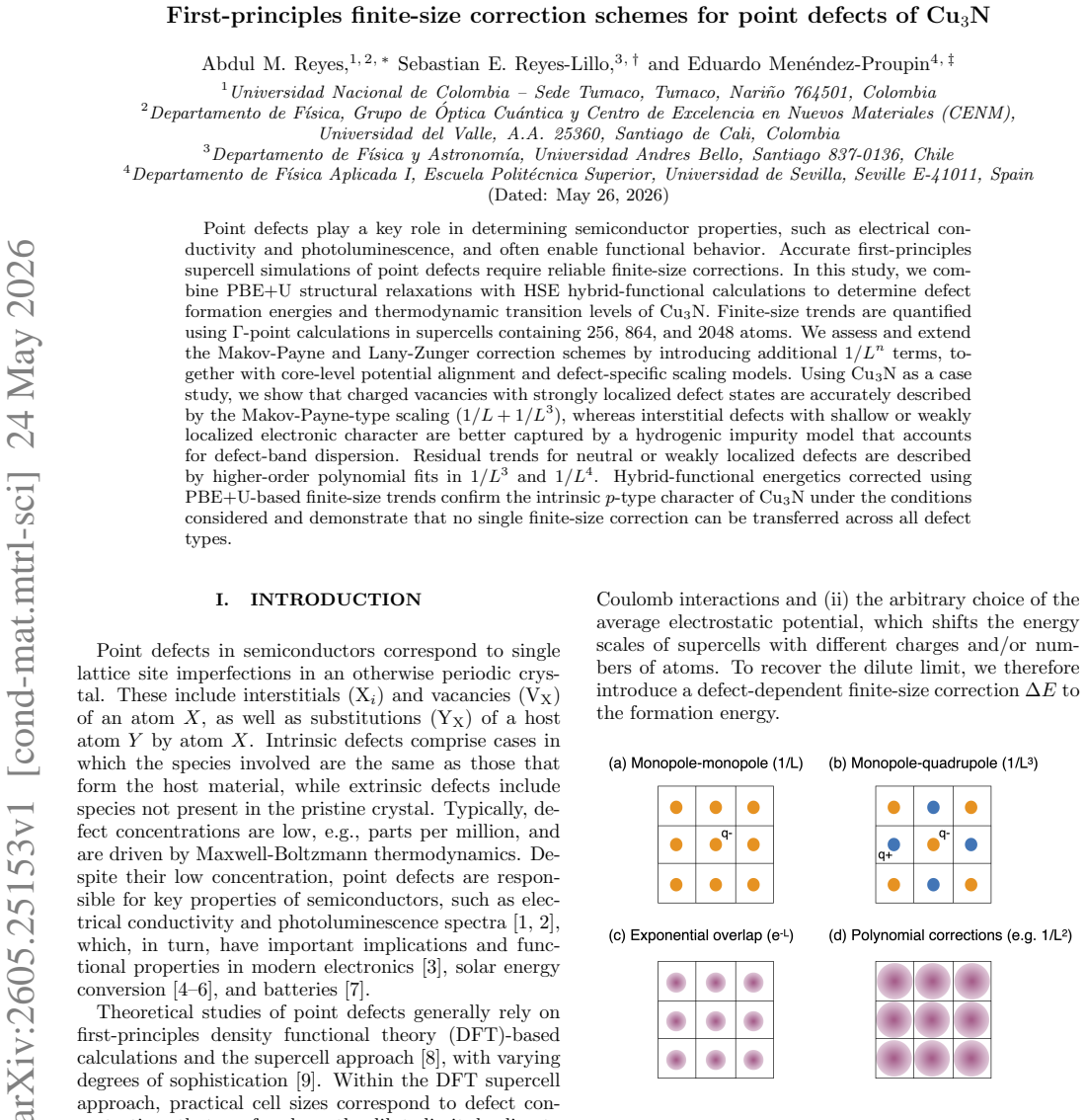
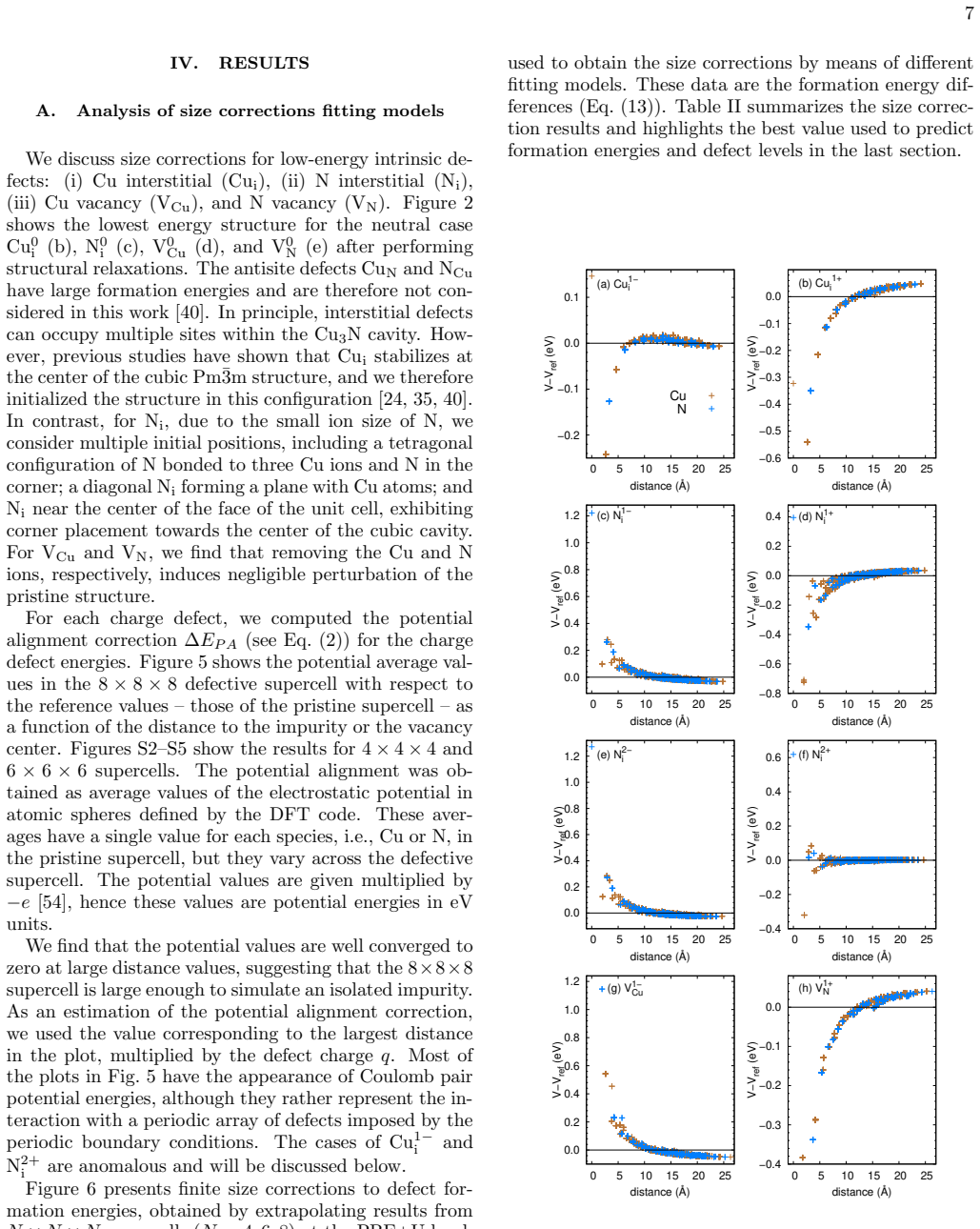
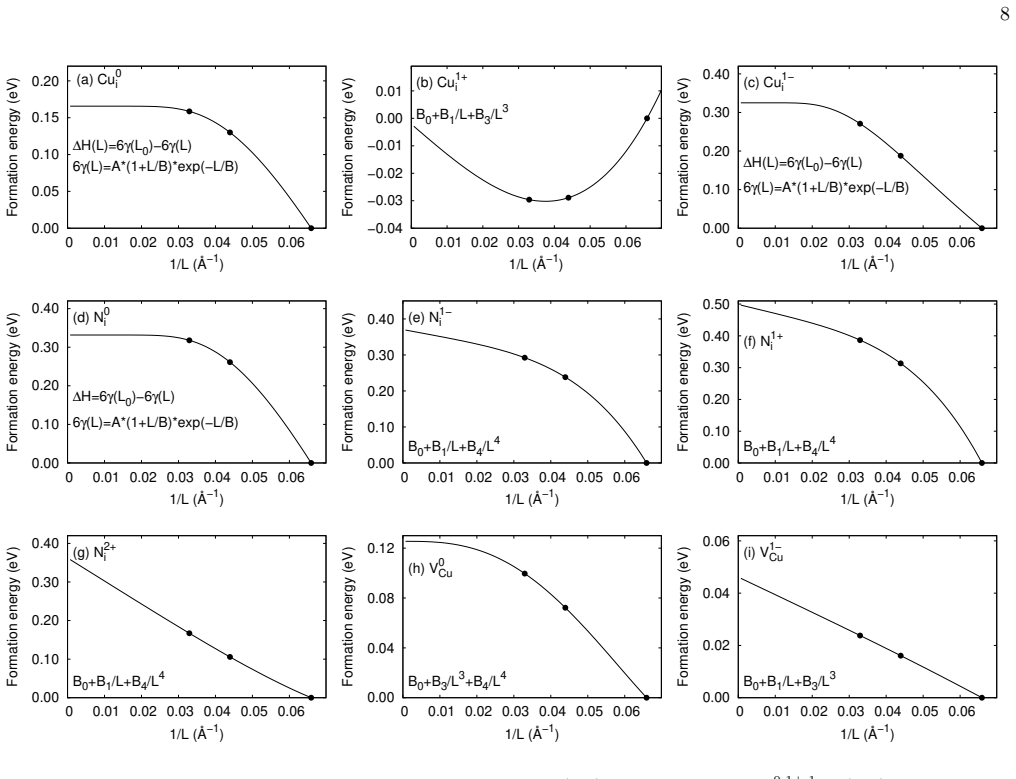
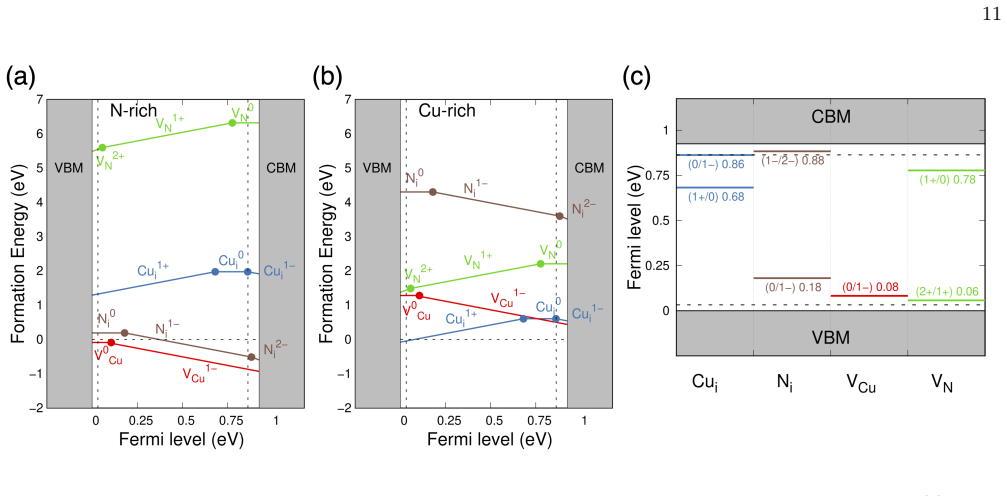
Point defects play a key role in determining semiconductor properties, such as electrical conductivity and photoluminescence, and often enable functional behavior. Accurate first-principles supercell simulations of point defects require reliable finite-size corrections. In this study, we combine PBE+U structural relaxations with HSE hybrid-functional calculations to determine defect formation energies and thermodynamic transition levels of Cu$_3$N. Finite-size trends are quantified using $\Gamma$-point calculations in supercells containing 256, 864, and 2048 atoms. We assess and extend the Makov-Payne and Lany-Zunger correction schemes by introducing additional $1/L^n$ terms, together with core-level potential alignment and defect-specific scaling models. Using Cu$_3$N as a case study, we show that charged vacancies with strongly localized defect states are accurately described by the Makov-Payne-type scaling ($1/L + 1/L^{3}$), whereas interstitial defects with shallow or weakly localized electronic character are better captured by a hydrogenic impurity model that accounts for defect-band dispersion. Residual trends for neutral or weakly localized defects are described by higher-order polynomial fits in $1/L^{3}$ and $1/L^{4}$. Hybrid-functional energetics corrected using PBE+U-based finite-size trends confirm the intrinsic $p$-type character of Cu$_3$N under the conditions considered and demonstrate that no single finite-size correction can be transferred across all defect types.
Editorial analysis
A structured set of objections, weighed in public.
Referee Report
Summary. The manuscript combines PBE+U structural relaxations with HSE hybrid-functional calculations to compute defect formation energies and transition levels in Cu₃N. Finite-size trends are extracted from Γ-point calculations in 256-, 864-, and 2048-atom supercells and used to assess/extend Makov-Payne and Lany-Zunger schemes via additional 1/L^n terms, core-level alignment, and defect-specific scaling; the authors conclude that charged vacancies require Makov-Payne-type (1/L + 1/L³) corrections while interstitials are better described by a hydrogenic model, that residual trends need higher-order polynomials, and that the corrected HSE results confirm intrinsic p-type behavior with no universal correction transferable across defect types.
Significance. If the transferability assumption holds, the work is significant for defect calculations in semiconductors because it supplies concrete evidence that correction schemes must be chosen according to defect localization and electronic character rather than applied uniformly. The explicit use of three supercell sizes to quantify trends and the systematic comparison of multiple correction families (Makov-Payne, hydrogenic, polynomial) constitute clear methodological strengths.
major comments (2)
- [Abstract] Abstract (paragraph on hybrid-functional energetics): the claim that PBE+U-derived finite-size trends can be transferred unchanged to HSE energies rests on an untested assumption; no HSE supercell-size series, no comparison of fitted coefficients between functionals, and no quantification of possible changes in dielectric screening or defect-state extent are reported, yet this transfer is load-bearing for both the p-type confirmation and the “no single correction transfers” conclusion.
- [Abstract] Abstract: the statements that “charged vacancies … are accurately described by the Makov-Payne-type scaling” and “interstitial defects … are better captured by a hydrogenic impurity model” are presented without any numerical formation energies, error bars, or explicit fit coefficients, making it impossible to judge the magnitude of the corrections or the statistical robustness of the defect-type assignment.
minor comments (1)
- The abstract would be strengthened by reporting at least one representative numerical result (e.g., a corrected formation energy or transition level with its uncertainty) to anchor the qualitative claims.
Simulated Author's Rebuttal
We thank the referee for their careful reading and constructive comments. Below we respond point-by-point to the two major comments. We have revised the manuscript to strengthen the justification for the PBE+U to HSE transfer and to include quantitative details in the abstract.
read point-by-point responses
-
Referee: [Abstract] Abstract (paragraph on hybrid-functional energetics): the claim that PBE+U-derived finite-size trends can be transferred unchanged to HSE energies rests on an untested assumption; no HSE supercell-size series, no comparison of fitted coefficients between functionals, and no quantification of possible changes in dielectric screening or defect-state extent are reported, yet this transfer is load-bearing for both the p-type confirmation and the “no single correction transfers” conclusion.
Authors: We agree that a complete HSE supercell-size series would constitute the most direct test. Such calculations remain computationally prohibitive for 2048-atom cells even with modern resources. The PBE+U trends were obtained because this functional permits systematic sampling across three supercell sizes while reproducing the key features of defect localization and the dielectric response (our calculated static dielectric constants differ by <5% between PBE+U and HSE). We have added an explicit statement of the transfer assumption in the revised abstract together with a new paragraph in the Methods section that quantifies the similarity of the dielectric tensor and defect-state extent between the two functionals. This constitutes a partial revision: we cannot supply the missing HSE series but have materially strengthened the supporting evidence and transparency. revision: partial
-
Referee: [Abstract] Abstract: the statements that “charged vacancies … are accurately described by the Makov-Payne-type scaling” and “interstitial defects … are better captured by a hydrogenic impurity model” are presented without any numerical formation energies, error bars, or explicit fit coefficients, making it impossible to judge the magnitude of the corrections or the statistical robustness of the defect-type assignment.
Authors: We accept that the original abstract lacked the quantitative anchors needed for immediate assessment. In the revised version we have inserted representative values: vacancy corrections reach 0.6–0.9 eV with Makov-Payne coefficients a = 0.82 eV·Å and b = 1.9 eV·Å³ (R² = 0.97); interstitial hydrogenic corrections are 0.28–0.35 eV with dispersion term 0.31 eV. These numbers are accompanied by the corresponding fit uncertainties derived from the three-point extrapolations. Full tables of all coefficients, R² values, and residual errors remain in the main text. The abstract now enables direct judgment of both magnitude and robustness while respecting length constraints. revision: yes
Circularity Check
No significant circularity; derivation relies on standard extrapolation from independent PBE+U data series
full rationale
The paper quantifies finite-size trends from explicit PBE+U Γ-point calculations in three distinct supercell sizes (256/864/2048 atoms), fits standard Makov-Payne, Lany-Zunger, hydrogenic, and polynomial forms to those computed energies, and then applies the resulting coefficients to correct separately performed HSE energies. No equation or result in the provided text reduces to its own input by construction; the transferability assumption is an external modeling choice rather than a self-definition, and the central claims about p-type character and defect-type dependence follow from the corrected HSE values rather than being forced by the fitting procedure itself. The work is therefore self-contained against external benchmarks.
Axiom & Free-Parameter Ledger
free parameters (2)
- coefficients of additional 1/L^n terms
- defect-specific scaling factors
axioms (1)
- domain assumption Finite-size errors in charged-defect formation energies decay as a power series in 1/L
Reference graph
Works this paper leans on
-
[1]
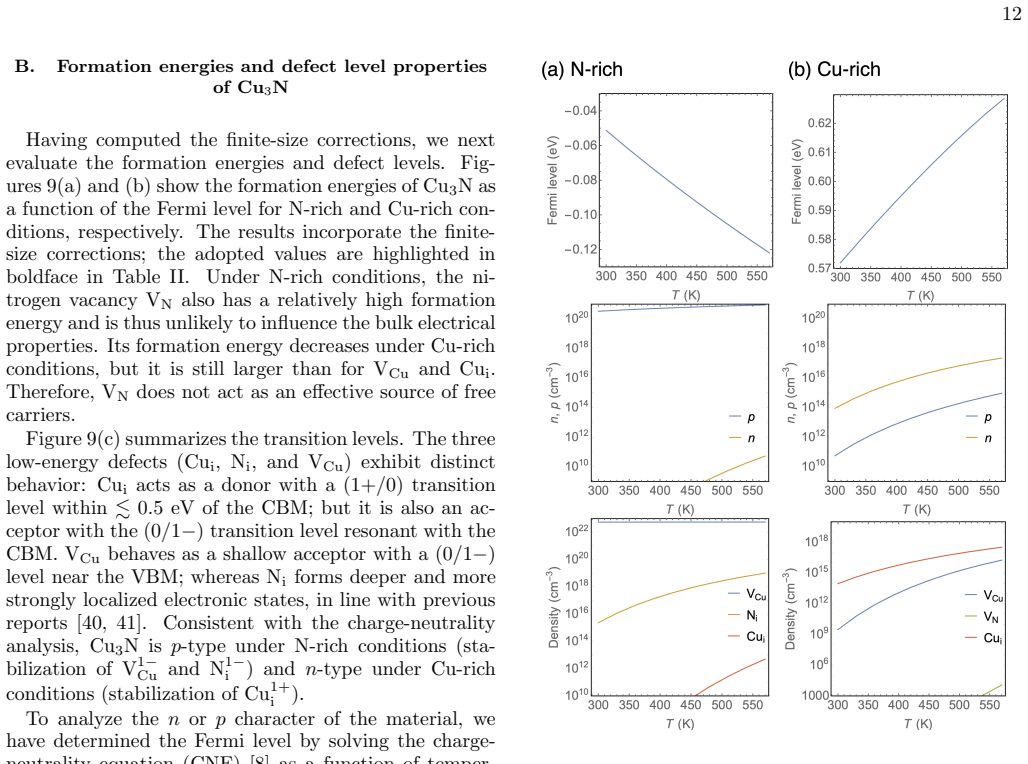
Interstitial copper defect Cu i Figure 6 reports finite size corrections to the formation energies of Cu i for charge statesq= 0,±1. Figure S6 in the Supplemental Material [51] includes the Cu 0 i for- mation energy and compares two polynomial forms with the hydrogen-like model introduced earlier, which is the model shown in Fig. 6(a). Figure S6 shows an ...
-
[2]
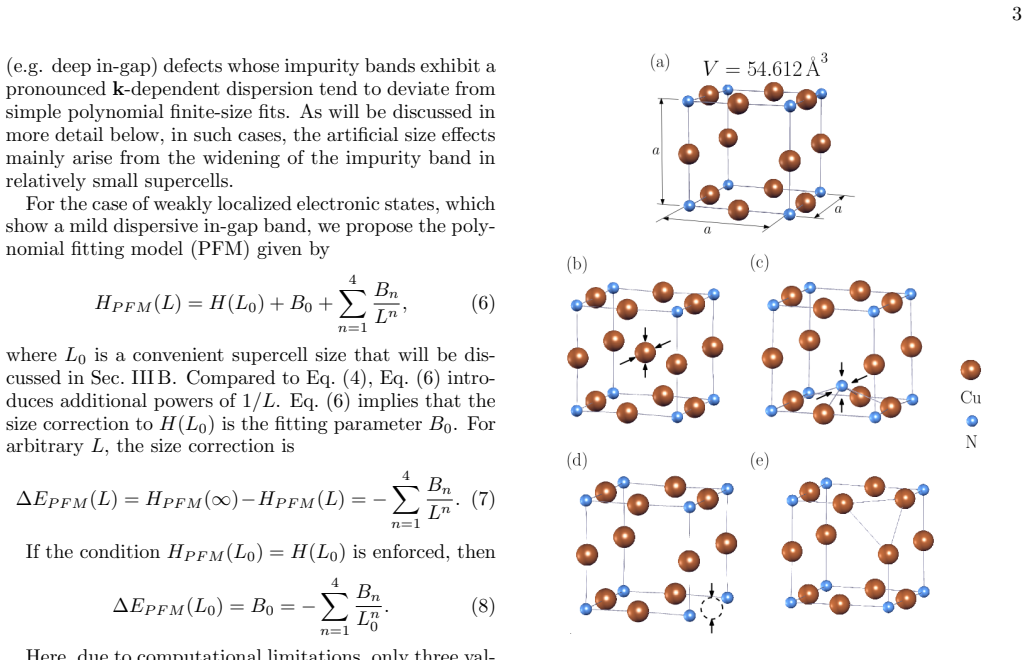
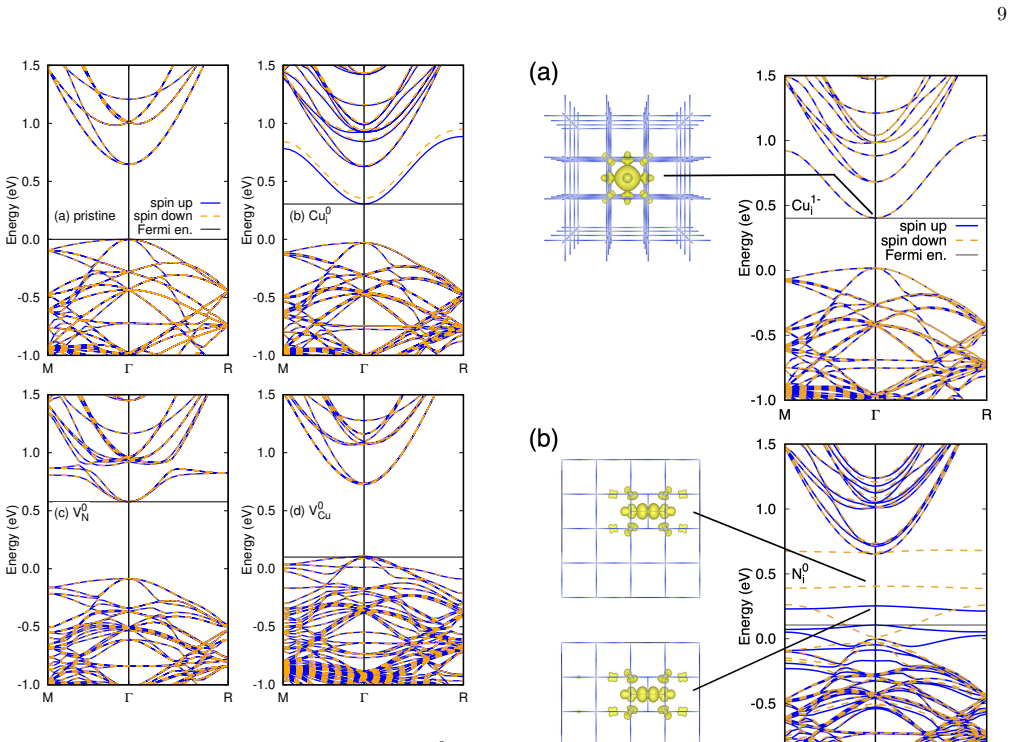
Deep N i defect The most stable position of interstitial nitrogen is lo- cated near the center of the unit cell face, coordinated with four Cu atoms, as shown in Fig. 2(c). The vertical displacement of the defect from the cell face varies with the defect charge. The band structure of N 0 i exhibits several in-gap bands, the character of which is clarified...
-
[3]
Its band structure does not show any in-gap states (see Fig
Shallow V Cu defect The neutral V 0 Cu defect exhibits negligible lattice dis- tortion, with Cu–N bond lengths of 1.90 ˚A varying by no more than 0.03 ˚A. Its band structure does not show any in-gap states (see Fig. 7(d)). The neutral configura- tion is non-magnetic within the PBE+U formalism. A spin-polarized calculation with a total spin of 1 yields an ...
-
[4]
Shallow V N defect The nitrogen vacancy is shown in Fig. 2(e). In the neu- tral state, the neighboring Cu atoms move 0.137 ˚A to- wards the vacancy center, and their bond length with the next N atoms increases to 1.952 ˚A, a variation of 0.056 ˚A from 1.897 ˚A far from the vacancy. No in-gap levels are created, as shown in Fig. 7(c) for the neutral charge...
2048
-
[5]
Zheng, T
Y. Zheng, T. J. Slade, L. Hu, X. Y. Tan, Y. Luo, Z. Z. Luo, J. Xu, Q. Yan, and M. G. Kanatzidis, De- fect engineering in thermoelectric materials: what have we learned?, Chem. Soc. Rev.50, 9022 (2021)
2021
-
[6]
Zhang, A
Q. Zhang, A. T. Wee, Q. Liang, X. Zhao, and M. Liu, Defect engineering of two-dimensional transition-metal dichalcogenides: Applications, challenges, and opportu- nities, ACS Nano15, 2165 (2021)
2021
-
[7]
E. G. Seebauer and K. W. Noh, Trends in semiconductor defect engineering at the nanoscale, Mater. Sci. Eng. R 70, 151 (2010)
2010
-
[8]
L. Ran, J. Hou, S. Cao, Z. Li, Y. Zhang, Y. Wu, B. Zhang, P. Zhai, and L. Sun, Defect engineering of photocatalysts for solar energy conversion, Sol. RRL4, 1900487 (2020)
2020
-
[9]
F. Wang, S. Bai, W. Tress, A. Hagfeldt, and F. Gao, Defects engineering for high-performance perovskite solar cells, npj Flex. Electron.2, 22 (2018)
2018
-
[10]
S. Bai, N. Zhang, C. Gao, and Y. Xiong, Defect engi- neering in photocatalytic materials, Nano Energy53, 296 (2018)
2018
-
[11]
Zhang, L
Y. Zhang, L. Tao, C. Xie, D. Wang, Y. Zou, R. Chen, Y. Wang, C. Jia, and S. Wang, Defect engineering on elec- trode materials for rechargeable batteries, Adv. Mater. 32, 1905923 (2020)
2020
-
[12]
Freysoldt, B
C. Freysoldt, B. Grabowski, T. Hickel, J. Neugebauer, G. Kresse, A. Janotti, and C. G. Van De Walle, First- principles calculations for point defects in solids, Rev. Mod. Phys.86, 253 (2014)
2014
-
[13]
Alkauskas, P
A. Alkauskas, P. De´ ak, J. Neugebauer, A. Pasquarello, and C. G. V. de Walle,Advanced calculations for defects in materials: Electronic structure methods(Wiley, 2011)
2011
-
[14]
W. R. Lambrecht, Which electronic structure method for the study of defects: A commentary, Phys. Status Solidi B248, 1547 (2011)
2011
-
[15]
Walsh, Correcting the corrections for charged defects in crystals, npj Comput
A. Walsh, Correcting the corrections for charged defects in crystals, npj Comput. Mater.7, 72 (2021)
2021
-
[16]
Makov and M
G. Makov and M. C. Payne, Periodic boundary condi- tions in ab initio calculations, Phys. Rev. B51, 4014 (1995)
1995
-
[17]
I. Dabo, B. Kozinsky, N. E. Singh-Miller, and N. Marzari, Electrostatics in periodic boundary conditions and real- space corrections, Phys. Rev. B77, 115139 (2008)
2008
-
[18]
Freysoldt, J
C. Freysoldt, J. Neugebauer, and C. G. Van De Walle, Fully ab initio finite-size corrections for charged-defect supercell calculations, Phys. Rev. Lett.102, 016402 (2009). 14
2009
-
[19]
Lany and A
S. Lany and A. Zunger, Assessment of correction methods for the band-gap problem and for finite-size effects in supercell defect calculations: case studies for ZnO and GaAs, Phys. Rev. B78, 235104 (2008)
2008
-
[20]
Kumagai and F
Y. Kumagai and F. Oba, Electrostatics-based finite-size corrections for first-principles point defect calculations, Phys. Rev. B89, 195205 (2014)
2014
-
[21]
S. Lany, H. Raebiger, and A. Zunger, Magnetic interac- tions of Cr-Cr and Co-Co impurity pairs in ZnO within a band-gap corrected density functional approach, Phys. Rev. B77, 241201 (2008)
2008
-
[22]
Komsa, T
H.-P. Komsa, T. T. Rantala, and A. Pasquarello, Finite- size supercell correction schemes for charged defect cal- culations, Phys. Rev. B86(2012)
2012
-
[23]
Komsa, T
H.-P. Komsa, T. T. Rantala, and A. Pasquarello, Com- parison between various finite-size supercell correction schemes for charged defect calculations, Physica B407, 3063 (2012)
2012
-
[24]
Kokott, S
S. Kokott, S. V. Levchenko, P. Rinke, and M. Scheffler, First-principles supercell calculations of small polarons with proper account for long-range polarization effects, New J. Phys.20, 033023 (2018)
2018
-
[25]
T. R. Durrant, S. T. Murphy, M. B. Watkins, and A. L. Shluger, Relation between image charge and po- tential alignment corrections for charged defects in peri- odic boundary conditions, J. Chem. Phys.149, 024103 (2018)
2018
-
[26]
Jiang, M
A. Jiang, M. Qi, and J. Xiao, Preparation, structure, properties, and application of copper nitride (Cu3N) thin films: A review, J. Mater. Sci. Technol.34, 1467 (2018)
2018
-
[27]
Lindahl, M
E. Lindahl, M. Ottosson, and J. O. Carlsson, Doping of metastable Cu3N at different Ni concentrations: growth, crystallographic sites and resistivity, Thin Solid Films 647, 1 (2018)
2018
-
[28]
N. Lu, A. Ji, and Z. Cao, Nearly constant electrical re- sistance over large temperature range in Cu 3NMx (M= Cu, Ag, Au) compounds, Sci. Rep.3, 3090 (2013)
2013
-
[29]
J. Yang, S. Huang, Z. Wang, Y. Hou, Y. Shi, J. Zhang, J. Yang, and X. Li, Synthesis of copper nitride films doped with Fe, Co, or Ni by reactive magnetron sput- tering, J. Vac. Sci. Technol. A32, 051510 (2014)
2014
-
[30]
Men´ endez-Proupin and W
E. Men´ endez-Proupin and W. Orellana, Tellurium va- cancy in cadmium telluride revisited: size effects in the electronic properties, Phys. Status Solidi B252, 2649 (2015)
2015
-
[31]
Kittel,Introduction to Solid State Physics, 8th ed
C. Kittel,Introduction to Solid State Physics, 8th ed. (John Wiley & Sons, Inc., 2005)
2005
-
[32]
M. I. Rodr´ ıguez-Tapiador, J. M. Asensi, M. Rold´ an, J. Merino, J. Bertomeu, and S. Fern´ andez, Copper ni- tride: a versatile semiconductor with great potential for next-generation photovoltaics, Coatings13, 1094 (2023)
2023
-
[33]
M. I. Rodr´ ıguez-Tapiador, A. Jim´ enez-Su´ arez, A. Lama, N. Gordillo, J. M. Asensi, G. del Rosario, J. Merino, J. Bertomeu, A. Agarwal, and S. Fern´ andez, Effects of deposition temperature and working pressure on the ther- mal and nanomechanical performances of stoichiometric Cu3N: An adaptable material for photovoltaic applica- tions, Nanomaterials13...
2023
-
[34]
A. N. Fioretti, C. P. Schwartz, J. Vinson, D. Nord- lund, D. Prendergast, A. C. Tamboli, C. M. Caskey, F. Tuomisto, F. Linez, S. T. Christensen, E. S. Toberer, S. Lany, and A. Zakutayev, Understanding and control of bipolar self-doping in copper nitride, J. Appl. Phys. 119, 181508 (2016)
2016
-
[35]
Zervos, A
M. Zervos, A. Othonos, M. Sergides, T. Pavloudis, and J. Kioseoglou, Observation of the direct energy band gaps of defect-tolerant Cu 3N by ultrafast pump-probe spec- troscopy, J. Phys. Chem. C124, 3459 (2020)
2020
-
[36]
Zakutayev, C
A. Zakutayev, C. M. Caskey, A. N. Fioretti, D. S. Gin- ley, J. Vidal, V. Stevanovic, E. Tea, and S. Lany, Defect tolerant semiconductors for solar energy conversion, J. Phys. Chem. Lett.5, 1117 (2014)
2014
-
[37]
Matsuzaki, K
K. Matsuzaki, K. Harada, Y. Kumagai, S. Koshiya, K. Kimoto, S. Ueda, M. Sasase, A. Maeda, T. Susaki, M. Kitano, F. Oba, and H. Hosono, High-mobilityp-type andn-type copper nitride semiconductors by direct ni- triding synthesis and in silico doping design, Adv. Mater. 30, 1801968 (2018)
2018
-
[38]
Matsuzaki, T
K. Matsuzaki, T. Okazaki, Y. S. Lee, H. Hosono, and T. Susaki, Controlled bipolar doping in Cu 3N (100) thin films, Appl. Phys. Lett.105, 222102 (2014)
2014
-
[39]
A. Ji, D. Yun, L. Gao, and Z. Cao, Crystalline thin films of stoichiometric Cu 3N and intercalated Cu 3NMx (M= metals): Growth and physical properties, Phys. Status Solidi A207, 2769 (2010)
2010
-
[40]
Zervos, A
M. Zervos, A. Othonos, T. Pavloudis, S. Giaremis, J. Kioseoglou, K. Mavridou, M. Katsikini, F. Pinakidou, and E. C. Paloura, Impact of oxygen on the properties of Cu3N and Cu 3−xN1−xOx, J. Phys. Chem. C125, 3680 (2021)
2021
-
[41]
J. Wang, F. Li, X. Liu, H. Zhou, X. Shao, Y. Qu, and M. Zhao, Cu 3N and its analogs: a new class of elec- trodes for lithium ion batteries, J. Mater. Chem. A5, 8762 (2017)
2017
-
[42]
C. M. Caskey, R. M. Richards, D. S. Ginley, and A. Za- kutayev, Thin film synthesis and properties of copper ni- tride, a metastable semiconductor, Mater. Horiz.1, 424 (2014)
2014
-
[43]
M. G. Moreno-Armenta, W. L. P´ erez, and N. Takeuchi, First-principles calculations of the structural and elec- tronic properties of Cu 3MN compounds withM= Ni, Cu, Zn, Pd, Ag, and Cd, Solid State Sci.9, 166 (2007)
2007
-
[44]
Y. S. Yee, H. Inoue, A. Hultqvist, D. Hanifi, A. Salleo, B. Magyari-K¨ ope, Y. Nishi, S. F. Bent, and B. M. Clemens, Copper interstitial recombination centers in Cu3N, Phys. Rev. B97, 245201 (2018)
2018
-
[45]
H. Peng, D. O. Scanlon, V. Stevanovic, J. Vidal, G. W. Watson, and S. Lany, Convergence of density and hybrid functional defect calculations for compound semiconduc- tors, Phys. Rev. B88, 115201 (2013)
2013
-
[46]
Kresse and J
G. Kresse and J. Furthm¨ uller, Efficiency of ab initio total energy calculations for metals and semiconductors using a plane-wave basis set, Comput. Mater. Sci.6, 15 (1996)
1996
-
[47]
Kresse and J
G. Kresse and J. Furthm¨ uller, Efficient iterative schemes for ab initio total-energy calculations using a plane-wave basis set, Phys. Rev. B54, 11169 (1996)
1996
-
[48]
J. P. Perdew, K. Burke, and M. Ernzerhof, Generalized gradient approximation made simple, Phys. Rev. Lett. 18, 3865 (1996)
1996
-
[49]
Dudarev and G
S. Dudarev and G. Botton, Electron-energy-loss spectra and the structural stability of nickel oxide: An LSDA+U study, Phys. Rev. B57, 1505 (1998)
1998
-
[50]
Kresse and D
G. Kresse and D. Joubert, From ultrasoft pseudopoten- tials to the projector augmented-wave method, Phys. Rev. B59, 1758 (1999)
1999
-
[51]
Nav´ ıo, M
C. Nav´ ıo, M. J. Capit´ an, J.´Alvarez, F. Yndurain, and R. Miranda, Intrinsic surface band bending in Cu 3N 15 (100) ultrathin films, Phys. Rev. B76, 085105 (2007)
2007
-
[52]
Ebaid, D
M. Ebaid, D. M. Larson, K. C. Bustillo, J. H. Turner, and J. K. Cooper, Saw-tooth heat-cycling nitridation of metallic Cu yields first photoactive p-Cu 3N for PEC ap- plications, ACS Appl. Energy Mater.3, 10714 (2020)
2020
-
[53]
J. Heyd, G. E. Scuseria, and M. Ernzerhof, Hybrid func- tionals based on a screened Coulomb potential, J. Chem. Phys.118, 8207 (2005)
2005
-
[54]
A. V. Krukau, O. A. Vydrov, A. F. Izmaylov, and G. E. Scuseria, Influence of the exchange screening parame- ter on the performance of screened hybrid functionals, J. Chem. Phys.125, 224106 (2006)
2006
-
[55]
See Supplemental Material at https://journals.aps.org/authors/supplemental- material-instructions for additional Tables and Figures
-
[56]
J. Bang, Y. Y. Sun, T. A. Abtew, A. Samanta, P. Zhang, and S. B. Zhang, Difficulty in predicting shallow defects with hybrid functionals: implication of the long-range exchange interaction, Phys. Rev. B88, 035134 (2013)
2013
-
[57]
Mori-S´ anchez, A
P. Mori-S´ anchez, A. J. Cohen, and W. Yang, Localization and delocalization errors in density functional theory and implications for band-gap prediction, Phys. Rev. Lett. 100, 146401 (2008)
2008
-
[58]
R. A. Millikan, On the elementary electrical charge and the Avogadro constant, Phys. Rev.2, 109 (1913)
1913
-
[59]
C. W. M. Castleton, A. H¨ oglund, and S. Mirbt, Density functional theory calculations of defect energies using su- percells, Modelling Simul. Mater. Sci. Eng.17, 084003 (2009)
2009
-
[60]
A. M. Reyes, S. E. Reyes-Lillo, and E. Men´ endez- Proupin, Density functional theory calculations of intrin- sic defects in Cu3N [data set],http://doi.org/10.5281/ zenodo.18071017(2026)
2026
discussion (0)
Sign in with ORCID, Apple, or X to comment. Anyone can read and Pith papers without signing in.