REVIEW 2 major objections 1 minor 1 cited by
Baton: Explicit Semantic Blueprints for Joint Video-Audio Generation
T0 review · 2 major / 1 minor · reviewed 2026-06-30 · grok-4.3
Pith's one-line read Explicit semantic planned tokens from a multimodal planner coordinate audio and video denoising trajectories in diffusion models.
desk verdict Baton adds a VA-Planner that produces aligned planned tokens plus Relative Semantic RoPE to coordinate video-audio diffusion, but the abstract supplies no equations, ablations, or numbers to check whether the alignment actually works. read the letter →
The pith
A machine-rendered reading of the paper's core claim, the machinery that carries it, and where it could break.
The reading
What carries the argument
The VA-Planner, a multimodal language model with dual semantic alignment towers that produces a pair of aligned video and audio planned tokens via cross-attention from learnable queries.
What would settle it
A controlled comparison on complex-semantic benchmarks where adding the planned tokens produces no measurable gain in cross-modal synchronization scores or fine-grained semantic accuracy relative to text-only baselines.
Extended reading notes
Core claim
Complementing coarse text guidance with semantically rich, modality-aware planned tokens, jointly reasoned and mutually aligned before denoising, restores fine-grained semantic detail and establishes a shared blueprint that coordinates both audio and video denoising trajectories.
Load-bearing premise
Learnable queries that cross-attend to video and audio features will generate planned tokens whose injection via cross-attention and Relative Semantic RoPE will coordinate the two denoising trajectories without creating new misalignments.
Editorial extensions
If this is right
- Fine-grained semantic details lost in standard text embeddings become available to guide both modalities.
- The two denoising processes share a common long-horizon blueprint instead of drifting independently.
- Relative Semantic RoPE supplies positional correspondence so each latent attends to the correct semantic cue even without direct spatial-temporal mapping.
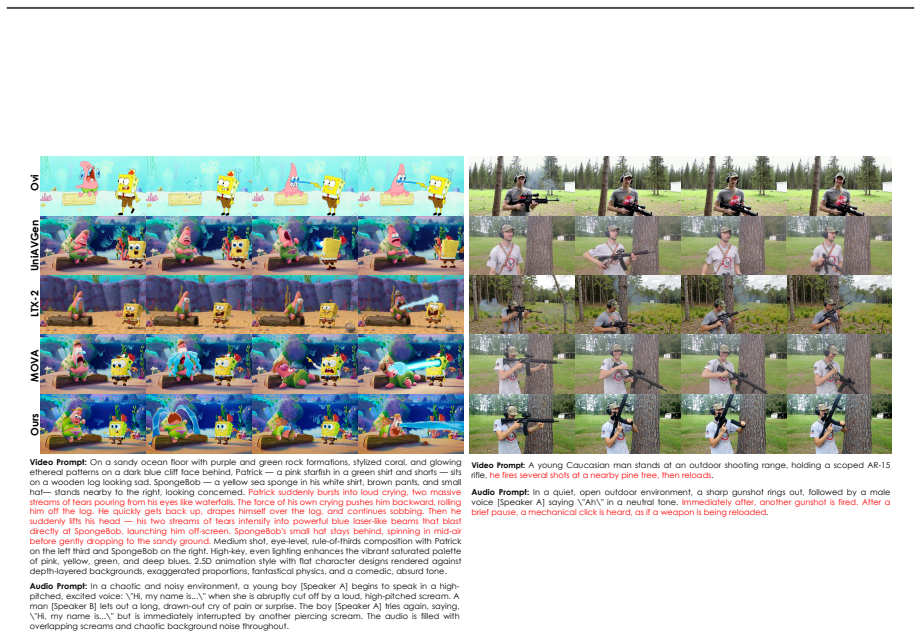
- Quantitative and qualitative results on existing benchmarks improve for synchronized audio-visual output.
Reading between the lines
- The same planning approach could be tested on longer sequences or additional paired modalities such as text and 3-D.
- If the planner is replaced by a stronger language model the coordination effect might scale without retraining the diffusion backbone.
- Failure cases on highly ambiguous scenes would reveal whether the planned tokens reduce or amplify semantic drift.
Editorial analysis
A structured set of objections, weighed in public.
Referee Report
Summary. The paper claims that current diffusion models for joint video-audio generation suffer from uncoordinated denoising trajectories due to reliance on coarse text embeddings; Baton addresses this by introducing the VA-Planner (a multimodal LM with dual alignment towers that produces semantically aligned video/audio planned tokens via learnable queries) whose tokens are injected via cross-attention, augmented by Relative Semantic RoPE to map keyframe-level tokens into a shared coordinate frame with diffusion latents, thereby providing a shared semantic blueprint that restores fine-grained detail and mutual alignment.
Significance. If the central claim holds, the work would offer a meaningful advance in multi-modal generative modeling by shifting from implicit text guidance to explicit, jointly-reasoned semantic planning; the planned-token + Relative Semantic RoPE mechanism could generalize to other synchronized generation tasks and the emphasis on pre-denoising alignment is a constructive direction.
major comments (2)
- [Method description of VA-Planner and Relative Semantic RoPE] The load-bearing premise—that VA-Planner outputs plus Relative Semantic RoPE produce coordinated trajectories without new misalignment—is stated in the abstract but receives no derivation, attention-map analysis, or formal mapping argument showing how keyframe-level planned tokens reliably attend to their “positionally corresponding” latents when no one-to-one spatial-temporal grid exists. This directly matches the skeptic concern and must be addressed with concrete evidence (e.g., attention visualizations or trajectory metrics) before the claim can be accepted.
- [Experiments section] The abstract asserts that “experiments on benchmarks show the effectiveness … both qualitatively and quantitatively,” yet supplies neither metrics, baselines, ablation tables, nor any quantitative comparison isolating the contribution of the planned tokens versus the RoPE component. Without these data the central claim cannot be evaluated.
minor comments (1)
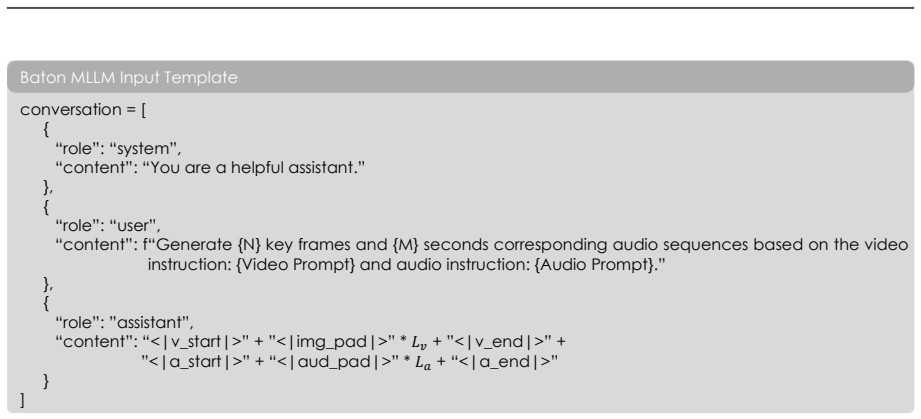
- [Abstract / Method overview] Notation for the dual alignment towers and the exact form of the learnable queries is introduced at a high level; a short pseudocode or diagram would clarify the cross-attention flow.
Simulated Author's Rebuttal
We thank the referee for the thoughtful and constructive review. We address each major comment below and commit to revisions that directly respond to the concerns raised.
read point-by-point responses
-
Referee: [Method description of VA-Planner and Relative Semantic RoPE] The load-bearing premise—that VA-Planner outputs plus Relative Semantic RoPE produce coordinated trajectories without new misalignment—is stated in the abstract but receives no derivation, attention-map analysis, or formal mapping argument showing how keyframe-level planned tokens reliably attend to their “positionally corresponding” latents when no one-to-one spatial-temporal grid exists. This directly matches the skeptic concern and must be addressed with concrete evidence (e.g., attention visualizations or trajectory metrics) before the claim can be accepted.
Authors: We agree that the manuscript would benefit from explicit evidence supporting the coordination claim. The current text describes the design rationale for Relative Semantic RoPE (mapping keyframe tokens and latents into a shared coordinate frame via relative offsets) but does not include attention visualizations or trajectory metrics. In revision we will add cross-attention map visualizations from the diffusion backbone and quantitative metrics (e.g., temporal alignment error and cross-modal consistency scores) that isolate the effect of the planned tokens plus RoPE. revision: yes
-
Referee: [Experiments section] The abstract asserts that “experiments on benchmarks show the effectiveness … both qualitatively and quantitatively,” yet supplies neither metrics, baselines, ablation tables, nor any quantitative comparison isolating the contribution of the planned tokens versus the RoPE component. Without these data the central claim cannot be evaluated.
Authors: The full manuscript contains a dedicated Experiments section reporting quantitative results on standard video-audio benchmarks together with baseline comparisons. To directly address the request for isolation of components, we will expand the section with additional ablation tables that separately measure the contribution of the VA-Planner tokens and the Relative Semantic RoPE, and we will include these tables in the main body rather than supplementary material. revision: yes
Circularity Check
No significant circularity; new architectural components introduced without self-referential reduction
full rationale
The paper's central claim rests on the introduction of VA-Planner (with learnable queries and dual alignment towers), planned tokens, and Relative Semantic RoPE as novel mechanisms for semantic planning and alignment. No equations, fitted parameters, or predictions are shown that reduce by construction to inputs. No self-citations are invoked as load-bearing uniqueness theorems or ansatzes. The derivation chain consists of explicit design choices (cross-attention for planned tokens, relative positional mapping) that are independent of the target result and do not rename known patterns or smuggle assumptions via prior self-work. The method is presented as a self-contained proposal evaluated on benchmarks.
Assumptions & free parameters
Cite this review
Pith. "Pith review of Baton: Explicit Semantic Blueprints for Joint Video-Audio Generation." pith.science (2026). https://pith.science/paper/ZOYC6GZL
@misc{pith2026260525195,
  author       = {Pith},
  title        = {Pith review of: Baton: Explicit Semantic Blueprints for Joint Video-Audio Generation},
  year         = {2026},
  howpublished = {\url{https://pith.science/paper/ZOYC6GZL}},
  note         = {Machine review of arXiv:2605.25195}
}
read the original abstract
Current open-source diffusion models struggle to generate stable and synchronized audio-visual content, particularly in scenarios demanding complex semantic reasoning. The root cause is that existing methods rely on coarse text embeddings from off-the-shelf encoders to guide audio-video denoising, which discards fine-grained semantics and, critically, lacks a shared long-horizon plan, leading to uncoordinated denoising trajectories and fragile cross-modal alignment. We propose Baton, the first framework that introduces explicit semantic planning into joint video-audio generation. Our key insight is that complementing coarse text guidance with semantically rich, modality-aware planned tokens, jointly reasoned and mutually aligned before denoising, can simultaneously restore fine-grained semantic detail and establish a shared blueprint that coordinates both audio and video denoising trajectories. Concretely, Baton first introduces the VA-Planner, a multimodal language model equipped with dual semantic alignment towers, where learnable queries cross-attend to both video and audio features to produce a pair of semantically aligned video and audio planned tokens as keyframe-level blueprints. These planned tokens are injected into the diffusion backbone via cross-attention layers, providing temporally grounded guidance complementary to coarse text embeddings. Since planned tokens do not share one-to-one spatial-temporal correspondence with diffusion latents, we further propose Relative Semantic RoPE, a relative positional encoding that maps planned tokens and latents into a shared spatial-temporal coordinate frame, enabling each latent to accurately attend to its positionally corresponding semantic cues. Experiments on benchmarks show the effectiveness of Baton both qualitatively and quantitatively.
Figures


Figures from the paper (18 more)






Forward citations
Cited by 1 Pith paper
-
Vorch-Omni: Multi-Task Orchestration of Sight and Sound
A single flow-matching diffusion transformer with explicit token roles and position types performs more than 30 audio-visual generation, editing, and reference-conditioned tasks without task-specific architectures.
Reference graph
Works this paper leans on
-
[1]
We train the MLLM for 10 epochs, with a batch size of 1 per GPU
(WavTokenizer-large-unify-40token). We train the MLLM for 10 epochs, with a batch size of 1 per GPU. In the second training stage (DiT Semantic Adaptation), the DiT is initialized by Ovi (Low et al., 2025). DiT and LMLPv/a (·) remain trainable. We train the DiT for 10 epochs in 640p videos (FPS=24), with a batch size of 1 per GPU. In the third training st...
work page 2025
-
[2]
instead of the distilled version for fair performance comparison. Compared to our DiT backbone Ovi (Low et al., 2025), Baton introduces approximately 28% additional GPU memory from the V A-Planner’s autoregressive planning and extra cross-attention layers, while achieving over 36% improvement in DeSync and 78% in P-Acc, demonstrating that the planning ove...
work page 2025
-
[3]
** Visual Prompt Alignment ** Whether the video accurately depicts all actions, interactions, and motion sequences described in the video prompt, performed by the correct subjects in the correct temporal order. Whether the camera movement and framing match any cinematographic instructions (e.g., fixed shot, panning, close-up). Whether the correct number o...
-
[4]
Whether speech or dialogue has the correct spoken content, speaker identity, language, and tone
** Audio Prompt Alignment ** Whether the audio contains the correct sound events, ambient sounds, music, or speech described in the audio prompt with matching types, timbres, and characteristics. Whether speech or dialogue has the correct spoken content, speaker identity, language, and tone. Whether the generated sounds obey physical plausibility (e.g., f...
-
[5]
** Human-Object and Human-Environment Interaction ** Whether characters interact with the correct objects in the correct manner as described (e.g., picking up the right item, placing it at the right location). Whether character-environment interactions are physically plausible (e.g., feet touching the ground while walking, hands making contact with surfac...
-
[6]
** Joint Video-Audio Alignment ** Whether audio events are temporally synchronized with their corresponding visual events (e.g., a clap sound aligns with hand contact, footsteps align with foot movement, speech aligns with lip movement). Whether the audio and video semantically correspond as a coherent audiovisual experience (e.g., piano sound when a pers...
Reviewed June 30, 2026 · model on record in the stance chip above.
Discussion (0). Continue with ORCID to comment.