REVIEW 2 major objections 1 minor 10 references
Clarification Is Not Enough: Post-Clarification Answering Remains the Bottleneck in Multi-Turn QA
T0 review · 2 major / 1 minor · reviewed 2026-06-30 · grok-4.3
Pith's one-line read In multi-turn question answering, supervised fine-tuning improves when to ask clarifying questions but final answer accuracy stays low even after correct clarification.
desk verdict The paper shows SFT fixes clarification policy fast on PACIFIC but leaves post-clarification answering accuracy low, yet the abstract supplies no details on input construction or scoring that would confirm the gap is real rather than benchmark artifact. read the letter →
The pith
A machine-rendered reading of the paper's core claim, the machinery that carries it, and where it could break.
The reading
What carries the argument
The decomposition of multi-turn QA into a clarification policy component and a post-clarification answering component, measured separately on the PACIFIC benchmark.
What would settle it
A controlled test in which models receive explicit correct clarifications as input and still produce the same accuracy drop compared with single-turn baselines.
Extended reading notes
Core claim
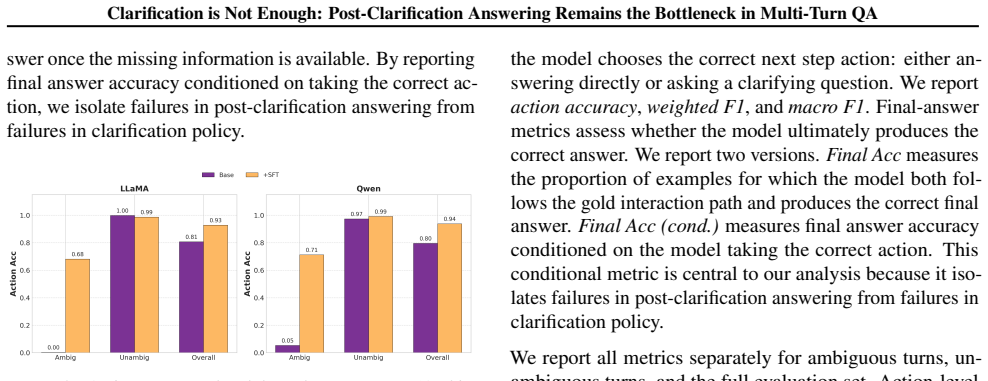
Supervised fine-tuning rapidly improves the clarification policy, however, final answer accuracy remains substantially lower even when the model takes the correct action. This gap indicates that understanding and correctly interpreting the user's response is the critical gap in multi-turn question-answering systems.
Load-bearing premise
The PACIFIC benchmark cleanly separates clarification policy performance from post-clarification answering performance and the observed accuracy gap is not an artifact of how the benchmark constructs or evaluates the post-clarification component.
Editorial analysis
A structured set of objections, weighed in public.
Referee Report
Summary. The paper claims that multi-turn QA for preference elicitation can be decomposed into a clarification policy (deciding whether to ask a clarifying question) and post-clarification answering (producing the final answer once information is provided). Using the PACIFIC benchmark, supervised fine-tuning rapidly improves the clarification policy, but final-answer accuracy remains substantially lower even after correct clarification actions, indicating that interpreting the user's response is the critical bottleneck.
Significance. If the benchmark cleanly isolates the two components, the result identifies a concrete capability gap in current models for multi-turn user interaction, with direct relevance to pluralistic alignment and intent elicitation. The policy-vs-answering decomposition provides a useful diagnostic lens.
major comments (2)
- [Benchmark and experimental setup (likely §3–4)] The central claim that the accuracy gap demonstrates a post-clarification interpretation deficit (rather than a benchmark artifact) is load-bearing on the construction of PACIFIC. The manuscript provides no description of how post-clarification inputs are generated (e.g., whether they are natural user responses, templated, or oracle facts), how they are formatted, or how answers are scored against the original ambiguous query. This detail is required to confirm isolation from policy effects or input artifacts.
- [Experiments and results (likely §4)] The abstract asserts that 'supervised fine-tuning rapidly improves the clarification policy' while final accuracy stays low, yet no quantitative results, data splits, metrics, or effect sizes are referenced. Without tables or figures showing policy accuracy before/after SFT versus post-clarification accuracy (conditional on correct policy), the magnitude and robustness of the reported gap cannot be evaluated.
minor comments (1)
- [Introduction] The introduction could more explicitly link the empirical gap to the pluralistic-alignment motivation stated in the abstract.
Simulated Author's Rebuttal
We thank the referee for the constructive comments highlighting the need for greater clarity on the PACIFIC benchmark construction and for explicit quantitative reporting. We address each point below and will revise the manuscript to strengthen these aspects.
read point-by-point responses
-
Referee: [Benchmark and experimental setup (likely §3–4)] The central claim that the accuracy gap demonstrates a post-clarification interpretation deficit (rather than a benchmark artifact) is load-bearing on the construction of PACIFIC. The manuscript provides no description of how post-clarification inputs are generated (e.g., whether they are natural user responses, templated, or oracle facts), how they are formatted, or how answers are scored against the original ambiguous query. This detail is required to confirm isolation from policy effects or input artifacts.
Authors: We agree that explicit details on post-clarification input generation are required to substantiate isolation of the components. Section 3 of the manuscript introduces PACIFIC but we will expand it in revision to describe that post-clarification inputs are drawn from the benchmark's natural user responses (not templated or oracle facts), their formatting as follow-up conversational turns, and the scoring procedure that evaluates final answers against the ground-truth resolution of the original ambiguous query. This addition will directly address concerns about potential artifacts. revision: yes
-
Referee: [Experiments and results (likely §4)] The abstract asserts that 'supervised fine-tuning rapidly improves the clarification policy' while final accuracy stays low, yet no quantitative results, data splits, metrics, or effect sizes are referenced. Without tables or figures showing policy accuracy before/after SFT versus post-clarification accuracy (conditional on correct policy), the magnitude and robustness of the reported gap cannot be evaluated.
Authors: The full manuscript reports these results in Section 4, including data splits, policy accuracy and conditional final-answer accuracy metrics, and effect sizes, with tables and figures comparing pre- and post-SFT performance and the persistent gap conditional on correct policy actions. We acknowledge that the abstract does not reference these specifics. In revision we will update the abstract to include key quantitative references and citations to the relevant tables/figures. revision: yes
Circularity Check
No circularity; empirical benchmark results are self-contained
full rationale
The paper reports observed accuracy gaps on the PACIFIC benchmark after SFT on clarification policy. No equations, parameters, or derivations are present. The central claim is a direct measurement of post-clarification accuracy conditional on correct policy action, not a quantity that reduces to its own inputs by construction. The benchmark is treated as an external evaluation artifact; no self-citation chain or ansatz is invoked to justify the separation or the gap. This matches the default case of a non-circular empirical study.
Assumptions & free parameters
Cite this review
Pith. "Pith review of Clarification Is Not Enough: Post-Clarification Answering Remains the Bottleneck in Multi-Turn QA." pith.science (2026). https://pith.science/paper/T3VV5MQD
@misc{pith2026260525204,
  author       = {Pith},
  title        = {Pith review of: Clarification Is Not Enough: Post-Clarification Answering Remains the Bottleneck in Multi-Turn QA},
  year         = {2026},
  howpublished = {\url{https://pith.science/paper/T3VV5MQD}},
  note         = {Machine review of arXiv:2605.25204}
}
read the original abstract
Pluralistic alignment requires systems to adapt to diverse user values, communication styles, and contextual assumptions. We believe that a foundational prerequisite for such alignment enabling accurate preference elicitation from people when their intent is under-specified or ambiguous. We study the problem of preference elicitation in multi-turn question answering by decomposing the problem into two components: a \textbf{clarification policy}, which decides whether to ask a clarifying question or answer directly, and \textbf{post-clarification answering}, which produces the correct final answer once the missing information is provided. We show, using the PACIFIC benchmark, that supervised fine-tuning rapidly improves the clarification policy, however, final answer accuracy remains substantially lower even when the model takes the correct action. This gap indicates that understanding and correctly interpreting the user's response is the critical gap in multi-turn question-answering systems.
Figures


Figures from the paper (5 more)


Reference graph
Works this paper leans on
-
[1]
Aliannejadi, M., Kiseleva, J., Chuklin, A., Dalton, J., and Burtsev, M. Convai3: Generating clarifying questions for open-domain dialogue systems (clariq).arXiv preprint arXiv:2009.11352,
-
[2]
What do you mean exactly? analyzing clarification questions in cqa
Braslavski, P., Savenkov, D., Agichtein, E., and Dubatovka, A. What do you mean exactly? analyzing clarification questions in cqa. InProceedings of the 2017 confer- ence on conference human information interaction and retrieval, pp. 345–348,
work page 2017
-
[3]
Chen, M., Sun, R., Arık, S. ¨O., and Pfister, T. Learning to clarify: Multi-turn conversations with action-based con- trastive self-training.arXiv preprint arXiv:2406.00222,
-
[4]
Deng, Y ., Lei, W., Zhang, W., Lam, W., and Chua, T.-S. Pacific: Towards proactive conversational question an- swering over tabular and textual data in finance. InPro- ceedings of the 2022 Conference on Empirical Methods in Natural Language Processing, pp. 6970–6984,
work page 2022
-
[5]
Radlinski, F. and Craswell, N. A theoretical framework for conversational search. InProceedings of the 2017 conference on conference human information interaction and retrieval, pp. 117–126,
work page 2017
-
[6]
Rao, S. and Daum´e III, H. Answer-based adversarial train- ing for generating clarification questions. InProceedings of the 2019 Conference of the North American Chapter of the Association for Computational Linguistics: Hu- man Language Technologies, Volume 1 (Long and Short Papers), pp. 143–155,
work page 2019
-
[7]
Collabllm: From passive responders to active collaborators
Wu, S., Galley, M., Peng, B., Cheng, H., Li, G., Dou, Y ., Cai, W., Zou, J., Leskovec, J., and Gao, J. Collabllm: From passive responders to active collaborators. InForty- second International Conference on Machine Learning. Xu, J., Wang, Y ., Tang, D., Duan, N., Yang, P., Zeng, Q., Zhou, M., and Sun, X. Asking clarification questions in knowledge-based q...
work page 2019
-
[8]
5 Clarification is Not Enough: Post-Clarification Answering Remains the Bottleneck in Multi-Turn QA Zhang, M. J. and Choi, E. Clarify when necessary: Resolv- ing ambiguity through interaction with lms. InFindings of the Association for Computational Linguistics: NAACL 2025, pp. 5526–5543,
work page 2025
Show all 10 references
-
[9]
irrelevant
6 Clarification is Not Enough: Post-Clarification Answering Remains the Bottleneck in Multi-Turn QA PACIFIC Dataset Example 1 Financial Context Product Categories:Drinkable Kefir, European-style soft cheeses, Cream and other, ProBugs, Other Dairy, Frozen Kefir Net Sales by Cat...
2019
-
[10]
Although some settings perform slightly better than others, no strong monotonic trend emerges
Tables 8 and 9 show that overall performance varies only modestly across clarification rates for both LLaMA and Qwen (Figure 8). Although some settings perform slightly better than others, no strong monotonic trend emerges. This result suggests that synthetic augmentation is n...
1938
Reviewed June 30, 2026 · model on record in the stance chip above.
Discussion (0). Continue with ORCID to comment.