Non-local low energy neutral excitations in a strongly disordered triangular Mott magnet Cr₃Se₂Br₅
Pith reviewed 2026-06-29 23:15 UTC · model grok-4.3
The pith
A field-independent residual linear term in thermal conductivity signals itinerant neutral excitations in a strongly disordered triangular Mott magnet.
A machine-rendered reading of the paper's core claim, the machinery that carries it, and where it could break.
Core claim
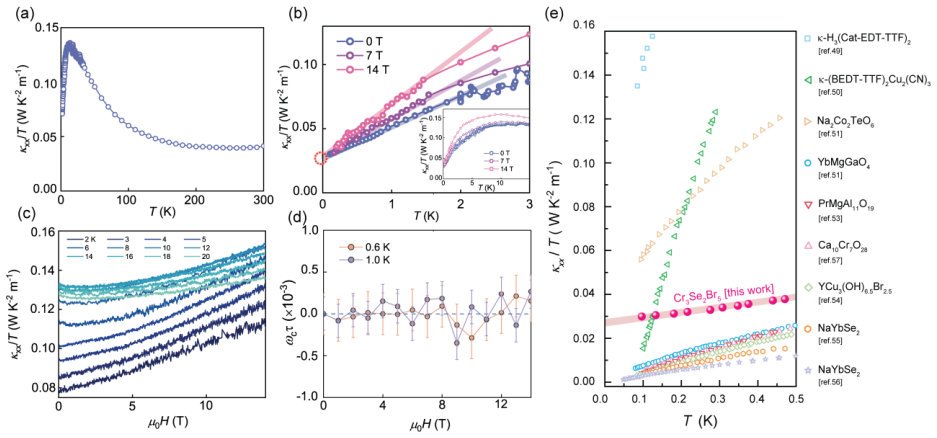
In Cr₃Se₂Br₅, strong intrinsic disorder coexists with the absence of magnetic order; the measured field-independent residual thermal conductivity term κ/T ≈ 0.03 W m^{-1} K^{-2} demonstrates that charge-neutral itinerant excitations persist and carry entropy at low energy.
What carries the argument
The residual linear term in thermal conductivity κ/T, interpreted as the signature of itinerant neutral excitations that survive Anderson localization in the disordered frustrated Mott insulator.
If this is right
- Itinerant neutral excitations can coexist with strong fixed disorder when frustration is present.
- Thermal transport measurements can detect charge-neutral entropy carriers in otherwise insulating magnets.
- The lack of conventional glassy behavior supports the non-local character of the excitations.
- Disorder and frustration together can reshape low-energy excitations away from localized modes.
Where Pith is reading between the lines
- Similar residual conductivity terms may appear in other van der Waals triangular Mott insulators with comparable disorder.
- The excitations could be tested by searching for a corresponding contribution to the spin thermal Hall effect or other neutral transport channels.
- This regime offers a concrete setting in which to examine whether fractionalized quasiparticles can remain mobile under strong disorder.
Load-bearing premise
The residual thermal conductivity arises from itinerant neutral excitations rather than from phonons or other bosonic modes that could produce a similar linear term.
What would settle it
A low-temperature thermal conductivity measurement that isolates phonon contributions and shows the linear term vanishes or is replaced by a T³ dependence would falsify the itinerant neutral excitation interpretation.
Figures
read the original abstract
Understanding if low-energy excitations can remain itinerant in the presence of strong disorder remains a central challenge in frustrated quantum magnets, where disorder is generally expected to localize excitations through Anderson-like mechanisms. Here we report the emergence of charge-neutral itinerant excitations in a van der Waals compound Cr$_3$Se$_2$Br$_5$, a strongly disordered $S = 3/2$ Mott insulator with a frustrated triangular lattice. Structural analysis reveals substantial intrinsic disorder arising from Cr-site deficiency and Se/Br-site mixing, which appear to be fixed and cannot be readily tuned. No long-range magnetic order or conventional glassy behavior is observed. In addition to its highly insulating nature, the magnetic specific heat C_mag/T and thermal conductivity \k{appa}_xx/T both exhibit linear temperature dependencies with substantial finite intercepts. In particular, a sizeable field-independent residual term $\kappa/T \approx 0.03~\mathrm{W\,m^{-1}\,K^{-2}}$ is observed, providing compelling evidence of itinerant low-energy excitations that carry entropy without charge. These findings conceptually advance our understanding of quantum matter by demonstrating a rare regime where the interplay of disorder, frustration, and electronic correlations actively reshapes the nature of low-energy excitations, allowing itinerant neutral excitations to coexist with strong intrinsic disorder.
Editorial analysis
A structured set of objections, weighed in public.
Referee Report
Summary. The manuscript reports the emergence of charge-neutral itinerant low-energy excitations in the van der Waals compound Cr₃Se₂Br₅, a strongly disordered S=3/2 Mott insulator on a frustrated triangular lattice. Structural disorder from Cr-site deficiency and Se/Br mixing is fixed and cannot be tuned. No long-range magnetic order or conventional glassy behavior is observed. The system is highly insulating, with both C_mag/T and κ_xx/T exhibiting linear temperature dependence and substantial finite intercepts; a field-independent residual κ/T ≈ 0.03 W m^{-1} K^{-2} is presented as compelling evidence for itinerant neutral excitations carrying entropy without charge.
Significance. If the central interpretation holds, the work addresses a key challenge in frustrated quantum magnets by demonstrating that disorder and frustration can permit delocalized neutral modes rather than localizing them. The experimental observation of a field-independent residual thermal conductivity term in a highly insulating, disordered Mott system would be a notable addition to the literature on neutral excitations, provided alternative contributions are quantitatively ruled out. The use of a van der Waals material with intrinsic, fixed disorder offers a concrete platform for such studies.
major comments (1)
- [Abstract and thermal transport section] Abstract and thermal conductivity results: The mapping of the observed field-independent κ/T ≈ 0.03 W m^{-1} K^{-2} intercept to itinerant neutral excitations is load-bearing for the headline claim, yet the manuscript provides no explicit phonon subtraction, mean-free-path estimate, or direct comparison of measured κ(T) to the phonon contribution expected from the measured C(T). In a strongly disordered lattice, phonon scattering can produce effective power-law behavior yielding a non-zero low-T intercept in κ/T; without this quantitative step the interpretation remains open to bosonic alternatives.
minor comments (1)
- [Abstract] The abstract contains a LaTeX artifact (\k{appa}); ensure consistent notation for κ_xx throughout the manuscript.
Simulated Author's Rebuttal
We thank the referee for their careful reading and constructive feedback. The primary concern regarding the need for explicit phonon analysis in the thermal conductivity data is addressed point-by-point below. We will incorporate the requested quantitative elements in a revised manuscript.
read point-by-point responses
-
Referee: [Abstract and thermal transport section] Abstract and thermal conductivity results: The mapping of the observed field-independent κ/T ≈ 0.03 W m^{-1} K^{-2} intercept to itinerant neutral excitations is load-bearing for the headline claim, yet the manuscript provides no explicit phonon subtraction, mean-free-path estimate, or direct comparison of measured κ(T) to the phonon contribution expected from the measured C(T). In a strongly disordered lattice, phonon scattering can produce effective power-law behavior yielding a non-zero low-T intercept in κ/T; without this quantitative step the interpretation remains open to bosonic alternatives.
Authors: We agree that the current manuscript would benefit from a more explicit quantitative treatment of possible phonon contributions. The field-independent residual κ/T term, combined with the linear C_mag/T and the absence of long-range order, forms the basis for the neutral-excitation interpretation, but a direct comparison is indeed not detailed in the presented text. In the revised version we will add: (1) a phonon mean-free-path estimate via the kinetic formula κ_ph = (1/3) C v l using the measured specific heat and an estimated sound velocity from the Debye model; (2) an explicit subtraction of the expected phonon term from the measured κ(T) to isolate any residual; and (3) a discussion of why strong disorder in this system is expected to suppress rather than enhance a linear-T phonon intercept (typically yielding T^2 or higher power laws at low T). The field independence remains a key discriminator, as phonons are not expected to respond to applied fields in this regime. These additions will be placed in the thermal-transport section and referenced in the abstract. revision: yes
Circularity Check
No significant circularity; experimental observations with direct interpretation
full rationale
The paper is an experimental report of measured quantities (κ_xx/T intercept, C_mag/T linear term) in a disordered material. No mathematical derivation chain, fitted parameters renamed as predictions, or self-citation load-bearing steps exist. The claim is an interpretation of data against external benchmarks (insulating behavior, lack of order), which does not reduce to its inputs by construction. This is the standard non-circular outcome for observation papers.
Axiom & Free-Parameter Ledger
axioms (1)
- domain assumption Linear temperature dependence in specific heat and thermal conductivity indicates gapless or fermionic-like excitations.
Reference graph
Works this paper leans on
-
[1]
Department of Physics, University of California, Berkeley, CA, USA
-
[2]
Material Sciences Division, Lawrence Berkeley National Lab, Berkeley, CA, USA
-
[3]
Department of Physics, the University of Texas at Dallas, Richardson, TX, USA
-
[4]
Department of Physics, University of Michigan, Ann Arbor, MI, USA
-
[5]
Department of Materials, the University of Texas at Dallas, Richardson, TX, USA
-
[6]
Neutron Scattering Division, Oak Ridge National Laboratory, Oak Ridge, TN, USA
-
[7]
Department of Chemistry, University of Houston, Houston, TX, USA
-
[8]
CIFAR Quantum Materials, Toronto, ON, Canada
-
[9]
Kavli Energy NanoScience Institute, Berkeley, CA, USA
-
[10]
Molecular Foundry, Lawrence Berkeley National Laboratory, Berkeley, CA, USA
-
[11]
Materials and Manufacturing Directorate, Air Force Research Laboratory, Wright Patterson Air Force Base, OH, USA. Understanding if low-energy excitations can remain itinerant in the presence of strong disorder remains a central challenge in frustrated quantum magnets, where disorder is generally expected to localize excitations through Anderson-like mecha...
-
[12]
entanglement retiling
Detailed crystallographic refinement details and atomic coordinates are summarized in Supplementary Table S1 and S2. The crystal structure is shown in Fig. 1c-e. The unit cell consists of three trigonal layers, with each adjacent layer shifted by 1/3 of the in-plane lattice vector. Thus, we denote this structure as “3T”. Cr and Se/Br form octahedra buildi...
2020
-
[13]
Quasiparticles in condensed matter systems
Wö lfle, P. Quasiparticles in condensed matter systems. Rep. Prog. Phys. 81, 032501 (2018)
2018
-
[14]
Anderson, P. W. More Is Different. Science 177, 393–396 (1972)
1972
-
[15]
Anyons in an exactly solved model and beyond
Kitaev, A. Anyons in an exactly solved model and beyond. Ann. Phys. 321, 2–111 (2006)
2006
-
[16]
& Fisher, M
Senthil, T. & Fisher, M. P. A. Z2 gauge theory of electron fractionalization in strongly correlated systems. Phys. Rev. B 62, 7850–7881 (2000)
2000
-
[17]
& Anderson, P
Baskaran, G., Zou, Z. & Anderson, P. W. The resonating valence bond state and high-Tc superconductivity — A mean field theory. Solid State Commun. 63, 973–976 (1987)
1987
-
[18]
Anderson, P. W. Resonating valence bonds: A new kind of insulator? Mater. Res. Bull. 8, 153–160 (1973)
1973
-
[19]
Spin liquids in frustrated magnets
Balents, L. Spin liquids in frustrated magnets. Nature 464, 199–208 (2010)
2010
-
[20]
& Ng, T.-K
Zhou, Y., Kanoda, K. & Ng, T.-K. Quantum spin liquid states. Rev. Mod. Phys. 89, 025003 (2017)
2017
-
[21]
Semeghini, G. et al. Probing topological spin liquids on a programmable quantum simulator. Science 374, 1242–1247 (2021)
2021
-
[22]
A., Nagaosa, N
Lee, P. A., Nagaosa, N. & Wen, X.-G. Doping a Mott insulator: Physics of high-temperature superconductivity. Rev. Mod. Phys. 78, 17–85 (2006)
2006
-
[23]
& Reuther, J
Niggemann, N., Hering, M. & Reuther, J. Classical spiral spin liquids as a possible route to quantum spin liquids. J. Phys.: Condens. Matter 32, 024001 (2019)
2019
-
[24]
& Li, J.-X
Wen, J., Yu, S.-L., Li, S., Yu, W. & Li, J.-X. Experimental identification of quantum spin liquids. npj Quantum Mater. 4, 12 (2019)
2019
-
[25]
& Balents, L
Savary, L. & Balents, L. Quantum spin liquids: a review. Rep. Prog. Phys. 80, 016502 (2016)
2016
-
[26]
Scheie, A. O. et al. Proximate spin liquid and fractionalization in the triangular antiferromagnet KYbSe2. Nat. Phys. 20, 74–81 (2024)
2024
-
[27]
& Senthil, T
Kimchi, I., Nahum, A. & Senthil, T. Valence Bonds in Random Quantum Magnets: Theory and Application to YbMgGaO4. Phys. Rev. X 8, 031028 (2018)
2018
-
[28]
A., White, S
Zhu, Z., Maksimov, P. A., White, S. R. & Chernyshev, A. L. Disorder-Induced Mimicry of a Spin Liquid in YbMgGaO4. Phys. Rev. Lett. 119, 157201 (2017)
2017
-
[29]
Murayama, H. et al. Effect of quenched disorder on the quantum spin liquid state of the triangular-lattice antiferromagnet 1T−TaS2. Phys. Rev. Res. 2, 013099 (2020)
2020
-
[30]
Yu, Y. J. et al. Heat transport study of the spin liquid candidate 1T-TaS2. Phys. Rev. B 96, 081111 (2017)
2017
-
[31]
Liu, W. et al. Electrical transport crossover and large magnetoresistance in selenium deficient van der Waals HfSe2-x (0≤x≤0.2). Phys. Rev. Mater. 8, 054006 (2024)
2024
-
[32]
Li, S. et al. Transport anomalies in the layered compound BaPt4Se6. npj Quantum Mater. 6, 80 (2021)
2021
-
[33]
& Dobrosavljević, V
Miranda, E. & Dobrosavljević, V. Disorder-driven non-Fermi liquid behaviour of correlated electrons. Rep. Prog. Phys. 68, 2337 (2005)
2005
-
[34]
& Henley, C
Sheng, Q. & Henley, C. L. Ordering due to disorder in a triangular Heisenberg antiferromagnet with exchange anisotropy. J. Phys.: Condens. Matter 4, 2937 (1992)
1992
-
[35]
& Kawamura, H
Shimokawa, T., Watanabe, K. & Kawamura, H. Static and dynamical spin correlations of the S=1/2 random-bond antiferromagnetic Heisenberg model on the triangular and kagome lattices. Phys. Rev. B 92, 134407 (2015)
2015
-
[36]
& Uematsu, K
Kawamura, H. & Uematsu, K. Nature of the randomness-induced quantum spin liquids in two dimensions. J. Phys.: Condens. Matter 31, 504003 (2019)
2019
-
[37]
Furukawa, T. et al. Quantum Spin Liquid Emerging from Antiferromagnetic Order by Introducing Disorder. Phys. Rev. Lett. 115, 077001 (2015)
2015
-
[38]
& Balents, L
Savary, L. & Balents, L. Disorder-Induced Quantum Spin Liquid in Spin Ice Pyrochlores. Phys. Rev. Lett. 118, 087203 (2016)
2016
-
[39]
L., Hering, M., Reuther, J
Buessen, F. L., Hering, M., Reuther, J. & Trebst, S. Quantum Spin Liquids in Frustrated Spin-1 Diamond Antiferromagnets. Phys. Rev. Lett. 120, 057201 (2018)
2018
-
[40]
P., Kee, H.-Y
Khait, I., Stavropoulos, P. P., Kee, H.-Y. & Kim, Y. B. Characterizing spin-one Kitaev quantum spin liquids. Phys. Rev. Res. 3, 013160 (2021)
2021
-
[41]
Xu, C. et al. Possible Kitaev Quantum Spin Liquid State in 2D Materials with S=3/2. Phys. Rev. Lett. 124, 087205 (2020)
2020
-
[42]
Song, Q. et al. Evidence for a single-layer van der Waals multiferroic. Nature 602, 601–605 (2022)
2022
-
[43]
Shen, Y. et al. Evidence for a spinon Fermi surface in a triangular-lattice quantum-spin- liquid candidate. Nature 540, 559–562 (2016)
2016
-
[44]
Li, Y. et al. Gapless quantum spin liquid ground state in the two-dimensional spin-1/2 triangular antiferromagnet YbMgGaO4. Sci. Rep. 5, 16419 (2015)
2015
-
[45]
& Chen, G
Li, F.-Y., Li, Y.-D., Yu, Y., Paramekanti, A. & Chen, G. Kitaev materials beyond iridates: Order by quantum disorder and Weyl magnons in rare-earth double perovskites. Phys. Rev. B 95, 085132 (2017)
2017
-
[46]
Zhong, R., Gao, T., Ong, N. P. & Cava, R. J. Weak-field induced nonmagnetic state in a Co- based honeycomb. Sci. Adv. 6, eaay6953 (2020)
2020
-
[47]
Day, R. P. et al. Colossal magnetoresistance and anisotropic spin dynamics in the antiferromagnetic semiconductor Eu5Sn2As6. Phys. Rev. B 111, 054406 (2025)
2025
-
[48]
v., Rosch, A., Vojta, M
Lö hneysen, H. v., Rosch, A., Vojta, M. & Wö lfle, P. Fermi-liquid instabilities at magnetic quantum phase transitions. Rev. Mod. Phys. 79, 1015–1075 (2007)
2007
-
[49]
& Steglich, F
Si, Q. & Steglich, F. Heavy Fermions and Quantum Phase Transitions. Science 329, 1161– 1166 (2010)
2010
-
[50]
Stewart, G. R. Heavy-fermion systems. Rev. Mod. Phys. 56, 755–787 (1984)
1984
-
[51]
Kondo, S. et al. LiV2O4: A Heavy Fermion Transition Metal Oxide. Phys. Rev. Lett. 78, 3729–3732 (1997)
1997
-
[52]
D., Kondo, S
Chmaissem, O., Jorgensen, J. D., Kondo, S. & Johnston, D. C. Structure and Thermal Expansion of LiV2O4: Correlation between Structure and Heavy Fermion Behavior. Phys. Rev. Lett. 79, 4866–4869 (1997)
1997
-
[53]
& Komatsubara, T
Fujita, T., Satoh, K., Ōnuki, Y. & Komatsubara, T. Specific heat of the dense Kondo compound CeCu6. J. Magn. Magn. Mater. 47, 66–68 (1985)
1985
-
[54]
& Jensen, J
Fulde, P. & Jensen, J. Electronic heat capacity of the rare-earth metals. Phys. Rev. B 27, 4085–4094 (1983)
1983
-
[55]
Wang, Y. R. Specific heat of quantum Heisenberg model on a triangular lattice with two exchange parameters and its application to He3 adsorbed on graphite. Phys. Rev. B 45, 12608– 12611 (1992)
1992
-
[56]
Singh, R. R. P. & Oitmaa, J. High-temperature series expansion study of the Heisenberg antiferromagnet on the hyperkagome lattice: Comparison with Na4Ir3O8. Phys. Rev. B 85, 104406 (2012)
2012
-
[57]
Zheng, G. et al. Thermodynamic Evidence of Fermionic Behavior in the Vicinity of One- Ninth Plateau in a Kagome Antiferromagnet. Phys. Rev. X 15, 021076 (2025)
2025
-
[58]
Quantum orders and symmetric spin liquids
Wen, X.-G. Quantum orders and symmetric spin liquids. Phys. Rev. B 65, 165113 (2002)
2002
-
[59]
Ran, Y., Hermele, M., Lee, P. A. & Wen, X.-G. Projected-Wave-Function Study of the Spin- 1/2 Heisenberg Model on the Kagomé Lattice. Phys. Rev. Lett. 98, 117205 (2007)
2007
-
[60]
Bordelon, M. M. et al. Field-tunable quantum disordered ground state in the triangular-lattice antiferromagnet NaYbO2. Nat. Phys. 15, 1058–1064 (2019)
2019
-
[61]
Shimozawa, M. et al. Quantum-disordered state of magnetic and electric dipoles in an organic Mott system. Nat. Commun. 8, 1821 (2017)
2017
-
[62]
Yamashita, M. et al. Thermal-transport measurements in a quantum spin-liquid state of the frustrated triangular magnet κ-(BEDT-TTF)2Cu2(CN)3. Nat. Phys. 5, 44–47 (2009)
2009
-
[63]
Rao, X. et al. Survival of itinerant excitations and quantum spin state transitions in YbMgGaO4 with chemical disorder. Nat. Commun. 12, 4949 (2021)
2021
-
[64]
Hong, X. et al. Phonon thermal transport shaped by strong spin-phonon scattering in a Kitaev material Na2Co2TeO6. npj Quantum Mater. 9, 18 (2024)
2024
-
[65]
Tu, C. P. et al. Gapped quantum spin liquid in a triangular-lattice Ising-type antiferromagnet PrMgAl11O19. Phys. Rev. Res. 6, 043147 (2024)
2024
-
[66]
Hong, X. et al. Heat transport of the kagome Heisenberg quantum spin liquid candidate YCu3(OH)6.5Br2.5: Localized magnetic excitations and a putative spin gap. Phys. Rev. B 106, L220406 (2022)
2022
-
[67]
Zhu, Z. et al. Fluctuating magnetic droplets immersed in a sea of quantum spin liquid. Innov. 4, 100459 (2023)
2023
-
[68]
Lyu, Y. et al. Entanglement Randomness and Gapped Itinerant Carriers in a Frustrated Quantum Magnet. Phys. Rev. X 15, 041035 (2025)
2025
-
[69]
Ni, J. M. et al. Ultralow-temperature heat transport in the quantum spin liquid candidate Ca10Cr7O28 with a bilayer kagome lattice. Phys. Rev. B 97, 104413 (2018)
2018
-
[70]
Yamashita, M. et al. Highly Mobile Gapless Excitations in a Two-Dimensional Candidate Quantum Spin Liquid. Science 328, 1246–1248 (2010)
2010
-
[71]
Li, N. et al. Possible itinerant excitations and quantum spin state transitions in the effective spin-1/2 triangular-lattice antiferromagnet Na2BaCo(PO4)2. Nat. Commun. 11, 4216 (2020)
2020
-
[72]
Acharyya, P. et al. Glassy thermal conductivity in Cs3Bi2I6Cl3 single crystal. Nat. Commun. 13, 5053 (2022)
2022
-
[73]
T., Hanus, R
Agne, M. T., Hanus, R. & Snyder, G. J. Minimum thermal conductivity in the context of diffuson -mediated thermal transport. Energy Environ. Sci. 11, 609–616 (2018)
2018
-
[74]
w., Halperin, B
Anderson, P. w., Halperin, B. I. & Varma, c. M. Anomalous low-temperature thermal properties of glasses and spin glasses. Philos. Mag.: A J. Theor. Exp. Appl. Phys. 25, 1–9 (1972)
1972
-
[75]
Phillips, W. A. Tunneling states in amorphous solids. J. Low Temp. Phys. 7, 351–360 (1972)
1972
-
[76]
Tavakoli, A. et al. Universality of thermal transport in amorphous nanowires at low temperatures. Phys. Rev. B 95, 165411 (2017)
2017
-
[77]
& Stamp, P
Schechter, M. & Stamp, P. C. E. Inversion symmetric two-level systems and the low- temperature universality in disordered solids. Phys. Rev. B 88, 174202 (2013)
2013
-
[78]
Disorder in Quantum Many-Body Systems
Vojta, T. Disorder in Quantum Many-Body Systems. Annu. Rev. Condens. Matter Phys. 10, 1–20 (2018)
2018
-
[79]
Liu, W. et al. A Three-Stage Magnetic Phase Transition Revealed in Ultrahigh-Quality van der Waals Bulk Magnet CrSBr. ACS Nano 16, 15917–15926 (2022)
2022
discussion (0)
Sign in with ORCID, Apple, or X to comment. Anyone can read and Pith papers without signing in.