Computing statistical solutions of a Mach 2000 astrophysical jet
Pith reviewed 2026-06-29 23:20 UTC · model grok-4.3
The pith
Statistical solutions to a Mach 2000 jet converge to a non-Dirac measure at rate 0.5 even as single realizations diverge.
A machine-rendered reading of the paper's core claim, the machinery that carries it, and where it could break.
Core claim
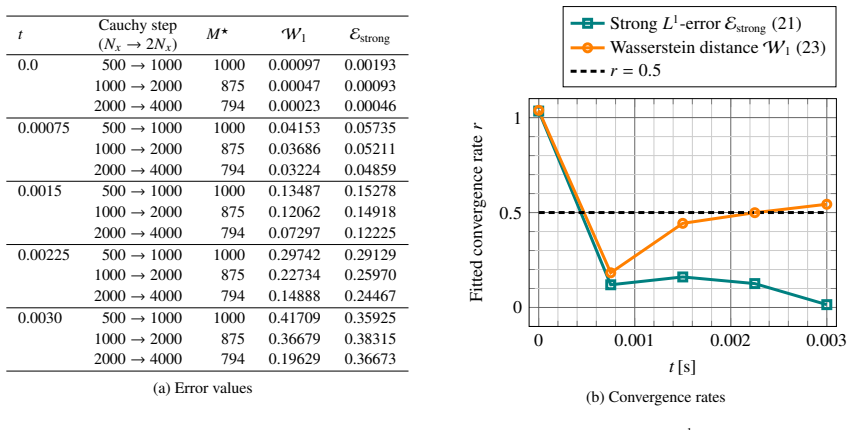
Defining the statistical solution as the pushforward of a probability measure through the vectorial lattice Boltzmann method operator, computations on grids up to 3.2 million cells demonstrate that the empirical measures converge in Wasserstein distance at rate 0.5, while sample-wise L1 errors diverge, indicating a non-Dirac admissible limit measure for the Mach 2000 jet.
What carries the argument
The pushforward measure induced by the vectorial lattice Boltzmann method operator applied to an initial probability measure, serving as the statistical solution to the Euler equations.
If this is right
- Individual realizations diverge physically due to chaotic shear-layer instabilities.
- The probability measure converges to an admissible limit at rate 0.5.
- The statistical solution is non-Dirac.
- The solution remains stable in the extreme compressible regime.
Where Pith is reading between the lines
- Similar ensemble methods could reveal statistical behavior in other high-Mach turbulent flows where deterministic uniqueness fails.
- The observed rate of 0.5 suggests a scaling law that might be tested against other compressible flow problems.
- Memory-mapped post-processing of empirical measures enables efficient handling of very large simulation ensembles.
- The results supply concrete numerical support for the breakdown of weak-strong uniqueness at extreme Mach numbers.
Load-bearing premise
The vectorial lattice Boltzmann method produces a pushforward measure that accurately represents the statistical solution of the Euler equations.
What would settle it
If refined simulations or different methods show the Wasserstein distance stopping its convergence or the limit measure becoming Dirac, the claim of convergence to a non-Dirac statistical solution would be falsified.
Figures
read the original abstract
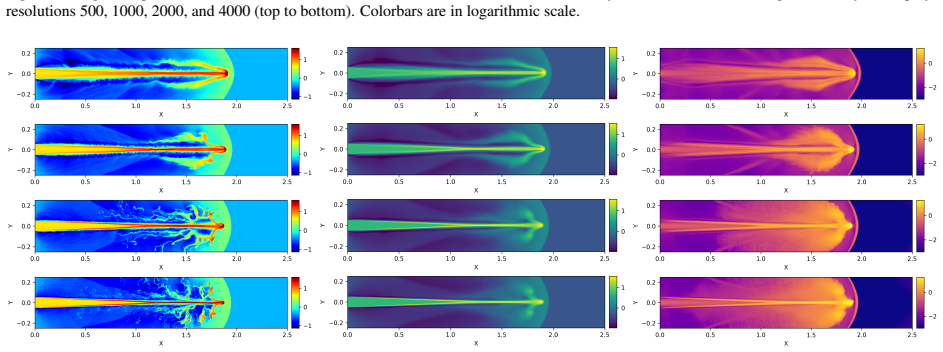
The simulation of extreme Mach astrophysical flows is traditionally viewed through the lens of deterministic positivity-preserving schemes. However, due to Kelvin--Helmholtz instabilities and shock anomalies, the multi-dimensional Euler equations admit a variety of non-unique entropy solutions in turbulent regimes. Here, we computationally explore the limits of weak-strong uniqueness of a Mach 2000 jet by defining the statistical solution as the pushforward of a probability measure through a vectorial lattice Boltzmann method operator. Utilizing optimized CUDA kernels, we compute an ensemble of 1000 Monte Carlo samples across a sequence of highly refined spatial grids of up to 3.2 million cells and subsequently post-process the empirical measures via memory-mapped CPU streaming. We contrast the strong sample-wise $L^1$ error divergence with the convergence of the probability measure in the 1-point Wasserstein distance via empirical Cauchy rates. Our results demonstrate that while individual flow realizations physically diverge due to chaotic shear-layer instabilities, the statistical solution converges to an admissible limit measure at a rate of 0.5. Consequently, we provide numerical evidence that the statistical solution to the considered problem is non-Dirac and remains stable in the extreme compressible regime.
Editorial analysis
A structured set of objections, weighed in public.
Referee Report
Summary. The manuscript computes statistical solutions to the multi-dimensional Euler equations for a Mach 2000 astrophysical jet by defining the statistical solution as the pushforward of an initial probability measure through a vectorial lattice Boltzmann method (LBM) operator. An ensemble of 1000 Monte Carlo samples is generated on a sequence of refined grids (up to 3.2 million cells) using optimized CUDA kernels, with post-processing of empirical measures via memory-mapped CPU streaming. The paper contrasts diverging sample-wise L1 errors (due to Kelvin-Helmholtz instabilities) with convergence of the empirical measures in the 1-point Wasserstein distance at rate 0.5, concluding that the statistical solution is non-Dirac and stable in the extreme compressible regime.
Significance. If the central claim holds, the work supplies concrete numerical evidence that statistical solutions to the Euler equations can converge in a weak metric even when individual realizations diverge chaotically, supporting the use of measure-valued approaches for non-unique entropy solutions in high-Mach turbulent flows. The large-scale ensemble computation (1000 samples, grids to 3.2M cells) with CUDA optimization and streaming post-processing demonstrates a practical capability for exploring statistical stability in extreme regimes. This is a strength for reproducibility in computational fluid dynamics.
major comments (2)
- [Abstract] Abstract (definition of statistical solution): The claim that the computed limit measure is an admissible statistical solution of the Euler equations rests on the unverified assumption that the vectorial LBM operator produces the correct pushforward measure. No comparison to reference schemes (e.g., finite-volume or DG methods), no recovery of known weak entropy solutions in lower-Mach or simpler geometries, and no analysis of LBM artifacts at Mach 2000 are provided. This is load-bearing for interpreting the rate-0.5 convergence and non-Dirac character as evidence for the Euler system rather than an LBM-specific artifact.
- [Abstract] Abstract (1-point Wasserstein distance): Convergence is reported only in the 1-point Wasserstein metric on empirical measures. If admissibility of the statistical solution requires control on multi-point correlations (as is standard for measure-valued solutions of conservation laws), the 1-point metric alone does not establish that the limit measure satisfies the full statistical formulation or remains stable under the Euler dynamics.
minor comments (1)
- [Abstract] The term 'empirical Cauchy rates' is used without an explicit definition or formula in the abstract; a precise statement of how the rate 0.5 is extracted from the sequence of empirical measures would improve clarity.
Simulated Author's Rebuttal
We thank the referee for the careful review and for recognizing the scale of the ensemble computations. We respond to each major comment below, indicating where revisions are planned.
read point-by-point responses
-
Referee: [Abstract] Abstract (definition of statistical solution): The claim that the computed limit measure is an admissible statistical solution of the Euler equations rests on the unverified assumption that the vectorial LBM operator produces the correct pushforward measure. No comparison to reference schemes (e.g., finite-volume or DG methods), no recovery of known weak entropy solutions in lower-Mach or simpler geometries, and no analysis of LBM artifacts at Mach 2000 are provided. This is load-bearing for interpreting the rate-0.5 convergence and non-Dirac character as evidence for the Euler system rather than an LBM-specific artifact.
Authors: We agree that the manuscript interprets the computed measure as a statistical solution to the Euler equations while relying on the LBM operator without direct cross-validation at Mach 2000. The vectorial LBM formulation recovers the compressible Euler equations in the appropriate scaling limit, and the method has been applied to high-Mach flows in prior work, but we acknowledge the absence of ensemble-scale comparisons with finite-volume or DG schemes and the lack of explicit artifact analysis at this Mach number. We will add a dedicated paragraph in the revised manuscript discussing the consistency assumptions and known limitations of LBM at extreme Mach numbers. revision: partial
-
Referee: [Abstract] Abstract (1-point Wasserstein distance): Convergence is reported only in the 1-point Wasserstein metric on empirical measures. If admissibility of the statistical solution requires control on multi-point correlations (as is standard for measure-valued solutions of conservation laws), the 1-point metric alone does not establish that the limit measure satisfies the full statistical formulation or remains stable under the Euler dynamics.
Authors: The 1-point Wasserstein distance is employed to quantify convergence of the one-point marginals of the empirical measure, which directly demonstrates both the non-Dirac character and the stability of the probability measure at rate 0.5. While a complete statistical solution in the sense of measure-valued or Young-measure formulations would benefit from multi-point correlation control, the present study uses the 1-point metric to isolate the key phenomenon: individual realizations diverge while the ensemble measure converges. This already supplies evidence that the statistical solution remains stable under the dynamics realized by the scheme. Extending the analysis to multi-point statistics is beyond the scope of the current computational campaign. revision: no
Circularity Check
No significant circularity; empirical Monte Carlo results do not reduce to fitted inputs or self-definitions
full rationale
The paper explicitly defines the statistical solution as the pushforward measure under the vectorial LBM operator and reports empirical convergence rates from direct Monte Carlo sampling of 1000 realizations on refined grids. No equation or claim reduces a reported quantity (e.g., the 0.5 rate or non-Dirac character) to a fitted parameter or prior self-citation by construction. The derivation chain consists of sampling, empirical measure computation, and post-processing in Wasserstein distance; these steps are independent of the target conclusions and do not invoke uniqueness theorems or ansatzes from the authors' prior work. This is a self-contained computational study whose central numerical evidence stands on its own without circular reduction.
Axiom & Free-Parameter Ledger
free parameters (2)
- Number of Monte Carlo samples
- Sequence of spatial grid resolutions
axioms (2)
- domain assumption The multi-dimensional Euler equations admit a variety of non-unique entropy solutions in turbulent regimes due to Kelvin-Helmholtz instabilities and shock anomalies.
- domain assumption The statistical solution is defined as the pushforward of a probability measure through the vectorial lattice Boltzmann method operator.
Reference graph
Works this paper leans on
-
[1]
De Lellis, C., Székelyhidi Jr, L., The Euler equations as a differential inclusion, Annals of Mathematics, 170(3), 1417–1436 (2009). 10.4007/annals.2009.170.1417
-
[2]
DiPerna, R.J., Measure-valued solutions to conservation laws, Archive for Rational Mechanics and Analysis, 88(3), 223–270 (1985). 10.1007/BF00752112
-
[3]
Fjordholm, U.S., Mishra, S., Tadmor, E., On the computation of measure-valued solutions, Acta Numerica, 25, 567–679 (2016). 10.1017/S0962492916000088
-
[4]
Fjordholm, U.S., Käppeli, R., Mishra, S., Tadmor, E., Construction of approximate entropy measure-valued solutions for hyperbolic systems of conservation laws, Foundations of Computational Mathematics, 17(3), 763– 827 (2017). 10.1007/s10208-015-9299-z
-
[5]
Lanthaler, S., Mishra, S., Computation of measure-valued solutions for the incompressible Eu- ler equations, Mathematical Models and Methods in Applied Sciences 25(11), 2043–2088 (2015). 10.1142/S0218202515500529
-
[6]
Wissocq, G., Liu, Y ., Abgrall, R., A Positive- And Bound-Preserving Vectorial Lattice Boltzmann Method in Two Dimensions, SIAM Journal on Scientific Computing, 47(6), A3276–A3302 (2025). 10.1137/24M1712412
-
[7]
Simonis, S., Grafen, J.L., Rohner, T., Computing weak-strong uniqueness in three dimensions: The statistical Euler limit of Navier–Stokes, To appear (2026)
2026
-
[8]
Simonis, S., Mishra, S., Computing statistical Navier–Stokes solutions, In: Hyperbolic Balance Laws: Interplay between Scales and Randomness, Eds.: Rémi Abgrall and Mauro Garavello and Mária Luká ˇcová-Medvid’ová and Konstantina Trivisa, Oberwolfach Report 21(1), 567–656 (2024), EMS Press. 10.4171/OWR/2024/10
-
[9]
Lye, K.O., Computation of statistical solutions of hyperbolic systems of conservation laws, Doctoral thesis, ETH Zurich (2020). 10.3929/ethz-b-000432014
-
[10]
Bouchut, F., Construction of BGK models with a family of kinetic entropies for a given system of conservation laws, Journal of Statistical Physics, 95, 113–170 (1999). 10.1023/A:1004525427365
-
[11]
Rees, M.J., The M87 jet: internal shocks in a plasma beam?, Monthly Notices of the Royal Astronomical Society, 184(1), 61P–65P (1978). 10.1093/mnras/184.1.61P
-
[12]
Blandford, R., Meier, D., Readhead, A., Relativistic Jets from Active Galactic Nuclei, Annual Review of As- tronomy and Astrophysics, 57, 467–509 (2019). 10.1146/annurev-astro-081817-051948
-
[13]
10.1146/annurev-astro-081915-023341
Bally, J., Protostellar Outflows, Annual Review of Astronomy and Astrophysics, 54, 134–171 (2016). 10.1146/annurev-astro-081915-023341
-
[14]
Piran, T., The physics of gamma-ray bursts, Reviews of Modern Physics, 76(4), 1143–1210 (2004). 10.1103/RevModPhys.76.1143
-
[15]
Zhang, X., Shu, C.-W., On positivity-preserving high order discontinuous Galerkin schemes for compress- ible Euler equations on rectangular meshes, Journal of Computational Physics, 229(23), 8918–8934 (2010). 10.1016/j.jcp.2010.08.016. 10
-
[16]
Wu, K., Shu, C.-W., Geometric Quasilinearization Framework for Analysis and Design of Bound-Preserving Schemes, SIAM Review, 65(4), 1031–1073 (2023). 10.1137/21M1458247
-
[17]
Rueda-Ramírez, A.M., Bolm, B., Kuzmin, D., Gassner, G.J., Monolithic Convex Limiting for Legendre-Gauss- Lobatto Discontinuous Galerkin Spectral-Element Methods, Communications on Applied Mathematics and Computation, 6, 1860–1898 (2024). 10.1007/s42967-023-00321-6
-
[18]
10.1016/j.compfluid.2022.105627
Rueda-Ramírez, A.M., Pazner, W., Gassner, G.J., Subcell limiting strategies for discontinuous Galerkin spectral element methods, Computers & Fluids, 247, 105627 (2022). 10.1016/j.compfluid.2022.105627
-
[19]
Dzanic, T., Martinelli, L., High-order limiting methods using maximum principle bounds derived from the Boltzmann equation I: Euler equations, Journal of Computational Physics, 529, 113895 (2025). 10.1016/j.jcp.2025.113895. 11
discussion (0)
Sign in with ORCID, Apple, or X to comment. Anyone can read and Pith papers without signing in.