Effects of Band Symmetry on Spin-Dependent Transport in Noncollinear Antiferromagnetic Tunnel Junctions
Pith reviewed 2026-06-29 22:01 UTC · model grok-4.3
The pith
Orbital symmetry selection rules control tunneling conductance in noncollinear AFMTJs, yielding TMR above 2000%.
A machine-rendered reading of the paper's core claim, the machinery that carries it, and where it could break.
Core claim
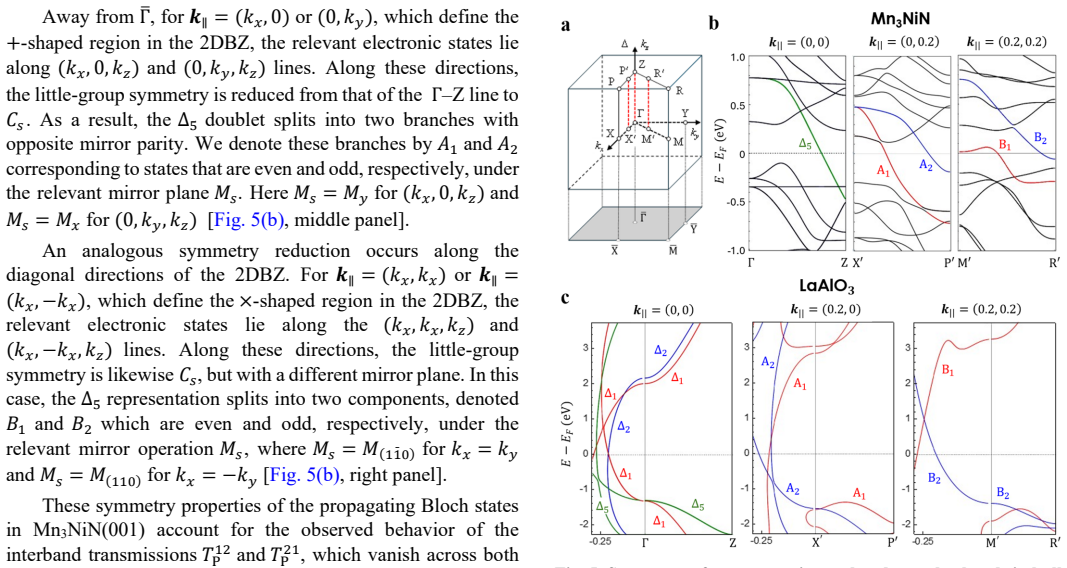
In Mn3NiN/LaAlO3/Mn3NiN (001) junctions based on the noncollinear Γ4g phase, orbital-symmetry selection rules suppress interband transmission in the parallel configuration while enabling symmetry-compatible interband tunneling in the antiparallel configuration along diagonal directions of the two-dimensional Brillouin zone. These additional channels enhance antiparallel conductance and reduce TMR relative to predictions based solely on spin polarization. Nevertheless, the TMR remains exceptionally large, exceeding 2000%, while band symmetry controls the attainable magnitude of TMR in AFMTJs.
What carries the argument
Orbital-symmetry selection rules that govern coupling between Mn3NiN Bloch states and LaAlO3 evanescent states.
If this is right
- TMR in AFMTJs is set by the combined action of spin polarization and symmetry-selective coupling.
- Antiparallel conductance receives extra contributions from symmetry-allowed interband channels.
- Accurate TMR predictions in AFMTJs require explicit treatment of band symmetry filtering.
- Band symmetry remains the dominant control on TMR magnitude even when spin polarization is large.
Where Pith is reading between the lines
- The same symmetry-matching logic may apply to other noncollinear antiferromagnets paired with oxide barriers.
- Material choices that alter the orbital character of electrode states could be used to tune the TMR ratio.
- Device models for ultrafast spintronics should incorporate symmetry filtering to predict realistic performance limits.
Load-bearing premise
The orbital-symmetry selection rules derived from the Bloch states of Mn3NiN and the evanescent states of LaAlO3 accurately determine transmission probabilities in the real junction.
What would settle it
A first-principles transport calculation or experimental conductance measurement on the Mn3NiN/LaAlO3/Mn3NiN junction that yields TMR significantly below 2000% or transmission probabilities that violate the predicted orbital symmetry selection rules.
Figures
read the original abstract
Antiferromagnetic tunnel junctions (AFMTJs) can exhibit large tunneling magnetoresistance (TMR), making them promising candidates for ultrafast and field-robust spintronic devices. Here, we elucidate the role of band symmetry in governing spin-dependent transport in AFMTJs. Using first-principles density-functional theory combined with quantum-transport calculations, we investigate Mn3NiN/LaAlO3/Mn3NiN (001) junctions based on the noncollinear $\Gamma_{4g}$ antiferromagnetic phase of Mn3NiN. Although Mn3NiN exhibits a large momentum-dependent spin polarization due to broken $PT$ symmetry, we show that the tunneling conductance is critically controlled by band symmetry of the electrode Bloch states and their symmetry-selective coupling to evanescent states in the LaAlO3 barrier. Orbital-symmetry selection rules suppress interband transmission in the parallel configuration, whereas the antiparallel configuration enables symmetry-compatible interband tunneling along the diagonal directions of the two-dimensional Brillouin zone. These additional transmission channels enhance the antiparallel conductance and reduce the TMR relative to predictions based solely on spin polarization. Nevertheless, the TMR remains exceptionally large, exceeding 2000%, while band symmetry controls the attainable magnitude of TMR in AFMTJs. Our results establish band-symmetry filtering as an essential ingredient of spin-dependent tunneling in AFMTJs.
Editorial analysis
A structured set of objections, weighed in public.
Referee Report
Summary. The paper examines spin-dependent tunneling in noncollinear antiferromagnetic tunnel junctions (AFMTJs) using first-principles DFT combined with quantum-transport calculations on Mn3NiN/LaAlO3/Mn3NiN (001) structures in the Γ4g phase. It reports that orbital-symmetry selection rules extracted from electrode Bloch states and barrier evanescent states suppress interband transmission in the parallel configuration while enabling symmetry-compatible interband channels along diagonal Brillouin-zone directions in the antiparallel case. This symmetry filtering reduces TMR relative to expectations based solely on momentum-dependent spin polarization, yet the calculated TMR still exceeds 2000%. The central conclusion is that band-symmetry filtering is an essential ingredient controlling attainable TMR magnitudes in AFMTJs.
Significance. If the quantitative results hold, the work supplies a concrete, calculation-derived demonstration that symmetry selection rules must be included alongside spin polarization when predicting TMR in AFMTJs. The explicit extraction of selection rules from computed states and their incorporation into Landauer transport provides a falsifiable, first-principles route to the reported >2000% TMR value, which is a strength for device-oriented spintronics research.
major comments (2)
- [§3] §3 (Results), transport calculations: the manuscript states that symmetry-suppressed parallel conductance and symmetry-allowed antiparallel interband channels reduce TMR relative to spin-polarization predictions, but does not quantify the reduction factor or show the hypothetical TMR value obtained when symmetry filtering is artificially disabled; without this comparison the claim that symmetry 'controls the attainable magnitude' remains qualitative.
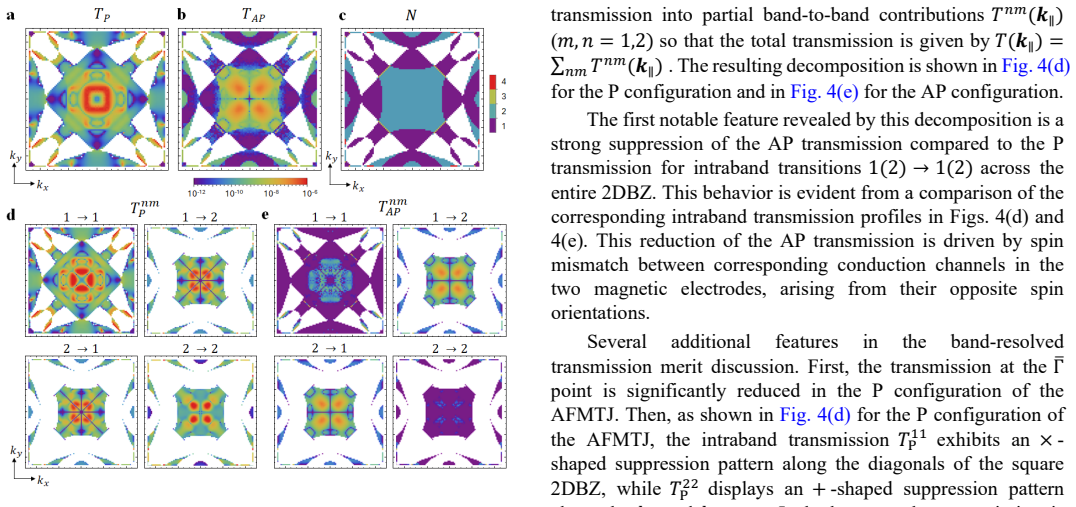
- [Fig. 4] Fig. 4 (or equivalent transmission map): the reported TMR >2000% is stated to survive after symmetry filtering, yet the k-resolved transmission plots are not accompanied by an explicit decomposition into symmetry-allowed versus forbidden channels; it is therefore unclear how much of the final TMR is attributable to the diagonal interband channels versus residual spin-polarization effects.
minor comments (3)
- [Abstract] The abstract and introduction use 'exceptionally large' for TMR >2000% without referencing prior AFMTJ benchmarks; a brief comparison sentence would help readers gauge the advance.
- [Fig. 3 caption] Notation for the two-dimensional Brillouin zone directions (e.g., 'diagonal directions') should be tied explicitly to high-symmetry points (X or M) in the figure captions or text.
- [Methods] The methods section should state the k-point sampling density used for the Landauer transmission integrals, as this directly affects the quantitative TMR value.
Simulated Author's Rebuttal
We thank the referee for the positive assessment and constructive comments on our manuscript. We respond point-by-point to the major comments below.
read point-by-point responses
-
Referee: [§3] §3 (Results), transport calculations: the manuscript states that symmetry-suppressed parallel conductance and symmetry-allowed antiparallel interband channels reduce TMR relative to spin-polarization predictions, but does not quantify the reduction factor or show the hypothetical TMR value obtained when symmetry filtering is artificially disabled; without this comparison the claim that symmetry 'controls the attainable magnitude' remains qualitative.
Authors: We agree that an explicit quantification would strengthen the presentation. Constructing a hypothetical TMR by artificially disabling symmetry filtering is not straightforward, as it would require unphysical modifications to the first-principles Hamiltonian or selection rules that could introduce artifacts unrelated to the physics. Our analysis instead relies on the direct computation of transmission with the symmetry rules extracted from the computed states. In the revised manuscript we will add a quantitative estimate in §3 by comparing our calculated TMR to the value expected from the electrode spin polarization alone (using the known momentum-dependent polarization of Mn3NiN), thereby making the reduction factor explicit. revision: partial
-
Referee: [Fig. 4] Fig. 4 (or equivalent transmission map): the reported TMR >2000% is stated to survive after symmetry filtering, yet the k-resolved transmission plots are not accompanied by an explicit decomposition into symmetry-allowed versus forbidden channels; it is therefore unclear how much of the final TMR is attributable to the diagonal interband channels versus residual spin-polarization effects.
Authors: We accept this suggestion. While the text derives the symmetry compatibility of the diagonal channels from the orbital character of the electrode Bloch states and barrier evanescent states, the figure itself does not overlay this information. In the revised manuscript we will update Fig. 4 (or add a supplementary panel) with explicit markers or shading indicating the symmetry-allowed interband channels in the antiparallel configuration, directly linking the plotted transmission to the selection-rule analysis. revision: yes
Circularity Check
No significant circularity; derivation is self-contained first-principles computation
full rationale
The paper's central results (TMR >2000% and symmetry-controlled magnitude) are outputs of explicit DFT + Landauer quantum-transport calculations on the Mn3NiN/LaAlO3/Mn3NiN junction. Orbital-symmetry selection rules are extracted directly from the computed Bloch and evanescent states rather than imposed externally or fitted; transmission probabilities follow from the Landauer formalism applied to those states. No load-bearing step reduces by construction to a fitted parameter, self-citation chain, or renamed input. The derivation chain is independent of the target observables and externally falsifiable via the underlying electronic-structure methods.
Axiom & Free-Parameter Ledger
Reference graph
Works this paper leans on
-
[1]
This corresponds to only ~2% lattice mismatch, indicating the feasibility of epitaxial growth of a heterostructure composed of these two compounds
and 3.81–3.83 Å [64]. This corresponds to only ~2% lattice mismatch, indicating the feasibility of epitaxial growth of a heterostructure composed of these two compounds. In constructing the Mn 3NiN/LaAlO3/Mn3NiN (001) junction, the in-plane lattice parameter was fixed to that of Mn 3NiN to simulate epitaxial growth ( a = 3.84 Å). Under this constraint, re...
2075
-
[2]
E. Y. Tsymbal, I. Žuti ć, Spintronics Handbook: Spin Transport and Magnetism, 2-nd edition (CRC press, 2019)
2019
-
[3]
Jullière, Tunneling between ferromagnetic films
M. Jullière, Tunneling between ferromagnetic films. Phys. Lett. A 54, 225 (1975)
1975
-
[4]
Maekawa and T
S. Maekawa and T. Shinjo (Eds.), Spin Dependent Transport in Magnetic Nanostructures (CRC Press, 2002)
2002
-
[5]
E. Y. Tsymbal and D. G. Pettifor, Perspectives of giant magnetoresistance. Solid State Physics 56, 113 (2001)
2001
-
[6]
Žuti ć, J
I. Žuti ć, J. Fabian, and S. Das Sarma, Spintronics: Fundamentals and applications. Rev. Mod. Phys. 76, 323 (2004)
2004
-
[7]
J. S. Moodera, L. R. Kinder, T. M. Wong, and R. Meservey, Large magnetoresistance at room temperature in ferromagnetic thin film tunnel junctions. Phys. Rev. Lett. 74, 3273 (1995)
1995
-
[8]
E. Y. Tsymbal, O. N. Mryasov, and P. R. LeClair, Spin-dependent tunneling in magnetic tunnel junctions. J. Phys. Condens. Matter 15, R109 (2003)
2003
-
[9]
Yuasa and D
S. Yuasa and D. D. Djayaprawi ra, Giant tunnel magnetoresistance in magnetic tunnel junctions with a crystalline MgO barrier. J. Phys. D: Appl. Phys. 40, R337 (2007)
2007
-
[10]
D. C. Ralph and M. D. Stiles, Spin transfer torques. J. Magn. Magn. Mater. 320, 1190 (2008)
2008
-
[11]
Manchon, J
A. Manchon, J. Železný, I. M. Miron, T. Jungwirth, J. Sinova, A. Thiaville, K. Garello, and P. Gambardella, Current-induced spin- orbit torques in ferromagnetic and antiferromagnetic systems. Rev. Mod. Phys. 91, 035004 (2019)
2019
-
[12]
Baltz, A
V. Baltz, A. Manchon, M. Tsoi , T. Moriyama, T. Ono, and Y. Tserkovnyak, Antiferromagnetic spintronics. Rev. Mod. Phys. 90, 015005 (2018)
2018
-
[13]
Jungwirth, J
T. Jungwirth, J. Sinova, A. Ma nchon, X. Marti, J. Wunderlich, and C. Felser, The multiple directions of antiferromagnetic spintronics. Nat. Phys. 14, 200 (2018)
2018
-
[14]
Železný, P
J. Železný, P. Wadley, K. Olejník, A. Hoffmann, and H. Ohno, Spin transport and spin torque in antiferromagnetic devices, Nat. Phys. 14, 220 (2018)
2018
-
[15]
A. D. Din, O. J. Amin, P. Wadley, and K. W. Edmonds, Antiferromagnetic spintronics and beyond. npj Spintronics 2, 25 (2024)
2024
-
[16]
H. Chen, L. Liu, X. Zhou, Z. Meng, X. Wang, Z. Duan, G. Zhao, H. Yan, P. Qin, and Z. Liu, Emerging antiferromagnets for spintronics. Adv. Mat. 36, 2310379 (2024)
2024
-
[17]
B. H. Rimmler, B. Pal, and S. S. P. Parkin, Non-collinear antiferromagnetic spintronics. Nat. Rev. Mater. 10, 109 (2025)
2025
-
[18]
Han, J.-Y
J. Han, J.-Y. Yoon, H. O hno, and S. Fukami, Unconventional responses in non-collinear antiferromagnets. Newton 1, 100012 (2025)
2025
-
[19]
H. Chen, Q. Niu, and A. H. MacDonald, Anomalous Hall effect arising from noncollinear antiferromagnetism. Phys. Rev. Lett. 112, 017205 (2014)
2014
-
[20]
Kübler and C
J. Kübler and C. Felser, N on-collinear antiferromagnets and the anomalous Hall effect. Europhys. Lett. 108, 67001 (2014). electrodes, as well as by the symmetry matching between the propagating Bloch states in th e electrodes and the evanescent states in the LaAlO3 barrier
2014
-
[21]
Nakatsuji, N
S. Nakatsuji, N. Kiyohara, a nd T. Higo, Large anomalous Hall effect in a non-collinear antiferromagnet at room temperature. Nat. Phys. 11, 1054 (2015)
2015
-
[22]
A. K. Nayak, J. Fi scher, Y. Sun, B. Yan, J. Kübler, C. Felser, and S. S. P. Parkin, Large anomalous Hall effect driven by a nonvanishing Berry curvature in the noncollinear antiferromagnet Mn 3Ge, Sci. Adv. 2, e1501870 (2016)
2016
-
[23]
T. Higo, D. Qu, Y. Li, C.-H. Chen, T. Asaba, M. Yoshida, K. Takubo, Y. Matsumoto, H. Ishiz uka, N. Nagaosa, M. Kawasaki, Y. Tokura, and S. Nakatsuji, Magnetic Weyl fermions and anomalous Hall effect in a ma gnetic topological semimetal, Nat. Photonics 12, 73 (2018)
2018
-
[24]
Gurung, D.-F
G. Gurung, D.-F. Shao, T. R. Paudel, and E. Y. Tsymbal, Anomalous Hall conductivity of noncollinear magnetic antiperovskites. Phys. Rev. Mater. 3, 044409 (2019)
2019
-
[25]
Zhou, J.-P
X. Zhou, J.-P. Hanke, W. Feng , F. Li, G.-Y. Guo, Y. Yao, S. Blügel, and Y. Mokrousov, Spin-order dependent anomalous Hall effect and magneto-optical effect in the noncollinear antiferromagnets Mn3XN with 𝑋 = Ga, Zn, Ag, or Ni. Phys. Rev. B 99, 104428 (2019)
2019
-
[26]
M. Raju, R. Romero, D. Nishio -Hamane, R. Uesugi, M. Asakura, Z. Tagay, T. Higo, N. P. Armitage, C. Broholm, and S. Nakatsuji, Anisotropic anomalous transport in the kagome-based topological antiferromagnetic Mn 3Ga epitaxial thin films. Phys. Rev. Mater. 8, 014204 (2024)
2024
-
[27]
Sinova, J
J. Sinova, J. Wunderlich, I. Žuti ć, and T. Jungwirth, Spin- polarized currents in antiferromagnets. Phys. Rev. Lett. 92, 126603 (2004)
2004
-
[28]
Železný, Y
J. Železný, Y. Zhang, C. Fe lser, and B. Yan, Spin-polarized current in non-collinear antiferromagnets. Phys. Rev. Lett. 119, 187204 (2017)
2017
-
[29]
Kimata, H
M. Kimata, H. Chen, K. Kondou, S. Sugimoto, P. K. Muduli, M. Ikhlas, Y. Omori, T. Tomita, A. H. MacDonald, S. Nakatsuji, and Y. Otani, Magnetic and magnetic inverse spin Hall effects in a non-collinear antiferromagnet. Nature 565, 627 (2019)
2019
-
[30]
T. Nan, C. X. Quintela, J. Irwin, G. Gurung, D.-F. Shao, J. Gibbons, N. Campbell, K. Song, S. Y. Choi, L. Guo, R. D. Johnson, P. Manuel, R. V. Chopdekar, I. Hallsteinsen, T. Tybell, P. J. Ryan, J. W. Kim, Y. S. Choi, P. G. Radaelli, D. C. Ralph, E. Y. Tsymbal, M. S. Rzchowski, and C.-B. Eom, Controlling spin current polarization through non-collinear anti...
2020
-
[31]
X. Chen, S. Shi, G. Shi, X. Fan, C. Song, X. Zhou, H. Bai, L. Liao, Y. Zhou, H. Zhang, A. Li, Y. Chen, X. Han, S. Jiang, Z. Zhu, H. Wu, X. Wang, D. Xue, and H. Yang, Observation of the antiferromagnetic spin Hall effect. Nat. Mater. 20, 800 (2021)
2021
-
[32]
Hu, D.-F
S. Hu, D.-F. Shao, H. Yang, C. Pan, Z. Fu, M. Tang, Y. Yang, W. Fan, S. Zhou, E. Y. Tsymbal, and X. Qiu, Efficient perpendicular magnetization switching by a magnetic spin Hall effect in a noncollinear antiferromagnet. Nat. Commun. 13, 4447 (2022). 13
2022
-
[33]
Y. You, H. Bai, X. Feng, X. Fan, L. Han, X. Zhou, Y. Zhou, R. Zhang, T. Chen, F. Pan, and C. Song, Cluster magnetic octupole induced out-of-plane spin po larization in antiperovskite antiferromagnet. Nat. Commun. 12, 6524 (2021)
2021
-
[34]
J.-Y. Yoon, Y. Takeuchi, R. Ta kechi, J. Han, T. Uchimura, Y. Yamane, S. Kanai, J. Ieda, H. Ohno, and S. Fukami, Electrical mutual switching in a noncollinear-antiferromagnetic- ferromagnetic heterostructure. Nat. Commun. 16, 1171 (2025)
2025
-
[35]
Zheng, L
Z. Zheng, L. Jia, Z. Zhang, Q. Shen, G. Zhou, Z. Cui, L. Ren, Z. Chen, N. F. Jamaludin, T. Zhao, R. Xiao, Q. Zhang, Y. Du, L. Liu, S. Gradečak, K. S. Novoselov, W. Zhao, X. Xu, Y. Zhang, and J. Chen, All-electrical perpendicular switching of chiral antiferromagnetic order. Nat. Mater. 24, 1407 (2025)
2025
-
[36]
D. Meng, S. Chen, C. Ren, J. Li, G. Lan, C. Li, Y. Liu, Y. Su, G. Yu, G. Chai, R. Xiong, W. Zhao, G. Yang, and S. Liang, Field- Free spin-orbit torque driven perpendicular magnetization switching of ferrimagnetic la yer based on noncollinear antiferromagnetic spin source. Adv. Electron. Mater. 10, 2300665 (2024)
2024
-
[37]
Torres-Amaris, A
D. Torres-Amaris, A. Ba utista-Hernandez, R. González- Hernández, A. H. Romero, and A. C. Garcia-Castro, Anomalous Hall conductivity control in Mn 3NiN antiperovskite by epitaxial strain along the kagome plane. Phys. Rev. B 106, 195113 (2022)
2022
-
[38]
Lukashev, R
P. Lukashev, R. F. Sabi rianov, and K. Belashchenko, Phys. Rev. B 78, 184414 (2008)
2008
-
[39]
Boldrin, F
D. Boldrin, F. Johnson, R. T hompson, A. P. Mihai, B. Zou, J. Zemen, J. Griffiths, P. Gubeljak , K. L. Ormandy, P. Manuel, D. D. Khalyavin, B. Ouladdiaf, N. Qureshi, P. Petrov, W. Bran ford, and L. F. Cohen, The biaxial strain dependence of magnetic order in spin frustrated Mn 3NiN thin films. Adv. Funct. Mater. 29, 1902502 (2019)
2019
-
[40]
J. Dong, X. Li, G. Gurung, M. Zhu, P. Zhang, F. Zheng, E. Y. Tsymbal, and J. Zhang, J. T unnelling magnetoresistance in non- collinear antiferromagnetic tunnel junctions. Phys. Rev. Lett. 128, 197201 (2022)
2022
-
[41]
Gurung, M
G. Gurung, M. Elekhtiar, Q. -Q. Luo, D.-F. Shao, and E. Y. Tsymbal, Nearly perfect spin polarization of non-collinear antiferromagnets. Nat. Commun. 15, 10242 (2024)
2024
-
[42]
S. Liu, T. Chen, B. Wu, H. Fan, Y. Zhu, S. Bi, Y. Liu, Y. Shi, W. Zhang, M. Wang, Q. Li, J. Yang, J. Lu, T. Zhou, and B. Liu, Mn 3SnN-based antiferromagnetic tunnel junction with giant tunneling magnetoresistance and multi-States: Design and theoretical validation. Adv. Sci. 12, e02985 (2025)
2025
-
[43]
X. Chen, T. Higo, K. Tanaka, T. Nomoto, H. Tsai, H. Idzuchi, M. Shiga, S. Sakamoto, R. Ando, H. Kosaki, T. Matsuo, D. Nishio- Hamane, R. Arita, S. Miwa, and S. Nakatsuji, Octupole-driven magnetoresistance in an antiferromagnetic tunnel junction. Nature 613, 490 (2023)
2023
-
[44]
P. Qin, H. Yan, X. Wang, H. Chen, Z. Meng, J. Dong, M. Zhu, J. Cai, Z. Feng, X. Zhou, L. Liu, T. Zhang, Z. Zeng, J. Zhang, C. Jiang, and Z. Liu, Room-temperature magnetoresistance in an all- antiferromagnetic tunnel junction. Nature 613, 485 (2023)
2023
-
[45]
J. Shi, S. Arpaci, V. L opez-Dominguez, V. K. Sangwan, F. Mahfouzi, J. Kim, J. G. Athas, M. Hamdi, C. Aygen, H. Arava, C. Phatak, M. Carpentieri, J. S. Jiang, M. A. Grayson, N. Kioussis, G. Finocchio, M. C. Hersam, and P. Khalili Amiri, Electrically controlled all-antiferromagnetic tunnel juncti ons on silicon with large room-temperature magnetoresistance...
2024
-
[46]
C.-T. Chou, S. Ghosh, B. C. McGoldrick, T. Nguyen, G. Gurung, E. Y. Tsymbal, M. Li, K. A. Mkhoyan, and L. Liu, Large Spin polarization from symmetry br eaking antiferromagnets in antiferromagnetic tunnel junctions, Nat. Commun. 15, 7840 (2024)
2024
-
[47]
J. Kang, M. Hamdi, S. K. Ch eung, L.-D. Yuan, M. Elekhtiar, W. Rogers, A. Meo, P. G. Lim, M. S. N. Tey, A. D’Addario, S. T. Konakanchi, E. Matt, J. Athas, S. Arpaci, L. Wan, S. C. Mehta, C. Phatak, P. Upadhyaya, M. Carpentieri, V. P. Dravid, M. C. Hersam, J. A. Katine, G. D. Fuchs, G. Finocchio, E. Y. Tsymbal, J. M. Rondinelli, and P. Khalili Amiri, P. Oc...
-
[48]
Shao and E
D.-F. Shao and E. Y. Tsymbal, Antiferromagnetic tunnel junctions for spintronics. npj Spintronics 2, 1 (2024)
2024
-
[49]
M. Zhu, J. Dong, X. Li, F. Zheng, Y. Zhou, K. Wu, and J. Zhang, Magnetic switching dynamics an d tunnel magnetoresistance effect based on spin-splitting noncollinear antiferromagnet Mn 3Pt. Chin. Phys. Lett. 41, 047502 (2024)
2024
-
[50]
Luo, X.-Y
Q.-Q. Luo, X.-Y. Guo, H. Zhou, G. Gurung, J.-M. Xu, W.-J. Lu, Y.-P. Sun, E. Y. Tsymbal, a nd D.-F. Shao, Angular-dependent tunneling magnetoresistance in a tunnel junction with ferromagnetic and noncollinear an tiferromagnetic electrodes. Phys. Rev. B 111, 144417 (2025)
2025
-
[51]
K. Tanaka, Y. Toga, S. Mi nami, S. Nakatsuji, T. Nomoto, T. Koretsune, and R. Arita, Ab-ini tio study of magnetoresistance effect in Mn 3Sn/MgO/Mn3Sn antiferromagnetic tunnel junction. arXiv:2509.21877 (2025)
work page internal anchor Pith review Pith/arXiv arXiv 2025
-
[52]
Mavropoulos, N
Ph. Mavropoulos, N. Papaniko laou, and P. H. Dederichs, Complex band structure and tunneling through ferromagnet/ insulator/ferromagnet junctions, Phys. Rev. Lett. 85, 1088 (2000)
2000
-
[53]
W. H. Butler, X. G. Zhang, T. C. Schulthess, and J. M. MacLaren, Spin-dependent tunneling conductance of Fe|MgO|Fe sandwiches, Phys. Rev. B 63, 054416 (2001)
2001
-
[54]
Velev, K.D
J. Velev, K.D. Belashchenko, D. A. Stewart, M. van Schilfgaarde, S. S. Jaswal, and E. Y. Tsymba l, Negative spin polarization and large tunneling magnetoresist ance in epitaxial Co/SrTiO 3/Co magnetic tunnel junctions, Phys. Rev. Lett. 95, 216601 (2005)
2005
-
[55]
J. M. De Teresa, A. Barthé lémy, A. Fert, J. P. Contour, F. Montaigne, and P. Seneor, Role of metal-oxide interface in determining the spin polarization of magnetic tunnel junctions. Science 286, 507 (1999)
1999
-
[56]
Fert, Nobel Lecture: Orig in, development, and future of spintronics, Rev
A. Fert, Nobel Lecture: Orig in, development, and future of spintronics, Rev. Mod. Phys. 80, 1517 (2008)
2008
-
[57]
K. D. Belashchenko and E. Y. Tsymbal, in Spintronics Handbook: Spin Transport and Magnetism, Vol. 1: Metallic Spintronics, 2nd Edition, E. Y. Tsymbal and I. Žutić, eds. (CRC Press, 2019) Chap. 13, pp. 525–558
2019
-
[58]
K. D. Belashchenko, E. Y. Tsymbal, M. van Schilfgaarde, D. Stewart, I. I. Oleinik, and S. S. Jaswal, Effect of interface bonding on spin-dependent tunneling from the oxidized Co surface, Phys. Rev. B 69, 174408 (2004)
2004
-
[59]
Giannozzi, S
P. Giannozzi, S. Baroni, N. Bonini, M. Calandra, R. Car, C. Cavazzoni, D. Ceresoli, G. L. Chiarotti, M. Cococcioni, I. Dabo, A. Dal Corso, S. de Gironcoli, S. Fabris, G. Fratesi, R. Gebauer, U. Gerstmann, C. Gougoussis, A. Kokalj, M. Lazzeri, L. Martin- Samos, N. Marzari, F. Mauri, R. Mazzarello, S. Paolini, A. Pasquarello, L. Paulatto, C. Sbraccia, S. Sc...
2009
-
[60]
Vanderbilt, Soft sel f-consistent pseudopotentials in a generalized eigenvalue formalism
D. Vanderbilt, Soft sel f-consistent pseudopotentials in a generalized eigenvalue formalism. Phys. Rev. B 41, 7892 (1990)
1990
-
[61]
J. P. Perdew, K. Burke, & M. Ernzerhof, Generalized gradient approximation made simple. Phys. Rev. Lett. 77, 3865 (1996)
1996
-
[62]
K. Zhao, T. Hajiri, H. Chen, R. Miki, H. Asano, and P. Gegenwart, Anomalous Hall effect in the noncollinear antiferromagnetic antiperovskite Mn 3Ni1−xCuxN. Phys. Rev. B 100, 4 (2019)
2019
-
[63]
Xiong, J
K. Xiong, J. Robertson, and S.J. Clark, Defect states in the high- dielectric-constant gate oxide LaAlO 3. Appl. Phys. Lett. 89, 2 (2006)
2006
-
[64]
M. Wu, C. Wang, Y. Sun, L. Chu, J. Yan, D. Chen, Q. Huang, and J.W. Lynn, Magnetic structure and lattice contraction in Mn3NiN. J. Appl. Phys. 114, 12 (2013)
2013
-
[65]
S. A. Hayward, F. D. Morrison, S. A. T. Redfern, E. K. H. Salje, J. F. Scott, K. S. Knight, S. Tarantino, A. M. Glazer, V. Shuvaeva, P. Daniel, and M. Zhang, Tran sformation processes in LaAlO 3: Neutron diffraction, dielectric , thermal, optical, and Raman studies. Phys. Rev. B 72, 054110 (2005)
2005
-
[66]
H. J. Choi & J. Ihm, Ab initio pseudopotential method for the calculation of conductance in quantum wires. Phys. Rev. B 59, 2267 (1999)
1999
-
[67]
Smogunov, A
A. Smogunov, A. Dal Corso, & E. Tosatti, Ballistic conductance of magnetic Co and Ni nanowires with ultrasoft pseudopotentials. Phys. Rev. B 70, 045417 (2004)
2004
-
[68]
J. D. Hunter, Matplotlib: A 2D graphics environment. Comput. Sci. Eng. 9, 90–95 (2007)
2007
-
[69]
Mathematica, Version 13.2, Wolfram Research, Inc., Champaign, IL (2024)
2024
-
[70]
Momma and F
K. Momma and F. Izumi, VESTA 3 for three-dimensional visualization of crystal, volumetric and morphology data. J. Appl. Crystallogr. 44, 1272–1276 (2011)
2011
-
[71]
Zemen, Z
J. Zemen, Z. Gercsi, and K. G. Sandeman, Piezomagnetism as a counterpart of the magnetovolu me effect in magnetically frustrated Mn-based antiperovskite nitrides. Phys. Rev. B 96, 024451 (2017)
2017
-
[72]
Shao, S.-H
D.-F. Shao, S.-H. Zhang, M. Li, C.-B. Eom, and E. Y. Tsymbal, Spin-neutral currents for spintronics, Phys. Rev. B 104, 195302 (2021)
2021
-
[73]
Boldrin, A
D. Boldrin, A. P. Mihai, B. Zou, J. Zemen, R. Thompson, E. Ware, B. V. Neamtu, L. Ghivelder, B. Esser, D. W. McComb, P. Petrov, and L. F. Cohen, Giant Piezomagnetism in Mn 3NiN. ACS Appl. Mater. Interfaces 10, 18863 (2018)
2018
-
[74]
Keshri, P
A. Keshri, P. Das, N. Devaraj, S. Chowdhury, J. K. Dey, S. Ojha, P. Gupta, M. Hoesch, F. Afaneh, B. Roul, T. Venkatesan, B. Saha, A. Narayan, M. Bibes, and S. Das, Unlocking exceptional negative valency and spin reconstruction in non ‐collinear anti‐ ferromagnetic antiperovskite Mn 3NiN film. Adv. Func. Mat. 35, 2500655 (2025)
2025
-
[75]
El-Mellouhi, E
F. El-Mellouhi, E. N. Brothers, M. J. Lucero, I. W. Bulik, and G. E. Scuseria, Structural phase transitions of the metal oxide perovskites SrTiO3, LaAlO3, and LaTiO3 studied with a screened hybrid functional. Phys. Rev. B 87, 035107 (2013)
2013
-
[76]
Boudali, M
A. Boudali, M. Driss Khodja, B. Amrani, D. Bourbie, K. Amara, and A. Abada, First-principles study of structural, elastic, electronic, and thermal properties of SrTiO 3 perovskite cubic. Phys. Lett. A 373, 879 (2009)
2009
discussion (0)
Sign in with ORCID, Apple, or X to comment. Anyone can read and Pith papers without signing in.