Disentangling the contributions of individual cations to magnetic order in a spinel high entropy oxide
Pith reviewed 2026-06-29 21:53 UTC · model grok-4.3
The pith
Different cations in spinel high-entropy oxides develop magnetic moments at rates set by their 3d crystal-field fillings.
A machine-rendered reading of the paper's core claim, the machinery that carries it, and where it could break.
Core claim
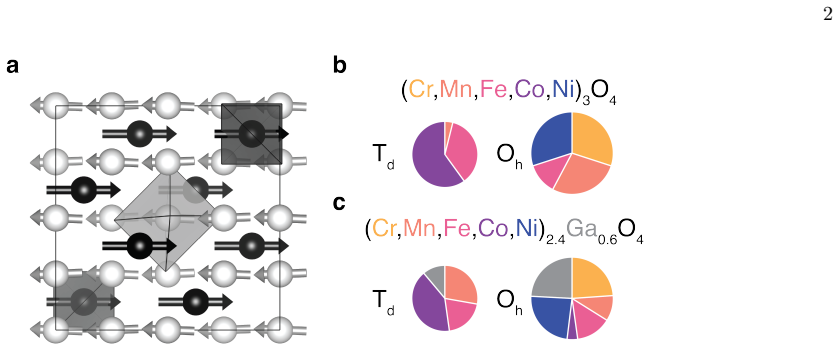
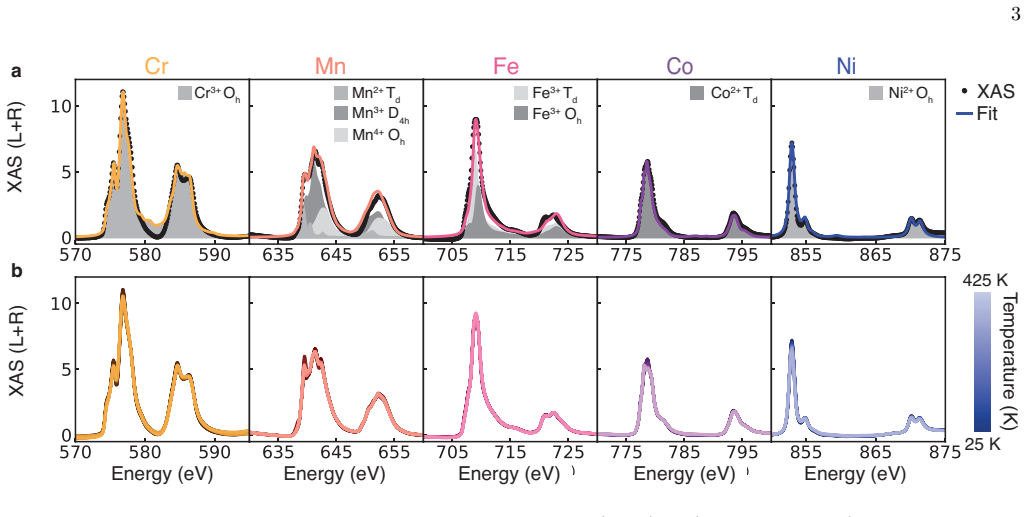
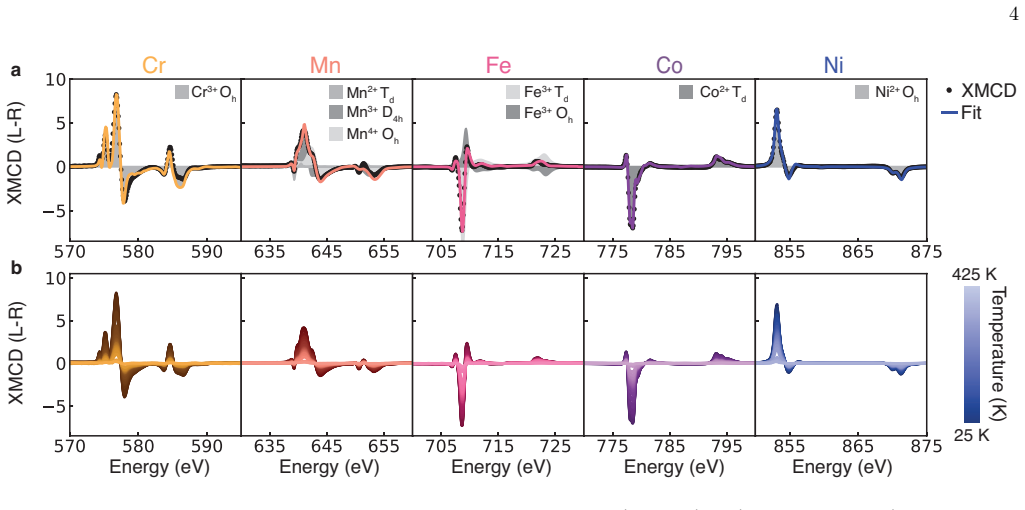
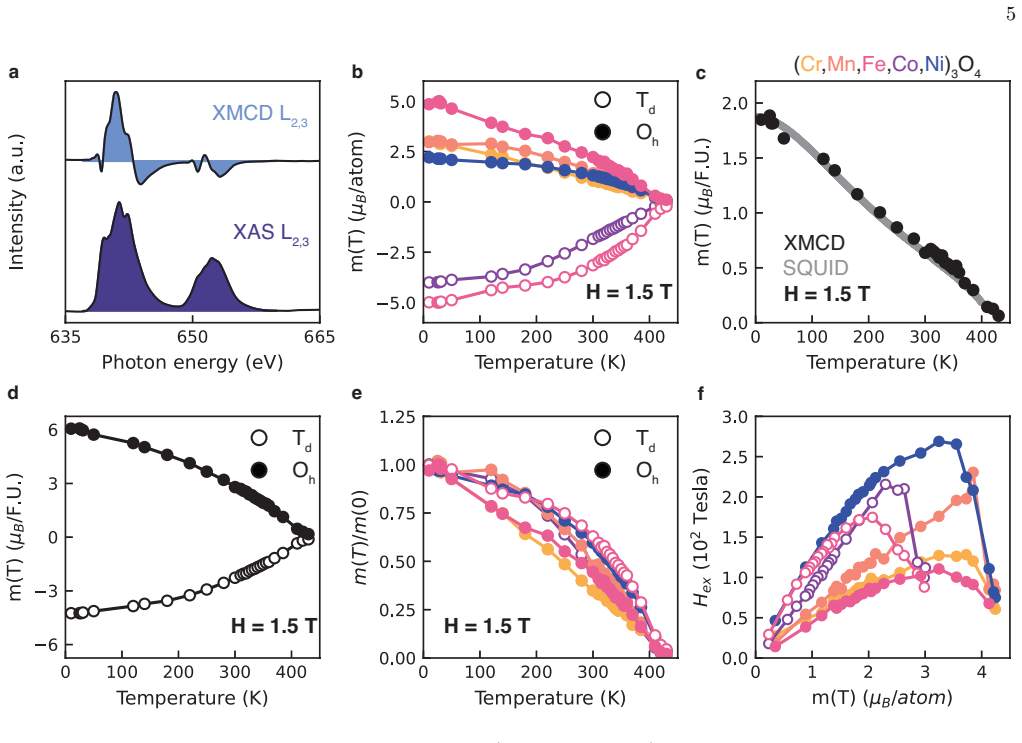
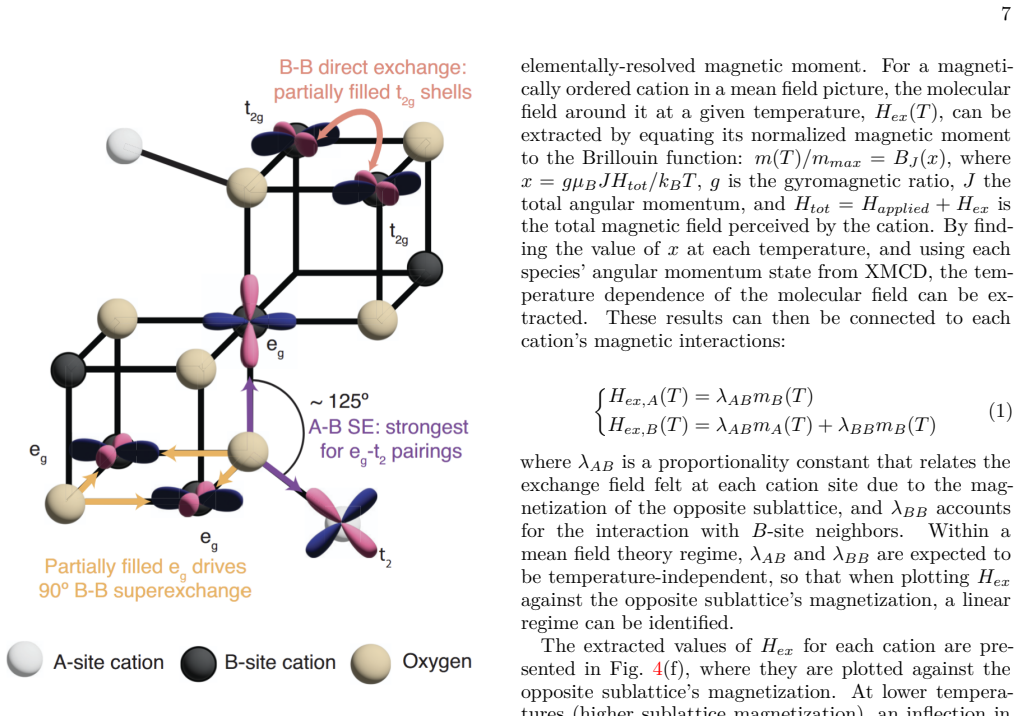
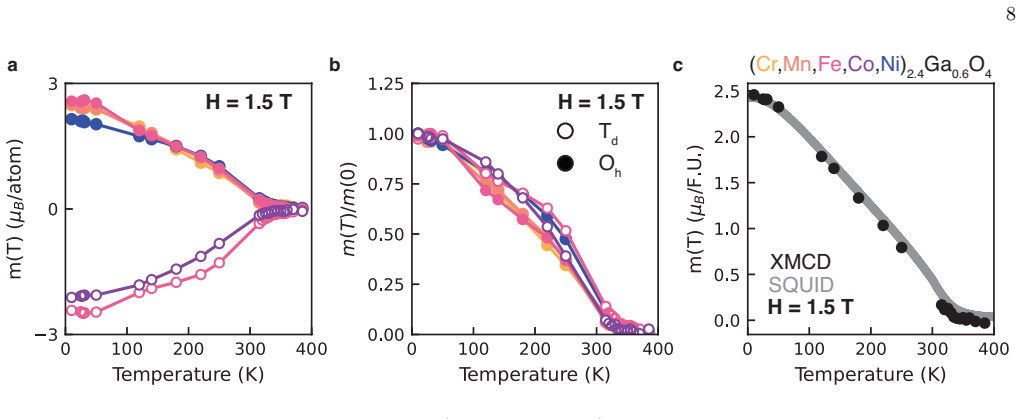
In the spinel high-entropy oxides (Cr,Mn,Fe,Co,Ni)3O4 and (Cr,Mn,Fe,Co,Ni)2.4Ga0.6O4, x-ray magnetic circular dichroism reveals that the magnetic transition temperature is identical for every cation, yet the rate at which each cation's moment increases with decreasing temperature is strongly cation-dependent. This dependence follows from the different 3d crystal-field level fillings, which dictate participation in the available A-B versus competing exchange pathways. Tetrahedral Fe3+ and octahedral Ni2+ harden rapidly through dominant A-B exchange, while octahedral Fe3+ and Cr3+ remain sluggish because of frustration; non-magnetic Ga substitution suppresses the differences by breaking linkag
What carries the argument
Element-specific XMCD magnetometry that extracts the temperature-dependent moment of each cation, interpreted through the 3d crystal-field fillings that select which exchange pathways each cation can access in the spinel structure.
If this is right
- Dominant A-B exchange produces rapid moment growth for tetrahedral Fe3+ and octahedral Ni2+.
- Competing interactions produce frustration and slower growth for octahedral Fe3+ and Cr3+.
- Non-magnetic Ga substitution relieves frustration and reduces the spread in growth rates by breaking magnetic linkages.
- Designing the magnetic response of spinel HEOs therefore requires knowledge of both cation site preferences and the exchange paths each cation can use.
Where Pith is reading between the lines
- The same element-specific approach could be used to map which ions drive order in other disordered magnetic oxides beyond spinels.
- If cation site occupancies can be tuned during synthesis, the sharpness or breadth of the magnetic transition might be engineered by selecting ions with particular crystal-field fillings.
- The finding implies that the overall ordering temperature in these materials is set by the fastest-hardening cations, while the low-temperature moment is set by the full set of participating ions.
Load-bearing premise
The observed differences in moment growth rates are produced by 3d crystal-field fillings and specific exchange pathways, which requires that site occupancies are known accurately and that XMCD sum-rule analysis remains valid without large corrections for chemical disorder.
What would settle it
Temperature-dependent XMCD spectra measured on a spinel HEO sample whose cation site occupancies have been independently determined by another technique such as neutron diffraction would show whether the moment-growth rates truly track the predicted crystal-field and pathway assignments.
Figures
read the original abstract
High entropy oxides (HEOs) can possess long-range ordered magnetic states despite their extreme chemical disorder. Very little is known about how the different chemical constituents in HEOs contribute to the emergence of these magnetic states. In this work, we leverage element-specific magnetometry attained via x-ray magnetic circular dichroism (XMCD) to understand how magnetic order is driven in two ferrimagnetic spinel-structured HEOs with compositions (Cr,Mn,Fe,Co,Ni)$_3$O$_4$ and (Cr,Mn,Fe,Co,Ni)$_{2.4}$Ga$_{0.6}$O$_4$. We find that while the magnetic transition is simultaneous for all chemical species, the rate at which their magnetic moments grow is strongly cation dependent. This behavior is explained by the varying $\textit{3d}$ crystal field level fillings of the magnetic cations, which in turn determine their ability to participate in the different magnetic exchange pathways available in the spinel structure. Dominant $A$-$B$ sublattice exchange enables some species to harden rapidly ($\textit{e.g.}$ tetrahedral Fe$^{3+}$ and octahedral Ni$^{2+}$) while others exhibit a sluggish transition due to frustration from competing interactions ($\textit{e.g.}$ octahedral Fe$^{3+}$ and Cr$^{3+}$). Non-magnetic substitution suppresses these differences, introducing broken magnetic linkages that relieve frustration. Tailoring the magnetism of HEO spinels therefore requires detailed knowledge of both their site selectivities and their exchange pathways.
Editorial analysis
A structured set of objections, weighed in public.
Referee Report
Summary. The manuscript uses element-specific XMCD magnetometry to study magnetic ordering in two ferrimagnetic spinel HEOs, (Cr,Mn,Fe,Co,Ni)3O4 and (Cr,Mn,Fe,Co,Ni)2.4Ga0.6O4. It reports that the magnetic transition temperature is the same for all cations, but the rate at which individual cation moments develop below Tc is strongly species-dependent. This is attributed to differences in 3d crystal-field fillings that control participation in A-B versus B-B superexchange pathways; tetrahedral Fe3+ and octahedral Ni2+ harden rapidly via dominant A-B exchange, while octahedral Fe3+ and Cr3+ are frustrated and sluggish. Ga substitution is claimed to relieve frustration by breaking linkages and equalizing growth rates. The work concludes that site selectivities and exchange pathways must be known in detail to tailor HEO magnetism.
Significance. If the element-specific moments and site assignments hold, the observation of simultaneous Tc but cation-dependent moment growth rates provides a concrete mechanistic picture of how long-range order emerges in chemically disordered spinels. The link to crystal-field fillings and specific exchange pathways is a useful framework for understanding and designing magnetic HEOs. The experimental approach of tracking multiple cations simultaneously is a strength.
major comments (2)
- Abstract: The central interpretation—that observed differences in moment growth rates map directly to 3d crystal-field fillings and A-B vs. B-B exchange pathways—requires that element-specific moments extracted via standard XMCD sum rules remain valid. In a chemically disordered HEO the local ligand environment fluctuates, which can alter branching ratios, introduce multiplet mixing, or violate assumptions of localized 3d states and negligible charge-transfer effects. The manuscript provides no evidence that these corrections are negligible or that sum-rule extractions have been validated for this disordered case; without such validation the mechanistic assignment is not unambiguous.
- Abstract: Accurate tetrahedral/octahedral site occupancies for each cation are required to assign species to specific exchange pathways. The paper assumes these occupancies are known reliably, yet offers no discussion of how they were determined in the disordered spinel or of possible local fluctuations that would affect pathway assignments.
Simulated Author's Rebuttal
We thank the referee for their detailed and constructive report. The two major comments raise important points about the robustness of our XMCD analysis and site assignments in a disordered system. We address each below and indicate where revisions have been made.
read point-by-point responses
-
Referee: Abstract: The central interpretation—that observed differences in moment growth rates map directly to 3d crystal-field fillings and A-B vs. B-B exchange pathways—requires that element-specific moments extracted via standard XMCD sum rules remain valid. In a chemically disordered HEO the local ligand environment fluctuates, which can alter branching ratios, introduce multiplet mixing, or violate assumptions of localized 3d states and negligible charge-transfer effects. The manuscript provides no evidence that these corrections are negligible or that sum-rule extractions have been validated for this disordered case; without such validation the mechanistic assignment is not unambiguous.
Authors: We agree that local disorder could in principle affect sum-rule applicability. However, the simultaneous Tc observed for all cations (a key experimental result) is independent of absolute moment magnitudes and relies only on the temperature at which dichroism appears, which is robust. For the relative growth rates, we have added a new paragraph in the revised manuscript (Section 3.2) citing prior XMCD studies on disordered spinels and mixed-valence oxides where sum rules were cross-validated against neutron diffraction and SQUID data; those works found deviations <15% for relative moments when charge-transfer effects are weak, as expected here given the oxide ligand field. We also note that the cation-dependent trends align quantitatively with crystal-field expectations without requiring absolute calibration. If the referee has specific corrections in mind, we would be happy to apply them. revision: yes
-
Referee: Abstract: Accurate tetrahedral/octahedral site occupancies for each cation are required to assign species to specific exchange pathways. The paper assumes these occupancies are known reliably, yet offers no discussion of how they were determined in the disordered spinel or of possible local fluctuations that would affect pathway assignments.
Authors: Site occupancies were obtained from Rietveld refinement of laboratory XRD patterns combined with the known preference rules for spinels (Cr^{3+} and Mn^{3+} strongly octahedral, Fe^{3+} and Co^{2+} mixed, Ni^{2+} octahedral). We have expanded the Experimental Methods and a new subsection in Results to detail the refinement procedure, including the constraints used and the resulting occupancies with uncertainties. Regarding local fluctuations, the average occupancies determine the dominant exchange pathways because superexchange is mediated by oxygen-mediated linkages whose statistics are captured by the mean site distribution; we have added a brief discussion of this point and a reference to Monte Carlo studies of disordered spinels showing that pathway assignments based on average occupancies correctly predict the observed ordering temperatures. revision: yes
Circularity Check
No circularity: purely experimental XMCD report with standard interpretation
full rationale
The manuscript is an experimental study reporting element-specific XMCD magnetometry on two spinel HEO compositions. The central observation (simultaneous magnetic transition but cation-dependent moment growth rates) is presented as a direct experimental finding. The subsequent attribution to 3d crystal-field fillings and A-B vs. B-B exchange pathways invokes only established spinel magnetism and ligand-field theory; no equations, fitted parameters, or self-citations are shown that reduce the reported result to the input data by construction. No derivation chain exists that could be circular.
Axiom & Free-Parameter Ledger
axioms (1)
- domain assumption XMCD sum rules can extract element-specific magnetic moments in spinel oxides
Reference graph
Works this paper leans on
-
[1]
C. M. Rost, E. Sachet, T. Borman, A. Moballegh, E. C. Dickey, D. Hou, J. L. Jones, S. Curtarolo, and J.-P. Maria, Entropy-stabilized oxides, Nature Communica- tions 6, 8485 (2015)
2015
-
[2]
Brahlek, M
M. Brahlek, M. Gazda, V. Keppens, A. R. Mazza, S. J. McCormack, A. Mielewczyk-Gryń, B. Musico, K. Page, C. M. Rost, S. B. Sinnott, et al. , What is in a name: Defining high entropy oxides, APL Materials 10 (2022)
2022
-
[3]
Sharma, M.-C
Y. Sharma, M.-C. Lee, K. C. Pitike, K. K. Mishra, Q. Zheng, X. Gao, B. L. Musico, A. R. Mazza, R. S. Katiyar, V. Keppens, et al. , High entropy oxide relaxor ferroelectrics, ACS Applied Materials & Interfaces 14, 11962 (2022)
2022
-
[4]
H. Qi, L. Chen, S. Deng, and J. Chen, High-entropy ferroelectric materials, Nature Reviews Materials 8, 355 (2023)
2023
-
[5]
T. Cui, T. Lin, Q. Jin, S. Chen, H. Hong, Q. Zhang, Y. Fan, D. Rong, J. Wang, C. Wang, et al. , Orbital con- trol of metal-to-insulator transition in high-entropy nick- elates, Physical Review Materials 7, 115802 (2023)
2023
-
[6]
Sarkar, R
A. Sarkar, R. Kruk, and H. Hahn, Magnetic properties of high entropy oxides, Dalton Transactions 50, 1973 (2021)
1973
-
[7]
Zhang, J
J. Zhang, J. Yan, S. Calder, Q. Zheng, M. A. McGuire, D. L. Abernathy, Y. Ren, S. H. Lapidus, K. Page, H. Zheng, J. W. Freeland, J. D. Budai, and R. P. Her- mann, Long-range antiferromagnetic order in a rocksalt high entropy oxide, Chemistry of Materials 31, 3705 (2019)
2019
-
[8]
M. P. Jimenez-Segura, T. Takayama, D. Bérardan, A. Hoser, M. Reehuis, H. Takagi, and N. Dragoe, Long- range magnetic ordering in rocksalt-type high-entropy ox- ides, Applied Physics Letters 114 (2019)
2019
-
[9]
Witte, A
R. Witte, A. Sarkar, R. Kruk, B. Eggert, R. A. Brand, H. Wende, and H. Hahn, High-entropy oxides: An emerg- ing prospect for magnetic rare-earth transition metal per- ovskites, Physical Review Materials 3, 034406 (2019)
2019
-
[10]
Witte, A
R. Witte, A. Sarkar, L. Velasco, R. Kruk, R. A. Brand, B. Eggert, K. Ollefs, E. Weschke, H. Wende, and H. Hahn, Magnetic properties of rare-earth and transition metal based perovskite type high entropy oxides, Journal of Ap- plied Physics 127 (2020)
2020
-
[11]
A. R. Mazza, E. Skoropata, Y. Sharma, J. Lapano, T. W. Heitmann, B. L. Musico, V. Keppens, Z. Gai, J. W. Free- land, T. R. Charlton, M. Brahlek, A. Moreo, E. Dagotto, and T. Z. Ward, Designing magnetism in high entropy oxides, Advanced Science 9, 2200391 (2022)
2022
-
[12]
Musicó, Q
B. Musicó, Q. Wright, T. Z. Ward, A. Grutter, E. Aren- holz, D. Gilbert, D. Mandrus, and V. Keppens, Tunable magnetic ordering through cation selection in entropic spinel oxides, Phys. Rev. Mater. 3, 104416 (2019)
2019
-
[13]
G. H. Johnstone, M. U. González-Rivas, K. M. Taddei, R. Sutarto, G. A. Sawatzky, R. J. Green, M. Oudah, and A. M. Hallas, Entropy engineering and tunable magnetic order in the spinel high-entropy oxide, Journal of the American Chemical Society 144, 20590 (2022)
2022
-
[14]
Nevgi, S
R. Nevgi, S. Dey, N. Bhattacharya, S. Ershadrad, T. Dan, S. Chakravarty, S. Kaushik, C. Klewe, G. E. Sterbinsky, B. Sanyal, et al. , Local structural distortions drive mag- netic molecular field in compositionally complex spinel oxide, Nature Communications 16, 7038 (2025)
2025
-
[15]
M. R. Chellali, A. Sarkar, S. H. Nandam, S. S. Bhat- tacharya, B. Breitung, H. Hahn, and L. Velasco, On the homogeneity of high entropy oxides: An investigation at the atomic scale, Scripta Materialia 166, 58 (2019)
2019
-
[16]
Sarkar, B
A. Sarkar, B. Eggert, R. Witte, J. Lill, L. Velasco, Q. Wang, J. Sonar, K. Ollefs, S. S. Bhattacharya, R. A. Brand, et al. , Comprehensive investigation of crys- tallographic, spin-electronic and magnetic structure of (Co0.2Cr0.2Fe0.2Mn0.2Ni0.2)3O4: Unraveling the suppres- sion of configuration entropy in high entropy oxides, Acta materialia 226, 117581 (2022)
2022
-
[17]
S. M. Masina, G. C. Nkala, M. A. Kiefer, C. L. Cao, L. A. Nagle-Cocco, Y. Mhlana, and K. H. Stone, A multi- pronged approach to the determination of cation distri- bution, site selectivity, and chemical ordering in high en- tropy spinel oxides, Journal of the American Chemical Society 147, 38283 (2025)
2025
-
[18]
C. M. Meier, T. D. Boyko, D. T. Teppala, P. Ufondu, E. Ionescu, and A. Moewes, The interplay of selective oc- cupation and magnetic properties of high entropy spinel oxides, Journal of Alloys and Compounds 1037, 181224 (2025)
2025
-
[19]
K. Wang, W. Hua, X. Huang, D. Stenzel, J. Wang, Z. Ding, Y. Cui, Q. Wang, H. Ehrenberg, B. Breitung, et al., Synergy of cations in high entropy oxide lithium ion battery anode, Nature Communications 14, 1487 (2023)
2023
-
[20]
M. U. González-Rivas, S. S. Aamlid, M. R. Rutherford, J. Freese, R. Sutarto, N. Chen, E. E. Villalobos-Portillo, H. Castillo-Michel, M. Kim, H. Takagi, R. J. Green, and A. M. Hallas, Impact of synthesis method on the struc- ture and function of high entropy oxides, Journal of the American Chemical Society 146, 26048 (2024) . 12
2024
-
[21]
Dbrowa, M
J. Dbrowa, M. Stygar, A. Mikua, A. Knapik, K. Mroczka, W. Tejchman, M. Danielewski, and M. Martin, Synthe- sis and microstructure of the (co,cr,fe,mn,ni)3o4 high en- tropy oxide characterized by spinel structure, Materials Letters 216, 32 (2018)
2018
-
[22]
Cieslak, M
J. Cieslak, M. Reissner, K. Berent, J. Dabrowa, M. Sty- gar, M. Mozdzierz, and M. Zajusz, Magnetic properties and ionic distribution in high entropy spinels studied by mössbauer and ab initio methods, Acta Materialia 206, 116600 (2021)
2021
-
[23]
A. Mao, F. Quan, H.-Z. Xiang, Z.-G. Zhang, K. Ku- ramoto, and A.-L. Xia, Facile synthesis and ferrimagnetic property of spinel (CoCrFeMnNi) 3O4 high-entropy oxide nanocrystalline powder, Journal of Molecular Structure 1194, 11 (2019)
2019
-
[24]
Y. He, L. Zhang, H.-w. Xiong, K.-c. Zhou, and X. Kang, The selective site occupation, structural and thermal sta- bility of high entropy (CoCrFeMnNi) 3O4 spinel, Journal of Alloys and Compounds 965, 171428 (2023)
2023
-
[25]
S. M. Masina, G. C. Nkala, M. A. Kiefer, C. L. Cao, L. A. V. Nagle-Cocco, Y. Mhlana, and K. H. Stone, A multi-pronged approach to the determination of cation distribution, site selectivity, and chemical ordering in high entropy spinel oxides, Journal of the American Chemical Society 147, 38283 (2025)
2025
-
[26]
Tanaka and T
A. Tanaka and T. Jo, Resonant 3d, 3p and 3s photoemis- sion in transition metal oxides predicted at 2p threshold, Journal of the Physical Society of Japan 63, 2788 (1994)
1994
-
[27]
Tanabe and S
Y. Tanabe and S. Sugano, On the absorption spectra of complex ions II, Journal of the Physical Society of Japan 9, 766 (1954)
1954
-
[28]
Atkins, Shriver and Atkins’ Inorganic Chemistry (Ox- ford University Press, USA, 2010)
P. Atkins, Shriver and Atkins’ Inorganic Chemistry (Ox- ford University Press, USA, 2010)
2010
-
[29]
van der Laan and A
G. van der Laan and A. I. Figueroa, X-ray magnetic circu- lar dichroisma versatile tool to study magnetism, Coordi- nation Chemistry Reviews 277-278, 95 (2014) , following Chemical Structures using Synchrotron Radiation
2014
-
[30]
D. G. Wickham and J. B. Goodenough, Suggestion con- cerning magnetic interactions in spinels, Phys. Rev. 115, 1156 (1959)
1959
-
[31]
G. F. Dionne, Magnetic oxides , Vol. 14 (Springer, 2009)
2009
-
[32]
Rodríguez-Carvajal, Recent advances in magnetic structure determination by neutron powder diffraction, Physica B: Condensed Matter 192, 55 (1993)
J. Rodríguez-Carvajal, Recent advances in magnetic structure determination by neutron powder diffraction, Physica B: Condensed Matter 192, 55 (1993)
1993
-
[33]
D. G. Hawthorn, F. He, L. Venema, H. Davis, A. J. Achkar, J. Zhang, R. Sutarto, H. Wadati, A. Radi, T. Wilson, G. Wright, K. M. Shen, J. Geck, H. Zhang, V. Novák, and G. A. Sawatzky, An in-vacuum diffrac- tometer for resonant elastic soft x-ray scattering, Review of Scientific Instruments 82, 073104 (2011)
2011
discussion (0)
Sign in with ORCID, Apple, or X to comment. Anyone can read and Pith papers without signing in.