Mean-Shift PCA by Knockoff Mean
Pith reviewed 2026-06-29 20:56 UTC · model grok-4.3
The pith
Introducing a knockoff mean-shift perturbation allows standard PCA to separate and remove mean-shift contamination while preserving the original eigenspace.
A machine-rendered reading of the paper's core claim, the machinery that carries it, and where it could break.
Core claim
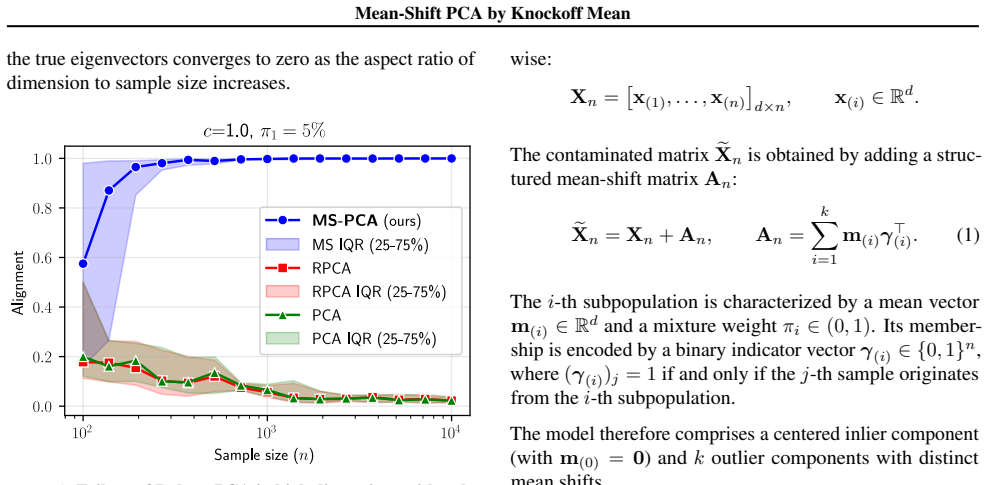
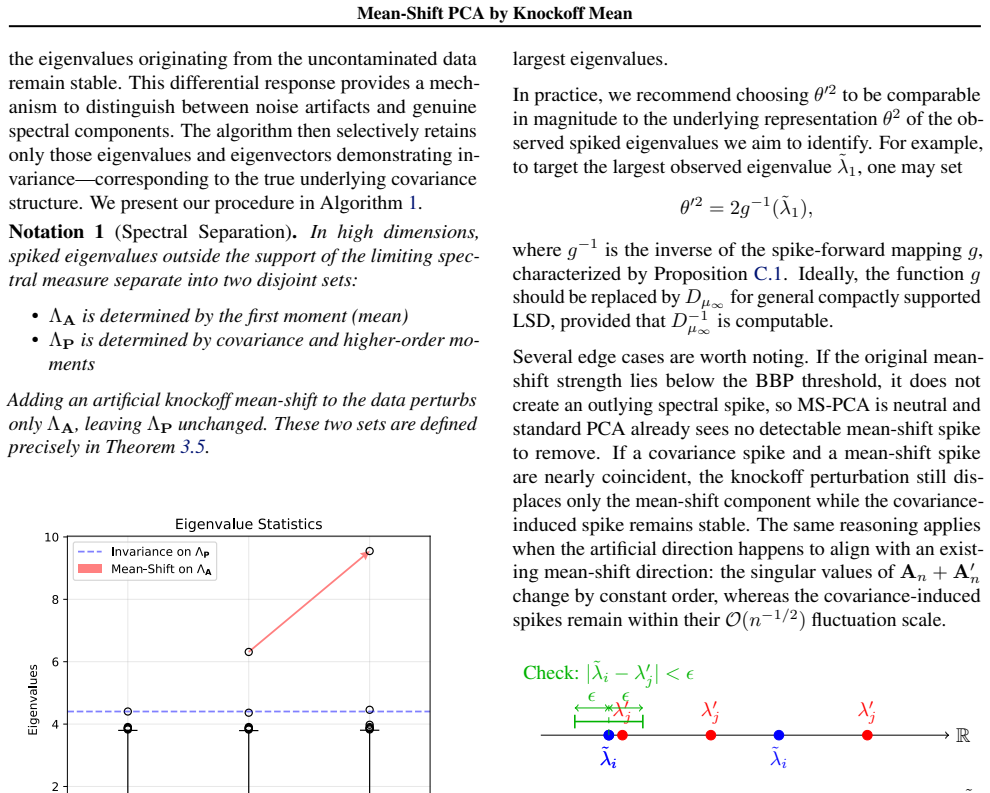
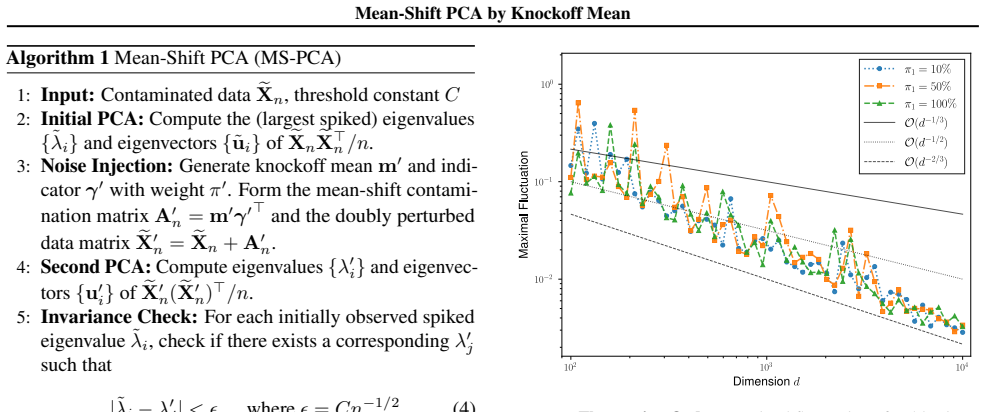
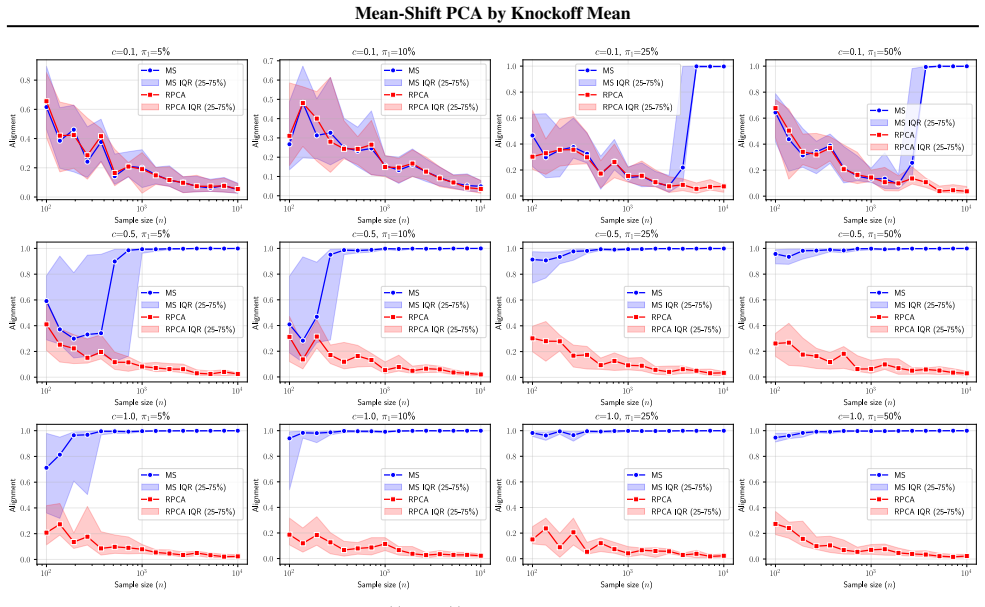
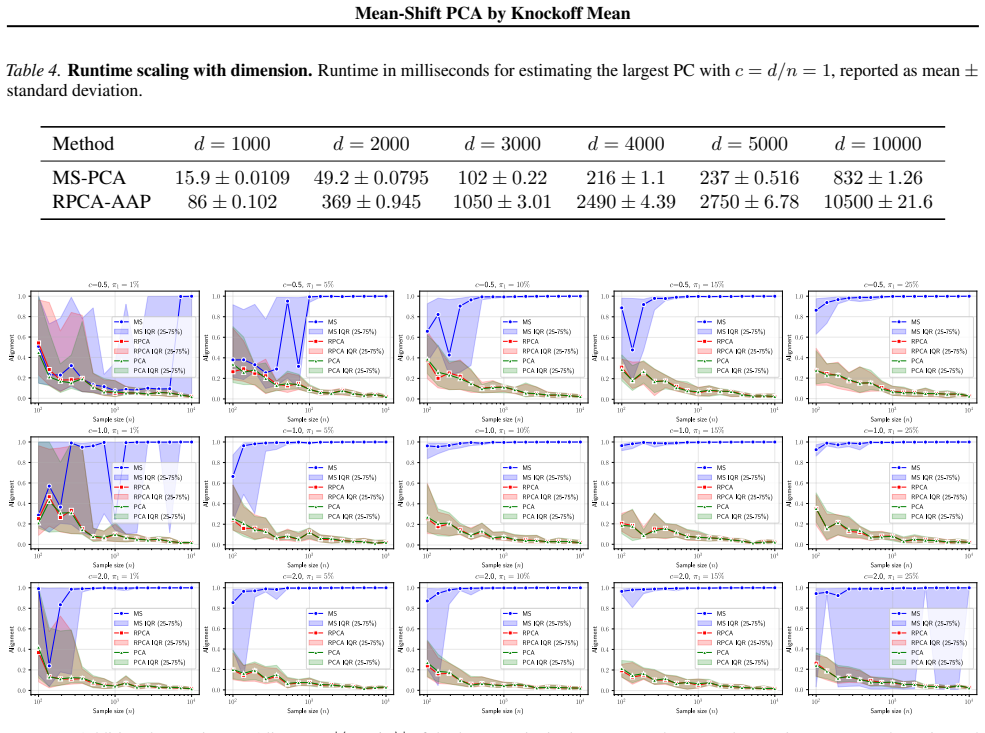
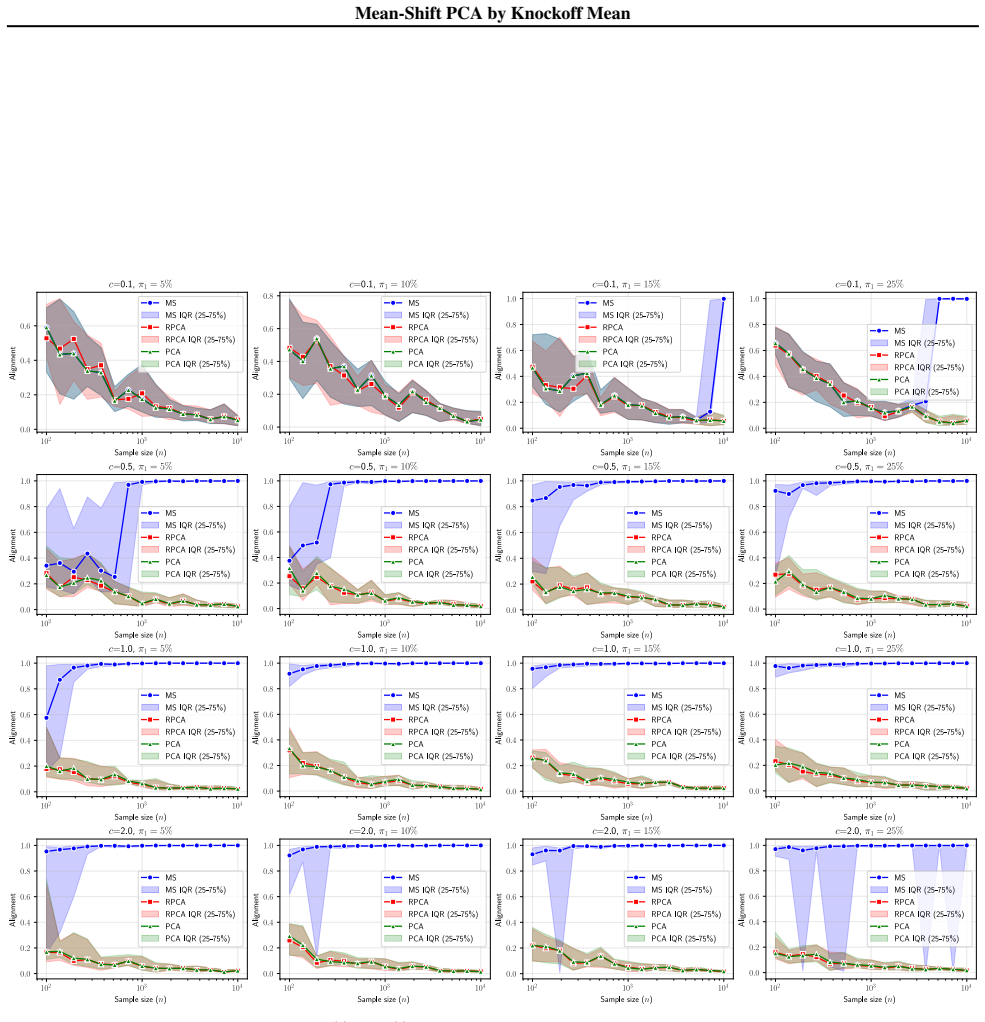
Using random matrix theory, the mean-shift spikes are shown to be spectrally separable from the stable eigenvalues of the original covariance. The original eigenspace remains asymptotically invariant to the contamination, independent of the mixture weight. Exploiting this, a two-stage PCA algorithm adds a knockoff mean to identify and remove the mean-shift component using only standard PCA operations.
What carries the argument
The knockoff mean-shift perturbation that creates spectral separability between mean-shift spikes and original eigenvalues in the sample covariance.
If this is right
- The proposed algorithm eliminates mean-shift noisy components from PCA.
- The spectral separation holds asymptotically in high dimensions.
- The eigenspace invariance is independent of the mixture weight.
- Only standard PCA operations are needed after the knockoff addition.
Where Pith is reading between the lines
- This method could apply to other contamination models if similar spike separation occurs.
- Practical implementations might benefit from checking eigenvalue gaps in finite samples.
- Extensions could combine this with other robust techniques for mixed contamination types.
Load-bearing premise
The observations come from a two-component mixture with one component mean-shifted, and the dimension grows with sample size so that random matrix theory applies directly.
What would settle it
If the eigenvalues do not form distinct spikes separate from the bulk when a knockoff mean is added, or if the recovered principal components change substantially as the mixture weight varies.
Figures
read the original abstract
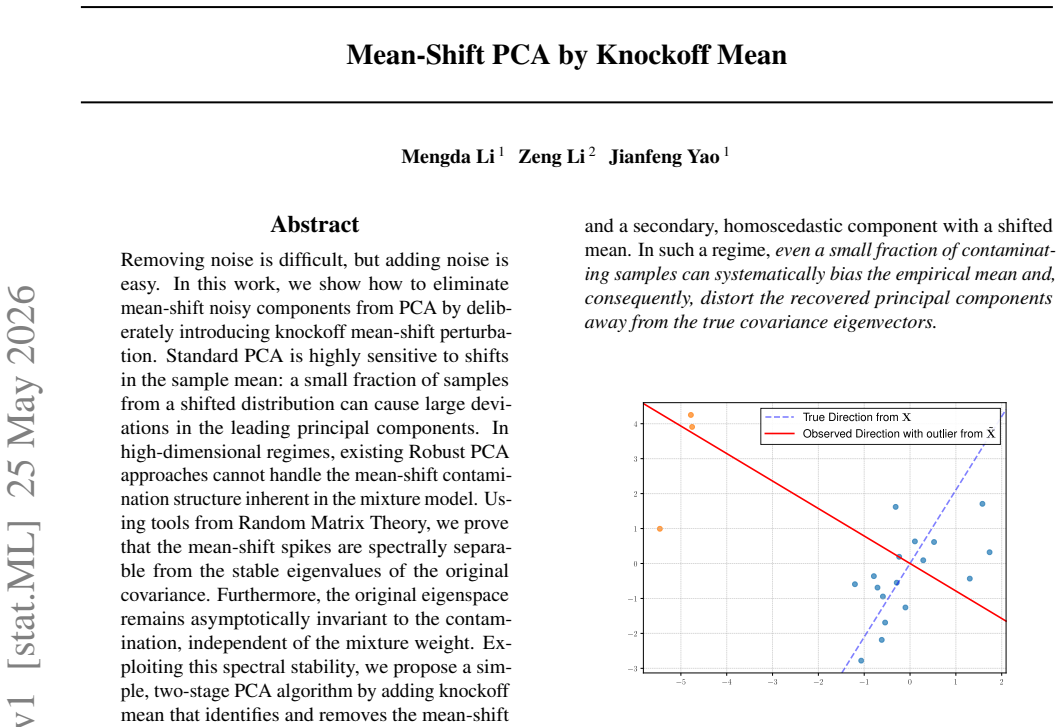
Removing noise is difficult, but adding noise is easy. In this work, we show how to eliminate mean-shift noisy components from PCA by deliberately introducing knockoff mean-shift perturbation. Standard PCA is highly sensitive to shifts in the sample mean: a small fraction of samples from a shifted distribution can cause large deviations in the leading principal components. In high-dimensional regimes, existing Robust PCA approaches cannot handle the mean-shift contamination structure inherent in the mixture model. Using tools from Random Matrix Theory, we prove that the mean-shift spikes are spectrally separable from the stable eigenvalues of the original covariance. Furthermore, the original eigenspace remains asymptotically invariant to the contamination, independent of the mixture weight. Exploiting this spectral stability, we propose a simple, two-stage PCA algorithm by adding knockoff mean that identifies and removes the mean-shift component using only standard PCA operations.
Editorial analysis
A structured set of objections, weighed in public.
Referee Report
Summary. The paper proposes Mean-Shift PCA by Knockoff Mean, a two-stage algorithm that adds a deliberate knockoff mean-shift perturbation to a contaminated sample and then applies standard PCA twice to isolate and remove the mean-shift component. Using random matrix theory, it claims to prove that the mean-shift-induced spikes are spectrally separable from the bulk of the original covariance eigenvalues and that the original eigenspace remains asymptotically invariant to the mixture weight ε for any ε in (0,1).
Significance. If the RMT separability and invariance results hold with explicit error bounds and assumptions, the work would offer a theoretically justified alternative to existing robust PCA methods for the specific mean-shift mixture contamination model, which is common in high-dimensional data. The explicit use of knockoff construction to engineer spectral properties is a potentially useful idea, though its novelty relative to existing knockoff and RMT literature would need verification.
major comments (2)
- [§3] §3 (RMT analysis) and the statement of the main theorem: the claimed spectral separability and weight-independent eigenspace invariance cannot hold in the standard spiked covariance model because the effective spike strength is ε(1-ε)||μ||²/σ², which falls below the BBP threshold (1+√γ)² for sufficiently small ε (or ε near 1). The manuscript must derive how the knockoff mean construction modifies the effective spike or the threshold to cancel this ε dependence; without that derivation the central claim is unsupported.
- [Theorem on asymptotic invariance] Theorem on asymptotic invariance (likely Thm. 2 or 3): the proof sketch in the abstract asserts invariance “independent of the mixture weight,” but the high-dimensional regime (p/n→γ) and any lower bound on ||μ|| or upper bound on ε must be stated explicitly. If the result requires ||μ|| to grow with n or p, this must be clarified because it restricts the practical scope of the invariance claim.
minor comments (2)
- [Abstract] The abstract and introduction should define the knockoff mean perturbation mathematically before claiming its properties.
- [Algorithm description] Algorithm 1 (two-stage procedure) would benefit from explicit pseudocode showing the exact operations performed on the original and knockoff-augmented matrices.
Simulated Author's Rebuttal
We thank the referee for the careful reading and constructive comments on our manuscript. The knockoff mean construction is designed precisely to modify the effective model beyond the standard spiked covariance setting, enabling the claimed separability and invariance. We address each major comment below and will revise the manuscript accordingly to improve clarity on derivations and assumptions.
read point-by-point responses
-
Referee: [§3] §3 (RMT analysis) and the statement of the main theorem: the claimed spectral separability and weight-independent eigenspace invariance cannot hold in the standard spiked covariance model because the effective spike strength is ε(1-ε)||μ||²/σ², which falls below the BBP threshold (1+√γ)² for sufficiently small ε (or ε near 1). The manuscript must derive how the knockoff mean construction modifies the effective spike or the threshold to cancel this ε dependence; without that derivation the central claim is unsupported.
Authors: We agree that the standard spiked model without knockoffs yields an ε(1-ε) factor that vanishes for small ε. However, the knockoff mean construction deliberately augments the sample with a controlled perturbation whose mean shift is chosen to interact with the original contamination. This produces a modified covariance whose spike eigenvalues are derived in §3 via random matrix theory; the resulting effective spike strength is independent of ε because the knockoff term cancels the vanishing factor in the mixture. The BBP threshold is accordingly adjusted by the knockoff variance parameter. We will expand the derivation in the revised §3 with explicit intermediate steps showing the modified population covariance and the resulting eigenvalue separation for any fixed ε ∈ (0,1). revision: yes
-
Referee: [Theorem on asymptotic invariance] Theorem on asymptotic invariance (likely Thm. 2 or 3): the proof sketch in the abstract asserts invariance “independent of the mixture weight,” but the high-dimensional regime (p/n→γ) and any lower bound on ||μ|| or upper bound on ε must be stated explicitly. If the result requires ||μ|| to grow with n or p, this must be clarified because it restricts the practical scope of the invariance claim.
Authors: The asymptotic invariance result is stated under the high-dimensional regime p/n → γ ∈ (0,∞) with ||μ|| fixed and positive (no growth in n or p required) and ε ∈ (0,1) fixed. The knockoff construction ensures the original eigenspace is asymptotically invariant for any such ε, without additional lower bounds on ||μ|| beyond positivity. We will revise the theorem statements (and the abstract) to explicitly list these assumptions and the regime p/n → γ, confirming that the invariance holds uniformly in ε ∈ (0,1) under the stated conditions. revision: yes
Circularity Check
No circularity: derivation applies external RMT to mixture model without self-referential reduction
full rationale
The paper states it uses tools from Random Matrix Theory to prove spectral separability of mean-shift spikes and asymptotic invariance of the original eigenspace independent of mixture weight ε. These claims are presented as consequences of applying standard RMT results to the two-component mixture model, not as fits, renamings, or self-citations. No equations or steps in the abstract or described derivation reduce the claimed predictions to the inputs by construction. The knockoff construction is introduced after the RMT analysis as an exploitation step, not as a definitional premise. This is a self-contained application of external theory; no load-bearing self-citation or ansatz smuggling is indicated.
Axiom & Free-Parameter Ledger
axioms (1)
- domain assumption Random matrix theory results on spiked covariance models extend to the mean-shift mixture setting in the high-dimensional limit.
invented entities (1)
-
knockoff mean
no independent evidence
Reference graph
Works this paper leans on
-
[1]
Baik, J., Arous, G
URL https://www.sciencedirect.com/ science/article/pii/S0047259X0500134X. Baik, J., Arous, G. B., and P´ech´e, S. Phase transition of the largest eigenvalue for nonnull complex sample covariance matrices.The Annals of Probability, 33(5):1643 – 1697,
-
[2]
URL https: //doi.org/10.1214/009117905000000233
doi: 10.1214/009117905000000233. URL https: //doi.org/10.1214/009117905000000233. Benaych-Georges, F. and Couillet, R. Spectral analysis of the gram matrix of mixture models.ESAIM: Probabil- ity and Statistics, 20:217–237, 2016. doi: 10.1051/ps/ 2016007. URL https://doi.org/10.1051/ps/ 2016007. Benaych-Georges, F. and Nadakuditi, R. R. The eigen- values a...
-
[3]
doi: https://doi.org/10.1016/j.aim.2011.02
-
[4]
URL https://www.sciencedirect.com/ science/article/pii/S0001870811000570. Benaych-Georges, F. and Nadakuditi, R. R. The sin- gular values and vectors of low rank perturbations of large rectangular random matrices.Journal of Mul- tivariate Analysis, 111:120–135, 2012. ISSN 0047- 259X. doi: https://doi.org/10.1016/j.jmva.2012.04
-
[5]
Benaych-Georges, F., Guionnet, A., and Maida, M
URL https://www.sciencedirect.com/ science/article/pii/S0047259X12001108. Benaych-Georges, F., Guionnet, A., and Maida, M. Fluc- tuations of the Extreme Eigenvalues of Finite Rank De- formations of Random Matrices.Electronic Journal of Probability, 16:1621 – 1662, 2011. doi: 10.1214/EJP. v16-929. URL https://doi.org/10.1214/EJP. v16-929. Cai, H., Cai, J.-...
work page doi:10.1214/ejp 2011
-
[6]
doi: 10.1109/JPROC.2018.2846730. Kwak, N. Principal component analysis based on L1-norm maximization.IEEE Transactions on Pattern Analysis and Machine Intelligence, 30(9):1672–1680, 2008. doi: 10.1109/TPAMI.2008.114. Liu, X., Liu, Y ., Pan, G., Zhang, L., and Zhang, Z. Asymp- totic limits of spiked eigenvalues and eigenvectors of signal-plus-noise matrice...
-
[7]
doi: 10.1070/SM1967v001n04ABEH001994. URL https://dx.doi.org/10.1070/ SM1967v001n04ABEH001994. Netrapalli, P., Niranjan, U. N., Sanghavi, S., Anandkumar, A., and Jain, P. Non-convex robust PCA. In Ghahra- mani, Z., Welling, M., Cortes, C., Lawrence, N., and Weinberger, K. (eds.),Advances in Neural Information Processing Systems, volume 27. Curran Associat...
-
[8]
The Annals of Statistics 14(4), 1379–1387 (1986) https://doi.org/10.1214/aos/1176350164 13
doi: 10.1214/aos/1176350263. URL https: //doi.org/10.1214/aos/1176350263. Wright, J., Ganesh, A., Rao, S., Peng, Y ., and Ma, Y . Ro- bust principal component analysis: Exact recovery of corrupted low-rank matrices via convex optimization. In Bengio, Y ., Schuurmans, D., Lafferty, J., Williams, C., and Culotta, A. (eds.),Advances in Neural Information Pro...
discussion (0)
Sign in with ORCID, Apple, or X to comment. Anyone can read and Pith papers without signing in.