Discovery of Molecular and Atomic Gas associated with HESS J1646-458 (Westerlund 1): Spatial TeV Gamma-Ray and Interstellar Proton Correspondence
Pith reviewed 2026-06-29 20:51 UTC · model grok-4.3
The pith
Molecular and atomic gas around Westerlund 1 shows moderate spatial match to the TeV gamma-ray shell of HESS J1646-458, supporting hadronic origin and total cosmic-ray proton energy of 6e49 erg.
A machine-rendered reading of the paper's core claim, the machinery that carries it, and where it could break.
Core claim
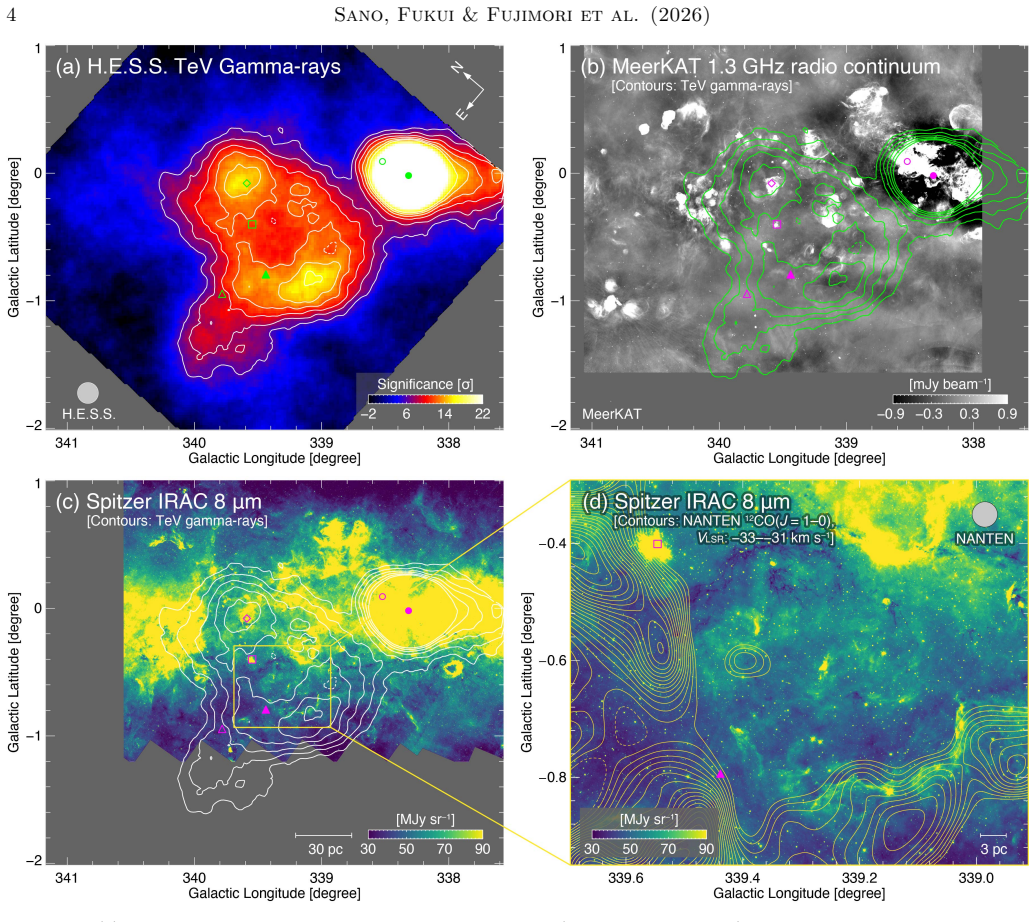
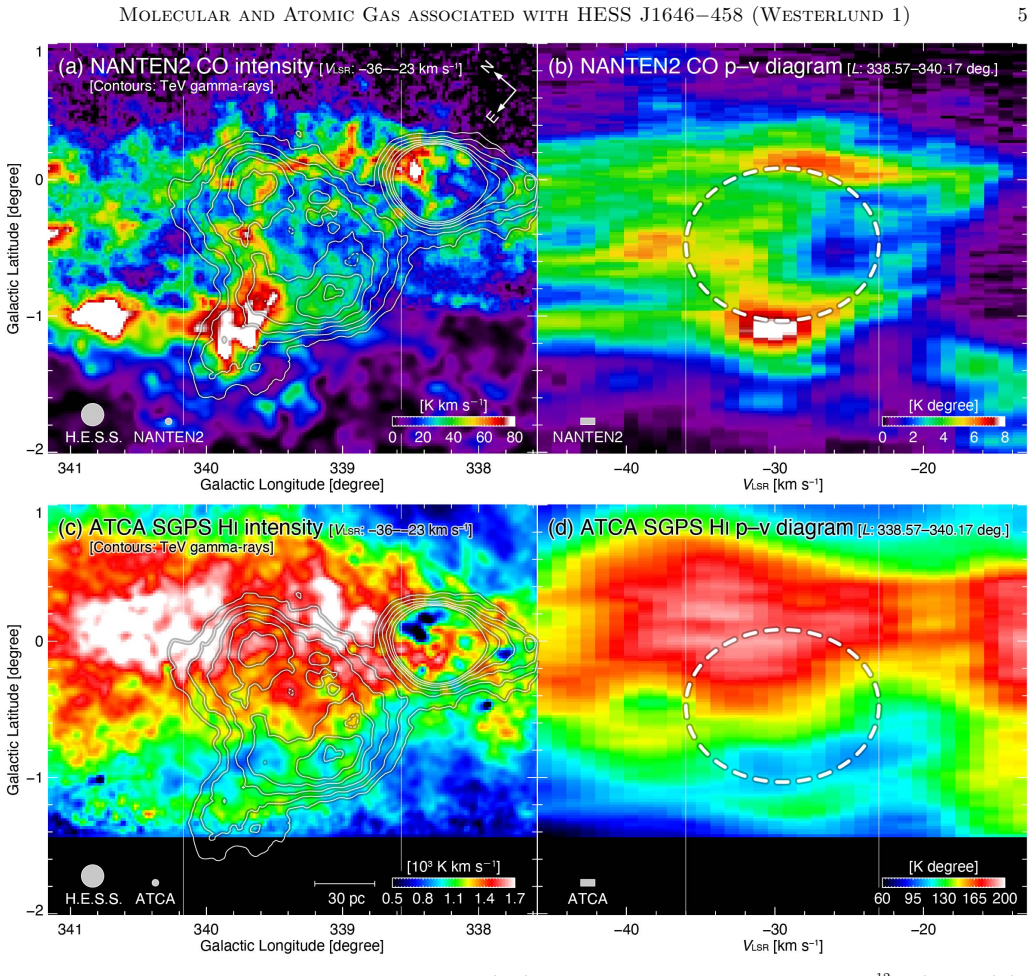
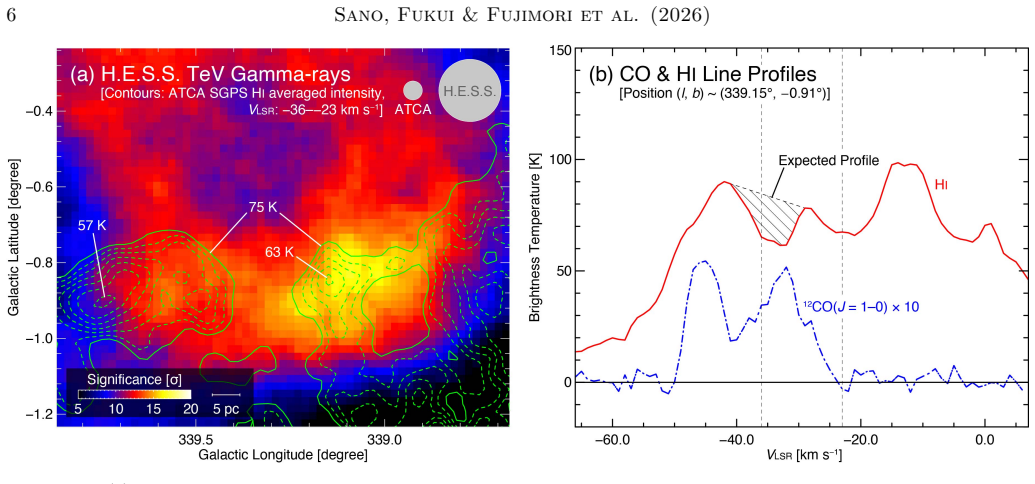
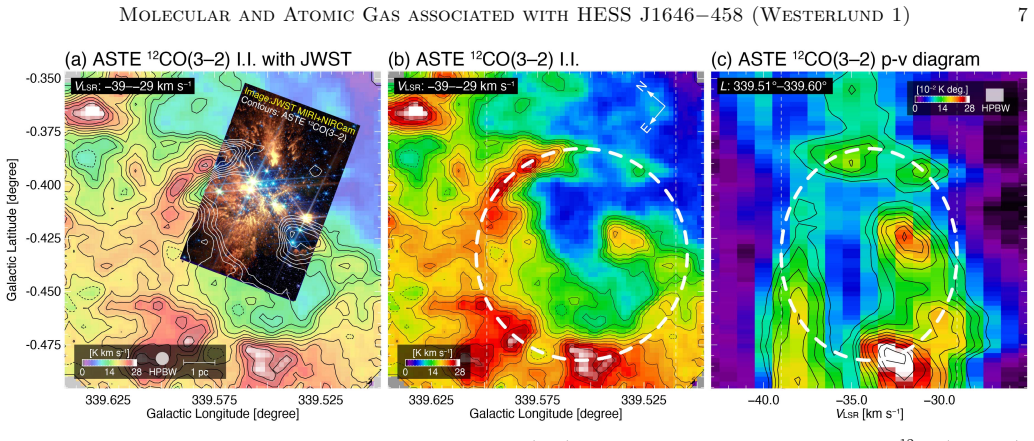
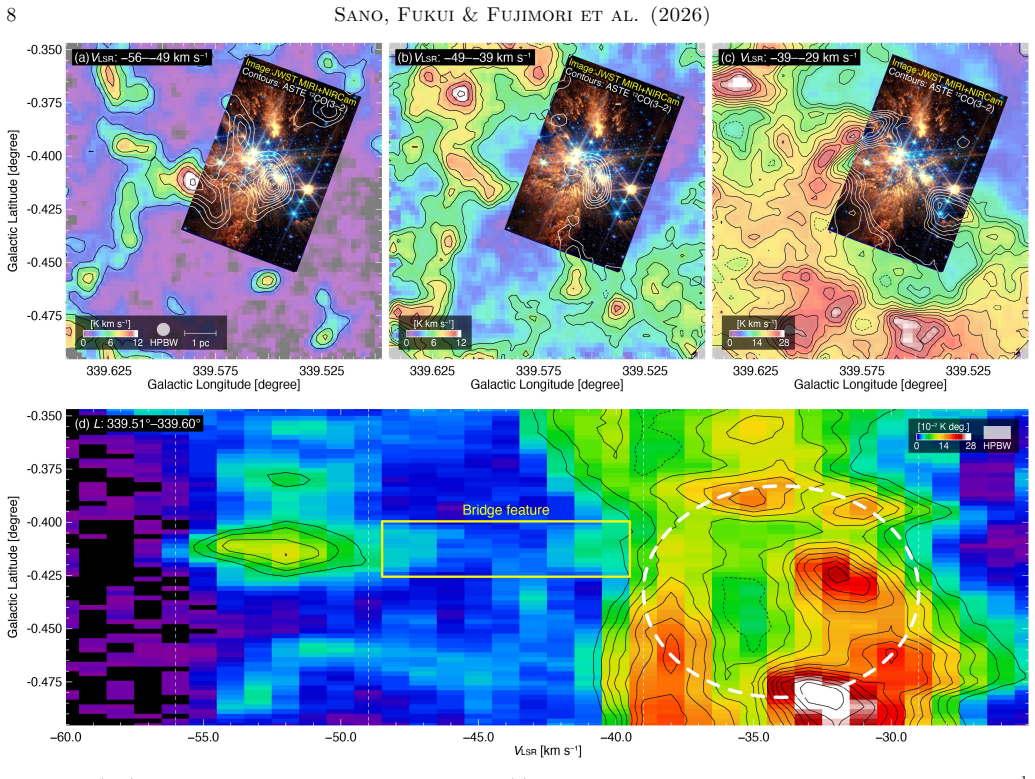
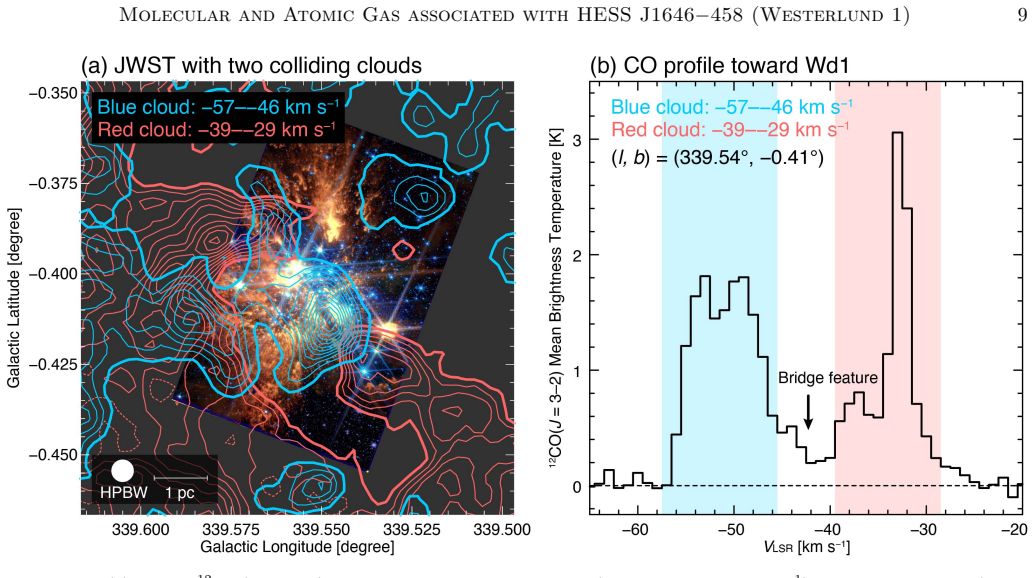
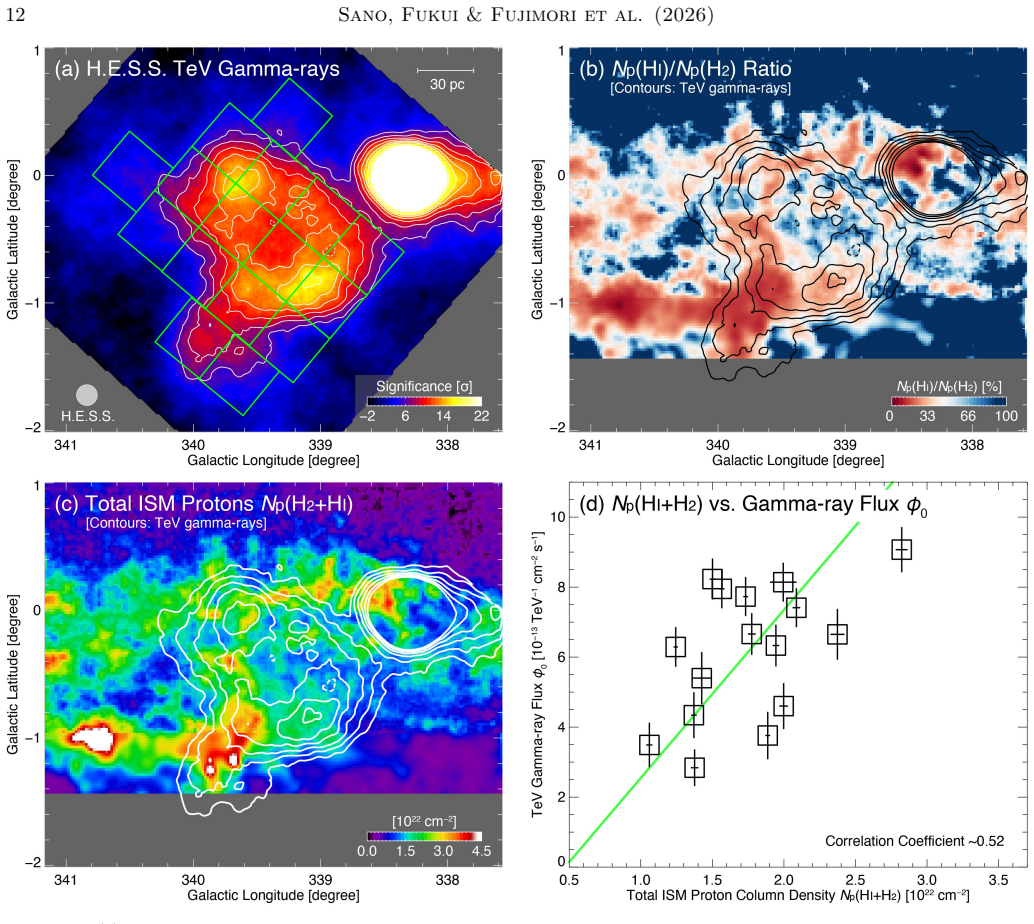
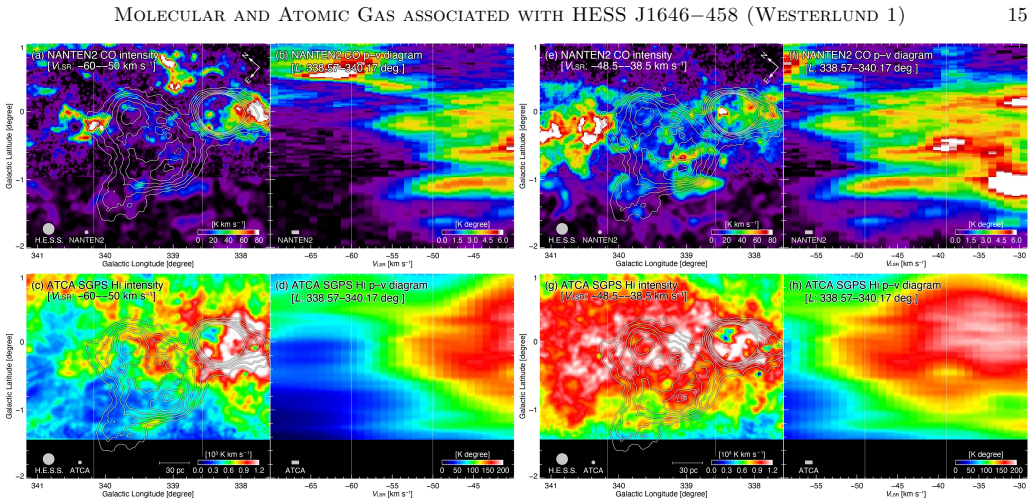
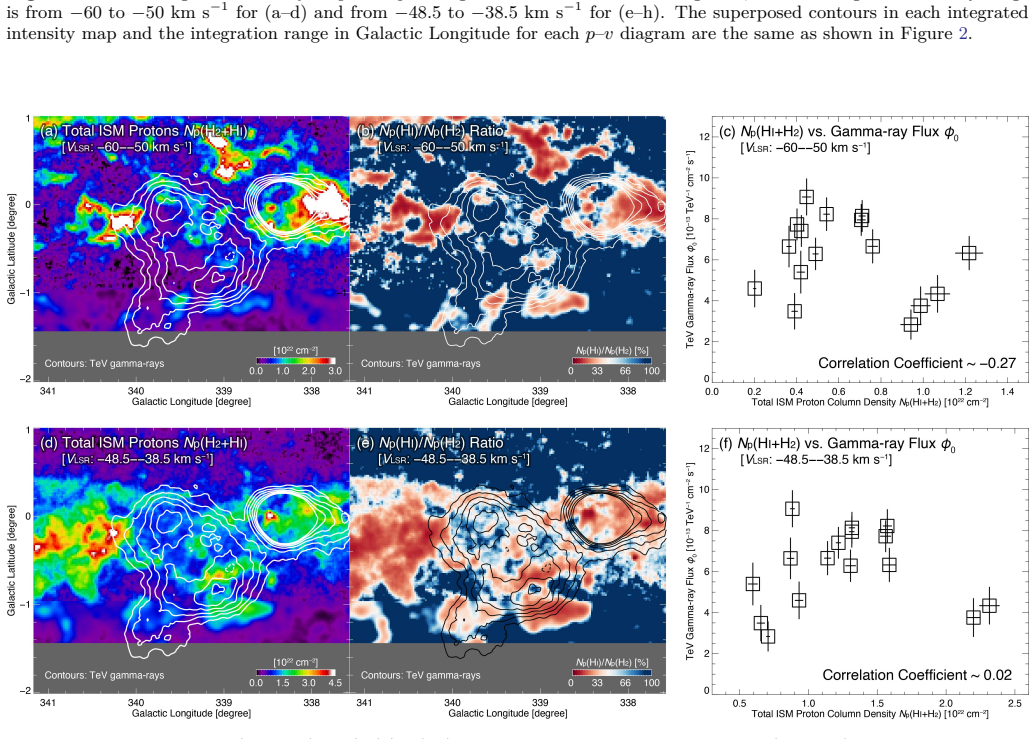
The interstellar proton column density at V_LSR from -36 to -23 km s^{-1} displays moderate spatial correspondence with the TeV gamma-ray shell. Together with the gas mass of approximately 1.6 times 10^6 solar masses and the absence of bright synchrotron X-rays, the TeV emission surrounding Westerlund 1 is consistent with hadronic production. The finding yields a total energy of accelerated cosmic-ray protons of approximately 6 times 10^49 erg. The same velocity components also show arc-like 8-micron structures, a cavity with 5 km/s expansion, and complementary cloud distributions indicative of physical association with the cluster via wind bubble and cloud-cloud collision.
What carries the argument
The spatial correspondence between the velocity-specific interstellar proton column density and the TeV gamma-ray shell morphology, used to infer hadronic pion-decay emission.
If this is right
- The TeV gamma-ray emission is produced by cosmic-ray protons colliding with interstellar gas rather than by leptonic processes.
- The total energy in accelerated cosmic-ray protons is approximately 6 times 10^49 erg.
- Both the molecular and atomic gas at the relevant velocities are physically associated with Westerlund 1.
- Star formation near the cluster may have been triggered by the cloud-cloud collision whose signatures are observed.
Where Pith is reading between the lines
- If the association holds, stellar winds from young massive clusters supply a measurable fraction of the energy in Galactic cosmic rays above GeV energies.
- Similar column-density to TeV-shell comparisons could be applied to other unidentified or cluster-associated TeV sources to test for hadronic contributions.
- The wind-blown cavity may act as a site where particles are accelerated or confined before interacting with the surrounding gas.
Load-bearing premise
The moderate spatial match between the specific-velocity gas column density and the TeV shell reflects a genuine physical connection rather than chance line-of-sight alignment, and the gamma rays are produced by hadronic rather than leptonic processes.
What would settle it
High-resolution maps showing that the TeV emission does not follow the velocity-specific gas distribution, or the detection of bright non-thermal X-ray synchrotron emission from the same region, would undermine the hadronic interpretation.
Figures
read the original abstract
We report CO and HI studies of molecular and atomic gas toward the TeV gamma-ray source HESS J1646$-$458, widely considered to be associated with the young massive cluster Westerlund 1 (Wd1). We found that molecular clouds at $V_\mathrm{LSR} \sim$$-32$ km s$^{-1}$ coincide with arc-like structures seen at 8 $\mu$m, likely illuminated by strong FUV radiation from Wd1. $^{12}$CO($J$ = 3-2) emission at the same velocity reveals a cavity-like structure with an expansion velocity of $\sim$$5$ km s$^{-1}$ toward the central region of Wd1, suggesting a recently formed wind-blown bubble driven by the cluster. We also identify a complementary spatial distribution between the $V_\mathrm{LSR} \sim$$-55$ and $\sim$$-32$ km s$^{-1}$ clouds, connected by an intermediate-velocity component at $V_\mathrm{LSR} \sim$$-44$ km s$^{-1}$. These characteristics are consistent with signatures of triggered star formation through a cloud-cloud collision and imply that both clouds are physically associated with Wd1. On larger scales, the total interstellar proton column density at $V_\mathrm{LSR}$ $\sim$$-36$-$-23$ km s$^{-1}$ shows a moderate spatial correspondence with the TeV gamma-ray shell. Together with this correlation, a substantial gas mass of $\sim$$1.6 \times 10^6$ $M_\odot$, and the absence of bright synchrotron X-rays, the TeV gamma-ray emission surrounding Wd1 is consistent with the hadronic origin. The present finding allows us to calculate the total energy of accelerated cosmic-ray protons to be $\sim$$6 \times 10^{49}$ erg.
Editorial analysis
A structured set of objections, weighed in public.
Referee Report
Summary. The paper reports CO(3-2) and HI observations toward HESS J1646-458/Westerlund 1, identifying molecular clouds at V_LSR ≈ −32 km s^{-1} that coincide with 8 μm arc-like structures and a cavity with ~5 km s^{-1} expansion, interpreted as a wind-blown bubble. Complementary spatial distributions between velocity components at −55 and −32 km s^{-1} connected by an intermediate-velocity bridge at −44 km s^{-1} are presented as evidence for cloud-cloud collision and triggered star formation. On larger scales, the interstellar proton column density integrated over V_LSR ∼ −36 to −23 km s^{-1} is stated to show moderate spatial correspondence with the TeV gamma-ray shell; combined with a total gas mass of ∼1.6×10^6 M_⊙ and the absence of bright synchrotron X-rays, this is used to argue for a hadronic origin and to derive a total energy in accelerated cosmic-ray protons of ∼6×10^{49} erg.
Significance. If the claimed physical association holds, the result would provide one of the few direct gas-mass anchors for the hadronic gamma-ray luminosity near a young massive cluster, yielding a concrete W_p estimate that can be compared with the cluster's mechanical power budget. The kinematic signatures of cloud-cloud collision also add to the growing sample of triggered star formation in the vicinity of Westerlund 1.
major comments (2)
- [Abstract] Abstract and § (results on large-scale correspondence): the central claim that the TeV emission is hadronic rests on the statement of 'moderate spatial correspondence' between N(H) at V_LSR ∼ −36 to −23 km s^{-1} and the gamma-ray shell. No correlation coefficient, overlap significance, or Monte-Carlo test against randomized maps or adjacent velocity slices is provided; without such a test the association could be consistent with chance projection in the Galactic plane, rendering both the hadronic interpretation and the derived W_p ∼ 6×10^{49} erg unsupported.
- [Abstract] Abstract and velocity-selection paragraphs: the velocity window V_LSR ∼ −36 to −23 km s^{-1} is presented without demonstration that the reported spatial match is robust to the exact choice of integration limits. Adjacent slices or a systematic search over velocity should be shown to establish that the correspondence is not an artifact of bin selection.
minor comments (1)
- [Abstract] Abstract: velocity notation mixes ∼ and − symbols inconsistently (e.g., V_LSR ∼−36–−23); adopt uniform formatting throughout the manuscript.
Simulated Author's Rebuttal
We thank the referee for the constructive comments. The points regarding the need for quantitative statistical support for the spatial correspondence and robustness checks on the velocity integration window are well taken. We will revise the manuscript to incorporate correlation analyses, Monte Carlo tests, and additional velocity-slice comparisons to strengthen the evidence for the hadronic origin and the derived proton energy budget.
read point-by-point responses
-
Referee: [Abstract] Abstract and § (results on large-scale correspondence): the central claim that the TeV emission is hadronic rests on the statement of 'moderate spatial correspondence' between N(H) at V_LSR ∼ −36 to −23 km s^{-1} and the gamma-ray shell. No correlation coefficient, overlap significance, or Monte-Carlo test against randomized maps or adjacent velocity slices is provided; without such a test the association could be consistent with chance projection in the Galactic plane, rendering both the hadronic interpretation and the derived W_p ∼ 6×10^{49} erg unsupported.
Authors: We agree that the current manuscript presents the spatial correspondence qualitatively without statistical quantification. In the revision we will add a pixel-by-pixel Spearman correlation coefficient between the integrated N(H) map and the TeV intensity, together with a Monte Carlo test that randomizes the gamma-ray morphology or compares against adjacent velocity slices to quantify the significance against chance alignment. These additions will provide a firmer statistical foundation for the hadronic interpretation and the W_p estimate. revision: yes
-
Referee: [Abstract] Abstract and velocity-selection paragraphs: the velocity window V_LSR ∼ −36 to −23 km s^{-1} is presented without demonstration that the reported spatial match is robust to the exact choice of integration limits. Adjacent slices or a systematic search over velocity should be shown to establish that the correspondence is not an artifact of bin selection.
Authors: We acknowledge that robustness to the precise velocity limits was not demonstrated. The revised version will include maps of N(H) for adjacent velocity intervals (e.g., −40 to −27 km s^{-1} and −32 to −19 km s^{-1}) and a brief systematic scan over a range of integration windows, showing that the chosen interval yields the strongest morphological match. This will confirm that the reported correspondence is not an artifact of bin selection. revision: yes
Circularity Check
No significant circularity in derivation chain
full rationale
The paper's conclusions rest on direct observational mappings of CO/HI gas at specific velocities, reported spatial overlap with the TeV shell, measured gas mass of 1.6e6 solar masses, and the absence of bright synchrotron X-rays. The proton energy estimate of ~6e49 erg follows from applying standard hadronic scaling relations to these independent inputs. No equations, self-citations, or ansatzes are shown that reduce any claimed result to a fitted parameter or definition by construction. The derivation remains self-contained against external benchmarks.
Axiom & Free-Parameter Ledger
free parameters (2)
- X_CO conversion factor
- Distance to Westerlund 1
axioms (2)
- domain assumption Velocity coincidence implies physical association with the cluster
- domain assumption Gamma-ray production is dominated by proton-proton interactions
Reference graph
Works this paper leans on
-
[1]
, " * write output.state after.block = add.period write newline
ENTRY address archivePrefix author booktitle chapter doi edition editor eprint howpublished institution journal key month number organization pages publisher school series title misctitle type volume year version url label extra.label sort.label short.list INTEGERS output.state before.all mid.sentence after.sentence after.block FUNCTION init.state.consts ...
-
[2]
write newline
" write newline "" before.all 'output.state := FUNCTION format.url url empty "" new.block "" url * "" * if FUNCTION format.eprint eprint empty "" archivePrefix empty "" archivePrefix "arXiv" = new.block " " eprint * " " * new.block " " eprint * " " * if if if FUNCTION format.doi doi empty "" " " doi * " " * if FUNCTION format.pid doi empty eprint empty ur...
-
[4]
2012, , 537, A114, 10.1051/0004-6361/201117928
Abramowski , A., Acero , F., Aharonian , F., et al. 2012, , 537, A114, 10.1051/0004-6361/201117928
-
[5]
2014 a , , 794, L1, 10.1088/2041-8205/794/1/L1
Abramowski , A., Aharonian , F., Ait Benkhali , F., et al. 2014 a , , 794, L1, 10.1088/2041-8205/794/1/L1
-
[6]
Abramowski , A., Aharonian , F., Benkhali , F. A., et al. 2014 b , , 439, 2828, 10.1093/mnras/stu139
-
[7]
2011, Science, 334, 1103, 10.1126/science.1210311
Ackermann , M., Ajello , M., Allafort , A., et al. 2011, Science, 334, 1103, 10.1126/science.1210311
-
[8]
2013, Science, 339, 807, 10.1126/science.1231160
---. 2013, Science, 339, 807, 10.1126/science.1231160
-
[9]
Aghakhanloo , M., Murphy , J. W., Smith , N., et al. 2020, , 492, 2497, 10.1093/mnras/stz3628
-
[10]
2021, Research Notes of the American Astronomical Society, 5, 14, 10.3847/2515-5172/abdc2c
---. 2021, Research Notes of the American Astronomical Society, 5, 14, 10.3847/2515-5172/abdc2c
-
[11]
2022, , 666, A124, 10.1051/0004-6361/202244323
Aharonian , F., Ashkar , H., Backes , M., et al. 2022, , 666, A124, 10.1051/0004-6361/202244323
-
[12]
R., Davies , B., Smith , N., Gehrz , R
Beasor , E. R., Davies , B., Smith , N., Gehrz , R. D., & Figer , D. F. 2021, , 912, 16, 10.3847/1538-4357/abec44
-
[13]
Bell , A. R. 1978, , 182, 147, 10.1093/mnras/182.2.147
-
[14]
Blandford , R. D., & Ostriker , J. P. 1978, , 221, L29, 10.1086/182658
-
[15]
Bolatto , A. D., Wolfire , M., & Leroy , A. K. 2013, , 51, 207, 10.1146/annurev-astro-082812-140944
work page internal anchor Pith review doi:10.1146/annurev-astro-082812-140944 2013
-
[16]
Bradley , A., Filipovi \'c , M. D., Smeaton , Z., et al. 2025, , 42, e101, 10.1017/pasa.2025.10070
-
[17]
Brandner , W., Clark , J. S., Stolte , A., et al. 2008, , 478, 137, 10.1051/0004-6361:20077579
-
[18]
Bykov , A. M. 2014, , 22, 77, 10.1007/s00159-014-0077-8
-
[19]
Casse , M., & Paul , J. A. 1980, , 237, 236, 10.1086/157863
-
[20]
Cesarsky , C. J., & Montmerle , T. 1983, , 36, 173, 10.1007/BF00167503
-
[21]
Cherenkov Telescope Array Consortium , Acharya , B. S., Agudo , I., et al. 2019, Science with the Cherenkov Telescope Array , 10.1142/10986
-
[22]
Churchwell , E., Babler , B. L., Meade , M. R., et al. 2009, , 121, 213, 10.1086/597811
-
[23]
S., Negueruela , I., Crowther , P
Clark , J. S., Negueruela , I., Crowther , P. A., & Goodwin , S. P. 2005, , 434, 949, 10.1051/0004-6361:20042413
-
[24]
Clark , J. S., Ritchie , B. W., & Negueruela , I. 2020, , 635, A187, 10.1051/0004-6361/201935903
-
[25]
2006, MNRAS, 372, 1699, doi: 10.1111/j.1365-2966.2006.10972.x
Crowther , P. A., Hadfield , L. J., Clark , J. S., Negueruela , I., & Vacca , W. D. 2006, , 372, 1407, 10.1111/j.1365-2966.2006.10952.x
-
[26]
Davies , B., & Beasor , E. R. 2019, , 486, L10, 10.1093/mnrasl/slz050
-
[27]
Dickey , J. M., & Lockman , F. J. 1990, , 28, 215, 10.1146/annurev.aa.28.090190.001243
-
[28]
2004, in Society of Photo-Optical Instrumentation Engineers (SPIE) Conference Series, Vol
Ezawa , H., Kawabe , R., Kohno , K., & Yamamoto , S. 2004, in Society of Photo-Optical Instrumentation Engineers (SPIE) Conference Series, Vol. 5489, Ground-based Telescopes, ed. J. M. Oschmann , Jr., 763--772, 10.1117/12.551391
-
[29]
Fok , T. K. T., Nakashima , J.-i., Yung , B. H. K., Hsia , C.-H., & Deguchi , S. 2012, , 760, 65, 10.1088/0004-637X/760/1/65
-
[30]
2014, , 788, 94, 10.1088/0004-637X/788/1/94
Fukuda , T., Yoshiike , S., Sano , H., et al. 2014, , 788, 94, 10.1088/0004-637X/788/1/94
-
[31]
2024, , 961, 162, 10.3847/1538-4357/ad0da3
Fukui , Y., Aruga , M., Sano , H., et al. 2024, , 961, 162, 10.3847/1538-4357/ad0da3
-
[32]
2021 a , , 73, S1, 10.1093/pasj/psaa103
Fukui , Y., Habe , A., Inoue , T., Enokiya , R., & Tachihara , K. 2021 a , , 73, S1, 10.1093/pasj/psaa103
-
[33]
2021 b , , 915, 84, 10.3847/1538-4357/abff4a
Fukui , Y., Sano , H., Yamane , Y., et al. 2021 b , , 915, 84, 10.3847/1538-4357/abff4a
-
[34]
2015, , 798, 6, 10.1088/0004-637X/798/1/6
Fukui , Y., Torii , K., Onishi , T., et al. 2015, , 798, 6, 10.1088/0004-637X/798/1/6
-
[35]
2012, , 746, 82, 10.1088/0004-637X/746/1/82
Fukui , Y., Sano , H., Sato , J., et al. 2012, , 746, 82, 10.1088/0004-637X/746/1/82
-
[36]
2017, , 850, 71, 10.3847/1538-4357/aa9219
---. 2017, , 850, 71, 10.3847/1538-4357/aa9219
-
[37]
Furukawa , N., Dawson , J. R., Ohama , A., et al. 2009, , 696, L115, 10.1088/0004-637X/696/2/L115
-
[38]
21cmfast: a fast, seminumerical simulation of the high-redshift 21-cm signal: 21cmfast , volume=
Gennaro , M., Brandner , W., Stolte , A., & Henning , T. 2011, , 412, 2469, 10.1111/j.1365-2966.2010.18068.x
-
[39]
2011, , 742, L30, 10.1088/2041-8205/742/2/L30
Giuliani , A., Cardillo , M., Tavani , M., et al. 2011, , 742, L30, 10.1088/2041-8205/742/2/L30
-
[40]
Goedhart , S., Cotton , W. D., Camilo , F., et al. 2024, , 531, 649, 10.1093/mnras/stae1166
-
[41]
G., Almendros-Abad , V., Lovell , J
Guarcello , M. G., Almendros-Abad , V., Lovell , J. B., et al. 2025, , 693, A120, 10.1051/0004-6361/202452150
-
[42]
H. E. S. S. Collaboration , Abramowski , A., Aharonian , F., et al. 2015, Science, 347, 406, 10.1126/science.1261313
-
[43]
K., Reville , B., Hinton , J., Mohrmann , L., & Vieu , T
H \"a rer , L. K., Reville , B., Hinton , J., Mohrmann , L., & Vieu , T. 2023, , 671, A4, 10.1051/0004-6361/202245444
-
[44]
2025, , 695, A3, 10.1051/0004-6361/202451964
Haubner , K., Sasaki , M., Mitchell , A., et al. 2025, , 695, A3, 10.1051/0004-6361/202451964
-
[45]
2018, , 70, S53, 10.1093/pasj/psx089
Inoue , T., Hennebelle , P., Fukui , Y., et al. 2018, , 70, S53, 10.1093/pasj/psx089
-
[46]
2022, , 659, A36, 10.1051/0004-6361/202142575
Kabanovic , S., Schneider , N., Ossenkopf-Okada , V., et al. 2022, , 659, A36, 10.1051/0004-6361/202142575
-
[47]
Klepach , E. G., Ptuskin , V. S., & Zirakashvili , V. N. 2000, Astroparticle Physics, 13, 161, 10.1016/S0927-6505(99)00108-5
-
[48]
Kothes , R., & Dougherty , S. M. 2007, , 468, 993, 10.1051/0004-6361:20077309
-
[49]
Landsman , W. B. 1993, in Astronomical Society of the Pacific Conference Series, Vol. 52, Astronomical Data Analysis Software and Systems II, ed. R. J. Hanisch , R. J. V. Brissenden , & J. Barnes , 246
1993
-
[50]
D., Carrasco , L., & Bronfman , L
Luna , A., Mayya , Y. D., Carrasco , L., & Bronfman , L. 2010, , 713, L45, 10.1088/2041-8205/713/1/L45
-
[51]
McClure-Griffiths , N. M., Dickey , J. M., Gaensler , B. M., et al. 2005, , 158, 178, 10.1086/430114
-
[52]
2004, in Astronomical Society of the Pacific Conference Series, Vol
Mizuno , A., & Fukui , Y. 2004, in Astronomical Society of the Pacific Conference Series, Vol. 317, Milky Way Surveys: The Structure and Evolution of our Galaxy, ed. D. Clemens , R. Shah , & T. Brainerd , 59
2004
-
[53]
1979, , 231, 95, 10.1086/157166
Montmerle , T. 1979, , 231, 95, 10.1086/157166
-
[54]
Muno , M. P., Clark , J. S., Crowther , P. A., et al. 2006, , 636, L41, 10.1086/499776
-
[55]
Navarete , F., Damineli , A., Ramirez , A. E., Rocha , D. F., & Almeida , L. A. 2022, , 516, 1289, 10.1093/mnras/stac2374
-
[56]
Negueruela , I., Alfaro , E. J., Dorda , R., et al. 2022, , 664, A146, 10.1051/0004-6361/202142985
-
[57]
Negueruela , I., Clark , J. S., & Ritchie , B. W. 2010, , 516, A78, 10.1051/0004-6361/201014032
-
[58]
Ohama , A., Dawson , J. R., Furukawa , N., et al. 2010, , 709, 975, 10.1088/0004-637X/709/2/975
-
[59]
Ohm , S., Hinton , J. A., & White , R. 2013, , 434, 2289, 10.1093/mnras/stt1170
-
[60]
2017, , 838, 132, 10.3847/1538-4357/aa6747
Okamoto , R., Yamamoto , H., Tachihara , K., et al. 2017, , 838, 132, 10.3847/1538-4357/aa6747
-
[61]
2024, Nature Astronomy, 8, 530, 10.1038/s41550-023-02168-6
Peron , G., Casanova , S., Gabici , S., Baghmanyan , V., & Aharonian , F. 2024, Nature Astronomy, 8, 530, 10.1038/s41550-023-02168-6
-
[62]
Planck Collaboration , Abergel , A., Ade , P. A. R., et al. 2014, , 571, A11, 10.1051/0004-6361/201323195
-
[63]
Rate , G., Crowther , P. A., & Parker , R. J. 2020, , 495, 1209, 10.1093/mnras/staa1290
-
[64]
A., Di Francesco , J., Kirk , H., et al
Ridge , N. A., Di Francesco , J., Kirk , H., et al. 2006, , 131, 2921, 10.1086/503704
-
[65]
Roy , A., Martin , P. G., Polychroni , D., et al. 2013, , 763, 55, 10.1088/0004-637X/763/1/55
-
[66]
2003, , 397, 133, 10.1051/0004-6361:20021504
Russeil , D. 2003, , 397, 133, 10.1051/0004-6361:20021504
-
[67]
2022, , 933, 157, 10.3847/1538-4357/ac7465
Sano , H., Yamaguchi , H., Aruga , M., et al. 2022, , 933, 157, 10.3847/1538-4357/ac7465
-
[68]
Sano , H., Reynoso , E. M., Mitsuishi , I., et al. 2017, Journal of High Energy Astrophysics, 15, 1, 10.1016/j.jheap.2017.04.002
-
[69]
Sano , H., Rowell , G., Reynoso , E. M., et al. 2019, , 876, 37, 10.3847/1538-4357/ab108f
-
[70]
1978, , 83, 1607, 10.1086/112370
Sato , F., & Fukui , Y. 1978, , 83, 1607, 10.1086/112370
-
[71]
A retrospective view of Miriad
Sault , R. J., Teuben , P. J., & Wright , M. C. H. 1995, in Astronomical Society of the Pacific Conference Series, Vol. 77, Astronomical Data Analysis Software and Systems IV, ed. R. A. Shaw , H. E. Payne , & J. J. E. Hayes , 433, 10.48550/arXiv.astro-ph/0612759
work page internal anchor Pith review Pith/arXiv arXiv doi:10.48550/arxiv.astro-ph/0612759 1995
-
[72]
2026, Journal of High Energy Astrophysics, 51, 100560, 10.1016/j.jheap.2026.100560
Shi , Z., & Yang , R.-Z. 2026, Journal of High Energy Astrophysics, 51, 100560, 10.1016/j.jheap.2026.100560
-
[73]
21cmfast: a fast, seminumerical simulation of the high-redshift 21-cm signal: 21cmfast , volume=
Williams , M. J., Bureau , M., & Cappellari , M. 2010, , 409, 1330, 10.1111/j.1365-2966.2010.17406.x
-
[74]
2017, , 600, A107, 10.1051/0004-6361/201630213
Yang , R.-z., & Aharonian , F. 2017, , 600, A107, 10.1051/0004-6361/201630213
-
[75]
Yang , R.-z., Aharonian , F., & de O \ n a Wilhelmi , E. 2019, Rendiconti Lincei. Scienze Fisiche e Naturali, 30, 159, 10.1007/s12210-019-00819-3
discussion (0)
Sign in with ORCID, Apple, or X to comment. Anyone can read and Pith papers without signing in.