Finite-N BMN index across all vacuum sectors
Pith reviewed 2026-06-29 20:57 UTC · model grok-4.3
The pith
The BMN matrix model Witten index at finite N up to 9 shows entropy growth of order N² near j∼N² that survives the sum over all partition sectors, accompanied by dominance switching from single- to double-partition sectors at N=5.
A machine-rendered reading of the paper's core claim, the machinery that carries it, and where it could break.
Core claim
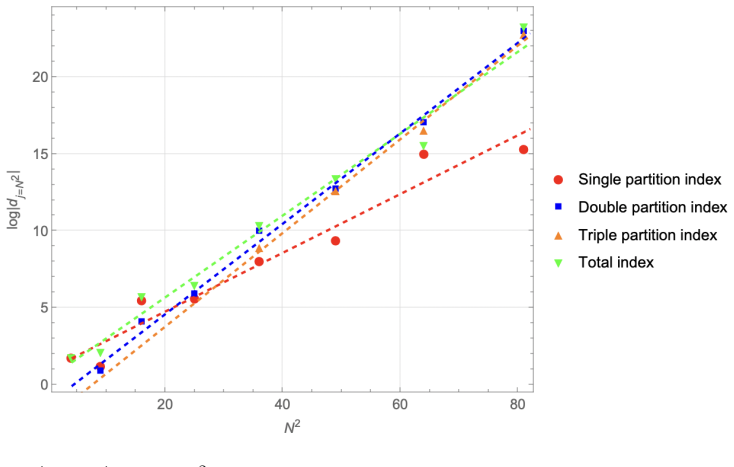
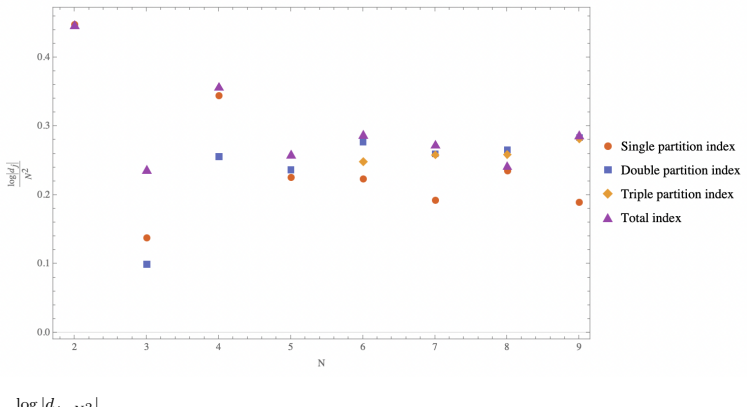
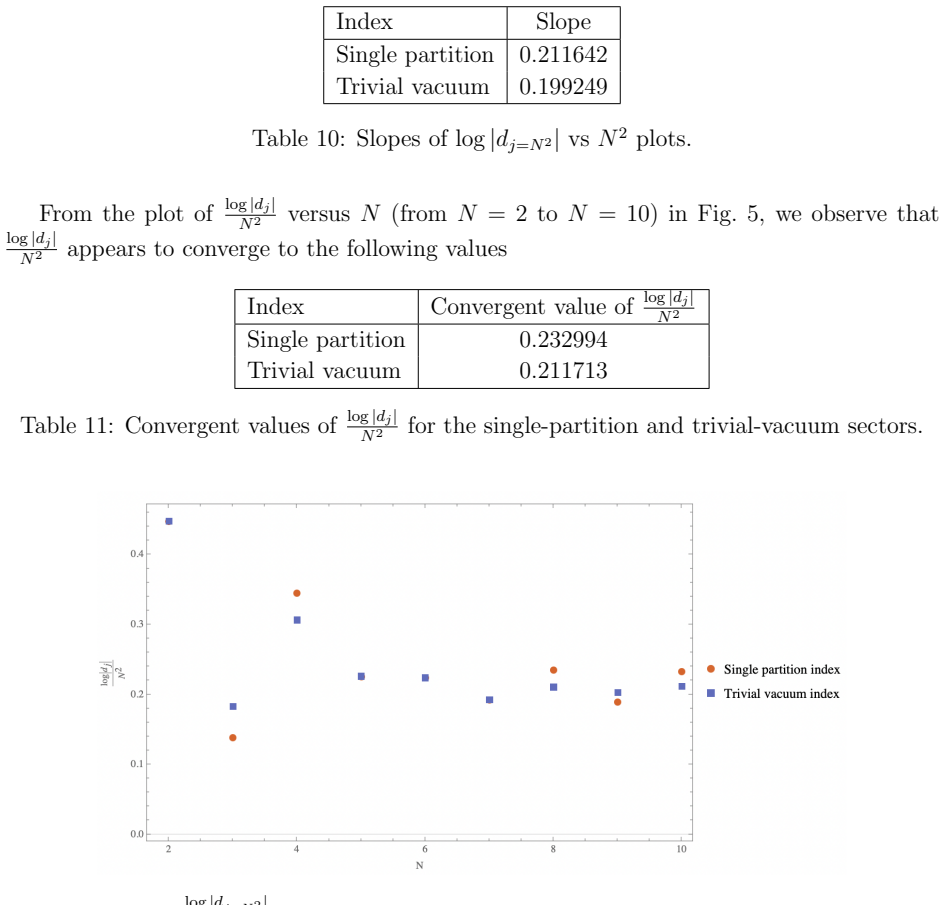
Evaluating every vacuum sector for N≤9 via character expansions and rooted-tree residues shows that, in the equal-fugacity expansion, the index coefficients near j∼N² exhibit entropy growth of order N² that persists after the full sector sum. The finite-N spectrum also displays dominance switching: near j=N² the leading sector changes with N, from single-partition sectors at small rank to double-partition sectors beginning at N=5.
What carries the argument
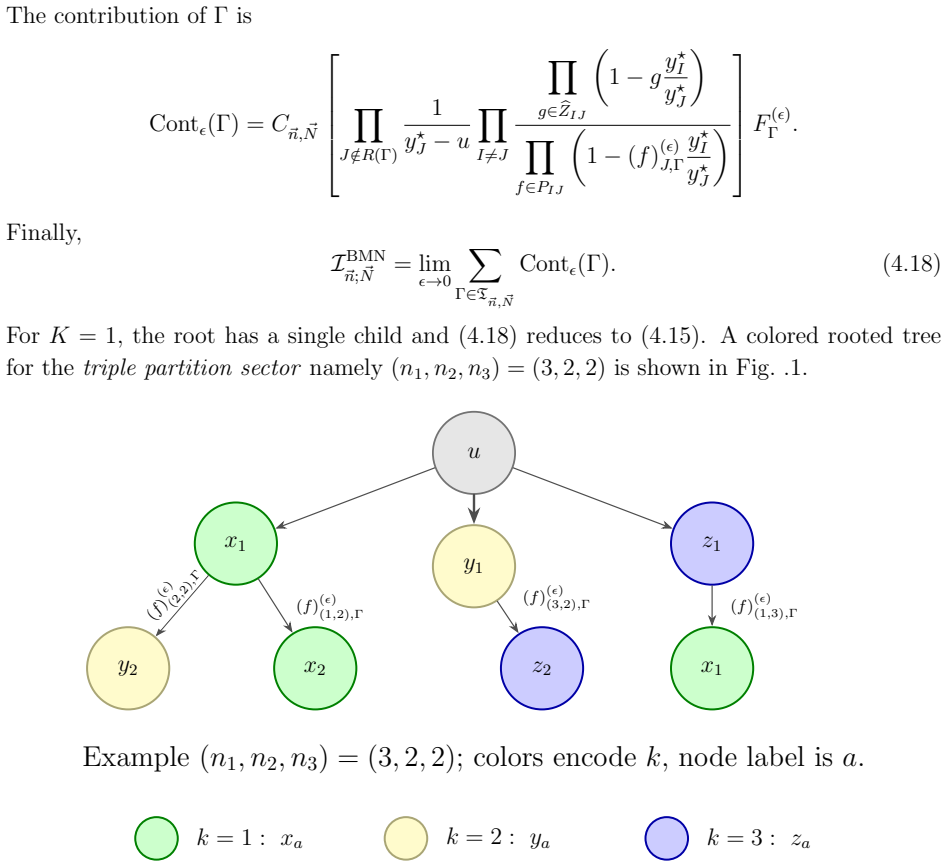
The unitary-matrix integral representation of the Witten index for each partition-labeled vacuum sector, reduced by symmetric-group character expansions and rooted-tree residue expansions.
If this is right
- The index supplies quantitative finite-N data for identifying protected plane-wave black-hole sectors.
- In the controlled type-IIA regime the results support a D2-dressed black-hole interpretation in which D0 black-hole sectors are accompanied by macroscopic spherical D2-brane degrees of freedom.
- Dominance switching constitutes a new organizational feature of the finite-N spectrum that any microscopic counting of plane-wave states must reproduce.
- The persistence of N² entropy growth after sector summation indicates that black-hole-like degeneracies remain protected across the full set of vacuum sectors.
Where Pith is reading between the lines
- The observed switch at N=5 may mark the onset of a pattern in which higher-multiplicity partitions become dominant at still larger N.
- The D2-dressing picture could be tested by comparing the index against holographic calculations that include explicit D2-brane probes in the plane-wave geometry.
- The same character and residue techniques could be applied to related supersymmetric matrix models to extract their finite-N indices and sectoral structure.
- If the entropy growth continues without cancellation at larger N, the index would furnish a concrete microscopic count for the entropy of protected black-hole states in the BMN limit.
Load-bearing premise
The unitary-matrix integral for each partition sector encodes its exact index contribution and the character and residue methods extract every term without omission or overcount up to N=9.
What would settle it
Explicit evaluation of the equal-fugacity coefficients for N=10 near j=N² that either continues to show uncancelled N² growth or exhibits sudden cancellation after the sector sum would decide the claim.
Figures
read the original abstract
We compute the finite-$N$ Witten index of BMN matrix quantum mechanics after summing over all partition-labeled supersymmetric vacuum sectors. Starting from the unitary-matrix integral for each sector, we develop two complementary evaluation methods: a symmetric-group character expansion, which reduces each fixed fugacity order to a finite combinatorial sum, and a residue expansion in which the contributing poles are organized by rooted trees, with a colored-tree generalization for multi-partition sectors. Where practical, direct integration and extraction of the constant term in the expanded integrand give independent coefficient-by-coefficient checks. We evaluate every vacuum sector for $N\leq 9$. In the equal-fugacity expansion, the coefficients near charges $j\sim N^2$ show entropy growth of order $N^2$, and, in this range, the sector sum does not cancel this growth. The finite-$N$ data also reveal a nontrivial sectoral organization: near $j=N^2$, the sector giving the largest contribution changes with $N$, from single-partition sectors at small rank to double-partition sectors starting at $N=5$. We call this phenomenon dominance switching. These results provide quantitative finite-$N$ input for using the BMN index as a diagnostic of protected plane-wave black-hole sectors and suggest a D2 dressed black-hole interpretation in the controlled type-IIA regime, where D0 black-hole sectors are accompanied by macroscopic spherical D2-brane degrees of freedom, analogous to dual dressed black holes in $AdS_5\times S^5$.
Editorial analysis
A structured set of objections, weighed in public.
Referee Report
Summary. The manuscript computes the finite-N Witten index of BMN matrix quantum mechanics summed over all partition-labeled supersymmetric vacuum sectors for N≤9. Starting from the unitary-matrix integral representation of each sector, two evaluation methods are developed: a symmetric-group character expansion that reduces fixed-fugacity orders to finite combinatorial sums, and a residue expansion organizing poles via rooted trees (with a colored-tree extension for multi-partition sectors). Direct integration provides coefficient-by-coefficient checks where practical. The central results are that, in the equal-fugacity expansion, coefficients near j∼N² exhibit entropy growth of order N² with no cancellation upon sector summation, and a dominance-switching phenomenon occurs in which the largest-contributing sector changes from single-partition to double-partition sectors beginning at N=5.
Significance. If the numerical coefficients are accurate, the work supplies exact finite-N data on the BMN index that can serve as quantitative input for diagnosing protected plane-wave black-hole sectors and for exploring D2-dressed black-hole interpretations in the controlled type-IIA regime. The provision of two independent evaluation methods together with direct-integration cross-checks constitutes a strength, as does the explicit evaluation across every vacuum sector up to N=9.
major comments (2)
- [Abstract (methods paragraph) and evaluation summary for N≤9] The accuracy of the summed index coefficients for N=5–9 rests on the colored-tree residue method correctly enumerating all poles in double-partition sectors (which dominate from N=5 onward). The manuscript states that direct-integration checks are performed only 'where practical,' leaving open whether the N=5–9 double-partition cases that drive the entropy-growth and dominance-switching claims were independently verified by the character expansion or direct integration.
- [Results on equal-fugacity expansion near j∼N²] The claim that the sector sum does not cancel the N² entropy growth near j∼N² is load-bearing for the black-hole diagnostic interpretation; this non-cancellation must be shown to survive any potential under-counting of higher-order or dependent residues in the colored-tree organization, yet the manuscript provides no explicit table or appendix confirming that the character-expansion sums and residue sums agree coefficient-by-coefficient for the double-partition sectors at N=5–9.
minor comments (2)
- Clarify the precise definition of the equal-fugacity limit and the range of charges j over which the N² growth is reported, including any cutoff or fitting procedure used to extract the growth rate.
- Add a short reproducibility note on the implementation of the colored-tree enumeration (e.g., how color assignments and tree rooting are enumerated) to facilitate independent checks of the N≤9 data.
Simulated Author's Rebuttal
We thank the referee for the careful reading and for identifying the need for stronger cross-verification of the double-partition results. We respond to each major comment below and will revise the manuscript accordingly.
read point-by-point responses
-
Referee: [Abstract (methods paragraph) and evaluation summary for N≤9] The accuracy of the summed index coefficients for N=5–9 rests on the colored-tree residue method correctly enumerating all poles in double-partition sectors (which dominate from N=5 onward). The manuscript states that direct-integration checks are performed only 'where practical,' leaving open whether the N=5–9 double-partition cases that drive the entropy-growth and dominance-switching claims were independently verified by the character expansion or direct integration.
Authors: The character expansion and residue expansion are independent methods. The former reduces each sector to a finite sum over symmetric-group characters, while the latter organizes the unitary integral via a rooted-tree (or colored-tree) enumeration of poles. We have performed explicit coefficient-by-coefficient comparisons between the two methods, as well as with direct integration, for all single-partition sectors up to N=9 and for double-partition sectors up to N=4, where all three approaches are computationally feasible; the results agree. For double-partition sectors at N=5–9 the character expansion becomes significantly more expensive, which is why the colored-tree residue method was used to obtain the reported values. The structural consistency of the colored-tree generalization with the verified single-partition case, together with the agreement on all accessible lower-N data, supports the reliability of the N=5–9 results. To make this verification explicit we will add an appendix tabulating the leading coefficients near j∼N² obtained from both the character expansion and the residue expansion for the dominant double-partition sectors at N=5 and N=6. revision: yes
-
Referee: [Results on equal-fugacity expansion near j∼N²] The claim that the sector sum does not cancel the N² entropy growth near j∼N² is load-bearing for the black-hole diagnostic interpretation; this non-cancellation must be shown to survive any potential under-counting of higher-order or dependent residues in the colored-tree organization, yet the manuscript provides no explicit table or appendix confirming that the character-expansion sums and residue sums agree coefficient-by-coefficient for the double-partition sectors at N=5–9.
Authors: We agree that an explicit side-by-side comparison for the double-partition sectors at N=5–9 would strengthen the non-cancellation claim. The entropy growth of order N² is observed in the summed coefficients computed via the colored-tree residue method. Because the character expansion supplies an independent combinatorial count of the same quantities, agreement between the two methods on all sectors where both can be evaluated indicates that the tree organization does not under-count poles. We will include in the revised manuscript a supplementary table that directly compares the character-expansion and residue-expansion coefficients near j∼N² for the leading double-partition sectors at N=5 (the onset of dominance switching), thereby confirming that the observed non-cancellation is robust. revision: yes
Circularity Check
Direct combinatorial evaluation of matrix integrals; no circular reductions
full rationale
The paper starts from the unitary-matrix integral representation of each partition-labeled sector and develops two independent evaluation techniques (symmetric-group character expansion reducing to finite sums, and rooted-tree residue expansion) that are applied directly to obtain exact coefficients for N≤9. These computations yield the reported entropy growth and dominance switching as outputs, without any parameter fitting, self-referential predictions, or load-bearing self-citations that reduce the central claims to their inputs. The methods are self-contained and externally verifiable by direct integration where noted, so the derivation chain does not collapse by construction.
Axiom & Free-Parameter Ledger
axioms (2)
- domain assumption The Witten index of each supersymmetric vacuum sector is given by a unitary matrix integral over eigenvalues.
- domain assumption The symmetric-group character expansion and the rooted-tree residue expansion together evaluate the integrals exactly at each fugacity order.
Forward citations
Cited by 2 Pith papers
-
Mass-Flow Invariance of $Q$-Cohomology in BMN Matrix Quantum Mechanics
Q-cohomology in BMN matrix QM is mass-flow invariant via a similarity transformation of the nilpotent supercharge component.
-
BPS Non-Renormalization in the BMN Matrix Model
Conjugation deformations preserve normalizability in the BMN matrix model, implying BPS states do not lift and their unsigned number is invariant except at the free and BFSS points.
Reference graph
Works this paper leans on
-
[1]
D. E. Berenstein, J. M. Maldacena and H. S. Nastase,Strings in flat space and pp waves from N=4 superYang-Mills,JHEP04(2002) 013 [hep-th/0202021]
work page internal anchor Pith review Pith/arXiv arXiv 2002
-
[2]
M Theory As A Matrix Model: A Conjecture
T. Banks, W. Fischler, S. H. Shenker and L. Susskind,M theory as a matrix model: A conjecture,Phys. Rev. D55(1997) 5112 [hep-th/9610043]
work page internal anchor Pith review Pith/arXiv arXiv 1997
-
[3]
M(atrix) Theory: Matrix Quantum Mechanics as a Fundamental Theory
W. Taylor,M(atrix) Theory: Matrix Quantum Mechanics as a Fundamental Theory, Rev. Mod. Phys.73(2001) 419 [hep-th/0101126]
work page internal anchor Pith review Pith/arXiv arXiv 2001
-
[4]
J. M. Maldacena, M. M. Sheikh-Jabbari and M. Van Raamsdonk,Transverse five-branes in matrix theory,JHEP01(2003) 038 [hep-th/0211139]
work page internal anchor Pith review Pith/arXiv arXiv 2003
-
[5]
Matrix Perturbation Theory For M-theory On a PP-Wave
K. Dasgupta, M. M. Sheikh-Jabbari and M. Van Raamsdonk,Matrix perturbation theory for M theory on a PP wave,JHEP05(2002) 056 [hep-th/0205185]
work page internal anchor Pith review Pith/arXiv arXiv 2002
-
[6]
On the Spectrum of PP-Wave Matrix Theory
N. Kim and J. Plefka,On the spectrum of PP wave matrix theory,Nucl. Phys. B643 (2002) 31 [hep-th/0207034]
work page internal anchor Pith review Pith/arXiv arXiv 2002
-
[7]
Protected Multiplets of M-Theory on a Plane Wave
K. Dasgupta, M. M. Sheikh-Jabbari and M. Van Raamsdonk,Protected multiplets of M theory on a plane wave,JHEP09(2002) 021 [hep-th/0207050]
work page internal anchor Pith review Pith/arXiv arXiv 2002
-
[8]
H. Lin and J. M. Maldacena,Fivebranes from gauge theory,Phys. Rev. D74(2006) 084014 [hep-th/0509235]
work page internal anchor Pith review Pith/arXiv arXiv 2006
-
[9]
Spherical transverse M5-branes from the plane wave matrix model
Y. Asano, G. Ishiki, S. Shimasaki and S. Terashima,Spherical transverse M5-branes from the plane wave matrix model,JHEP02(2018) 076 [1711.07681]
work page internal anchor Pith review Pith/arXiv arXiv 2018
-
[10]
N. Kim, T. Klose and J. Plefka,Plane wave matrix theory fromN= 4super Yang-Mills onR×S 3,Nucl. Phys. B671(2003) 359 [hep-th/0306054]
work page internal anchor Pith review Pith/arXiv arXiv 2003
-
[11]
N=4 SYM on R x S^3 and Theories with 16 Supercharges
G. Ishiki, Y. Takayama and A. Tsuchiya,N=4 SYM onR×S 3 and theories with 16 supercharges,JHEP10(2006) 007 [hep-th/0605163]. 113
work page internal anchor Pith review Pith/arXiv arXiv 2006
-
[12]
Embedding of theories with SU(2|4) symmetry into the plane wave matrix model
G. Ishiki, S. Shimasaki, Y. Takayama and A. Tsuchiya,Embedding of theories with SU(2|4)symmetry into the plane wave matrix model,JHEP11(2006) 089 [hep-th/0610038]
work page internal anchor Pith review Pith/arXiv arXiv 2006
-
[13]
Exact results for perturbative partition functions of theories with SU(2|4) symmetry
Y. Asano, G. Ishiki, T. Okada and S. Shimasaki,Exact results for perturbative partition functions of theories withSU(2|4)symmetry,JHEP02(2013) 148 [1211.0364]
work page internal anchor Pith review Pith/arXiv arXiv 2013
-
[14]
Emergent bubbling geometries in the plane wave matrix model
Y. Asano, G. Ishiki, T. Okada and S. Shimasaki,Emergent bubbling geometries in the plane wave matrix model,JHEP05(2014) 075 [1401.5079]
work page internal anchor Pith review Pith/arXiv arXiv 2014
-
[15]
M. S. Costa, L. Greenspan, J. Penedones and J. Santos,Thermodynamics of the BMN matrix model at strong coupling,JHEP03(2015) 069 [1411.5541]
work page internal anchor Pith review Pith/arXiv arXiv 2015
-
[16]
C.-M. Chang and Y.-H. Lin,Words to describe a black hole,JHEP02(2023) 109 [2209.06728]
- [17]
- [18]
- [19]
-
[20]
C.-M. Chang and Y.-H. Lin,Holographic covering and the fortuity of black holes, 2402.10129
-
[21]
C.-M. Chang, Y.-H. Lin and H. Zhang,Fortuity in the D1-D5 system,2501.05448
-
[22]
Chang,Witten index of BMN matrix quantum mechanics,SciPost Phys.19 (2025) 147 [2404.18442]
C.-M. Chang,Witten index of BMN matrix quantum mechanics,SciPost Phys.19 (2025) 147 [2404.18442]
-
[23]
F. A. Dolan,Counting BPS operators in N=4 SYM,Nucl. Phys. B790(2008) 432 [0704.1038]
work page internal anchor Pith review Pith/arXiv arXiv 2008
-
[24]
Murthy,Growth of the 1 16-BPS index in 4dN= 4supersymmetric Yang-Mills theory,Phys
S. Murthy,Growth of the 1 16-BPS index in 4dN= 4supersymmetric Yang-Mills theory,Phys. Rev. D105(2022) L021903 [2005.10843]
-
[25]
D. Gaiotto and J. H. Lee,The giant graviton expansion,JHEP08(2024) 025 [2109.02545]. 114
- [26]
- [27]
-
[28]
R. de Mello Koch, M. Kim, S. Kim, J. Lee and S. Lee,Brane-fused black hole operators,JHEP07(2025) 216 [2412.08695]
-
[29]
Y. Imamura,Finite-N superconformal index via the AdS/CFT correspondence,PTEP 2021(2021) 123B05 [2108.12090]
- [30]
- [31]
- [32]
- [33]
-
[34]
R. de Mello Koch and A. Jevicki,Structure of loop space at finite N,JHEP06(2025) 011 [2503.20097]
-
[35]
R. de Mello Koch, A. Ghosh and H. J. R. Van Zyl,Bosonic fortuity in vector models, JHEP06(2025) 246 [2504.14181]
-
[36]
Chen,Fortuity with a single matrix,2511.00790
Y. Chen,Fortuity with a single matrix,2511.00790
- [37]
-
[38]
C.-M. Chang and H. Zhang,Fortuity and R-charge concentration in the D1-D5 CFT, 2511.23294
- [39]
- [40]
-
[41]
Two roads to fortuity in ABJM theory
C. Behan and L. P. de Gioia,Two roads to fortuity in ABJM theory,2512.23603. 115
work page internal anchor Pith review Pith/arXiv arXiv
-
[42]
Localization of N=4 Superconformal Field Theory on S^1 x S^3 and Index
S. Nawata,Localization ofN=4 Superconformal Field Theory onS 1 ×S 3 and Index, JHEP11(2011) 144 [1104.4470]. 116
work page internal anchor Pith review Pith/arXiv arXiv 2011
discussion (0)
Sign in with ORCID, Apple, or X to comment. Anyone can read and Pith papers without signing in.