Magnetoelastic effects in the metallic frustrated antiferromagnet CrB₂
Pith reviewed 2026-06-29 20:56 UTC · model grok-4.3
The pith
Longitudinal magnetoelastic coupling suppresses Fermi-surface nesting and enhances frustration in CrB₂ while transverse coupling relieves it via lattice distortion
A machine-rendered reading of the paper's core claim, the machinery that carries it, and where it could break.
Core claim
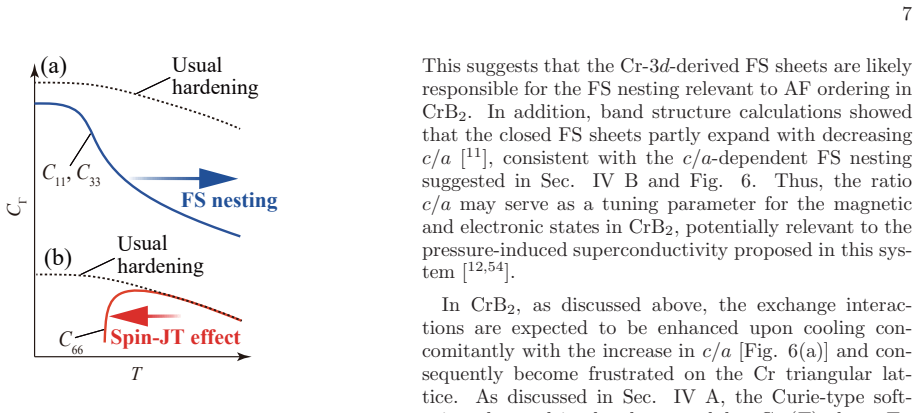
The central claim is that in CrB₂ the temperature dependence of elastic moduli indicates that longitudinal magnetoelastic coupling suppresses Fermi-surface nesting and enhances frustrated exchange interactions, while transverse magnetoelastic coupling is responsible for relieving the frustration by driving a symmetry-lowering lattice distortion at the Néel temperature.
What carries the argument
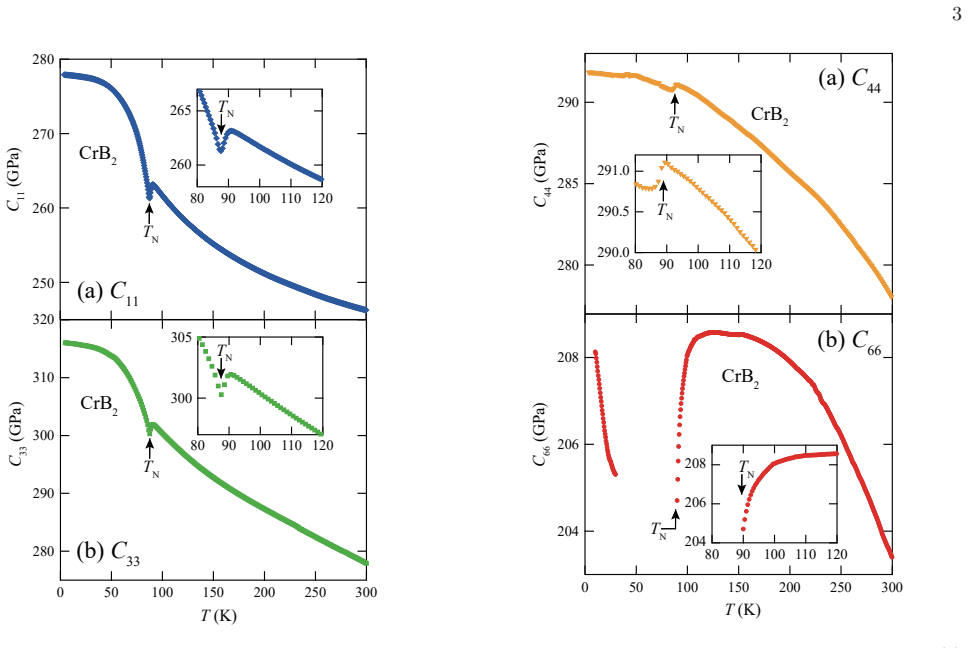
Ultrasound velocity measurements of elastic moduli, particularly the ab-plane shear modulus showing Curie-type softening and the compressive moduli showing nesting-related softness
If this is right
- The shear modulus softening implies a lattice distortion occurs at TN to relieve frustration.
- Suppression of nesting by longitudinal coupling explains the enhancement of frustration.
- Transverse coupling is the primary mechanism for relieving frustration in this system.
- The metallic nature allows both nesting and exchange to be affected by lattice strains.
Where Pith is reading between the lines
- If the distinction holds, similar elastic measurements could identify coupling types in other metallic frustrated magnets.
- Applying strain along specific axes might tune the balance between nesting and frustration.
- The precursor softening suggests that the distortion symmetry can be predicted from the modulus affected.
Load-bearing premise
The Curie-type softening observed in the ab-plane shear modulus is caused by an impending symmetry-lowering lattice distortion at TN rather than by other magnetic or electronic effects.
What would settle it
A high-resolution X-ray or neutron diffraction measurement finding no change in crystal symmetry or lattice parameters at TN would falsify the precursor interpretation of the softening.
Figures
read the original abstract
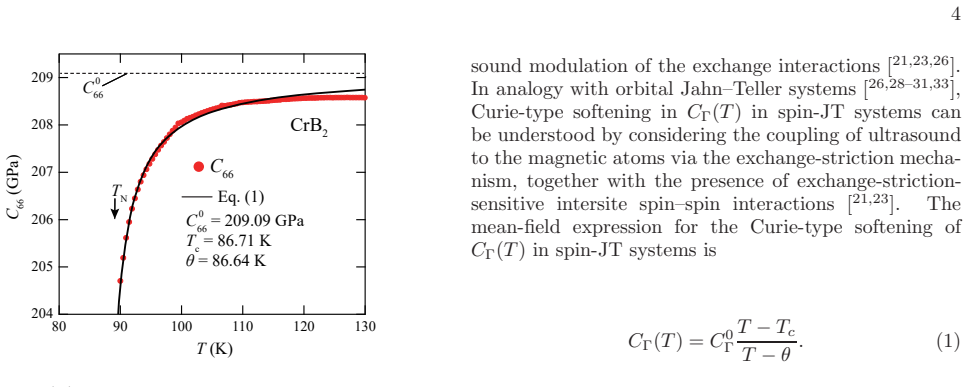
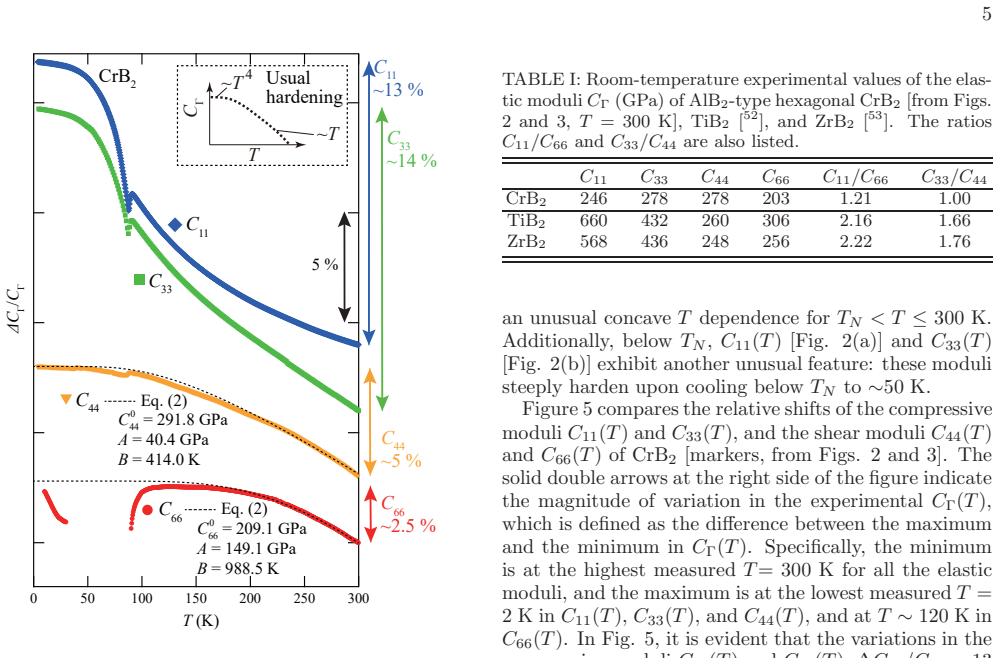
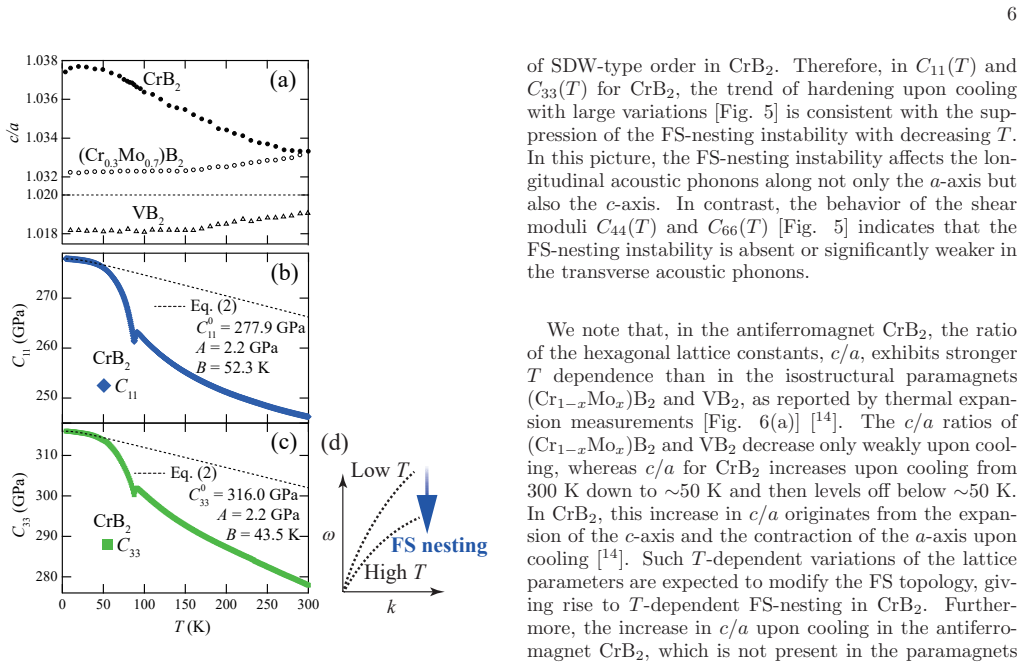
Hexagonal chromium diboride CrB$_2$ is a metallic frustrated antiferromagnet with a N\'{e}el temperature $T_N \sim$ 88 K. In CrB$_2$, Cr 3$d$ electrons not only give rise to localized magnetic moments but also contribute to metallic conduction. We perform ultrasound velocity measurements on a single crystal of hexagonal CrB$_2$ to determine its elastic properties. The temperature dependence of the $ab$-plane shear elastic modulus exhibits Curie-type softening upon cooling from $\sim$120 K down to $T_N$. This behavior is interpreted as a precursor to a symmetry-lowering lattice distortion at $T_N$, indicating that magnetic frustration is relieved via transverse magnetoelastic coupling. In addition, the $a$-axis and $c$-axis compressive elastic moduli show unusual softness and their suppression upon cooling, which are naturally explained by Fermi-surface nesting and its suppression upon cooling. The present results suggest that, in CrB$_2$, longitudinal magnetoelastic coupling suppresses Fermi-surface nesting and enhances frustrated exchange interactions, while transverse magnetoelastic coupling plays a key role in relieving the frustration.
Editorial analysis
A structured set of objections, weighed in public.
Referee Report
Summary. The manuscript reports ultrasound velocity measurements on single-crystal hexagonal CrB₂, a metallic frustrated antiferromagnet with T_N ≈ 88 K. The ab-plane shear modulus exhibits Curie-type softening from ~120 K to T_N, interpreted as a precursor to a symmetry-lowering lattice distortion at T_N driven by transverse magnetoelastic coupling that relieves frustration. The a- and c-axis compressive moduli show unusual softness and suppression upon cooling, attributed to Fermi-surface nesting suppressed by longitudinal magnetoelastic coupling. The results distinguish the roles of longitudinal (nesting suppression, enhanced frustration) and transverse (frustration relief) couplings.
Significance. If the central interpretations are substantiated, the work provides concrete experimental evidence for how magnetoelastic effects can simultaneously suppress nesting and relieve frustration in a metallic frustrated antiferromagnet, offering a useful case study for similar systems where elastic and magnetic degrees of freedom are coupled. The ultrasound approach directly probes the relevant moduli and is well-suited to the problem.
major comments (2)
- [Abstract] Abstract and interpretation section: The claim that the observed Curie-type softening of the ab-plane shear modulus is 'a precursor to a symmetry-lowering lattice distortion at T_N' is presented without any supporting structural data (diffraction, thermal expansion, or specific-heat anomalies indicating a lattice change). This leaves the assignment to transverse magnetoelastic coupling and the distinction from longitudinal effects unsupported by the elastic data alone; alternative origins such as magnetic fluctuations remain possible.
- [Results/Discussion] Results and discussion: The attribution of a- and c-axis compressive modulus softness to Fermi-surface nesting and its suppression is stated qualitatively but lacks quantitative comparison to calculated nesting vectors, band-structure predictions, or control measurements (e.g., doping or pressure) that would make the longitudinal-coupling interpretation load-bearing rather than plausible.
minor comments (2)
- [Figure 2 / Methods] The temperature range and fitting procedure used to establish the 'Curie-type' form of the softening should be shown explicitly (e.g., a plot of 1/(C - C0) vs T) to allow readers to assess the quality of the fit.
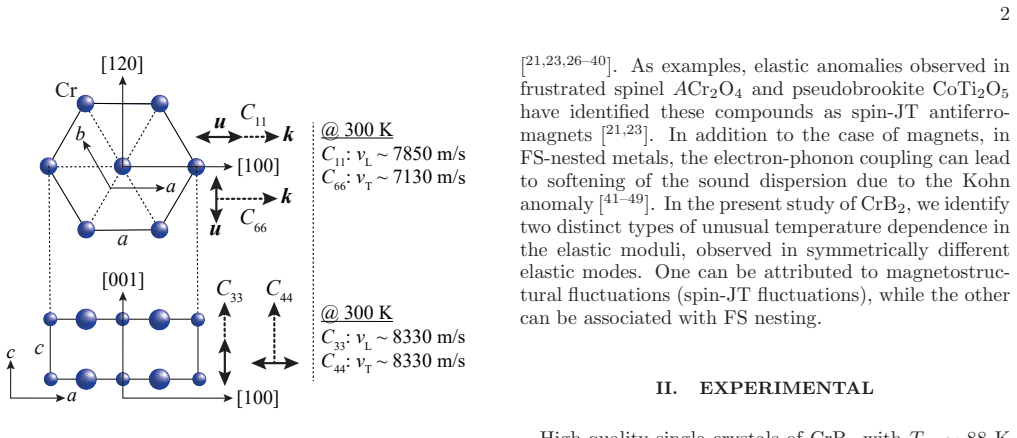
- [Methods] Notation for the elastic moduli (C_{11}, C_{44}, etc.) and the precise ultrasound propagation directions should be defined once in the text or a table for clarity.
Simulated Author's Rebuttal
We thank the referee for the careful reading and constructive comments on our manuscript. We respond to each major comment below, indicating planned revisions where appropriate.
read point-by-point responses
-
Referee: [Abstract] Abstract and interpretation section: The claim that the observed Curie-type softening of the ab-plane shear modulus is 'a precursor to a symmetry-lowering lattice distortion at T_N' is presented without any supporting structural data (diffraction, thermal expansion, or specific-heat anomalies indicating a lattice change). This leaves the assignment to transverse magnetoelastic coupling and the distinction from longitudinal effects unsupported by the elastic data alone; alternative origins such as magnetic fluctuations remain possible.
Authors: We agree that the manuscript lacks direct structural probes such as diffraction or thermal expansion data to confirm a lattice distortion at T_N. The interpretation of the ab-plane shear modulus softening as a precursor is based on its Curie-type temperature dependence, which is a recognized signature of magnetoelastic coupling in frustrated magnets. The mode-specific nature of the softening (ab-plane shear vs. compressive) underpins the distinction between transverse and longitudinal couplings. While magnetic fluctuations cannot be ruled out solely from elastic data, the observed behavior aligns with frustration relief rather than generic fluctuations. We will revise the abstract and discussion sections to present this as an interpretation supported by the ultrasound results, explicitly note the absence of direct structural evidence, and discuss why fluctuations are less favored given the metallic character and temperature range. revision: yes
-
Referee: [Results/Discussion] Results and discussion: The attribution of a- and c-axis compressive modulus softness to Fermi-surface nesting and its suppression is stated qualitatively but lacks quantitative comparison to calculated nesting vectors, band-structure predictions, or control measurements (e.g., doping or pressure) that would make the longitudinal-coupling interpretation load-bearing rather than plausible.
Authors: The discussion of the compressive moduli is indeed qualitative and relies on consistency with known Fermi-surface nesting in CrB2 from prior literature. The unusual softness and its suppression upon cooling match the expected effects of longitudinal magnetoelastic coupling. We do not include new band-structure calculations or control experiments (doping/pressure) in this work, as the focus is on ultrasound measurements. We will revise the results and discussion to include additional references to existing ARPES and DFT studies on nesting vectors in CrB2, clarify the qualitative nature of the link, and note that quantitative validation would require separate theoretical or doping studies. This keeps the interpretation plausible but not definitive based on the present data. revision: partial
Circularity Check
No circularity in derivation chain
full rationale
The manuscript reports experimental ultrasound velocity data on CrB2 elastic moduli and offers physical interpretations of the observed Curie-type softening and compressive modulus behavior in terms of longitudinal versus transverse magnetoelastic coupling. No equations, fitted parameters, self-citations, or ansatzes are invoked that reduce any central claim to an input by construction; the temperature dependences are presented as raw observations whose interpretation remains open to alternative mechanisms. The analysis is therefore self-contained against external benchmarks.
Axiom & Free-Parameter Ledger
Reference graph
Works this paper leans on
-
[1]
Lacroix, P
C. Lacroix, P. Mendels, and F. Mila, eds., Introduction to Frustrated Magnetism: Materials, Experiments, Theory , Vol. 164 (Springer, 2011)
2011
-
[2]
Lacroix, Frustrated metallic systems: A review of some peculiar behavior, J
C. Lacroix, Frustrated metallic systems: A review of some peculiar behavior, J. Phys. Soc. Jpn. 79 , 011008 (2010)
2010
-
[3]
Vojta, Frustration and quantum criticality, Rep
M. Vojta, Frustration and quantum criticality, Rep. Prog. Phys. 81 , 064501 (2018)
2018
-
[4]
Bauer, A
A. Bauer, A. Regnat, C. G. F. Blum, S. Gottlieb-Sch\"onmeyer, B. Pedersen, M. Meven, S. Wurmehl, J. Kune s , and C. Pfleiderer, Low-temperature properties of single-crystal CrB _2 , Phys. Rev. B 90 , 064414 (2014)
2014
-
[5]
Funahashi, Y
S. Funahashi, Y. Hamaguchi, T. Tanaka, and E. Bannai, Helical magnetic structure in CrB _2 , Solid State Commun. 23 , 859 (1977)
1977
-
[6]
E. Kaya, Y. Kousaka, K. Kakurai, M. Takeda, and J. Akimitsu, Spherical neutron polarimetry studies on the magnetic structure of single crystal Cr _ 1-x Mo _x B _2 ( x = 0, 0.15), Physica (Amsterdam) 404B , 2524 (2009)
2009
-
[7]
P. Park, K. Park, T. Kim, Y. Kousaka, K. H. Lee, T. G. Perring, J. Jeong, U. Stuhr, J. Akimitsu, M. Kenzelmann, and J.-G. Park, Momentum-Dependent Magnon Lifetime in the Metallic Noncollinear Triangular Antiferromagnet CrB _2 , Phys. Rev. Lett. 125 , 027202 (2020)
2020
-
[8]
S. H. Liu, L. Kopp, W. B. England, and H. W. Myron, Energy bands, electronic properties, and magnetic ordering of CrB _2 , Phys. Rev. B 11 , 3463 (1975)
1975
-
[9]
X. B. Wang, D. C. Tian, and L. L. Wang, The electronic structure and chemical stability of the AlB _2 -type transition-metal diborides, J. Phys.: Condens. Matter 6 , 10185 (1994)
1994
-
[10]
Vajeeston, P
P. Vajeeston, P. Ravindran, C. Ravi, and R. Asokamani, Electronic structure, bonding, and ground-state properties of AlB _2 -type transition-metal diborides, Phys. Rev. B 63 , 045115 (2001)
2001
-
[11]
Brasse, L
M. Brasse, L. Chioncel, J. Kune s , A. Bauer, A. Regnat, C. G. F. Blum, S. Wurmehl, C. Pfleiderer, M. A. Wilde, and D. Grundler, de Haas--van Alphen effect and Fermi surface properties of single-crystal CrB _2 , Phys. Rev. B 88 , 155138 (2013)
2013
-
[12]
Biswas, A
S. Biswas, A. Kreisel, A. Valadkhani, M. D\"urrnagel, T. Schwemmer, R. Thomale, R. Valent\' , and I. I. Mazin, Hybrid s -wave superconductivity in CrB _2 , Phys. Rev. B 108 , L020501 (2023)
2023
-
[13]
Wang, Heavy fermions in frustrated Hund's metal with portions of incipient flat bands, Phys
Y. Wang, Heavy fermions in frustrated Hund's metal with portions of incipient flat bands, Phys. Rev. B 111 , 035127 (2025)
2025
-
[14]
Nishihara, M
Y. Nishihara, M. Tokumoto, Y. Yamaguchi, and S. Ogawa, Magneto-volume effect of the itinerant-electron antiferromagnet CrB _2 , J. Phys. Soc. Jpn. 56 , 1562 (1987)
1987
-
[15]
Yamashita and K
Y. Yamashita and K. Ueda, Spin-Driven Jahn-Teller Distortion in a Pyrochlore System, Phys. Rev. Lett. 85 , 4960 (2000)
2000
-
[16]
Tchernyshyov, R
O. Tchernyshyov, R. Moessner, and S. L. Sondhi, Order by Distortion and String Modes in Pyrochlore Antiferromagnets, Phys. Rev. Lett. 88 , 067203 (2002)
2002
-
[17]
G. A. Gehring and K. A. Gehring, Co-operative Jahn-Teller effects, Rep. Prog. Phys. 38 , 1 (1975)
1975
-
[18]
S. -H. Lee, C. Broholm, T. H. Kim, W. Ratcliff II, and S. W. Cheong, Local Spin Resonance and Spin-Peierls-like Phase Transition in a Geometrically Frustrated Antiferromagnet, Phys. Rev. Lett. 84 , 3718 (2000)
2000
-
[19]
Ortega-San-Mart n, A
L. Ortega-San-Mart n, A. J. Williams, C. D. Gordon, S. Klemme, and J. P. Attfield, Low temperature neutron diffraction study of MgCr _2 O _4 spinel, J. Phys.: Condens. Matter 20 , 104238 (2008)
2008
-
[20]
J. -H. Chung, M. Matsuda, S. -H. Lee, K. Kakurai, H. Ueda, T. J. Sato, H. Takagi, K. -P. Hong, and S. Park, Statics and Dynamics of Incommensurate Spin Order in a Geometrically Frustrated Antiferromagnet CdCr _2 O _4 , Phys. Rev. Lett. 95 , 247204 (2005)
2005
-
[21]
Watanabe, S
T. Watanabe, S. Ishikawa, H. Suzuki, Y. Kousaka, and K. Tomiyasu, Observation of elastic anomalies driven by coexisting dynamical spin Jahn-Teller effect and dynamical molecular-spin state in the paramagnetic phase of frustrated MgCr _2 O _4 , Phys. Rev. B 86 , 144413 (2012)
2012
-
[22]
F. K. K. Kirschner, R. D. Johnson, F. Lang, D. D. Khalyavin, P. Manuel, T. Lancaster, D. Prabhakaran, and S. J. Blundell, Spin Jahn-Teller antiferromagnetism in CoTi _2 O _5 , Phys. Rev. B 99 , 064403 (2019)
2019
-
[23]
Watanabe, K
T. Watanabe, K. Takayanagi, R. Nishimura, Y. Hara, D. Prabhakaran, R. D. Johnson, and S. J. Blundell, Elastic softness of low-symmetry frustrated A Ti _2 O _5 ( A = Co, Fe), Phys. Rev. B 111 , 024426 (2025)
2025
-
[24]
Guratinder, R
K. Guratinder, R. D. Johnson, D. Prabhakaran, R. A. Taylor, F. Lang, S. J. Blundell, L. S. Taran, S. V. Streltsov, T. J. Williams, S. R. Giblin, T. Fennell, K. Schmalzl, and C. Stock, Magnetoelastic Dynamics of the Spin Jahn-Teller Transition in CoTi _2 O _5 , Phys. Rev. Lett. 134 , 256702 (2025)
2025
-
[25]
Kohn, Image of the Fermi surface in the vibration spectrum of a metal, Phys
W. Kohn, Image of the Fermi surface in the vibration spectrum of a metal, Phys. Rev. Lett. 2 , 393 (1959)
1959
-
[26]
L\"uthi, Physical Acoustics in the Solid State (Springer, 2005)
B. L\"uthi, Physical Acoustics in the Solid State (Springer, 2005)
2005
-
[27]
L\"uthi and W
B. L\"uthi and W. Rehwald, in Structural Phase Transitions I (Springer, Berlin, 1981), p. 131
1981
-
[28]
Y. Kino, B. L\"uthi, and M. E. Mullen, Cooperative Jahn-Teller Phase Transition in the Nickel-Zinc-Chromite System, J. Phys. Soc. Jpn. 33 , 687 (1972); Elastic properties and cooperative Jahn-Teller effect in nickel chromite, Solid State Commun. 12 , 275 (1973)
1972
-
[29]
Kataoka and J
M. Kataoka and J. Kanamori, A Theory of the Cooperative Jahn-Teller Effect --Crystal Distortions in Cu _ 1-x Ni _x Cr _2 O _4 and Fe _ 1-x Ni _x Cr _2 O _4 --, J. Phys. Soc. Jpn. 32 , 113 (1972)
1972
-
[30]
Hazama, T
H. Hazama, T. Goto, Y. Nemoto, Y. Tomioka, A. Asamitsu, and Y. Tokura, Quadrupolar effect in the perovskite manganite La _ 1-x Sr _x MnO _3 , Phys. Rev. B 62 , 15012 (2000)
2000
-
[31]
Y. Nii, N. Abe, and T. Arima, Orbital-spin-coupled fluctuations in spinel vanadate MnV _2 O _4 , Phys. Rev. B 87 , 085111 (2013)
2013
-
[32]
Watanabe, T
T. Watanabe, T. Ishikawa, S. Hara, A. T. M. N. Islam, E. M. Wheeler, and B. Lake, Multiple lattice instabilities resolved by magnetic-field and disorder sensitivities in MgV _2 O _4 , Phys. Rev. B 90 , 100407(R) (2014)
2014
-
[33]
Watanabe, S
T. Watanabe, S. Kobayashi, Y. Hara, J. Xu, B. Lake, J.-Q. Yan, A. Niazi, and D. C. Johnston, Orbital- and spin-driven lattice instabilities in quasi-one-dimensional CaV _2 O _4 , Phys. Rev. B 98 , 094427 (2018)
2018
-
[34]
Bhattacharjee, S
S. Bhattacharjee, S. Zherlitsyn, O. Chiatti, A. Sytcheva, J. Wosnitza, R. Moessner, M. E. Zhitomirsky, P. Lemmens, V. Tsurkan, and A. Loidl, Interplay of spin and lattice degrees of freedom in the frustrated antiferromagnet CdCr _2 O _4 : High-field and temperature-induced anomalies of the elastic constants, Phys. Rev. B 83 , 184421 (2011)
2011
-
[35]
Watanabe, S
T. Watanabe, S. Hara, and S. Ikeda, Jahn-Teller inactivity and magnetic frustration in GeCo _2 O _4 probed by ultrasound velocity measurements, Phys. Rev. B 78 , 094420 (2008)
2008
-
[36]
Watanabe, S
T. Watanabe, S. Hara, S. Ikeda, and K. Tomiyasu, Elastic instabilities in an antiferromagnetically ordered phase of the orbitally frustrated spinel GeCo _2 O _4 , Phys. Rev. B 84 , 020409(R) (2011)
2011
-
[37]
Watanabe, S
T. Watanabe, S. Yamada, R. Koborinai, and T. Katsufuji, Variety of elastic anomalies in an orbital-active nearly itinerant cobalt vanadate spinel, Phys. Rev. B 96 , 014422 (2017)
2017
-
[38]
Watanabe, S
T. Watanabe, S. Takita, K. Tomiyasu, and K. Kamazawa, Acoustic study of dynamical molecular-spin state without magnetic phase transition in spin-frustrated ZnFe _2 O _4 , Phys. Rev. B 92 , 174420 (2015)
2015
-
[39]
Watanabe, H
T. Watanabe, H. Kato, Y. Hara, J. W. Krizan, and R. J. Cava, Softening of breathing elastic mode and trigonal elastic mode in the disordered pyrochlore magnet NaCaCo _2 F _7 , Phys. Rev. B 101 , 214425 (2020)
2020
-
[40]
Watanabe, R
T. Watanabe, R. Okada, and K. Tomiyasu, Symmetry-resolved elastic anomalies in spin-crossover cobaltite LaCoO _3 , Phys. Rev. B 106 , 144432 (2022)
2022
-
[41]
W. M. Shaw and L. D. Muhlestein, Investigation of the Phonon Dispersion Relations of Chromium by inelastic Neutron Scattering, Phys. Rev. B 4 , 969 (1971)
1971
-
[42]
Lamago, M
D. Lamago, M. Hoesch, M. Krisch, R. Heid, K.-P. Bohnen, P. B\"oni, and D. Reznik, Measurement of strong phonon softening in Cr with and without Fermi-surface nesting by inelastic x-ray scattering, Phys. Rev. B 82 , 195121 (2010)
2010
-
[43]
B. M. Powell, P. Martel, and A. D. B. Woods, Lattice Dynamics of Niobium-Molybdenum Alloys, Phys. Rev. 171 , 727 (1968)
1968
-
[44]
D. L. Farber, M. Krisch, D. Antonangeli, A. Beraud, J. Badro, F. Occelli, and D. Orlikowski, Lattice Dynamics of Molybdenum at High Pressure, Phys. Rev. Lett. 96 , 115502 (2006)
2006
-
[45]
C. Yang, Y. Zhang, N. P. Salke, Y. Bi, A. Alatas, A. H. Said, J. Hong, and J.-F. Lin, Kohn anomaly and elastic softening in body-centered cubic molybdenum at high pressure, Phys. Rev. B 105 , 094105 (2022)
2022
-
[46]
Zhang, C
Y. Zhang, C. Yang, A. Alatas, A. H. Said, N. P. Salke, J. Hong, and J.-F. Lin, Pressure effect on Kohn anomaly and electronic topological transition in single-crystal tantalum, Phys. Rev. B 100 , 075145 (2019)
2019
-
[47]
S. Wang, S. Th\' e baud, D. H. Moseley, J. R. Torres, M. E. Manley, Y. Cheng, S. Chi, D. L. Abernathy, G. E. Granroth, A. T. Savici, A. F. May, P. Raghuvanshi, L. Lindsay, and R. H. Hermann, Kohn anomalies and phonon anharmonicity in iridium, Phys. Rev. B 112 , 184305 (2025)
2025
-
[48]
Stassis, M
C. Stassis, M. Bullock, J. Zarestky, P. Canfield, and A. I. Goldman, Phonon mode coupling in superconducting LuNi _2 B _2 C, Phys. Rev. B 55 , R8678 (1997)
1997
-
[49]
Isida, A
S. Isida, A. Matsushita, H. Takeya, and M. Suzuki, Ultrasonic study on superconducting YNi _2 B _2 C, Physica C 349 , 150 (2001)
2001
-
[50]
Y. P. Varshni, Temperature Dependence of the Elastic Constants, Phys. Rev. B 2 , 3952 (1970)
1970
-
[51]
R. M. Bozorth, Ferromagnetism (Van Nostrand, Princeton, NJ, 1951)
1951
-
[52]
P. S. Spoor, J. D. Maynard, M. J. Pan, D. J. Green, J. R. Hellmann, and T. Tanaka, Elastic constants and crystal anisotropy of titanium diboride, Appl. Phys. Lett. 70 , 1959 (1997)
1959
-
[53]
N. L. Okamoto, M. Kusakari, K. Tanaka, H. Inui, M. Yamaguchi, and S. Otani, Temperature dependence of thermal expansion and elastic constants of single crystals of ZrB _2 and the suitability of ZrB _2 as a substrate for GaN film, J. Appl. Phys. 93 , 88 (2003)
2003
- [54]
-
[55]
Regnat, Low-temperature properties and magnetic structure of CrB _2 , MnB _2 , and CuMnSb, PhD Thesis, Technical University of Munich, 2019
A. Regnat, Low-temperature properties and magnetic structure of CrB _2 , MnB _2 , and CuMnSb, PhD Thesis, Technical University of Munich, 2019
2019
discussion (0)
Sign in with ORCID, Apple, or X to comment. Anyone can read and Pith papers without signing in.