From Contrast to Consistency: Rethinking Event-based Continuous-Time Optical Flow Estimation
Pith reviewed 2026-06-29 22:57 UTC · model grok-4.3
The pith
Enforcing spatio-temporal structural consistency yields state-of-the-art event-based continuous-time optical flow estimates.
A machine-rendered reading of the paper's core claim, the machinery that carries it, and where it could break.
Core claim
The central claim is that grounding continuous-time optical flow estimation from events in the principle of Spatio-temporal Structural Consistency (STSC) overcomes the limitations of contrast maximization frameworks by jointly enforcing local structural stability and trajectory continuity, ensuring physically coherent motion across time, and that a bidirectionally complementary multi-scale architecture together with curriculum-guided hybrid training enables effective learning from sparse annotations to reach state-of-the-art performance.
What carries the argument
Spatio-temporal Structural Consistency (STSC) principle that jointly enforces local structural stability and trajectory continuity.
If this is right
- Achieves state-of-the-art performance on continuous-time optical flow benchmarks.
- Achieves state-of-the-art performance on standard optical flow benchmarks as well.
- Enables smooth transition from supervised point constraints to self-supervised manifold regularization.
- Produces physically coherent motion across time.
Where Pith is reading between the lines
- The framework could extend to other asynchronous sensor fusion tasks where temporal density of labels is low.
- Consistency constraints may prove more reliable than sharpening objectives when ground truth is temporally sparse.
- Coherent trajectories produced this way could directly feed into downstream motion forecasting modules.
- The curriculum strategy suggests a general template for blending supervision levels in event-based learning.
Load-bearing premise
That enforcing local structural stability and trajectory continuity through STSC will produce physically coherent motion without additional mechanisms under complex dynamics.
What would settle it
Demonstrating distorted trajectories on a complex-motion event benchmark after applying the full STSC framework, multi-scale architecture, and curriculum training would show the consistency principle fails to deliver the claimed coherence.
Figures
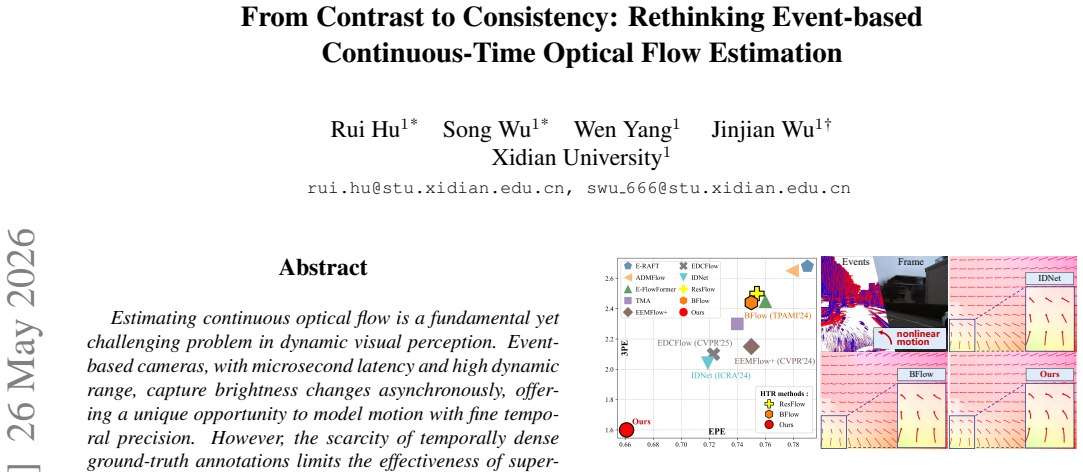


read the original abstract
Estimating continuous optical flow is a fundamental yet challenging problem in dynamic visual perception. Event-based cameras, with microsecond latency and high dynamic range, capture brightness changes asynchronously, offering a unique opportunity to model motion with fine temporal precision. However, the scarcity of temporally dense ground-truth annotations limits the effectiveness of supervised learning, while contrast maximization (CM) frameworks, focused on sharpening the Image of Warped Events (IWE), often neglect temporal continuity and structural coherence, leading to distorted trajectories under complex motion. To overcome these challenges, we propose a hybrid-supervised framework for continuous-time optical flow estimation, grounded in the principle of Spatio-temporal Structural Consistency (STSC). This paradigm jointly enforces local structural stability and trajectory continuity, ensuring physically coherent motion across time. To further enhance representation and robustness, we design a bidirectionally complementary multi-scale architecture and employ a curriculum-guided hybrid training strategy, enabling a smooth transition from supervised point constraints to self-supervised manifold regularization. Comprehensive experiments across multiple benchmarks show that our method achieves state-of-the-art performance in both continuous-time and standard optical flow estimation, demonstrating the effectiveness of the proposed learning paradigm.
Editorial analysis
A structured set of objections, weighed in public.
Referee Report
Summary. The paper proposes a hybrid-supervised framework for continuous-time optical flow estimation using event cameras. It introduces the Spatio-temporal Structural Consistency (STSC) principle to jointly enforce local structural stability and trajectory continuity. The approach features a bidirectionally complementary multi-scale architecture and a curriculum-guided hybrid training strategy that transitions from supervised point constraints to self-supervised manifold regularization. Comprehensive experiments are reported to achieve state-of-the-art performance on multiple benchmarks for both continuous-time and standard optical flow tasks.
Significance. If the empirical claims hold without post-hoc selection or circular regularization effects, the work could advance event-based vision by mitigating trajectory distortion issues common in contrast-maximization methods. The hybrid training strategy is a reasonable response to scarce dense ground-truth data, and the combination of structural and temporal consistency constraints offers a plausible path toward more physically coherent motion estimates.
minor comments (2)
- [Abstract] Abstract: The central SOTA claim is stated without any quantitative metrics, benchmark names, baseline comparisons, or error bars, preventing assessment of effect sizes or potential overfitting.
- [Abstract] Abstract: The STSC principle is described at a high level ('jointly enforces local structural stability and trajectory continuity') but lacks even a brief mathematical formulation or reference to the specific loss terms that implement it.
Simulated Author's Rebuttal
We thank the referee for the summary and for recognizing the potential significance of the hybrid-supervised STSC framework, particularly the curriculum-guided transition and the combination of structural and temporal constraints. We address the implicit concern about empirical robustness below. No explicit major comments were enumerated in the report.
read point-by-point responses
-
Referee: If the empirical claims hold without post-hoc selection or circular regularization effects, the work could advance event-based vision by mitigating trajectory distortion issues common in contrast-maximization methods.
Authors: We confirm that all reported results use the full test sets of the cited benchmarks with no post-hoc selection or cherry-picking of sequences. The manifold regularization term is derived from the STSC principle and is applied only after the supervised point-constraint stage in the curriculum schedule; it does not reuse the same loss surface or create circular dependence on the final flow field. Ablation studies isolating the regularization component are provided in the supplementary material. revision: no
Circularity Check
No significant circularity in derivation chain
full rationale
The paper presents a hybrid-supervised learning framework for continuous-time event-based optical flow, centered on the Spatio-temporal Structural Consistency (STSC) principle, a bidirectional multi-scale architecture, and curriculum training. The abstract and available text contain no equations, derivations, or parameter-fitting steps that reduce a claimed prediction or result to its own inputs by construction. No self-citations are invoked as load-bearing uniqueness theorems, no ansatzes are smuggled via prior work, and no renaming of known results occurs. The central claims rest on empirical SOTA performance across benchmarks, which is externally falsifiable and independent of any internal definitional loop. This is a standard empirical ML contribution with no detectable circularity.
Axiom & Free-Parameter Ledger
axioms (1)
- domain assumption Event-based cameras capture brightness changes asynchronously with microsecond latency and high dynamic range.
invented entities (1)
-
Spatio-temporal Structural Consistency (STSC)
no independent evidence
Reference graph
Works this paper leans on
-
[1]
Simultaneous optical flow and intensity estimation from an event camera
Patrick Bardow, Andrew J Davison, and Stefan Leuteneg- ger. Simultaneous optical flow and intensity estimation from an event camera. InProceedings of the IEEE conference on computer vision and pattern recognition, pages 884–892,
-
[2]
Event-based visual flow.IEEE transactions on neural networks and learning systems, 25 (2):407–417, 2013
Ryad Benosman, Charles Clercq, Xavier Lagorce, Sio-Hoi Ieng, and Chiara Bartolozzi. Event-based visual flow.IEEE transactions on neural networks and learning systems, 25 (2):407–417, 2013. 2
2013
-
[3]
Spatio-temporal recurrent networks for event-based optical flow estimation
Ziluo Ding, Rui Zhao, Jiyuan Zhang, Tianxiao Gao, Ruiqin Xiong, Zhaofei Yu, and Tiejun Huang. Spatio-temporal recurrent networks for event-based optical flow estimation. InProceedings of the AAAI conference on artificial intelli- gence, pages 525–533, 2022. 7
2022
-
[4]
A unifying contrast maximization framework for event cam- eras, with applications to motion, depth, and optical flow estimation
Guillermo Gallego, Henri Rebecq, and Davide Scaramuzza. A unifying contrast maximization framework for event cam- eras, with applications to motion, depth, and optical flow estimation. InProceedings of the IEEE conference on computer vision and pattern recognition, pages 3867–3876,
-
[5]
Event-based vision: A survey.IEEE transactions on pattern analysis and machine intelligence, 44(1):154–180, 2020
Guillermo Gallego, Tobi Delbr ¨uck, Garrick Orchard, Chiara Bartolozzi, Brian Taba, Andrea Censi, Stefan Leutenegger, Andrew J Davison, J ¨org Conradt, Kostas Daniilidis, et al. Event-based vision: A survey.IEEE transactions on pattern analysis and machine intelligence, 44(1):154–180, 2020. 1
2020
-
[6]
Dsec: A stereo event camera dataset for driv- ing scenarios.IEEE Robotics and Automation Letters, 6(3): 4947–4954, 2021
Mathias Gehrig, Willem Aarents, Daniel Gehrig, and Davide Scaramuzza. Dsec: A stereo event camera dataset for driv- ing scenarios.IEEE Robotics and Automation Letters, 6(3): 4947–4954, 2021. 1, 5, 6, 7
2021
-
[7]
E-raft: Dense optical flow from event cam- eras
Mathias Gehrig, Mario Millh ¨ausler, Daniel Gehrig, and Da- vide Scaramuzza. E-raft: Dense optical flow from event cam- eras. In2021 International Conference on 3D Vision (3DV), pages 197–206. IEEE, 2021. 2, 4, 7
2021
-
[8]
Dense continuous-time optical flow from event cameras
Mathias Gehrig, Manasi Muglikar, and Davide Scaramuzza. Dense continuous-time optical flow from event cameras. IEEE Transactions on Pattern Analysis and Machine Intel- ligence, 46(7):4736–4746, 2024. 1, 2, 6, 7, 8
2024
-
[9]
Unsupervised joint learning of optical flow and intensity with event cameras
Shuang Guo, Friedhelm Hamann, and Guillermo Gallego. Unsupervised joint learning of optical flow and intensity with event cameras. InProceedings of the IEEE/CVF Interna- tional Conference on Computer Vision, pages 7980–7989,
-
[10]
Motion- prior contrast maximization for dense continuous-time mo- tion estimation
Friedhelm Hamann, Ziyun Wang, Ioannis Asmanis, Kenneth Chaney, Guillermo Gallego, and Kostas Daniilidis. Motion- prior contrast maximization for dense continuous-time mo- tion estimation. InEuropean Conference on Computer Vi- sion, pages 18–37. Springer, 2024. 1, 7
2024
-
[11]
Event-based video frame interpolation with cross- modal asymmetric bidirectional motion fields
Taewoo Kim, Yujeong Chae, Hyun-Kurl Jang, and Kuk-Jin Yoon. Event-based video frame interpolation with cross- modal asymmetric bidirectional motion fields. InProceed- ings of the IEEE/CVF Conference on Computer Vision and Pattern Recognition, pages 18032–18042, 2023. 1
2023
-
[12]
Kingma and Jimmy Ba
Diederik P. Kingma and Jimmy Ba. Adam: A method for stochastic optimization. InProceedings of the 3rd Inter- national Conference on Learning Representations (ICLR),
-
[13]
Spike- flownet: event-based optical flow estimation with energy- efficient hybrid neural networks
Chankyu Lee, Adarsh Kumar Kosta, Alex Zihao Zhu, Ken- neth Chaney, Kostas Daniilidis, and Kaushik Roy. Spike- flownet: event-based optical flow estimation with energy- efficient hybrid neural networks. InEuropean conference on computer vision, pages 366–382. Springer, 2020. 7
2020
-
[14]
Blinkflow: A dataset to push the limits of event-based optical flow estimation
Yijin Li, Zhaoyang Huang, Shuo Chen, Xiaoyu Shi, Hong- sheng Li, Hujun Bao, Zhaopeng Cui, and Guofeng Zhang. Blinkflow: A dataset to push the limits of event-based optical flow estimation. In2023 IEEE/RSJ International Conference on Intelligent Robots and Systems (IROS), pages 3881–3888. IEEE, 2023. 2, 7
2023
-
[15]
Flow-guided sparse transformer for video deblurring.arXiv preprint arXiv:2201.01893,
Jing Lin, Yuanhao Cai, Xiaowan Hu, Haoqian Wang, You- liang Yan, Xueyi Zou, Henghui Ding, Yulun Zhang, Radu Timofte, and Luc Van Gool. Flow-guided sparse transformer for video deblurring.arXiv preprint arXiv:2201.01893,
-
[16]
Edcflow: Exploring temporally dense difference maps for event-based optical flow estimation
Daikun Liu, Lei Cheng, Teng Wang, and Changyin Sun. Edcflow: Exploring temporally dense difference maps for event-based optical flow estimation. InProceedings of the Computer Vision and Pattern Recognition Conference, pages 1984–1993, 2025. 2, 7
1984
-
[17]
Tma: Temporal motion aggregation for event-based optical flow
Haotian Liu, Guang Chen, Sanqing Qu, Yanping Zhang, Zhi- jun Li, Alois Knoll, and Changjun Jiang. Tma: Temporal motion aggregation for event-based optical flow. InProceed- ings of the IEEE/CVF International Conference on Com- puter Vision, pages 9685–9694, 2023. 2, 7
2023
-
[18]
An iterative image reg- istration technique with an application to stereo vision
Bruce D Lucas and Takeo Kanade. An iterative image reg- istration technique with an application to stereo vision. In IJCAI’81: 7th international joint conference on Artificial in- telligence, pages 674–679, 1981. 2
1981
-
[19]
Learning optical flow from event camera with rendered dataset
Xinglong Luo, Kunming Luo, Ao Luo, Zhengning Wang, Ping Tan, and Shuaicheng Liu. Learning optical flow from event camera with rendered dataset. InProceedings of the IEEE/CVF International Conference on Computer Vision, pages 9847–9857, 2023. 7
2023
-
[20]
Efficient meshflow and opti- cal flow estimation from event cameras
Xinglong Luo, Ao Luo, Zhengning Wang, Chunyu Lin, Bing Zeng, and Shuaicheng Liu. Efficient meshflow and opti- cal flow estimation from event cameras. InProceedings of the IEEE/CVF Conference on Computer Vision and Pattern Recognition, pages 19198–19207, 2024. 7
2024
-
[21]
Lifetime estimation of events from dynamic vision sensors
Elias Mueggler, Christian Forster, Nathan Baumli, Guillermo Gallego, and Davide Scaramuzza. Lifetime estimation of events from dynamic vision sensors. In2015 IEEE international conference on Robotics and Automation (ICRA), pages 4874–4881. IEEE, 2015. 2
2015
-
[22]
Taming contrast max- imization for learning sequential, low-latency, event-based optical flow
Federico Paredes-Vall ´es, Kirk YW Scheper, Christophe De Wagter, and Guido CHE De Croon. Taming contrast max- imization for learning sequential, low-latency, event-based optical flow. InProceedings of the IEEE/CVF international conference on computer vision, pages 9695–9705, 2023. 1, 7
2023
-
[23]
Planar object tracking via weighted optical flow
Jon ´aˇs ˇSer`ych and Ji ˇr´ı Matas. Planar object tracking via weighted optical flow. InProceedings of the IEEE/CVF Win- ter Conference on Applications of Computer Vision, pages 1593–1602, 2023. 1
2023
-
[24]
Secrets of event-based optical flow
Shintaro Shiba, Yoshimitsu Aoki, and Guillermo Gallego. Secrets of event-based optical flow. InEuropean Conference on Computer Vision, pages 628–645. Springer, 2022. 2, 7
2022
-
[25]
Smith and Nicholay Topin
Leslie N. Smith and Nicholay Topin. Super-convergence: Very fast training of neural networks using large learn- ing rates. InArtificial Intelligence and Machine Learning for Multi-Domain Operations Applications, page 1100612. SPIE, 2019. 6
2019
-
[26]
Reducing the sim-to-real gap for event cam- eras
Timo Stoffregen, Cedric Scheerlinck, Davide Scaramuzza, Tom Drummond, Nick Barnes, Lindsay Kleeman, and Robert Mahony. Reducing the sim-to-real gap for event cam- eras. InEuropean Conference on Computer Vision, pages 534–549. Springer, 2020. 6
2020
-
[27]
Raft: Recurrent all-pairs field transforms for optical flow
Zachary Teed and Jia Deng. Raft: Recurrent all-pairs field transforms for optical flow. InComputer Vision–ECCV 2020: 16th European Conference, Glasgow, UK, August 23– 28, 2020, Proceedings, Part II 16, pages 402–419. Springer,
2020
-
[28]
Time lens: Event-based video frame interpo- lation
Stepan Tulyakov, Daniel Gehrig, Stamatios Georgoulis, Julius Erbach, Mathias Gehrig, Yuanyou Li, and Davide Scaramuzza. Time lens: Event-based video frame interpo- lation. InProceedings of the IEEE/CVF conference on com- puter vision and pattern recognition, pages 16155–16164,
-
[29]
Time lens++: Event-based frame interpolation with paramet- ric non-linear flow and multi-scale fusion
Stepan Tulyakov, Alfredo Bochicchio, Daniel Gehrig, Sta- matios Georgoulis, Yuanyou Li, and Davide Scaramuzza. Time lens++: Event-based frame interpolation with paramet- ric non-linear flow and multi-scale fusion. InProceedings of the IEEE/CVF Conference on Computer Vision and Pattern Recognition, pages 17755–17764, 2022. 1
2022
-
[30]
Learning dense and continuous optical flow from an event camera.IEEE Transactions on Image Processing, 31:7237–7251, 2022
Zhexiong Wan, Yuchao Dai, and Yuxin Mao. Learning dense and continuous optical flow from an event camera.IEEE Transactions on Image Processing, 31:7237–7251, 2022. 2
2022
-
[31]
Lightweight event-based optical flow estimation via iterative deblurring
Yilun Wu, Federico Paredes-Vall ´es, and Guido CHE De Croon. Lightweight event-based optical flow estimation via iterative deblurring. In2024 IEEE International Con- ference on Robotics and Automation (ICRA), pages 14708– 14715. IEEE, 2024. 1, 2, 6, 7
2024
-
[32]
Folt: Fast multiple object tracking from uav- captured videos based on optical flow
Mufeng Yao, Jiaqi Wang, Jinlong Peng, Mingmin Chi, and Chao Liu. Folt: Fast multiple object tracking from uav- captured videos based on optical flow. InProceedings of the 31st ACM International Conference on Multimedia, pages 3375–3383, 2023. 1
2023
-
[33]
Towards anytime optical flow estimation with event cameras.Sensors, 25(10): 3158, 2025
Yaozu Ye, Hao Shi, Kailun Yang, Ze Wang, Xiaoting Yin, Lei Sun, Yaonan Wang, and Kaiwei Wang. Towards anytime optical flow estimation with event cameras.Sensors, 25(10): 3158, 2025. 2, 4
2025
-
[34]
Spatio- temporal deformable attention network for video deblurring
Huicong Zhang, Haozhe Xie, and Hongxun Yao. Spatio- temporal deformable attention network for video deblurring. InEuropean Conference on Computer Vision, pages 581–
-
[35]
Resflow: Fine-tuning residual optical flow for event-based high temporal resolution motion estimation.IEEE Transactions on Circuits and Systems for Video Technology, 2025
Qianang Zhou, Zhiyu Zhu, Junhui Hou, Yongjian Deng, Youfu Li, and Junlin Xiong. Resflow: Fine-tuning residual optical flow for event-based high temporal resolution motion estimation.IEEE Transactions on Circuits and Systems for Video Technology, 2025. 2, 6, 7
2025
-
[36]
The multi- vehicle stereo event camera dataset: An event camera dataset for 3d perception.IEEE Robotics and Automation Letters, 3 (3):2032–2039, 2018
Alex Zihao Zhu, Dinesh Thakur, Tolga ¨Ozaslan, Bernd Pfrommer, Vijay Kumar, and Kostas Daniilidis. The multi- vehicle stereo event camera dataset: An event camera dataset for 3d perception.IEEE Robotics and Automation Letters, 3 (3):2032–2039, 2018. 5, 7
2032
-
[37]
EV-FlowNet: Self-Supervised Optical Flow Estimation for Event-based Cameras
Alex Zihao Zhu, Liangzhe Yuan, Kenneth Chaney, and Kostas Daniilidis. Ev-flownet: Self-supervised optical flow estimation for event-based cameras.arXiv preprint arXiv:1802.06898, 2018. 7
work page internal anchor Pith review Pith/arXiv arXiv 2018
discussion (0)
Sign in with ORCID, Apple, or X to comment. Anyone can read and Pith papers without signing in.