The evolution of pairing correlation with 3d_(z²) electron filling in a bilayer two-orbital model for La₃Ni₂O₇
Pith reviewed 2026-06-29 20:46 UTC · model grok-4.3
The pith
The itinerancy of the 3d_z2 orbital favors superconducting pairing in the bilayer two-orbital model for La3Ni2O7.
A machine-rendered reading of the paper's core claim, the machinery that carries it, and where it could break.
Core claim
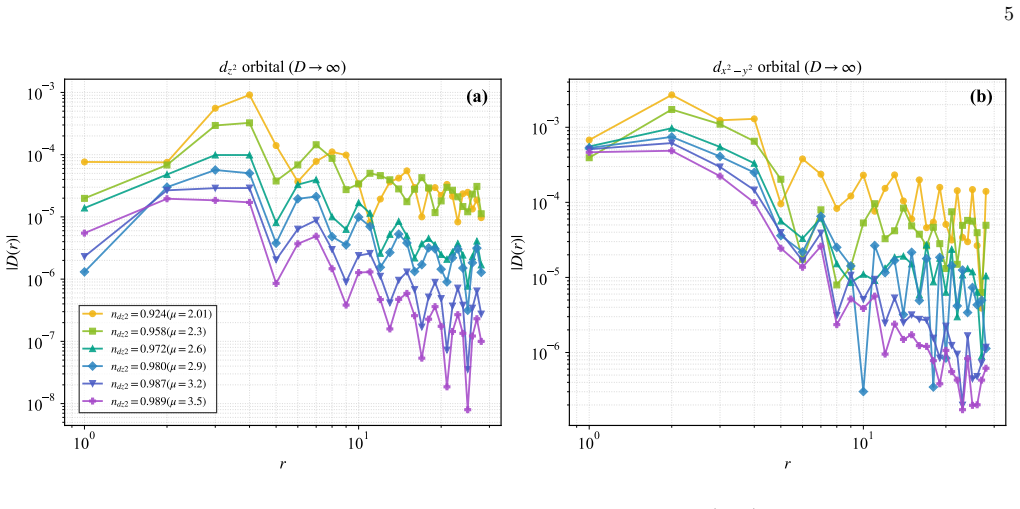
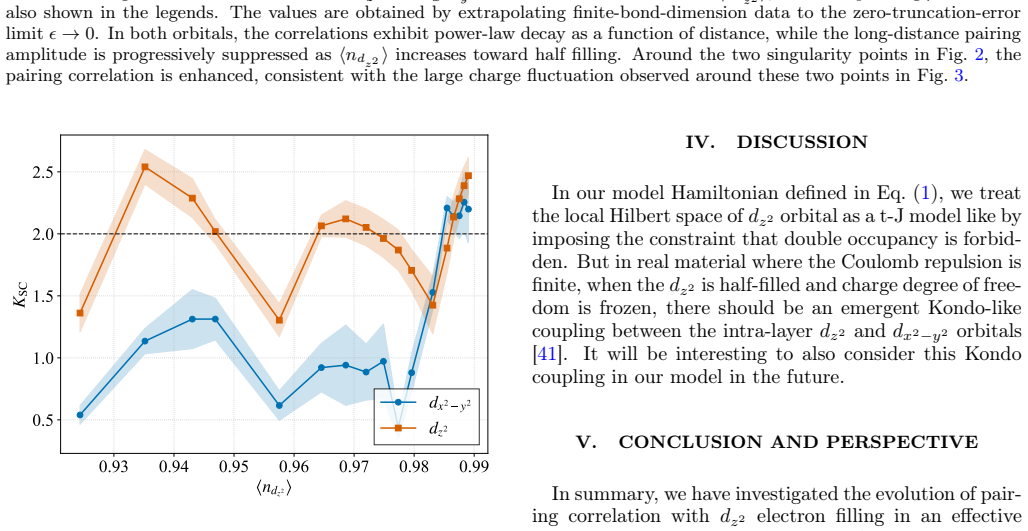
Systematic DMRG calculations on the effective bilayer two-orbital model show a pronounced suppression of superconducting correlations as the 3d_z2 orbital filling approaches half-filling. The results demonstrate that greater itinerancy of the 3d_z2 orbital is favorable for pairing, while pairing correlations are enhanced in regions of large charge fluctuations, pointing to a competition between charge order and superconductivity.
What carries the argument
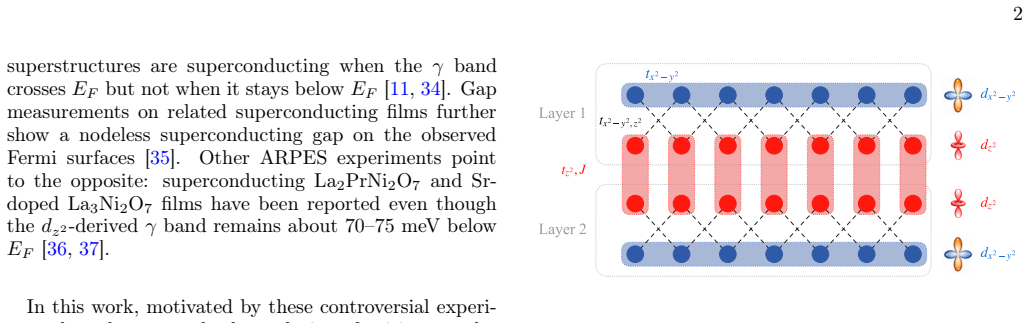
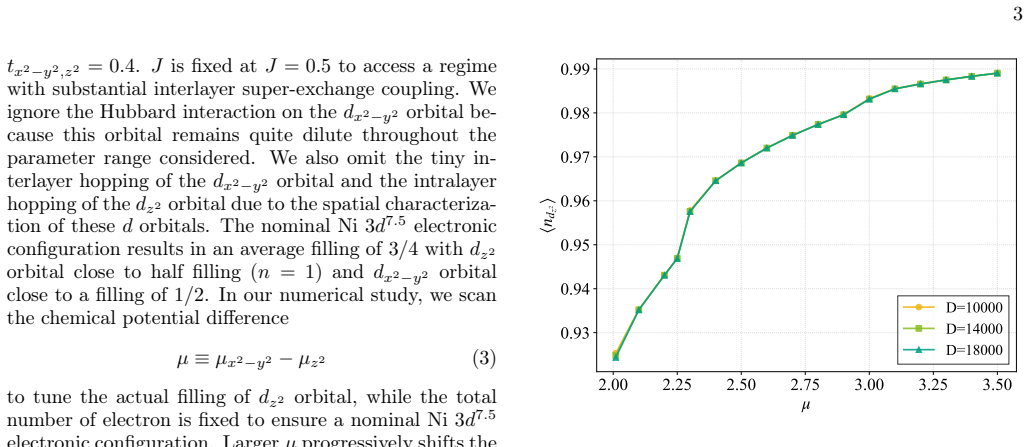
Density-matrix renormalization group simulations on a minimal one-dimensional bilayer two-orbital model with controlled variation of 3d_z2 electron filling from 1/12 doping to half-filling.
If this is right
- Superconducting correlations are suppressed near half-filling of the 3d_z2 orbital.
- Pairing correlations increase in regions of large charge fluctuations.
- Charge-order tendencies compete with and can suppress superconductivity in the model.
- Greater itinerancy of the 3d_z2 electrons promotes the superconducting state.
Where Pith is reading between the lines
- If the trend persists in two-dimensional calculations, experiments that enlarge the 3d_z2 Fermi pocket should raise the superconducting transition temperature.
- The reported competition suggests that pressure or doping windows that avoid charge-ordered phases could optimize superconductivity.
- The one-dimensional results leave open whether interlayer or in-plane charge fluctuations dominate the competition in the real material.
Load-bearing premise
The effective bilayer two-orbital model with its chosen hoppings and interactions, together with the one-dimensional geometry, accurately captures the pairing physics of the real quasi-two-dimensional pressurized material.
What would settle it
A DMRG or experimental result showing that pairing correlations strengthen rather than weaken as 3d_z2 filling approaches half-filling would falsify the central claim.
Figures
read the original abstract
The discovery of high-${T_c}$ superconductivity in pressurized bilayer nickelate La$_3$Ni$_2$O$_7$ presents a new arena for exploring unconventional pairing mechanisms. A pivotal yet unresolved issue is the specific role of the $3d_{z^{2}}$ orbital of Ni. While its inter-layer super-exchange antiferromagnetic coupling is widely considered crucial for superconductivity, the role of its itinerancy remains undetermined. Early studies showed that the superconductivity is accompanied by the emergence of a small Fermi pocket of the $3d_{z^{2}}$ orbitals. However, recent experiments show controversial results on the role of the $3d_{z^{2}}$ Fermi pocket on superconductivity. Motivated by these experimental results, we investigate an effective bilayer two-orbital model for La$_3$Ni$_2$O$_7$ using density-matrix renormalization group (DMRG) on a minimal one-dimensional geometry. By systematically varying the $3d_{z^{2}}$ orbital filling from $1/12$ doping to half-filling, we observe a pronounced suppression of superconducting correlations near half-filling. Our results demonstrate the itinerancy of $3d_{z^{2}}$ orbital is favorable for the pairing in the bilayer two-orbital model for La$_3$Ni$_2$O$_7$. Moreover, we observe that the pairing correlation is enhanced in regions where charge fluctuations are large, suggesting a competition between charge order and superconductivity in the model.
Editorial analysis
A structured set of objections, weighed in public.
Referee Report
Summary. The paper studies the role of 3d_z2 orbital filling and itinerancy in an effective bilayer two-orbital Hubbard-like model for pressurized La3Ni2O7. Using DMRG on a minimal 1D chain geometry, the authors vary the 3d_z2 filling from 1/12 doping to half-filling and report a pronounced suppression of superconducting (pairing) correlations near half-filling. They conclude that 3d_z2 itinerancy favors pairing and that pairing correlations are enhanced where charge fluctuations are large, implying competition between charge order and superconductivity.
Significance. If the reported filling dependence is robust, the work would provide numerical evidence that the small 3d_z2 Fermi pocket observed in some experiments is beneficial for superconductivity in La3Ni2O7, helping to resolve the ongoing debate on the orbital's role beyond its interlayer superexchange. The additional observation linking pairing to charge fluctuations offers a concrete suggestion for the interplay of orders in the model.
major comments (1)
- [Abstract / Methods] Abstract and model section: The central claim that 3d_z2 itinerancy favors pairing rests on DMRG results obtained exclusively in a minimal 1D geometry. In 1D, pairing correlations are algebraic and can be strongly modified by umklapp scattering and charge-density-wave tendencies that are absent or renormalized differently in the quasi-2D material; no independent check (e.g., comparison to ladder or 2D calculations, or finite-size scaling that isolates geometry effects) is indicated to establish that the observed suppression near half-filling survives in higher dimensions.
minor comments (2)
- [Abstract] Abstract: No error bars, bond-dimension convergence data, or truncation-error estimates are mentioned for the DMRG pairing correlations, making it difficult to assess the statistical significance of the reported suppression near half-filling.
- [Model definition] The manuscript should clarify how the effective bilayer two-orbital parameters (hopping and interaction strengths) were chosen and whether they remain representative across the full range of 3d_z2 fillings studied.
Simulated Author's Rebuttal
We thank the referee for the careful reading and the substantive comment on the dimensionality of our calculations. We respond point-by-point below.
read point-by-point responses
-
Referee: [Abstract / Methods] Abstract and model section: The central claim that 3d_z2 itinerancy favors pairing rests on DMRG results obtained exclusively in a minimal 1D geometry. In 1D, pairing correlations are algebraic and can be strongly modified by umklapp scattering and charge-density-wave tendencies that are absent or renormalized differently in the quasi-2D material; no independent check (e.g., comparison to ladder or 2D calculations, or finite-size scaling that isolates geometry effects) is indicated to establish that the observed suppression near half-filling survives in higher dimensions.
Authors: We agree that the 1D geometry imposes limitations: algebraic decay, umklapp scattering, and CDW tendencies can differ from quasi-2D behavior. The minimal 1D chain was selected because it permits controlled, high-accuracy DMRG access to long-distance pairing and charge correlations in the two-orbital bilayer model, which remains computationally prohibitive in 2D. The suppression near half-filling is tied to the reduction in charge fluctuations, a mechanism that is physically motivated by the material parameters and should be qualitatively robust. We will revise the manuscript to add an explicit paragraph in the discussion section acknowledging these 1D-specific caveats, clarifying that the reported trend is within the 1D model, and noting that ladder or 2D studies would be needed to confirm survival in higher dimensions. revision: partial
- Direct numerical verification of the filling dependence in 2D or quasi-2D geometries, as DMRG for the two-orbital bilayer model in higher dimensions exceeds current computational resources.
Circularity Check
No circularity: direct DMRG simulation of model parameters
full rationale
The paper reports DMRG results on a fixed bilayer two-orbital Hamiltonian while varying 3d_z2 filling; the observed suppression of pairing correlations near half-filling and the link to charge fluctuations are direct numerical outputs, not quantities fitted from the same data or defined in terms of themselves. No self-citation chain, ansatz smuggling, or uniqueness theorem is invoked to justify the central claims. The 1D geometry is an explicit modeling choice whose limitations are external to any internal reduction.
Axiom & Free-Parameter Ledger
free parameters (2)
- 3d_z2 orbital filling
- model interaction and hopping strengths
axioms (2)
- domain assumption The bilayer two-orbital model Hamiltonian accurately represents the low-energy physics of pressurized La3Ni2O7.
- domain assumption DMRG on a minimal 1D geometry captures the qualitative pairing and charge fluctuation trends of the quasi-2D system.
Forward citations
Cited by 1 Pith paper
-
What Does the Single-Particle Spectrum Imply on the Pairing Nature and Pairing Mechanism in La$_3$Ni$_2$O$_7$?
Symmetry analysis shows orbital hybridization vanishes along the BZ diagonal, allowing the gap on alpha/beta pockets to test d_x2-y2 vs d_z2 dominance; experiments and RPA favor Hund's rule mechanism with full gap.
Reference graph
Works this paper leans on
-
[1]
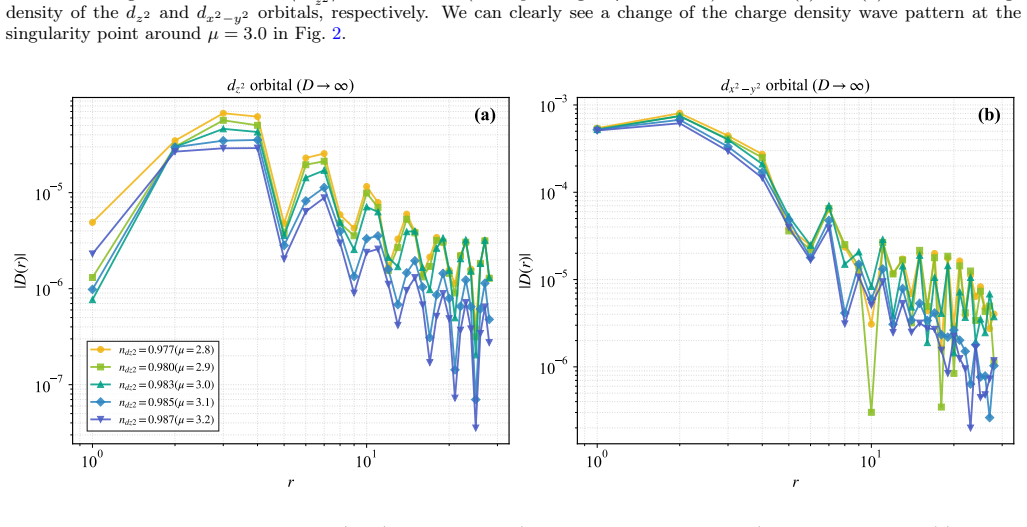
Moreover, the two singularity points in Fig
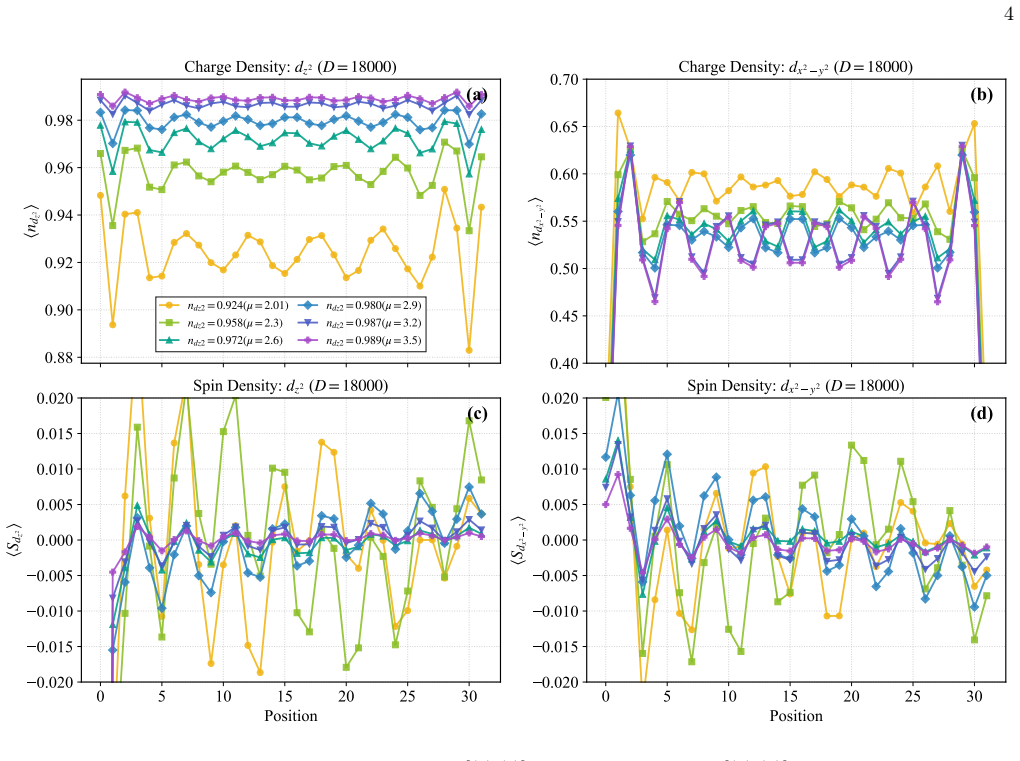
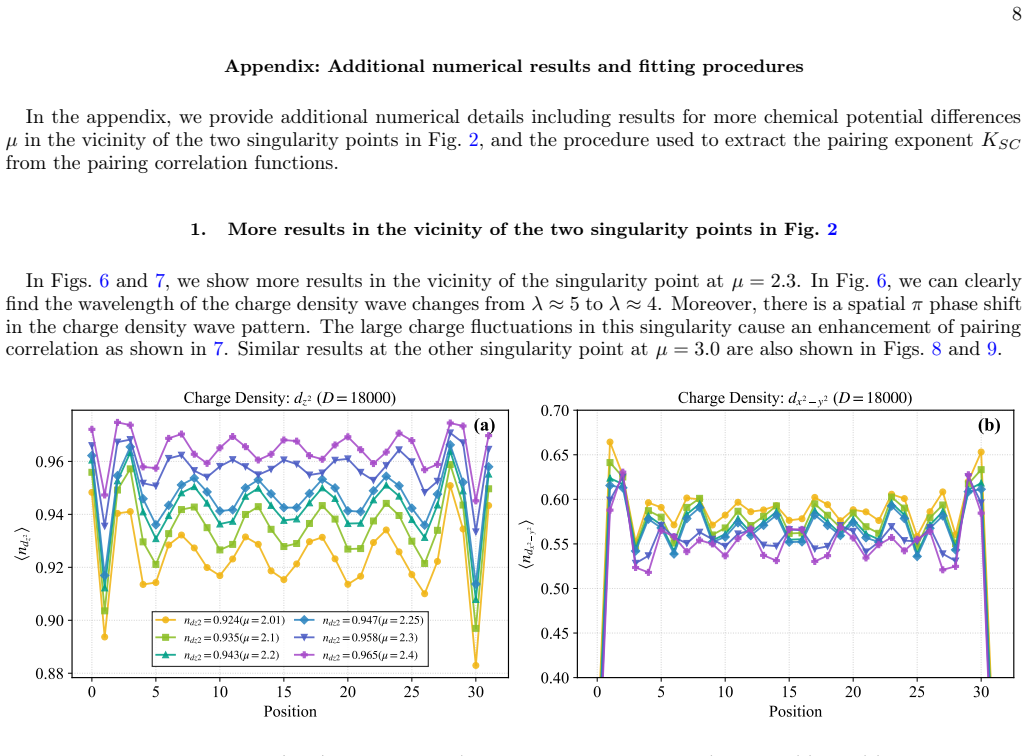
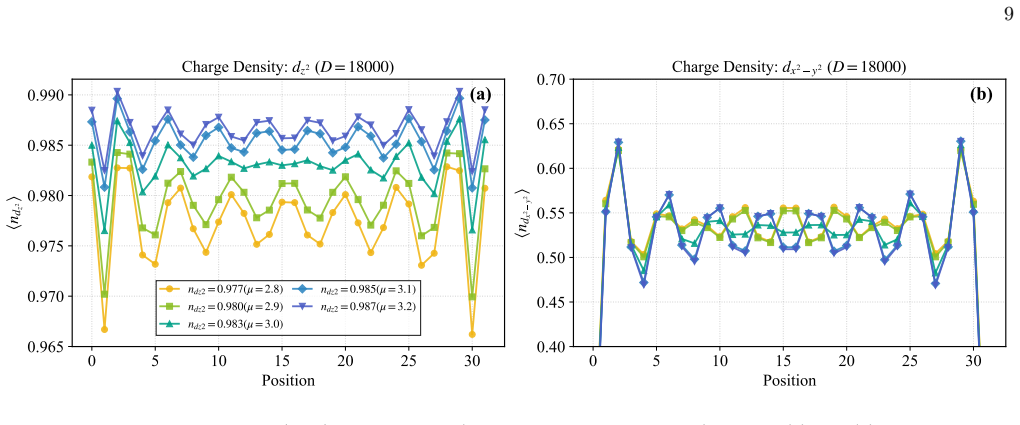
Overall, with the increase of filling ofdz2 orbital, the strength of the charge density waves is enhanced (sup- pressed) in the dx2−y2 (dz2) orbital. Moreover, the two singularity points in Fig. 2 mark the positions where the charge density wave pattern is changed. Around the first singularity point with µ = 2 .3 and ⟨ndz2 ⟩ ≈ 0.958, the wave-length of ch...
-
[2]
H. Sun, M. Huo, X. Hu, J. Li, Z. Liu, Y. Han, L. Tang, Z. Mao, P. Yang, B. Wang, J. Cheng, D.-X. Yao, G.-M. Zhang, and M. Wang, Signatures of superconductivity near 80 K in a nickelate under high pressure, Nature621, 493 (2023)
2023
-
[3]
D. Li, K. Lee, B. Y. Wang, M. Osada, S. Crossley, H. R. Lee, Y. Cui, Y. Hikita, and H. Y. Hwang, Supercon- ductivity in an infinite-layer nickelate, Nature572, 624 (2019)
2019
-
[4]
Osada, B
M. Osada, B. Y. Wang, B. H. Goodge, S. P. Harvey, K. Lee, D. Li, L. F. Kourkoutis, and H. Y. Hwang, Nick- elate superconductivity without rare-earth magnetism: (La,Sr)NiO2, Advanced Materials33, 2104083 (2021)
2021
-
[5]
S. W. Zeng, C. J. Li, L. E. Chow, Y. Cao, Z. T. Zhang, C. S. Tang, X. M. Yin, Z. S. Lim, J. X. Hu, P. Yang, andAriando,Superconductivityininfinite-layernickelate La1−xCaxNiO2 thin films, Science Advances8, eabl9927 (2022)
2022
-
[6]
J. G. Bednorz and K. A. Müller, Possible high-Tc super- conductivity in the Ba-La-Cu-O system, Zeitschrift für Physik B Condensed Matter64, 189 (1986)
1986
-
[7]
Kamihara, T
Y. Kamihara, T. Watanabe, M. Hirano, and H. Hosono, Iron-basedlayeredsuperconductorLa[O 1−xFx]FeAs( x = 0.05–0.12) with Tc = 26 K , Journal of the American Chemical Society130, 3296 (2008)
2008
-
[8]
Wang, H.-H
M. Wang, H.-H. Wen, T. Wu, D.-X. Yao, and T. Xiang, Normal and superconducting properties of La 3Ni2O7, Chinese Physics Letters41, 077402 (2024)
2024
-
[9]
Y. Wang, K. Jiang, J. Ying, T. Wu, J. Cheng, J. Hu, and X. Chen, Recent progress in nickelate superconductors, National Science Review12, nwaf373 (2025)
2025
-
[10]
E. K. Ko, Y. Yu, Y. Liu, L. Bhatt, J. Li, V. Thampy, C.-T. Kuo, B. Y. Wang, Y. Lee, K. Lee, J.-S. Lee, B. H. Goodge, D. A. Muller, and H. Y. Hwang, Signa- tures of ambient pressure superconductivity in thin film La3Ni2O7, Nature638, 935 (2025)
2025
-
[11]
G. Zhou, W. Lv, H. Wang, Z. Nie, Y. Chen, Y. Li, H. Huang, W.-Q. Chen, Y.-J. Sun, Q.-K. Xue, and Z. Chen, Ambient-pressure superconductivity onset above 40 K in (La,Pr) 3Ni2O7 films, Nature 640, 641 (2025)
2025
-
[12]
Z. Nie, Y. Li, W. Lv, L. Xu, Z. Jiang, P. Fu, G. Zhou, W. Song, Y. Chen, H. Wang, H. Huang, J. Lin, J.-F. Jia, D. Shen, P. Li, Q.-K. Xue, and Z. Chen, Supercon- ductivity and electronic structures of nickelate thin film superstructures, Nature652, 628 (2026)
2026
-
[13]
Z. Luo, X. Hu, M. Wang, W. Wu, and D.-X. Yao, Bilayer two-orbital model of La3Ni2O7 under pressure, Physical Review Letters131, 126001 (2023)
2023
-
[14]
Christiansson, F
V. Christiansson, F. Petocchi, and P. Werner, Correlated electronicstructureofLa 3Ni2O7 underpressure,Physical Review Letters131, 206501 (2023)
2023
-
[15]
Sakakibara, N
H. Sakakibara, N. Kitamine, M. Ochi, and K. Kuroki, Possible high-Tc superconductivity in La3Ni2O7 under high pressure through manifestation of a nearly half-filled bilayer hubbard model, Physical Review Letters 132, 106002 (2024)
2024
-
[16]
Y. Shen, M. Qin, and G.-M. Zhang, Effective bi- layer model hamiltonian and density-matrix renormal- ization group study for the high-Tc superconductivity in La3Ni2O7 under high pressure, Chinese Physics Letters 40, 127401 (2023)
2023
-
[17]
M. Gao, Z. Lu, and T. Xiang, Finding high-temperature superconductors by metallizing theσ-bonding electrons, Physics 44, 421 (2015)
2015
-
[18]
Y. Gu, C. Le, Z. Yang, X. Wu, and J. Hu, Effective model and pairing tendency in the bilayer Ni-based supercon- ductorLa 3Ni2O7,PhysicalReview B 111,174506 (2025)
2025
-
[19]
Lechermann, J
F. Lechermann, J. Gondolf, S. Bötzel, and I. M. Eremin, Electroniccorrelationsandsuperconductinginstabilityin La3Ni2O7 under high pressure, Physical Review B108, L201121 (2023)
2023
-
[20]
Zhang, L.-F
Y. Zhang, L.-F. Lin, A. Moreo, and E. Dagotto, Elec- tronic structure, dimer physics, orbital-selective behav- ior, and magnetic tendencies in the bilayer nickelate su- perconductor La3Ni2O7 under pressure, Physical Review B 108, L180510 (2023)
2023
-
[21]
Q.-G. Yang, D. Wang, and Q.-H. Wang, Possibles±-wave superconductivity in La3Ni2O7, Physical Review B108, L140505 (2023)
2023
-
[22]
C. Lu, Z. Pan, F. Yang, and C. Wu, Interlayer-coupling- driven high-temperature superconductivity in La3Ni2O7 under pressure, Physical Review Letters 132, 146002 (2024)
2024
-
[23]
Yang, G.-M
Y.-f. Yang, G.-M. Zhang, and F.-C. Zhang, Interlayer va- lencebondsandtwo-componenttheoryforhigh- Tc super- conductivity of La3Ni2O7 under pressure, Physical Re- view B108, L201108 (2023)
2023
-
[24]
Su, Bilayer t-j-j⊥ model and magnetically mediated pairing in the pressurized nickelate La3Ni2O7, Physical Review Letters132, 036502 (2024)
X.-Z.Qu, D.-W.Qu, J.Chen, C.Wu, F.Yang, W.Li,and G. Su, Bilayer t-j-j⊥ model and magnetically mediated pairing in the pressurized nickelate La3Ni2O7, Physical Review Letters132, 036502 (2024)
2024
-
[25]
Y. Shen, J. Huang, X. Qian, G.-M. Zhang, and M. Qin, Numerical study of the bilayer two-orbital model for La3Ni2O7 on a plaquette ladder, Physical Review B111, L180508 (2025)
2025
-
[26]
W.-Y. Chen, C.-Q. Chen, M. Wang, S.-S. Gong, and D.- X. Yao, Superconductivity of bilayer two-orbital Hub- 7 bard model for La3Ni2O7 under high pressure (2025), arXiv:2511.01801 [cond-mat.supr-con]
- [27]
-
[28]
Oh and Y.-H
H. Oh and Y.-H. Zhang, Type-IIt-j model and shared su- perexchange coupling from hund’s rule in superconduct- ing La3Ni2O7, Physical Review B108, 174511 (2023)
2023
-
[29]
Jiang, Z
K. Jiang, Z. Wang, and F.-C. Zhang, High-temperature superconductivity in La3Ni2O7, Chinese Physics Letters 41, 017402 (2024)
2024
-
[30]
Fan, J.-F
Z. Fan, J.-F. Zhang, B. Zhan, D. Lv, X.-Y. Jiang, B. Nor- mand, and T. Xiang, Superconductivity in nickelate and cuprate superconductors with strong bilayer coupling, Physical Review B110, 024514 (2024)
2024
-
[31]
Liu, J.-W
Y.-B. Liu, J.-W. Mei, F. Ye, W.-Q. Chen, and F. Yang, s±-wave pairing and the destructive role of apical-oxygen deficiencies in La3Ni2O7 under pressure, Physical Review Letters 131, 236002 (2023)
2023
-
[32]
Qu, D.-W
X.-Z. Qu, D.-W. Qu, X.-W. Yi, W. Li, and G. Su, Hund’s rule, interorbital hybridization, and high-Tc supercon- ductivity in the bilayer nickelate La3Ni2O7, Physical Re- view B112, L161101 (2025)
2025
-
[33]
H. Yang and Y.-H. Zhang, Magnetism and superconduc- tivity in bilayer nickelate (2025), arXiv:2512.13793 [cond- mat.str-el]
-
[34]
Y. Zhang, L.-F. Lin, T. A. Maier, and E. Dagotto, Su- perconductivity in Ruddlesden–Popper nickelates: a re- view of recent progress, focusing on thin films (2026), arXiv:2604.18385 [cond-mat.supr-con]
work page internal anchor Pith review Pith/arXiv arXiv 2026
-
[35]
P. Li, G. Zhou, W. Lv, Y. Li, C. Yue, H. Huang, L. Xu, J. Shen, Y. Miao, W. Song, Z. Nie, Y. Chen, H. Wang, W. Chen, Y. Huang, Z.-H. Chen, T. Qian, J. Lin, J. He, Y.-J. Sun, Z. Chen, and Q.-K. Xue, Angle-resolved photoemission spectroscopy of supercon- ducting (La,Pr)3Ni2O7/SrLaAlO4 heterostructures, Na- tional Science Review12, nwaf205 (2025)
2025
-
[36]
J. Shen, G. Zhou, Y. Miao, P. Li, Z. Ou, Y. Chen, Z. Wang, R. Luan, H. Sun, Z. Feng, X. Yong, Y. Li, L. Xu, W. Lv, Z. Nie, H. Wang, H. Huang, Y.-J. Sun, Q.-K.Xue, J.He,andZ.Chen,Nodelesssuperconducting gap and electron-boson coupling in (La,Pr,Sm) 3Ni2O7 films,Science,eadw8329(2026),arXiv:2502.17831[cond- mat.supr-con]
work page internal anchor Pith review arXiv 2026
-
[37]
B. Y. Wang, Y. Zhong, S. Abadi, Y. Liu, Y. Yu, X. Zhang, Y.-M. Wu, R. Wang, J. Li, Y. Tarn, E. K. Ko, V. Thampy, M. Hashimoto, D. Lu, Y. S. Lee, T. P. Dev- ereaux, C. Jia, H. Y. Hwang, and Z.-X. Shen, Electronic structure of compressively strained thin film La2PrNi2O7 (2025), arXiv:2504.16372 [cond-mat.supr-con]
- [38]
-
[39]
S. R. White, Density matrix formulation for quantum renormalization groups, Physical Review Letters 69, 2863 (1992)
1992
-
[40]
S. R. White, Density-matrix algorithms for quantum renormalization groups, Physical Review B 48, 10345 (1993)
1993
-
[41]
Interlayer hybridization enables superconductivity in bilayer nickelates
S. Zhang, M. Zhang, Q. Luo, Z. Tao, H.-Y. Huang, K. Li, G. Channagowdra, J. Li, J. Fu, D.-J. Huang, Y. Xie, Y. Lu, and Y. Peng, Interlayer hybridization enables superconductivity in bilayer nickelates (2026), arXiv:2604.14701 [cond-mat.supr-con]
work page internal anchor Pith review Pith/arXiv arXiv 2026
-
[42]
Khaliullin and J
G. Khaliullin and J. Chaloupka, Orbital order and su- perconductivity in bilayer nickelate compounds, Physical Review B113, L041115 (2026). 8 Appendix: Additional numerical results and fitting procedures In the appendix, we provide additional numerical details including results for more chemical potential differences µ in the vicinity of the two singulari...
2026
-
[43]
2 In Figs
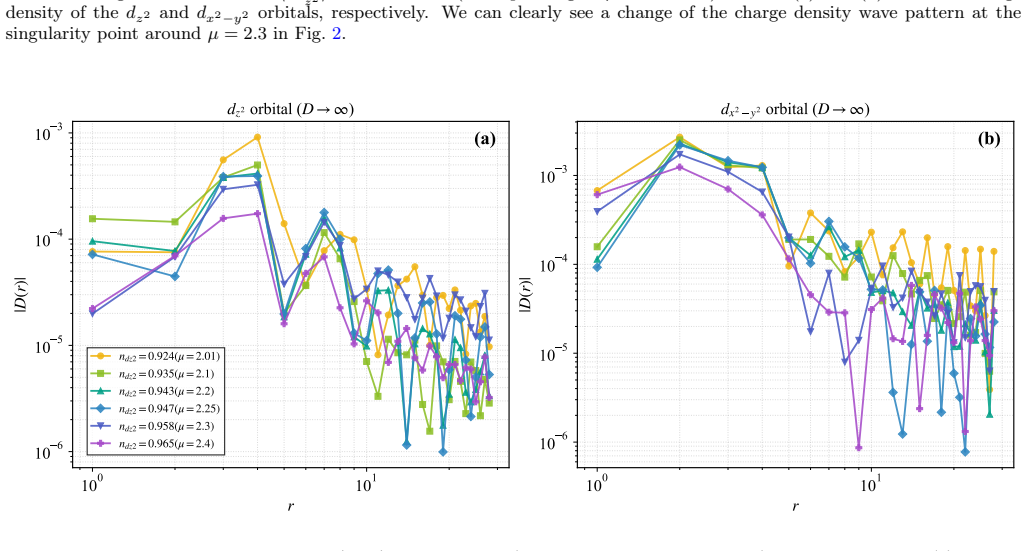
More results in the vicinity of the two singularity points in Fig. 2 In Figs. 6 and 7, we show more results in the vicinity of the singularity point atµ = 2.3. In Fig. 6, we can clearly find the wavelength of the charge density wave changes fromλ ≈ 5 to λ ≈ 4. Moreover, there is a spatialπ phase shift in the charge density wave pattern. The large charge f...
-
[44]
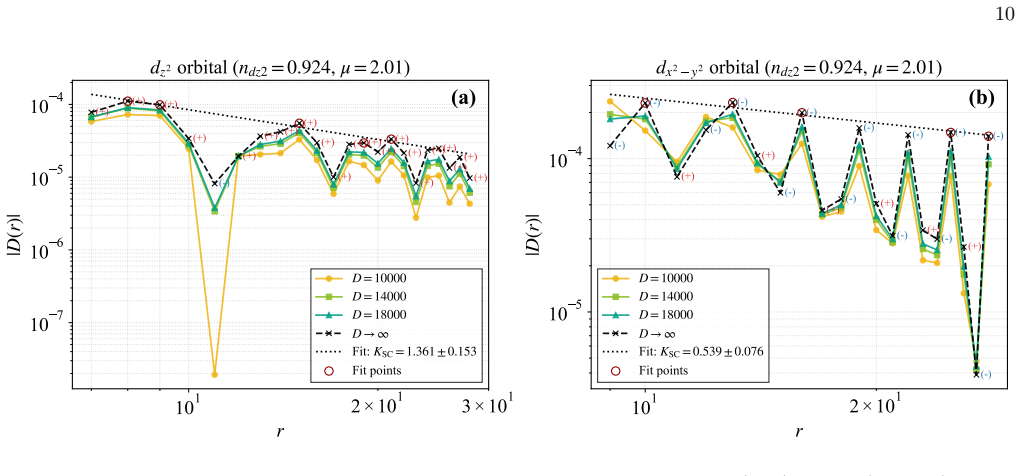
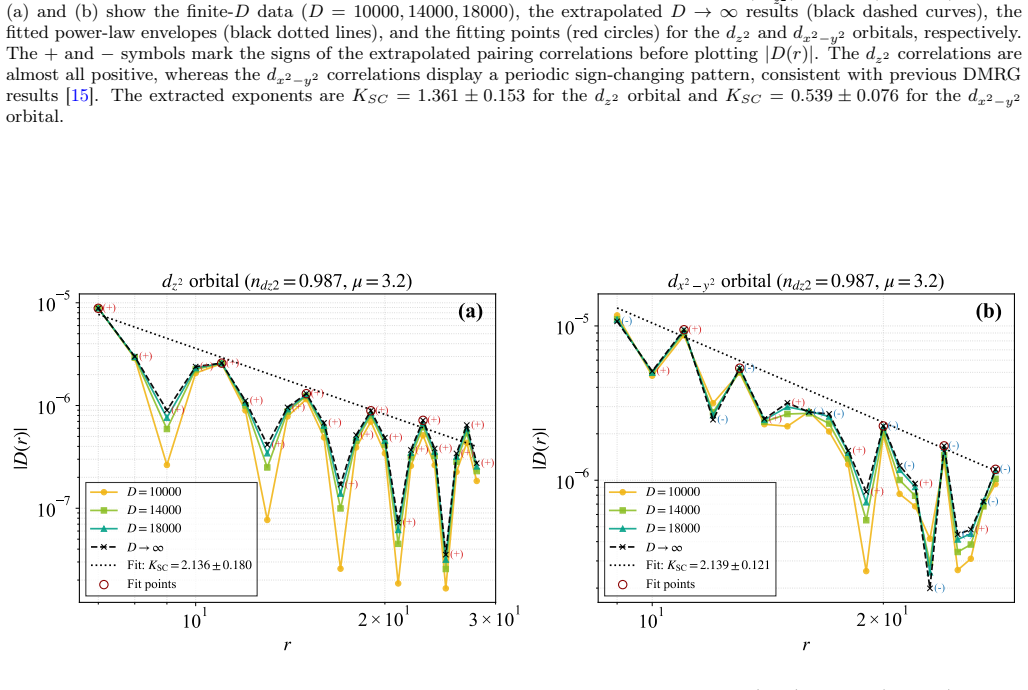
Extrapolation to D → ∞ and extraction ofKSC In DMRG calculations, we push the bond dimension to as large as18000 and the truncation error is at the order of 10−6. To further reduce the finite bond dimension error, we also perform finite truncation error extrapolation for the pairing correlation results as shown for two representativeµ values (µ = 2.01 and...
discussion (0)
Sign in with ORCID, Apple, or X to comment. Anyone can read and Pith papers without signing in.