REVIEW 1 major objections 17 references
RobQMUSIC replaces the l2-norm with an l1-norm in phase retrieval to achieve robust DoA estimation from Rydberg atomic receivers despite outliers.
Reviewed by Pith at T0; open to challenge. T0 means a machine referee read the full paper against a public rubric. the ladder, T0–T4 →
RobQMUSIC replaces the l2-norm phase retrieval in Quantum-MUSIC with an l1-norm formulation solved by IRLS to achieve robust DoA estimation under outlier contamination.
T0 review reviewed 2026-06-29 challenge →
load-bearing objection RobQMUSIC swaps l2 for l1-norm phase retrieval solved by embedded IRLS in Quantum-MUSIC to gain outlier robustness in Rydberg DoA estimation, but the simulation evidence stays thin on details. the 1 major comments →
Robust Quantum-MUSIC for DoA Estimation Using Rydberg Atomic Receiver Arrays
The pith
A machine-rendered reading of the paper's core claim, the machinery that carries it, and where it could break.
The reading
Core claim
By formulating the phase-retrieval step as a weighted l1-norm problem and solving it with IRLS embedded in alternating minimization, RobQMUSIC recovers phase information robustly from magnitude-only observations in Rydberg receivers, enabling reliable MUSIC-based DoA estimation even under outlier contamination.
What carries the argument
The l1-norm phase-retrieval problem solved via IRLS within the alternating minimization framework for phase recovery prior to MUSIC.
Load-bearing premise
That the l1-norm formulation solved by IRLS will correctly handle outlier measurements in the phase retrieval without introducing new modeling errors.
What would settle it
A set of simulations or experiments showing that at high outlier contamination levels, RobQMUSIC's DoA estimation error increases to match or exceed that of Quantum-MUSIC.
If this is right
- RobQMUSIC achieves near-identical DoA accuracy to Quantum-MUSIC under ideal conditions.
- It maintains performance over wide ranges of outlier levels where Quantum-MUSIC fails.
- The method requires no increase in structural complexity relative to the baseline.
Where Pith is reading between the lines
- Similar l1-norm robustness techniques could apply to other phase-retrieval tasks in sensing arrays.
- Hardware faults or interference in atomic receivers might be mitigated without redesigning the sensor array.
Editorial analysis
A structured set of objections, weighed in public.
Referee Report
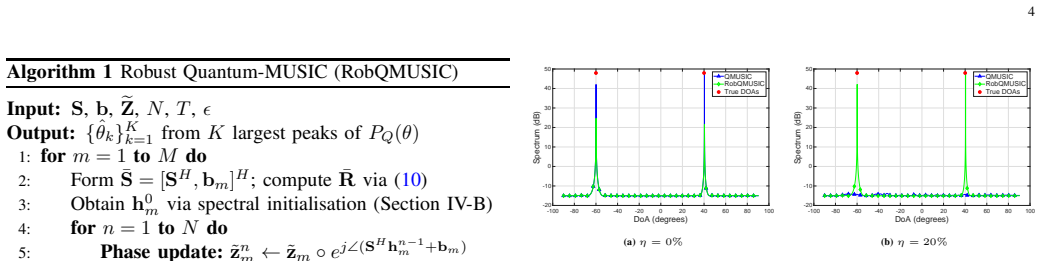
Summary. The manuscript proposes Robust Quantum-MUSIC (RobQMUSIC) for direction-of-arrival estimation with Rydberg atomic receiver arrays. It replaces the ℓ₂-norm phase-retrieval step of the prior Quantum-MUSIC algorithm with an ℓ₁-norm formulation solved via an embedded Iteratively Reweighted Least Squares (IRLS) procedure inside the alternating-minimization loop. The central claim is that the modification yields near-identical accuracy under ideal conditions while remaining robust across a wide range of outlier contamination levels at which the baseline fails.
Significance. If the simulation evidence holds, the work supplies a low-complexity robustness fix for a practical limitation of quantum wireless sensing. The approach re-uses an established IRLS solver and therefore adds no structural overhead, which is a concrete engineering advantage for hardware-constrained Rydberg arrays.
major comments (1)
- [Simulation results (abstract and results section)] The abstract states that 'simulation results demonstrate' near-identical accuracy and robustness over 'a wide range of outlier contamination levels,' yet supplies no information on Monte-Carlo trial count, error-bar reporting, the precise outlier model (e.g., fraction, distribution, or saturation mechanism), or the exact baseline implementations. Because these simulations constitute the sole empirical support for the central robustness claim, their omission is load-bearing.
Simulated Author's Rebuttal
We thank the referee for highlighting the need for greater transparency in the simulation methodology. The comment correctly identifies that the current presentation of results lacks sufficient detail to fully support the robustness claims, and we will address this directly in revision.
read point-by-point responses
-
Referee: [Simulation results (abstract and results section)] The abstract states that 'simulation results demonstrate' near-identical accuracy and robustness over 'a wide range of outlier contamination levels,' yet supplies no information on Monte-Carlo trial count, error-bar reporting, the precise outlier model (e.g., fraction, distribution, or saturation mechanism), or the exact baseline implementations. Because these simulations constitute the sole empirical support for the central robustness claim, their omission is load-bearing.
Authors: We agree that these parameters are essential for reproducibility and for allowing readers to assess the strength of the robustness claims. In the revised manuscript we will (i) state the Monte-Carlo trial count, (ii) report error bars (standard deviation across trials), (iii) give the precise outlier model including contamination fraction, distribution, and saturation mechanism, and (iv) specify the exact baseline implementations (including any parameter settings). These additions will be placed in both the abstract (where space permits) and the dedicated simulation section. No other changes to the algorithmic contribution or conclusions are required. revision: yes
Circularity Check
No significant circularity; derivation is an independent algorithmic modification
full rationale
The paper's central contribution is the substitution of an ℓ2-norm phase-retrieval step (from prior Quantum-MUSIC) with an ℓ1-norm formulation solved via embedded IRLS. This change is presented as a direct, non-circular engineering modification whose robustness is then checked by simulation; no equation reduces to a self-definition, no fitted parameter is relabeled as a prediction, and no load-bearing premise rests on a self-citation chain. The derivation chain therefore remains self-contained against external benchmarks.
Axiom & Free-Parameter Ledger
Cite this review
Pith. "Pith review of Robust Quantum-MUSIC for DoA Estimation Using Rydberg Atomic Receiver Arrays." pith.science (2026). https://pith.science/paper/FSESVKJI
@misc{pith2026260525688,
  author       = {Pith},
  title        = {Pith review of: Robust Quantum-MUSIC for DoA Estimation Using Rydberg Atomic Receiver Arrays},
  year         = {2026},
  howpublished = {\url{https://pith.science/paper/FSESVKJI}},
  note         = {Machine review of arXiv:2605.25688}
}
read the original abstract
Quantum wireless sensing using Rydberg atomic receivers enables high-sensitivity signal acquisition direction-of-arrival (DoA) estimation. However, it suffers from a fundamental limitation, where only the magnitude of the received signal is observable. The recently proposed Quantum-MUSIC algorithm addresses this problem by recovering phase information through alternating minimization and subsequently applying the MUSIC algorithm for DoA estimation. However, the existing approach relies on an $\ell_2$-norm phase retrieval step, making it highly sensitive to outlier measurements produced by hardware faults, sensor saturation, or adversarial interference. In this letter, we propose a \emph{Robust Quantum-MUSIC} (RobQMUSIC) framework that replaces the $\ell_2$-norm with an $\ell_1$-norm formulation. The resulting weighted phase-retrieval problem is solved efficiently via an Iteratively Reweighted Least Squares (IRLS) scheme embedded within the alternating minimization loop, requiring no increase in structural complexity relative to the baseline algorithm. Simulation results demonstrate that RobQMUSIC achieves near-identical DoA estimation accuracy to Quantum-MUSIC under ideal conditions, while maintaining robust performance over a wide range of outlier contamination levels at which Quantum-MUSIC fails entirely.
Figures



Reference graph
Works this paper leans on
-
[1]
Harnessing Rydberg Atomic Receivers: From Quantum Physics to Wireless Communications
Y . Chen, X. Guo, C. Y uen, Y . Zhao, Y . L. Guan, C. M. S. See, M. D´ ebbah, and L. Hanzo, “Harnessing Rydberg Atomic Receiv ers: From Quantum Physics to Wireless Communications,” 2026. [O nline]. Available: https://arxiv.org/abs/2501.11842
work page internal anchor Pith review Pith/arXiv arXiv 2026
-
[2]
Rydberg Atomic RF Sensor-ba sed Quantum Radar,
S. Banerjee and N. K. Kundu, “Rydberg Atomic RF Sensor-ba sed Quantum Radar,” in 2026 IEEE Applied Sensing Conference (APSCON) , 2026, pp. 1–4
2026
-
[3]
An Atomic Re ceiver for AM and FM Radio Communication,
D. A. Anderson, R. E. Sapiro, and G. Raithel, “An Atomic Re ceiver for AM and FM Radio Communication,” IEEE Transactions on Antennas and Propagation, vol. 69, no. 5, pp. 2455–2462, 2021
2021
-
[4]
Ry- dberg Atom Electric Field Sensors for Communications and Se nsing,
C. T. Fancher, D. R. Scherer, M. C. S. John, and B. L. S. Marl ow, “Ry- dberg Atom Electric Field Sensors for Communications and Se nsing,” IEEE Transactions on Quantum Engineering , vol. 2, pp. 1–13, 2021
2021
-
[5]
Determining the Angle-of-Arrival of a Radio-Fr equency Source with a Rydberg Atom-Based Sensor,
A. K. Robinson, N. Prajapati, D. Senic, M. T. Simons, and C . L. Holloway, “Determining the Angle-of-Arrival of a Radio-Fr equency Source with a Rydberg Atom-Based Sensor,” Applied Physics Letters , vol. 118, no. 11, p. 114001, 2021
2021
-
[6]
Digital Beamform ing and Receiving Array Research Based on Rydberg Field Probes,
R. Mao, Y . Lin, Y . Fu, Y . Ma, and K. Y ang, “Digital Beamform ing and Receiving Array Research Based on Rydberg Field Probes, ” IEEE Transactions on Antennas and Propagation , vol. 72, no. 2, pp. 2025– 2029, 2024
2025
-
[7]
Quantum-MUSIC: Multiple Sig nal Classification for Quantum Wireless Sensing,
H. Kim, H. Park, and S. Kim, “Quantum-MUSIC: Multiple Sig nal Classification for Quantum Wireless Sensing,” IEEE Wireless Commu- nications Letters , vol. 14, no. 6, pp. 1623–1627, 2025
2025
-
[8]
Towards Atomic MIMO Receiv ers,
M. Cui, Q. Zeng, and K. Huang, “Towards Atomic MIMO Receiv ers,” IEEE Journal on Selected Areas in Communications , vol. 43, no. 3, pp. 659–673, 2025
2025
-
[9]
Multiple emitter location and signal param eter estimation,
R. Schmidt, “Multiple emitter location and signal param eter estimation,” IEEE Transactions on Antennas and Propagation , vol. 34, no. 3, pp. 276–280, 1986
1986
-
[10]
An Introduction To Compres sive Sampling,
E. J. Candes and M. B. Wakin, “An Introduction To Compres sive Sampling,” IEEE Signal Processing Magazine , vol. 25, no. 2, pp. 21–30, 2008
2008
-
[11]
Boyd and L
S. Boyd and L. V andenberghe, Convex Optimization . Cambridge University Press, 2004
2004
-
[12]
Iteratively Reweighted Least Squares Minimization for Sparse Recovery ,
I. Daubechies, R. DeV ore, M. Fornasier, and C. S. G¨ unt¨ urk, “Iteratively Reweighted Least Squares Minimization for Sparse Recovery ,” Commu- nications on Pure and Applied Mathematics , vol. 63, no. 1, pp. 1–38, 2010
2010
-
[13]
Improved Iteratively Rewe ighted Least Squares for Unconstrained Smoothed ℓq Minimization,
M.-J. Lai, Y . Xu, and W. Yin, “Improved Iteratively Rewe ighted Least Squares for Unconstrained Smoothed ℓq Minimization,” SIAM Journal on Numerical Analysis , vol. 51, no. 2, pp. 927–957, 2013
2013
-
[14]
Electric Field Measureme nt and Application Based on Rydberg Atoms,
B. Liu, L.-H. Zhang, Z.-K. Liu, Z.-Y . Zhang, Z.-H. Zhu, W . Gao, G.- C. Guo, D.-S. Ding, and B.-S. Shi, “Electric Field Measureme nt and Application Based on Rydberg Atoms,” Electromagnetic Science, vol. 1, no. 1, pp. 1–16, 2023
2023
-
[15]
Phase Retr ieval via Wirtinger Flow: Theory and Algorithms,
E. J. Cand` es, X. Li, and M. Soltanolkotabi, “Phase Retr ieval via Wirtinger Flow: Theory and Algorithms,” IEEE Transactions on Infor- mation Theory , vol. 61, no. 4, pp. 1985–2007, 2015
1985
-
[16]
ARC: an Open-Source Library for Calculating Properties of Alkal i Rydberg Atoms,
N. ˇSibali´ c, J. D. Pritchard, C. S. Adams, and K. J. Weatherill, “ARC: an Open-Source Library for Calculating Properties of Alkal i Rydberg Atoms,” Computer Physics Communications , vol. 220, pp. 319–331, 2017
2017
-
[17]
Robust Directio n-of-Arrival Estimation in the Presence of Outliers,
P . Rajpurohit, P . Babu, and P . Stoica, “Robust Directio n-of-Arrival Estimation in the Presence of Outliers,” IEEE Transactions on Aerospace and Electronic Systems , vol. 61, no. 4, pp. 10 921–10 927, 2025
2025
This paper was first reviewed by grok-4.3 on June 29, 2026.
discussion (0)
Sign in with ORCID, Apple, or X to comment. Anyone can read and Pith papers without signing in.