Near-Room-Temperature Antiferromagnetic Ordering in the Quadruple Perovskite Sr4NaRu3O12
Pith reviewed 2026-06-29 20:43 UTC · model grok-4.3
The pith
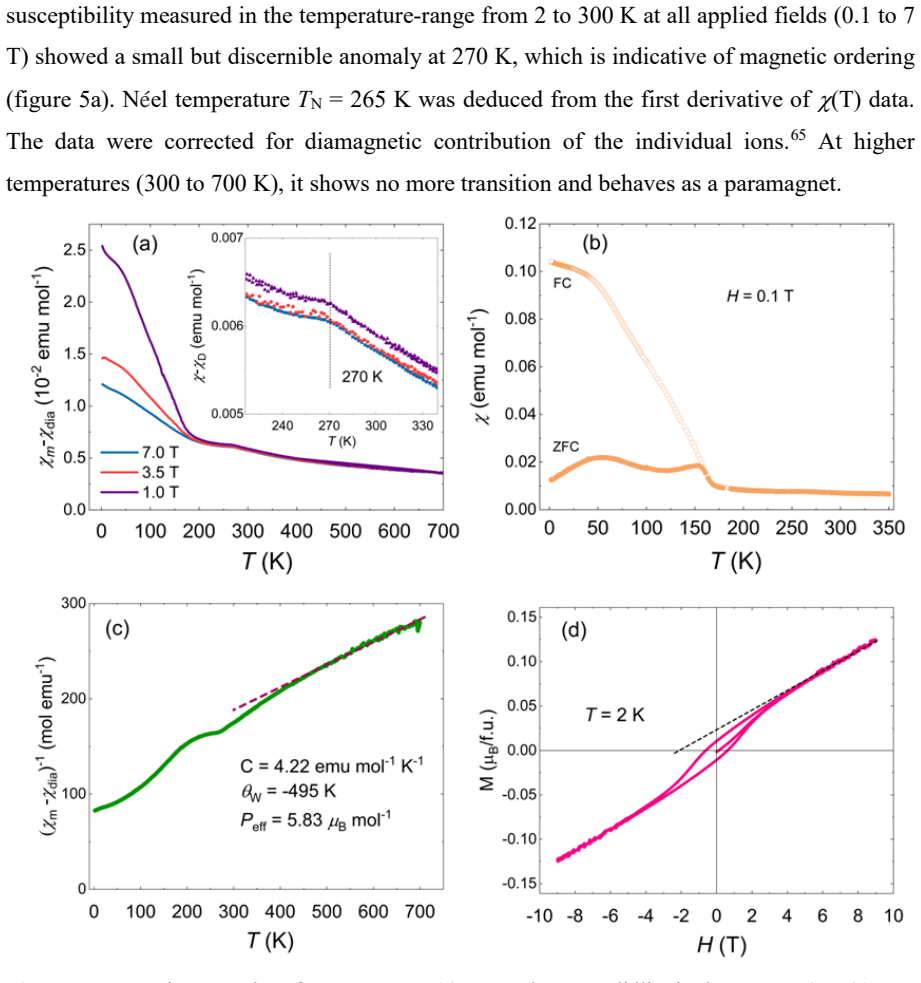
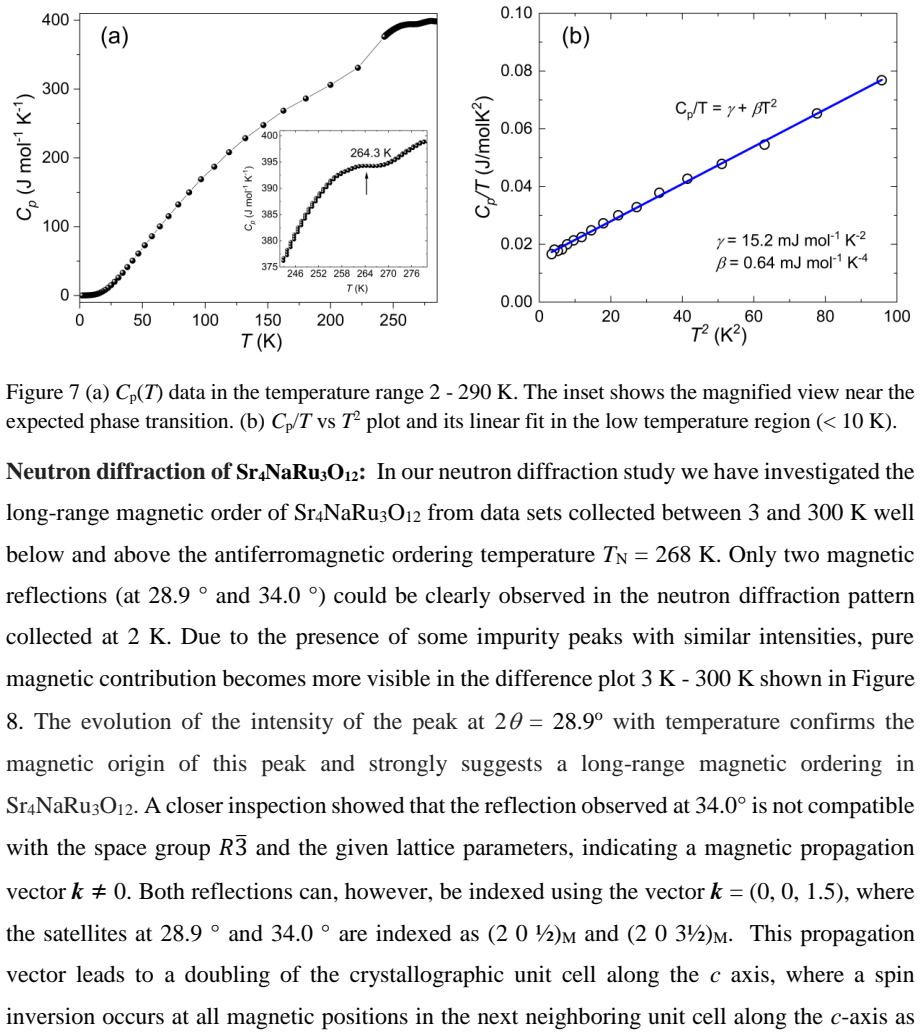
Sr4NaRu3O12 orders antiferromagnetically below 265 K with collinear Ru moments along the c axis.
A machine-rendered reading of the paper's core claim, the machinery that carries it, and where it could break.
Core claim
Sr4NaRu3O12 crystallizes in space group R-3 with Na and Ru ordered on the B sites, forming only corner-connected RuO6 and NaO6 octahedra and yielding a unit cell with a equal to 11.25 angstroms and c equal to 27.6 angstroms. It undergoes a transition to an antiferromagnetic state below TN approximately 265 K. The Ru moments adopt a collinear antiferromagnetic arrangement along the hexagonal c axis with propagation vector k equal to (0, 0, 1.5). Moments lying on the three-fold roto-inversion axis do not contribute appreciably to the order because they sit between antiferromagnetically coupled Ru atoms and are therefore highly frustrated. Band-structure calculations on the compound are consist
What carries the argument
The 1:3 B-site ordered quadruple perovskite structure of corner-connected RuO6 and NaO6 octahedra that stabilizes collinear antiferromagnetic order with propagation vector k = (0, 0, 1.5) at 265 K.
If this is right
- The Ru moments on three-fold roto-inversion sites remain largely unpolarized owing to frustration between neighboring antiferromagnetically aligned spins.
- The compound is semiconducting in its antiferromagnetic state according to both experiment and band-structure calculations.
- Sr4LiRu3O12, prepared under the same protocol, exhibits a magnetic anomaly at a lower temperature near 110 K that may arise from competing ferromagnetic and antiferromagnetic interactions.
- The large unit cell arising from Na/Ru ordering produces a magnetic propagation vector that is commensurate with the hexagonal lattice.
Where Pith is reading between the lines
- The near-room-temperature transition temperature implies that the strength of the dominant Ru-Ru superexchange interaction is unusually large for an oxide perovskite.
- Selective ordering on the Ru sublattice may allow chemical substitution on the frustrated sites to tune the balance between ordered and disordered magnetism.
- The same synthesis route that yields the Na compound could be used to test whether other alkali-metal substitutions raise or lower the ordering temperature in isostructural quadruple perovskites.
Load-bearing premise
The neutron diffraction data and magnetic measurements correctly identify long-range collinear antiferromagnetic order rather than short-range correlations, impurity phases, or competing interactions that could mimic the observed transition.
What would settle it
Absence of magnetic Bragg peaks at positions generated by the propagation vector k = (0, 0, 1.5) in neutron diffraction data collected below 265 K would falsify the reported long-range magnetic structure.
Figures
read the original abstract
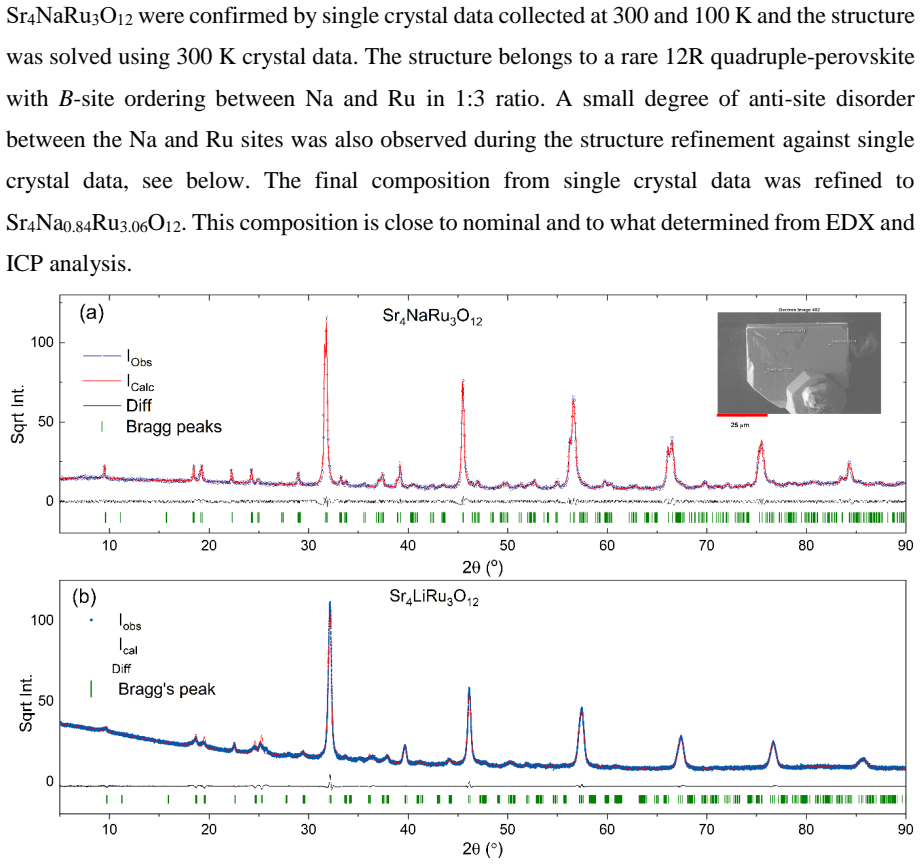
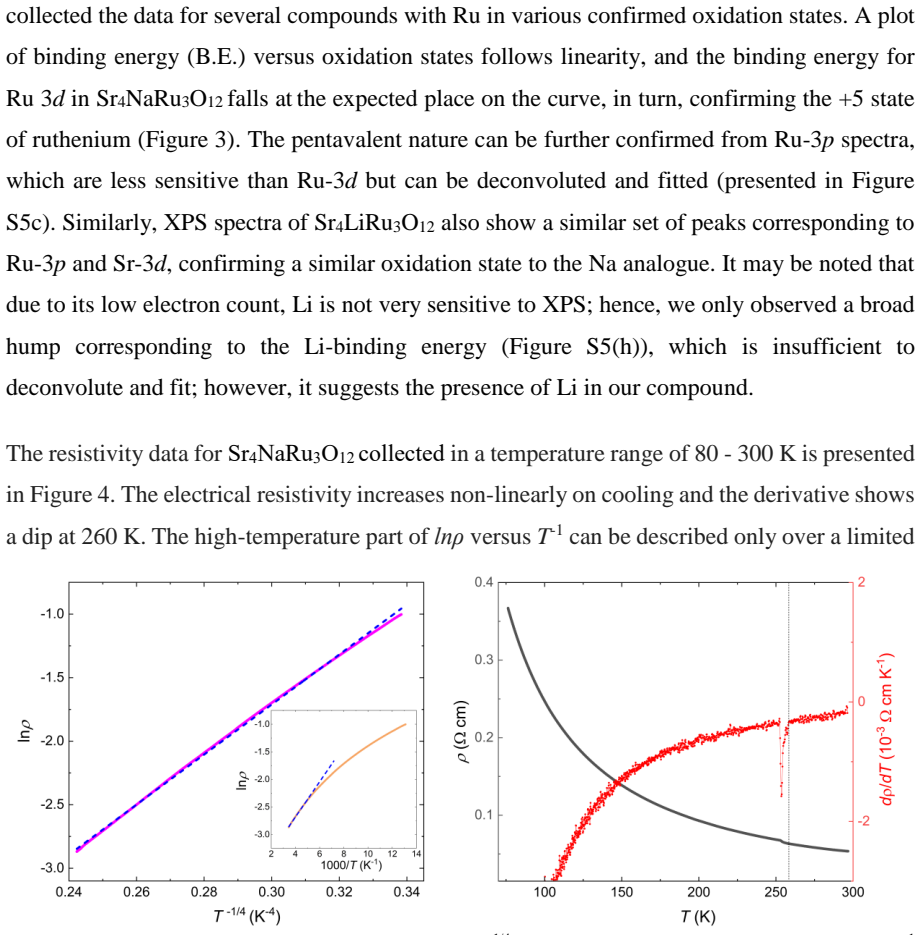
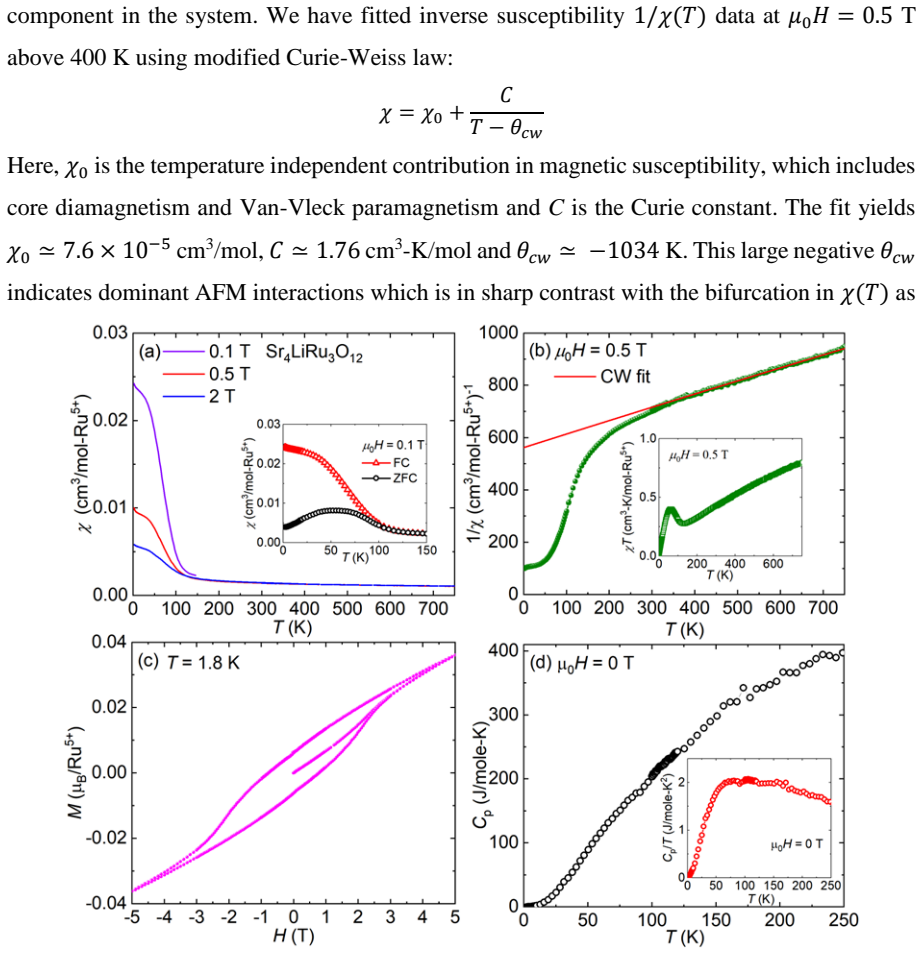
We report the synthesis, structure and magnetic properties of two 1:3 ordered quadruple perovskites Sr4MRu3O12 (M = Li and Na). Sr4NaRu3O12 crystallizes in the centrosymmetric space group R-3 and Sr4LiRu3O12 appears to be isostructural to the Na compound based on the PXRD data. In Sr4NaRu3O12, both Na and Ru are predominantly ordered at the B sites (here Na/Li and Ru) and the structure contains only corner-connected RuO6 and NaO6 octahedra. This atomic ordering also leads to a rather large unit cell with a = 11.25 {\AA} and c = 27.6 {\AA} compared to the basic 12R structure (a = 5.5 {\AA} and c ~ 27 {\AA}). Magnetic measurements reveal that Sr4NaRu3O12 undergoes a magnetic transition to an antiferromagnetic state below TN ~ 265 K which is confirmed by DSC and neutron diffraction. The Ru moments show a collinear antiferromagnetic spin alignment along the hexagonal c axis with a propagation vector k = (0, 0, 1.5). Interestingly, those Ru moments lying on the three-fold roto-inversion do not significantly contribute to the magnetic order, since they are located between antiferromagnetically coupled Ru atoms and are therefore probably highly frustrated. Band structure calculations on Sr4NaRu3O12 complement the observed magnetic ground state and a semiconducting behavior in the compound. Sr4LiRu3O12 shows a magnetic anomaly below 110 K, possibly associated with competing ferromagnetic and antiferromagnetic interactions.
Editorial analysis
A structured set of objections, weighed in public.
Referee Report
Summary. The manuscript reports the synthesis and structural characterization of the quadruple perovskites Sr4NaRu3O12 (space group R-3, a=11.25 Å, c=27.6 Å) and Sr4LiRu3O12. For the Na compound it claims a transition to long-range collinear antiferromagnetic order below TN ≈ 265 K with propagation vector k=(0,0,1.5), Ru moments aligned along the hexagonal c-axis, and suppressed moments on the three-fold roto-inversion sites; this is supported by magnetic susceptibility, DSC, and neutron diffraction. Complementary DFT calculations indicate a semiconducting antiferromagnetic ground state. The Li analog is reported to show a magnetic anomaly near 110 K possibly arising from competing interactions.
Significance. If the reported near-room-temperature antiferromagnetic ordering and its detailed magnetic structure are confirmed, the result would constitute a notable addition to the limited set of quadruple perovskites exhibiting high TN, offering a platform to study frustration on the three-fold sites and the role of B-site ordering. The multi-technique experimental approach (susceptibility, DSC, neutron diffraction) together with band-structure calculations is a strength of the work.
major comments (2)
- [Neutron diffraction] Neutron diffraction section: the central claim of long-range collinear AF order with k=(0,0,1.5) and suppressed moments on the 3-fold sites rests on the peak indexing and magnetic refinement; the manuscript must report the magnetic R-factor, the fitted moment values with uncertainties, and an explicit test that alternative propagation vectors or short-range models do not fit the data equally well.
- [Magnetic properties] Magnetic properties section: the susceptibility and DSC data establishing TN ~ 265 K require a quantitative discussion of possible impurity phases (noted as 'predominantly' ordered in the abstract) and their potential contribution to the observed transition, including any low-temperature upturns or additional anomalies.
minor comments (2)
- [Abstract] The abstract states that moments on the three-fold roto-inversion sites 'do not significantly contribute'; this should be tied explicitly to the Wyckoff positions and the refined moment values in the neutron section.
- [Figures and tables] Figure captions and text should consistently report error bars or uncertainties on TN, lattice parameters, and magnetic moments.
Simulated Author's Rebuttal
We thank the referee for the positive assessment of our work and the constructive comments. We address each major comment below and will revise the manuscript accordingly.
read point-by-point responses
-
Referee: [Neutron diffraction] Neutron diffraction section: the central claim of long-range collinear AF order with k=(0,0,1.5) and suppressed moments on the 3-fold sites rests on the peak indexing and magnetic refinement; the manuscript must report the magnetic R-factor, the fitted moment values with uncertainties, and an explicit test that alternative propagation vectors or short-range models do not fit the data equally well.
Authors: We agree that these quantitative details are required to fully support the claimed magnetic structure. In the revised manuscript we will report the magnetic R-factor, the refined moment values with uncertainties, and an explicit comparison showing that alternative propagation vectors and short-range models yield significantly worse fits to the neutron data. revision: yes
-
Referee: [Magnetic properties] Magnetic properties section: the susceptibility and DSC data establishing TN ~ 265 K require a quantitative discussion of possible impurity phases (noted as 'predominantly' ordered in the abstract) and their potential contribution to the observed transition, including any low-temperature upturns or additional anomalies.
Authors: We will expand the magnetic properties section to include a quantitative discussion of possible impurity phases, their estimated volume fractions, and an assessment of any contribution they may make to the transition at TN ≈ 265 K or to low-temperature features in the susceptibility and DSC data. revision: yes
Circularity Check
No significant circularity; experimental report with independent data
full rationale
The manuscript is an experimental report of synthesis, PXRD structure solution, magnetic susceptibility, DSC, and neutron powder diffraction on Sr4NaRu3O12. The central claim of collinear antiferromagnetic order below TN ≈ 265 K with propagation vector k = (0,0,1.5) is established directly by indexing of magnetic Bragg peaks and Rietveld refinement of the magnetic structure against the neutron data; no equations, fitted parameters, or self-citations are invoked to derive this result from itself. Band-structure calculations are presented only as complementary confirmation of semiconducting behavior and are not used to predict or justify the magnetic ordering. No self-definitional, fitted-input-called-prediction, or self-citation-load-bearing steps exist. The derivation chain is therefore self-contained against external experimental benchmarks.
Axiom & Free-Parameter Ledger
axioms (2)
- domain assumption Powder X-ray diffraction and Rietveld analysis reliably determine the R-3 space group and Na/Ru site ordering.
- standard math Neutron diffraction peaks can be indexed to a magnetic propagation vector k=(0,0,1.5) to confirm long-range antiferromagnetic order.
Reference graph
Works this paper leans on
-
[1]
https://doi.org/10.1021/cm9801791. (12) Uchino, K. Glory of Piezoelectric Perovskites. Sci. Technol. Adv. Mater. 2015, 16 (4), 046001. https://doi.org/10.1088/1468-6996/16/4/046001. (13) Schneemeyer, L. F.; Waszczak, J. V.; Siegrist, T.; van Dover, R. B.; Rupp, L. W.; Batlogg, B.; Cava, R. J.; Murphy, D. W. Superconductivity in YBa2Cu3O7 Single Crystals. ...
-
[2]
https://doi.org/10.1021/ja109431t. (20) Shi, Y. G.; Guo, Y. F.; Yu, S.; Arai, M.; Belik, A. A.; Sato, A.; Yamaura, K.; Takayama -Muromachi, E.; Tian, H. F.; Yang, H. X.; Li, J. Q.; Varga, T.; Mitchell, J. F.; Okamoto, S. Continuous Metal -Insulator Transition of the Antiferromagnetic Perovskite NaOsO3. Phys. Rev. B 2009, 80 (16), 161104. https://doi.org/1...
-
[3]
(26) Marchandier, T.; Rousse, G.; Jacquet, Q.; Abakumov, A
https://doi.org/10.1002/anie.201310110. (26) Marchandier, T.; Rousse, G.; Jacquet, Q.; Abakumov, A. M.; Fauth, F.; Colin, C. V.; Tarascon, J. -M. Magnetic and Intercalation Properties of BaRu2O6 and SrRu2O6. Chem. Mater. 2020, 32 (19), 8471–8480. https://doi.org/10.1021/acs.chemmater.0c02469. (27) Prasad, B. E.; Kanungo, S.; Jansen, M.; Komarek, A. C.; Ya...
-
[5]
https://doi.org/10.1103/PhysRevB.57.1505. (54) Stitzer, K. E.; Smith, M. D.; Gemmill, W. R.; zur Loye, H.-C. Novel Mixed-Valent (V/VI) Triple Perovskite Ruthenates: Observation of a Complex Low-Temperature Structural and Magnetic Transition. J. Am. Chem. Soc. 2002, 124 (46), 13877–13885. https://doi.org/10.1021/ja0271781. (55) Quarez, E.; Mentré, O. Elect...
-
[6]
https://doi.org/10.1039/B212123A. (69) Streltsov, S. V.; Khomskii, D. I. Covalent Bonds against Magnetism in Transition Metal Compounds. Proc. Natl. Acad. Sci. 2016, 113 (38), 10491–10496. https://doi.org/10.1073/pnas.1606367113. (70) Middey, S.; Nandy, A. K.; Pandey, S. K.; Mahadevan, P.; Sarma, D. D. Route to High Néel Temperatures in 4d and 5d Transiti...
-
[7]
https://doi.org/10.1021/acs.inorgchem.7b00983. (77) Streltsov, S. V. Magnetic Moment Suppression in Ba 3CoRu2O9: Hybridization Effect. Phys. Rev. B 2013, 88 (2), 024429. https://doi.org/10.1103/PhysRevB.88.024429. (78) Singh, D. J. Electronic and Magnetic Properties of the 4d Itinerant Ferromagnet SrRuO3. J. Appl. Phys. 1996, 79 (8), 4818–4820. https://do...
discussion (0)
Sign in with ORCID, Apple, or X to comment. Anyone can read and Pith papers without signing in.