Terahertz-induced local-field dynamics and transient birefringence in aqueous electrolytes
Pith reviewed 2026-06-29 19:42 UTC · model grok-4.3
The pith
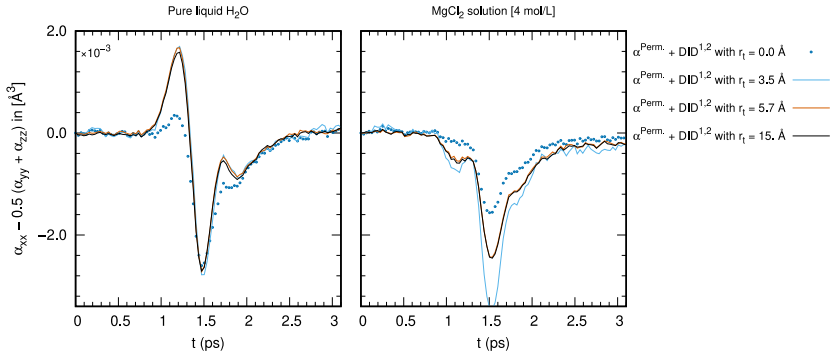
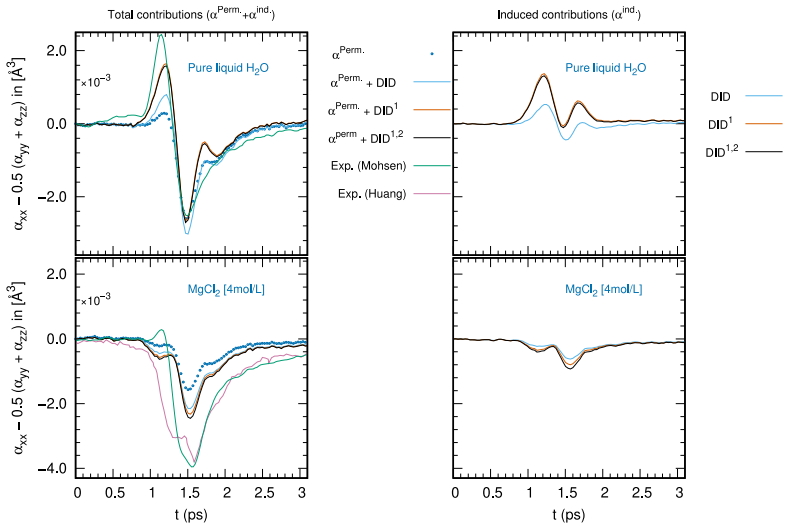
Polarizable trajectories and a local-field optical response recover the measured terahertz Kerr effect signals in aqueous MgCl2.
A machine-rendered reading of the paper's core claim, the machinery that carries it, and where it could break.
Core claim
Induced polarization must be retained both inside the molecular-dynamics trajectories and inside the optical-response calculation if the structural dynamics encoded in electrolyte terahertz Kerr-effect birefringence are to be recovered; the local-field terms generated by the evolving liquid structure are essential to the correct line shape and concentration dependence.
What carries the argument
Hyperpolarizability-enhanced dipole-induced-dipole (DID) response model that couples literature values of first and second molecular hyperpolarizabilities to the instantaneous local electric field produced by the liquid structure.
If this is right
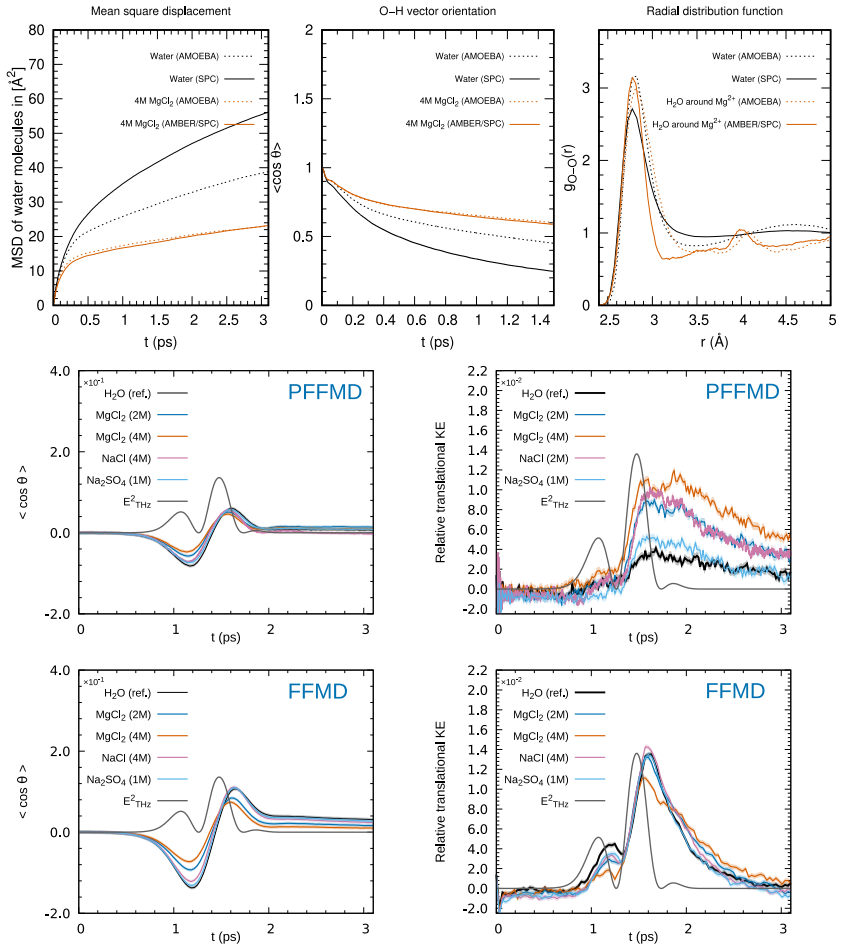
- For neat water the local-field corrections convert an insufficient intramolecular response into the experimentally observed bipolar TKE line shape.
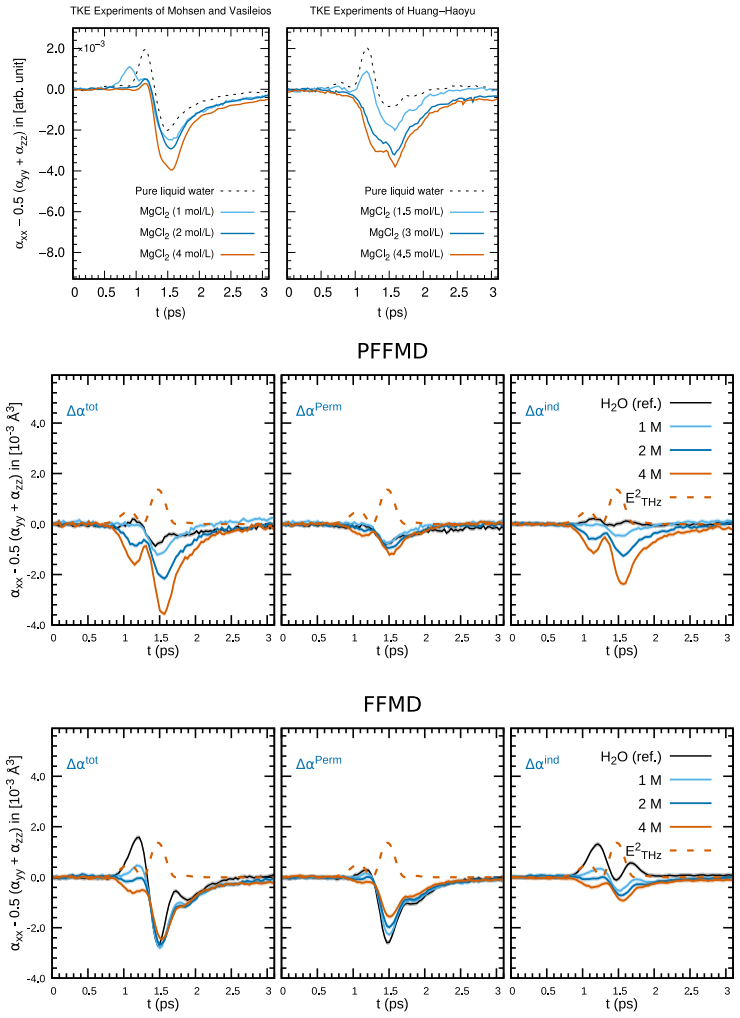
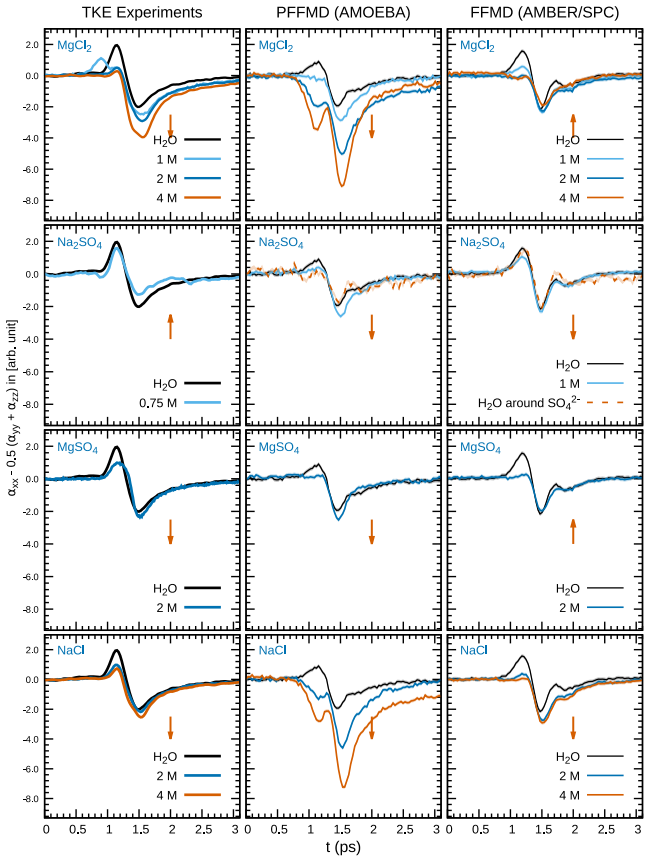
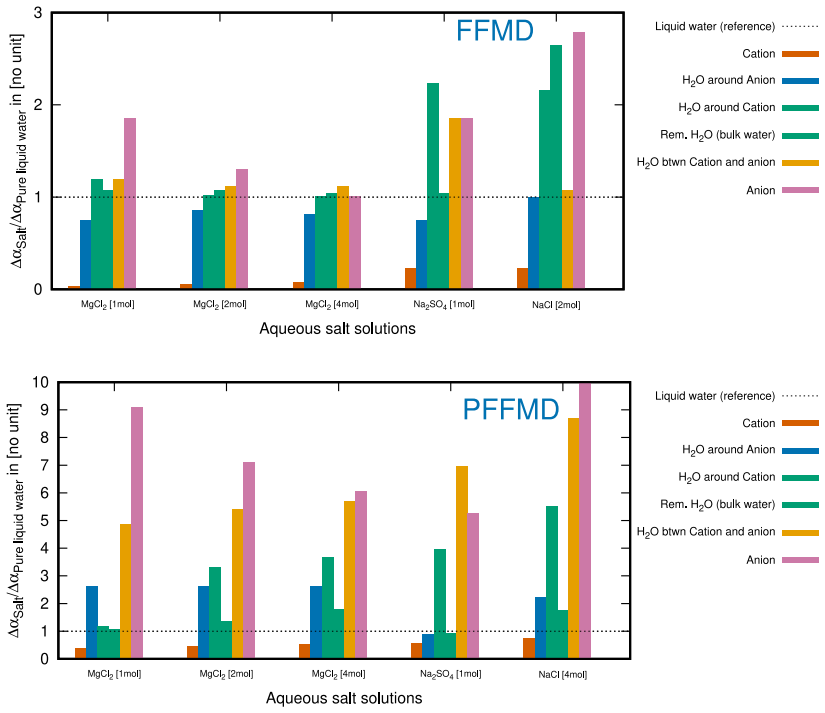
- Polarizable force-field trajectories are necessary to obtain the correct enhancement of negative birefringence with increasing MgCl2 concentration.
- At high salt concentration the response is dominated by field-polarized anions and by water molecules that sit between oppositely charged ions.
Where Pith is reading between the lines
- The same simulation protocol could be used to predict how ion size and charge alter the TKE signal through changes in the distribution of local fields around hydrated ions.
- Applying the framework to time-resolved signals at different terahertz frequencies would test whether the local-field dynamics remain the dominant contributor across the spectrum.
- The identified sensitivity to bridging water suggests that TKE measurements could serve as an experimental reporter of ion-pairing statistics in concentrated electrolytes.
Load-bearing premise
The multipolar expansion of the field-dependent molecular energy together with fixed literature hyperpolarizabilities, when inserted into the DID model and driven by instantaneous local fields, accurately represents the nonlinear optical response without system-specific empirical adjustments.
What would settle it
Quantitative mismatch between the predicted concentration dependence of the TKE birefringence and new experimental data collected on a different electrolyte such as NaCl would falsify the claim that the polarizable-plus-extended-response combination is generally required.
Figures
read the original abstract
Terahertz Kerr-effect (TKE) spectroscopy provides a time-domain optical probe of the intermolecular structural dynamics of liquids, but the measured birefringence can only be interpreted microscopically if transient molecular structure, local electric fields, and nonlinear optical response are treated on the same footing. We combine terahertz-driven non-equilibrium molecular dynamics with a hyperpolarizability-enhanced dipole-induced-dipole (DID) response model to connect the measured TKE signal of water and aqueous electrolytes to molecular-scale hydration dynamics. Starting from a multipolar expansion of the field-dependent molecular energy, the optical response is written as a differential polarizability in which first and second molecular hyperpolarizabilities are coupled to the instantaneous local field generated by the evolving liquid structure. For neat water, these local-field terms convert an insufficiently structured intramolecular response into the experimentally observed bipolar TKE line shape. For aqueous MgCl2, polarizable force-field trajectories combined with the extended optical response reproduce the concentration-dependent enhancement of the negative birefringence, whereas non-polarizable trajectories yield the wrong trend. Species-resolved analysis assigns the high-concentration response to strongly field-polarized anions and, more importantly, to water molecules bridging cations and anions. The work identifies TKE birefringence as a sensitive readout of ion-hydration local-field dynamics and shows that induced polarization in both the trajectory and the optical response is required to recover the structural dynamics encoded in electrolyte TKE measurements.
Editorial analysis
A structured set of objections, weighed in public.
Referee Report
Summary. The paper combines terahertz-driven non-equilibrium molecular dynamics with a hyperpolarizability-enhanced dipole-induced-dipole (DID) response model, derived from a multipolar expansion of the field-dependent molecular energy, to interpret TKE birefringence signals. For neat water the local-field terms produce the observed bipolar line shape from an otherwise insufficient intramolecular response. For aqueous MgCl2, polarizable force-field trajectories plus the extended optical response recover the experimental concentration-dependent enhancement of negative birefringence while non-polarizable trajectories produce the opposite trend; the high-concentration signal is assigned to field-polarized anions and cation-anion bridging water molecules.
Significance. If the central reproduction holds, the work supplies a microscopic, species-resolved link between ion-hydration structure, instantaneous local fields, and the measured nonlinear optical response, showing that induced polarization must be treated consistently in both the dynamics and the optical model. It thereby positions TKE as a sensitive probe of electrolyte local-field dynamics without system-specific fitting parameters beyond literature hyperpolarizabilities.
major comments (2)
- [Abstract] Abstract and § on optical response: the central claim that literature first- and second-order hyperpolarizabilities together with the DID truncation accurately capture the concentration-dependent electrolyte response without adjustments rests on an untested transferability assumption; no independent validation (e.g., comparison to gas-phase or cluster calculations for ion-perturbed molecules) is provided, leaving open the possibility that the reproduced MgCl2 trend arises from cancellation rather than physical fidelity.
- [Results] Results on MgCl2 trends: the statement that non-polarizable trajectories yield the wrong sign while polarizable ones match experiment is load-bearing, yet the manuscript supplies neither quantitative error bars on the simulated birefringence nor a direct comparison of the underlying local-field distributions, preventing assessment of whether the trend reversal is robust or sensitive to trajectory length or cutoff choices.
minor comments (2)
- Notation for the differential polarizability and the instantaneous local field should be defined once with explicit symbols before being used in the species-resolved analysis.
- The manuscript would benefit from a short table listing the literature sources and numerical values adopted for the first and second hyperpolarizabilities of water, Cl− and Mg2+.
Simulated Author's Rebuttal
We thank the referee for the careful reading and constructive feedback. We address each major comment below with clarifications and indicate revisions where the manuscript will be strengthened.
read point-by-point responses
-
Referee: [Abstract] Abstract and § on optical response: the central claim that literature first- and second-order hyperpolarizabilities together with the DID truncation accurately capture the concentration-dependent electrolyte response without adjustments rests on an untested transferability assumption; no independent validation (e.g., comparison to gas-phase or cluster calculations for ion-perturbed molecules) is provided, leaving open the possibility that the reproduced MgCl2 trend arises from cancellation rather than physical fidelity.
Authors: The first- and second-order hyperpolarizabilities are taken directly from established literature values for water, Mg^{2+} and Cl^{-} without any adjustment to match the TKE data. The hyperpolarizability-enhanced DID response follows rigorously from the multipolar expansion of the field-dependent molecular energy, as derived in the manuscript. While we do not perform new gas-phase or cluster calculations here, the model reproduces the experimental concentration dependence using these fixed, species-specific parameters. We will revise the optical-response section and abstract to state the transferability assumption explicitly, cite the provenance of each hyperpolarizability value, and note that the trend reproduction itself constitutes a non-trivial test of the framework. revision: partial
-
Referee: [Results] Results on MgCl2 trends: the statement that non-polarizable trajectories yield the wrong sign while polarizable ones match experiment is load-bearing, yet the manuscript supplies neither quantitative error bars on the simulated birefringence nor a direct comparison of the underlying local-field distributions, preventing assessment of whether the trend reversal is robust or sensitive to trajectory length or cutoff choices.
Authors: We agree that error bars and local-field distribution comparisons would strengthen the presentation. The trajectories were generated with standard production lengths and cutoffs, but to demonstrate robustness we will add quantitative error bars (block-averaged standard errors from independent runs) to the birefringence versus concentration plots and include a supplementary figure comparing the instantaneous local-field distributions obtained with the polarizable and non-polarizable force fields. These additions will allow readers to assess the statistical significance of the sign reversal directly. revision: yes
Circularity Check
No significant circularity; optical response derived from external literature values
full rationale
The derivation starts from a multipolar expansion of field-dependent molecular energy and couples literature first/second hyperpolarizabilities to instantaneous local fields via the DID model. No parameters are fitted to the target TKE signals, no self-citations bear the central claim, and the concentration-dependent trends are obtained from independent MD trajectories rather than by construction from the optical response itself. The model is presented as using no system-specific empirical adjustments, making the chain self-contained against external benchmarks.
Axiom & Free-Parameter Ledger
free parameters (1)
- molecular hyperpolarizabilities
axioms (1)
- domain assumption The multipolar expansion of the field-dependent molecular energy remains valid under the terahertz field strengths and liquid configurations encountered.
Reference graph
Works this paper leans on
-
[1]
1S. Mukamel,Principles of nonlinear optical spectroscopy(Oxford University Press, New York, 1995). 2B. D. Bursulaya and H. J. Kim, The Journal of Physical Chemistry B101, 10994 (1997). 3T. Kampfrath, M. Wolf, and M. Sajadi, Chemical Physics Letters692, 319 (2018). 4T. Kampfrath, R. K. Campen, M. Wolf, and M. Sajadi, The Journal of Physical Chemistry Lette...
-
[2]
59J. J. Molina, S. Lectez, S. Tazi, M. Salanne, J.-F. Dufrêche, J. Roques, E. Simoni, P. A. Madden, and P. Turq, The Journal of Chemical Physics134, 014511 (2011). 60P. Jungwirth, J. E. Curtis, and D. J. Tobias, Chemical Physics Letters367, 704 (2003). 61D. Jiao, C. King, A. Grossfield, T. A. Darden, and P. Ren, The Journal of Physical Chemistry B110, 185...
2011
discussion (0)
Sign in with ORCID, Apple, or X to comment. Anyone can read and Pith papers without signing in.