Alignment-free ultra-broadband parametric frequency conversion in lead-halide perovskites
Pith reviewed 2026-06-29 21:42 UTC · model grok-4.3
The pith
Lead-halide perovskites generate bright coherent emission across wide infrared ranges via four-wave mixing without phase matching or alignment.
A machine-rendered reading of the paper's core claim, the machinery that carries it, and where it could break.
Core claim
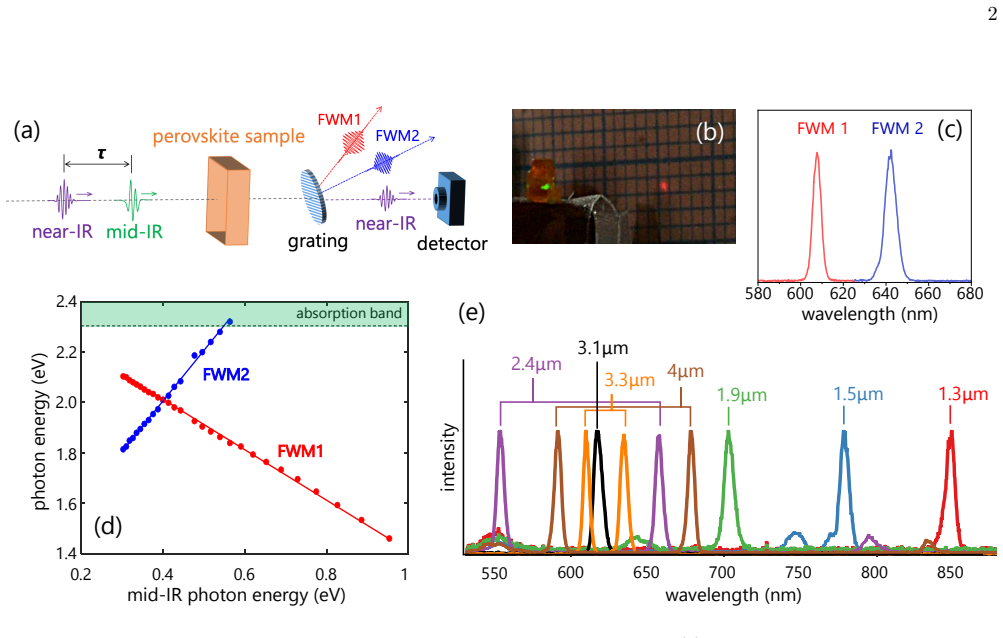
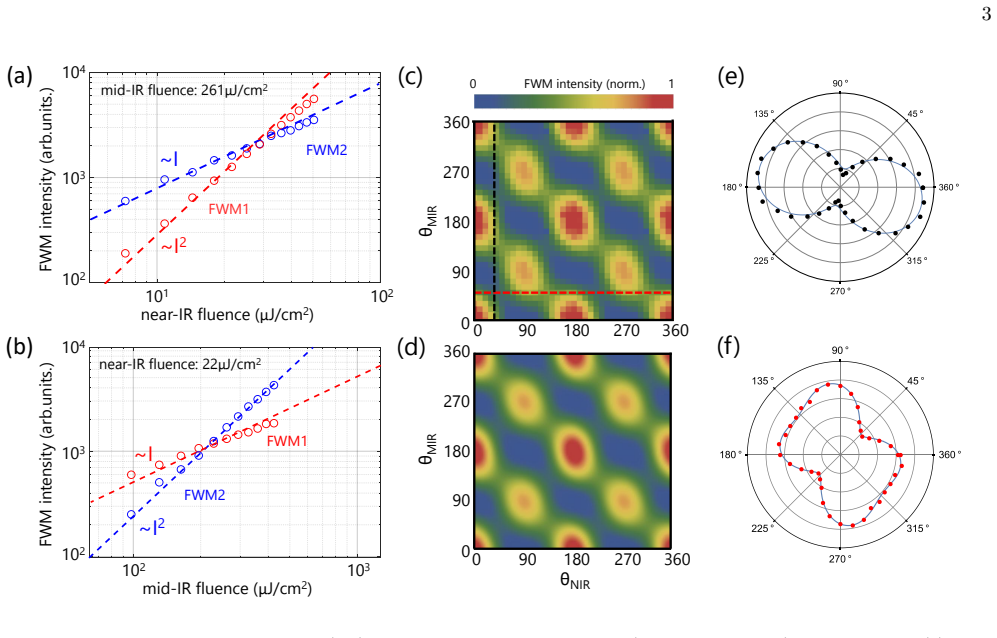
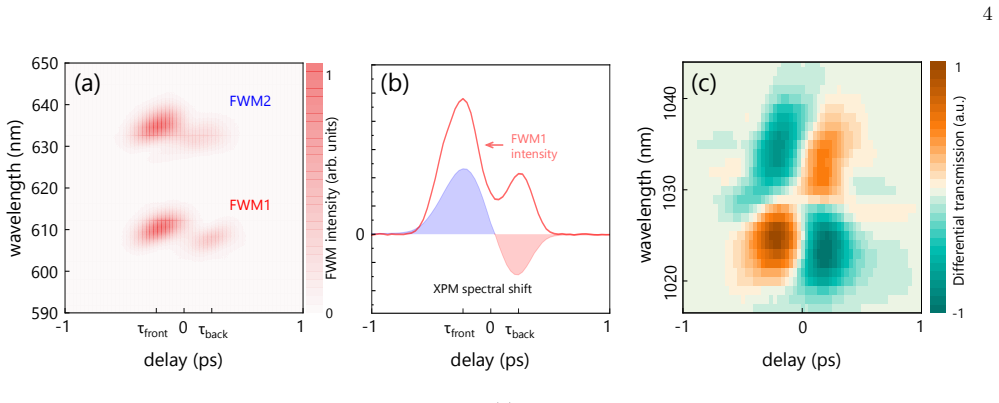
In thick single-crystal lead-halide perovskites, ultra-broadband four-wave mixing of near- and mid-infrared femtosecond pulses produces bright, coherent, and highly collimated emission across an exceptionally wide continuous tuning range without phase-matching engineering, angular alignment, or dispersion optimization. Time-resolved measurements show that the emission originates near the crystal surfaces, relaxing phase-matching constraints, while the large intrinsic χ^(3) response maintains efficient and directional frequency conversion despite the strongly localized interaction volume.
What carries the argument
Surface-localized four-wave mixing sustained by the large intrinsic third-order nonlinearity of lead-halide perovskite crystals.
If this is right
- Lead-halide perovskites function as bulk platforms for ultra-broadband nonlinear photonics.
- Compact, alignment-free architectures for ultrafast frequency conversion become feasible.
- Efficient parametric conversion persists even when the interaction volume is strongly localized near surfaces.
Where Pith is reading between the lines
- The same surface-relaxation mechanism could be tested in other high-nonlinearity materials that normally require phase-matching engineering.
- Thick crystals could be used directly in devices without surface polishing or coatings optimized for phase matching.
- The approach may simplify portable or integrated sources that need wide continuous tuning in the infrared.
Load-bearing premise
The nonlinear emission originates near the crystal surfaces, where phase-matching constraints are relaxed.
What would settle it
Time-resolved measurements that locate the emission deep inside the crystal bulk rather than near the surfaces, or that show the emission vanishing when surface regions are removed or altered, would falsify the central claim.
Figures
read the original abstract
Lead-halide perovskites were demonstrated to exhibit some of the largest known optical nonlinearities, yet their potential for frequency conversion remains largely untapped. Here we demonstrate ultra-broadband four-wave mixing of near- and mid-infrared femtosecond pulses in thick single-crystal LHPs, generating bright, coherent, and highly collimated emission across an exceptionally wide continuous tuning range without phase-matching engineering, angular alignment, or dispersion optimization. Time resolved measurements reveal that the emission originates near the crystal surfaces, where phase-matching constraints are relaxed, while the unusually large intrinsic $\chi^{(3)}$ response preserves efficient and directional frequency conversion despite the strongly localized interaction volume. These results position LHPs as a powerful bulk platform for ultra-broadband nonlinear photonics, opening a pathway toward compact, alignment-free architectures for ultrafast frequency conversion.
Editorial analysis
A structured set of objections, weighed in public.
Referee Report
Summary. The manuscript reports an experimental demonstration of ultra-broadband four-wave mixing in thick single-crystal lead-halide perovskites using near- and mid-infrared femtosecond pulses. It claims generation of bright, coherent, and highly collimated emission across an exceptionally wide continuous tuning range without phase-matching engineering, angular alignment, or dispersion optimization. Time-resolved measurements are invoked to establish that the emission originates near the crystal surfaces, where phase-matching constraints are relaxed, while the large intrinsic χ^{(3)} enables efficient directional conversion despite the localized interaction volume.
Significance. If the central experimental claims hold with supporting quantitative data and calculations, the result would be significant for nonlinear photonics. It would establish lead-halide perovskites as a bulk platform for alignment-free, ultra-broadband frequency conversion, potentially enabling simpler compact architectures that exploit intrinsic material nonlinearity rather than engineered phase matching.
major comments (1)
- [time-resolved measurements and discussion of emission origin] The central claim that surface-localized interaction (inferred from time-resolved data) plus large χ^{(3)} produces highly collimated emission across the ultra-broad tuning range without phase-matching engineering requires a forward calculation of the angular acceptance bandwidth and expected divergence as a function of pump/idler wavelengths using the measured interaction length; this calculation is absent and is load-bearing for explaining the observed collimation given material dispersion in LHPs.
minor comments (1)
- The abstract and main text would benefit from explicit reporting of quantitative metrics including conversion efficiencies, tuning range in wavelength or wavenumber, beam divergence angles, and error bars on all claims.
Simulated Author's Rebuttal
We thank the referee for their thorough review and valuable feedback on our manuscript. We address the major comment in detail below.
read point-by-point responses
-
Referee: [time-resolved measurements and discussion of emission origin] The central claim that surface-localized interaction (inferred from time-resolved data) plus large χ^{(3)} produces highly collimated emission across the ultra-broad tuning range without phase-matching engineering requires a forward calculation of the angular acceptance bandwidth and expected divergence as a function of pump/idler wavelengths using the measured interaction length; this calculation is absent and is load-bearing for explaining the observed collimation given material dispersion in LHPs.
Authors: We agree with the referee that a forward calculation of the angular acceptance bandwidth and expected divergence would strengthen our explanation of the observed collimation. Although the time-resolved data support the surface-localized interaction, we did not include such a calculation in the original manuscript. We will compute the angular acceptance using the measured interaction length (from time-resolved measurements), the material dispersion of LHPs, and the pump/idler wavelengths across the tuning range, and incorporate these results into the revised manuscript. revision: yes
Circularity Check
No circularity: purely experimental demonstration with no derivation chain
full rationale
The manuscript is an experimental report on four-wave mixing in LHP crystals. It contains no equations, no fitted parameters, no self-citations invoked as uniqueness theorems, and no modeling steps that could reduce to inputs by construction. Claims rest on direct time-resolved measurements and observed emission properties. The reader's assessment of score 0.0 is consistent with the absence of any load-bearing derivation. No steps meet the criteria for circularity.
Axiom & Free-Parameter Ledger
axioms (2)
- standard math Four-wave mixing is described by the third-order nonlinear susceptibility χ^{(3)}
- domain assumption Phase-matching constraints relax near crystal surfaces
Reference graph
Works this paper leans on
-
[1]
K. Lin, J. Xing, L. N. Quan, F. P. G. de Arquer, X. Gong, J. Lu, L. Xie, W. Zhao, D. Zhang, C. Yan, W. Li, X. Liu, Y. Lu, J. Kirman, E. H. Sargent, Q. Xiong, and Z. Wei, Perovskite light-emitting diodes with external quantum efficiency exceeding 20 per cent, Nature562, 245 (2018)
2018
-
[2]
P. Du, J. Li, L. Wang, L. Sun, X. Wang, X. Xu, L. Yang, J. Pang, W. Liang, J. Luo, Y. Ma, and J. Tang, Ef- ficient and large-area all vacuum-deposited perovskite light-emitting diodes via spatial confinement, Nature Communications12, 4751 (2021)
2021
-
[3]
J. S. Kim, J.-M. Heo, G.-S. Park, S.-J. Woo, C. Cho, H. J. Yun, D.-H. Kim, J. Park, S.-C. Lee, S.-H. Park, E. Yoon, N. C. Greenham, and T.-W. Lee, Ultra-bright, efficient and stable perovskite light-emitting diodes, Na- ture611, 688 (2022)
2022
-
[4]
R. Lin, J. Xu, M. Wei, Y. Wang, Z. Qin, Z. Liu, J. Wu, K. Xiao, B. Chen, S. M. Park, G. Chen, H. R. Atapattu, K. R. Graham, J. Xu, J. Zhu, L. Li, C. Zhang, E. H. Sargent, and H. Tan, All-perovskite tandem solar cells with improved grain surface passivation, Nature603, 73 (2022)
2022
-
[5]
H. Chen, A. Maxwell, C. Li, S. Teale, B. Chen, T. Zhu, E. Ugur, G. Harrison, L. Grater, J. Wang, Z. Wang, 7 L. Zeng, S. M. Park, L. Chen, P. Serles, R. A. Awni, B. Subedi, X. Zheng, C. Xiao, N. J. Podraza, T. Fil- leter, C. Liu, Y. Yang, J. M. Luther, S. De Wolf, M. G. Kanatzidis, Y. Yan, and E. H. Sargent, Regulat- ing surface potential maximizes voltage...
2023
-
[6]
X. Dai, S. Chen, H. Jiao, L. Zhao, K. Wang, Z. Ni, Z. Yu, B. Chen, Y. Gao, and J. Huang, Efficient mono- lithic all-perovskite tandem solar modules with small cell-to-module derate, Nature Energy7, 923 (2022)
2022
-
[7]
Zhang, S
Q. Zhang, S. T. Ha, X. Liu, T. C. Sum, and Q. Xiong, Room-temperature near-infrared high-q per- ovskite whispering-gallery planar nanolasers, Nano Let- ters14, 5995 (2014)
2014
-
[8]
C. Qin, A. S. D. Sandanayaka, C. Zhao, T. Matsushima, D. Zhang, T. Fujihara, and C. Adachi, Stable room- temperature continuous-wave lasing in quasi-2d per- ovskite films, Nature585, 53 (2020)
2020
-
[9]
W. Sun, Y. Liu, G. Qu, Y. Fan, W. Dai, Y. Wang, Q. Song, J. Han, and S. Xiao, Lead halide perovskite vortex microlasers, Nature Communications11, 4862 (2020)
2020
-
[10]
Q. Han, J. Wang, J. Lu, L. Sun, F. Lyu, H. Wang, Z. Chen, and Z. Wang, Transition between exciton- polariton and coherent photonic lasing in all-inorganic perovskite microcuboid, ACS Photonics7, 454 (2020)
2020
-
[11]
J. Wang, Y. Peng, H. Xu, J. Feng, Y. Huang, J. Wu, T. C. H. Liew, and Q. Xiong, Controllable vortex lasing arrays in a geometrically frustrated exciton–polariton lattice at room temperature, National Science Review 10, nwac096 (2023)
2023
-
[12]
Biliroglu, M
M. Biliroglu, M. T¨ ure, A. Ghita, M. Kotyrov, X. Qin, D. Seyitliyev, N. Phonthiptokun, M. Abdelsamei, J. Chai, R. Su, U. Herath, A. K. Swan, V. V. Tem- nov, V. Blum, F. So, and K. Gundogdu, Unconventional solitonic high-temperature superfluorescence from per- ovskites, Nature642, 71 (2025)
2025
-
[13]
M. A. Becker, R. Vaxenburg, G. Nedelcu, P. C. Ser- cel, A. Shabaev, M. J. Mehl, J. G. Michopoulos, S. G. Lambrakos, N. Bernstein, J. L. Lyons, T. St¨ oferle, R. F. Mahrt, M. V. Kovalenko, D. J. Norris, G. Rain` o, and A. L. Efros, Bright triplet excitons in caesium lead halide perovskites, Nature553, 189 (2018)
2018
-
[14]
S.-T. Ha, C. Shen, J. Zhang, and Q. Xiong, Laser cool- ing of organic–inorganic lead halide perovskites, Nature Photonics10, 115 (2016)
2016
-
[15]
A. M. Abu Baker, G. S. Boltaev, M. Iqbal, M. Pylnev, N. M. Hamdan, and A. S. Alnaser, Giant third-order nonlinear response of mixed perovskite nanocrystals, Materials15, 10.3390/ma15010389 (2022)
-
[16]
J. Yi, L. Miao, J. Li, W. Hu, C. Zhao, and S. Wen, Third-order nonlinear optical response of ch3nh3pbi3 perovskite in the mid-infrared regime, Opt. Mater. Ex- press7, 3894 (2017)
2017
-
[17]
Zhang, J
R. Zhang, J. Fan, X. Zhang, H. Yu, H. Zhang, Y. Mai, T. Xu, J. Wang, and H. J. Snaith, Nonlinear optical response of organic–inorganic halide perovskites, ACS Photonics3, 371 (2016)
2016
-
[18]
B. S. Kalanoor, L. Gouda, R. Gottesman, S. Tirosh, E. Haltzi, A. Zaban, and Y. R. Tischler, Third-order optical nonlinearities in organometallic methylammo- nium lead iodide perovskite thin films, ACS Photonics 3, 361 (2016)
2016
-
[19]
K. N. Krishnakanth, S. Seth, A. Samanta, and S. V. Rao, Broadband femtosecond nonlinear optical proper- ties of cspbbr3 perovskite nanocrystals, Opt. Lett.43, 603 (2018)
2018
-
[20]
Su´ arez, M
I. Su´ arez, M. Vall´ es-Pelarda, A. F. Gualdr´ on-Reyes, I. Mora-Ser´ o, A. Ferrando, H. Michinel, J. R. Salgueiro, and J. P. M. Pastor, Outstanding nonlinear optical properties of methylammonium- and cs-pbx3 (x = br, i, and br–i) perovskites: Polycrystalline thin films and nanoparticles, APL Materials7, 041106 (2019)
2019
-
[21]
Mirershadi, S
S. Mirershadi, S. Ahmadi-Kandjani, A. Zawadzka, H. Rouhbakhsh, and B. Sahraoui, Third order nonlinear optical properties of organometal halide perovskite by means of the z-scan technique, Chemical Physics Let- ters647, 7 (2016)
2016
-
[22]
Nadafan, Z
M. Nadafan, Z. Dehghani, Z. Shadrokh, and Y. Abdi, A remarkable third-order nonlinear optical behavior of single-crystal bromide organic-inorganic lead halide perovskite, Optics & Laser Technology160, 109055 (2023)
2023
-
[23]
Hansryd, P
J. Hansryd, P. Andrekson, M. Westlund, J. Li, and P.- O. Hedekvist, Fiber-based optical parametric amplifiers and their applications, IEEE Journal of Selected Topics in Quantum Electronics8, 506 (2002)
2002
-
[24]
W. Gu, X. Gao, W. Dong, Y. Wang, H. Zhou, J. Xu, and X. Zhang, All-optical complex-valued convolution based on four-wave mixing, Optica11, 64 (2024)
2024
-
[25]
Hudelist, J
F. Hudelist, J. Kong, C. Liu, J. Jing, Z. Y. Ou, and W. Zhang, Quantum metrology with parametric amplifier-based photon correlation interferometers, Na- ture Communications5, 3049 (2014)
2014
-
[26]
G. B. Lemos, V. Borish, G. D. Cole, S. Ramelow, R. Lapkiewicz, and A. Zeilinger, Quantum imaging with undetected photons, Nature512, 409 (2014)
2014
-
[27]
J. Wang, S. Paesani, Y. Ding, R. Santagati, P. Skrzypczyk, A. Salavrakos, J. Tura, R. Augusiak, L. Manˇ cinska, D. Bacco, D. Bonneau, J. W. Silver- stone, Q. Gong, A. Ac´ ın, K. Rottwitt, L. K. Oxenløwe, J. L. O’Brien, A. Laing, and M. G. Thompson, Mul- tidimensional quantum entanglement with large-scale integrated optics, Science360, 285 (2018)
2018
-
[28]
J. Zhou, N. Park, K. Vahala, M. Newkirk, and B. Miller, Four-wave mixing wavelength conversion efficiency in semiconductor traveling-wave amplifiers measured to 65 nm of wavelength shift, IEEE Photonics Technology Letters6, 984–987 (1994)
1994
-
[29]
Melloni, F
A. Melloni, F. Morichetti, and M. Martinelli, Four-wave mixing and wavelength conversion in coupled-resonator optical waveguides, Journal of the Optical Society of America B25, C87 (2008)
2008
-
[30]
Noskovicova, M
E. Noskovicova, M. Koys, M. Jerigova, D. Velic, and D. Lorenc, Resonantly enhanced terahertz four-wave mixing in fluorides, Optics Letters49, 4370 (2024)
2024
-
[31]
Q. Dong, B. Sun, F. Chen, and J. Jiang, Flat frequency comb generation based on efficiently multiple four-wave mixing without polarization control, Photonic Sensors 6, 85 (2016)
2016
-
[32]
Z. Tan and L. Huang, Optical-frequency-comb gener- ation based on single-tone modulation and four-wave mixing effect in one single semiconductor optical am- plifier, Photonics9, 10.3390/photonics9100746 (2022)
-
[33]
Y. Yang, X. Jiang, S. Kasumie, G. Zhao, L. Xu, J. M. Ward, L. Yang, and S. N. Chormaic, Four-wave mixing parametric oscillation and frequency comb generation at visible wavelengths in a silica microbubble resonator, 8 Opt. Lett.41, 5266 (2016)
2016
-
[34]
C. Y. Wang, T. Herr, P. Del’Haye, A. Schliesser, J. Hofer, R. Holzwarth, T. W. H¨ ansch, N. Picqu´ e, and T. J. Kippenberg, Mid-infrared optical frequency combs at 2.5µm based on crystalline microresonators, Nature Communications4, 1345 (2013)
2013
-
[35]
A. V. Husakou and J. Herrmann, Frequency comb gen- eration by four-wave mixing in a multicore photonic crystal fiber, Applied Physics Letters83, 3867 (2003)
2003
-
[36]
X. Xue, F. Leo, Y. Xuan, J. A. Jaramillo-Villegas, P.- H. Wang, D. E. Leaird, M. Erkintalo, M. Qi, and A. M. Weiner, Second-harmonic-assisted four-wave mixing in chip-based microresonator frequency comb generation, Light: Science & Applications6, e16253 (2017)
2017
-
[37]
Stolen and J
R. Stolen and J. Bjorkholm, Parametric amplification and frequency conversion in optical fibers, IEEE Jour- nal of Quantum Electronics18, 1062 (1982)
1982
-
[38]
Kuyken, X
B. Kuyken, X. Liu, G. Roelkens, R. Baets, J. Richard M. Osgood, and W. M. J. Green, 50 db parametric on- chip gain in silicon photonic wires, Opt. Lett.36, 4401 (2011)
2011
-
[39]
S. Diez, C. Schmidt, R. Ludwig, H. Weber, K. Ober- mann, S. Kindt, I. Koltchanov, and K. Petermann, Four-wave mixing in semiconductor optical amplifiers for frequency conversion and fast optical switching, IEEE Journal of Selected Topics in Quantum Electron- ics3, 1131–1145 (1997)
1997
-
[40]
A. Pscherer, M. Meierhofer, D. Wang, H. Kelkar, D. Mart´ ın-Cano, T. Utikal, S. G¨ otzinger, and V. San- doghdar, Single-molecule vacuum rabi splitting: Four- wave mixing and optical switching at the single-photon level, Physical Review Letters127, 10.1103/phys- revlett.127.133603 (2021)
-
[41]
Salem, M
R. Salem, M. A. Foster, A. C. Turner, D. F. Geraghty, M. Lipson, and A. L. Gaeta, Signal regeneration us- ing low-power four-wave mixing on silicon chip, Nature Photonics2, 35 (2008)
2008
-
[42]
F. Li, T. D. Vo, C. Husko, M. Pelusi, D.-X. Xu, A. Dens- more, R. Ma, S. Janz, B. J. Eggleton, and D. J. Moss, All-optical xor logic gate for 40gb/s dpsk signals via fwm in a silicon nanowire, Opt. Express19, 20364 (2011)
2011
-
[43]
A. G. Radnaev, Y. O. Dudin, R. Zhao, H. H. Jen, S. D. Jenkins, A. Kuzmich, and T. A. B. Kennedy, A quan- tum memory with telecom-wavelength conversion, Na- ture Physics6, 894 (2010)
2010
-
[44]
R. C. Pooser, A. M. Marino, V. Boyer, K. M. Jones, and P. D. Lett, Quantum correlated light beams from non-degenerate four-wave mixing in an atomic vapor: the d1 and d2 lines of 85rb and 87rb, Opt. Express17, 16722 (2009)
2009
-
[45]
H. Takesue and K. Inoue, Generation of polarization- entangled photon pairs and violation of bell’s inequal- ity using spontaneous four-wave mixing in a fiber loop, Physical Review A70, 10.1103/physreva.70.031802 (2004)
-
[46]
ichi Harada, H
K. ichi Harada, H. Takesue, H. Fukuda, T. Tsuchizawa, T. Watanabe, K. Yamada, Y. Tokura, and S. ichi Itabashi, Generation of high-purity entangled photon pairs using silicon wire waveguide, Opt. Express16, 20368 (2008)
2008
-
[47]
Garay-Palmett, D
K. Garay-Palmett, D. Cruz-Delgado, F. Dominguez- Serna, E. Ortiz-Ricardo, J. Monroy-Ruz, H. Cruz- Ramirez, R. Ramirez-Alarcon, and A. B. U’Ren, Photon-pair generation by intermodal spontaneous four-wave mixing in birefringent, weakly guiding optical fibers, Phys. Rev. A93, 033810 (2016)
2016
-
[48]
B. Fang, O. Cohen, J. B. Moreno, and V. O. Lorenz, State engineering of photon pairs produced through dual-pump spontaneous four-wave mixing, Opt. Ex- press21, 2707 (2013)
2013
-
[49]
Zatti, J
L. Zatti, J. E. Sipe, and M. Liscidini, Generation of photon pairs by spontaneous four-wave mixing in lin- early uncoupled resonators, Phys. Rev. A107, 013514 (2023)
2023
-
[50]
A. M. Zheltikov, Phase matching as a gate for photon entanglement, Scientific Reports7, 46115 (2017)
2017
-
[51]
Srivathsan, G
B. Srivathsan, G. K. Gulati, B. Chng, G. Maslennikov, D. Matsukevich, and C. Kurtsiefer, Narrow band source of transform-limited photon pairs via four-wave mixing in a cold atomic ensemble, Phys. Rev. Lett.111, 123602 (2013)
2013
-
[52]
R. Z. Vered, Y. Shaked, Y. Ben-Or, M. Rosenbluh, and A. Pe’er, Classical-to-quantum transition with broad- band four-wave mixing, Phys. Rev. Lett.114, 063902 (2015)
2015
-
[53]
Harrison, S
R. Harrison, S. Butcher, and R. Wood, High power widely tunable infra-red generation from four-wave mix- ing in germanium, Optics & Laser Technology11, 133–136 (1979)
1979
-
[54]
Liu and T
J. Liu and T. Kobayashi, Cascaded four-wave mixing and multicolored arrays generation in a sapphire plate by using two crossing beams of femtosecond laser, Opt. Express16, 22119 (2008)
2008
-
[55]
Liu and T
J. Liu and T. Kobayashi, Generation of sub-20-fs multi- color laser pulses using cascaded four-wave mixing with chirped incident pulses, Opt. Lett.34, 2402 (2009)
2009
-
[56]
Zhang, H
H. Zhang, H. Liu, J. Si, W. Yi, F. Chen, and X. Hou, Low threshold power density for the generation of fre- quency up-converted pulses in bismuth glass by two crossing chirped femtosecond pulses, Opt. Express19, 12039 (2011)
2011
-
[57]
Crespo, J
H. Crespo, J. T. Mendon¸ ca, and A. D. Santos, Cascaded highly nondegenerate four-wave-mixing phenomenon in transparent isotropic condensed media, Opt. Lett.25, 829 (2000)
2000
-
[58]
Lu, L.-F
C.-H. Lu, L.-F. Yang, M. Zhi, A. V. Sokolov, S.-D. Yang, C.-C. Hsu, and A. H. Kung, Generation of octave- spanning supercontinuum by raman-assisted four-wave mixing in single-crystal diamond, Opt. Express22, 4075 (2014)
2014
-
[59]
He and T
J. He and T. Kobayashi, Generation of sub-20-fs deep- ultraviolet pulses by using chirped-pulse four-wave mix- ing in caf2 plate, Opt. Lett.38, 2938 (2013)
2013
-
[60]
W. Liu, L. Zhu, L. Wang, and C. Fang, Cascaded four- wave mixing for broadband tunable laser sideband gen- eration, Opt. Lett.38, 1772 (2013)
2013
-
[61]
Liu and T
J. Liu and T. Kobayashi, Generation and amplification of tunable multicolored femtosecond laser pulses by us- ing cascaded four-wave mixing in transparent bulk me- dia, Sensors10, 4296 (2010)
2010
-
[62]
P. Wang, J. Liu, F. Li, X. Shen, and R. Li, Genera- tion of high-energy tunable multicolored femtosecond sidebands directly after a ti:sapphire femtosecond laser, Applied Physics Letters105, 201901 (2014)
2014
-
[63]
L. Zhu, W. Liu, and C. Fang, Tunable sideband laser from cascaded four-wave mixing in thin glass for ultra-broadband femtosecond stimulated raman spec- 9 troscopy, Applied Physics Letters103, 061110 (2013)
2013
-
[64]
E. G. Carnemolla, W. Jaffray, M. Clerici, L. Caspani, D. Faccio, F. Biancalana, C. Devault, V. M. Shalaev, A. Boltasseva, and M. Ferrera, Visible photon gener- ation via four-wave mixing in near-infrared near-zero- index thin films, Opt. Lett.46, 5433 (2021)
2021
-
[65]
Suchowski, K
H. Suchowski, K. O’Brien, Z. J. Wong, A. Salandrino, X. Yin, and X. Zhang, Phase mismatch–free nonlin- ear propagation in optical zero-index materials, Science 342, 1223 (2013)
2013
-
[66]
A. S. Kowligy, D. D. Hickstein, A. Lind, D. R. Carl- son, H. Timmers, N. Nader, D. L. Maser, D. Westly, K. Srinivasan, S. B. Papp, and S. A. Diddams, Tun- able mid-infrared generation via wide-band four-wave mixing in silicon nitride waveguides, Optics Letters43, 4220 (2018)
2018
-
[67]
P. Zhao, V. Shekhawat, M. Girardi, Z. He, V. Torres- Company, and P. A. Andrekson, Ultra-broadband opti- cal amplification using nonlinear integrated waveguides, Nature640, 918–923 (2025)
2025
-
[68]
Timmerkamp, M
M. Timmerkamp, M. Gao, and C. Fallnich, Widely tun- able dual-wavelength waveguide-based optical paramet- ric oscillator, Optics Express33, 8545 (2025)
2025
-
[69]
Y. Dai, Y. Wang, S. Das, S. Li, H. Xue, A. Mohsen, and Z. Sun, Broadband plasmon-enhanced four-wave mixing in monolayer mos2, Nano Letters21, 6321 (2021)
2021
-
[70]
Corso, T
C. Corso, T. Mansuryan, A. Tonello, Y. Arosa, Y. Stepanenko, V. Couderc, and K. Krupa, Tunable four-wave mixing enabled by a self-phase modulation of chirped pulses, Optics Letters48, 5531 (2023)
2023
-
[71]
M. I. Saidaminov, A. L. Abdelhady, B. Murali, E. Alarousu, V. M. Burlakov, W. Peng, I. Dursun, L. Wang, Y. He, G. Maculan, A. Goriely, T. Wu, O. F. Mohammed, and O. M. Bakr, High-quality bulk hy- brid perovskite single crystals within minutes by inverse temperature crystallization, Nature Communications6, 10.1038/ncomms8586 (2015)
-
[72]
M. I. Saidaminov, M. A. Haque, J. Almutlaq, S. Sarmah, X. Miao, R. Begum, A. A. Zhumekenov, I. Dursun, N. Cho, B. Murali, O. F. Mo- hammed, T. Wu, and O. M. Bakr, Inorganic lead halide perovskite single crystals: Phase-selective low- temperature growth, carrier transport properties, and self-powered photodetection, Advanced Optical Materi- als5, 10.1002/a...
-
[73]
Ishteev, K
A. Ishteev, K. Konstantinova, G. Ermolaev, D. Kise- lev, D. S. Muratov, M. Voronova, T. Ilina, P. Lagov, O. Uvarov, Y. Pavlov, M. Letovaltseva, A. Arsenin, V. Volkov, S. Didenko, D. Saranin, and A. Di Carlo, Investigation of structural and optical properties of mapbbr¡sub¿3¡/sub¿monocrystals under fast electron irradiation, Journal of Materials Chemistry ...
2022
-
[74]
M. C. Brennan, D. M. Krein, E. Rowe, C. L. McCleese, L. Sun, K. G. Berry, P. R. Stevenson, M. A. Susner, and T. A. Grusenmeyer, Fundamental optical constants and anti-reflection coating of melt-grown, polished cspbbr3 crystals, MRS Communications14, 900–908 (2024)
2024
-
[75]
Lorenc, A
D. Lorenc, A. G. Volosniev, A. A. Zhumekenov, S. Lee, M. Ib´ a˜ nez, O. M. Bakr, M. Lemeshko, and Z. Alpich- shev, Observation of analogue dynamic schwinger effect and non-perturbative light sensing in lead halide per- ovskites, ACS Photonics12, 5220–5230 (2025)
2025
-
[76]
D. Lorenc and Z. Alpichshev, Mid-infrared kerr in- dex evaluation via cross-phase modulation with a near- infrared probe beam, Applied Physics Letters123, 10.1063/5.0161713 (2023)
-
[77]
R. W. Boyd,Nonlinear Optics, 2nd ed. (Academic Press, San Diego, CA, 2000)
2000
-
[78]
Ren and X
J. Ren and X. Zhang, Ultrafast four-wave mixing phase- matched by transient nonlinear phase modulation in a mapbbr3 single crystal, Laser & Photonics Reviews19, 2401021 (2025)
2025
-
[79]
Baudrier-Raybaut, R
M. Baudrier-Raybaut, R. Ha¨ ıdar, P. Kupecek, P. Lemasson, and E. Rosencher, Random quasi-phase- matching in bulk polycrystalline isotropic nonlinear ma- terials, Nature432, 374 (2004)
2004
-
[80]
S. E. Skipetrov, Disorder is the new order, Nature432, 285 (2004)
2004
discussion (0)
Sign in with ORCID, Apple, or X to comment. Anyone can read and Pith papers without signing in.