REVIEW 2 major objections 1 minor 25 references
The Remodeling of Fiber Distributions in Biological Tissues: Rotation without Rotation
T0 review · 2 major / 1 minor · reviewed 2026-06-29 · grok-4.3
Pith's one-line read Malthusian growth plus linear mechanical remodeling produces generalized bimodal Von Mises fiber distributions in tissues via selective deposition.
desk verdict The paper derives Von Mises fiber distributions analytically from growth plus linear remodeling, but those linear rules look chosen to close onto the target stats rather than derived independently. read the letter →
The pith
A machine-rendered reading of the paper's core claim, the machinery that carries it, and where it could break.
The reading
What carries the argument
The rotation without rotation mechanism: fibers reorient in the absence of angular mechanical coupling through selective deposition and removal along preferred directions.
What would settle it
A direct measurement showing that fiber addition and removal rates depend nonlinearly on local stress, or that orientation changes require explicit angular torques rather than selective growth, would falsify the claimed emergence of the distributions.
Extended reading notes
Core claim
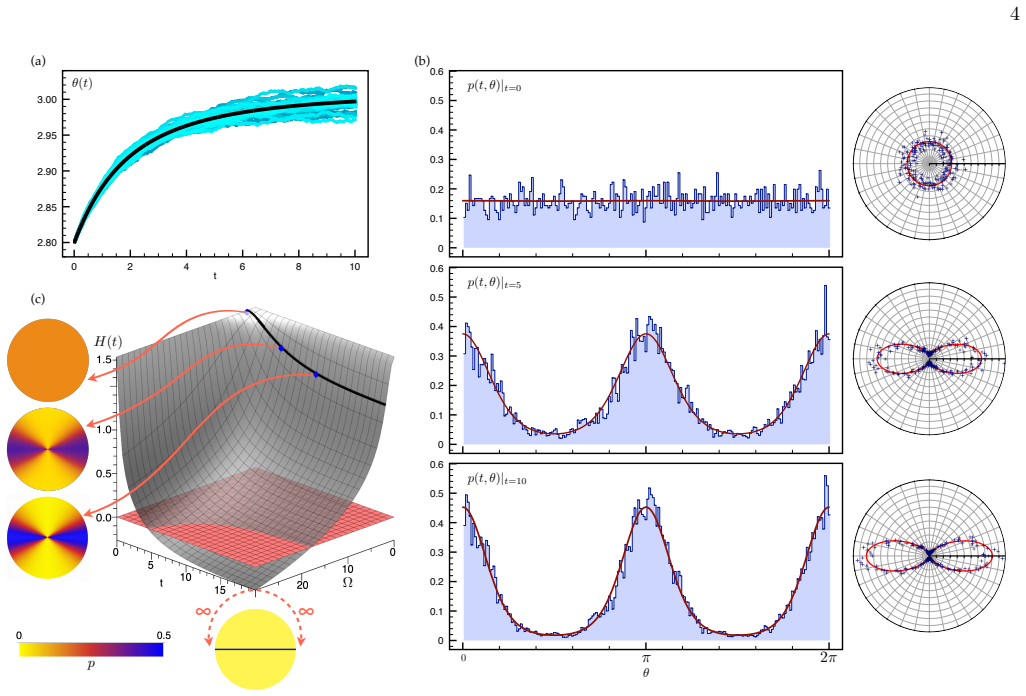
The combined action of Malthusian growth dynamics and the introduction of linear relations governing mechanical remodeling naturally gives rise to generalized bimodal Von Mises distributions as emergent states of living matter. The theory reveals a rotation without rotation mechanism, in which fibers progressively reorient in the absence of angular mechanical coupling via selective deposition and removal along preferred directions. The resulting analytical solutions quantitatively reproduce experimentally observed distributions and establish a direct mechanobiological origin for directional statistics in biological tissues. By interpreting the evolving normalized fiber density as a probabili
Load-bearing premise
Linear relations are assumed to govern mechanical remodeling, and the evolving normalized fiber density is treated as a probability distribution function.
Editorial extensions
If this is right
- Closed-form drift terms for the Fokker-Planck equation follow directly from the remodeling rules.
- Tissue remodeling emerges as the collective result of noisy single-fiber stochastic dynamics.
- A dynamical Shannon entropy can be defined on the normalized fiber density to track the temporal growth of order.
- Analytical solutions for the fiber distributions match quantitative experimental observations.
Reading between the lines
- The same selective-deposition logic could be tested in other fiber systems such as actin networks or plant cell walls under controlled stress.
- Numerical integration of the derived stochastic differential equation would allow simulation of remodeling under time-varying loads not treated in the paper.
- The entropy formulation invites comparison with other nonequilibrium ordering processes in active matter where growth rather than rotation drives alignment.
Editorial analysis
A structured set of objections, weighed in public.
Referee Report
Summary. The manuscript develops a theoretical model for collagen fiber remodeling in living tissues. It asserts that Malthusian growth dynamics combined with introduced linear relations for mechanical remodeling analytically produce generalized bimodal Von Mises distributions as emergent states. This yields a 'rotation without rotation' mechanism via selective fiber deposition and removal without angular coupling. The normalized fiber density is interpreted as a PDF to construct a dynamical Shannon entropy and derive closed-form Fokker-Planck drift terms, leading to an associated stochastic differential equation. The solutions are claimed to quantitatively match experimental fiber orientation distributions.
Significance. If the derivations hold and the linear remodeling relations follow from established biomechanics rather than ansatz, the work would supply a minimal mechanobiological framework connecting growth, remodeling, and nonequilibrium directional statistics, with analytical tractability and explicit stochastic mapping. The entropy and Fokker-Planck formulations could offer falsifiable predictions for temporal evolution of tissue microstructure.
major comments (2)
- [Abstract] Abstract: the central claim that Malthusian growth 'naturally gives rise' to generalized bimodal Von Mises distributions via linear mechanical remodeling relations is load-bearing, yet the abstract presents the linear relations as introduced without an independent constitutive derivation, variational principle, or experimental calibration separate from the target statistics. This leaves open whether the emergence is by construction from the modeling choice rather than from first-principles tissue mechanics.
- [Abstract] Abstract: the mapping of evolving normalized fiber density to a probability distribution function for the dynamical Shannon entropy and Fokker-Planck framework inherits the same premise; without explicit justification that this normalization is dynamically consistent with the growth-remodeling equations, the stochastic interpretation and drift expressions rest on an unverified step.
minor comments (1)
- [Abstract] Abstract: the phrase 'quantitatively reproduce experimentally observed distributions' should be supported by explicit comparison metrics or figures in the main text; the abstract alone does not specify error measures or which experiments are matched.
Simulated Author's Rebuttal
We thank the referee for the careful reading and constructive comments. We address the two major comments point by point below.
read point-by-point responses
-
Referee: [Abstract] Abstract: the central claim that Malthusian growth 'naturally gives rise' to generalized bimodal Von Mises distributions via linear mechanical remodeling relations is load-bearing, yet the abstract presents the linear relations as introduced without an independent constitutive derivation, variational principle, or experimental calibration separate from the target statistics. This leaves open whether the emergence is by construction from the modeling choice rather than from first-principles tissue mechanics.
Authors: We agree that the linear remodeling relations are introduced as constitutive assumptions rather than derived from a variational principle within this manuscript. They are the simplest form consistent with linear mechanobiological response, in which fiber deposition and removal rates depend linearly on local mechanical stimulus; this is a standard modeling choice in the field that permits closed-form solutions. The emergence of the generalized bimodal Von Mises distributions is then a mathematical consequence of combining these relations with Malthusian growth, without requiring additional angular coupling. We will revise the abstract to state this modeling premise more explicitly and will add a new subsection in the revised manuscript that motivates the linear form from established biomechanics literature and discusses routes to experimental calibration. revision: partial
-
Referee: [Abstract] Abstract: the mapping of evolving normalized fiber density to a probability distribution function for the dynamical Shannon entropy and Fokker-Planck framework inherits the same premise; without explicit justification that this normalization is dynamically consistent with the growth-remodeling equations, the stochastic interpretation and drift expressions rest on an unverified step.
Authors: The normalization step is dynamically consistent because the total (orientation-integrated) fiber density obeys the Malthusian growth equation independently of orientation; dividing the orientation-dependent density by this total therefore yields a probability density whose evolution is closed under the remodeling terms. We will insert an explicit derivation of this consistency, together with verification that the resulting Fokker-Planck drift terms are obtained directly from the deterministic equations, in the revised manuscript. revision: yes
Circularity Check
Linear remodeling relations introduced to produce target Von Mises distributions
-
other
[Abstract]
"we demonstrate analytically that the combined action of Malthusian growth dynamics and the introduction of linear relations governing mechanical remodeling naturally gives rise to generalized bimodal Von Mises distributions as emergent states of living matter."
The linear relations are explicitly introduced as part of the model setup. The paper then claims this combination produces the target distributions as an emergent result. Because the linearity is selected to close the equations onto Von Mises form (as implied by the analytic demonstration and 'introduction' phrasing), the claimed natural emergence reduces to the modeling choice rather than an independent derivation from tissue mechanics.
full rationale
The paper's central claim rests on introducing linear relations for mechanical remodeling, then stating that Malthusian growth plus these relations 'naturally gives rise' to generalized bimodal Von Mises distributions. The abstract presents the linearity as an introduced modeling choice rather than a derived constitutive law from independent biomechanics. This makes the emergence of the specific distributions dependent on the ansatz chosen for analytic solvability, reducing the 'natural' origin claim to a modeling selection. The subsequent interpretation of normalized fiber density as a PDF for entropy/Fokker-Planck inherits the same premise. No self-citation chain or external uniqueness theorem is invoked here, but the load-bearing step is the un-derived linearity assumption.
Assumptions & free parameters
assumptions (2)
- domain assumption Malthusian growth dynamics apply to fiber populations in tissues
- ad hoc to paper Linear relations govern mechanical remodeling
Cite this review
Pith. "Pith review of The Remodeling of Fiber Distributions in Biological Tissues: Rotation without Rotation." pith.science (2026). https://pith.science/paper/G56HDZZD
@misc{pith2026260525732,
  author       = {Pith},
  title        = {Pith review of: The Remodeling of Fiber Distributions in Biological Tissues: Rotation without Rotation},
  year         = {2026},
  howpublished = {\url{https://pith.science/paper/G56HDZZD}},
  note         = {Machine review of arXiv:2605.25732}
}
read the original abstract
Collagen remodeling in living tissues exhibits anisotropic orientation patterns commonly described by Von Mises distributions, yet the physical origin of such nonequilibrium organization remains unresolved. In the present work, we demonstrate analytically that the combined action of Malthusian growth dynamics and the introduction of linear relations governing mechanical remodeling naturally gives rise to generalized bimodal Von Mises distributions as emergent states of living matter. The theory reveals a {\it rotation without rotation} mechanism, in which fibers progressively reorient in the absence of angular mechanical coupling via selective deposition and removal along preferred directions. The resulting analytical solutions quantitatively reproduce experimentally observed distributions and establish a direct mechanobiological origin for directional statistics in biological tissues. By interpreting the evolving normalized fiber density as a probability distribution function, we formulate a dynamical Shannon entropy framework that captures the temporal emergence of microstructural organization. The theory further yields closed-form expressions for the drift of the associated Fokker--Planck equation, enabling the corresponding stochastic differential equation to be derived, thus revealing that tissue remodeling is the collective outcome of noisy single-fiber dynamics. These results establish a minimal theoretical framework that connects biomechanics, stochastic processes, and nonequilibrium statistical organization in living matter.
Figures

Reference graph
Works this paper leans on
-
[1]
Lo Buglio, A
G. Lo Buglio, A. Lo Cicero, S. Campora, and G. Ghersi, International Journal of Molecular Sciences25, 13523 (2024)
2024
-
[2]
Ettema, V
L. Ettema, V. Maˇ zeika, M. Alizadeh,et al., Scientific Reports16, 1047 (2026)
2026
-
[3]
M. Ueda, S. Saito, T. Murata, T. Hirano, R. Bise, K. Kabashima, and S. Suzuki, Scientific Reports9, 10644 (2019)
2019
-
[4]
Turˇ canov´ a, J
M. Turˇ canov´ a, J. Fischer, M. Hermanov´ a, Z. Bednaˇ r´ ık, P. Sk´ acel, and J. Burˇ sa, Journal of Biomechanics161, 111868 (2023)
2023
-
[5]
G. A. Holzapfel, R. Ogden, and S. Sherifova, Proceedings of the Royal Society A475, 20180736 (2019)
2019
-
[6]
A. J. Schriefl, A. J. Reinisch, S. Sankaran, D. M. Pierce, and G. A. Holzapfel, Journal of the Royal Society Inter- face9, 3081 (2012)
2012
-
[7]
Gizzi, C
A. Gizzi, C. J. Cyron, C. Falcinelli, and M. Vasta, Jour- nal of the Mechanics and Physics of Solids183, 105491 (2024)
2024
-
[8]
C. J. Cyron, R. C. Aydin, and J. D. Humphrey, Biomechanics and Modeling in Mechanobiology15, 1389 (2016)
2016
Show all 25 references
-
[9]
Zwiebach,A First Course in String Theory(Cam- bridge University Press, Cambridge, 2004)
B. Zwiebach,A First Course in String Theory(Cam- bridge University Press, Cambridge, 2004)
2004
-
[10]
J. D. Murray,Mathematical Biology I: An Introduction, 3rd ed. (Springer, New York, 2001)
2001
-
[11]
Miller and T
C. Miller and T. C. Gasser, Journal of the Mechanics and Physics of Solids154, 104500 (2021)
2021
-
[12]
Y. C. Fung, Annals of Biomedical Engineering19, 3 (1991)
1991
-
[13]
K. V. Mardia and P. E. Jupp,Directional Statistics(Wi- ley, Chichester, 2009)
2009
-
[14]
J. D. Humphrey, E. R. Dufresne, and M. A. Schwartz, Nature Reviews Molecular Cell Biology15, 802 (2014)
2014
-
[15]
J. D. Griffiths and D. F. Schroeter,Introduction to Quan- tum Mechanics, 3rd ed. (Cambridge University Press, Cambridge, 2018)
2018
-
[16]
Gardiner,Stochastic Methods: A Handbook for the Natural and Social Sciences, 4th ed
C. Gardiner,Stochastic Methods: A Handbook for the Natural and Social Sciences, 4th ed. (Springer, Berlin, 2009)
2009
-
[17]
A. L. Krause, A. M. Burton, N. T. Fadai, and R. A. Van Gorder, Physical Review E97, 042215 (2018)
2018
-
[18]
D. R. Brillinger, Journal of Theoretical Probability10, 429 (1997)
1997
-
[19]
H. B. Van Lengerich, arXiv preprint arXiv:2001.02357 (2020)
2001
-
[20]
V. I. Bogachev and S. V. Shaposhnikov, Journal of Evo- lution Equations25, 20 (2025)
2025
-
[21]
Dupire, Risk7, 18 (1994)
B. Dupire, Risk7, 18 (1994)
1994
-
[22]
K. V. Mardia, Journal of the Royal Statistical Society Series B37, 371 (1975)
1975
-
[23]
C. E. Shannon, Bell System Technical Journal27, 379 (1948)
1948
-
[24]
Apaza and M
L. Apaza and M. Sandoval, Physical Review E96, 022606 (2017)
2017
-
[25]
Giammarini, A
A. Giammarini, A. Pastore, and A. Grillo, Mathematics and Mechanics of Solids30, 1 (2025)
2025
Reviewed June 29, 2026 · model on record in the stance chip above.
Discussion (0). Sign in to comment.