REVIEW 3 major objections 1 minor 4 references
Lithium-rich M-dwarfs at the ZAMS: Evidence for planetary engulfment?
T0 review · 3 major / 1 minor · reviewed 2026-06-29 · grok-4.3
Pith's one-line read Early M-dwarfs in young clusters show lithium enrichment consistent with engulfing 3-10 Earth masses of planetary material.
desk verdict The paper flags six Li-rich early M-dwarfs in 50-200 Myr clusters at 2-3% occurrence and links them to 3-10 Earth-mass engulfment, but the age assignments rest on standard isochrones that may not hold for active stars. read the letter →
The pith
A machine-rendered reading of the paper's core claim, the machinery that carries it, and where it could break.
The reading
What carries the argument
The central mechanism is the delivery of lithium via engulfment of planetary material after radiative core formation stops the efficient pre-main-sequence lithium burning in M-dwarfs.
What would settle it
High-resolution spectroscopy or astrometry revealing that the outliers are not cluster members at the stated ages or showing chemical patterns inconsistent with volatile-depleted material.
Extended reading notes
Core claim
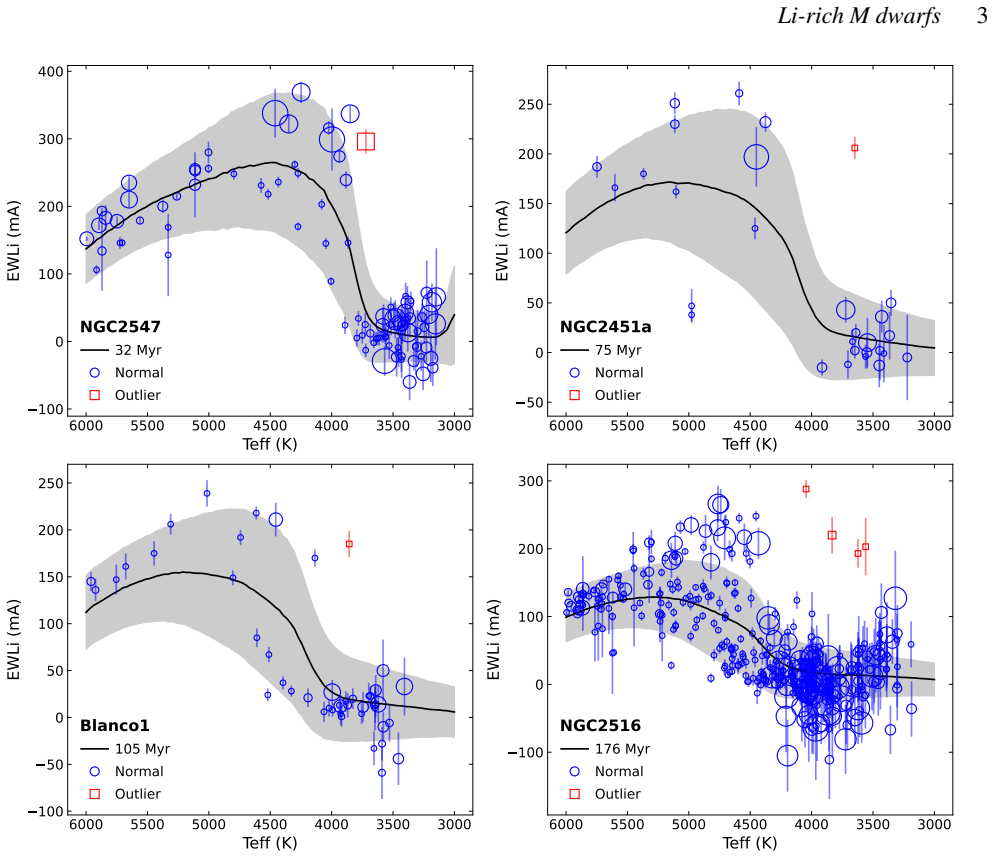
The paper claims that the lithium-rich early M-dwarfs identified in clusters at 50-200 Myr are explained by the engulfment of 3-10 Earth masses of volatile-depleted planetary material after the formation of a radiative core has ended rapid pre-main sequence lithium depletion. The outliers represent 2-3 per cent of stars in the temperature range 3560-4045 K and are otherwise normal cluster members.
Load-bearing premise
The six lithium-rich stars are genuine cluster members at the quoted ages and their lithium excess cannot be produced by any mechanism other than planetary engulfment.
Editorial extensions
If this is right
- The observed occurrence rate sets a lower limit on the frequency of engulfment events between ages of roughly 30-200 Myr.
- This frequency depends on the timescale of ongoing lithium depletion at the zero-age main sequence.
- Planetary formation simulations with dynamical interactions are consistent with such engulfment events.
- The prevalence of close-in Earth-like planets around M-dwarfs supports the availability of material for engulfment.
Reading between the lines
- If the interpretation holds, dynamical instabilities causing engulfment would affect a few percent of M-dwarf planetary systems in the first 200 Myr.
- Lithium abundance could serve as an observable tracer for recent engulfment events in field M-dwarfs beyond clusters.
- Engulfment might leave detectable imprints on surface metallicity or rotation that could be tested with larger samples.
Signed reviews
Editorial analysis
A structured set of objections, weighed in public.
Referee Report
Summary. The manuscript identifies six early M-dwarfs in three open clusters (NGC 2451a, Blanco 1, NGC 2516) at ages 50-200 Myr that show anomalously high lithium abundances relative to cluster siblings of similar T_eff (3560-4045 K). These stars are otherwise indistinguishable in CMD position, parallax, and kinematics from other members, with only one showing binarity evidence and all being slow rotators. The Li excess is interpreted as consistent with engulfment of 3-10 M_⊕ of volatile-depleted planetary material after radiative-core formation ends rapid pre-MS depletion; the 2-3% occurrence rate is presented as a lower limit to the frequency of such events between ~30-200 Myr, supported by reference to published dynamical engulfment simulations and the prevalence of close-in Earth-like planets around M-dwarfs.
Significance. If the age assignments and exclusion of alternative explanations hold, the result supplies a concrete observational signature linking lithium anomalies in young M-dwarfs to planetary engulfment, with direct implications for dynamical migration and planet-star interactions in the 30-200 Myr window. The work leverages well-characterized clusters and external formation models to generate a falsifiable prediction for the frequency of engulfment events; the explicit framing as a lower limit and the use of multiple independent clusters are positive features that facilitate follow-up abundance and activity studies.
major comments (3)
- [CMD membership and age arguments] CMD membership section: The claim that absolute CMD positions rule out younger Li-rich interlopers rests on standard (non-magnetic) isochrones. Pre-MS M-dwarf models that incorporate 30-50% spot filling factors or magnetic inflation are known to shift 10-30 Myr tracks into the observed locus within typical photometric errors; a quantitative test with activity-adjusted isochrones is required to confirm that none of the six outliers remain compatible with ages ≪ 50 Myr, as this directly underpins the assertion that rapid pre-MS Li depletion has already ended.
- [Li abundance analysis and engulfed-mass estimate] Abundance and model comparison section: The statement that the Li enhancements are 'consistent with' engulfment of 3-10 M_⊕ is derived from external depletion models rather than a self-consistent fit to the observed data. No table of measured equivalent widths, derived A(Li) values with uncertainties, or explicit exclusion of alternative mixing mechanisms (e.g., rotationally induced or convective overshoot) is provided; without these, the central interpretation remains qualitative and the error budget on the engulfed-mass range is unclear.
- [Discussion of occurrence rate] Occurrence-rate paragraph: The 2-3% fraction is stated to be a lower limit that 'depends on the timescale for ongoing Li depletion at the ZAMS,' yet no completeness correction, selection-function modeling, or Poisson/statistical uncertainty is reported. This omission limits the quantitative weight that can be attached to the implied frequency of engulfment events between 30-200 Myr.
minor comments (1)
- [Abstract] The abstract refers to the stars as 'slow rotators' without citing specific v sin i or period measurements; a brief reference to the relevant table or figure would improve traceability.
Simulated Author's Rebuttal
We thank the referee for their constructive and detailed report. We address each of the three major comments below, indicating where revisions will be made to strengthen the manuscript.
read point-by-point responses
-
Referee: [CMD membership and age arguments] CMD membership section: The claim that absolute CMD positions rule out younger Li-rich interlopers rests on standard (non-magnetic) isochrones. Pre-MS M-dwarf models that incorporate 30-50% spot filling factors or magnetic inflation are known to shift 10-30 Myr tracks into the observed locus within typical photometric errors; a quantitative test with activity-adjusted isochrones is required to confirm that none of the six outliers remain compatible with ages ≪ 50 Myr, as this directly underpins the assertion that rapid pre-MS Li depletion has already ended.
Authors: We agree that magnetic inflation and spot coverage can affect pre-MS isochrone positions for M-dwarfs. Our original analysis used standard PARSEC isochrones to demonstrate incompatibility with ages ≪50 Myr. To address this directly, the revised manuscript will include a quantitative comparison using magnetic models with 30-50% spot filling factors. We expect this test to confirm the conclusion, but will report the results explicitly. revision: yes
-
Referee: [Li abundance analysis and engulfed-mass estimate] Abundance and model comparison section: The statement that the Li enhancements are 'consistent with' engulfment of 3-10 M_⊕ is derived from external depletion models rather than a self-consistent fit to the observed data. No table of measured equivalent widths, derived A(Li) values with uncertainties, or explicit exclusion of alternative mixing mechanisms (e.g., rotationally induced or convective overshoot) is provided; without these, the central interpretation remains qualitative and the error budget on the engulfed-mass range is unclear.
Authors: The mass estimates rely on published depletion models applied to the observed abundances. We will add a table of equivalent widths, A(Li) values, and uncertainties for the six stars and the comparison sample. We will also expand the discussion to explicitly address why rotationally induced mixing is unlikely (given the slow rotation) and why convective overshoot is limited post-radiative-core formation. A full self-consistent evolutionary fit lies outside the scope of this observational study. revision: partial
-
Referee: [Discussion of occurrence rate] Occurrence-rate paragraph: The 2-3% fraction is stated to be a lower limit that 'depends on the timescale for ongoing Li depletion at the ZAMS,' yet no completeness correction, selection-function modeling, or Poisson/statistical uncertainty is reported. This omission limits the quantitative weight that can be attached to the implied frequency of engulfment events between 30-200 Myr.
Authors: The 2-3% is the raw observed fraction in the three clusters, presented as a lower limit. We will add Poisson uncertainties to this fraction and a short discussion of the selection function and cluster completeness in the relevant magnitude range. A full statistical completeness model is not possible with the existing data but the limitations will be stated clearly. revision: yes
Circularity Check
Minor self-citation present but central claims rely on external models and independent data
full rationale
The paper identifies Li-rich M-dwarfs via cluster membership (parallaxes, kinematics, CMD positions using standard isochrones) and interprets their abundances by direct comparison to external lithium-depletion models and published planetary formation simulations. The 3-10 M_⊕ engulfed-mass range is obtained from those external benchmarks rather than any internal fit or self-definition. No load-bearing step reduces by construction to a self-citation chain, fitted parameter renamed as prediction, or ansatz smuggled from the authors' prior work; the derivation chain remains self-contained against external benchmarks and falsifiable data.
Assumptions & free parameters
free parameters (1)
- engulfed planetary mass =
3-10 M_earth
assumptions (2)
- domain assumption Standard models of pre-main-sequence lithium depletion in early M-dwarfs
- domain assumption Cluster ages 50-200 Myr and secure membership from kinematics and CMD position
Cite this review
Pith. "Pith review of Lithium-rich M-dwarfs at the ZAMS: Evidence for planetary engulfment?." pith.science (2026). https://pith.science/paper/VWQDCKHM
@misc{pith2026260525747,
  author       = {Pith},
  title        = {Pith review of: Lithium-rich M-dwarfs at the ZAMS: Evidence for planetary engulfment?},
  year         = {2026},
  howpublished = {\url{https://pith.science/paper/VWQDCKHM}},
  note         = {Machine review of arXiv:2605.25747}
}
abstract
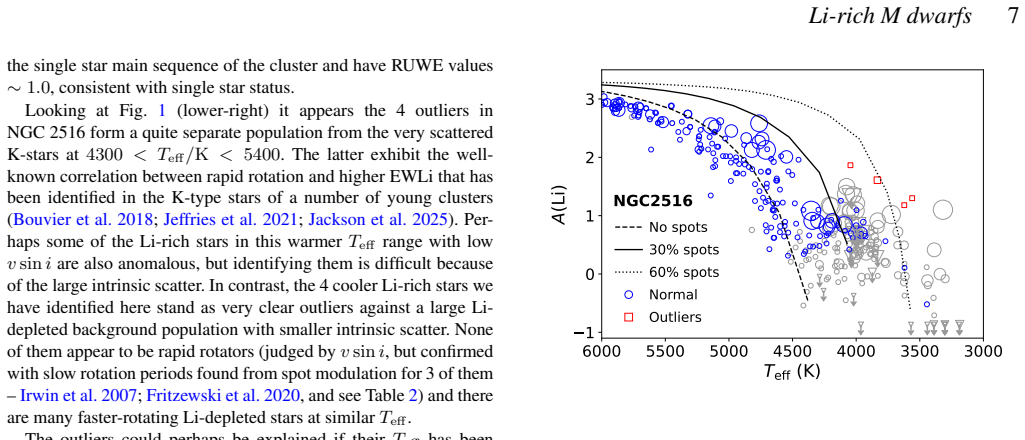
We identify 6 early M-dwarfs, in 3 open clusters (NGC 2451a, Blanco 1 and NGC 2516) at ages of 50-200 Myr, that are anomalously enriched in lithium compared with Li-depleted siblings of similar spectral type. The Li-rich outliers represent 2-3 per cent of stars with $3560 < T_{\rm eff}/{\rm K} < 4045$ in clusters at those ages but are otherwise indistinguishable in their positions, parallaxes and kinematics from other cluster members; their placement in absolute colour-magnitude diagrams is incompatible with being much younger Li-rich interlopers, only one shows evidence of binarity and they are all slow rotators. The enhanced Li abundances are consistent with the engulfment of 3-10 $M_\oplus$ of volatile-depleted planetary material after the formation of a radiative core has ended rapid pre main sequence Li depletion. Published planetary formation simulations featuring engulfment via dynamical interactions, and the preponderance of Earth-like exoplanets in close orbits around M-dwarfs, offer some support to this scenario. The observed occurrence rate would be a lower limit to the frequency with which such engulfment events occur between ages of $\sim (30-200)$ Myr, that depends in the timescale for ongoing Li depletion at the ZAMS.
Figures


Figures from the paper (3 more)


Reference graph
Works this paper leans on
-
[1]
The Long-Term Dynamical Evolution of Planetary Systems
Ahuir J., Strugarek A., Brun A. S., Mathis S., 2021, A&A, 650, A126 Allard F., Homeier D., Freytag B., 2012, Philosophical Transactions of the Royal Society of London Series A, 370, 2765 Armitage P. J., Clarke C. J., 1996, MNRAS, 280, 458 Ashwell J. F., Jeffries R. D., Smalley B., Deliyannis C. P., Steinhauer A., King J. R., 2005, MNRAS, 363, L81 Baraffe ...
work page Pith review arXiv doi:10.2458/azu_uapress_9780816531240- 2021
-
[2]
and Vista Hemisphere Survey (J Ks, McMahon et al. 2013). The SEDs were modelled us- ing theBT-SETTL CIFISTatmospheres (Allard et al
2013
-
[3]
Virtual Observatory SED Analyzer
imple- mented as part of the “Virtual Observatory SED Analyzer" (VOSA) tool (Bayo et al. 2008). The free parameters wereT eff and the ex- tinction, whilstloggwas fixed at 4.5 and the metallicity at the solar composition (defined by Caffau et al. 2011). The Bayes analysis fit- ting mode was used. All of the SEDs were well-modelled by the chosen atmospheres...
2008
-
[4]
Isochrones of Li depletion from theSPOTS models of Somers et al
The points shaded in grey are those which have an EWLi smaller than twice its error bar and which arguably should also be treated as upper limits (see §4.1). Isochrones of Li depletion from theSPOTS models of Somers et al. (2020), at the nominal age of the cluster, are shown for spot areal coverage fractions of 0, 30 and 60 per cent. MNRAS000, 1–14 (2026)
2020
Reviewed June 29, 2026 · model on record in the stance chip above.
Discussion (0). Continue with ORCID to comment.