Topological fragility and bilinear magnetoelectric resistance in gapless edge states
Pith reviewed 2026-06-29 20:36 UTC · model grok-4.3
The pith
Gapless 1D edge states in topological insulators exhibit bilinear magnetoelectric resistance much larger than in 2D systems when a modest magnetic field is applied.
A machine-rendered reading of the paper's core claim, the machinery that carries it, and where it could break.
Core claim
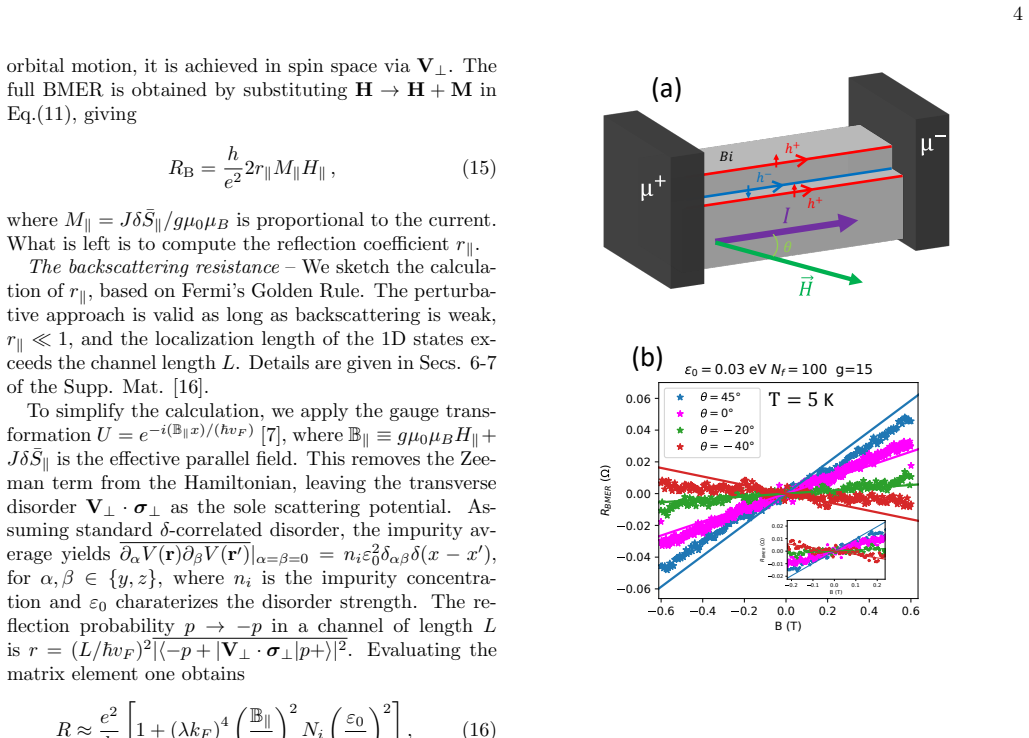
In time-reversal symmetric systems, 1D spin-momentum locked edge states exhibit a bilinear magnetoelectric resistance significantly larger than in 2D systems. This requires spin-momentum locking to maximize time-reversal symmetry breaking in the nonlinear regime together with random spin-orbit interaction, which together generate a robust backscattering channel under a modest external magnetic field. The account needs no gap opening or complex many-body effects and quantitatively explains observations in bismuth hinge states.
What carries the argument
Bilinear magnetoelectric resistance generated when spin-momentum locking combines with random spin-orbit interaction to produce backscattering in a magnetic field.
If this is right
- The resistance effect appears at modest magnetic fields and scales bilinearly with field strength.
- The magnitude is substantially larger in 1D edge states than in corresponding 2D systems.
- The same ingredients explain the resistances measured in bismuth hinge states.
- The backscattering channel forms without requiring the opening of an energy gap.
Where Pith is reading between the lines
- The fragility could limit the use of edge states in low-dissipation devices that must operate in small magnetic fields.
- Systems with weaker random spin-orbit coupling might show reduced resistance under the same conditions.
- The bilinear form predicts a specific field dependence that could be checked by sweeping the magnetic field at fixed current.
Load-bearing premise
Random spin-orbit interaction combined with spin-momentum locking generates a robust backscattering channel in a modest external magnetic field without any gap opening or complex many-body effects.
What would settle it
Measurement showing that resistance in these edge states remains independent of magnetic field strength or shows no bilinear dependence despite the presence of random spin-orbit interaction would falsify the mechanism.
Figures
read the original abstract
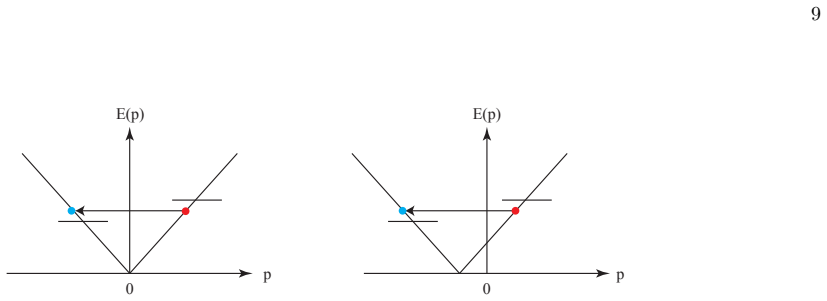
In time-reversal symmetric systems such as topological and higher-order topological insulators, 1D spin-momentum locked edge and hinge states are theoretically ``perfectly conducting'', being immune to backscattering by non-magnetic disorder. Here, we reveal a fundamental ``topological fragility'': these states exhibit a bilinear magnetoelectric resistance significantly larger than in 2D systems. This effect requires two ingredients: (i) spin-momentum locking, which maximizes time-reversal symmetry breaking in the non-linear regime, and (ii) random spin-orbit interaction -- the same mechanism behind Elliott - Yafet spin relaxation in heavy elements. Together, these generate a robust backscattering channel when a modest external magnetic field is applied. Our theory requires no gap opening or complex many-body effects, offering a simple and general mechanism that quantitatively explains recent observations in Bismuth hinge states.
Editorial analysis
A structured set of objections, weighed in public.
Referee Report
Summary. The paper claims that 1D spin-momentum-locked edge/hinge states in time-reversal-symmetric topological insulators, conventionally viewed as perfectly conducting, exhibit a 'topological fragility' manifested as bilinear magnetoelectric resistance that is significantly larger than in 2D systems. The effect is generated by the combination of spin-momentum locking (maximizing TRS breaking in the nonlinear regime) and random spin-orbit interaction (the Elliott-Yafet mechanism), which together produce a robust backscattering channel under modest external B without gap opening or many-body effects; the theory is presented as parameter-free and quantitatively accounts for recent Bismuth hinge-state observations.
Significance. If the central derivation is correct, the result identifies a symmetry-based, perturbative channel that limits the ideal conductivity of helical 1D states while preserving their gapless character. It supplies a concrete, falsifiable link between the Elliott-Yafet spin-relaxation mechanism and nonlinear magnetotransport, offers a simple explanation for existing experiments, and carries implications for the design of topological interconnects. The absence of ad-hoc parameters and the explicit connection to established spin-relaxation physics are notable strengths.
major comments (1)
- [Abstract, final paragraph; §3] Abstract (final paragraph) and §3 (mechanism derivation): The central claim that the backscattering channel remains elastic and gapless rests on the assertion that random SOI plus Zeeman term from modest B does not generate an effective mass or pinned phase. In a helical Luttinger liquid any backscattering operator is RG-relevant; the manuscript must supply the explicit perturbative or symmetry argument showing why higher-order virtual processes or finite-disorder renormalization do not open a gap, as this step is load-bearing for the 'gapless edge states' part of the title and abstract.
minor comments (2)
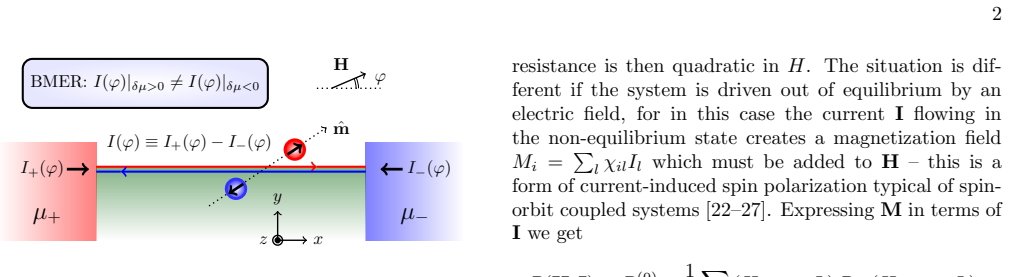
- [§2] Notation for the bilinear magnetoelectric resistance coefficient is introduced without a clear definition of the current and field directions relative to the edge; a short schematic or coordinate convention would improve readability.
- [§4] The quantitative comparison to 2D systems is stated as 'significantly larger' but lacks an explicit numerical factor or table entry; adding the ratio derived from the model would strengthen the claim.
Simulated Author's Rebuttal
We thank the referee for the careful reading, the recognition of the work's significance, and the constructive major comment. We address the point below and will revise the manuscript accordingly.
read point-by-point responses
-
Referee: [Abstract, final paragraph; §3] Abstract (final paragraph) and §3 (mechanism derivation): The central claim that the backscattering channel remains elastic and gapless rests on the assertion that random SOI plus Zeeman term from modest B does not generate an effective mass or pinned phase. In a helical Luttinger liquid any backscattering operator is RG-relevant; the manuscript must supply the explicit perturbative or symmetry argument showing why higher-order virtual processes or finite-disorder renormalization do not open a gap, as this step is load-bearing for the 'gapless edge states' part of the title and abstract.
Authors: We agree this clarification is necessary. In §3 the backscattering is obtained from second-order virtual processes in which the random SOI (Elliott-Yafet) mediates a spin flip while the Zeeman term supplies the time-reversal-odd component; the resulting operator is elastic because the intermediate states lie off-shell by an energy set by the SOI strength, not by a gap at the Fermi level. Because the effective amplitude scales linearly with B, it remains perturbatively small for modest fields. The random character of the SOI further ensures that any putative phase-pinning term averages to zero upon disorder averaging, preventing the generation of a relevant mass operator. We will add to the revised §3 an explicit perturbative expansion together with a symmetry argument showing that the composite operator respects the gapless condition to leading order in B and disorder; a brief RG estimate will confirm that the flow stays weak on the scales set by the mean free path. These additions will be confined to the mechanism section and will not alter the quantitative predictions or the abstract. revision: yes
Circularity Check
No circularity: derivation self-contained via symmetry and known mechanisms
full rationale
The abstract and provided context present a mechanism relying on spin-momentum locking plus random SOI (Elliott-Yafet) to generate backscattering in modest B without gap opening. No equations, fitted parameters, or self-citations are quoted that reduce any prediction to inputs by construction. The central claim rests on perturbative symmetry arguments and external observations in Bismuth, with no load-bearing self-definition, ansatz smuggling, or renaming of known results evident from the given text. This is the normal case of an independent theoretical proposal.
Axiom & Free-Parameter Ledger
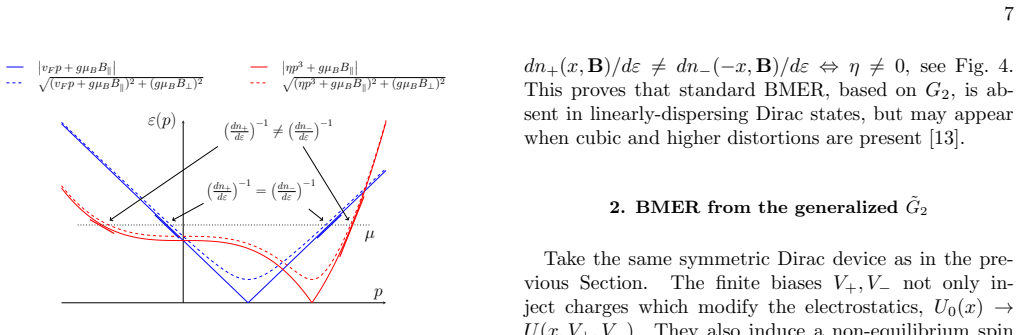
axioms (2)
- domain assumption 1D edge and hinge states in time-reversal symmetric topological insulators are spin-momentum locked and immune to backscattering by non-magnetic disorder
- ad hoc to paper Random spin-orbit interaction generates backscattering when combined with spin-momentum locking under modest magnetic field
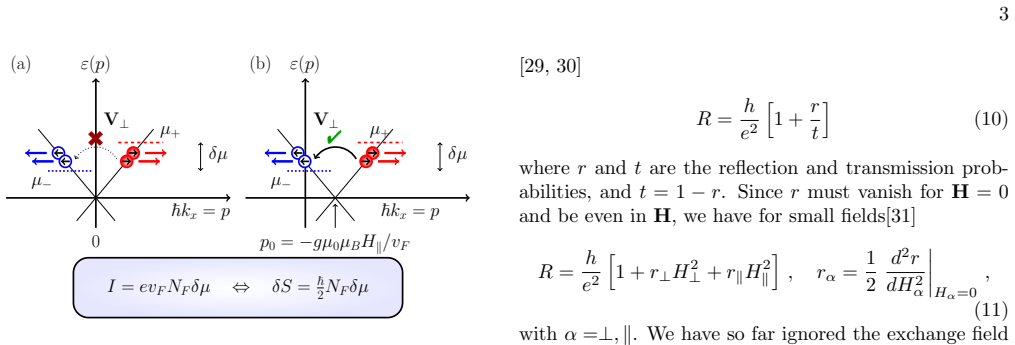
Reference graph
Works this paper leans on
-
[1]
topological fragility
yield anetBMER given by RBi B ≈ δM M 2 RB .(18) To estimate the exchange constantJ, which controls the energy splitting between up and down spin states, we proceed by neglecting numerical factors of order 1. On dimensional grounds,J=αε/n 1D, withα, ε, n 1D respectively an effective fine structure constant, a rel- evant energy scale and a 1D density. The c...
-
[2]
M. Z. Hasan and C. L. Kane, Rev. Mod. Phys.82, 3045 (2010)
2010
-
[3]
Schindler, A
F. Schindler, A. M. Cook, M. G. Vergniory, Z. Wang, S. S. P. Parkin, B. A. Bernevig, and T. Neupert, Science Advances4, eaat0346 (2018)
2018
-
[4]
Schindler, Z
F. Schindler, Z. Wang, M. G. Vergniory, A. M. Cook, A. Murani, S. Sengupta, A. Y. Kasumov, R. Deblock, S. Jeon, I. Drozdov, H. Bouchiat, S. Gu´ eron, A. Yazdani, B. A. Bernevig, and T. Neupert, Nature Phys.14, 918 (2018)
2018
-
[5]
Geier, L
M. Geier, L. Trifunovic, M. Hoskam, and P. W. Brouwer, Phys. Rev. B97, 205135 (2018)
2018
-
[6]
P. He, S. S. Zhang, D. Zhu, Y. Liu, Y. Wang, J. Yu, G. Vignale, and H. Yang, Nature Phys.14, 495 (2018)
2018
-
[7]
P. He, S. S.-L. Zhang, D. Zhu, S. Shi, O. G. Heinonen, G. Vignale, and H. Yang, Phys. Rev. Lett.123, 016801 (2019)
2019
-
[8]
Dyrda l, J
A. Dyrda l, J. Barna´ s, and A. Fert, Phys. Rev. Lett.124, 046802 (2020)
2020
-
[9]
W. Zhao, Z. Fei, T. Song, H. K. Choi, T. Palomaki, B. Sun, P. Malinowski, M. A. McGuire, J.-H. Chu, X. Xu, and D. H. Cobden, Nat. Mater.19, 503 (2020)
2020
-
[10]
W. Zhao, E. Runburg, Z. Fei, J. Mutch, P. Malinowski, 6 B. Sun, X. Huang, D. Pesin, Y.-T. Cui, X. Xu, J.-H. Chu, and D. H. Cobden, Phys. Rev. X11, 041034 (2021)
2021
-
[11]
C. Wu, B. A. Bernevig, and S.-C. Zhang, Phys. Rev. Lett.96, 106401 (2006)
2006
-
[12]
Magnetochiral anisotropy on a quantum spin hall edge,
Y. Chen, G. Quaresima, W. Zhao, E. Runburg, D. Cob- den, and D. A. Pesin, “Magnetochiral anisotropy on a quantum spin hall edge,” (2024), arXiv:2407.16023 [cond-mat]
-
[13]
T. L. Schmidt, S. Rachel, F. von Oppen, and L. I. Glaz- man, Phys. Rev. Lett.108, 156402 (2012)
2012
-
[14]
A. C. Balram, K. Flensberg, J. Paaske, and M. S. Rud- ner, Phys. Rev. Lett.123, 246803 (2019)
2019
-
[15]
Meservey and P
R. Meservey and P. M. Tedrow, Phys. Rev. Lett.41, 805 (1978)
1978
-
[16]
Y. F. Komnik, I. B. Berkutov, and V. V. Andrievskii, Low Temperature Physics31, 326 (2005)
2005
-
[17]
See Supplemental Material at [url].,
-
[18]
Revealing helical states in crystalline bismuth joseph- son junctions via non reciprocal magnetotransport,
M. Bard, A. Bernard, A. Kasumov, F. Fortuna, M. Fer- rier, R. Deblock, F. Brisset, N. Finding, G. Patriarche, E. Gerber, B. Wieder, S. Gu´ eron, and H. Bouchiat, “Revealing helical states in crystalline bismuth joseph- son junctions via non reciprocal magnetotransport,” In preparation
-
[19]
S´ anchez and M
D. S´ anchez and M. B¨ uttiker, Phys. Rev. Lett.93, 106802 (2004)
2004
-
[20]
L¨ ofgren, C
A. L¨ ofgren, C. A. Marlow, I. Shorubalko, R. P. Taylor, P. Omling, L. Samuelson, and H. Linke, Phys. Rev. Lett. 92, 046803 (2004)
2004
-
[21]
Spivak and A
B. Spivak and A. Zyuzin, Phys. Rev. Lett.93, 226801 (2004)
2004
-
[22]
Angers, E
L. Angers, E. Zakka-Bajjani, R. Deblock, S. Gu´ eron, H. Bouchiat, A. Cavanna, U. Gennser, and M. Polianski, Phys. Rev. B75, 115309 (2007)
2007
-
[23]
E. L. Ivchenko and G. E. Pikus, Soviet Journal of Exper- imental and Theoretical Physics Letters27, 604 (1978)
1978
-
[24]
L. E. Vorob’ev, E. L. Ivchenko, G. E. Pikus, I. I. Farb- shteˇin, V. A. Shalygin, and A. V. Shturbin, Soviet Jour- nal of Experimental and Theoretical Physics Letters29, 441 (1979)
1979
-
[25]
A. G. Aronov and Y. B. Lyanda-Geller, JETP Lett.50, 431 (1989)
1989
-
[26]
V. M. Edelstein, Solid State Commun.73, 233 (1990)
1990
-
[27]
Y. K. Kato, R. C. Myers, A. C. Gossard, and D. D. Awschalom, Phys. Rev. Lett.93, 176601 (2004)
2004
-
[28]
Gorini, A
C. Gorini, A. Maleki Sheikhabadi, K. Shen, I. V. Tokatly, G. Vignale, and R. Raimondi, Phys. Rev. B95, 205424 (2017)
2017
-
[29]
We assume that the system equilibrates to the state of minimum energy in the presence of the magnetizing field before any current is driven in the channel
-
[30]
Datta,Electronic Transport in Mesoscopic Systems (Cambridge University Press, Cambridge, 1995)
S. Datta,Electronic Transport in Mesoscopic Systems (Cambridge University Press, Cambridge, 1995)
1995
-
[31]
P. A. Mello and N. Kumar,Quantum Transport in Meso- scopic Systems(Oxford University Press, Oxford, 2004)
2004
-
[32]
To focus on the essentials without overburdening the no- tation we assume a diagonalr ij
-
[33]
Corrections in the form of orthogonal components may be generated by subleading mechanisms [27, 39] which we neglect
-
[34]
C. A. Marlow, R. P. Taylor, M. Fairbanks, I. Shorubalko, and H. Linke, Phys. Rev. Lett.96, 116801 (2006)
2006
-
[35]
C. Li, A. Kasumov, A. Murani, S. Sengupta, F. For- tuna, K. Napolskii, D. Koshkodaev, G. Tsirlina, Y. Ka- sumov, I. Khodos, R. Deblock, M. Ferrier, S. Gu´ eron, and H. Bouchiat, Phys. Rev. B90, 245427 (2014)
2014
-
[36]
Murani, A
A. Murani, A. Kasumov, S. Sengupta, Y. A. Ka- sumov, V. T. Volkov, I. I. Khodos, F. Brisset, R. Dela- grange, A. Chepelianskii, R. Deblock, H. Bouchiat, and S. Gu´ eron, Nat. Commun.8, 15941 (2017)
2017
-
[37]
Bernard, Y
A. Bernard, Y. Peng, A. Kasumov, R. Deblock, M. Fer- rier, F. Fortuna, V. T. Volkov, Y. A. Kasumov, Y. Oreg, F. von Oppen, H. Bouchiat, and S. Gueron, Nat. Phys. 19, 358 (2023)
2023
-
[38]
ˇZuti´ c, J
I. ˇZuti´ c, J. Fabian, and S. Das Sarma, Rev. Mod. Phys. 76, 323 (2004)
2004
-
[39]
Raimondi and P
R. Raimondi and P. Schwab, Physica E: Low-dimensional Systems and Nanostructures42, 952 (2010)
2010
-
[40]
Engel, E
H.-A. Engel, E. I. Rashba, and B. I. Halperin, Phys. Rev. Lett.98, 036602 (2007)
2007
-
[41]
B¨ uttiker, Journal of Physics: Condensed Matter , 9361 (1993)
M. B¨ uttiker, Journal of Physics: Condensed Matter , 9361 (1993)
1993
-
[42]
Christen and M
T. Christen and M. B¨ uttiker, EPL35, 523 (1996)
1996
-
[43]
Gasparian, T
V. Gasparian, T. Christen, and M. B¨ uttiker, Phys. Rev. A54, 4022 (1996)
1996
-
[44]
D. C. Vaz, F. Trier, A. Dyrda l, A. Johansson, K. Gar- cia, A. Barth´ el´ emy, I. Mertig, J. Barna´ s, A. Fert, and M. Bibes, Phys. Rev. Mater.4, 071001 (2020)
2020
-
[45]
random Dirac cone
Note that the “random Dirac cone” model from Ref. [7] is fundamentally different, though still related to some ran- domness in spin-orbit coupling. Indeed, such model does not work for 1D edge states, yielding only aV ∥ compo- nent,ergono BMER. END MATTER
-
[46]
injectivities
BMER ` a la Landauer-B¨ uttiker Within the Landauer-B¨ uttiker approach a systematic treatment of non-linear transport is possible [18, 40, 41], but some generalizations are necessary to describe BMER in Dirac states. For clarity’s sake we present them within the context of a 1D two-terminal helical device, adopting the language of Refs. [40–42]. The curr...
-
[47]
The finite biasesV +, V− not only in- ject charges which modify the electrostatics,U 0(x)→ U(x, V +, V−)
BMER from the generalized ˜G2 Take the same symmetric Dirac device as in the pre- vious Section. The finite biasesV +, V− not only in- ject charges which modify the electrostatics,U 0(x)→ U(x, V +, V−). They also induce a non-equilibrium spin polarization which modifies the magnetic field term in the Hamiltonian,gµ BB·σ→[gµ BB+J δ ¯S(V)]·σ≡ B(V+, V−)·σ. T...
-
[48]
BMER in topological edge channels The edges of a non-magnetic topological insulator – or specific hinges of higher-order topological insulators – host two counter-propagating sets of states related to each other by a time reversal transformation. In the absence of 8 disorder, these are eigenstates of 1D momentumk=ℏ/pwith two-component spinor wave function...
-
[49]
A scalar impurity potential is unable to connect states at the same energy because they have opposite spin orientations
BMER: an explicit simple example As an example of the general BMER mechanism we consider the model introduced in Section 1. A scalar impurity potential is unable to connect states at the same energy because they have opposite spin orientations. However the spin can be flipped if we allow for spin-orbit interaction between the impurity and the electron. We...
-
[50]
Edge channel magneto-static field from spin-momentum locking We model the edge channel as a cylinder of radiusainfinitely extended along thezaxis. The magnetization density is uniform within the cylinder and zero outside: M(ρ) = gµBδ ¯S πa2 Θ(a−ρ) ˆm(47) whereδ ¯Sis the uniform linear spin density along the channel in units ofℏ/2, see main text,ρthe dista...
-
[51]
This would hold even in very narrow edge channels deep in the bulk gap,α≈1, with large effectiveg≈10
Exchange versus magnetostatics From the discussion above and in the main text there are two non-equilibrium corrections to the edge/hinge channel Hamiltonian, one from exchange,δH x, and one from magneto-statics,δH m: δHx +δH m =J δ ¯S·σ+gµ BB< ·σ.(65) The corresponding energies are Ex =J δ ¯S , J≃ℏv F (66) and Em =µ 0 (gµB)2δ ¯S πa2 .(67) Their ratio is ...
-
[52]
non-equilibrium spin-orbit field
Remarks on the “non-equilibrium spin-orbit field” For completeness, let us mention a subtle issue related to the definition of a current-induced non-equilibrium correction to the Hamiltonian. In the literature [7, 43] it was proposed to consider a correction due to the spin-orbit field averaged over the non-equilibrium state. Namely, from the standard spi...
-
[53]
∥” is defined by the spin-momentum locking texture, whatever this is for the 1D topological channel, while the directions orthogonal to it are denoted by “⊥
Fermi Golden Rule in a minimal model Take the model Hamiltonian H=ℏv F pxσ∥ +B·σ+V 0 +V ∥σ∥ +V ⊥ ·σ ⊥ | {z } δH ,(73) 13 with the established notation where “∥” is defined by the spin-momentum locking texture, whatever this is for the 1D topological channel, while the directions orthogonal to it are denoted by “⊥”. The fieldBhas the dimensions of an energ...
-
[54]
BMER from random spin-orbit interaction As a specific form of (73) we take (p x → −iℏ∇ x) H=−iℏv F ∇xσx +B xσx| {z } ∥ +B⊥ ·σ ⊥ + λ2 2 [{∂zV,−i∇ x}σ y +{∂ yV,−i∇ x}σ z] | {z } δV⊥ .(75) The random partδV ⊥ ≡V ⊥ ·σ ⊥ comes from SOC with the disorder potentialV(r) λ2 2 ∇V ×,−i∇ xˆ x ·σ,(76) withλa material-dependent effective Compton wavelength. With the ga...
-
[55]
Neglecting such variations we assume all edges to be identical in this respect
Combining different helicities In a real sample there will beM >1 physical edges transporting in parallel, in principle each with slightly different properties such as Fermi energy and velocity. Neglecting such variations we assume all edges to be identical in this respect. One has 1 R = M R ,(88) 15 withRthe full resistance, and that the full currentI to...
discussion (0)
Sign in with ORCID, Apple, or X to comment. Anyone can read and Pith papers without signing in.