Dealloying by peritectic melting
Pith reviewed 2026-06-29 21:37 UTC · model grok-4.3
The pith
Peritectic melting of Ti-Ag alloys forms bicontinuous structures when a Ti-rich solid grows through an Ag-rich liquid film and develops coalescing dendritic branches.
A machine-rendered reading of the paper's core claim, the machinery that carries it, and where it could break.
Core claim
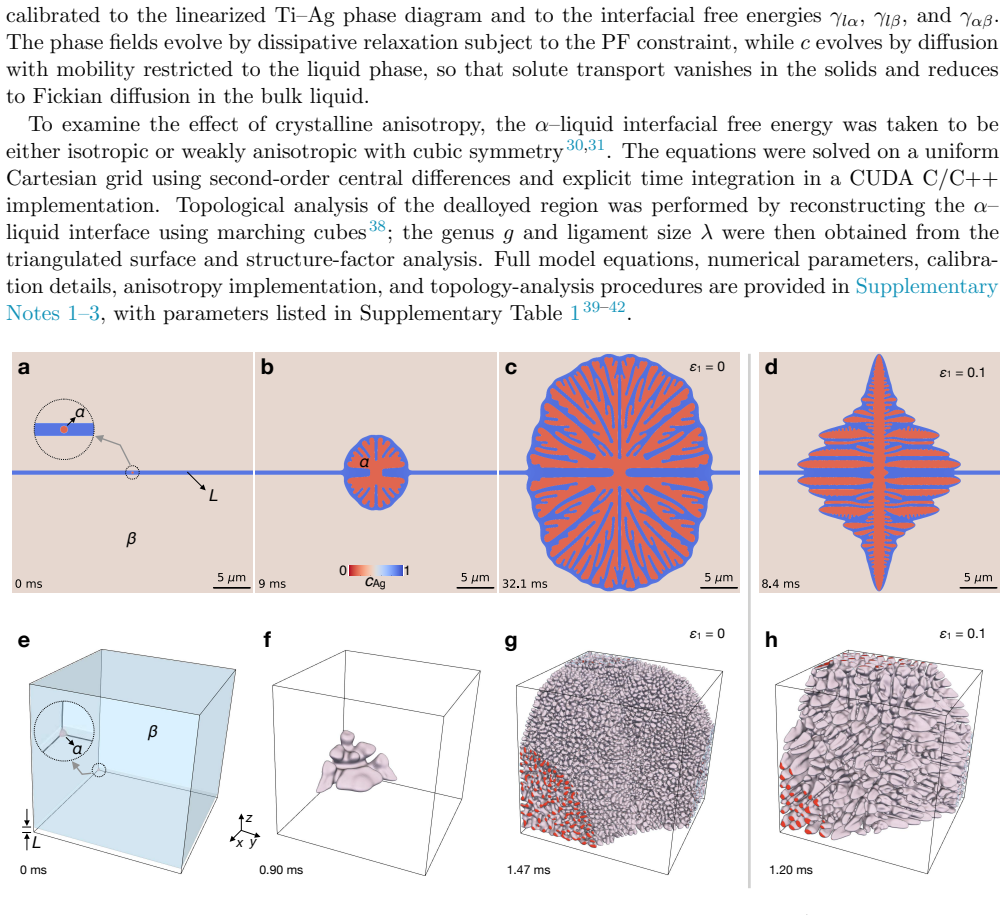
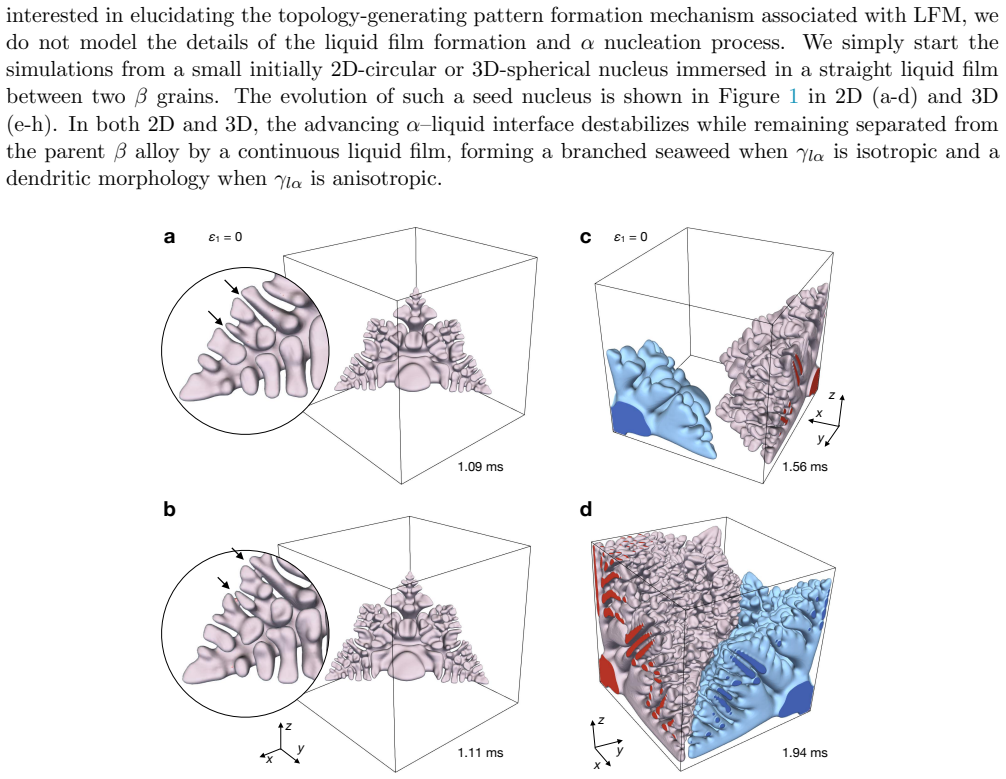
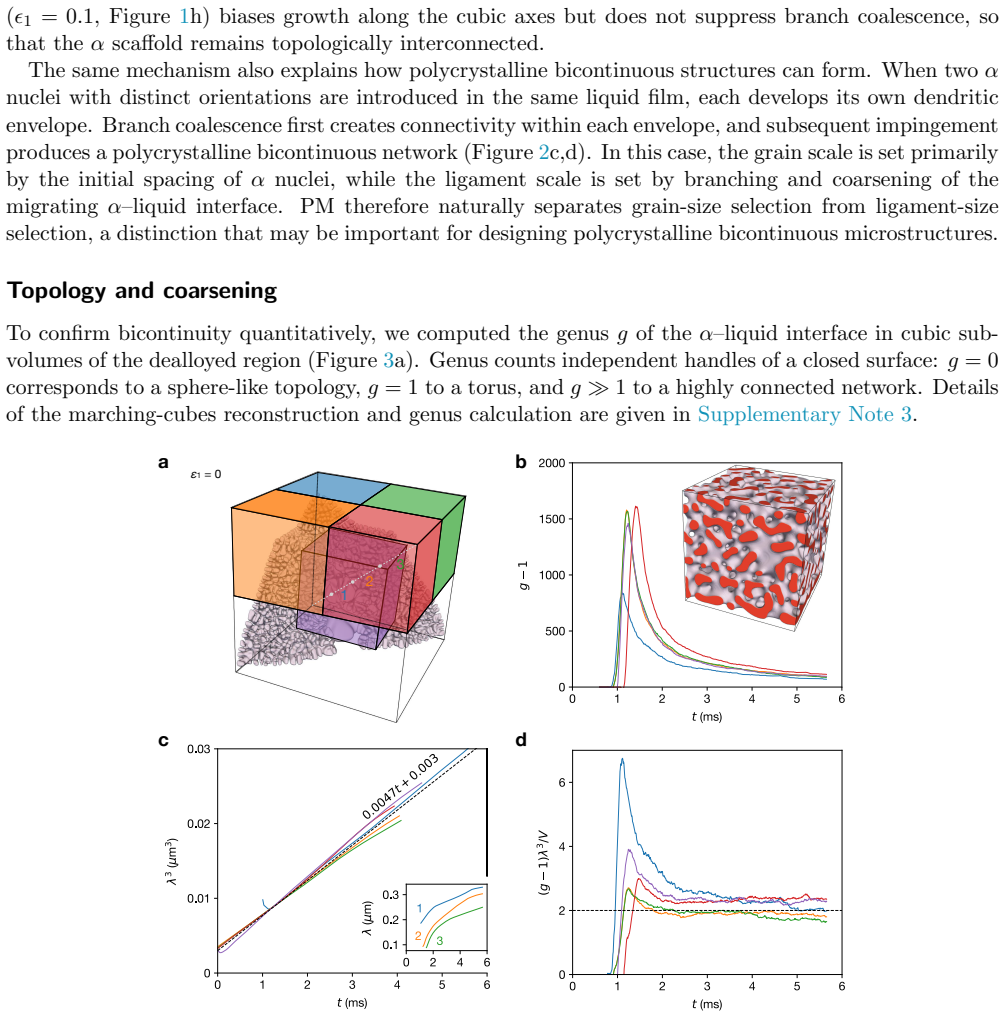
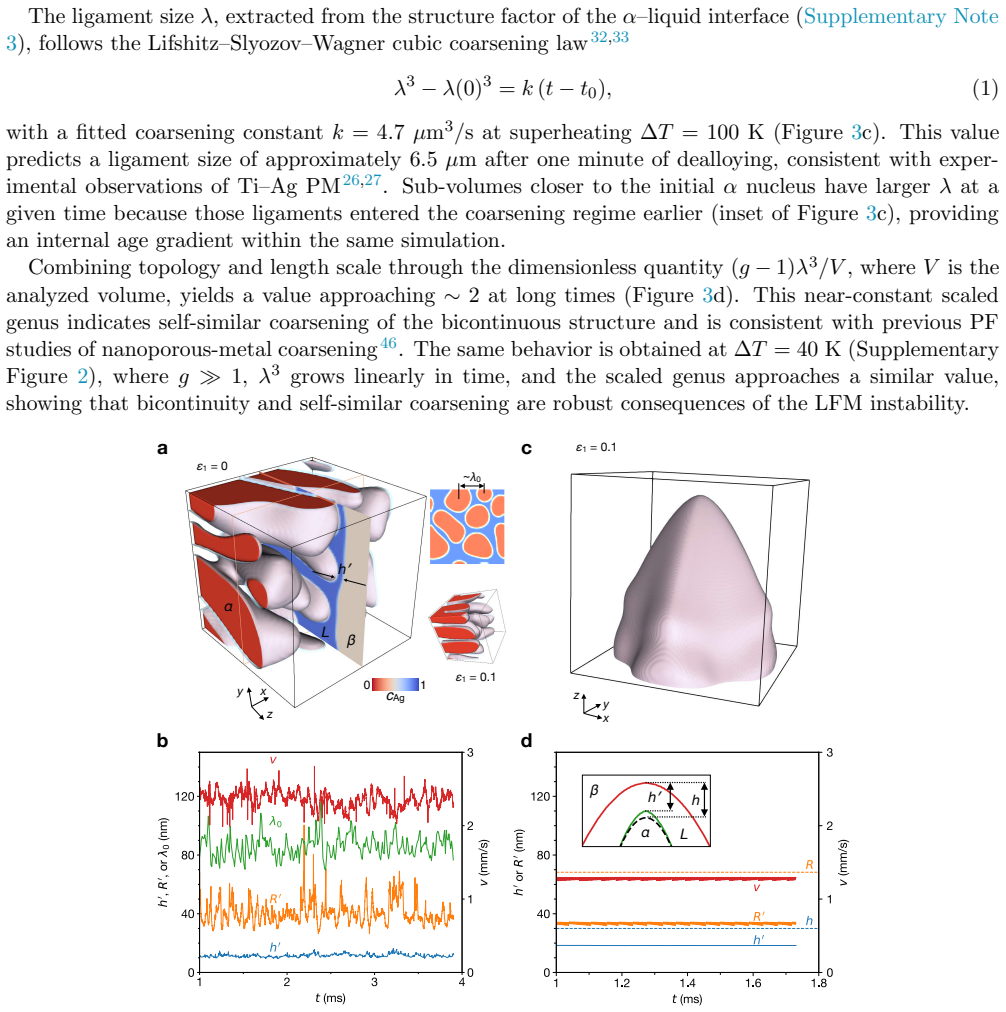
In the Ti-Ag peritectic system, liquid film migration undergoes a morphological instability in three dimensions. The solid-liquid interface develops branched structures whose coalescence generates bicontinuous networks. The sharp-interface model yields time-independent velocity and initial width, followed by diffusive coarsening scaling as t to the one third.
What carries the argument
The three-dimensional morphological instability of the solidification front in liquid film migration, which produces side-branch coalescence into handles.
Load-bearing premise
The phase-field model and sharp-interface theory fully capture the liquid film migration and three-dimensional instability without missing kinetic or other physical effects.
What would settle it
An experiment that measures whether the solidification front velocity remains constant in time or varies would confirm or refute the predicted constant-speed regime.
Figures
read the original abstract
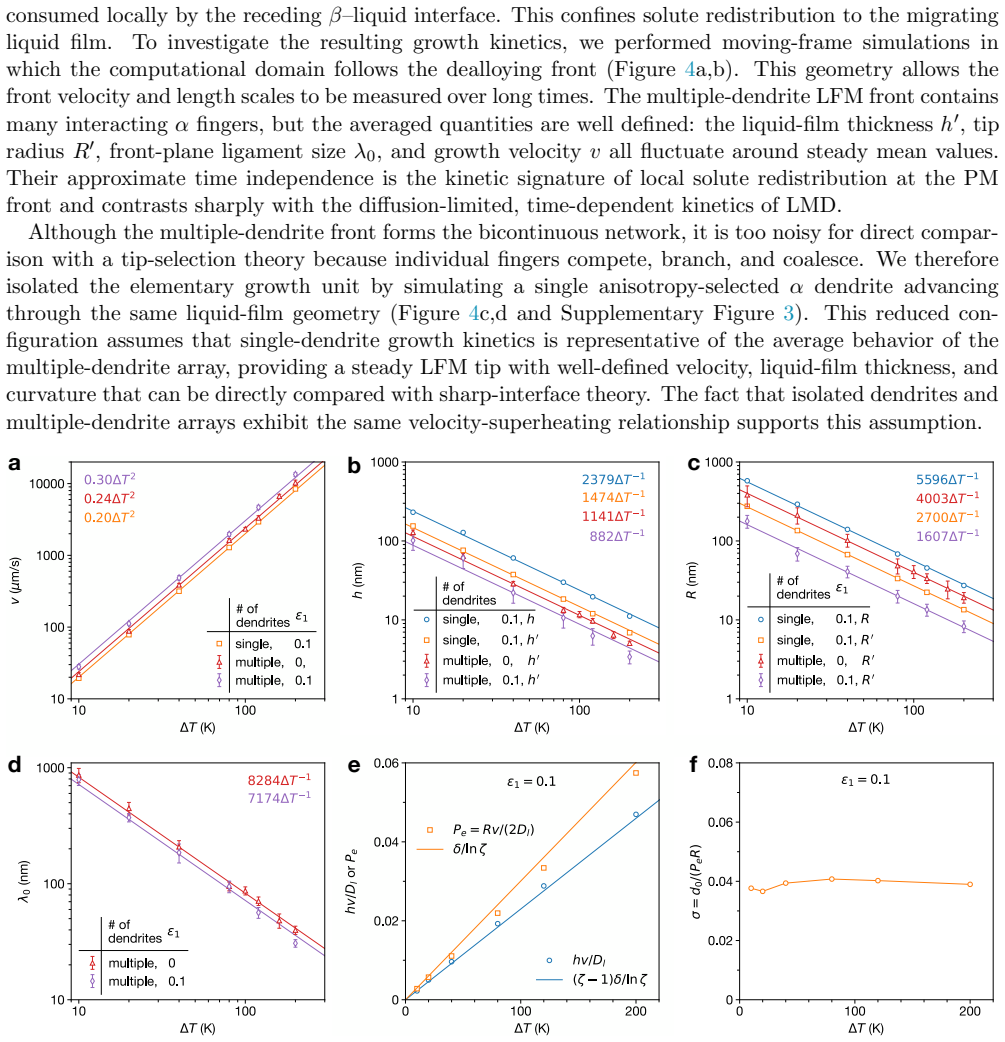
Peritectic melting of Ti--Ag has been shown experimentally to form bicontinuous structures, but the mechanism remains unclear. Here we use phase-field simulations to show that these structures arise from a morphological instability of liquid film migration in three dimensions: a Ti-rich solid growing through an Ag-rich liquid film develops a branched seaweed or dendritic structure whose side branches coalesce to form handles, generating a high-genus bicontinuous topology. A sharp-interface theory predicts a solidification-front velocity and an initial ligament width that are constant in time, in contrast to liquid metal dealloying; subsequent $t^{1/3}$ coarsening reproduces the experimentally observed final ligament width.
Editorial analysis
A structured set of objections, weighed in public.
Referee Report
Summary. The manuscript claims that bicontinuous structures formed during peritectic melting of Ti-Ag arise from a three-dimensional morphological instability during liquid film migration. Phase-field simulations demonstrate a Ti-rich solid advancing through an Ag-rich liquid film that develops branched seaweed or dendritic morphologies; side-branch coalescence generates handles and high-genus topology. A sharp-interface theory is derived that predicts time-independent solidification-front velocity and initial ligament width (in contrast to liquid-metal dealloying), followed by t^{1/3} coarsening that reproduces the experimentally observed final ligament width.
Significance. If the phase-field results and sharp-interface predictions are quantitatively validated, the work supplies a mechanistic explanation for bicontinuous microstructure formation that is distinct from liquid-metal dealloying and rests on a combination of simulation and analytic theory rather than fitted parameters. This could open new processing routes for porous or high-surface-area materials in peritectic systems.
major comments (1)
- [Phase-field results and comparison to theory] The phase-field simulations are asserted to produce a genuine 3D morphological instability whose branch coalescence yields the high-genus topology, yet no explicit comparison of simulated front velocity or initial ligament width against the sharp-interface theory is reported. This verification is load-bearing for the central claim that the observed structures originate from the instability rather than from interface kinetics, solute trapping, or grid effects.
Simulated Author's Rebuttal
We thank the referee for their careful reading of the manuscript and for identifying this important point. We address the major comment below and will incorporate the requested comparison in the revised manuscript.
read point-by-point responses
-
Referee: [Phase-field results and comparison to theory] The phase-field simulations are asserted to produce a genuine 3D morphological instability whose branch coalescence yields the high-genus topology, yet no explicit comparison of simulated front velocity or initial ligament width against the sharp-interface theory is reported. This verification is load-bearing for the central claim that the observed structures originate from the instability rather than from interface kinetics, solute trapping, or grid effects.
Authors: We agree that an explicit, quantitative comparison between the phase-field results and the sharp-interface theory is necessary to substantiate the central claim. In the revised manuscript we will add a dedicated subsection (and associated figure) that directly extracts the solidification-front velocity and the initial ligament width from multiple phase-field runs and compares these values to the analytic predictions. This addition will also include a brief discussion of how the chosen interface thickness and grid resolution were verified to lie in the sharp-interface limit, thereby addressing possible concerns about kinetics or discretization artifacts. revision: yes
Circularity Check
No circularity: sharp-interface predictions and standard coarsening are independent of fitted data
full rationale
The derivation uses phase-field simulations to identify the 3D instability mechanism (branching and handle formation), then invokes an independent sharp-interface analysis to predict constant front velocity and initial ligament width. The subsequent application of the known t^{1/3} coarsening law to reach the final observed width does not reduce any claimed prediction to a fit performed on the target data; the initial width is obtained from the theory rather than adjusted to match experiment. No self-definitional loops, fitted-input-as-prediction, or load-bearing self-citations appear in the provided chain.
Axiom & Free-Parameter Ledger
Reference graph
Works this paper leans on
-
[1]
Nanostructured materials for electrochemical energy conversion and storage devices.Advanced Materials, 20(15):2878–2887, 2008
Yu-Guo Guo, Jin-Song Hu, and Li-Jun Wan. Nanostructured materials for electrochemical energy conversion and storage devices.Advanced Materials, 20(15):2878–2887, 2008. 9
2008
-
[2]
Nanoporous carbon for electrochemical capacitive energy storage.Chemical Society Reviews, 49(10):3005–3039, 2020
Hui Shao, Yih-Chyng Wu, Zifeng Lin, Pierre-Louis Taberna, and Patrice Simon. Nanoporous carbon for electrochemical capacitive energy storage.Chemical Society Reviews, 49(10):3005–3039, 2020
2020
-
[3]
Gold catalysts: nanoporous gold foams.Angewandte Chemie International Edition, 45(48):8241–8244, 2006
Volkmar Zielasek, Birte J¨ urgens, Christian Schulz, J¨ urgen Biener, Monika M Biener, Alex V Hamza, and Marcus B¨ aumer. Gold catalysts: nanoporous gold foams.Angewandte Chemie International Edition, 45(48):8241–8244, 2006
2006
-
[4]
Nanoporous gold catalysts for selective gas-phase oxidative coupling of methanol at low temperature.Science, 327(5963):319–322, 2010
A Wittstock, V Zielasek, J Biener, CM Friend, and M B¨ aumer. Nanoporous gold catalysts for selective gas-phase oxidative coupling of methanol at low temperature.Science, 327(5963):319–322, 2010
2010
-
[5]
Electrochemical dna biosensor based on nanoporous gold electrode and multifunctional encoded dna- au bio bar codes.Analytical chemistry, 80(23):9124–9130, 2008
Kongcheng Hu, Dongxiao Lan, Xuemei Li, and Shusheng Zhang. Electrochemical dna biosensor based on nanoporous gold electrode and multifunctional encoded dna- au bio bar codes.Analytical chemistry, 80(23):9124–9130, 2008
2008
-
[6]
Nanoporous metals: fabrication strategies and advanced elec- trochemical applications in catalysis, sensing and energy systems.Chemical Society Reviews, 41(21):7016–7031, 2012
Jintao Zhang and Chang Ming Li. Nanoporous metals: fabrication strategies and advanced elec- trochemical applications in catalysis, sensing and energy systems.Chemical Society Reviews, 41(21):7016–7031, 2012
2012
-
[7]
Scaling equation for yield strength of nanoporous open-cell foams.Acta Materialia, 55(4):1343–1349, 2007
AM Hodge, J Biener, JR Hayes, PM Bythrow, CA Volkert, and AV Hamza. Scaling equation for yield strength of nanoporous open-cell foams.Acta Materialia, 55(4):1343–1349, 2007
2007
-
[8]
Deforming nanoporous metal: Role of lattice coherency.Acta Materialia, 57(9):2665– 2672, 2009
Hai-Jun Jin, Lilia Kurmanaeva, J¨ org Schmauch, Harald R¨ osner, Yulia Ivanisenko, and J¨ org Weissm¨ uller. Deforming nanoporous metal: Role of lattice coherency.Acta Materialia, 57(9):2665– 2672, 2009
2009
-
[9]
Evolution of nanoporosity in dealloying.Nature, 410(6827):450–453, 2001
Jonah Erlebacher, Michael J Aziz, Alain Karma, Nikolay Dimitrov, and Karl Sieradzki. Evolution of nanoporosity in dealloying.Nature, 410(6827):450–453, 2001
2001
-
[10]
Monolithic nanoporous copper by dealloying Mn–Cu.Journal of Materials Research, 21(10):2611–2616, 2006
JR Hayes, AM Hodge, J Biener, AV Hamza, and Karl Sieradzki. Monolithic nanoporous copper by dealloying Mn–Cu.Journal of Materials Research, 21(10):2611–2616, 2006
2006
-
[11]
Oxygen reduction in nanoporous metal–ionic liquid composite electrocatalysts.Nature materials, 9(11):904–907, 2010
J Snyder, T Fujita, MW Chen, and J Erlebacher. Oxygen reduction in nanoporous metal–ionic liquid composite electrocatalysts.Nature materials, 9(11):904–907, 2010
2010
-
[12]
Pattern formation during electrochemical and liquid metal dealloying.Mrs Bulletin, 43(1):27–34, 2018
Ian McCue, Alain Karma, and Jonah Erlebacher. Pattern formation during electrochemical and liquid metal dealloying.Mrs Bulletin, 43(1):27–34, 2018
2018
-
[13]
The attack of solid alloys by liquid metals and salt melts.Acta Metallurgica, 7(11):722–735, 1959
John David Harrison and C Wagner. The attack of solid alloys by liquid metals and salt melts.Acta Metallurgica, 7(11):722–735, 1959
1959
-
[14]
Dealloying by metallic melt.Ma- terials Letters, 65(7):1076–1078, 2011
Takeshi Wada, Kunio Yubuta, Akihisa Inoue, and Hidemi Kato. Dealloying by metallic melt.Ma- terials Letters, 65(7):1076–1078, 2011
2011
-
[15]
Topology- generating interfacial pattern formation during liquid metal dealloying.Nature communications, 6(1):1–8, 2015
Pierre-Antoine Geslin, Ian McCue, Bernard Gaskey, Jonah Erlebacher, and Alain Karma. Topology- generating interfacial pattern formation during liquid metal dealloying.Nature communications, 6(1):1–8, 2015
2015
-
[16]
Bulk-nanoporous-silicon negative electrode with extremely high cyclability for lithium-ion batteries prepared using a top-down process.Nano letters, 14(8):4505–4510, 2014
Takeshi Wada, Tetsu Ichitsubo, Kunio Yubuta, Haruhiko Segawa, Hirokazu Yoshida, and Hidemi Kato. Bulk-nanoporous-silicon negative electrode with extremely high cyclability for lithium-ion batteries prepared using a top-down process.Nano letters, 14(8):4505–4510, 2014
2014
-
[17]
Optimizing niobium dealloying with metallic melt to fabricate porous structure for electrolytic capacitors.Acta Materialia, 84:497–505, 2015
Joung Wook Kim, Masashi Tsuda, Takeshi Wada, Kunio Yubuta, Sung Gyoo Kim, and Hidemi Kato. Optimizing niobium dealloying with metallic melt to fabricate porous structure for electrolytic capacitors.Acta Materialia, 84:497–505, 2015. 10
2015
-
[18]
Size effects in the mechanical properties of bulk bicontinuous Ta/Cu nanocomposites made by liquid metal dealloying.Advanced Engineering Materials, 18(1):46–50, 2016
Ian McCue, Stephen Ryan, Kevin Hemker, Xiandong Xu, Nan Li, Mingwei Chen, and Jonah Er- lebacher. Size effects in the mechanical properties of bulk bicontinuous Ta/Cu nanocomposites made by liquid metal dealloying.Advanced Engineering Materials, 18(1):46–50, 2016
2016
-
[19]
Porous graphite fabricated by liquid metal dealloying of silicon carbide.Carbon, 165:45–54, 2020
G Greenidge and J Erlebacher. Porous graphite fabricated by liquid metal dealloying of silicon carbide.Carbon, 165:45–54, 2020
2020
-
[20]
Topological control of liquid-metal-dealloyed structures.Nature Communications, 13(1):2918, 2022
Longhai Lai, Bernard Gaskey, Alyssa Chuang, Jonah Erlebacher, and Alain Karma. Topological control of liquid-metal-dealloyed structures.Nature Communications, 13(1):2918, 2022
2022
-
[21]
Microstructural pattern formation during liquid metal dealloying: Phase-field simulations and theoretical analyses.Physical Review Materials, 6(9):093803, 2022
Longhai Lai, Pierre-Antoine Geslin, and Alain Karma. Microstructural pattern formation during liquid metal dealloying: Phase-field simulations and theoretical analyses.Physical Review Materials, 6(9):093803, 2022
2022
-
[22]
Ultrafine nanoporous intermetallic catalysts by high-temperature liquid metal dealloying for electrochemical hydrogen production.Nature Commu- nications, 13(1):5157, 2022
Ruirui Song, Jiuhui Han, Masayuki Okugawa, Rodion Belosludov, Takeshi Wada, Jing Jiang, Daixiu Wei, Akira Kudo, Yuan Tian, Mingwei Chen, et al. Ultrafine nanoporous intermetallic catalysts by high-temperature liquid metal dealloying for electrochemical hydrogen production.Nature Commu- nications, 13(1):5157, 2022
2022
-
[23]
Three-dimensional bicontinuous nanoporous materials by vapor phase dealloying.Nature communications, 9(1):1–7, 2018
Zhen Lu, Cheng Li, Jiuhui Han, Fan Zhang, Pan Liu, Hao Wang, Zhili Wang, Chun Cheng, Linghan Chen, Akihiko Hirata, et al. Three-dimensional bicontinuous nanoporous materials by vapor phase dealloying.Nature communications, 9(1):1–7, 2018
2018
-
[24]
Vapor phase dealloying: A versatile approach for fabricating 3d porous materials.Acta Materialia, 163:161–172, 2019
Jiuhui Han, Cheng Li, Zhen Lu, Hao Wang, Zhili Wang, Kentaro Watanabe, and Mingwei Chen. Vapor phase dealloying: A versatile approach for fabricating 3d porous materials.Acta Materialia, 163:161–172, 2019
2019
-
[25]
Vapor phase dealloying kinetics of mnzn alloys
Zhen Lu, Fan Zhang, Daixiu Wei, Jiuhui Han, Yanjie Xia, Jing Jiang, Mingwang Zhong, Akihiko Hirata, Kentaro Watanabe, Alain Karma, et al. Vapor phase dealloying kinetics of mnzn alloys. Acta Materialia, 212:116916, 2021
2021
-
[26]
Evolution of a bicontinuous struc- ture in peritectic melting: The simplest form of dealloying.Physical Review Materials, 3(11):113601, 2019
Wen-Kai Hu, Jun-Chao Shao, Shao-Gang Wang, and Hai-Jun Jin. Evolution of a bicontinuous struc- ture in peritectic melting: The simplest form of dealloying.Physical Review Materials, 3(11):113601, 2019
2019
-
[27]
How peritectic melting forms bicontinuous microstructures.Acta Materialia, 289:120917, 2025
Zhongyang Li, Lukas L¨ uhrs, Tobias Krekeler, and J¨ org Weissm¨ uller. How peritectic melting forms bicontinuous microstructures.Acta Materialia, 289:120917, 2025
2025
-
[28]
Melting of Cu–In solid solutions at small superheating by droplet formation and liquid film migration.Acta Metallurgica, 37(2):603–613, 1989
T Muschik, WA Kaysser, and T Hehenkamp. Melting of Cu–In solid solutions at small superheating by droplet formation and liquid film migration.Acta Metallurgica, 37(2):603–613, 1989
1989
-
[29]
Kinetics of isothermal phase transformations above and below the peritectic temperature: Phase-field simulations.Acta materialia, 58(5):1750–1760, 2010
G Boussinot, EA Brener, and DE Temkin. Kinetics of isothermal phase transformations above and below the peritectic temperature: Phase-field simulations.Acta materialia, 58(5):1750–1760, 2010
2010
-
[30]
Predictions of dendritic growth rates in the linearized solvability theory
A Barbieri and JS Langer. Predictions of dendritic growth rates in the linearized solvability theory. Physical Review A, 39(10):5314, 1989
1989
-
[31]
Orientation selection in dendritic evolution.Nature materials, 5(8):660–664, 2006
Tomorr Haxhimali, Alain Karma, Fr´ ed´ eric Gonzales, and Michel Rappaz. Orientation selection in dendritic evolution.Nature materials, 5(8):660–664, 2006
2006
-
[32]
The kinetics of precipitation from supersaturated solid solu- tions.Journal of physics and chemistry of solids, 19(1-2):35–50, 1961
Ilya M Lifshitz and Vitaly V Slyozov. The kinetics of precipitation from supersaturated solid solu- tions.Journal of physics and chemistry of solids, 19(1-2):35–50, 1961
1961
-
[33]
Theory of the aging of precipitates by dissolution-reprecipitation (ostwald ripening).Z Elektrochem, 65(7):581–11, 1961
C Wagner. Theory of the aging of precipitates by dissolution-reprecipitation (ostwald ripening).Z Elektrochem, 65(7):581–11, 1961. 11
1961
-
[34]
The temperature field around a spherical, cylindrical, or pointed crystal growing in a cooling solution
GP Ivantsov. The temperature field around a spherical, cylindrical, or pointed crystal growing in a cooling solution. InDokl. Akad. Nauk SSSR, volume 58, pages 567–569, 1947
1947
-
[35]
Velocity-selection problem for combined motion of melting and solidification fronts.Physical review letters, 94(18):184501, 2005
Efim A Brener and DE Temkin. Velocity-selection problem for combined motion of melting and solidification fronts.Physical review letters, 94(18):184501, 2005
2005
-
[36]
Melting of alloys along the inter-phase boundaries in eutectic and peritectic systems.Acta materialia, 55(8):2785–2789, 2007
Efim A Brener and DE Temkin. Melting of alloys along the inter-phase boundaries in eutectic and peritectic systems.Acta materialia, 55(8):2785–2789, 2007
2007
-
[37]
Quantitative phase-field modeling of two-phase growth.Physical Review E, 72(1):011602, 2005
R Folch and M Plapp. Quantitative phase-field modeling of two-phase growth.Physical Review E, 72(1):011602, 2005
2005
-
[38]
Marching cubes: A high resolution 3d surface construction algorithm
William E Lorensen and Harvey E Cline. Marching cubes: A high resolution 3d surface construction algorithm. InSeminal graphics: pioneering efforts that shaped the field, pages 347–353. 1998
1998
-
[39]
SGTE data for pure elements.CALPHAD, 15(4):317–425, 1991
Alan T Dinsdale. SGTE data for pure elements.CALPHAD, 15(4):317–425, 1991
1991
-
[40]
Experimental study and thermodynamic assessment of the Ag–Ti system.CALPHAD, 29(4):269–275, 2005
Mei Li, Changrong Li, Fuming Wang, and Weijing Zhang. Experimental study and thermodynamic assessment of the Ag–Ti system.CALPHAD, 29(4):269–275, 2005
2005
-
[41]
Quantification and prediction of solidification textures under additive manufacturing conditions.Nature Communica- tions, 2025
Mingwang Zhong, Adriana Eres-Castellanos, Kaihua Ji, Alec I Saville, Brian Rodgers, Dan R Cough- lin, John W Gibbs, John D Roehling, Joseph T McKeown, Amy J Clarke, et al. Quantification and prediction of solidification textures under additive manufacturing conditions.Nature Communica- tions, 2025
2025
-
[42]
Growth competition of columnar dendritic grains: A phase-field study.Acta Materialia, 82:64–83, 2015
Damien Tourret and Alain Karma. Growth competition of columnar dendritic grains: A phase-field study.Acta Materialia, 82:64–83, 2015
2015
-
[43]
Fractal and compact growth morphologies in phase transitions with diffusion transport.Physical Review E, 49(4):2972, 1994
T Ihle and H M¨ uller-Krumbhaar. Fractal and compact growth morphologies in phase transitions with diffusion transport.Physical Review E, 49(4):2972, 1994
1994
-
[44]
Symmetry-broken double fingers and seaweed patterns in thin-film directional solidification of a nonfaceted cubic crystal.Physical Review E, 51(5):4751, 1995
Silv` ere Akamatsu, Gabriel Faivre, and Thomas Ihle. Symmetry-broken double fingers and seaweed patterns in thin-film directional solidification of a nonfaceted cubic crystal.Physical Review E, 51(5):4751, 1995
1995
-
[45]
In situ and real-time 3-d microtomography investigation of dendritic solidification in an al–10 wt.% cu alloy.Acta Materialia, 57(7):2300–2310, 2009
Nathalie Limodin, Luc Salvo, Elodie Boller, Michel Su´ ery, M Felberbaum, Sylvain Gailli` egue, and Kamel Madi. In situ and real-time 3-d microtomography investigation of dendritic solidification in an al–10 wt.% cu alloy.Acta Materialia, 57(7):2300–2310, 2009
2009
-
[46]
Phase-field investigation of the coarsening of porous structures by surface diffusion.Physical Review Materials, 3(8):083401, 2019
Pierre-Antoine Geslin, Mickael Buchet, Takeshi Wada, and Hidemi Kato. Phase-field investigation of the coarsening of porous structures by surface diffusion.Physical Review Materials, 3(8):083401, 2019
2019
-
[47]
In situ observation of liquid metal dealloying and etching of porous fecr by x-ray tomography and x-ray diffraction.Materialia, 18:101125, 2021
Morgane Mokhtari, Christophe Le Bourlot, J´ erome Adrien, Anne Bonnin, Wolfgang Ludwig, Pierre- Antoine Geslin, Takeshi Wada, Jannick Duchet-Rumeau, Hidemi Kato, and Eric Maire. In situ observation of liquid metal dealloying and etching of porous fecr by x-ray tomography and x-ray diffraction.Materialia, 18:101125, 2021. 12 Supplemental Materials: Dealloy...
2021
discussion (0)
Sign in with ORCID, Apple, or X to comment. Anyone can read and Pith papers without signing in.