Hybridization of Ferromagnetic and Cyclotron Resonances in a Two-Dimensional Electron System on a Ferromagnetic Film
Pith reviewed 2026-06-29 20:32 UTC · model grok-4.3
The pith
Ferromagnetic resonance in a film and cyclotron resonance in an overlying 2D electron system repel each other under a perpendicular magnetic field, altering frequencies and linewidths.
A machine-rendered reading of the paper's core claim, the machinery that carries it, and where it could break.
Core claim
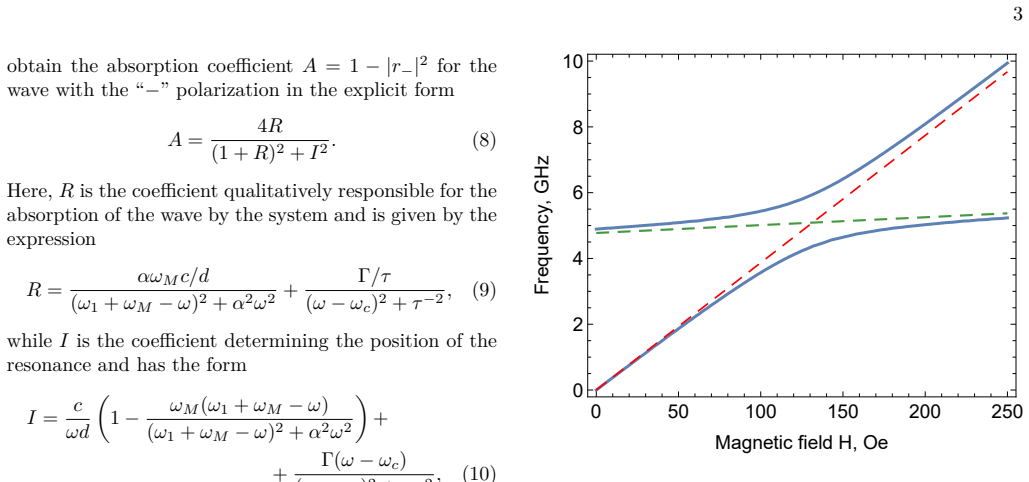
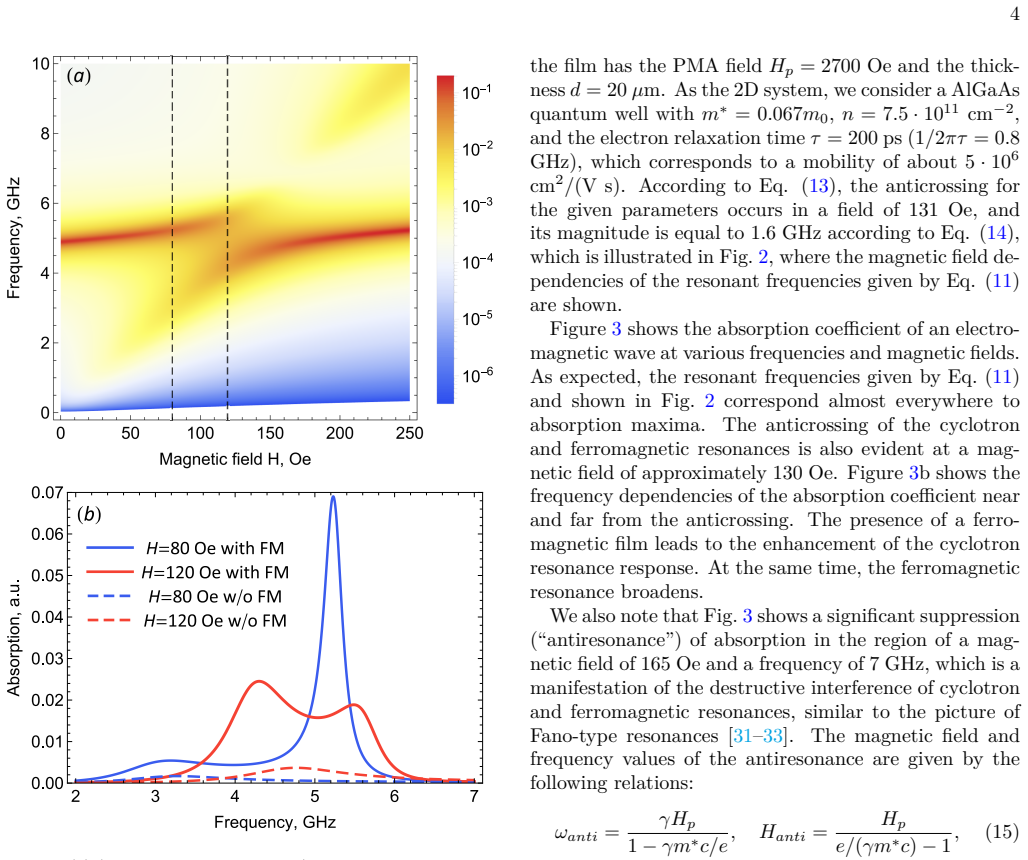
The ferromagnetic resonance of the film and the cyclotron resonance of the 2D electrons interact in the magnetic field, leading to their repulsion (anticrossing). The anticrossing region is characterized not only by the modification of resonance frequencies compared to the cyclotron resonance in the 2D system without the ferromagnetic substrate and the ferromagnetic resonance in the film without the 2D system, but also by a strong change in the resonance linewidths.
What carries the argument
Electromagnetic coupling between the 2D electron layer and the ferromagnetic film within a linear-response model of the full multilayer stack placed in a perpendicular static field, producing hybridized modes.
If this is right
- Resonance frequencies deviate from their isolated values inside the anticrossing window.
- Resonance linewidths undergo substantial modification due to the interaction.
- The microwave absorption spectrum of the combined system differs from the sum of the separate film and 2D-layer spectra.
- The anticrossing occurs only when the static field is applied perpendicular to the layers.
Where Pith is reading between the lines
- The linewidth changes imply an exchange of damping between the magnetic and electronic modes that could be tuned by gate voltage.
- Similar hybridization may appear in other geometries where a magnetic film is placed near a high-mobility 2D electron gas.
- The effect supplies a field-tunable mechanism for controlling microwave transmission or reflection in hybrid structures.
Load-bearing premise
The calculation assumes that electromagnetic coupling between the layers can be treated in linear response while ignoring nonlinearities and interface disorder.
What would settle it
Microwave spectra of the fabricated stack that show the two resonances crossing without frequency repulsion or without accompanying linewidth changes would falsify the predicted hybridization.
Figures
read the original abstract
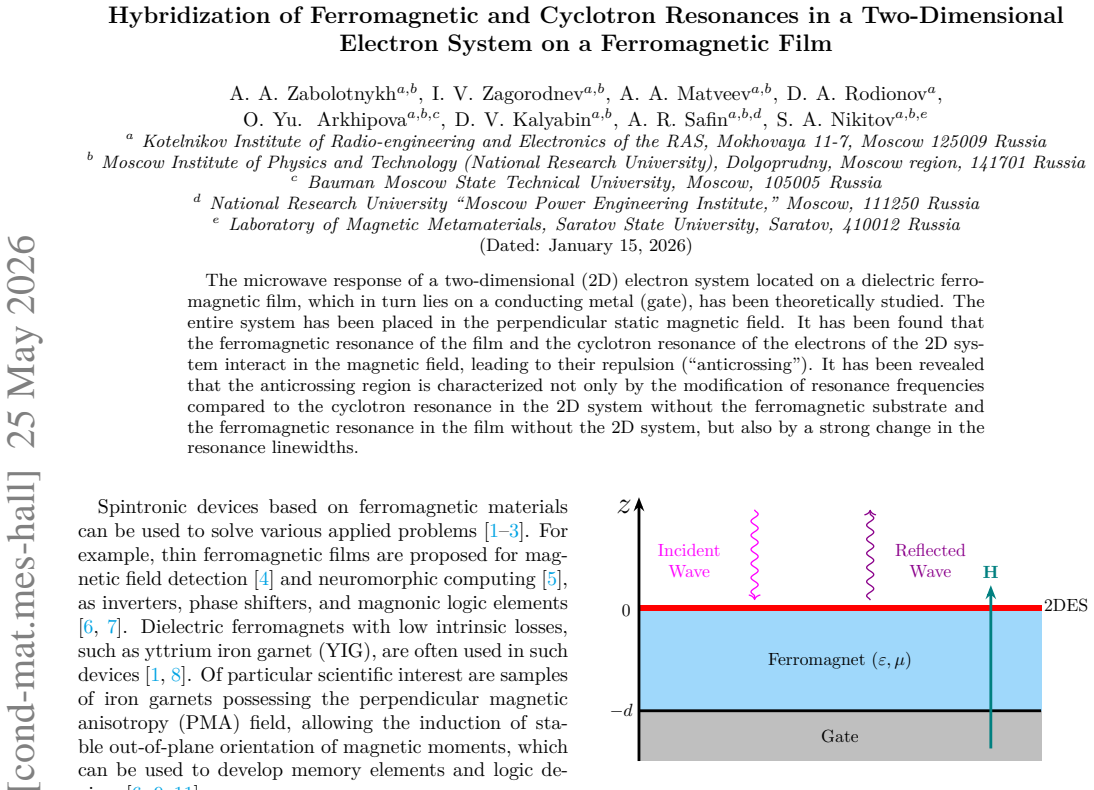
The microwave response of a two-dimensional (2D) electron system located on a dielectric ferromagnetic film, which in turn lies on a conducting metal (gate), has been theoretically studied. The entire system has been placed in the perpendicular static magnetic field. It has been found that the ferromagnetic resonance of the film and the cyclotron resonance of the electrons of the 2D system interact in the magnetic field, leading to their repulsion ('anticrossing'). It has been revealed that the anticrossing region is characterized not only by the modification of resonance frequencies compared to the cyclotron resonance in the 2D system without the ferromagnetic substrate and the ferromagnetic resonance in the film without the 2D system, but also by a strong change in the resonance linewidths.
Editorial analysis
A structured set of objections, weighed in public.
Referee Report
Summary. The manuscript theoretically studies the microwave response of a 2D electron system on a dielectric ferromagnetic film atop a conducting metal gate, placed in a perpendicular static magnetic field. It reports that the film's ferromagnetic resonance and the 2DES cyclotron resonance interact via electromagnetic coupling, producing an anticrossing in resonance frequencies together with strong modifications to the resonance linewidths in the coupling region.
Significance. If the underlying linear-response calculation is sound, the result would be significant for hybrid 2DES-ferromagnet systems in the mesoscopic regime, as it identifies both frequency repulsion and damping changes as direct consequences of the geometry and perpendicular field. The absence of free parameters or ad-hoc entities in the stated claim is a strength.
major comments (1)
- Abstract: the central claims of anticrossing and linewidth modification are stated without any explicit susceptibility function, response equations, or limiting-case checks, rendering it impossible to verify that these features emerge rigorously from the linear-response model of the coupled system.
Simulated Author's Rebuttal
We thank the referee for the detailed reading of our manuscript. The single major comment concerns the level of technical detail provided in the abstract; we address it directly below.
read point-by-point responses
-
Referee: Abstract: the central claims of anticrossing and linewidth modification are stated without any explicit susceptibility function, response equations, or limiting-case checks, rendering it impossible to verify that these features emerge rigorously from the linear-response model of the coupled system.
Authors: Abstracts are concise summaries and conventionally omit explicit functions or equations. The linear-response framework is fully specified in the main text: the electromagnetic boundary-value problem is solved using the susceptibility tensor of the ferromagnetic film (with Gilbert damping) coupled to the 2DES conductivity tensor (Drude model with cyclotron frequency). The resulting dispersion relation for the hybrid modes is derived in Section II, and the microwave absorption is obtained from the imaginary part of the effective surface impedance in Section III. Limiting cases are recovered explicitly: (i) vanishing 2DES density restores the bare FMR frequency and linewidth; (ii) vanishing film magnetization restores the bare cyclotron resonance. These checks are shown in Figs. 2 and 3. If the referee considers the main-text presentation insufficiently explicit, we will add an appendix containing the full susceptibility expressions and the 4 imes4 boundary-condition matrix. revision: no
Circularity Check
No significant circularity
full rationale
The derivation proceeds from a linear-response calculation of the coupled microwave susceptibility for the 2DES plus ferromagnetic film in perpendicular B. The anticrossing and linewidth modification are presented as direct consequences of this electromagnetic coupling applied to the given geometry; the abstract and description supply no equations or steps that reduce any reported prediction to a fitted input by construction, nor any load-bearing self-citation chain. The central claim therefore remains independent of the patterns that would trigger a circularity flag.
Axiom & Free-Parameter Ledger
Reference graph
Works this paper leans on
-
[1]
S. A. Nikitov, A. R. Safin, D. V. Kalyabin, A. V. Sadovnikov, E. N. Beginin, M. V. Logunov, M. A. Moro- zova, S. A. Odintsov, S. A. Osokin, A. Yu. Sharaevskaya, Yu. P. Sharaevsky, and A. I. Kirilyuk, Phys. Usp. 63, 945 (2020). doi:10.3367/UFNe.2019.07.038609
-
[2]
Q. Shao, P. Li, L. Liu et al., IEEE Trans. Magn. 57(7), 800439 (2021). doi:10.1109/TMAG.2021.3078583
-
[3]
C. Chappert, A. Fert, and F. Van Dau, Nat. Mater. 6(11), 813 (2007). doi:10.1038/nmat2024
-
[4]
S. Vysotskii, A. Kozhevnikov, M. Balinskiy, A. Khitun, and Y. Filimonov, J. Appl. Phys. 132(8), 084504 (2022). doi:10.1063/5.0102336
-
[5]
A. V. Sadovnikov, A. A. Grachev, S. A. Odintsov, A. A. Martyshkin, V. A. Gubanov, S. E. Sheshukova, and S. A. Nikitov, JETP Lett. 108, 312 (2018). doi: 10.1134/S0021364018170113
-
[6]
A. Mahmoud, F. Ciubotaru, F. Vanderveken, A. Chumak, S. Hamdioui, C. Adelmann, and S. Coto- fana, J. Appl. Phys. 128(16), 161101 (2020). doi: 10.1063/5.0019328
-
[7]
A. V. Chumak, P. Kabos, M. Wu et al., IEEE Trans. Magn. 58(6), 0800172 (2022). doi: 10.1109/TMAG.2022.3149664
-
[8]
M. C. Onbasli, A. Kehlberger, D. H. Kim, G. Jakob, M. Kläui, A. V. Chumak, B. Hillebrands, and C. A. Ross, APL Mater. 2(10), 106102 (2014). doi:10.1063/1.4896936
-
[9]
J. Xu, D. Zhang, Y. Zhang, Z. Zhong, H. Zhang, X. Xu, X. Luo, Q. Yang, B. Liu, and L. Jin, AIP Adv. 12(6), 065026 (2022). doi:10.1063/5.0098656
-
[10]
S. Das, R. Mansell, L. Flajšman, L. Yao, J. W. van der Jagt, S. Chen, D. Ravelosona, L. Herrera Diez, and S. van Dijken, Phys. Rev. Mater. 8(11), 114419 (2024). doi: 10.1103/PhysRevMaterials.8.114419
-
[11]
X. Zhang, L. Jin, D. Zhang, B. Liu, H. Meng, L. Zhang, Z. Zhong, and X. Tang, Front. Mater. 9, 879711 (2022). doi:10.3389/fmats.2022.879711
-
[12]
C. Heins, V. Iurchuk, O. Gladii, L. Körber, A. Kákay, J. Fassbender, K. Schultheiss, and H. Schultheiss, Phys. Rev. B 111(13), 134434 (2025). doi: 10.1103/PhysRevB.111.134434
-
[13]
K. D. Samoilenko, D. A. Volkov, D. A. Gabrielyan at al., JETP Lett. 121, 554 (2025). doi: 10.1134/S002136402460530X
-
[14]
S. Emori, A. Matyushov, H. Jeon, C. J. Babroski, T. Nan, A. M. Belkessam, J. G. Jones, M. E. McConney, G. J. Brown, B. M. Howe, and N. X. Sun, Appl. Phys. Lett. 112(18), 182406 (2018). doi:10.1063/1.5025623
-
[15]
A. V. Sadovnikov, A. A. Grachev, E. N. Be- ginin at al., JETP Lett. 106, 465 (2017). doi: 10.1134/S0021364017190110
-
[16]
F. Monzon, M. Johnson, and M. Roukes, Appl. Phys. Lett. 71(21), 3087 (1997). doi:10.1063/1.120254
-
[17]
G. Meier, D. Grundler, K. - B. Broocks, C. Heyn, and D. Heitmann, J. Magn. Magn. Mater. 210, 138 (2000). doi:10.1016/S0304-8853(99)00625-3
-
[18]
Y. V. Bludov, J. N. Gomes, G. d. A. Farias, J. Fernández- Rossier, M. I. Vasilevskiy, and N. M. Peres, 2D Mater. 6(4), 045003 (2019). doi:10.1088/2053-1583/ab2513
-
[19]
A. M. Pikalov, A. V. Dorofeenko, and A. B. Granovsky, JETP Lett. 113, 521 (2021). doi: 10.1134/S0021364021080105
-
[20]
A. T. Costa, M. I. Vasilevskiy, J. Fernández-Rossier, and N. M. Peres, Nano Lett. 23(10), 4510 (2023). doi: 10.1021/acs.nanolett.3c00907
-
[21]
H. Y. Yuan and Ya. M. Blanter, Phys. Rev. Lett. 133(15), 156703 (2024). doi:10.1103/PhysRevLett.133.156703
-
[22]
N. Kuznetsov, H. Qin, L. Flajšman, and S. van Dijken, Sci. Adv. 11(2), eads2420 (2025). doi: 10.1126/sciadv.ads2420
-
[23]
H. Y. Yuan, Ya. M. Blanter, and H. Q. Lin, Phys. Rev. B 111, 024422 (2025). doi:10.1103/PhysRevB.111.024422
-
[24]
K. W. Chiu, T. K. Lee, and J. J. Quinn, Surf. Sci. 58(1), 182 (1976). doi:10.1016/0039-6028(76)90132-1
-
[25]
T. N. Theis, J. P.Kotthaus, and P. J. Stiles, Solid State Commun. 24(4), 273 (1977). doi:10.1016/0038- 1098(77)90205-8
-
[26]
T. Ando, A. B. Fowler, and F. Stern, Rev. Mod. Phys. 54(2), 437 (1982). doi:10.1103/RevModPhys.54.437
-
[27]
A. A. Zabolotnykh and V. A. Volkov, Phys. Rev. B 103, 125301 (2021). doi:10.1103/PhysRevB.103.125301
-
[28]
V. M. Muravev, I. V. Andreev, N. D. Semenov, P. A. Gusikhin, and I. V. Kukushkin, Phys. Rev. B 110(20), 205416 (2024). doi:10.1103/PhysRevB.110.205416
-
[29]
D. D. Stancil and A. Prahabkar, Spin Waves Theory and Applications (Springer, New York, 2009)
2009
-
[30]
S. M. Rezende, Fundamentals of Magnonics (Springer, Cham, 2020)
2020
-
[31]
Fano, Nuovo Cimento 12(3), 154 (1935)
U. Fano, Nuovo Cimento 12(3), 154 (1935). doi: 10.1007/BF02958288
-
[32]
U. Fano, Phys. Rev. 124(6), 1866 (1961). doi: 10.1103/PhysRev.124.1866
-
[33]
Y. S. Joe, A. M. Satanin, and C. S. Kim, Physica Scripta 74(2), 259 (2006). doi:10.1088/0031-8949/74/2/020
-
[34]
Y. J. Chung, K. Villegas Rosales, K. Baldwin, P. Ma- dathil, K. West, M. Shayegan, and L. Pfeiffer, Nat. Mater. 20, 632 (2021). doi:10.1038/s41563-021-00942-3
-
[35]
R. Khymyn, I. Lisenkov, V. Tiberkevich, B. A. Ivanov, and A. Slavin, Sci. Rep. 7, 43705 (2017). doi: 10.1038/srep43705
discussion (0)
Sign in with ORCID, Apple, or X to comment. Anyone can read and Pith papers without signing in.