A Variational Dissipative Framework for Quantum Algorithms
Pith reviewed 2026-06-29 21:25 UTC · model grok-4.3
The pith
Parameterized ancilla-assisted dissipation lets variational quantum circuits prepare mixed states and handle both optimization and recovery tasks.
A machine-rendered reading of the paper's core claim, the machinery that carries it, and where it could break.
Core claim
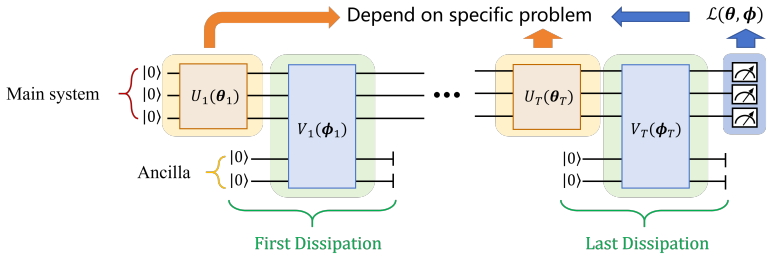
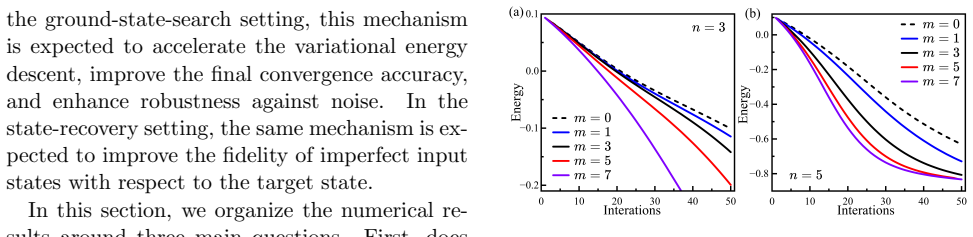
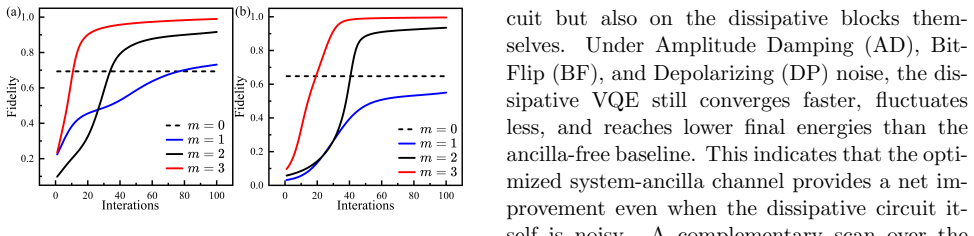
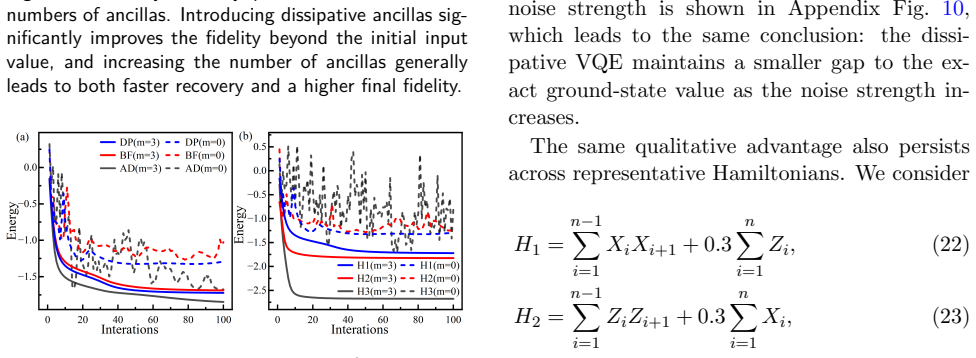
The paper claims that ancilla-assisted engineered dissipation, implemented via parameterized system-ancilla couplings followed by ancilla reset and trace-out, functions as a reusable trainable primitive inside variational quantum algorithms. When inserted into system-only variational layers, the resulting circuit can prepare wider classes of mixed states. The same block improves convergence to low-energy states inside a dissipative variational quantum eigensolver and, when trained as a recovery channel, suppresses preparation noise to increase fidelity with a target state.
What carries the argument
The ancilla-assisted dissipative block realized by parameterized system-ancilla couplings followed by ancilla reset and trace-out, which supplies a trainable non-unitary transformation.
If this is right
- The same dissipative block design supports both ground-state search and state recovery without requiring separate architectures.
- Variational circuits gain access to mixed states through explicit non-unitary transformations rather than only through decoherence.
- Engineered dissipation can be treated as an optimizable resource that aids convergence toward low-energy states.
- Preparation noise can be countered by training the dissipative module to act as a recovery channel.
Where Pith is reading between the lines
- The framework may generalize to other tasks such as open-system simulation where controlled dissipation is already present.
- On hardware with native reset operations, the overhead of the ancilla block could be low enough to test directly without full error correction.
- If the trainable couplings prove robust, the method could reduce the circuit depth needed for certain state-preparation problems by off-loading work to the dissipative step.
Load-bearing premise
That the parameters of the system-ancilla couplings can be trained to produce dissipative channels that measurably improve convergence or fidelity over what purely unitary circuits achieve, without the training process being dominated by noise or optimization barriers.
What would settle it
A controlled numerical test on a small number of qubits showing that the dissipative variational eigensolver reaches the same or higher energies than a standard unitary VQE, or that the trained recovery channel yields equal or lower fidelity than a unitary circuit alone.
Figures
read the original abstract
Dissipation engineering has attracted growing interest as an approach to controlling open quantum systems through engineered system-environment interactions. Standard variational quantum circuits are usually built from unitary operations and therefore explore only a restricted family of states. To go beyond this limitation, we introduce a variational dissipative framework in which ancilla-assisted engineered dissipation is incorporated into parameterized quantum algorithms. In this framework, system-only variational layers are combined with trainable dissipative modules, so that the circuit can prepare a broader class of mixed states through ancilla-assisted nonunitary transformations. Within this framework, the same ancilla-assisted dissipative block is used in two representative settings with different objectives. For ground-state search, it is integrated into a dissipative variational quantum eigensolver to improve the convergence toward low-energy states. For state recovery, it is trained as a recovery channel to suppress preparation noise and enhance fidelity with the target state. In both cases, the block is realized through parameterized system-ancilla couplings followed by ancilla reset and trace-out. Our results show that engineered dissipation can be incorporated into variational quantum circuits as a reusable trainable primitive rather than treated only as a source of noise. In this sense, the proposed framework identifies ancilla-assisted dissipative channels as a concrete variational resource that can support both optimization and recovery tasks within a unified design.
Editorial analysis
A structured set of objections, weighed in public.
Referee Report
Summary. The manuscript introduces a variational dissipative framework for quantum algorithms that incorporates ancilla-assisted engineered dissipation into variational quantum circuits as trainable modules. System-only variational layers are combined with dissipative blocks realized via parameterized system-ancilla couplings followed by ancilla reset and trace-out. The same block is applied in two settings: a dissipative variational quantum eigensolver for ground-state search to improve convergence to low-energy states, and a recovery channel to suppress preparation noise and enhance target-state fidelity. The central claim is that this treats dissipation as a reusable variational resource rather than noise, with numerical results asserted to demonstrate advantages over unitary circuits in both tasks.
Significance. If the numerical results and derivations hold, the work could be significant by extending variational quantum algorithms beyond the unitary manifold to prepare mixed states and by unifying optimization and recovery tasks under a single trainable dissipative primitive. This aligns with interest in open-system control and could offer practical benefits on NISQ hardware where dissipation is unavoidable. The construction itself is standard for non-unitary maps, but the claimed performance gains would need concrete validation to establish novelty over existing dissipative or non-unitary variational approaches.
major comments (1)
- Abstract: The central claim that 'our results show' engineered dissipation improves convergence or fidelity beyond unitary VQCs rests on asserted numerical results, yet the manuscript provides no derivations, circuit diagrams, cost functions, optimization details, benchmarks, error bars, or comparisons to unitary baselines. This absence is load-bearing for assessing whether the trainable dissipative blocks deliver the stated advantage without being dominated by noise or optimization barriers.
Simulated Author's Rebuttal
We thank the referee for the constructive feedback. We address the major comment below and will revise the manuscript to strengthen the presentation of supporting evidence for our claims.
read point-by-point responses
-
Referee: Abstract: The central claim that 'our results show' engineered dissipation improves convergence or fidelity beyond unitary VQCs rests on asserted numerical results, yet the manuscript provides no derivations, circuit diagrams, cost functions, optimization details, benchmarks, error bars, or comparisons to unitary baselines. This absence is load-bearing for assessing whether the trainable dissipative blocks deliver the stated advantage without being dominated by noise or optimization barriers.
Authors: We agree that the abstract's claim requires explicit supporting material in the manuscript to be fully substantiated. The full manuscript contains dedicated numerical sections for both the dissipative VQE and recovery applications, including parameterized circuit constructions, cost functions, and optimization procedures. However, to directly address this concern, we will revise the manuscript by expanding the main text (or adding a supplementary section) with circuit diagrams, explicit benchmarks against unitary baselines, error bars from multiple runs, and direct comparisons of convergence/fidelity metrics. This will allow readers to evaluate whether the dissipative blocks provide measurable advantages. revision: yes
Circularity Check
No significant circularity detected
full rationale
The paper proposes a variational dissipative framework that augments standard unitary VQCs with ancilla-assisted dissipative blocks (parameterized system-ancilla couplings followed by reset and trace-out). This is presented as a reusable trainable primitive for both ground-state optimization and noise-recovery tasks. The construction follows the standard Stinespring dilation for non-unitary maps and does not reduce any claimed prediction or first-principles result to a fitted parameter or self-citation by definition. No load-bearing step equates an output to its own input via the listed circularity patterns; the numerical demonstrations are treated as external validation rather than tautological confirmation.
Axiom & Free-Parameter Ledger
free parameters (1)
- trainable parameters in system-ancilla couplings
axioms (1)
- standard math Standard quantum mechanics for open systems, including ancilla reset and partial trace operations, holds and can be engineered.
Reference graph
Works this paper leans on
-
[1]
Peruzzo, J
A. Peruzzo, J. McClean, P. Shadbolt, M.-H. Yung, X.-Q. Zhou, P. J. Love, A. Aspuru- Guzik, and J. L. O’Brien, Nature Commu- nications5, 4213 (2014). 10
2014
-
[2]
J. R. McClean, J. Romero, R. Babbush, and A. Aspuru-Guzik, New Journal of Physics 18, 023023 (2016)
2016
-
[3]
Kandala, A
A. Kandala, A. Mezzacapo, K. Temme, M. Takita, M. Brink, J. M. Chow, and J. M. Gambetta, Nature549, 242 (2017)
2017
-
[4]
Cerezo, A
M. Cerezo, A. Arrasmith, R. Babbush, S. C. Benjamin, S. Endo, K. Fujii, J. R. McClean, K. Mitarai, X. Yuan, L. Cincio, and P. J. Coles, Nature Reviews Physics3, 625 (2021)
2021
-
[5]
Tilly, H
J. Tilly, H. Chen, S. Cao, D. Picozzi, K. Se- tia, Y. Li, E. Grant, L. Wossnig, I. Rungger, G. H. Booth, and J. Tennyson, Physics Re- ports986, 1 (2022)
2022
-
[6]
Preskill, Quantum2, 79 (2018)
J. Preskill, Quantum2, 79 (2018)
2018
-
[7]
Bharti, A
K. Bharti, A. Cervera-Lierta, T. H. Kyaw, T. Haug, S. Alperin-Lea, A. Anand, M. De- groote, H. Heimonen, J. S. Kottmann, T. Menke, W.-K. Mok, S. Sim, L.-C. Kwek, and A. Aspuru-Guzik, Reviews of Modern Physics94, 015004 (2022)
2022
-
[8]
S. J. Devitt, W. J. Munro, and K. Nemoto, Reports on Progress in Physics76, 076001 (2013)
2013
-
[9]
D. A. Lidar and T. A. Brun, eds.,Quan- tum Error Correction(Cambridge Univer- sity Press, Cambridge, 2013)
2013
-
[10]
Temme, S
K. Temme, S. Bravyi, and J. M. Gambetta, Physical Review Letters119, 180509 (2017)
2017
-
[11]
Li and S
Y. Li and S. C. Benjamin, Physical Review X7, 021050 (2017)
2017
-
[12]
S. Endo, S. C. Benjamin, and Y. Li, Physical Review X8, 031027 (2018)
2018
-
[13]
S. Endo, Z. Cai, S. C. Benjamin, and X. Yuan, Journal of the Physical Society of Japan90, 032001 (2021)
2021
-
[14]
Breuer and F
H.-P. Breuer and F. Petruccione,The The- ory of Open Quantum Systems(Oxford Uni- versity Press, Oxford, 2002)
2002
-
[15]
Rivas and S
A. Rivas and S. F. Huelga,Open Quantum Systems: An Introduction(Springer, Berlin, 2012)
2012
-
[16]
Gorini, A
V. Gorini, A. Kossakowski, and E. C. G. Su- darshan, Journal of Mathematical Physics 17, 821 (1976)
1976
-
[17]
Lindblad, Communications in Mathe- matical Physics48, 119 (1976)
G. Lindblad, Communications in Mathe- matical Physics48, 119 (1976)
1976
-
[18]
J. F. Poyatos, J. I. Cirac, and P. Zoller, Physical Review Letters77, 4728 (1996)
1996
-
[19]
Diehl, A
S. Diehl, A. Micheli, A. Kantian, B. Kraus, H. P. B¨ uchler, and P. Zoller, Nature Physics 4, 878 (2008)
2008
-
[20]
Verstraete, M
F. Verstraete, M. M. Wolf, and J. I. Cirac, Nature Physics5, 633 (2009)
2009
-
[21]
J. T. Barreiro, M. M¨ uller, P. Schindler, D. Nigg, T. Monz, M. Chwalla, M. Hennrich, C. F. Roos, P. Zoller, and R. Blatt, Nature 470, 486 (2011)
2011
-
[22]
Schindler, M
P. Schindler, M. M¨ uller, D. Nigg, J. T. Barreiro, E. A. Martinez, M. Hennrich, T. Monz, S. Diehl, P. Zoller, and R. Blatt, Nature Physics9, 361 (2013)
2013
-
[23]
W. F. Stinespring, Proceedings of the Amer- ican Mathematical Society6, 211 (1955)
1955
-
[24]
Kraus,States, Effects, and Operations: Fundamental Notions of Quantum Theory, Lecture Notes in Physics, Vol
K. Kraus,States, Effects, and Operations: Fundamental Notions of Quantum Theory, Lecture Notes in Physics, Vol. 190 (Springer, Berlin, 1983)
1983
-
[25]
M. A. Nielsen and I. L. Chuang,Quan- tum Computation and Quantum Informa- tion, 10th ed. (Cambridge University Press, Cambridge, 2010)
2010
-
[26]
X. Yuan, S. Endo, Q. Zhao, Y. Li, and S. C. Benjamin, Quantum3, 191 (2019)
2019
-
[27]
McArdle, T
S. McArdle, T. Jones, S. Endo, Y. Li, S. C. Benjamin, and X. Yuan, npj Quantum In- formation5, 75 (2019)
2019
-
[28]
S. Endo, J. Sun, Y. Li, S. C. Benjamin, and X. Yuan, Physical Review Letters125, 010501 (2020)
2020
-
[29]
Yoshioka, K
N. Yoshioka, K. Tatsumi, K. M. Nakanishi, K. Mitarai, and K. Fujii, Physical Review Research2, 043289 (2020)
2020
-
[30]
T. M. Watad and N. H. Lindner, Quantum Science and Technology9, 025015 (2024)
2024
-
[31]
H. Chen, N. Gomes, S. Niu, and W. A. de Jong, Quantum8, 1252 (2024)
2024
-
[32]
Y. Ilin and I. Arad, arXiv preprint arXiv:2407.09635 (2024), arXiv:2407.09635 [quant-ph]
-
[33]
Cobos, D
J. Cobos, D. F. Locher, A. Bermudez, M. M¨ uller, and E. Rico, PRX Quantum5, 030340 (2024)
2024
- [34]
-
[35]
H. M. Wiseman and G. J. Milburn,Quan- tum Measurement and Control(Cambridge University Press, Cambridge, 2010)
2010
-
[36]
Schuch and J
N. Schuch and J. Siewert, Physical Review A67, 032301 (2003). 11
2003
-
[37]
Barends, C
R. Barends, C. Quintana, Y. Chen, Z. Chen, B. Chiaro, J. Kelly, A. Megrant, C. Neill, P. O’Malley, P. Roushan, D. Sank, A. Vainsencher, J. Wenner, T. C. White, A. N. Cleland, and J. M. Martinis, Physi- cal Review Letters123, 210501 (2019)
2019
-
[38]
D¨ ur, G
W. D¨ ur, G. Vidal, and J. I. Cirac, Physical Review A62, 062314 (2000)
2000
-
[39]
H. J. Briegel and R. Raussendorf, Physical Review Letters86, 910 (2001)
2001
-
[40]
Raussendorf and H
R. Raussendorf and H. J. Briegel, Physical Review Letters86, 5188 (2001)
2001
-
[41]
M. Hein, J. Eisert, and H. J. Briegel, Phys- ical Review A69, 062311 (2004)
2004
-
[42]
E. Lieb, T. Schultz, and D. Mattis, Annals of Physics16, 407 (1961)
1961
-
[43]
Pfeuty, Annals of Physics57, 79 (1970)
P. Pfeuty, Annals of Physics57, 79 (1970)
1970
-
[44]
Sachdev,Quantum Phase Transitions, 2nd ed
S. Sachdev,Quantum Phase Transitions, 2nd ed. (Cambridge University Press, Cam- bridge, 2011)
2011
-
[45]
R. J. Baxter,Exactly Solved Models in Sta- tistical Mechanics(Academic Press, Lon- don, 1982)
1982
-
[46]
E. Zapusek, I. Rojkov, and F. Reiter, arXiv preprint arXiv:2507.02043 (2025)
-
[47]
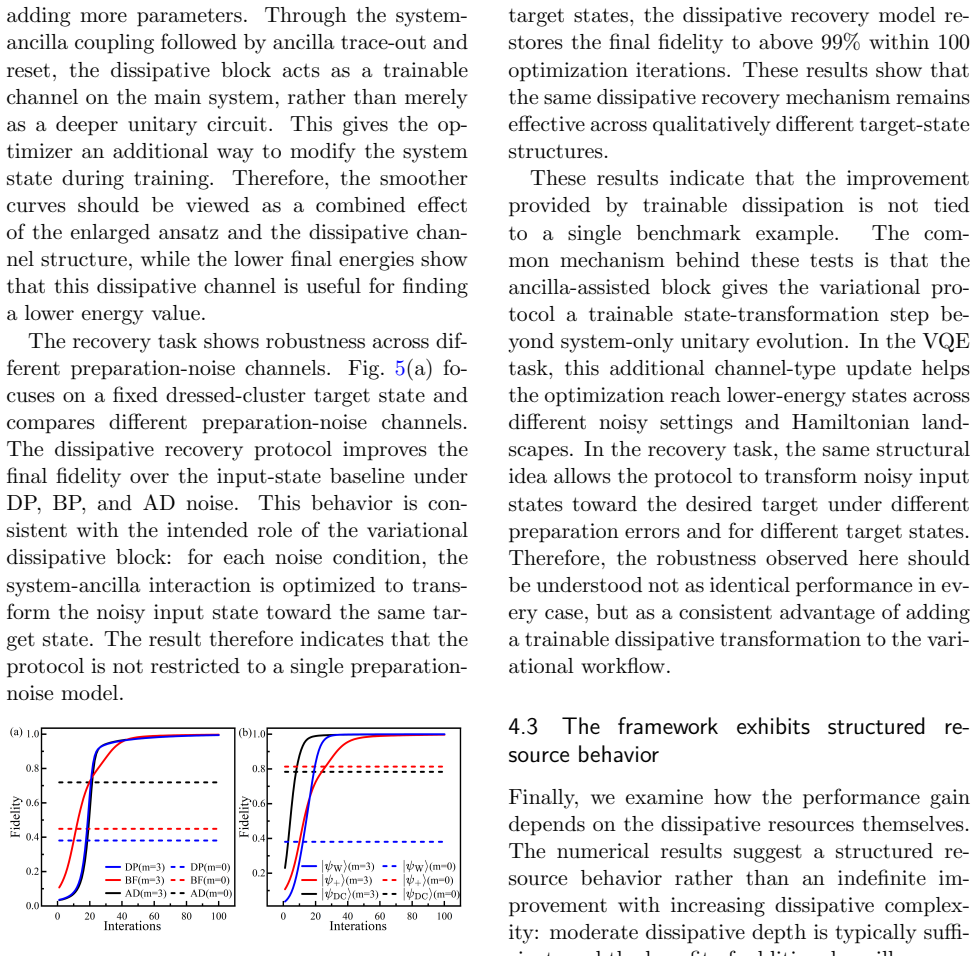
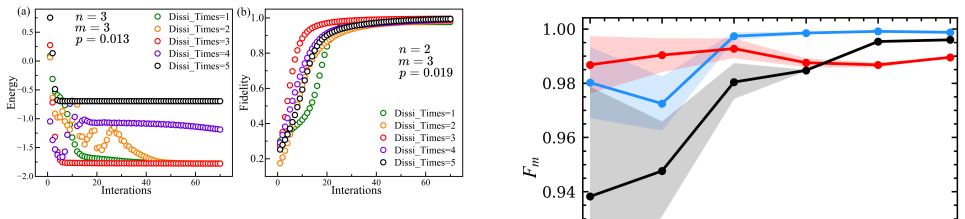
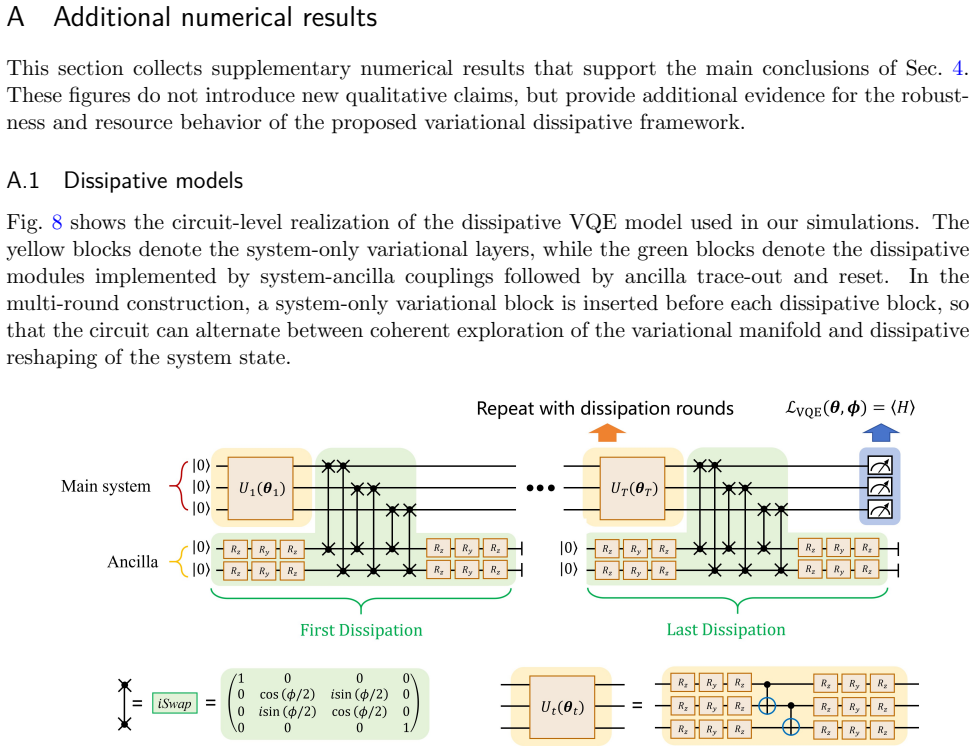
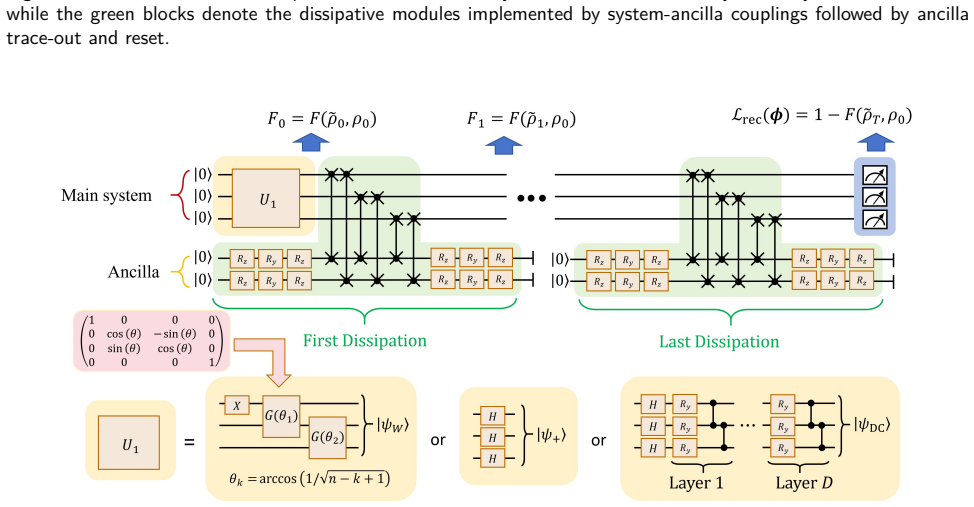
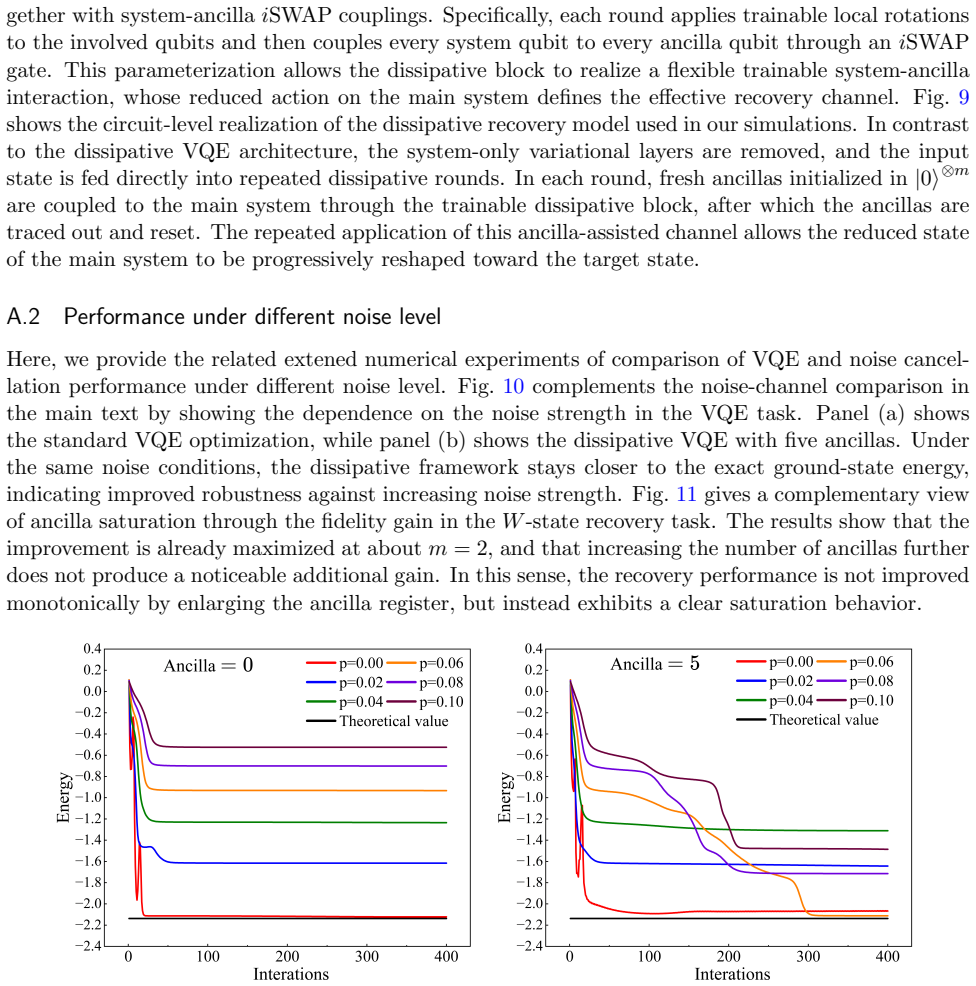
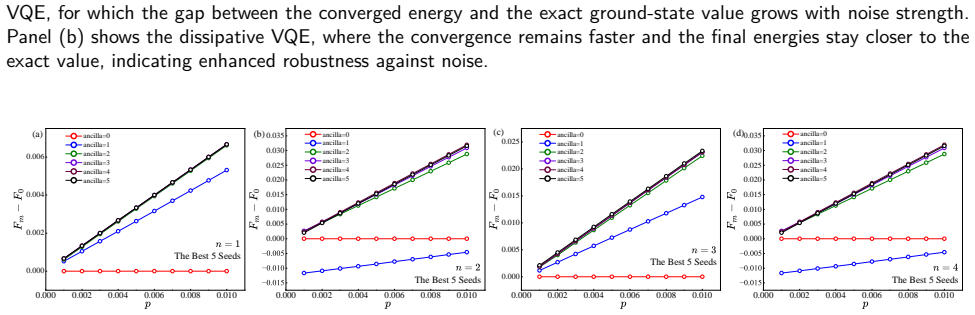
S. Wang, E. Fontana, M. Cerezo, K. Sharma, A. Sone, L. Cincio, and P. J. Coles, Nature communications12, 6961 (2021). 12 A Additional numerical results This section collects supplementary numerical results that support the main conclusions of Sec. 4. These figures do not introduce new qualitative claims, but provide additional evidence for the robust- nes...
discussion (0)
Sign in with ORCID, Apple, or X to comment. Anyone can read and Pith papers without signing in.