REVIEW 2 major objections 2 minor 5 references
Neural operator policies for PDE control trained on small agent groups transfer directly to much larger groups without retraining.
Reviewed by Pith at T0; open to challenge. T0 means a machine referee read the full paper against a public rubric. the ladder, T0–T4 →
T0 review · grok-4.3
2026-06-29 20:41 UTC pith:NFMF2DSN
load-bearing objection CINOC reframes PDE control as operator learning to get cardinality-invariant policies that transfer across agent counts, with experiments on several regimes, but the mean-field theorem's regularity assumptions look unverified for the architectures used. the 2 major comments →
CINOC: Cardinality-Invariant Neural Operator Policies for Scalable PDE Control
The pith
A machine-rendered reading of the paper's core claim, the machinery that carries it, and where it could break.
Core claim
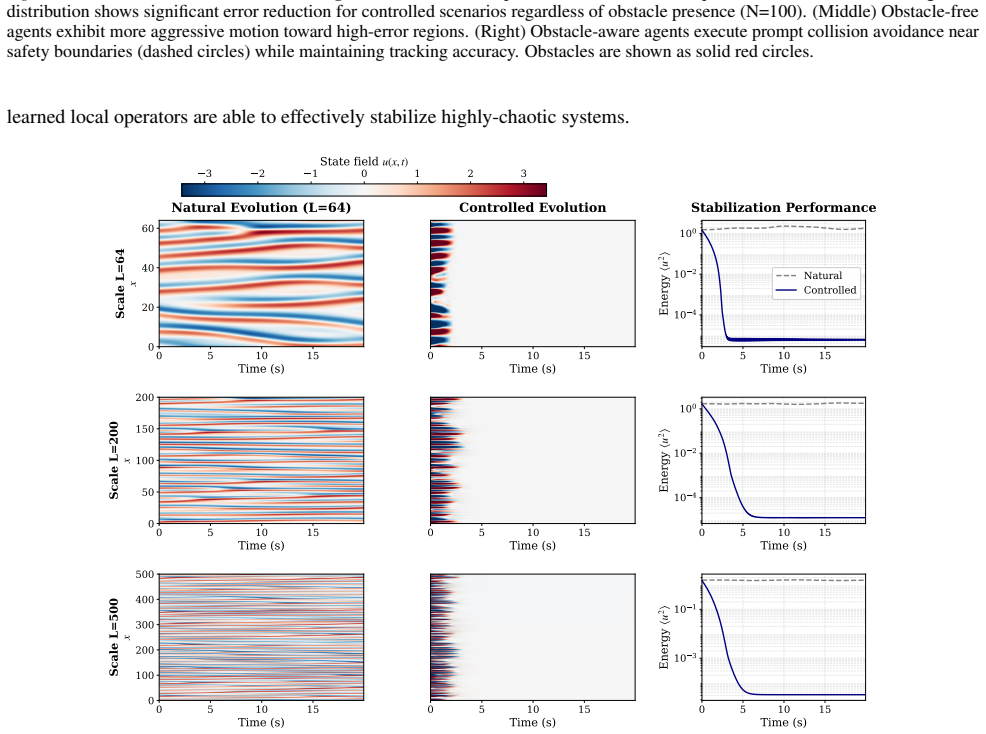
Reformulating PDE control as an operator learning problem that maps state fields to continuous control functions produces policies that are invariant to the number of agents. Because every agent uses the identical policy and agents coordinate solely through the shared physical environment, the learned behavior exhibits self-normalization: a policy trained on a small swarm applies unchanged to a swarm of arbitrary size and tolerates the loss of individual agents. This invariance is supported by a mean-field theorem establishing that policy gradients computed on finite-agent systems converge to those of the continuous control limit.
What carries the argument
The neural operator policy mapping state fields to continuous control functions, trained end-to-end through differentiable PDE solvers, whose cardinality invariance follows from convergence of finite-agent policy gradients to the mean-field limit.
Load-bearing premise
The mean-field convergence result holds for the specific neural operator architectures used and the differentiable PDE solvers faithfully reproduce the dynamics required for the observed invariance.
What would settle it
An explicit numerical check that policy gradients obtained from a finite swarm of agents diverge from the gradients computed in the corresponding continuous mean-field formulation would falsify the claimed explanation for the observed transfer.
If this is right
- A single policy trained on a small population can be deployed on populations of any larger size without retraining or architectural change.
- The same policy remains functional after the loss of some agents, providing robustness to partial failure.
- The method applies uniformly to linear, nonlinear, chaotic, and turbulent PDEs for tasks including tracking, stabilization, and density transport.
- Training through differentiable solvers removes the need for separate discretization or hand-designed controllers when the sensor-actuator count changes.
Where Pith is reading between the lines
- The approach could remove the need to retrain controllers whenever the number of physical devices changes in deployed systems.
- Similar self-normalization may appear in other shared-policy multi-agent problems where agents interact only through a common medium.
- Training cost could be further reduced by simulating only the smallest viable swarm size rather than the target population size.
Editorial analysis
A structured set of objections, weighed in public.
Referee Report
Summary. The manuscript introduces Cardinality-Invariant Neural Operator Control (CINOC), reformulating multi-agent PDE control as an operator-learning task in which a shared neural operator maps the PDE state field to a continuous control function. Policies are trained end-to-end via differentiable PDE solvers; the resulting policies exhibit cardinality invariance, permitting zero-shot transfer from small training swarms to substantially larger populations and robustness to partial agent loss. A mean-field theorem is supplied to show that policy gradients computed on finite-N systems converge to those of the corresponding continuous control limit. Empirical results are reported for tracking, stabilization, and density-transport tasks on linear, nonlinear, chaotic, and turbulent PDEs.
Significance. If the mean-field convergence holds for the specific operator architectures and the empirical invariance is reproducible, the work would provide a practical route to scalable distributed control without retraining when actuator or sensor counts change. The combination of neural-operator representations with a supporting convergence theorem is a notable strength relative to fixed-dimensional policy approaches.
major comments (2)
- [Theorem section] Theorem (mean-field section): the stated convergence of finite-N policy gradients to the continuous limit is asserted without verification of the uniform Lipschitz or compactness conditions on the neural operator that are required for standard mean-field arguments to apply when the operator is composed with the PDE dynamics. The manuscript does not establish that these conditions hold independently of N for the DeepONet- or FNO-style layers employed in CINOC.
- [§5] §5 (Experiments): the reported zero-shot transfer and robustness results rely on the differentiable solver faithfully reproducing the continuous limit; no ablation or error analysis quantifies how discretization artifacts in the solver affect gradient convergence or the observed cardinality invariance as N increases.
minor comments (2)
- [Notation] Notation for the state field, control operator, and mean-field limit is introduced piecemeal; a consolidated symbol table would improve readability.
- [Introduction] Related-work discussion omits several recent papers on mean-field control of PDEs and on neural operators for distributed actuation.
Simulated Author's Rebuttal
We thank the referee for the constructive comments on our manuscript. We address each major comment below and indicate the revisions that will be incorporated.
read point-by-point responses
-
Referee: [Theorem section] Theorem (mean-field section): the stated convergence of finite-N policy gradients to the continuous limit is asserted without verification of the uniform Lipschitz or compactness conditions on the neural operator that are required for standard mean-field arguments to apply when the operator is composed with the PDE dynamics. The manuscript does not establish that these conditions hold independently of N for the DeepONet- or FNO-style layers employed in CINOC.
Authors: We acknowledge that the theorem relies on standard mean-field regularity assumptions without an explicit verification that the uniform Lipschitz and compactness conditions hold independently of N for the specific DeepONet and FNO architectures. In the revised manuscript we will add a remark immediately following the theorem statement that lists these conditions and supplies a brief argument that they are satisfied: the operators are finite-depth with globally Lipschitz activations and parameter norms bounded independently of N, which implies the required uniform bounds when composed with the PDE flow under the problem's standing assumptions on the dynamics. If the referee finds this insufficient we are prepared to move a full proof sketch to the appendix. revision: yes
-
Referee: [§5] §5 (Experiments): the reported zero-shot transfer and robustness results rely on the differentiable solver faithfully reproducing the continuous limit; no ablation or error analysis quantifies how discretization artifacts in the solver affect gradient convergence or the observed cardinality invariance as N increases.
Authors: We agree that an explicit quantification of discretization effects would strengthen the empirical support for the observed cardinality invariance. In the revised Section 5 we will include a new ablation that reports cardinality-invariance metrics and policy-gradient norms for increasing N under three different spatial/temporal discretization resolutions of the differentiable solver. This will directly illustrate the sensitivity (or lack thereof) of the reported zero-shot transfer results to solver artifacts. revision: yes
Circularity Check
No significant circularity; mean-field theorem presented as independent explanatory result
full rationale
The paper's central claim is that CINOC policies, formulated as neural operator mappings from state fields to continuous controls and trained via differentiable PDE solvers, exhibit cardinality invariance due to shared policies and environmental coordination. The mean-field theorem is introduced to explain gradient convergence from finite to continuous limits. No quoted equations or derivations reduce the invariance to a definitional identity, a fitted parameter renamed as prediction, or a self-citation chain. The architecture choice and theorem are independent of the target scalability result, with empirical validation on multiple PDEs providing external content. This matches the default case of a self-contained derivation.
Axiom & Free-Parameter Ledger
read the original abstract
Controlling partial differential equations (PDEs) with learning-based policies remains fundamentally limited by fixed-dimensional representations: policies trained for a specific sensor, actuator, or agent configuration typically fail when the configuration changes. This limitation is particularly severe in multi-agent PDE control, where policies do not scale across population sizes without retraining. We address this challenge by introducing Cardinality Invariant Neural Operator Control (CINOC), reformulating PDE control as an operator learning problem that maps state fields to continuous control functions and trains them end-to-end through differentiable PDE solvers, yielding policies that naturally adapt to varying sensor and actuator configurations. Remarkably, CINOC policies trained on small swarms exhibit cardinality invariance, allowing for zero-shot transfer to significantly larger populations as well as robustness to partial agent failure. This scalability arises from agents sharing a common policy and coordinating through their physical environment, which produces an emergent self-normalization effect. To explain this phenomenon, we provide a theorem grounded in mean-field theory demonstrating that policy gradients computed from finite-agent systems converge to those of a continuous control limit. Empirically, we validate CINOC on tracking, stabilization, and density transport across linear, nonlinear, chaotic, and turbulent PDEs.
Figures




Reference graph
Works this paper leans on
-
[1]
URL https://arxiv.org/abs/2601. 15015. GitHub: https://github.com/safe-autonomous- systems/fluidgym. Bhan, L., Shi, Y ., and Krstic, M. Neural operators for bypassing gain and control computations in PDE back- stepping.IEEE Transactions on Automatic Control, 69 (8):5310–5325, 2023. Bhan, L., Bian, Y ., Krstic, M., and Shi, Y . PDE control gym: A benchmark...
2023
-
[2]
Bradbury, J., Frostig, R., Hawkins, P., Johnson, M
URL https://proceedings.mlr.press/ v283/bousias25a.html. Bradbury, J., Frostig, R., Hawkins, P., Johnson, M. J., Leary, C., Maclaurin, D., Necula, G., Paszke, A., VanderPlas, J., Wanderman-Milne, S., and Zhang, Q. JAX: composable transformations of Python+NumPy programs, 2018. URL http://github.com/jax-ml/jax. Carrillo, J. A. and Choi, Y .-P. Mean-field l...
2018
-
[3]
cc/paper_files/paper/2018/file/ 842424a1d0595b76ec4fa03c46e8d755-Paper
URL https://proceedings.neurips. cc/paper_files/paper/2018/file/ 842424a1d0595b76ec4fa03c46e8d755-Paper. pdf. de Jong, T. O., Shukla, K., and Lazar, M. Deep Operator Neural Network Model Predictive Control.arXiv preprint arXiv:2505.18008, 2025. Demetriou, M. A. Guidance of mobile actuator-plus-sensor networks for improved control and estimation of dis- tr...
-
[4]
arXiv preprint arXiv:2006.07869 (2020)
URL https://openreview.net/forum? id=c_E8kFWfhp0. Pan, J., Xing, J., Reiter, R., Zhai, Y ., Aljalbout, E., and Scaramuzza, D. Learning on the Fly: Rapid Policy Adap- tation via Differentiable Simulation. InIEEE Robotics and Automation Letters, 2026. Pan, Y ., Farahmand, A.-m., White, M., Nabi, S., Grover, P., and Nikovski, D. Reinforcement learning with f...
-
[5]
URL https://openreview.net/forum? id=XopATjibyz. Theraulaz, G. and Bonabeau, E. A brief history of stigmergy. Artificial life, 5(2):97–116, 1999. Turing, A. M. The chemical basis of morphogenesis.Bul- letin of mathematical biology, 52(1):153–197, 1990. Vasanth, J., Rabault, J., Alc ´antara- ´Avila, F., Mortensen, M., and Vinuesa, R. Multi-agent reinforcem...
discussion (0)
Sign in with ORCID, Apple, or X to comment. Anyone can read and Pith papers without signing in.