Benchmarking Transparent Conductors
Pith reviewed 2026-06-29 21:33 UTC · model grok-4.3
The pith
Transparent conductors should be evaluated by the transparency they achieve at a fixed, device-required sheet resistance.
A machine-rendered reading of the paper's core claim, the machinery that carries it, and where it could break.
Core claim
The central claim is that transparent conductors are more usefully benchmarked by fixing sheet resistance R_S to an application-specific target and reporting the transparency T_app(R_S) that can be obtained at that resistance. This replaces conventional figures of merit, which evaluate performance at conditions that may be impractical for devices. When applied to representative conventional and emerging TCOs, the approach defines the relevant sheet-resistance ranges for different uses and shows how each material performs within those ranges, supplying an application-rooted basis for material selection and development.
What carries the argument
The T_app(R_S) metric, which quantifies the optical transparency achievable at a fixed, application-relevant sheet resistance.
If this is right
- Materials are ranked by absolute transparency gains at a specified R_S rather than by abstract figures of merit.
- Each application defines its own relevant sheet-resistance range for performance mapping.
- Material development focuses on transparency improvements under fixed electrical constraints.
- Device integration is aided by direct selection of materials according to operational R_S values.
Where Pith is reading between the lines
- The fixed-constraint approach could be adapted to evaluate other functional materials where one performance axis is set by device operation.
- Some materials may rank differently under this method than under conventional metrics, altering development priorities.
- The framework supplies a template for any class of materials where performance must be assessed at fixed operational parameters.
Load-bearing premise
Widely used metrics guide material design toward conditions that can be impractical for devices.
What would settle it
Compare devices built from materials chosen by T_app(R_S) at the target resistance against those chosen by traditional metrics, and check whether the former deliver measurably higher transparency or efficiency at the required R_S.
Figures
read the original abstract
Transparent conducting oxides (TCOs) are central to optoelectronic technologies, yet their design is often guided by popular figures of merit that are disconnected from the electrical requirement of actual devices. As a result, widely used metrics guide material design under conditions that can be impractical for devices. Here, we introduce a benchmarking framework to guide TCO development, in which transparent conductors are evaluated at fixed, application-relevant sheet resistance $(R_S)$. The resulting metric, $T_{app}(R_S)$, anchors comparison to device requirements, asking instead: What optical transparency can be obtained at the sheet resistance required by a given application? This approach provides a directly interpretable measure of performance, enabling materials to be benchmarked in terms of absolute transparency gains at a specified $R_S$. Applied to representative conventional and emerging TCOs, the framework defines the sheet-resistance landscape relevant to each application and maps how different materials perform within it. In doing so, it provides an application-rooted guide to material development and selection. More broadly, this approach establishes a general strategy for evaluating materials under fixed operational constraints, bridging the gap between materials design and device integration.
Editorial analysis
A structured set of objections, weighed in public.
Referee Report
Summary. The manuscript introduces a benchmarking framework for transparent conducting oxides (TCOs) that evaluates materials at fixed, application-relevant sheet resistance R_S rather than via traditional figures of merit. The central metric T_app(R_S) quantifies the optical transparency achievable at a specified R_S, with the paper claiming to apply this framework to representative conventional and emerging TCOs in order to define the relevant sheet-resistance landscape and map material performance within it.
Significance. If substantiated, the framework supplies a parameter-free, device-anchored alternative to existing metrics by directly tying comparisons to operational constraints; this could improve alignment between materials design and device integration and offers a generalizable strategy for constraint-based evaluation of other functional materials.
major comments (1)
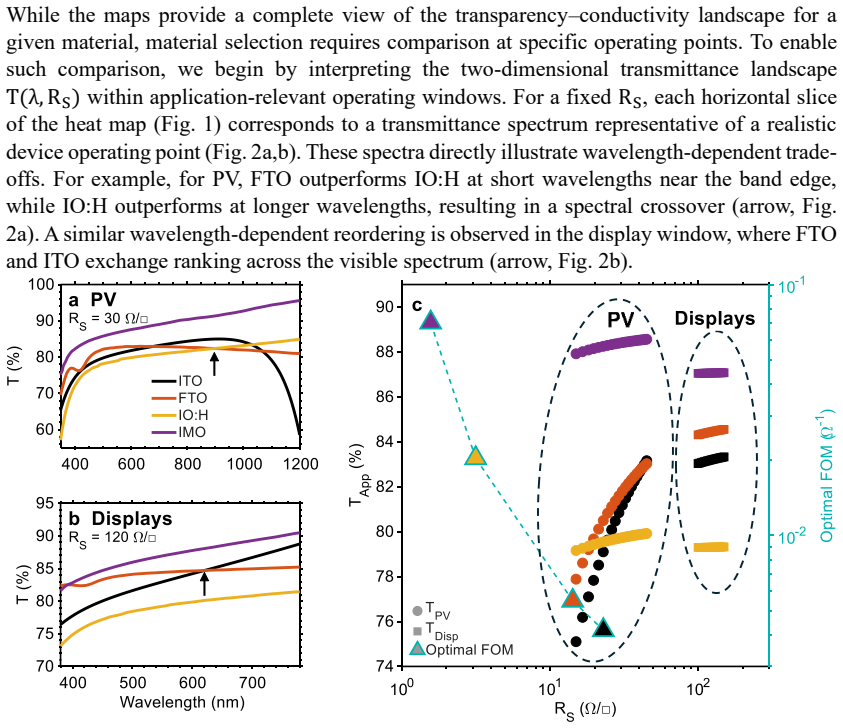
- [Application to TCOs (abstract and results sections)] The abstract and main text claim that the framework is "Applied to representative conventional and emerging TCOs" and that it "defines the sheet-resistance landscape" and "maps how different materials perform within it," yet no numerical data, calculations, tables, figures, error analysis, or validation against real materials are supplied. This directly undermines the central claim that the approach provides an "application-rooted guide to material development and selection."
Simulated Author's Rebuttal
We thank the referee for their detailed review and for identifying this critical gap. The comment correctly notes that the abstract and text make claims about applying the framework to TCOs without supplying the supporting data or figures. We agree this must be addressed and will revise accordingly.
read point-by-point responses
-
Referee: [Application to TCOs (abstract and results sections)] The abstract and main text claim that the framework is "Applied to representative conventional and emerging TCOs" and that it "defines the sheet-resistance landscape" and "maps how different materials perform within it," yet no numerical data, calculations, tables, figures, error analysis, or validation against real materials are supplied. This directly undermines the central claim that the approach provides an "application-rooted guide to material development and selection."
Authors: We accept the referee's observation. The submitted manuscript introduces the T_app(R_S) concept and describes its intended use on TCOs at a high level but does not include the concrete calculations, tables of values at application-relevant R_S (e.g., 10–100 Ω/sq), comparative figures, or error estimates drawn from literature property ranges. In the revised version we will add a new Results subsection that applies the metric to representative materials (ITO, FTO, AZO, and two emerging candidates), supplies the numerical T_app(R_S) values, plots the sheet-resistance landscape, and includes a brief discussion of uncertainty arising from reported mobility and carrier-density variations. This will directly support the abstract claims and furnish the application-rooted guide promised in the text. revision: yes
Circularity Check
No significant circularity; metric introduced by direct definition
full rationale
The paper proposes T_app(R_S) as a new benchmarking metric defined directly by evaluating optical transparency at fixed, application-specified sheet resistance R_S. The abstract presents this as an alternative evaluation strategy motivated by device needs, without any derivation chain, fitted parameters, equations, or self-citations that reduce the result to its own inputs. No load-bearing steps match the enumerated circularity patterns; the framework is self-contained as a re-framing of comparison conditions.
Axiom & Free-Parameter Ledger
axioms (1)
- domain assumption Widely used metrics guide material design under conditions that can be impractical for devices.
Reference graph
Works this paper leans on
-
[1]
Determination of the thickness and optical constants of amorphous silicon
Swanepoel, R. Determination of the thickness and optical constants of amorphous silicon. J. Phys. [E] 16, 1214–1222 (1983)
1983
-
[2]
A., Myers, D
Gueymard, C. A., Myers, D. & Emery, K. Proposed reference irradiance spectra for solar energy systems testing. Sol. Energy 73, 443–467 (2002)
2002
-
[3]
CIE spectral luminous efficiency for photopic vision
International Commission On Illumination (Cie). CIE spectral luminous efficiency for photopic vision. International Commission on Illumination (CIE) https://doi.org/10.25039/CIE.DS.dktna2s3
-
[4]
The conductivity of thin metallic films according to the electron theory of metals
Fuchs, K. The conductivity of thin metallic films according to the electron theory of metals. Math. Proc. Camb. Philos. Soc. 34, 100–108 (1938)
1938
-
[5]
Sondheimer, E. H. The mean free path of electrons in metals. Adv. Phys. 50, 499–537 (2001)
2001
-
[6]
Mayadas, A. F . & Shatzkes, M. Electrical-Resistivity Model for Polycrystalline Films: the Case of Arbitrary Reflection at External Surfaces. Phys. Rev. B 1, 1382–1389 (1970)
1970
-
[7]
& Dressel, M
Hövel, M., Gompf, B. & Dressel, M. Dielectric properties of ultrathin metal films around the percolation threshold. Phys. Rev. B 81, 035402 (2010)
2010
-
[8]
King, P . D. C. & Veal, T. D. Conductivity in transparent oxide semiconductors. J. Phys. Condens. Matter 23, 334214 (2011)
2011
-
[9]
& Horn, K
Aballe, L., Rogero, C. & Horn, K. Quantum size effects in ultrathin epitaxial Mg films on Si(111). Phys. Rev. B 65, 125319 (2002)
2002
-
[10]
Granqvist, C. G. Transparent conductors as solar energy materials: A panoramic review. Sol. Energy Mater. Sol. Cells 91, 1529–1598 (2007)
2007
-
[11]
Transparent conducting oxide semiconductors for transparent electrodes
Minami, T. Transparent conducting oxide semiconductors for transparent electrodes. Semicond. Sci. Technol. 20, S35 (2005)
2005
-
[12]
Ionic amorphous oxide semiconductors: Material design, carrier transport, and device application
Hosono, H. Ionic amorphous oxide semiconductors: Material design, carrier transport, and device application. J. Non-Cryst. Solids 352, 851–858 (2006)
2006
-
[13]
Zhang, L. et al. Correlated metals as transparent conductors. Nat. Mater. 15, 204–210 (2016)
2016
-
[14]
Minenkov, A. et al. Monitoring the Electrochemical Failure of Indium Tin Oxide Electrodes via Operando Ellipsometry Complemented by Electron Microscopy and Spectroscopy. ACS Appl. Mater. Interfaces 16, 9517–9531 (2024)
2024
-
[15]
Asl, H. Z. & Rozati, S. M. High-quality spray-deposited fluorine-doped tin oxide: effect of film thickness on structural, morphological, electrical, and optical properties. Appl. Phys. A 125, 689 (2019)
2019
-
[16]
& Miranda, H
Ching-Prado, E., Watson, A. & Miranda, H. Optical and electrical properties of fluorine doped tin oxide thin film. J. Mater. Sci. Mater. Electron. 29, 15299–15306 (2018)
2018
-
[17]
Budhi, A. W. S. Hydrogenated indium oxide (IO: H) for thin film solar cell. (Master’s thesis, Delft University of Technology, 2016)
2016
-
[18]
O., Adesina, A
Egbo, K. O., Adesina, A. E., Ezeh, C. V ., Liu, C. P . & Yu, K. M. Effects of free carriers on the optical properties of high mobility transition metal doped In₂O₃ transparent conductors. Phys. Rev. Mater. 5, 094603 (2021)
2021
-
[19]
K., Ghosh, K., Patel, R
Gupta, R. K., Ghosh, K., Patel, R. & Kahol, P . K. Effect of thickness on optoelectrical properties of Mo-doped indium oxide films. Appl. Surf. Sci. 255, 3046– 3048 (2008)
2008
discussion (0)
Sign in with ORCID, Apple, or X to comment. Anyone can read and Pith papers without signing in.