Anomalous Hall Effect in Silicon-Compatible Altermagnetic alpha-MnTe Thin Films
Pith reviewed 2026-06-29 21:30 UTC · model grok-4.3
The pith
Alpha-MnTe films grown directly on silicon show a hysteretic Hall response from altermagnetic Berry curvature despite zero net magnetization.
A machine-rendered reading of the paper's core claim, the machinery that carries it, and where it could break.
Core claim
Epitaxial alpha-MnTe thin films on Si(111) exhibit a pronounced hysteretic anomalous Hall effect generated by finite, uncompensated Berry curvature that arises from the breaking of compensation symmetry in the thin-film geometry; first-principles calculations confirm that the altermagnetic spin-split band structure supplies this curvature, establishing MnTe/Si(111) as a silicon-compatible platform for Berry-phase-driven functionalities.
What carries the argument
Uncompensated Berry curvature arising from the altermagnetic spin-split bands in the thin-film geometry.
If this is right
- MnTe can be integrated directly into silicon-based device flows without buffer layers.
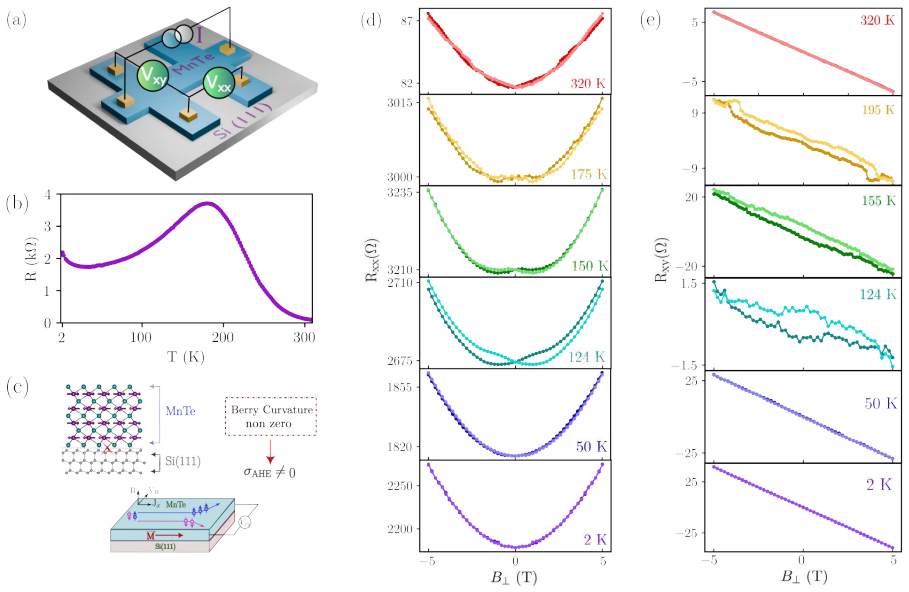
- The anomalous Hall response persists across a range of temperatures with correlated longitudinal and transverse hysteresis.
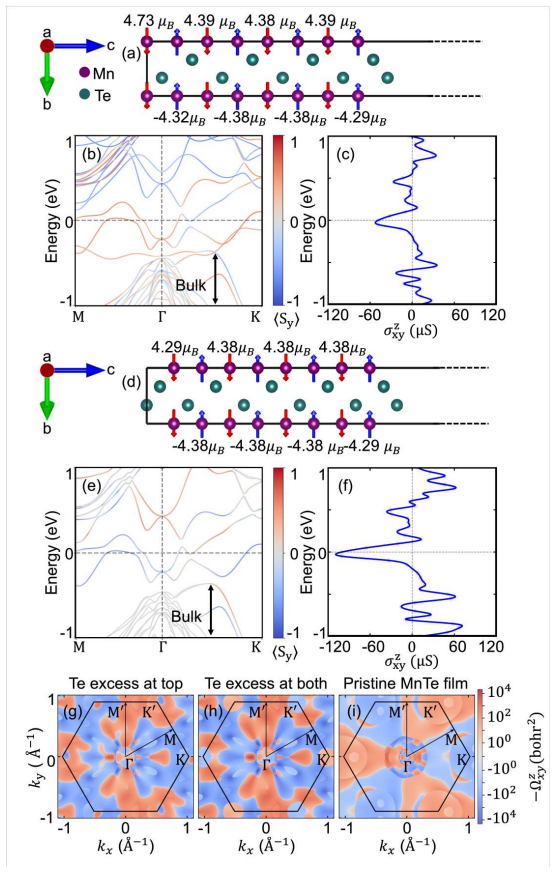
- First-principles band calculations reproduce the measured Hall conductivity from the altermagnetic band structure.
- The thin-film geometry supplies the symmetry breaking needed to generate net Berry curvature in an otherwise compensated altermagnet.
Where Pith is reading between the lines
- Similar symmetry-breaking routes may allow other altermagnetic candidates to be integrated on silicon once suitable epitaxial conditions are identified.
- Device architectures that rely on Hall readout rather than magnetization reversal could be tested directly on these films.
- Temperature-dependent scaling of the Hall conductivity offers a way to separate intrinsic Berry-phase contributions from extrinsic scattering terms.
Load-bearing premise
The measured hysteretic Hall signal is produced by intrinsic Berry curvature of the altermagnetic state rather than by defects, interfaces, or measurement artifacts.
What would settle it
Observation of identical hysteretic Hall response in polycrystalline or randomly oriented MnTe films of the same thickness would indicate that the effect does not require the epitaxial altermagnetic symmetry.
Figures
read the original abstract
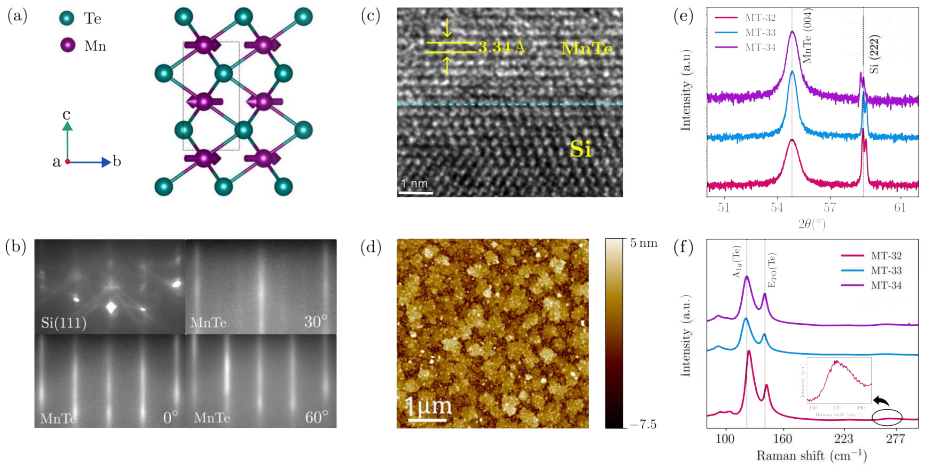
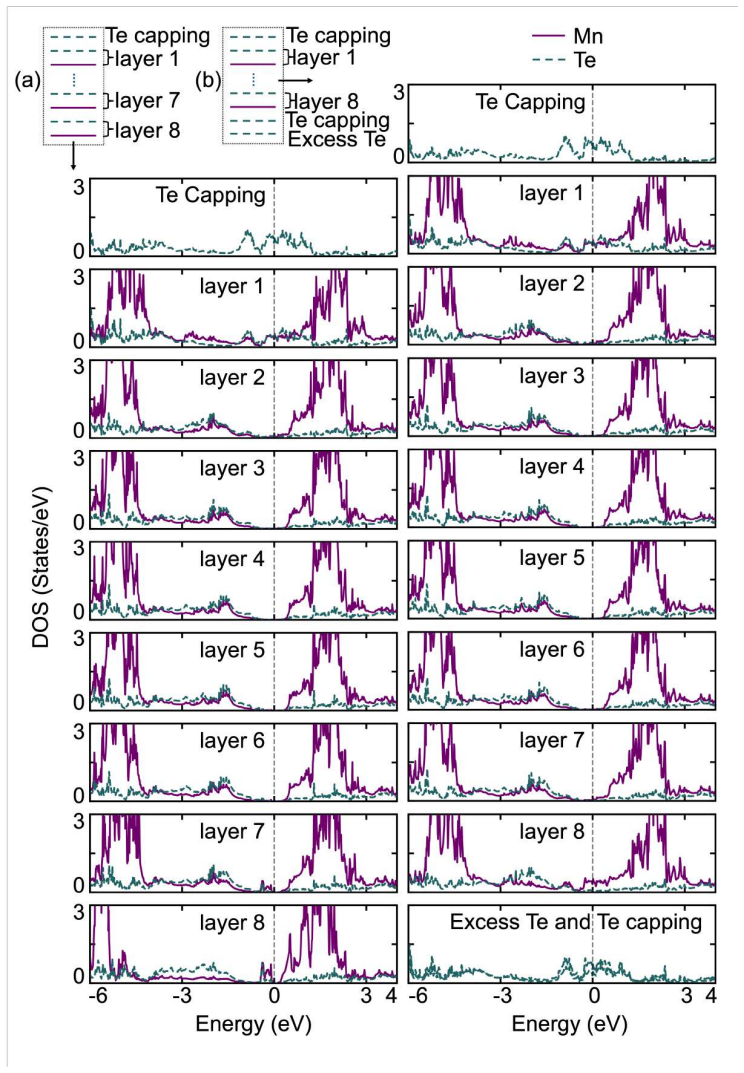
Integrating spin-dependent functionality with mainstream semiconductor technology is a central goal of modern spintronics, yet most candidate materials remain incompatible with silicon-based platforms. Here, we report the direct epitaxial integration of alpha-MnTe thin films on Si(111) via molecular beam epitaxy and demonstrate a robust anomalous Hall effect (AHE) in this silicon-compatible altermagnetic system. Despite the absence of net magnetization, the films exhibit a pronounced hysteretic Hall response, providing clear evidence of finite Berry curvature generated by symmetry breaking in the thin-film geometry. High resolution structural and spectroscopic characterization confirms phase-pure, epitaxial growth with hexagonal NiAs-type symmetry, while magnetotransport measurements reveal correlated hysteresis in both transverse and longitudinal channels with systematic temperature evolution. First-principles calculations reveal substantial uncompensated Berry curvature arising from the spin-split band structure consistent with altermagnetic symmetry and the origin of the observed Hall response. These results establish MnTe/Si(111) as a silicon-compatible altermagnetic platform and chart a concrete pathway for embedding Berry-phase-driven functionalities into scalable semiconductor device architectures.
Editorial analysis
A structured set of objections, weighed in public.
Referee Report
Summary. The manuscript reports molecular-beam-epitaxy growth of phase-pure α-MnTe thin films on Si(111), structural confirmation of hexagonal NiAs-type symmetry, and the observation of a hysteretic anomalous Hall effect (AHE) in the absence of net magnetization. The AHE is attributed to uncompensated Berry curvature arising from altermagnetic symmetry breaking in the thin-film geometry, with first-principles calculations cited as consistent with the measured transport response and temperature evolution.
Significance. If the central interpretation holds, the work establishes a silicon-compatible altermagnetic platform that integrates Berry-phase-driven spintronic functionality with mainstream semiconductor technology, addressing a key materials bottleneck for scalable altermagnetic devices.
major comments (2)
- [Abstract / magnetotransport measurements] Abstract and magnetotransport section: the claim that the observed hysteretic Hall response constitutes 'clear evidence' of intrinsic uncompensated Berry curvature is not secured by quantitative comparison of the measured Hall resistivity magnitude or its temperature dependence against the first-principles Berry-curvature integral; without such scaling or error analysis, extrinsic interface or defect contributions cannot be excluded at the level required for the central claim.
- [High resolution structural and spectroscopic characterization] Structural and spectroscopic characterization: while phase purity and epitaxial registry are reported, no quantitative bounds are given on possible minority phases, interface reconstruction, or strain-induced moments that could produce an extrinsic AHE; these bounds are load-bearing for the assertion that the response originates solely from altermagnetic symmetry breaking.
minor comments (1)
- [Abstract] The abstract refers to 'correlated hysteresis in both transverse and longitudinal channels' without specifying the longitudinal resistivity component or its scaling with the Hall signal; a brief clarification would improve readability.
Simulated Author's Rebuttal
We thank the referee for their careful reading and constructive feedback. We address each major comment point by point below.
read point-by-point responses
-
Referee: [Abstract / magnetotransport measurements] Abstract and magnetotransport section: the claim that the observed hysteretic Hall response constitutes 'clear evidence' of intrinsic uncompensated Berry curvature is not secured by quantitative comparison of the measured Hall resistivity magnitude or its temperature dependence against the first-principles Berry-curvature integral; without such scaling or error analysis, extrinsic interface or defect contributions cannot be excluded at the level required for the central claim.
Authors: We agree that the manuscript would benefit from a more explicit quantitative comparison between the measured Hall resistivity and the Berry-curvature integral from first-principles calculations. The existing calculations demonstrate that altermagnetic symmetry breaking produces uncompensated Berry curvature whose sign and temperature evolution are consistent with the data, but we did not perform a direct scaling or error analysis. In the revised manuscript we will add this comparison, including an estimate of the expected AHE magnitude from the calculated Berry curvature and a discussion of possible extrinsic contributions. We will also revise the abstract wording from 'clear evidence' to language that reflects the consistency with the intrinsic mechanism while acknowledging the need for further exclusion of extrinsic effects. revision: partial
-
Referee: [High resolution structural and spectroscopic characterization] Structural and spectroscopic characterization: while phase purity and epitaxial registry are reported, no quantitative bounds are given on possible minority phases, interface reconstruction, or strain-induced moments that could produce an extrinsic AHE; these bounds are load-bearing for the assertion that the response originates solely from altermagnetic symmetry breaking.
Authors: We acknowledge that explicit quantitative bounds on minority phases and potential extrinsic sources are necessary to support the central claim. The reported XRD and TEM data indicate phase-pure epitaxial growth, yet upper limits on minority-phase fractions were not quantified. In the revision we will extract and report quantitative bounds from the XRD peak intensities (e.g., minority phases <1 %) and will add discussion of the absence of detectable interface reconstruction or strain-induced moments, based on the measured lattice parameters, rocking-curve widths, and the lack of net magnetization in SQUID magnetometry. These additions will directly address the load-bearing requirement identified by the referee. revision: yes
Circularity Check
No significant circularity; central claim is experimental observation supported by independent measurements.
full rationale
The paper reports epitaxial growth and magnetotransport data on MnTe/Si(111) films, with the AHE observation presented as direct experimental evidence. First-principles calculations are described only as revealing Berry curvature 'consistent with' the altermagnetic state and the observed response; they function as a post-hoc check rather than a derivation from which the result is obtained. No equations reduce a fitted parameter to a 'prediction,' no self-citation chain supplies a uniqueness theorem or ansatz, and the structural/transport data are externally falsifiable. The derivation chain is therefore self-contained against external benchmarks.
Axiom & Free-Parameter Ledger
Reference graph
Works this paper leans on
-
[1]
In-plane Hall effect in a RuO2 single crystal
(1) Zhou, X.; Yao, Y.; Li, Z.; Cao, J.; Wu, W.; Luo, J. In-plane Hall effect in a RuO2 single crystal. J. Phys. Chem. Lett.2025, 16, 7883–7888. (2) Wang, M.; Zhang, J.; Tian, D.; Yu, P.; Kagawa, F. Unveiling an in-plane Hall effect in rutile RuO2 films. Commun. Phys.2025, 8, 28. (3) ˇSmejkal, L.; Sinova, J.; Jungwirth, T. Beyond Conventional Ferromagnetis...
2025
discussion (0)
Sign in with ORCID, Apple, or X to comment. Anyone can read and Pith papers without signing in.