From Early Adoption to Sustained Use: Understanding GenAI Usage Among Software Developers in Italian SMEs
Pith reviewed 2026-06-29 20:22 UTC · model grok-4.3
The pith
Developers sustain GenAI tool use based on personal productivity gains and enjoyment, not social or organizational pressure.
A machine-rendered reading of the paper's core claim, the machinery that carries it, and where it could break.
Core claim
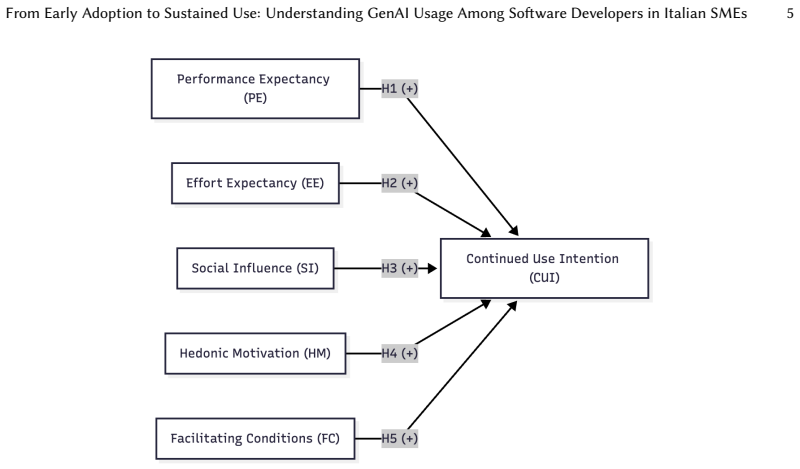
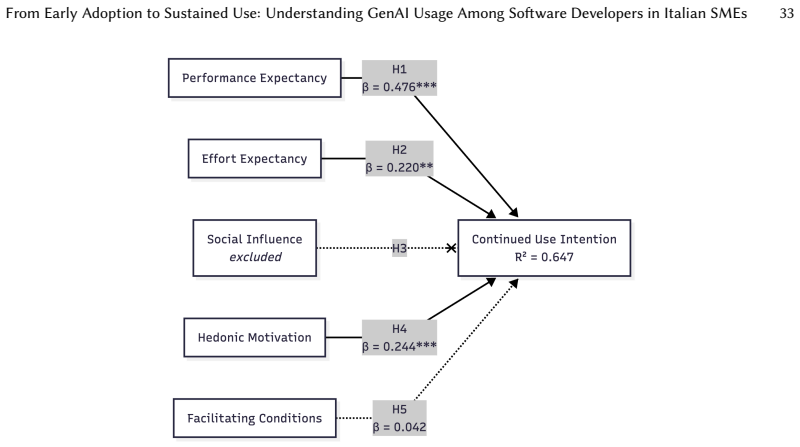
The adapted UTAUT2 structural model explains 64.7 percent of the variance in developers' intention to continue using GenAI tools. Performance expectancy, hedonic motivation, and effort expectancy emerge as significant predictors, while social influence and facilitating conditions do not. This pattern indicates that, once tools are in use, sustained adoption in professional contexts is driven primarily by individual-level perceptions rather than external social or organizational factors.
What carries the argument
An adapted UTAUT2 model tested via partial least squares structural equation modeling on survey data from 154 developers across Italian SMEs.
If this is right
- Sustained GenAI use hinges on users directly experiencing productivity and enjoyment benefits rather than external encouragement.
- Organizational promotion efforts may have limited impact compared with ensuring tools deliver immediate individual value.
- Technology-adoption models require distinct handling of initial versus continued-use phases in professional software settings.
- SMEs can achieve ongoing GenAI adoption without substantial investment in social norms or infrastructure support.
Where Pith is reading between the lines
- Training that emphasizes concrete productivity techniques could raise retention rates more effectively than broad awareness campaigns.
- The dominance of individual factors may apply to other discretionary AI tools where usage is not mandated.
- Collecting longitudinal usage logs would test whether reported intention reliably predicts actual long-term behavior.
Load-bearing premise
The standard UTAUT2 constructs, after adaptation, remain sufficient to explain continued-use intention for GenAI without needing new or domain-specific factors.
What would settle it
A replication survey that replaces self-reported intention with logged tool-usage frequency and finds that social or organizational variables become significant predictors.
Figures
read the original abstract
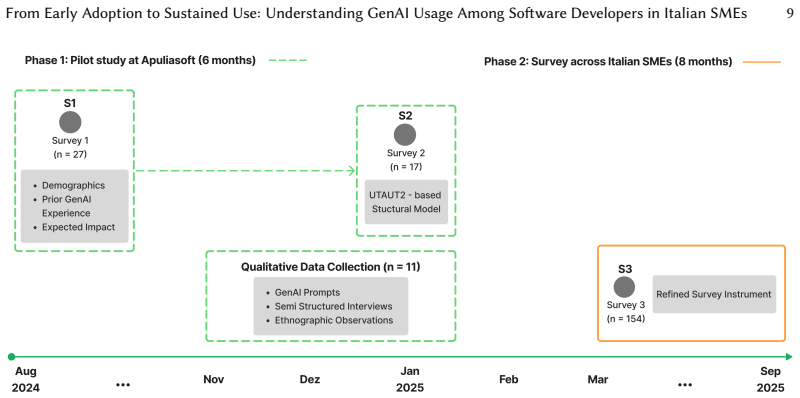
Generative AI tools are rapidly transforming software development practice, prompting unprecedented research interest. However, existing studies have predominantly examined initial adoption rather than sustained use. Understanding what drives developers to continue using these tools after initial adoption remains underexplored, particularly in small and medium-sized enterprises where resource constraints shape technology decisions differently than in large organisations. This study investigates factors associated with developers' intentions to continue using GenAI tools, adapting the UTAUT2 framework to post-adoption professional contexts. We employed a two-phase mixed-methods design. Phase 1 comprised a six-month longitudinal pilot study at an Italian software company combining surveys and interviews with 17 developers to explore how perceptions of GenAI evolve as experience accumulates. These insights informed a structural model tested in Phase 2 through a cross-sectional survey of 154 developers across Italian SMEs, analysed using PLS-SEM. The model explained substantial variance in continued use intention (R2 = 0.647), with individual-level perceptions, particularly around productivity, enjoyment, and ease of use, driving sustained adoption, whereas social and organisational factors played no significant role. These findings suggest that, for GenAI tools, post-adoption behaviour differs from initial adoption patterns: in voluntary professional contexts, sustained use is driven primarily by individual-level factors rather than by social and organisational support.
Editorial analysis
A structured set of objections, weighed in public.
Referee Report
Summary. The paper claims that a two-phase mixed-methods study adapting UTAUT2 to post-adoption contexts shows that continued-use intention for GenAI tools among 154 developers in Italian SMEs is substantially explained (R² = 0.647) by individual-level perceptions of productivity, enjoyment, and ease of use, while social and organizational factors are non-significant; Phase 1 longitudinal insights from 17 developers informed the model tested via PLS-SEM in Phase 2.
Significance. If the adapted measurement model holds, the result is significant for distinguishing post-adoption from initial-adoption patterns in voluntary professional settings and for resource-constrained SMEs, where individual perceptions appear to dominate over social/organizational support.
major comments (1)
- [Methods (Phase 2)] Methods (Phase 2 survey and model specification): The adaptation of UTAUT2 constructs for GenAI continued-use intention reports no confirmatory factor analysis, item re-development, or pilot validation beyond the n=17 Phase 1 longitudinal study. This is load-bearing because the headline R²=0.647 and the claim that only individual-level paths are significant rest on the measurement model's validity; without evidence that Phase 1 insights produced re-validated scales rather than simple reuse, the non-significant social/organizational paths and overall model interpretation cannot be assessed.
minor comments (1)
- [Abstract] Abstract and results: The phrase 'informed a structural model' is vague; explicit description of which items were retained, dropped, or modified based on Phase 1 would improve traceability.
Simulated Author's Rebuttal
We appreciate the referee's detailed feedback on our manuscript. Below we provide a point-by-point response to the major comment.
read point-by-point responses
-
Referee: [Methods (Phase 2)] Methods (Phase 2 survey and model specification): The adaptation of UTAUT2 constructs for GenAI continued-use intention reports no confirmatory factor analysis, item re-development, or pilot validation beyond the n=17 Phase 1 longitudinal study. This is load-bearing because the headline R²=0.647 and the claim that only individual-level paths are significant rest on the measurement model's validity; without evidence that Phase 1 insights produced re-validated scales rather than simple reuse, the non-significant social/organizational paths and overall model interpretation cannot be assessed.
Authors: We thank the referee for this observation. Our Phase 1 longitudinal study with 17 developers was designed to generate insights into post-adoption perceptions through repeated surveys and interviews over six months. These insights directly informed the adaptation of UTAUT2 constructs, for example by refining items to focus on sustained use rather than initial adoption. Although we did not perform a standalone confirmatory factor analysis or an additional pilot study, the measurement model in Phase 2 was validated using the standard procedures for PLS-SEM, including assessment of indicator reliability, internal consistency reliability, convergent validity, and discriminant validity. We report these metrics in the manuscript to support the model's validity. We acknowledge that more explicit documentation of the adaptation process would strengthen the paper and will revise the methods section to include a table or detailed description mapping Phase 1 findings to specific construct adaptations. This will allow readers to better evaluate the scale development. revision: partial
Circularity Check
No circularity; result from independent survey data via standard PLS-SEM
full rationale
The paper's core claim (R²=0.647 with individual-level factors dominant) is obtained by applying PLS-SEM to a fresh cross-sectional survey (n=154) after a separate longitudinal pilot (n=17). UTAUT2 is cited as an external framework adapted for the context; Phase 1 insights inform item selection but do not substitute for or tautologically define the fitted paths. No self-citation chains, fitted inputs renamed as predictions, or self-definitional constructs appear in the reported derivation. The analysis is therefore self-contained against external benchmarks.
Axiom & Free-Parameter Ledger
axioms (1)
- domain assumption UTAUT2 constructs are appropriate and sufficient for post-adoption continued-use intention in voluntary professional contexts
Reference graph
Works this paper leans on
-
[1]
Adoption of AI in construction design: Insights from UTAUT2 and TOE frameworks
Alharthi, S., et al., 2025. Adoption of AI in construction design: Insights from UTAUT2 and TOE frameworks. Results in Engineering doi:10.1016/j.rineng.2025.104576
-
[2]
Ayinaddis, S.G., 2025. Artificial intelligence adoption dynamics and knowledge in SMEs and large firms: A systematic review and bibliometric analysis. Journal of Innovation & Knowledge 10, 100682. doi: 10.1016/j.jik.2025.100682
-
[3]
Badghish, S., Soomro, Y.A., 2024. Artificial intelligence adoption by SMEs to achieve sustainable business performance: Application of technology–organization–environment framework. Sustainability 16, 1864. doi: 10.3390/su16051864
-
[4]
Sampling in software engineering research: A critical review and guidelines
Baltes, S., Ralph, P., 2022. Sampling in software engineering research: A critical review and guidelines. Empirical Software Engineering 27, 94
2022
-
[5]
World bank sme finance
Bank, W., 2025. World bank sme finance. URL: https://www.worldbank.org/en/topic/smefinance. Accessed: 2026-01-14
2025
-
[6]
Grounded copilot: How programmers interact with code-generating models
Barke, S., James, M.B., Polikarpova, N., 2023. Grounded copilot: How programmers interact with code-generating models. Proc. ACM Program. Lang. 7. doi:10.1145/3586030
-
[7]
Motivation in software engineering: A systematic literature review
Beecham, S., Baddoo, N., Hall, T., Robinson, H., Sharp, H., 2008. Motivation in software engineering: A systematic literature review. Inf. Softw. Technol. 50, 860–878. doi:10.1016/J.INFSOF.2007.09.004
-
[8]
Understanding information systems continuance: An expectation-confirmation model
Bhattacherjee, A., 2001. Understanding information systems continuance: An expectation-confirmation model. MIS Q. 25, 351–370
2001
-
[9]
Factors affecting ERP system adoption: A comparative analysis between smes and large companies
Buonanno, G., Faverio, P., Pigni, F., Ravarini, A., Sciuto, D., Tagliavini, M., 2005. Factors affecting ERP system adoption: A comparative analysis between smes and large companies. J. Enterp. Inf. Manag. 18, 384–426. doi:10.1108/ 17410390510609572
2005
-
[10]
Managing human resources in small organizations: What do we know? Human resource management review 14, 295–323
Cardon, M.S., Stevens, C.E., 2004. Managing human resources in small organizations: What do we know? Human resource management review 14, 295–323
2004
-
[11]
Distinctive characteristics of small businesses as sites for informal learning
Coetzer, A., Kock, H., Wallo, A., 2017. Distinctive characteristics of small businesses as sites for informal learning. Human Resource Development Review 16, 111–134
2017
-
[12]
Basics of qualitative research: Techniques and procedures for developing grounded theory
Corbin, J., Strauss, A., 2014. Basics of qualitative research: Techniques and procedures for developing grounded theory. Sage publications
2014
-
[13]
Designing and conducting mixed methods research
Creswell, J.W., Clark, V.L.P., 2017. Designing and conducting mixed methods research. Sage publications
2017
-
[14]
The effects of generative ai on high-skilled work: Evidence from three field experiments with software developers
Cui, Z.K., Demirer, M., Jaffe, S., Musolff, L., Peng, S., Salz, T., 2025. The effects of generative ai on high-skilled work: Evidence from three field experiments with software developers. Available at SSRN 4945566
2025
-
[15]
The 2026 State of Product Security for the AI Era
Cycode, 2026. The 2026 State of Product Security for the AI Era. Industry Report. Cycode. URL: https://cycode.com/ thank-you-page/state-of-product-security-ai-era-2026/. Accessed: 2026-01-14
2026
-
[16]
Github copilot AI pair programmer: Asset or liability? J
Dakhel, A.M., Majdinasab, V., Nikanjam, A., Khomh, F., Desmarais, M.C., Jiang, Z.M.J., 2023. Github copilot AI pair programmer: Asset or liability? J. Syst. Softw. 203, 111734. doi:10.1016/J.JSS.2023.111734
-
[17]
An Industry Case Study on Adoption of AI-based Programming Assistants, in: Proc
Davila, N., Wiese, I., Steinmacher, I., Lucio da Silva, L., Kawamoto, A., Favaro, G.J.P., Nunes, I., 2024. An Industry Case Study on Adoption of AI-based Programming Assistants, in: Proc. of the 46th Intl. Conf. on Software Engineering: Software Engineering in Practice, Association for Computing Machinery, New York, NY, USA. pp. 92–102. doi: 10. 1145/3639...
arXiv 2024
-
[18]
Perceived usefulness, perceived ease of use, and user acceptance of information technology
Davis, F.D., 1989. Perceived usefulness, perceived ease of use, and user acceptance of information technology. MIS Q. 13, 319–340. doi:10.2307/249008
-
[19]
Rethinking IT governance for smes
Devos, J.G., Landeghem, H.V., Deschoolmeester, D.A.K., 2012. Rethinking IT governance for smes. Ind. Manag. Data Syst. 112, 206–223. doi:10.1108/02635571211204263
-
[20]
Accelerate State of DevOps 2024
DORA, 2024. Accelerate State of DevOps 2024. Technical Report. Google. URL: https://dora.dev/research/2024/dora- report/. Accessed: 2026-01-14
2024
-
[21]
State of AI-assisted Software Development
DORA, 2025. State of AI-assisted Software Development. Technical Report. Google. URL: https://dora.dev/research/ai/. Accessed: 2026-01-14
2025
-
[22]
Statistical power analyses using G* Power 3.1: Tests for correlation and regression analyses
Faul, F., Erdfelder, E., Buchner, A., Lang, A.G., 2009. Statistical power analyses using G* Power 3.1: Tests for correlation and regression analyses. Behavior research methods 41, 1149–1160
2009
-
[23]
Evaluating structural equation models with unobservable variables and measurement error
Fornell, C., Larcker, D.F., 1981. Evaluating structural equation models with unobservable variables and measurement error. Journal of marketing research 18, 39–50
1981
-
[24]
Gerosa, M.A., Wiese, I., Trinkenreich, B., Link, G., Robles, G., Treude, C., Steinmacher, I., Sarma, A., 2021. The shifting sands of motivation: Revisiting what drives contributors in open source, in: 43rd IEEE/ACM Int’l Conf. on Software Engineering, ICSE 2021, Madrid, Spain, 22-30 May 2021, IEEE. pp. 1046–1058. doi: 10.1109/ICSE43902.2021.00098
-
[25]
AI Copilot Code Quality: Evaluating 2024’s Increased Defect Rate via Code Quality Metrics
GitClear, 2025. AI Copilot Code Quality: Evaluating 2024’s Increased Defect Rate via Code Quality Metrics. Technical Report. GitClear. URL: https://www.gitclear.com/coding_on_copilot_data_shows_ais_downward_pressure_on_code_ quality. Accessed: 2026-01-14
2025
-
[26]
Measuring the impact of GitHub Copilot
GitHub, 2024. Measuring the impact of GitHub Copilot. URL: https://resources.github.com/learn/pathways/copilot/ essentials/measuring-the-impact-of-github-copilot/. Accessed: 2026-01-14. , Vol. 1, No. 1, Article . Publication date: May 2026. 42 Calefato et al
2024
-
[27]
When to use and how to report the results of pls-sem
Hair, J.F., Risher, J.J., Sarstedt, M., Ringle, C.M., 2019. When to use and how to report the results of pls-sem. European Business Review 31, 2–24. doi:10.1108/EBR-11-2018-0203
-
[28]
The State of Software Delivery 2025
Harness, 2025. The State of Software Delivery 2025. Technical Report. Harness. URL: https://cdn.prod.website-files.com/ 6222ca42ea87e1bd1aa1d10c/677e767b5ad65ea20c02bfe6_The%20State%20of%20Software%20Delivery%20Report.pdf. Accessed: 2026-01-14
2025
-
[29]
An empirical study on challenges for LLM application developers
He, X., Xu, J., Gao, C., Chen, J., Huang, Z., Yang, L., Zhou, X., 2025. An empirical study on challenges for LLM application developers. ACM Transactions on Software Engineering and Methodology 34. doi:10.1145/3715007
-
[30]
User acceptance of hedonic information systems
van der Heijden, H., 2004. User acceptance of hedonic information systems. MIS Q. 28, 695–704
2004
-
[31]
A new criterion for assessing discriminant validity in variance-based structural equation modeling
Henseler, J., Ringle, C.M., Sarstedt, M., 2015. A new criterion for assessing discriminant validity in variance-based structural equation modeling. Journal of the academy of marketing science 43, 115–135
2015
-
[32]
Cutoff criteria for fit indexes in covariance structure analysis: Conventional criteria versus new alternatives
Hu, L.t., Bentler, P.M., 1999. Cutoff criteria for fit indexes in covariance structure analysis: Conventional criteria versus new alternatives. Structural Equation Modeling: A Multidisciplinary Journal 6, 1–55
1999
-
[33]
Imai, S., 2022. Is github copilot a substitute for human pair-programming? an empirical study, in: 44th IEEE/ACM Intl. Conf. on Software Engineering: ICSE Companion 2022, Pittsburgh, PA, USA, May 22-24, 2022, ACM/IEEE. pp. 319–321. doi:10.1145/3510454.3522684
-
[34]
Information technology adoption across time: A cross-sectional comparison of pre-adoption and post-adoption beliefs
Karahanna, E., Straub, D.W., Chervany, N.L., 1999. Information technology adoption across time: A cross-sectional comparison of pre-adoption and post-adoption beliefs. MIS Q. 23, 183–213
1999
-
[35]
Kemell, K., Saarikallio, M., Nguyen-Duc, A., Abrahamsson, P., 2025. Still just personal assistants? - A multiple case study of generative AI adoption in software organizations. Inf. Softw. Technol. 186, 107805. doi:10.1016/J.INFSOF. 2025.107805
-
[36]
Kim, S., Park, H., Lee, J., 2024. Determinants of generative AI system adoption and usage behavior in Korean companies: Applying the UTAUT model. Systems 12, 468. doi:10.3390/systems12110468
-
[37]
Extending UTAUT with competitive pressure for smes digitalization adoption in two european nations: a multi-group analysis
Kwarteng, M.A., Ntsiful, A., Lerma, D.F.P., Novák, P., 2024. Extending UTAUT with competitive pressure for smes digitalization adoption in two european nations: a multi-group analysis. Aslib J. Inf. Manag. 76, 842–868. doi:10.1108/ AJIM-11-2022-0482
2024
-
[38]
Investigating the Role of Cultural Values in Adopting Large Language Models for Software Engineering
Lambiase, S., Catolino, G., Palomba, F., Ferrucci, F., Russo, D., 2025. Investigating the Role of Cultural Values in Adopting Large Language Models for Software Engineering. ACM Trans. Softw. Eng. Methodol. doi:10.1145/3725529
-
[39]
Liang, J.T., Yang, C., Myers, B.A., 2024. A Large-Scale Survey on the Usability of AI Programming Assistants: Successes and Challenges, in: Proc. of the IEEE/ACM 46th Intl. Conf. on Software Engineering, Association for Computing Machinery, New York, NY, USA. pp. 1–13. doi:10.1145/3597503.3608128
-
[40]
How habit limits the predictive power of intention: The case of information systems continuance
Limayem, M., Hirt, S.G., Cheung, C.M.K., 2007. How habit limits the predictive power of intention: The case of information systems continuance. MIS Q. 31, 705–737
2007
-
[41]
Mastropaolo, A., Pascarella, L., Guglielmi, E., Ciniselli, M., Scalabrino, S., Oliveto, R., Bavota, G., 2023. On the robustness of code generation techniques: An empirical study on github copilot, in: 45th IEEE/ACM Intl. Conf. on Software Engineering, ICSE 2023, Melbourne, Australia, May 14-20, 2023, IEEE. pp. 2149–2160. doi: 10.1109/ICSE48619.2023. 00181
-
[42]
Software developers’ perceptions of productivity, in: Cheung, S., Orso, A., Storey, M.D
Meyer, A.N., Fritz, T., Murphy, G.C., Zimmermann, T., 2014. Software developers’ perceptions of productivity, in: Cheung, S., Orso, A., Storey, M.D. (Eds.), Proc. of the 22nd ACM SIGSOFT Intl. Symposium on Foundations of Software Engineering, (FSE-22), Hong Kong, China, November 16 - 22, 2014, ACM. pp. 19–29. doi: 10.1145/2635868.2635892
-
[43]
Moore, G.C., Benbasat, I., 1991. Development of an instrument to measure the perceptions of adopting an information technology innovation. Inf. Syst. Res. 2, 192–222. doi:10.1287/ISRE.2.3.192
-
[44]
Instructional manipulation checks: Detecting satisficing to increase statistical power
Oppenheimer, D.M., Meyvis, T., Davidenko, N., 2009. Instructional manipulation checks: Detecting satisficing to increase statistical power. Journal of Experimental Social Psychology 45, 867–872. doi:10.1016/j.jesp.2009.03.009
-
[45]
Early Results from a Study of GenAI Adoption in a Large Brazilian Company: The Case of Globo
Pereira, G., Prikladnicki, R., Jackson, V., van der Hoek, A., Fortes, L., Macaubas, I., 2024. Early Results from a Study of GenAI Adoption in a Large Brazilian Company: The Case of Globo. Springer Nature Switzerland, Cham. pp. 275–293. doi:10.1007/978-3-031-55642-5\_13
-
[46]
Pereira, G.V., Jackson, V., Prikladnicki, R., van der Hoek, A., Fortes, L., Araujo, C., Coelho, A., Chelli, L., Ramos, D.,
-
[47]
Exploring GenAI in Software Development: Insights from a Case Study in a Large Brazilian Company , in: 2025 IEEE/ACM 47th Intl. Conf. on Software Engineering: Software Engineering in Practice (ICSE-SEIP), IEEE Computer Society, Los Alamitos, CA, USA. pp. 330–341. doi:10.1109/ICSE-SEIP66354.2025.00035
-
[48]
Software process improvement in small and medium software enterprises: a systematic review
Pino, F.J., García, F., Piattini, M., 2008. Software process improvement in small and medium software enterprises: a systematic review. Softw. Qual. J. 16, 237–261. doi:10.1007/S11219-007-9038-Z
-
[49]
Common method biases in behavioral research: a critical review of the literature and recommended remedies
Podsakoff, P.M., MacKenzie, S.B., Lee, J.Y., Podsakoff, N.P., 2003. Common method biases in behavioral research: a critical review of the literature and recommended remedies. Journal of Applied Psychology 88, 879
2003
-
[50]
Guest editors’ introduction: Why are small software organizations different? IEEE Software 24, 18–22
Richardson, I., Von Wangenheim, C.G., 2007. Guest editors’ introduction: Why are small software organizations different? IEEE Software 24, 18–22. doi:10.1109/MS.2007.12. , Vol. 1, No. 1, Article . Publication date: May 2026. From Early Adoption to Sustained Use: Understanding GenAI Usage Among Software Developers in Italian SMEs 43
-
[51]
Explaining software developer acceptance of methodologies: A comparison of five theoretical models
Riemenschneider, C.K., Hardgrave, B.C., Davis, F.D., 2002. Explaining software developer acceptance of methodologies: A comparison of five theoretical models. IEEE Trans. Software Eng. 28, 1135–1145. doi: 10.1109/TSE.2002.1158287
-
[52]
SmartPLS 4
Ringle, C.M., Wende, S., Becker, J.M., 2024. SmartPLS 4. URL: https://www.smartpls.com
2024
-
[53]
Diffusion of innovations 5th
Rogers, E., 2003. Diffusion of innovations 5th
2003
-
[54]
Ross, S.I., Martinez, F., Houde, S., Muller, M., Weisz, J.D., 2023. The programmer’s assistant: Conversational interaction with a large language model for software development, in: Proc. of the 28th Intl. Conf. on Intelligent User Interfaces. doi:10.1145/3581641.3584037
-
[55]
Navigating the complexity of generative ai adoption in software engineering
Russo, D., 2024. Navigating the complexity of generative ai adoption in software engineering. ACM Trans. Softw. Eng. Methodol. 33. URL: https://doi.org/10.1145/3652154, doi:10.1145/3652154
-
[56]
PLS-SEM for Software Engineering Research: An Introduction and Survey
Russo, D., Stol, K.J., 2021. PLS-SEM for Software Engineering Research: An Introduction and Survey. ACM Comput. Surv. 54, 78:1–78:38. doi:10.1145/3447580
-
[57]
Schulze Brock, P., Katsinis, A., Lagüera González, J., Bella, L.D., Odenthal, L., Hell, M., Lozar, B., Secades Casino, B.,
-
[58]
Publications Office of the European Union
Annual Report on European SMEs 2024/2025, SME performance review. Publications Office of the European Union. doi:doi/10.2760/7714438
-
[59]
The new normal: The status quo of AI adoption in SMEs
Schwaeke, J., Peters, A., Kanbach, D.K., Kraus, S., Jones, P., 2025. The new normal: The status quo of AI adoption in SMEs. Journal of Small Business Management 63, 1297–1331
2025
-
[60]
Qualitative methods in empirical studies of software engineering
Seaman, C.B., 1999. Qualitative methods in empirical studies of software engineering. IEEE Trans. Software Eng. 25, 557–572. doi:10.1109/32.799955
-
[61]
Intention—behavior relations: A conceptual and empirical review
Sheeran, P., 2002. Intention—behavior relations: A conceptual and empirical review. European Review of Social Psychology 12, 1–36. doi:10.1080/14792772143000003
-
[62]
Predictive model assessment in PLS-SEM: guidelines for using PLSpredict
Shmueli, G., Sarstedt, M., Hair, J.F., Cheah, J.H., Ting, H., Vaithilingam, S., Ringle, C.M., 2019. Predictive model assessment in PLS-SEM: guidelines for using PLSpredict. European Journal of Marketing 53, 2322–2347. doi: 10.1108/ EJM-02-2019-0189
2019
-
[63]
The user experience of ChatGPT: Findings from a questionnaire study of early users, in: Proc
Skjuve, M., Følstad, A., Brandtzaeg, P.B., 2023. The user experience of ChatGPT: Findings from a questionnaire study of early users, in: Proc. of the 5th Intl. Conf. on Conversational User Interfaces. doi:10.1145/3571884.3597144
-
[64]
Stack overflow 2025 developer survey
StackOverflow, 2025. Stack overflow 2025 developer survey. URL: https://survey.stackoverflow.co/2025/ai
2025
-
[65]
2024 annual report - the state of a nation
di Statistica, I.N., 2024. 2024 annual report - the state of a nation. URL: https://www.istat.it/en/publication/2024- annual-report-the-state-of-a-nation/
2024
-
[66]
Microsoft internal memo: ’using ai is no longer optional
Stewart, A., 2025. Microsoft internal memo: ’using ai is no longer optional. ’ - business insider. URL: https://www. businessinsider.com/microsoft-internal-memo-using-ai-no-longer-optional-github-copilot-2025-6
2025
-
[67]
Generative ai in the wild: Prospects, challenges, and strategies, in: Proc
Sun, Y., Jang, E., Ma, F., Wang, T., 2024. Generative ai in the wild: Prospects, challenges, and strategies, in: Proc. of the 2024 CHI Conf. on Human Factors in Computing Systems, Association for Computing Machinery, New York, NY, USA. URL: https://doi.org/10.1145/3613904.3642160, doi:10.1145/3613904.3642160
-
[68]
Consumer acceptance and use of information technology: A meta- analytic evaluation of UTAUT2
Tamilmani, K., Rana, N.P., Dwivedi, Y.K., 2021. Consumer acceptance and use of information technology: A meta- analytic evaluation of UTAUT2. Inf. Syst. Frontiers 23, 987–1005. doi:10.1007/S10796-020-10007-6
-
[69]
Tamilmani, K., Rana, N.P., Prakasam, N., Dwivedi, Y.K., 2019. The battle of brain vs. heart: A literature review and meta-analysis of "hedonic motivation" use in UTAUT2. Int. J. Inf. Manag. 46, 222–235. doi: 10.1016/J.IJINFOMGT. 2019.01.008
-
[70]
Project management in small to medium-sized enterprises: fitting the practices to the needs of the firm to deliver benefit
Turner, R., Ledwith, A., 2018. Project management in small to medium-sized enterprises: fitting the practices to the needs of the firm to deliver benefit. Journal of Small Business Management 56, 475–493
2018
-
[71]
Vaithilingam, P., Zhang, T., Glassman, E.L., 2022. Expectation vs. experience: Evaluating the usability of code generation tools powered by large language models, in: CHI Conf. on Human Factors in Computing Systems Extended Abstracts. doi:10.1145/3491101.3519665
-
[72]
User acceptance of information technology: Toward a unified view
Venkatesh, V., Morris, M.G., Davis, G.B., Davis, F.D., 2003. User acceptance of information technology: Toward a unified view. MIS Q. 27, 425–478. doi:10.2307/30036540
-
[73]
Consumer acceptance and use of information technology: Extending the unified theory of acceptance and use of technology
Venkatesh, V., Thong, J.Y.L., Xu, X., 2012. Consumer acceptance and use of information technology: Extending the unified theory of acceptance and use of technology. MIS Q. 36, 157–178
2012
-
[74]
Unified theory of acceptance and use of technology: A synthesis and the road ahead
Venkatesh, V., Thong, J.Y.L., Xu, X., 2016. Unified theory of acceptance and use of technology: A synthesis and the road ahead. J. Assoc. Inf. Syst. 17, 1. doi:10.17705/1JAIS.00428
-
[75]
Weisz, J.D., Kumar, S.V., Muller, M.J., Browne, K., Goldberg, A., Heintze, K.E., Bajpai, S., 2025. Examining the use and impact of an AI code assistant on developer productivity and experience in the enterprise, in: Yamashita, N., Evers, V., Yatani, K., Ding, S.X. (Eds.), Proc. of the Extended Abstracts of the CHI Conf. on Human Factors in Computing Syste...
-
[76]
Quantifying developers’ adoption of security tools, in: Proc
Witschey, J., Zielinska, O., Welk, A., Murphy-Hill, E., Mayhorn, C., Zimmermann, T., 2015. Quantifying developers’ adoption of security tools, in: Proc. of the 2015 10th Joint Meeting on Foundations of Software Engineering, Association for Computing Machinery, New York, NY, USA. p. 260–271. URL: https://doi.org/10.1145/2786805.2786816, doi: 10. 1145/27868...
-
[77]
Zhou, X., Liang, P., Zhang, B., Li, Z., Ahmad, A., Shahin, M., Waseem, M., 2025. Exploring the problems, their causes and solutions of AI pair programming: A study on github and stack overflow. J. Syst. Softw. 219, 112204. doi:10.1016/J.JSS.2024.112204. , Vol. 1, No. 1, Article . Publication date: May 2026. From Early Adoption to Sustained Use: Understand...
discussion (0)
Sign in with ORCID, Apple, or X to comment. Anyone can read and Pith papers without signing in.