Light-Induced Transient Polarization Reversal in Rhombohedrally Stacked Bilayer Transition-Metal Dichalcogenides via an Electronic Mechanism
Pith reviewed 2026-06-29 21:23 UTC · model grok-4.3
The pith
An electronic mechanism reverses out-of-plane polarization in rhombohedral bilayer TMDs within 200 fs without interlayer sliding.
A machine-rendered reading of the paper's core claim, the machinery that carries it, and where it could break.
Core claim
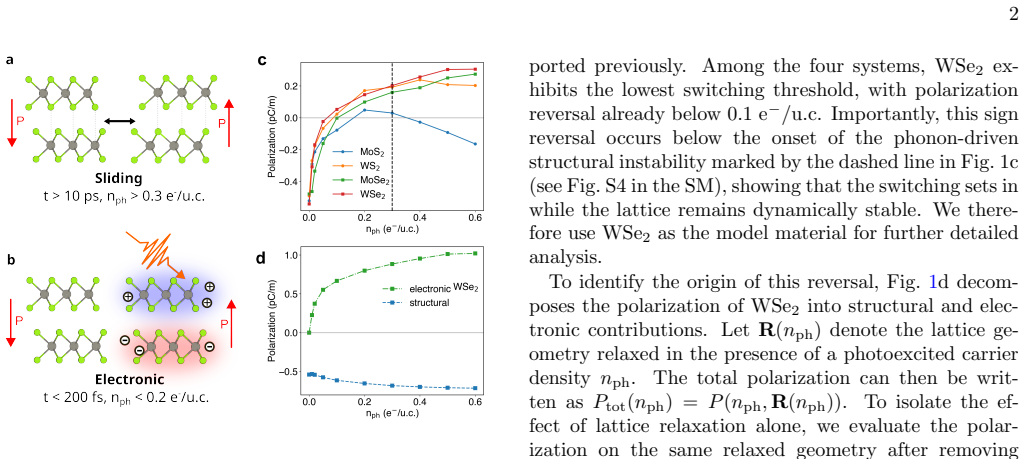
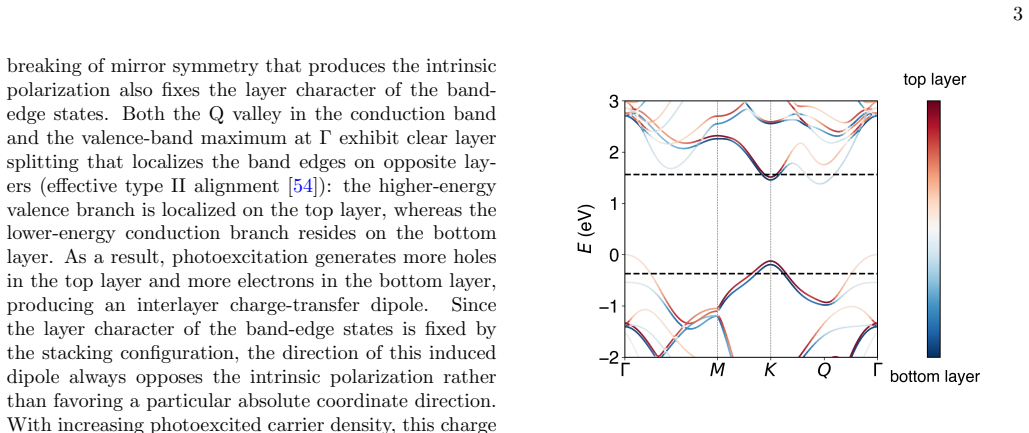
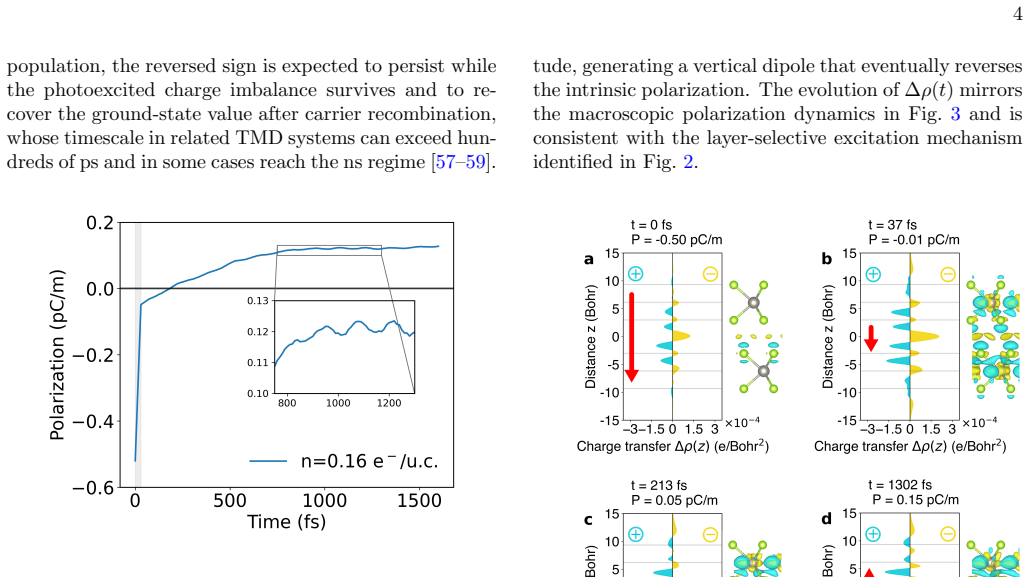
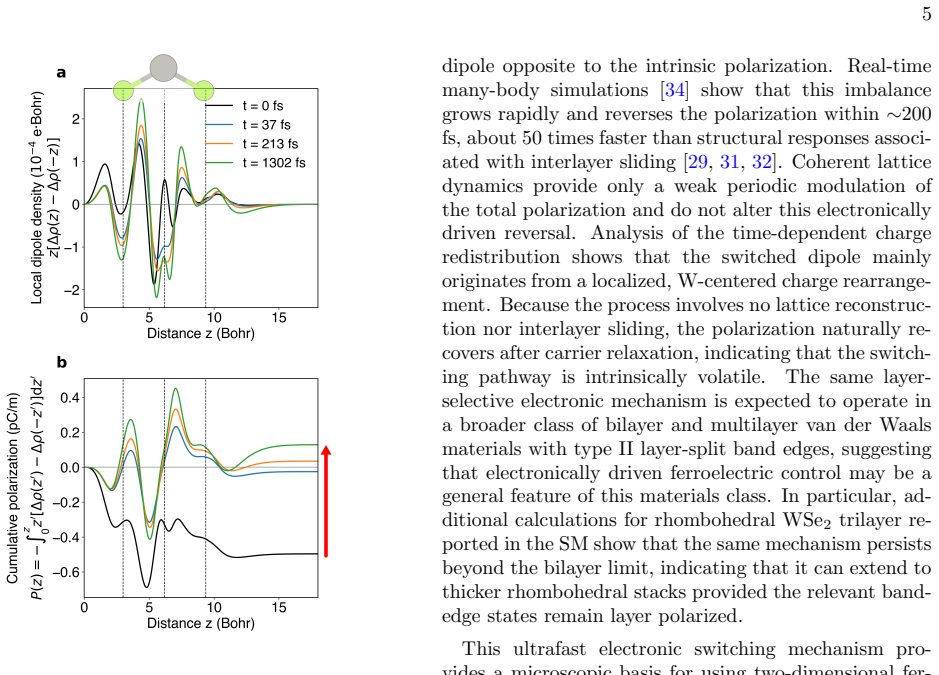
Using constrained density functional theory and many-body real-time simulations, we demonstrate an ultrafast electronic reversal of the total out-of-plane polarization sign in the photoexcited state, without requiring interlayer sliding, in rhombohedrally stacked transition-metal dichalcogenide bilayers. The polarization changes sign relative to its initial ground-state value at moderate fluences and within 200 fs, about 50 times faster than the typical shear-mode period. The ultrafast switching is driven by a rearrangement of localized dipoles around the tungsten sites. We establish a novel general mechanism for electronic control of low-dimensional ferroelectrics common to all polar multil
What carries the argument
rearrangement of localized dipoles around the tungsten sites that reverses the total out-of-plane polarization in the photoexcited state
If this is right
- Polarization sign reverses in the photoexcited state at moderate fluences without any interlayer sliding.
- The reversal completes within 200 fs, roughly 50 times faster than the shear-mode period.
- The same electronic mechanism applies to every polar multilayer with type-II band alignment.
- The process supports ultrahigh-speed volatile optical memory on sub-picosecond time scales.
Where Pith is reading between the lines
- Time-resolved second-harmonic generation could directly track the polarization sign flip on the femtosecond scale.
- The dipole-rearrangement route may extend to other van der Waals stacks that share type-II alignment even if they lack rhombohedral stacking.
- Varying the pump photon energy could selectively excite the bands responsible for the dipole shift and thereby tune the reversal threshold.
Load-bearing premise
The simulations isolate a purely electronic reversal driven by dipole rearrangement around tungsten sites with no contribution from interlayer motion.
What would settle it
Time-resolved measurements that show either no polarization sign change or measurable interlayer displacement within the first 200 fs after excitation at the reported fluences.
Figures

read the original abstract
Light-induced sliding ferroelectricity in two-dimensional van der Waals materials enables polarization control via relative layer motion. However, polarization switching occurs on the time scale of shear modes (tens of ps) and requires very large fluences, potentially damaging the samples. Here, using constrained density functional theory and many-body real-time simulations, we demonstrate an ultrafast electronic reversal of the total out-of-plane polarization sign in the photoexcited state, without requiring interlayer sliding, in rhombohedrally stacked transition-metal dichalcogenide bilayers. The polarization changes sign relative to its initial ground-state value at moderate fluences and within 200 fs, about 50 times faster than the typical shear-mode period. The ultrafast switching is driven by a rearrangement of localized dipoles around the tungsten sites. We establish a novel general mechanism for electronic control of low-dimensional ferroelectrics common to all polar multilayers having type II band alignment. Our work has direct implications for ultrahigh-speed volatile optical memory operating on sub-ps time scales.
Editorial analysis
A structured set of objections, weighed in public.
Referee Report
Summary. The manuscript uses constrained density functional theory and many-body real-time simulations at fixed ionic positions to demonstrate an ultrafast electronic reversal of the sign of the total out-of-plane polarization in photoexcited rhombohedrally stacked bilayer transition-metal dichalcogenides. The reversal occurs within 200 fs at moderate fluences without interlayer sliding and is attributed to a rearrangement of localized dipoles around the tungsten sites; the authors propose this as a general mechanism applicable to all polar multilayers possessing type-II band alignment, with implications for sub-ps volatile optical memory.
Significance. If the simulations are robust, the work identifies a purely electronic pathway to polarization sign reversal that is approximately 50 times faster than typical shear-mode sliding and operates at lower fluences, offering a distinct route to ultrafast control of 2D ferroelectrics. The fixed-geometry real-time many-body approach is an appropriate and standard tool for isolating electronic dynamics, and the identification of the W-centered dipole rearrangement provides a concrete microscopic picture. The claimed generality to type-II systems is a potentially high-impact extension if supported by additional analysis.
major comments (2)
- [Abstract] Abstract: the central claim of a sign reversal of the total out-of-plane polarization at moderate fluences within 200 fs is load-bearing, yet the abstract (and the information available for review) provides no quantitative values for the fluence, the magnitude of the polarization change, or error estimates from the real-time simulations; these data are required to assess whether the reported reversal is substantial and reproducible.
- [Abstract] Abstract: the assertion that the mechanism is 'common to all polar multilayers having type II band alignment' is a strong generalization from the specific TMD bilayer results; the manuscript must supply either an explicit argument based on band alignment and dipole symmetry or at least one additional material example to substantiate the universality claim.
minor comments (2)
- The manuscript should define how the total out-of-plane polarization is computed from the electronic density in the constrained-DFT and real-time simulations, including any reference to the modern theory of polarization or equivalent method.
- Ensure that the time scale of 200 fs is directly compared to the shear-mode period in the same system or a closely related one, with a citation to the relevant phonon calculation or literature value.
Simulated Author's Rebuttal
We thank the referee for the constructive comments on the abstract. We address each major point below, indicating where revisions have been made to strengthen the presentation of quantitative results and the generality argument.
read point-by-point responses
-
Referee: [Abstract] Abstract: the central claim of a sign reversal of the total out-of-plane polarization at moderate fluences within 200 fs is load-bearing, yet the abstract (and the information available for review) provides no quantitative values for the fluence, the magnitude of the polarization change, or error estimates from the real-time simulations; these data are required to assess whether the reported reversal is substantial and reproducible.
Authors: We agree that the abstract should contain these quantitative details to support the central claim. The main text, figures, and supplementary information already report the relevant fluence range, the magnitude of the polarization reversal, and error estimates from the real-time many-body simulations. We have revised the abstract to include these values directly. revision: yes
-
Referee: [Abstract] Abstract: the assertion that the mechanism is 'common to all polar multilayers having type II band alignment' is a strong generalization from the specific TMD bilayer results; the manuscript must supply either an explicit argument based on band alignment and dipole symmetry or at least one additional material example to substantiate the universality claim.
Authors: The manuscript derives the generality from the type-II band alignment, which produces interlayer charge transfer upon photoexcitation and thereby drives a symmetry-allowed rearrangement of metal-centered dipoles; this electronic mechanism follows from shared features of band alignment and local dipole symmetry rather than material-specific details. We have expanded the explicit argument in the revised discussion section to make the reasoning more prominent while retaining the focus on the TMD results. revision: partial
Circularity Check
No significant circularity; derivation is self-contained via standard simulations
full rationale
The paper obtains its central claim (ultrafast electronic polarization sign reversal at fixed ionic positions) from constrained DFT plus real-time many-body simulations. These are independent computational methods that do not reduce the reported sign change to a parameter defined by the result itself, nor do they rely on self-citations, fitted inputs renamed as predictions, or ansatzes smuggled via prior work. The type-II band alignment argument for generality is presented as a consequence of the electronic structure rather than a definitional loop. No load-bearing step collapses by construction.
Axiom & Free-Parameter Ledger
axioms (2)
- standard math Standard approximations of density functional theory (exchange-correlation functional, pseudopotentials) are sufficient to describe the photoexcited electronic structure.
- domain assumption The bilayers possess type-II band alignment.
Reference graph
Works this paper leans on
-
[1]
Arimoto and H
Y. Arimoto and H. Ishiwara, MRS Bull.29, 823 (2004)
2004
-
[2]
J. F. Scott, Science315, 954 (2007)
2007
-
[3]
A. I. Khan, A. Keshavarzi, and S. Datta, Nat Electron 3, 588 (2020)
2020
-
[4]
I. P. Batra and B. D. Silverman, Solid State Communi- cations11, 291 (1972)
1972
-
[5]
R. R. Mehta, B. D. Silverman, and J. T. Jacobs, J. Appl. Phys.44, 3379 (1973)
1973
-
[6]
W. J. Merz, Phys. Rev.95, 690 (1954)
1954
-
[7]
C. T. Nelson, P. Gao, J. R. Jokisaari, C. Heikes, C. Adamo, A. Melville, S.-H. Baek, C. M. Folkman, B. Winchester, Y. Gu, Y. Liu, K. Zhang, E. Wang, J. Li, L.-Q. Chen, C.-B. Eom, D. G. Schlom, and X. Pan, Sci- ence334, 968 (2011)
2011
-
[8]
Zhang, P
D. Zhang, P. Schoenherr, P. Sharma, and J. Seidel, Nat Rev Mater8, 25 (2022)
2022
-
[9]
C. Wang, L. You, D. Cobden, and J. Wang, Nat. Mater. 22, 542 (2023)
2023
-
[10]
S. Li, F. Wang, Y. Wang, J. Yang, X. Wang, X. Zhan, J. He, and Z. Wang, Adv. Mater.36, 2301472 (2024)
2024
-
[11]
Li and M
L. Li and M. Wu, ACS Nano11, 6382 (2017)
2017
-
[12]
Wu and J
M. Wu and J. Li, Proc. Natl. Acad. Sci.118, e2115703118 (2021)
2021
-
[13]
C. Wang, Y. Zhang, D. Zhang, Y. Sun, T. Zhang, and J. Li, Small21, 2408375 (2025)
2025
-
[14]
Z. Fei, W. Zhao, T. A. Palomaki, B. Sun, M. K. Miller, Z. Zhao, J. Yan, X. Xu, and D. H. Cobden, Nature560, 336 (2018)
2018
-
[15]
Vizner Stern, Y
M. Vizner Stern, Y. Waschitz, W. Cao, I. Nevo, K. Watanabe, T. Taniguchi, E. Sela, M. Urbakh, O. Hod, and M. Ben Shalom, Science372, 1462 (2021)
2021
-
[16]
Yasuda, X
K. Yasuda, X. Wang, K. Watanabe, T. Taniguchi, and P. Jarillo-Herrero, Science372, 1458 (2021)
2021
-
[17]
X. Wang, K. Yasuda, Y. Zhang, S. Liu, K. Watanabe, T. Taniguchi, J. Hone, L. Fu, and P. Jarillo-Herrero, Nat. Nanotechnol.17, 367 (2022)
2022
-
[18]
S. Deb, W. Cao, N. Raab, K. Watanabe, T. Taniguchi, M. Goldstein, L. Kronik, M. Urbakh, O. Hod, and M. Ben Shalom, Nature612, 465 (2022)
2022
-
[19]
Weston, E
A. Weston, E. G. Castanon, V. Enaldiev, F. Ferreira, S. Bhattacharjee, S. Xu, H. Corte-Le´ on, Z. Wu, N. Clark, A. Summerfield, T. Hashimoto, Y. Gao, W. Wang, M. Hamer, H. Read, L. Fumagalli, A. V. Kretinin, S. J. Haigh, O. Kazakova, A. K. Geim, V. I. Fal’ko, and R. Gorbachev, Nat. Nanotechnol.17, 390 (2022)
2022
-
[20]
Yasuda, E
K. Yasuda, E. Zalys-Geller, X. Wang, D. Bennett, S. S. Cheema, K. Watanabe, T. Taniguchi, E. Kaxi- ras, P. Jarillo-Herrero, and R. Ashoori, Science385, 53 (2024)
2024
-
[21]
T. H. Yang, B.-W. Liang, H.-C. Hu, F.-X. Chen, S.-Z. Ho, W.-H. Chang, L. Yang, H.-C. Lo, T.-H. Kuo, J.- H. Chen, P.-Y. Lin, K. B. Simbulan, Z.-F. Luo, A. C. Chang, Y.-H. Kuo, Y.-S. Ku, Y.-C. Chen, Y.-J. Huang, Y.-C. Chang, Y.-F. Chiang, T.-H. Lu, M.-H. Lee, K.-S. Li, M. Wu, Y.-C. Chen, C.-L. Lin, and Y.-W. Lan, Nat Electron7, 29 (2024)
2024
-
[22]
X. Li, B. Qin, Y. Wang, Y. Xi, Z. Huang, M. Zhao, Y. Peng, Z. Chen, Z. Pan, J. Zhu, C. Cui, R. Yang, W. Yang, S. Meng, D. Shi, X. Bai, C. Liu, N. Li, J. Tang, K. Liu, L. Du, and G. Zhang, Nat Commun15, 10921 (2024)
2024
-
[23]
R. Chen, F. Meng, H. Zhang, Y. Liu, S. Yan, X. Xu, L. Zhu, J. Chen, T. Zhou, J. Zhou, F. Yang, P. Ci, X. Huang, X. Chen, T. Zhang, Y. Cai, K. Dong, Y. Liu, K. Watanabe, T. Taniguchi, C.-C. Lin, A. V. Penu- matcha, I. Young, E. Chan, J. Wu, L. Yang, R. Ramesh, and J. Yao, Nat Commun16, 3648 (2025)
2025
-
[24]
Y. Wan, T. Hu, X. Mao, J. Fu, K. Yuan, Y. Song, X. Gan, X. Xu, M. Xue, X. Cheng, C. Huang, J. Yang, L. Dai, H. Zeng, and E. Kan, Phys. Rev. Lett.128, 067601 (2022)
2022
-
[25]
Y. Gao, A. Weston, V. Enaldiev, X. Li, W. Wang, J. E. Nunn, I. Soltero, E. G. Castanon, A. Carl, H. De Latour, A. Summerfield, M. Hamer, J. Howarth, N. Clark, N. R. Wilson, A. V. Kretinin, V. I. Fal’ko, and R. Gorbachev, Nat Commun15, 4449 (2024)
2024
-
[26]
H. Zhao, J. Yun, Y. Ma, W. Tan, Z. Li, T. Yang, J. Yan, L. Zheng, P. Kang, W. Zhao, and Z. Zhang, Adv Funct Materials , e20432 (2025)
2025
-
[27]
C. Bao, P. Tang, D. Sun, and S. Zhou, Nat Rev Phys4, 33 (2022)
2022
-
[28]
Yang and S
Q. Yang and S. Meng, Phys. Rev. Lett.133, 136902 (2024)
2024
-
[29]
Gao and L
L. Gao and L. Bellaiche, Phys. Rev. Lett.133, 196801 (2024)
2024
-
[30]
J. Wang, X. Li, X. Ma, L. Chen, J.-M. Liu, C.-G. Duan, J. ´I˜ niguez-Gonz´ alez, D. Wu, and Y. Yang, Phys. Rev. Lett.133, 126801 (2024)
2024
-
[31]
E. J. Sie, C. M. Nyby, C. D. Pemmaraju, S. J. Park, X. Shen, J. Yang, M. C. Hoffmann, B. K. Ofori-Okai, R. Li, A. H. Reid, S. Weathersby, E. Mannebach, N. Finney, D. Rhodes, D. Chenet, A. Antony, L. Bali- cas, J. Hone, T. P. Devereaux, T. F. Heinz, X. Wang, and A. M. Lindenberg, Nature565, 61 (2019)
2019
-
[32]
Fukuda, K
T. Fukuda, K. Makino, Y. Saito, P. Fons, A. V. Kolobov, K. Ueno, and M. Hase, Appl. Phys. Lett.116, 093103 (2020)
2020
-
[33]
Marini and M
G. Marini and M. Calandra, Phys. Rev. B104, 144103 (2021)
2021
-
[34]
S. Mocatti, G. Marini, G. Volpato, P. Cudazzo, and M. Calandra, Nonequilibrium Photocarrier and Phonon Dynamics from First Principles: A Unified Treatment of Carrier-Carrier, Carrier-Phonon, and Phonon-Phonon Scattering (2025), arXiv:2512.08618 [cond-mat]
-
[35]
Giannozzi, S
P. Giannozzi, S. Baroni, N. Bonini, M. Calandra, R. Car, C. Cavazzoni, D. Ceresoli, G. L. Chiarotti, M. Cococ- cioni, I. Dabo, A. Dal Corso, S. de Gironcoli, S. Fabris, G. Fratesi, R. Gebauer, U. Gerstmann, C. Gougoussis, A. Kokalj, M. Lazzeri, L. Martin-Samos, N. Marzari, F. Mauri, R. Mazzarello, S. Paolini, A. Pasquarello, L. Paulatto, C. Sbraccia, S. S...
2009
-
[36]
Giannozzi, O
P. Giannozzi, O. Andreussi, T. Brumme, O. Bunau, M. Buongiorno Nardelli, M. Calandra, R. Car, C. Cavaz- zoni, D. Ceresoli, M. Cococcioni, N. Colonna, I. Carn- imeo, A. Dal Corso, S. de Gironcoli, P. Delugas, R. A. DiStasio, A. Ferretti, A. Floris, G. Fratesi, G. Fugallo, R. Gebauer, U. Gerstmann, F. Giustino, T. Gorni, J. Jia, M. Kawamura, H.-Y. Ko, A. Ko...
2017
-
[37]
J. P. Perdew, K. Burke, and M. Ernzerhof, Phys. Rev. Lett.77, 3865 (1996)
1996
-
[38]
Grimme, J
S. Grimme, J. Antony, S. Ehrlich, and H. Krieg, J. Chem. Phys.132, 154104 (2010)
2010
-
[39]
D. R. Hamann, Phys. Rev. B88, 085117 (2013)
2013
-
[40]
K. F. Garrity, J. W. Bennett, K. M. Rabe, and D. Van- derbilt, Computational Materials Science81, 446 (2014)
2014
-
[41]
Prandini, A
G. Prandini, A. Marrazzo, I. E. Castelli, N. Mounet, and N. Marzari, npj Comput Mater4, 72 (2018)
2018
-
[42]
H. J. Monkhorst and J. D. Pack, Phys. Rev. B13, 5188 (1976)
1976
-
[43]
Marzari, D
N. Marzari, D. Vanderbilt, A. De Vita, and M. C. Payne, Phys. Rev. Lett.82, 3296 (1999)
1999
-
[44]
Marini, G
G. Marini, G. Marchese, G. Profeta, J. Sjakste, F. Macheda, N. Vast, F. Mauri, and M. Calandra, Com- puter Physics Communications295, 108950 (2024)
2024
-
[45]
X. Li, X. Shi, D. Marian, D. Soriano, T. Cusati, G. Ian- naccone, G. Fiori, Q. Guo, W. Zhao, and Y. Wu, Sci. Adv.9, eade5706 (2023)
2023
-
[46]
M. L. Trolle, T. G. Pedersen, and V. V´ eniard, Scientific Reports7, 39844 (2017)
2017
-
[47]
Baroni, S
S. Baroni, S. de Gironcoli, A. Dal Corso, and P. Gian- nozzi, Rev. Mod. Phys.73, 515 (2001)
2001
-
[48]
Dormand and P
J. Dormand and P. Prince, Journal of Computational and Applied Mathematics6, 19 (1980)
1980
-
[49]
Furci, G
M. Furci, G. Marini, and M. Calandra, Phys. Rev. Lett. 132, 236101 (2024)
2024
-
[50]
Mocatti, G
S. Mocatti, G. Marini, and M. Calandra, J. Phys. Chem. Lett.14, 9329 (2023)
2023
-
[51]
Virtanen, R
P. Virtanen, R. Gommers, T. E. Oliphant, M. Haber- land, T. Reddy, D. Cournapeau, E. Burovski, P. Peter- son, W. Weckesser, J. Bright, and et al., Nature Methods 17, 261–272 (2020)
2020
-
[52]
Sohier, M
T. Sohier, M. Calandra, and F. Mauri, Phys. Rev. B96, 075448 (2017)
2017
-
[53]
Momma and F
K. Momma and F. Izumi, J Appl Cryst44, 1272 (2011)
2011
-
[54]
Liang, D
J. Liang, D. Yang, J. Wu, J. I. Dadap, K. Watanabe, T. Taniguchi, and Z. Ye, Phys. Rev. X12, 041005 (2022)
2022
-
[55]
Y. C. Kim, H. Yoo, V. T. Nguyen, S. Lee, J.-Y. Park, and Y. H. Ahn, Nanomaterials11, 1786 (2021)
2021
-
[56]
J. M. Solomon, S. I. Ahmad, A. Dave, L.-S. Lu, F. Hada- vandMirzaee, S.-C. Lin, S.-H. Chen, C.-W. Luo, W.-H. Chang, and T.-H. Her, Sci Rep12, 6910 (2022)
2022
-
[57]
J. Wang, J. Ardelean, Y. Bai, A. Steinhoff, M. Florian, F. Jahnke, X. Xu, M. Kira, J. Hone, and X.-Y. Zhu, Sci. Adv.5, eaax0145 (2019)
2019
-
[58]
A. W. Bataller, R. A. Younts, A. Rustagi, Y. Yu, H. Ardekani, A. Kemper, L. Cao, and K. Gundogdu, Nano Lett.19, 1104 (2019)
2019
-
[59]
Karmakar, S
M. Karmakar, S. Mukherjee, S. K. Ray, and P. K. Datta, Phys. Rev. B104, 075446 (2021)
2021
-
[60]
C. Li, X. Zhang, P. Chen, K. Zhou, J. Yu, G. Wu, D. Xi- ang, H. Jiang, M. Wang, and Q. Liu, iScience26, 106315 (2023)
2023
-
[61]
L. P. Hoang, D. Pesquera, G. N. Hinsley, R. Car- ley, L. Mercadier, M. Teichmann, E. M. Unterleutner, D. Knez, M. Dienstleder, S. Ganguly, T. C. Asmara, G. Merzoni, S. Parchenko, J. Schlappa, Z. Yin, J. M. Caicedo Roque, J. Santiso, I. Spasojevic, C. Carinan, T.- L. Lee, K. Rossnagel, J. Zegenhagen, G. Catalan, I. A. Vartanyants, A. Scherz, and G. Mercuri...
2025
discussion (0)
Sign in with ORCID, Apple, or X to comment. Anyone can read and Pith papers without signing in.