Boltzmann Distribution from Invariance of Coarse-Graining-Scale and Energy-Shift
Pith reviewed 2026-06-29 19:34 UTC · model grok-4.3
The pith
Two invariances—coarse-graining scale and uniform energy shift—uniquely fix the Boltzmann factor from the mean energy per particle.
A machine-rendered reading of the paper's core claim, the machinery that carries it, and where it could break.
Core claim
Two physical facts—coarse-graining-scale invariance of the empirical distribution and invariance under a uniform shift of the energy zero—uniquely yield the Boltzmann factor, whose parameter is fixed by the mean energy per particle. For separable Hamiltonians the weight factorizes into kinetic and configurational parts that share this parameter, identified from the kinetic part as the inverse kinetic temperature. The principle extends to any physical quantity possessing a stationary distribution and translational invariance.
What carries the argument
The joint requirement of coarse-graining-scale invariance and energy-shift invariance, which together constrain the functional form of any stationary distribution to a pure exponential whose rate is fixed by the mean value.
If this is right
- For separable Hamiltonians the equilibrium weight factorizes into kinetic and configurational contributions that share the same parameter.
- The parameter extracted from the kinetic part is identified as the inverse kinetic temperature.
- The same invariance principle determines the stationary distributions of velocity, spacing, collision time, and pressure-dependent displacements.
- In the nonlinear lattice, harmonic elasticity, anharmonic corrections, internal pressure, and thermal expansion all follow directly from the exponential weights.
Where Pith is reading between the lines
- The derivation supplies a route to temperature that bypasses separate thermodynamic postulates and begins from the mean energy alone.
- Because the argument uses only stationarity and translational invariance, it can be checked on any observable whose histogram is empirically stationary.
- The brief discussion of ensemble relations suggests that the same weights can be re-expressed in different ensembles without changing the underlying exponential form.
Load-bearing premise
That these two invariances are together necessary and sufficient to select the exponential without further assumptions from ergodicity, Liouville's theorem, or entropy maximization.
What would settle it
A classical many-body simulation in which the measured histogram of particle energies changes functional form when the bin width is altered or when a constant is added to all energies, while the mean energy remains well defined.
Figures
read the original abstract
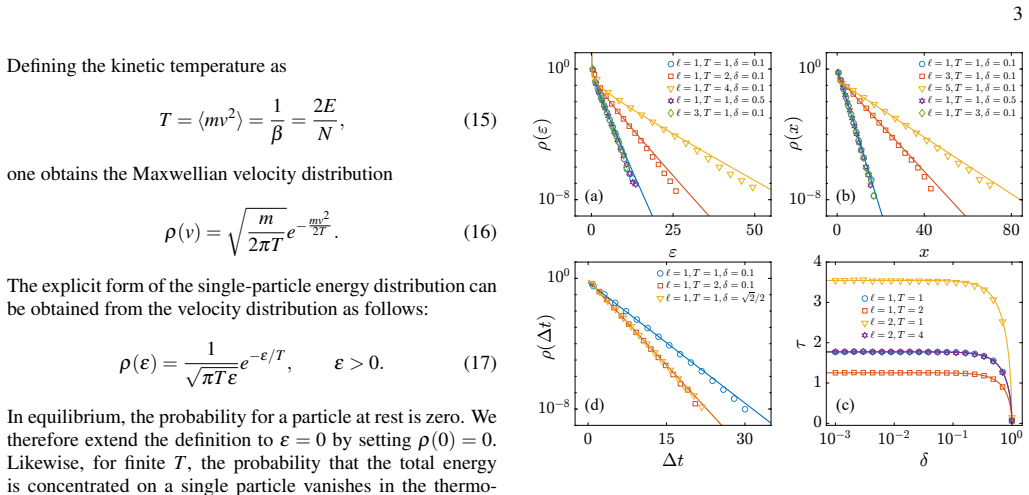
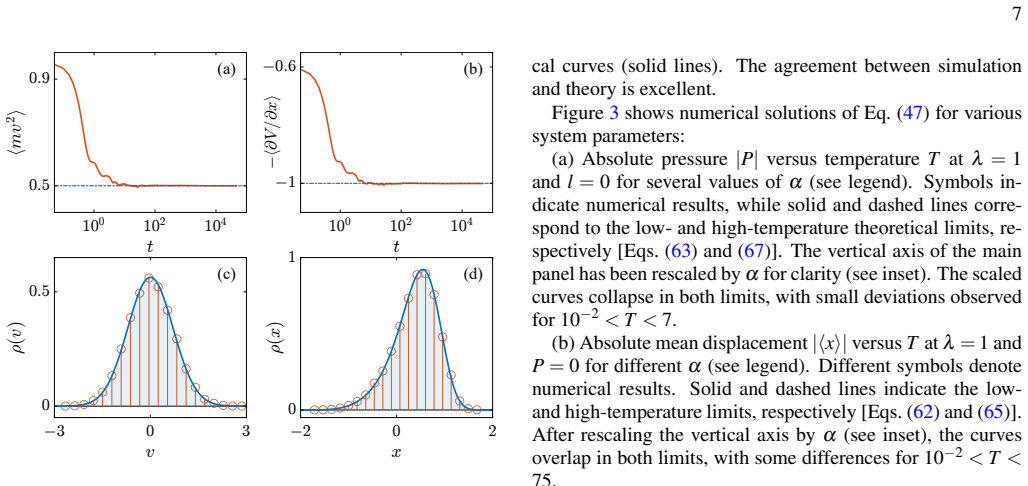
We present a concise derivation of the Boltzmann form for single-particle energy distributions in classical many-body Hamiltonian systems. The derivation relies on two physical facts: coarse-graining-scale invariance of the empirical distribution and invariance under a uniform shift of the energy zero. These conditions uniquely yield the Boltzmann factor, whose parameter is fixed by the mean energy per particle. For separable Hamiltonians, the equilibrium weight factorizes into kinetic and configurational contributions sharing the same parameter, identified from the kinetic part as the inverse kinetic temperature. The principle extends to any physical quantity with a stationary distribution and translational invariance. It is illustrated in a one-dimensional diatomic hard-core gas and a nonlinear lattice chain, where it predicts velocity, energy, spacing, collision-time, and pressure-dependent displacement distributions in agreement with simulations. The lattice model further shows how harmonic elasticity, anharmonic corrections, internal pressure, and thermal expansion emerge from the same exponential equilibrium weights. Finally, the relationships among different ensembles are briefly discussed.
Editorial analysis
A structured set of objections, weighed in public.
Referee Report
Summary. The manuscript claims a concise derivation of the Boltzmann factor for single-particle energy distributions in classical Hamiltonian systems from two physical invariances: coarse-graining-scale invariance of the empirical distribution and invariance under uniform energy zero shift. These conditions are asserted to uniquely determine the exponential form, with the parameter fixed by the mean energy per particle. For separable Hamiltonians the weight factorizes into kinetic and configurational parts sharing the same parameter (identified as inverse kinetic temperature from the kinetic sector). The principle is extended to other stationary distributions with translational invariance and illustrated via simulations on a 1D diatomic hard-core gas and a nonlinear lattice chain, where it reproduces velocity, energy, spacing, collision-time and pressure-dependent displacement distributions, and recovers harmonic elasticity, anharmonic corrections, internal pressure and thermal expansion from the same weights. Brief remarks on ensemble relationships are included.
Significance. If the derivation is free of hidden regularity assumptions and the circularity concern is resolved, the work would supply an alternative foundation for the Boltzmann distribution grounded in observable invariances rather than entropy maximization or ergodic theory. The explicit numerical tests on two distinct models constitute a strength, providing falsifiable predictions that can be checked directly against molecular dynamics. The factorization result for separable Hamiltonians and the extension to non-energy observables are potentially useful for applications in which only partial information is available.
major comments (3)
- [Abstract, §2] Abstract and §2 (derivation): the uniqueness claim requires an explicit functional equation obtained from the two invariances together with a proof that the only solutions (under the stated conditions) are exponentials. Without this step it is unclear whether continuity, monotonicity or measurability is implicitly invoked to exclude other solutions permitted by the axiom of choice.
- [§2, §3] §2 and §3: the parameter is fixed by the mean energy per particle, yet the mean energy is itself computed from the distribution whose form is being derived. This creates a verification gap that must be addressed before the claim that the distribution is determined solely by the two invariances can be accepted.
- [§4] §4 (lattice model): the emergence of thermal expansion and anharmonic corrections is presented as following directly from the exponential weights, but the mapping from the invariance conditions to the pressure-dependent displacement distribution is not shown in sufficient detail to confirm that no additional dynamical assumptions are required.
minor comments (2)
- [§2] Notation for the coarse-graining scale and the energy shift should be introduced once and used consistently; several paragraphs employ different symbols for the same quantities.
- [Figures 2–4] Figure captions for the simulation comparisons should state the number of particles, integration time step and total simulation length so that reproducibility is immediate.
Simulated Author's Rebuttal
We thank the referee for the careful reading and constructive comments. We address each major comment below.
read point-by-point responses
-
Referee: [Abstract, §2] Abstract and §2 (derivation): the uniqueness claim requires an explicit functional equation obtained from the two invariances together with a proof that the only solutions (under the stated conditions) are exponentials. Without this step it is unclear whether continuity, monotonicity or measurability is implicitly invoked to exclude other solutions permitted by the axiom of choice.
Authors: We agree that an explicit functional equation and uniqueness proof would strengthen the presentation. The revised manuscript will state the functional equation obtained by combining the two invariances and prove that the exponential is the unique solution under the assumption of continuity (or measurability) of the empirical distribution, which is physically appropriate. Non-measurable solutions permitted by the axiom of choice are excluded on physical grounds. revision: yes
-
Referee: [§2, §3] §2 and §3: the parameter is fixed by the mean energy per particle, yet the mean energy is itself computed from the distribution whose form is being derived. This creates a verification gap that must be addressed before the claim that the distribution is determined solely by the two invariances can be accepted.
Authors: The two invariances fix the functional form (exponential) without reference to the value of the parameter. The observed mean energy then determines the numerical value of that parameter. We will revise §§2 and 3 to separate these steps explicitly, stating that the form follows solely from the invariances while the parameter is fixed by matching to the independently measured mean energy, thereby removing any appearance of circularity. revision: yes
-
Referee: [§4] §4 (lattice model): the emergence of thermal expansion and anharmonic corrections is presented as following directly from the exponential weights, but the mapping from the invariance conditions to the pressure-dependent displacement distribution is not shown in sufficient detail to confirm that no additional dynamical assumptions are required.
Authors: We will expand the relevant subsection of §4 to provide the explicit mapping from the stated invariances (coarse-graining-scale and energy-shift, together with translational invariance) to the pressure-dependent displacement distribution. The added steps will confirm that the result follows directly from the general principle without further dynamical assumptions. revision: yes
Circularity Check
No circularity: derivation from stated invariances is independent
full rationale
The abstract states that coarse-graining-scale invariance and energy-shift invariance uniquely yield the Boltzmann factor, with its single parameter then fixed by the observed mean energy per particle. This parameter fixing is the standard physical closure (analogous to determining temperature from average kinetic energy) and does not reduce the functional form to a tautology or to a fit on a subset of the same data. No equations, self-citations, or ansatzes are quoted that would exhibit any of the enumerated circular patterns. The claimed uniqueness therefore stands or falls on whether the functional equation is solved rigorously, but that question is one of mathematical completeness rather than circularity.
Axiom & Free-Parameter Ledger
free parameters (1)
- inverse-temperature parameter
axioms (2)
- domain assumption Coarse-graining-scale invariance of the empirical distribution
- domain assumption Invariance under a uniform shift of the energy zero
Reference graph
Works this paper leans on
-
[1]
For weak pressure, the minimumx ∗ can be expanded around theP=0 solution
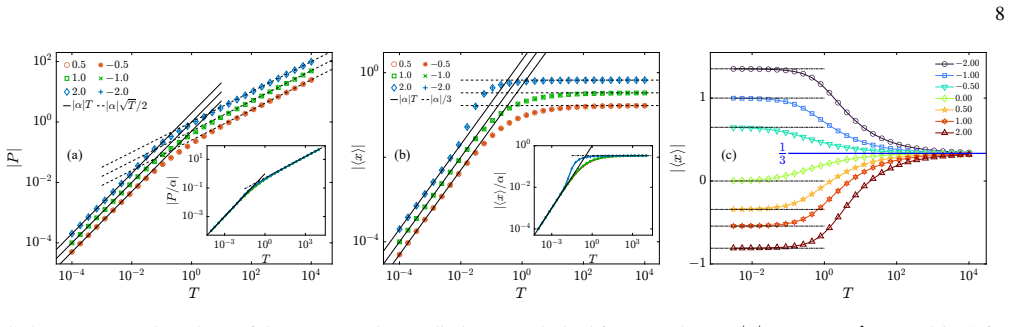
Low-temperature limit We define the effective potential U(x) = x2 2 + αx3 3 + λx 4 4 +Px.(53) 6 For sufficiently smallT, the integral is dominated by the global minimumx ∗ ofU(x), determined by U ′(x∗) =0,(54) or explicitly x∗ +αx 2 ∗ +λx 3 ∗ +P=0.(55) The corresponding stability condition is U ′′(x∗) =1+2αx ∗ +3λx 2 ∗ >0.(56) Ifx ∗ is a nondegenerate glo...
-
[2]
If the mean strain is constrained to vanish,⟨x⟩=0, Eq
High-temperature limit In the high-temperature limit,T→∞, withα,λ, andP fixed, the mean relative displacement has the asymptotic form ⟨x⟩=− α 3λ −2 Γ(3/4) Γ(1/4) P− α 3λ + 2α3 27λ 2 √ λT +O(T −1).(64) Therefore, one has lim T→∞ ⟨x⟩=− α 3λ ,(65) which indicates that in high-temperature limits, the relative displacement is entirely determined by the ratio o...
-
[3]
Khinchin,Mathematical F oundations of Statistical Mechan- ics(Dover Publications, Inc., New York, 1949)
A. Khinchin,Mathematical F oundations of Statistical Mechan- ics(Dover Publications, Inc., New York, 1949)
1949
-
[4]
Gibbs,Elementary Principles in Statistical Mechanics (Charles Scribners Sons, New York, 1902)
J. Gibbs,Elementary Principles in Statistical Mechanics (Charles Scribners Sons, New York, 1902). 9
1902
-
[5]
Planck,Theory of Heat(Macmillan, London, 1932)
M. Planck,Theory of Heat(Macmillan, London, 1932)
1932
-
[6]
Landau and E
L. Landau and E. Lifshitz,Statistical Physics: V olume 5 of Course of Theoretical Physics, 3rd ed. (Pergamon Press Ltd, Oxford, 1980)
1980
-
[7]
Goldstein, J
S. Goldstein, J. L. Lebowitz, R. Tumulka, and N. Zangh `ı, Canonical typicality, Phys. Rev. Lett.96, 050403 (2006)
2006
-
[8]
Ehrenfest and T
P. Ehrenfest and T. Ehrenfest,The Conceptual F oundations of the Statistical Approach in Mechanics(Dover Publications, Inc., New York, 2002)
2002
-
[9]
K. Ufniarz and G. Siudem, Combinatorial origins of the canon- ical ensemble (2008), arXiv:2008.00244
-
[10]
R. K. Pathria and P. D. Beale,Statistical Mechanics, 3rd ed. (Elsevier, Amsterdam, 2011)
2011
-
[11]
E. T. Jaynes, Information theory and statistical mechanics, Phys. Rev.106, 620 (1957)
1957
-
[12]
J. E. Shore and R. W. Johnson, Axiomatic derivation of the prin- ciple of maximum entropy and the principle of minimum cross- entropy, IEEE Trans. Inf. TheoryIT-26, 26 (1980)
1980
-
[13]
Ge and H
H. Ge and H. Qian, Physical origins of entropy production, free energy dissipation, and their mathematical representations, Phys. Rev. E81, 051133 (2010)
2010
-
[14]
Metropolis, A
N. Metropolis, A. W. Rosenbluth, M. N. Rosenbluth, A. H. Teller, and E. Teller, Equation of state calculations by fast com- puting machines, J. Chem. Phys.21, 1087 (1953)
1953
-
[15]
Boltzmann,Lectures on gas theory(Dover Publications, Inc., New York, 1964)
L. Boltzmann,Lectures on gas theory(Dover Publications, Inc., New York, 1964)
1964
-
[16]
S. G. Brush,The Kinetic Theory of Gases: An Anthology of Classic Papers with Historical Commentary, edited by N. S. Hall and S. G. Brush (Imperial College Press, London, 2003)
2003
-
[17]
Hosoya, K
A. Hosoya, K. Maruyama, and Y . Shikano, Operational deriva- tion of Boltzmann distribution with Maxwell’s demon model, Sci. Rep.5, 17011 (2015)
2015
-
[18]
Brandenburger and K
A. Brandenburger and K. Steverson, Axioms for the Boltzmann distribution, Found. Phys.49, 444 (2019)
2019
-
[19]
Q. A. Wang, L. Nivanen, M. Pezeril, and A. L. Mehaute, On the energy translation invariance of probability distributions (2002), arXiv:cond-mat/0206043
work page internal anchor Pith review Pith/arXiv arXiv 2002
-
[20]
S. A. Frank, Common probability patterns arise from simple invariances, Entropy18, 192 (2016)
2016
-
[21]
Sandomirskiy and O
F. Sandomirskiy and O. Tamuz, On the origin of the Boltzmann distribution, Mathematische Annalen392, 5617 (2025)
2025
-
[22]
Acz ´el,Lectures on Functional Equations and Their Applica- tions, edited by H
J. Acz ´el,Lectures on Functional Equations and Their Applica- tions, edited by H. Oser, Mathematics in Science and Engineer- ing (Academic Press, New York, 1966)
1966
-
[23]
Casati, Energy transport and the Fourier heat law in classical systems, Found
G. Casati, Energy transport and the Fourier heat law in classical systems, Found. Phys.16, 51 (1986)
1986
-
[24]
Grassberger, W
P. Grassberger, W. Nadler, and L. Yang, Heat conduction and entropy production in a one-dimensional hard-particle gas, Phys. Rev. Lett.89, 180601 (2002)
2002
-
[25]
Spohn, Nonlinear fluctuating hydrodynamics for anhar- monic chains, J
H. Spohn, Nonlinear fluctuating hydrodynamics for anhar- monic chains, J. Stat. Phys.154, 1191 (2014)
2014
-
[26]
Abramowitz and I
M. Abramowitz and I. A. Stegun, eds.,Handbook of Mathe- matical Functions: With F ormulas, Graphs, and Mathematical Tables(Dover Publications, Inc., New York, 1972)
1972
-
[27]
Yang,An Introduction to Hypergeometric, Supertrigono- metric, and Superhyperbolic Functions(Academic Press, Lon- don, 2021)
X.-J. Yang,An Introduction to Hypergeometric, Supertrigono- metric, and Superhyperbolic Functions(Academic Press, Lon- don, 2021)
2021
-
[28]
Yoshida, Construction of higher order symplectic integra- tors, Phys
H. Yoshida, Construction of higher order symplectic integra- tors, Phys. Lett. A150, 262 (1990)
1990
-
[29]
Zhong, Y
Y . Zhong, Y . Zhang, J. Wang, and H. Zhao, Normal heat con- duction in one-dimensional momentum conserving lattices with asymmetric interactions, Phys. Rev. E85, 060102(R) (2012)
2012
-
[30]
L. Wang, B. Hu, and B. Li, Validity of fourier’s law in one- dimensional momentum-conserving lattices with asymmetric interparticle interactions, Phys. Rev. E88, 052112 (2013)
2013
-
[31]
A. V . Savin and Y . A. Kosevich, Thermal conductivity of molec- ular chains with asymmetric potentials of pair interactions, Phys. Rev. E89, 032102 (2014)
2014
-
[32]
S. Feng, W. Fu, Y . Zhang, and H. Zhao, Phonon damping in one-dimensional lattices with asymmetric interactions, Sci. China-Phys. Mech. Astron.65, 117006 (2022)
2022
-
[33]
W. Fu, Y . Zhang, and H. Zhao, Universal law of thermalization for one-dimensional perturbed Toda lattices, New J. Phys.21, 043009 (2019)
2019
-
[34]
N. S. Krylov,Works on the F oundations of Statistical Physics, Princeton Series in Physics (Princeton University Press, Prince- ton, New Jersey, 1979)
1979
discussion (0)
Sign in with ORCID, Apple, or X to comment. Anyone can read and Pith papers without signing in.