MIND: Multi-Scale Intent Diffusion for Text-Driven Physics-Based Humanoid Control
Reviewed by Pith T0 review T1 audit T2 compute T3 formal T4 kernel 2026-06-29 23:05 UTCgrok-4.3pith:MC3TZKVKrecord.jsonopen to challenge →
The pith
MIND bridges text commands and physics-based humanoid actions by diffusing through multi-scale behavioral intents extracted from states.
A machine-rendered reading of the paper's core claim, the machinery that carries it, and where it could break.
Core claim
MIND is an end-to-end diffusion framework that treats behavioral intent as the semantic bridge between text and low-level actions; a holistic intent predictor supplies global dynamics while an immediate intent predictor supplies step-wise guidance, with humanoid states first mapped to a latent space that supports more effective intent modeling.
What carries the argument
multi-scale intent diffusion mechanism that imposes a hierarchical inductive bias via separate holistic and immediate intent predictors operating on latent state encodings
If this is right
- Text commands can drive physics-based control without an intermediate kinematic motion generator.
- Global intent sets overall behavior while per-step intent refines local dynamics inside the diffusion process.
- Latent encoding of states improves semantic modeling compared with operating on raw states or actions.
- The resulting motions satisfy physical constraints while remaining faithful to the input language description.
Where Pith is reading between the lines
- The same intent-bridge idea could be tested on other embodied tasks that must map language to continuous control.
- Transfer to real robots would require checking whether the learned latent state representation tolerates sensor noise.
- The hierarchical structure might extend naturally to longer-horizon or multi-character text-conditioned tasks.
- If the gains hold, intent diffusion could lower the volume of demonstration data needed for imitation learning.
Load-bearing premise
Humanoid states contain richer motion dynamics that align more closely with textual descriptions than low-level actions do.
What would settle it
A side-by-side benchmark in which an otherwise identical diffusion model that predicts actions directly, without the state-based intent predictors, matches or exceeds MIND on semantic alignment, physical stability, and coherence metrics.
Figures
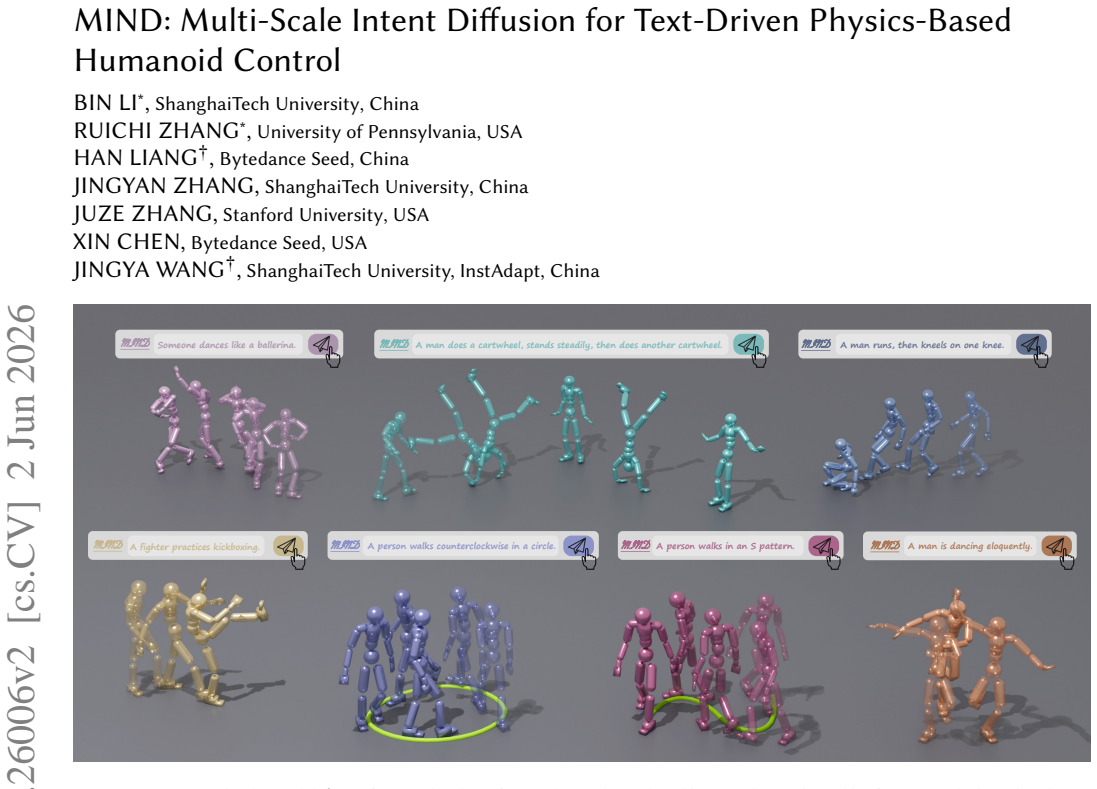


read the original abstract
Enabling physics-based humanoids to execute diverse behaviors from high-level textual commands remains a significant challenge. Existing methods typically follow either a two-stage paradigm that combines kinematic motion generation with physics-based tracking, or an end-to-end imitation-learning paradigm that directly generates actions from text. However, the former suffers from the inherent domain shift between kinematic generation and physics-based tracking, while the latter struggles with the substantial modality gap between textual commands and low-level actions, limiting effective semantic alignment. Notably, humanoid states encode rich motion dynamics that are more semantically aligned with textual descriptions than low-level actions, making them a natural basis for deriving behavioral intent. Building upon this insight, we propose MIND, a novel end-to-end diffusion framework for text-driven physics-based humanoid control that leverages behavioral intent as a semantic bridge between textual commands and low-level actions. At its core, MIND introduces a multi-scale intent diffusion mechanism, where a holistic intent predictor captures global behavioral dynamics to guide overall behavior synthesis, while an immediate intent predictor provides step-wise, fine-grained signals for local behavior refinement at each diffusion step. This hierarchical intent formulation imposes a structured inductive bias for humanoid control, improving semantic alignment and behavioral naturalness. Furthermore, MIND encodes humanoid states into a latent space to enable more effective semantic intent modeling. Extensive experiments demonstrate that MIND outperforms existing methods and synthesizes coherent, physically plausible, and semantically aligned humanoid behaviors from text commands. Project page: https://binlee26.github.io/MIND_page.
Editorial analysis
A structured set of objections, weighed in public.
Referee Report
Summary. The manuscript introduces MIND, an end-to-end diffusion-based framework for text-driven physics-based humanoid control. It encodes humanoid states into a latent space and employs a multi-scale intent diffusion mechanism consisting of a holistic intent predictor (capturing global behavioral dynamics) and an immediate intent predictor (providing step-wise fine-grained signals). This hierarchical formulation is presented as a semantic bridge that imposes structured inductive bias to address domain shift in two-stage pipelines and modality gap in direct action generation, with the claim that it produces coherent, physically plausible, and semantically aligned behaviors outperforming prior methods.
Significance. If the empirical results hold, the work offers a potentially useful inductive bias for text-to-physics control by shifting intent modeling to state latents rather than actions. The multi-scale diffusion design could influence subsequent hierarchical generative models in character animation, provided the quantitative gains and physical metrics are reproducible.
major comments (2)
- [Abstract] Abstract: the central claim that 'extensive experiments demonstrate that MIND outperforms existing methods' is unsupported by any quantitative metrics, ablation results, or error analysis in the provided text. Without these data the performance and plausibility assertions cannot be evaluated.
- [Experiments] No tables, figures, or sections present comparative results (e.g., success rate, physical plausibility scores, semantic alignment metrics) or ablations isolating the holistic vs. immediate intent predictors, which are load-bearing for the outperformance claim.
minor comments (1)
- [Abstract] The abstract contains several long compound sentences that reduce readability; consider splitting the description of the two predictors.
Simulated Author's Rebuttal
Thank you for the review. We address the concerns about unsupported claims and missing experimental evidence point by point.
read point-by-point responses
-
Referee: [Abstract] Abstract: the central claim that 'extensive experiments demonstrate that MIND outperforms existing methods' is unsupported by any quantitative metrics, ablation results, or error analysis in the provided text. Without these data the performance and plausibility assertions cannot be evaluated.
Authors: We agree that the abstract's performance claim requires explicit quantitative support within the manuscript. The provided text contains no metrics, tables, or analysis. We will revise the manuscript to include these elements so that the claim is properly substantiated. revision: yes
-
Referee: [Experiments] No tables, figures, or sections present comparative results (e.g., success rate, physical plausibility scores, semantic alignment metrics) or ablations isolating the holistic vs. immediate intent predictors, which are load-bearing for the outperformance claim.
Authors: The observation is correct: the provided manuscript text includes no comparative results, physical or semantic metrics, or ablations on the two intent predictors. We will add a dedicated experiments section containing these tables, figures, and ablation studies to support the central claims. revision: yes
Circularity Check
No significant circularity detected
full rationale
The paper introduces a new end-to-end diffusion framework (MIND) with multi-scale intent predictors operating on latent humanoid states. No equations or claims reduce by construction to fitted inputs, self-cited uniqueness theorems, or renamed empirical patterns. The central claims rest on the proposed architectural inductive bias and reported empirical outperformance rather than any self-referential derivation loop. The derivation chain is self-contained as a methodological proposal.
Axiom & Free-Parameter Ledger
axioms (1)
- domain assumption Humanoid states encode rich motion dynamics that are more semantically aligned with textual descriptions than low-level actions.
invented entities (1)
-
multi-scale intent diffusion mechanism
no independent evidence
Reference graph
Works this paper leans on
-
[1]
Kimodo: Scaling controllable human motion generation,
Film: Visual reasoning with a general conditioning layer. InProceedings of the AAAI conference on artificial intelligence, Vol. 32. Alec Radford, Jong Wook Kim, Chris Hallacy, Aditya Ramesh, Gabriel Goh, Sandhini Agarwal, Girish Sastry, Amanda Askell, Pamela Mishkin, Jack Clark, et al . 2021. Learning transferable visual models from natural language super...
-
[2]
CLoSD: Closing the Loop between Simulation and Diffusion for multi-task character control
Calm: Conditional adversarial latent models for directable virtual characters. InACM SIGGRAPH 2023 conference proceedings. 1–9. Guy Tevet, Sigal Raab, Setareh Cohan, Daniele Reda, Zhengyi Luo, Xue Bin Peng, Amit H Bermano, and Michiel van de Panne. 2024. Closd: Closing the loop be- tween simulation and diffusion for multi-task character control.arXiv prep...
work page Pith review arXiv 2023
discussion (0)
Sign in with ORCID, Apple, or X to comment. Anyone can read and Pith papers without signing in.