Magnetic ground state of a prototype quasicrystal approximant: a candidate for octahedral spin ice physics
Pith reviewed 2026-06-29 20:33 UTC · model grok-4.3
The pith
Neutron diffraction in Cd6Tb reveals a noncoplanar multi-k order of Ising-like moments on corner-sharing octahedra with only one third fully ordered.
A machine-rendered reading of the paper's core claim, the machinery that carries it, and where it could break.
Core claim
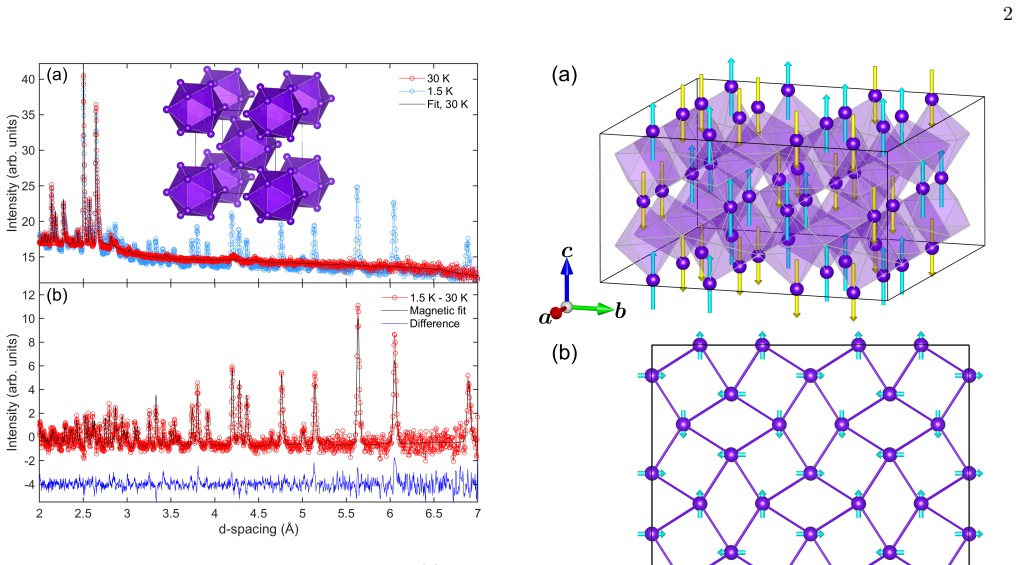
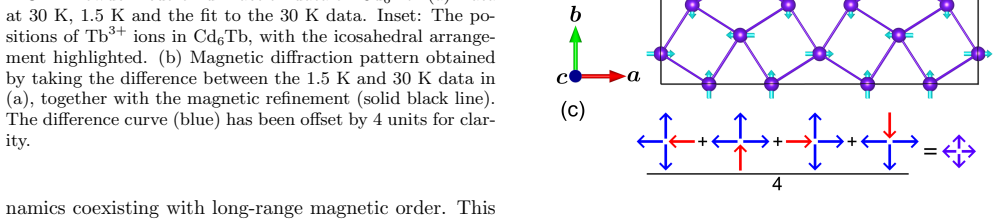
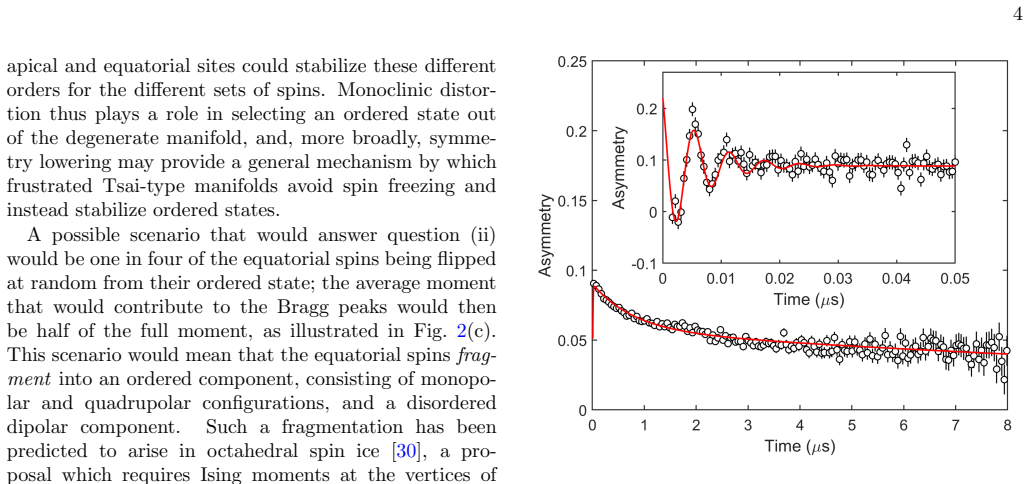
Using neutron diffraction measurements, we find a noncoplanar multi-k magnetic ground state composed of Ising-like Tb moments arranged on a network of corner-sharing octahedra, the ingredients required to host octahedral spin-ice physics. Remarkably, only one third of the Tb moments develop long-range magnetic order, whereas the remaining moments display strongly reduced static order accompanied by persistent spin dynamics on microsecond timescales, as evidenced by muon spin rotation. This coexistence of ordered and fluctuating moments constitutes a potential realization of magnetic fragmentation - a key prediction of octahedral spin-ice physics - in a quasicrystal-related material.
What carries the argument
The network of corner-sharing octahedra formed by the Tb sites, which supplies the local connectivity and Ising anisotropy needed for octahedral spin-ice rules and the resulting fragmentation into ordered and fluctuating moment components.
If this is right
- The multi-k noncoplanar structure satisfies the local ice-rule constraints on each octahedron while leaving a fluctuating sublattice.
- The one-third ordered fraction matches the expected fragmentation pattern in which some moments freeze and others remain dynamic.
- The same local octahedral connectivity is preserved in true quasicrystals, implying that fragmentation may appear there as well.
- The microsecond dynamics detected by muons set a lower bound on the fluctuation timescale inside the fragmented state.
Where Pith is reading between the lines
- If the octahedral network in Cd6Tb faithfully reproduces the relevant connectivity of quasicrystals, similar partial ordering should be searchable in other Tsai-type approximants with different rare-earth ions.
- Temperature- or field-dependent muon measurements could distinguish intrinsic fragmentation dynamics from disorder-induced relaxation.
- Single-crystal neutron studies under applied field would test whether the fluctuating component can be polarized without destroying the ordered fraction.
Load-bearing premise
That the observed partial ordering and muon relaxation arise directly from the octahedral geometry and spin-ice fragmentation rather than from sample disorder or extrinsic relaxation channels.
What would settle it
A measurement showing that all Tb moments develop full long-range order below the transition temperature, or that the muon relaxation rate vanishes at low temperature without applied field, would falsify the fragmentation claim.
Figures
read the original abstract
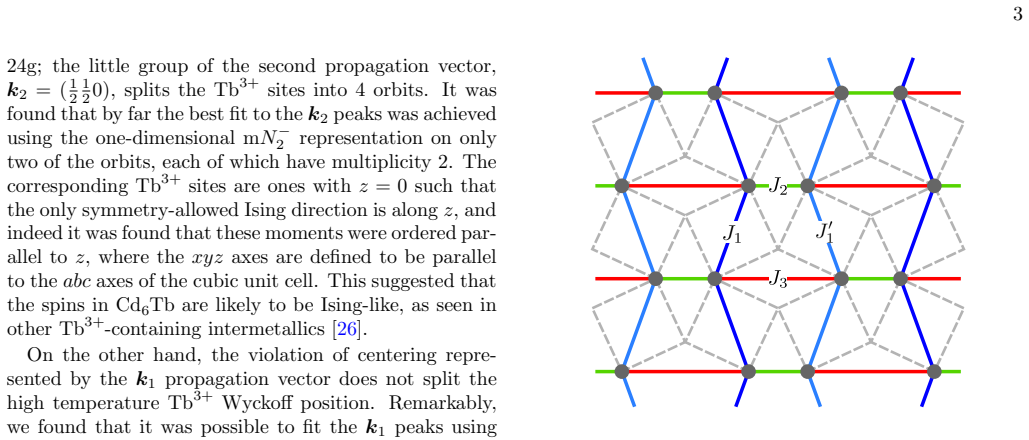
Magnetic ordering in quasicrystals has recently emerged as a fertile ground for discovering unconventional magnetic states beyond the framework of periodic crystals. However, elucidating the microscopic origin of such states remains challenging due to the intrinsic aperiodicity of quasicrystals. Here, we address this issue by investigating the prototypical Tsai-type quasicrystal approximant Cd6Tb, which preserves the essential local geometry and connectivity of icosahedral quasicrystals while allowing detailed structural and magnetic characterization due to its translational periodicity. Using neutron diffraction measurements, we find a noncoplanar multi-k magnetic ground state composed of Ising-like Tb moments arranged on a network of corner-sharing octahedra, the ingredients required to host octahedral spin-ice physics. Remarkably, only one third of the Tb moments develop long-range magnetic order, whereas the remaining moments display strongly reduced static order accompanied by persistent spin dynamics on microsecond timescales, as evidenced by muon spin rotation. This coexistence of ordered and fluctuating moments constitutes a potential realization of magnetic fragmentation - a key prediction of octahedral spin-ice physics - in a quasicrystal-related material.
Editorial analysis
A structured set of objections, weighed in public.
Referee Report
Summary. The manuscript reports neutron diffraction and muon spin rotation measurements on the Tsai-type quasicrystal approximant Cd6Tb. It identifies a noncoplanar multi-k magnetic ground state consisting of Ising-like Tb moments arranged on a network of corner-sharing octahedra. Only one third of the Tb moments develop long-range order while the remainder exhibit strongly reduced static order accompanied by persistent spin dynamics on microsecond timescales; this coexistence is interpreted as a realization of magnetic fragmentation, a key prediction of octahedral spin-ice physics.
Significance. If the fragmentation interpretation is robust, the work supplies an experimental platform for octahedral spin-ice physics in a periodic approximant that preserves the local connectivity of icosahedral quasicrystals. The combination of diffraction-derived structure and μSR dynamics offers a concrete test of fragmentation predictions outside the canonical pyrochlore setting.
major comments (1)
- [Abstract] Abstract (final paragraph) and μSR results section: the claim that the observed 1/3 long-range order plus reduced static moments and microsecond dynamics directly realizes magnetic fragmentation requires that the μSR relaxation arises solely from intrinsic Tb-moment fluctuations. No temperature-dependent line-shape analysis, comparison to a non-magnetic isostructural reference, or quantitative exclusion of static inhomogeneity or multiple muon sites is described; without these checks the fragmentation assignment remains an untested interpretation rather than a data-driven conclusion.
minor comments (1)
- [Abstract] Abstract: the statement that neutron diffraction and μSR 'support' the claims would be strengthened by explicit mention of error bars, refinement R-factors, or data tables for the magnetic structure solution.
Simulated Author's Rebuttal
We thank the referee for their careful reading of the manuscript and for identifying an important point regarding the robustness of the magnetic fragmentation interpretation. We address the major comment below.
read point-by-point responses
-
Referee: [Abstract] Abstract (final paragraph) and μSR results section: the claim that the observed 1/3 long-range order plus reduced static moments and microsecond dynamics directly realizes magnetic fragmentation requires that the μSR relaxation arises solely from intrinsic Tb-moment fluctuations. No temperature-dependent line-shape analysis, comparison to a non-magnetic isostructural reference, or quantitative exclusion of static inhomogeneity or multiple muon sites is described; without these checks the fragmentation assignment remains an untested interpretation rather than a data-driven conclusion.
Authors: We agree that the fragmentation interpretation would be strengthened by the additional controls noted. The current manuscript combines neutron diffraction (establishing the 1/3 ordered multi-k structure on the octahedral network) with μSR (showing reduced static fields and persistent dynamics below the ordering temperature) to motivate the fragmentation scenario, but does not include an explicit non-magnetic reference comparison or a dedicated line-shape study. In the revised manuscript we will add μSR data on the isostructural non-magnetic compound Cd6Y to demonstrate that the observed relaxation is Tb-moment specific. We will also expand the μSR section with a temperature-dependent line-shape analysis and a brief discussion of why multiple muon sites or static inhomogeneity are inconsistent with the known crystal structure and the sharp magnetic transition seen in diffraction. These additions will make the assignment more data-driven while preserving the original scientific narrative. revision: yes
Circularity Check
Purely experimental report; no derivation chain or fitted predictions present
full rationale
The manuscript reports neutron diffraction and muon spin rotation data on the Cd6Tb approximant, identifying a multi-k magnetic structure with partial ordering and dynamics. No equations, ansatze, fitted parameters, or theoretical derivations are presented as predictions. All claims rest on direct experimental observables interpreted against external spin-ice theory; no self-citation chain, self-definitional loop, or renaming of results occurs. The paper is therefore self-contained with respect to its data and contains no circularity.
Axiom & Free-Parameter Ledger
axioms (2)
- standard math Standard assumptions of neutron diffraction for determining magnetic structures from Bragg peaks
- domain assumption Muon spin relaxation arises from intrinsic electronic spin dynamics rather than static disorder or instrumental effects
Reference graph
Works this paper leans on
-
[2]
Shechtman, I
D. Shechtman, I. Blech, D. Gratias, and J. W. Cahn, Metallic phase with long-range orientational order and no translational symmetry, Phys. Rev. Lett.53, 1951 (1984)
1951
-
[3]
Shechtman and I
D. Shechtman and I. A. Blech, The microstructure of rapidly solidified Al 6Mn, Metall. Trans. A16, 1005 (1985)
1985
-
[4]
I. R. Fisher, K. O. Cheon, A. F. Panchula, P. C. Can- field, M. Chernikov, H. R. Ott, and K. Dennis, Magnetic and transport properties of single-grain R-Mg-Zn icosa- hedral quasicrystals [R=Y, (Y 1−xGdx), (Y1−xTbx), Tb, Dy, Ho, and Er], Phys. Rev. B59, 308 (1999)
1999
-
[5]
T. J. Sato, J. Guo, and A. P. Tsai, Magnetic properties of the icosahedral Cd-Mg-rare-earth quasicrystals, J. Phys.: Condens. Matter13, L105 (2001)
2001
-
[6]
T. Kong, S. L. Bud’ko, A. Jesche, J. McArthur, A. Kreyssig, A. I. Goldman, and P. C. Canfield, Magnetic and transport properties of i-R-Cd icosahedral quasicrys- tals (R=Y, Gd-Tm), Phys. Rev. B90, 014424 (2014)
2014
-
[7]
Al-Qadi, P
K. Al-Qadi, P. Wang, Z. M. Stadnik, and J. Przewo´ znik, Structural, magnetic, and M¨ ossbauer spectral study of the icosahedral quasicrystal Zn 77Fe7Sc16, Phys. Rev. B 79, 224202 (2009)
2009
-
[8]
Tamura, A
R. Tamura, A. Ishikawa, S. Suzuki, T. Kotajima, Y. Tanaka, T. Seki, N. Shibata, T. Yamada, T. Fujii, C.-W. Wang, M. Avdeev, K. Nawa, D. Okuyama, and T. J. Sato, Experimental observation of long-range mag- netic order in icosahedral quasicrystals, J. Am. Chem. Soc.143, 19938 (2021)
2021
-
[9]
Takeuchi, F
R. Takeuchi, F. Labib, T. Tsugawa, Y. Akai, A. Ishikawa, S. Suzuki, T. Fujii, and R. Tamura, High phase-purity and composition-tunable ferromagnetic icosahedral qua- sicrystal, Phys. Rev. Lett.130, 176701 (2023)
2023
-
[10]
Tamura, T
R. Tamura, T. Abe, S. Yoshida, Y. Shimozaki, S. Suzuki, A. Ishikawa, F. Labib, M. Avdeev, K. Kinjo, K. Nawa, and T. J. Sato, Observation of antiferromagnetic order in a quasicrystal, Nat. Phys.21, 974 (2025)
2025
-
[11]
Lifshitz, Symmetry of magnetically ordered quasicrys- tals, Phys
R. Lifshitz, Symmetry of magnetically ordered quasicrys- tals, Phys. Rev. Lett.80, 2717 (1998)
1998
-
[12]
Thiem and J
S. Thiem and J. T. Chalker, Long-range magnetic order in models for rare-earth quasicrystals, Phys. Rev. B92, 224409 (2015)
2015
-
[13]
Lopez-Bezanilla and C
A. Lopez-Bezanilla and C. Nisoli, Field-induced mag- netic phases in a qubit Penrose quasicrystal, Sci. Adv. 9, eadf6631 (2023)
2023
-
[14]
Watanabe, Topological magnetic textures and long- range orders in terbium-based quasicrystal and approx- imant, Proc
S. Watanabe, Topological magnetic textures and long- range orders in terbium-based quasicrystal and approx- imant, Proc. Natl. Acad. Sci. U.S.A.118, e2112202118 (2021)
2021
-
[15]
A. I. Goldman and R. F. Kelton, Quasicrystals and crys- talline approximants, Rev. Mod. Phys.65, 213 (1993)
1993
-
[16]
T. J. Sato, A. Ishikawa, A. Sakurai, M. Hattori, M. Avdeev, and R. Tamura, Whirling spin order in the quasicrystal approximant Au 72Al14Tb14, Phys. Rev. B 100, 054417 (2019)
2019
-
[17]
K. K. Thilakan, F. Denoel, Y.-C. Huang, O. Fa- belo, R. Mathieu, C. P. G´ omez, and M. Sahlberg, Single-crystal neutron diffraction study on the Ho13.6Au61.1Al25.3 quasicrystal approximant, J. Al- loys Compd.1002, 175263 (2024)
2024
-
[18]
Labib, K
F. Labib, K. Nawa, S. Suzuki, H.-C. Wu, A. Ishikawa, K. Inagaki, T. Fujii, K. Kinjo, T. J. Sato, and R. Tamura, Unveiling exotic magnetic phase diagram of a non-Heisenberg quasicrystal approximant, Mater. Today Phys.40, 101321 (2024)
2024
-
[19]
Tamura, Y
R. Tamura, Y. Muro, T. Hiroto, K. Nishimoto, and T. Takabatake, Long-range magnetic order in the qua- sicrystalline approximant Cd 6Tb, Phys. Rev. B82, 220201 (2010)
2010
-
[20]
A. Mori, H. Ota, S. Yoshiuchi, K. Iwakawa, Y. Taga, Y. Hirose, T. Takeuchi, E. Yamamoto, Y. Haga, F. Honda, R. Settai, and Y. ¯Onuki, Electrical and mag- 6 netic properties of quasicrystal approximants RCd 6 (R: Rare earth), J. Phys. Soc. Jpn.81, 024720 (2012)
2012
-
[21]
Nishimoto, T
K. Nishimoto, T. Sato, and R. Tamura, Low-temperature superstructures of a series of Cd 6M (M = Ca, Y, Sr, Pr, Nd, Sm, Gd, Tb, Dy, Ho, Er, Tm, Yb and Lu) crystalline approximants, J. Phys.: Condens. Matter25, 235403 (2013)
2013
-
[22]
Tamura, Y
R. Tamura, Y. Murao, S. Takeuchi, M. Ichihara, M. Isobe, and Y. Ueda, A low-temperature order-disorder transition in a cubic Cd 6Yb crystalline approximant, Jpn. J. Appl. Phys.41, L524 (2002)
2002
-
[23]
L. C. Chapon, P. Manuel, P. G. Radaelli, C. Ben- son, L. Perrott, S. Ansell, N. J. Rhodes, D. Raspino, D. Duxbury, E. Spill, and J. Norris, Wish: The new powder and single crystal magnetic diffractometer on the second target station, Neutron News22, 22 (2011)
2011
-
[24]
Rodr´ ıguez-Carvajal, Recent advances in magnetic structure determination by neutron powder diffraction, Physica B192, 55 (1993)
J. Rodr´ ıguez-Carvajal, Recent advances in magnetic structure determination by neutron powder diffraction, Physica B192, 55 (1993)
1993
-
[25]
See supplementary material at [link to be inserted] for further details of the experiments and analysis and for Refs. [43-49]
-
[26]
Y. A. Izyumov, V. E. Naish, and R. P. Ozerov,Neutron diffraction of magnetic materials(Consultants Bureau, New York, 1991)
1991
-
[27]
Hiroto, T
T. Hiroto, T. J. Sato, H. Cao, T. Hawai, T. Yokoo, S. Itoh, and R. Tamura, Noncoplanar ferrimagnetism and local crystalline-electric-field anisotropy in the quasicrys- tal approximant Au70Si17Tb13, J. Phys.: Condens. Mat- ter32, 415802 (2020)
2020
-
[28]
Tamura, K
R. Tamura, K. Edagawa, K. Shibata, K. Nishimoto, S. Takeuchi, K. Saitoh, M. Isobe, and Y. Ueda, Group theoretical treatment of the low-temperature phase tran- sition of the Cd 6Ca 1/1-cubic approximant, Phys. Rev. B72, 174211 (2005)
2005
-
[29]
Liu,Phase transition in the 1/1 approximant to the Tsai type quasicrystal : atomic structure , diffuse scatter- ing and atomic scale simulation, Ph.D
D. Liu,Phase transition in the 1/1 approximant to the Tsai type quasicrystal : atomic structure , diffuse scatter- ing and atomic scale simulation, Ph.D. thesis, Universit´ e Grenoble Alpes (2015)
2015
-
[30]
M. G. Kim, G. Beutier, A. Kreyssig, T. Hiroto, T. Ya- mada, J. W. Kim, M. de Boissieu, R. Tamura, and A. I. Goldman, Antiferromagnetic order in the quasicrystal approximant Cd6Tb studied by x-ray resonant magnetic scattering, Phys. Rev. B85, 134442 (2012)
2012
-
[31]
Szab´ o, F
A. Szab´ o, F. Orlandi, and P. Manuel, Fragmented spin ice and multi-kordering in rare-earth antiperovskites, Phys. Rev. Lett.129, 247201 (2022)
2022
-
[32]
S. T. Bramwell and M. J. P. Gingras, Spin ice state in frustrated magnetic pyrochlore materials, Science294, 1495 (2001)
2001
-
[33]
Fennell, P
T. Fennell, P. P. Deen, A. R. Wildes, K. Schmalzl, D. Prabhakaran, A. T. Boothroyd, R. J. Aldus, D. F. Mc- Morrow, and S. T. Bramwell, Magnetic coulomb phase in the spin ice Ho 2Ti2O7, Science326, 415 (2009)
2009
- [34]
-
[35]
Amato, H
A. Amato, H. Luetkens, K. Sedlak, A. Stoykov, R. Scheuermann, M. Elender, A. Raselli, and D. Graf, The new versatile general purpose surface-muon instru- ment (GPS) based on silicon photomultipliers forµsr measurements on a continuous-wave beam, Rev. Sci. In- strum.88, 093301 (2017)
2017
- [36]
-
[37]
Ibuka, K
S. Ibuka, K. Iida, and T. J. Sato, Magnetic properties of the Ag–In–rare-earth 1/1 approximants, J. Phys.: Con- dens. Matter23, 056001 (2011)
2011
-
[38]
Kashimoto, S
S. Kashimoto, S. Motomura, S. Francoual, S. Matsuo, and T. Ishimasa, Systematic study of magnetic properties in Zn-based Tsai-type icosahedral quasicrystals and their approximant, Philos. Mag.86, 725 (2006)
2006
-
[39]
Labib, H
F. Labib, H. Takakura, A. Ishikawa, and R. Tamura, Competition between spin-glass and antiferromagnetic states in Tsai-type 1/1 and 2/1 quasicrystal approxi- mants, Phys. Rev. Mater.6, 124412 (2022)
2022
-
[40]
T. J. Sato, H. Takakura, A. P. Tsai, and K. Shibata, Magnetic excitations in the Zn-Mg-Tb icosahedral qua- sicrystal: An inelastic neutron scattering study, Phys. Rev. B73, 054417 (2006)
2006
-
[41]
T. J. Sato, H. Takakura, J. Guo, A. P. Tsai, and K. Ohoyama, Magnetic correlations in the Cd–Mg–Tb icosahedral quasicrystal, J. Alloys Compd.342, 365 (2002)
2002
-
[42]
Tamuraet al., ISIS Pulsed Neutron and Muon Source (2024),https://doi.org/10.5286/ISIS.E.RB2420089
R. Tamuraet al., ISIS Pulsed Neutron and Muon Source (2024),https://doi.org/10.5286/ISIS.E.RB2420089
-
[43]
Momma and F
K. Momma and F. Izumi,VESTA3for three-dimensional visualization of crystal, volumetric and morphology data, J. Appl. Cryst.44, 1272 (2011)
2011
-
[44]
Arnoldet al., Mantid—data analysis and visualiza- tion package for neutron scattering andµsr experiments, Nucl
O. Arnoldet al., Mantid—data analysis and visualiza- tion package for neutron scattering andµsr experiments, Nucl. Instrum. Methods Phys. Res., Sect. A764, 156 (2014)
2014
-
[45]
C. P. G´ omez and S. Lidin, Comparative structural study of the disordered MCd6 quasicrystal approximants, Phys. Rev. B68, 024203 (2003)
2003
-
[46]
A. P. Tsai, J. Q. Guo, E. Abe, H. Takakura, and T. J. Sato, A stable binary quasicrystal, Nature408, 537 (2000)
2000
-
[47]
Tsai and C
A.-P. Tsai and C. P. G´ omez, Quasicrystals and approxi- mants in Cd-M systems and related alloys, inQuasicrys- tals, Handbook of Metal Physics, Vol. 3, edited by T. Fu- jiwara and Y. Ishii (Elsevier, 2008) pp. 75–106
2008
-
[48]
H. T. Stokes, D. M. Hatch, and B. J. Campbell, ISOTROPY software suite,https://iso.byu.edu
-
[49]
B. J. Campbell, H. T. Stokes, D. E. Tanner, and D. M. Hatch, ISODISPLACE: a web-based tool for exploring structural distortions, J. Appl. Cryst.39, 607 (2006)
2006
-
[50]
Suter and B
A. Suter and B. Wojek, Musrfit: A free platform- independent framework forµsr data analysis, Physics Procedia30, 69 (2012). 7 METHODS Sample synthesisA polycrystalline alloy with a nom- inal composition of Cd 6Tb was synthesized by melting high-purity constituent elements in an alumina crucible sealed in an evacuated quartz tube under an Ar atmo- sphere a...
2012
-
[51]
propagation vector splits the single Tb Wyckoff position in the parentIm ¯3 structure into 4 orbits, with multiplicities 4, 4, 2 and 2, labeled as Tb1, Tb2, Tb3 and Tb4 respectively. A good fit was obtained using the one-dimensional mN − 2 representation on only orbits Tb3 and Tb4 (we follow the ISODISTORT [S7, S8] notation for irreducible representations...
-
[52]
+–” structure has octahedra where all spins are pointing in (and vice versa) whereas the “++
order according to the (100) propagation vector, with the basis vectors transformed appropriately. The magnitude of the moments on both sites was constrained to be the same because the diffraction pattern cannot distinguish between moments on only one site, or on both, so the most symmetric option was chosen. Whether the relative phase between the Tb1 and...
1915
-
[53]
could be active in the structure, i.e., ( 1 2 1
-
[54]
on orbits Tb3 and Tb4 and (0 1 2 1
-
[55]
This structure has much lower symmetry (magnetic space groupP S¯1) with many magnetic irreps allowed to be active, for which we see no evidence
on orbit Tb1, with (100) only having non-zero Fourier coefficients on orbit Tb2. This structure has much lower symmetry (magnetic space groupP S¯1) with many magnetic irreps allowed to be active, for which we see no evidence. We therefore rule out this structure from further consideration. C. Magneto-elastic coupling We have verified that the magnetic str...
-
[56]
respectively, and the order parameter direction for mH + 4 is (a, b,0). SV. PROPOSED EXCHANGE INTERACTIONS The main text presented a two-dimensional version of the proposed exchange interactions for simplicity. In Fig. S2, we show the full three-dimensional model. While theJ 2 andJ 3 bonds alongain this figure are not symmetry- equivalent to those alongb,...
-
[57]
These calibration data are shown in Fig
Data at 5 K The data at 5 K were collected before the helium gas entered the pocket, so the calibration performed at 300 K and 30 G at the beginning of the experiment could be used. These calibration data are shown in Fig. S3. It can be seen that even at this elevated temperature, the oscillations in the applied field are strongly damped, implying that th...
-
[58]
This was used to determine the appropriateαas the geometry had changed, as well as to obtain an estimate of the proportion of muons which stopped outside the sample, (1−f magnetic)
Data at 1.5 K Because of the gas entering the sample pocket, a second calibration measurement at 300 K in 30 G transverse field was taken at the end of the experiment. This was used to determine the appropriateαas the geometry had changed, as well as to obtain an estimate of the proportion of muons which stopped outside the sample, (1−f magnetic). These d...
2011
discussion (0)
Sign in with ORCID, Apple, or X to comment. Anyone can read and Pith papers without signing in.