WhoSaidIt: Human-LLM Collaborative Annotation for Text-Based Multilingual Speaker-Attribute Classification
Pith reviewed 2026-06-29 21:44 UTC · model grok-4.3
The pith
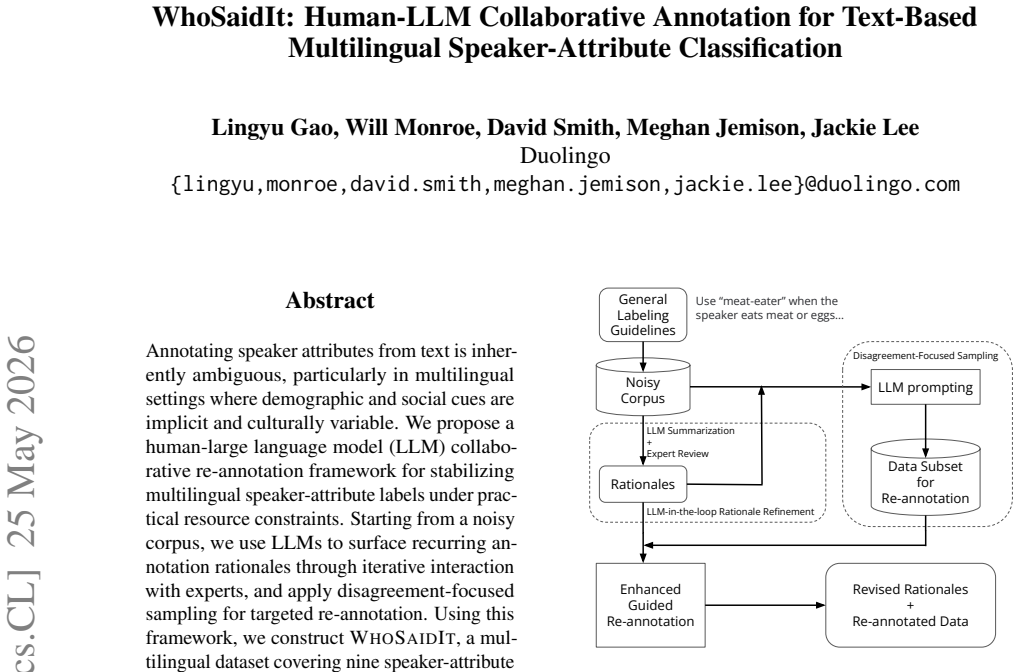
A human-LLM collaboration framework stabilizes noisy multilingual speaker-attribute labels by targeting annotation disagreements.
A machine-rendered reading of the paper's core claim, the machinery that carries it, and where it could break.
Core claim
The authors establish that iterative interaction between LLMs and experts surfaces recurring annotation rationales from a noisy corpus, and disagreement-focused sampling enables targeted re-annotation to create more stable multilingual labels for nine speaker attributes, with measurable divergence from original annotations and mixed LLM classification results.
What carries the argument
The human-LLM collaborative re-annotation framework that surfaces recurring rationales through iterative expert interaction and uses disagreement sampling for re-annotation.
If this is right
- Original and revised annotations diverge substantially, particularly across languages.
- LLMs exhibit both strengths and limitations when classifying speaker attributes from text.
- Providing explicit rationales influences how models behave on the task.
- The framework operates effectively under practical resource constraints for dataset construction.
Where Pith is reading between the lines
- Similar collaborative methods could apply to annotating other ambiguous text features like sentiment or intent in multilingual data.
- Stabilized labels might lead to more reliable cross-lingual transfer in downstream speaker-attribute models.
- The observed cross-lingual differences suggest that language-specific cultural factors play a larger role than previously quantified.
- Extending the framework to additional languages could test its scalability beyond the nine attributes studied.
Load-bearing premise
Iterative LLM-expert interaction reliably identifies annotation rationales that experts can use to create more consistent labels across languages.
What would settle it
A controlled experiment showing that independent expert re-annotation without LLM assistance achieves equivalent stability and cross-lingual consistency as the collaborative method.
Figures
read the original abstract
Annotating speaker attributes from text is inherently ambiguous, particularly in multilingual settings where demographic and social cues are implicit and culturally variable. We propose a human-large language model (LLM) collaborative re-annotation framework for stabilizing multilingual speaker-attribute labels under practical resource constraints. Starting from a noisy corpus, we use LLMs to surface recurring annotation rationales through iterative interaction with experts, and apply disagreement-focused sampling for targeted re-annotation. Using this framework, we construct WhoSaidIt, a multilingual dataset covering nine speaker-attribute labels. We quantify divergence between original and revised annotations, benchmark recent LLMs, and analyze the effect of explicit rationales on model behavior. Our results reveal substantial cross-lingual differences in annotation decisions and demonstrate both the strengths and limitations of LLMs in speaker-attribute classification.
Editorial analysis
A structured set of objections, weighed in public.
Referee Report
Summary. The manuscript proposes a human-LLM collaborative re-annotation framework for stabilizing multilingual speaker-attribute labels under resource constraints. It uses LLMs to surface recurring rationales via iterative expert interaction and disagreement-focused sampling for targeted re-annotation on a noisy corpus, resulting in the WhoSaidIt dataset with nine speaker-attribute labels. The work quantifies divergence between original and revised annotations, benchmarks recent LLMs, and analyzes the effect of explicit rationales on model behavior, revealing substantial cross-lingual differences in annotation decisions along with LLM strengths and limitations in speaker-attribute classification.
Significance. If the central claim holds, the framework would provide a practical method for improving label stability in multilingual annotation tasks with limited resources and offer useful benchmarks on LLM performance in this domain. The emphasis on rationale surfacing and cross-lingual analysis could inform future annotation pipelines. However, the absence of direct stability validation limits the assessed impact.
major comments (2)
- [Abstract] Abstract: The claim that the framework 'stabilizes' multilingual speaker-attribute labels lacks supporting evidence. Results quantify divergence between original and revised annotations and cross-lingual differences but supply no before/after stability metric (e.g., IAA, test-retest agreement) or control condition without LLM input to demonstrate that changes reflect genuine stabilization rather than annotator drift or LLM influence.
- [Abstract] Abstract: No quantitative evidence, error analysis, or validation steps are described to support claims about divergence and LLM behavior, preventing evaluation of whether iterative LLM-expert interaction reliably surfaces rationales that improve label stability across languages.
minor comments (1)
- The abstract refers to 'nine speaker-attribute labels' without naming them; this should be specified in the introduction or methods for clarity.
Simulated Author's Rebuttal
We thank the referee for their constructive feedback. We provide point-by-point responses to the major comments below.
read point-by-point responses
-
Referee: [Abstract] Abstract: The claim that the framework 'stabilizes' multilingual speaker-attribute labels lacks supporting evidence. Results quantify divergence between original and revised annotations and cross-lingual differences but supply no before/after stability metric (e.g., IAA, test-retest agreement) or control condition without LLM input to demonstrate that changes reflect genuine stabilization rather than annotator drift or LLM influence.
Authors: We acknowledge that the manuscript does not include a direct before/after stability metric such as IAA or a control condition without LLM input. The reported divergence between original and revised annotations serves as an indirect indicator of the framework's effect via disagreement-focused sampling and rationale surfacing, but it does not formally demonstrate stabilization independent of annotator drift. We will revise the abstract to avoid the term 'stabilizes' and add an explicit limitations discussion addressing this point. revision: yes
-
Referee: [Abstract] Abstract: No quantitative evidence, error analysis, or validation steps are described to support claims about divergence and LLM behavior, preventing evaluation of whether iterative LLM-expert interaction reliably surfaces rationales that improve label stability across languages.
Authors: The manuscript reports quantitative divergence measures, LLM benchmarks, and rationale-effect analysis in the results sections. To strengthen support for the claims about the iterative process, we will expand the error analysis and validation details in the revision, with additional cross-lingual breakdowns. revision: partial
Circularity Check
No circularity; methodological paper with no derivations or self-referential reductions
full rationale
The paper describes an annotation framework, dataset construction via LLM-expert interaction, quantification of annotation divergence, and LLM benchmarking. No equations, fitted parameters presented as predictions, or load-bearing self-citations appear in the abstract or described content. Central claims rest on empirical process and results rather than any derivation that reduces to its own inputs by construction. This is the expected non-finding for a resource/construction paper without mathematical claims.
Axiom & Free-Parameter Ledger
Reference graph
Works this paper leans on
-
[1]
Llms in the loop: Leveraging large language model annotations for active learning in low-resource languages. InMachine Learning and Knowledge Dis- covery in Databases. Applied Data Science Track - European Conference, ECML PKDD 2024, Vilnius, Lithuania, September 9-13, 2024, Proceedings, Part X, volume 14950 ofLecture Notes in Computer Sci- ence, pages 39...
work page internal anchor Pith review Pith/arXiv arXiv 2024
-
[2]
In Proceedings of the 2023 ACM Conference on Fair- ness, Accountability, and Transparency, FAccT ’23, page 1531–1552, New York, NY , USA
Auditing cross-cultural consistency of human- annotated labels for recommendation systems. In Proceedings of the 2023 ACM Conference on Fair- ness, Accountability, and Transparency, FAccT ’23, page 1531–1552, New York, NY , USA. Association for Computing Machinery. Francisco M. Rangel Pardo, Fabio Celli, Paolo Rosso, Martin Potthast, Benno Stein, and Walt...
2023
-
[3]
InWorking Notes of CLEF 2015 - Con- ference and Labs of the Evaluation forum, Toulouse, France, September 8-11, 2015, CEUR Workshop Pro- ceedings
Overview of the 3rd author profiling task at PAN 2015. InWorking Notes of CLEF 2015 - Con- ference and Labs of the Evaluation forum, Toulouse, France, September 8-11, 2015, CEUR Workshop Pro- ceedings. CEUR-WS.org. Barbara Plank. 2022. The “problem” of human label variation: On ground truth in data, modeling and evaluation. InProceedings of the 2022 Confe...
2015
-
[4]
Topic or style? exploring the most useful features for authorship attribution. InProceedings of the 27th International Conference on Computational Linguistics, pages 343–353, Santa Fe, New Mexico, USA. Association for Computational Linguistics. Hope Schroeder, Deb Roy, and Jad Kabbara. 2025. Just put a human in the loop? investigating LLM-assisted annotat...
work page internal anchor Pith review Pith/arXiv arXiv 2025
-
[5]
They had sashimi yesterday
TwiSty: A multilingual Twitter stylometry cor- pus for gender and personality profiling. InProceed- ings of the Tenth International Conference on Lan- guage Resources and Evaluation (LREC’16), pages 1632–1637, Portorož, Slovenia. European Language Resources Association (ELRA). Xinru Wang, Hannah Kim, Sajjadur Rahman, Kushan Mitra, and Zhengjie Miao. 2024....
2024
-
[6]
I had sashimi yesterday
The speaker explicitly eats or expresses intent to eat meat, seafood, or eggs. E.g., “I had sashimi yesterday”
-
[7]
The main dish is steak
The sentence describes, recommends, buys, or cooks meat/egg dishes in a way that assumes the speaker or user is okay with meat. E.g., “The main dish is steak.”, “Do you like hot pots?”, “Let’s grill beef.”
-
[8]
I don’t eat raw fish
The sentence includes a negative statement that still implies meat-eating, e.g., “I don’t eat raw fish” which implies fish is okay when cooked. “ I don’t like boiled eggs” implies eggs are consumed otherwise
-
[9]
How much is the chicken?
The sentence contains general or descriptive references to meat or egg-based food that assumes it’s acceptable or desirable to the audience. E.g., “How much is the chicken?”, “Hot dogs are delicious.” Please assign a label of 0 only if: - The speaker clearly reject animal products consumption. E.g., “I’m vegetarian”, “I don’t eat eggs.” - There is no refe...
2026
discussion (0)
Sign in with ORCID, Apple, or X to comment. Anyone can read and Pith papers without signing in.