Goal-driven Bayesian Optimal Experimental Design for Robust Decision-Making Under Model Uncertainty
Pith reviewed 2026-06-29 22:11 UTC · model grok-4.3
The pith
Goal-driven Bayesian optimal experimental design optimizes experiments directly for downstream decision objectives rather than total parameter information gain.
A machine-rendered reading of the paper's core claim, the machinery that carries it, and where it could break.
Core claim
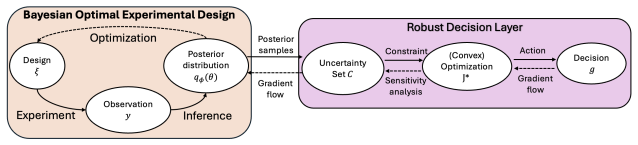
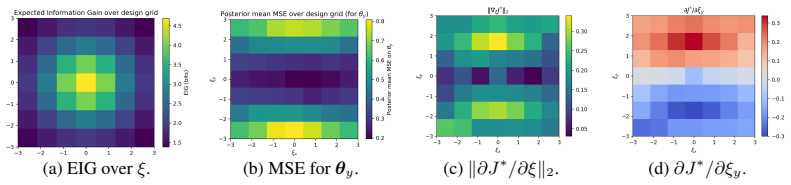
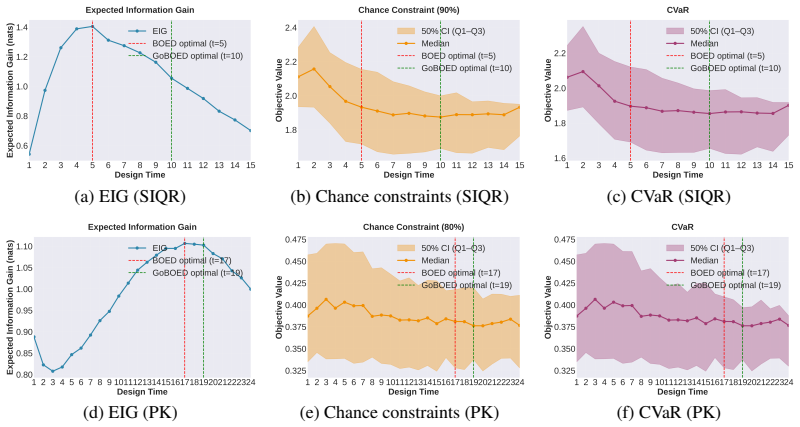
GoBOED directly optimizes experimental designs for a specified decision-making objective by combining an amortized variational posterior surrogate with a differentiable convex decision layer. It theoretically demonstrates that the resulting gradients are insensitive to parameter directions irrelevant to the decision objective, justifying why goal-driven designs achieve equivalent decision quality over a wider set of experimental designs than information-gain maximization. Across source localization, epidemic management, and pharmacokinetic control, GoBOED identifies designs that better align with downstream decision objectives and reveals substantially wider near-optimal design windows than
What carries the argument
The goal-driven objective formed by an amortized variational posterior surrogate combined with a differentiable convex optimization layer for the decision problem, which routes gradients only through decision-relevant parameter directions.
If this is right
- GoBOED produces designs that maintain high decision quality across a wider range of experimental choices than information-maximizing designs.
- In the three evaluated domains the method yields decisions that more closely match the specified objective.
- Near-optimal design windows are substantially wider than those predicted by goal-agnostic BOED.
- The gradient insensitivity to irrelevant parameter directions supplies a formal reason for the observed robustness.
Where Pith is reading between the lines
- The method could allow experimenters to accept a broader set of practical designs without loss of decision performance, lowering the cost of finding an acceptable experiment.
- If suitable differentiable surrogates exist, the same gradient-insensitivity argument might apply to non-convex decision problems.
- In sequential or adaptive settings the approach might reduce the total number of experiments required by tolerating more variation in each individual design choice.
Load-bearing premise
The downstream decision objective can be represented as a differentiable convex optimization layer through which gradients with respect to the experimental design can be computed.
What would settle it
A setting in which the decision objective is non-convex or cannot be expressed as a differentiable layer and GoBOED no longer produces higher decision quality than standard BOED across the tested applications.
Figures
read the original abstract
Bayesian optimal experimental design (BOED) selects experiments to maximize information gain about model parameters. However, in decision-critical settings, reducing parameter uncertainty does not necessarily improve downstream decisions, as only specific parameter directions relevant to the objective truly matter. We propose GoBOED, a goal-driven BOED framework that directly optimizes experimental designs for a specified decision-making objective. GoBOED combines an amortized variational posterior surrogate with a differentiable convex decision layer, enabling gradient-based design optimization that is fully decision-focused. We theoretically show that GoBOED gradients are insensitive to parameter directions irrelevant to the decision objective, providing a formal justification for why goal-driven design achieves equivalent decision quality over a wider set of experimental designs than information-gain maximization. Empirically, across source localization, epidemic management, and pharmacokinetic control, GoBOED identifies designs that better align with downstream decision objectives and reveals that near-optimal design windows are substantially wider than those predicted by goal-agnostic BOED approaches.
Editorial analysis
A structured set of objections, weighed in public.
Referee Report
Summary. The paper proposes GoBOED, a goal-driven Bayesian optimal experimental design framework that optimizes experimental designs directly for a downstream decision objective using an amortized variational posterior surrogate combined with a differentiable convex decision layer. It claims a theoretical result that GoBOED gradients are insensitive to parameter directions irrelevant to the decision objective (providing justification over information-gain BOED), and reports empirical improvements showing wider near-optimal design windows in source localization, epidemic management, and pharmacokinetic control tasks.
Significance. If the gradient insensitivity result holds under the stated assumptions, the work supplies a formal justification for decision-focused experimental design, which could improve robustness in applications where only specific parameter directions affect the objective. The reported widening of near-optimal design windows would be a practically useful observation for real-world experimental planning under model uncertainty.
major comments (2)
- [Theoretical derivation (abstract and implied main theory section)] The central theoretical claim of gradient insensitivity (abstract) is derived via backpropagation through the differentiable convex decision layer; the manuscript must explicitly delineate the class of decision objectives that admit an exact convex-optimization representation (with well-defined KKT or implicit gradients w.r.t. the design) and confirm that no approximation is introduced in the three empirical domains, as this assumption is load-bearing for the formal result.
- [Empirical evaluation sections] Empirical validation across the three tasks requires explicit confirmation that each downstream decision objective is exactly representable as the required differentiable convex layer; without this, the claimed equivalence to the theoretical insensitivity property cannot be verified.
Simulated Author's Rebuttal
We thank the referee for the constructive comments highlighting the importance of clearly stating the assumptions underlying our theoretical result. We address each major comment below and will revise the manuscript accordingly.
read point-by-point responses
-
Referee: [Theoretical derivation (abstract and implied main theory section)] The central theoretical claim of gradient insensitivity (abstract) is derived via backpropagation through the differentiable convex decision layer; the manuscript must explicitly delineate the class of decision objectives that admit an exact convex-optimization representation (with well-defined KKT or implicit gradients w.r.t. the design) and confirm that no approximation is introduced in the three empirical domains, as this assumption is load-bearing for the formal result.
Authors: We agree that the gradient insensitivity result is load-bearing on the decision objective admitting an exact differentiable convex representation. In the revised manuscript we will add a dedicated subsection that delineates the admissible class (convex programs whose solutions admit well-defined KKT conditions or implicit-function gradients with respect to the design variable) and explicitly states the technical conditions required for the back-propagation argument. For the three empirical domains we confirm that the downstream objectives (quadratic source-localization cost, linear epidemic-control policy, and convex pharmacokinetic dosing problem) are each formulated as exact convex programs; the differentiable convex layer implements the exact solution via implicit differentiation with no approximation. We will include this verification in the new subsection. revision: yes
-
Referee: [Empirical evaluation sections] Empirical validation across the three tasks requires explicit confirmation that each downstream decision objective is exactly representable as the required differentiable convex layer; without this, the claimed equivalence to the theoretical insensitivity property cannot be verified.
Authors: We acknowledge the referee’s point. The revised manuscript will add explicit statements in each experimental subsection confirming that the decision objective is exactly representable as the differentiable convex layer used in the theory (with the same implicit-gradient implementation). This will make the link between the empirical results and the gradient-insensitivity theorem direct and verifiable. revision: yes
Circularity Check
No circularity; new framework with explicit modeling assumptions
full rationale
The paper introduces GoBOED as a novel combination of amortized variational posterior surrogate and differentiable convex decision layer. The claimed gradient insensitivity is derived directly from backpropagation through this explicitly constructed layer, which is presented as a modeling choice rather than a reduction of any fitted quantity or prediction to its own inputs. No self-definitional steps, fitted-input predictions, or load-bearing self-citations appear in the described derivation chain. The result is self-contained as a new architectural proposal whose theoretical property follows from the stated differentiability assumption.
Axiom & Free-Parameter Ledger
axioms (1)
- domain assumption The decision-making objective admits a differentiable convex formulation allowing gradient flow through the decision layer
invented entities (1)
-
GoBOED framework
no independent evidence
Reference graph
Works this paper leans on
-
[1]
Decoupled Weight Decay Regularization
PMLR. URLhttps://proceedings.mlr.press/v15/lacoste_julien11a.html. Yurong Lai, Xiaoyan Chu, Li Di, Wei Gao, Yingying Guo, Xingrong Liu, Chuang Lu, Jialin Mao, Hong Shen, Huaping Tang, et al. Recent advances in the translation of drug metabolism and pharmacokinetics science for drug discovery and development.Acta Pharmaceutica Sinica B, 12 (6):2751–2777, 2...
work page internal anchor Pith review Pith/arXiv arXiv 2022
-
[2]
while prioritizing uncertainty reduction in controlled state variables
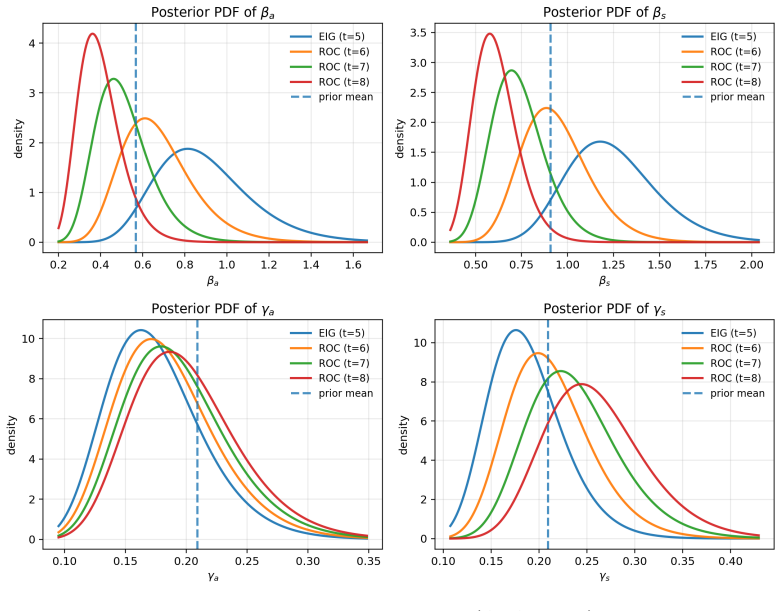
developed a control-oriented approach that connects optimal control and sensor placement 24 Figure 5: Posterior densities for the SIQR model parameters (βa, βs, γa, γs) under different observa- tion times. while prioritizing uncertainty reduction in controlled state variables. The linearity in these models makes the problems mathematically tractable and c...
2024
discussion (0)
Sign in with ORCID, Apple, or X to comment. Anyone can read and Pith papers without signing in.