AirCast-SR: A Foundation Model for Kilometer-Scale Atmospheric Super-Resolution via Latent Consistency Diffusion
Pith reviewed 2026-06-30 17:32 UTC · model grok-4.3
The pith
AirCast-SR downscales global weather forecasts from 28 km to 1 km resolution with near-zero bias across variables.
A machine-rendered reading of the paper's core claim, the machinery that carries it, and where it could break.
Core claim
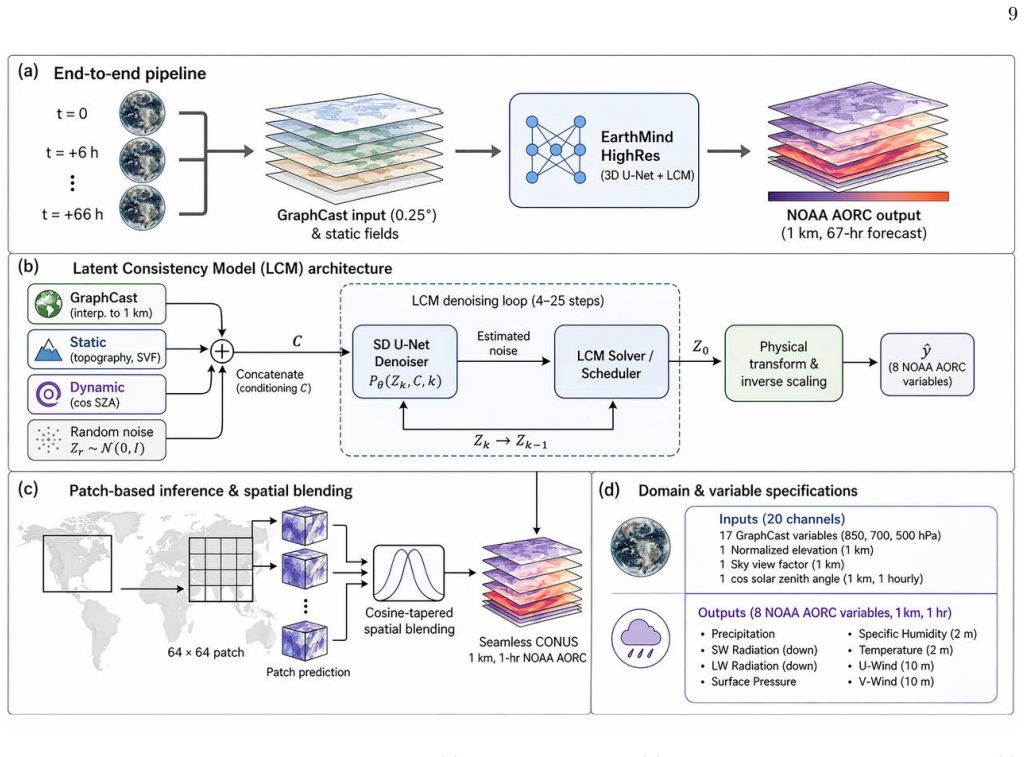
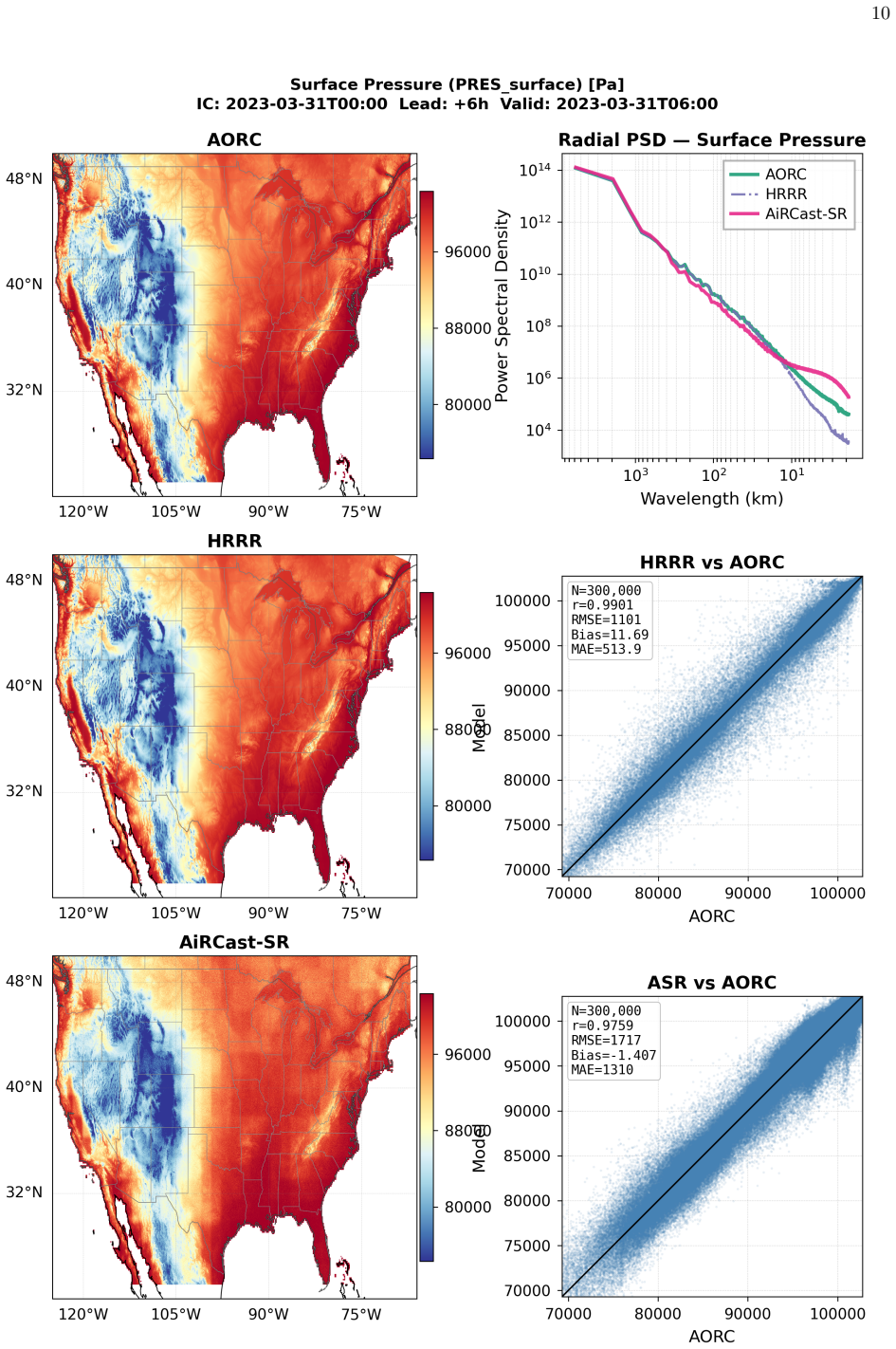
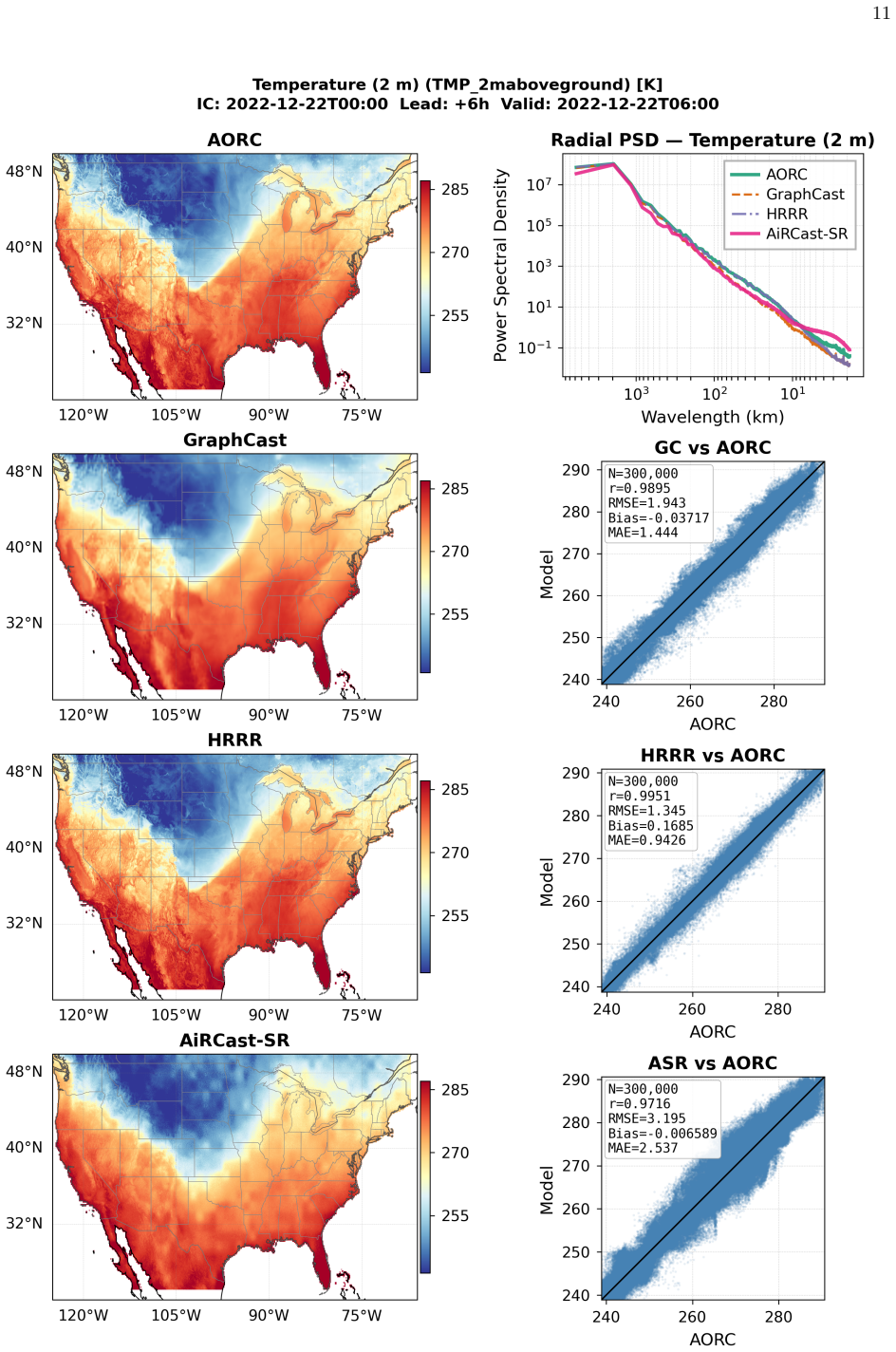
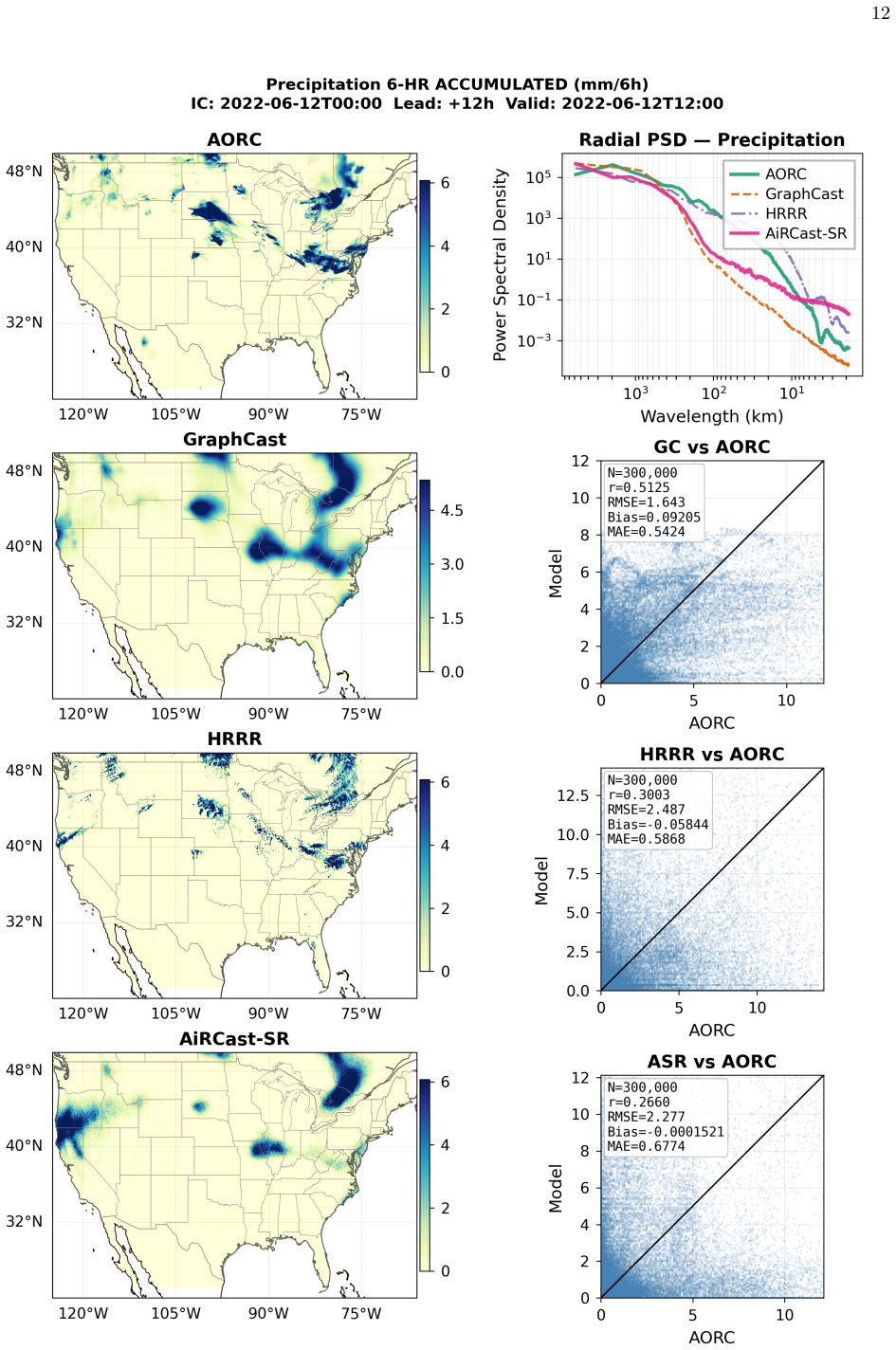
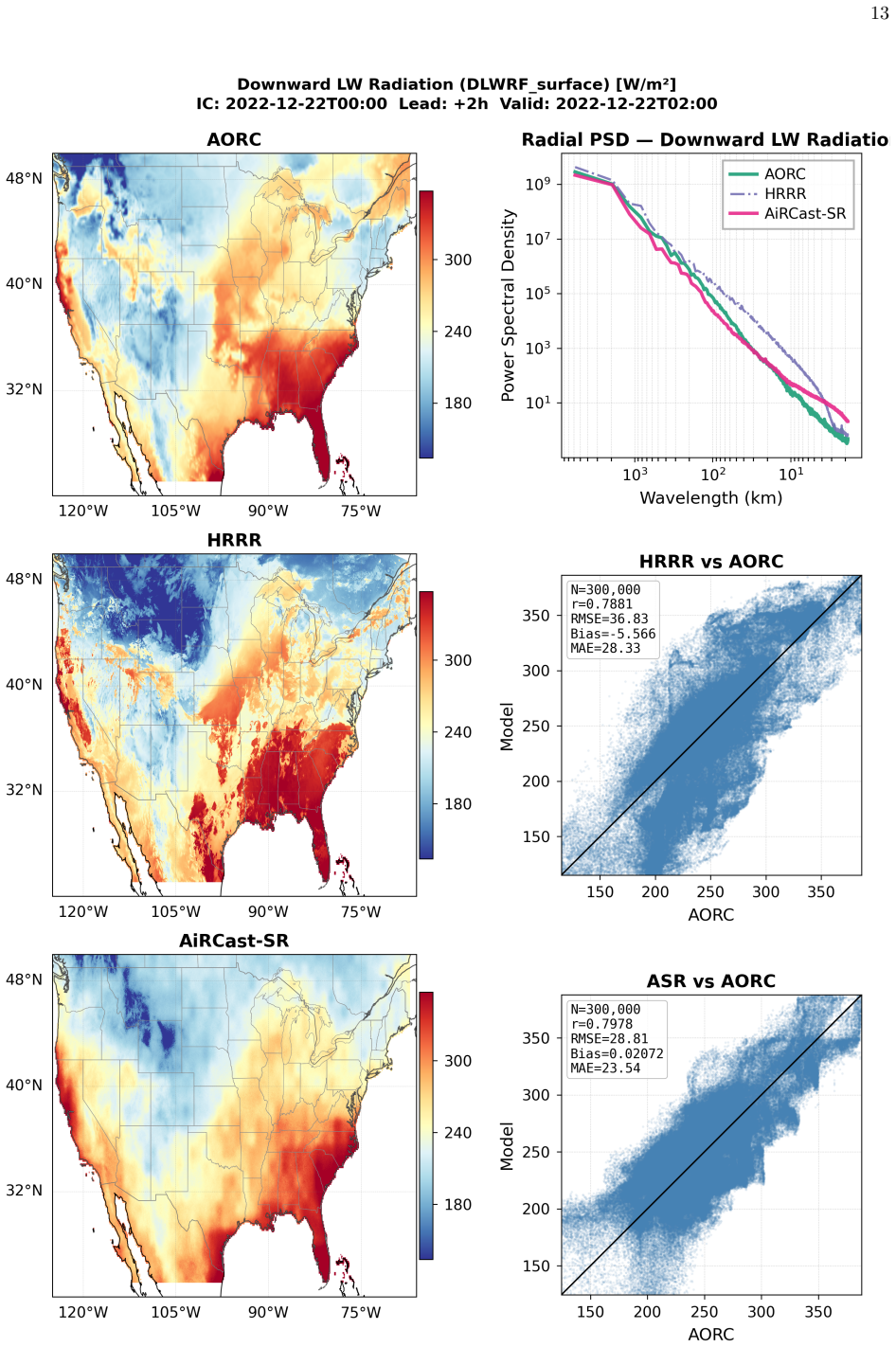
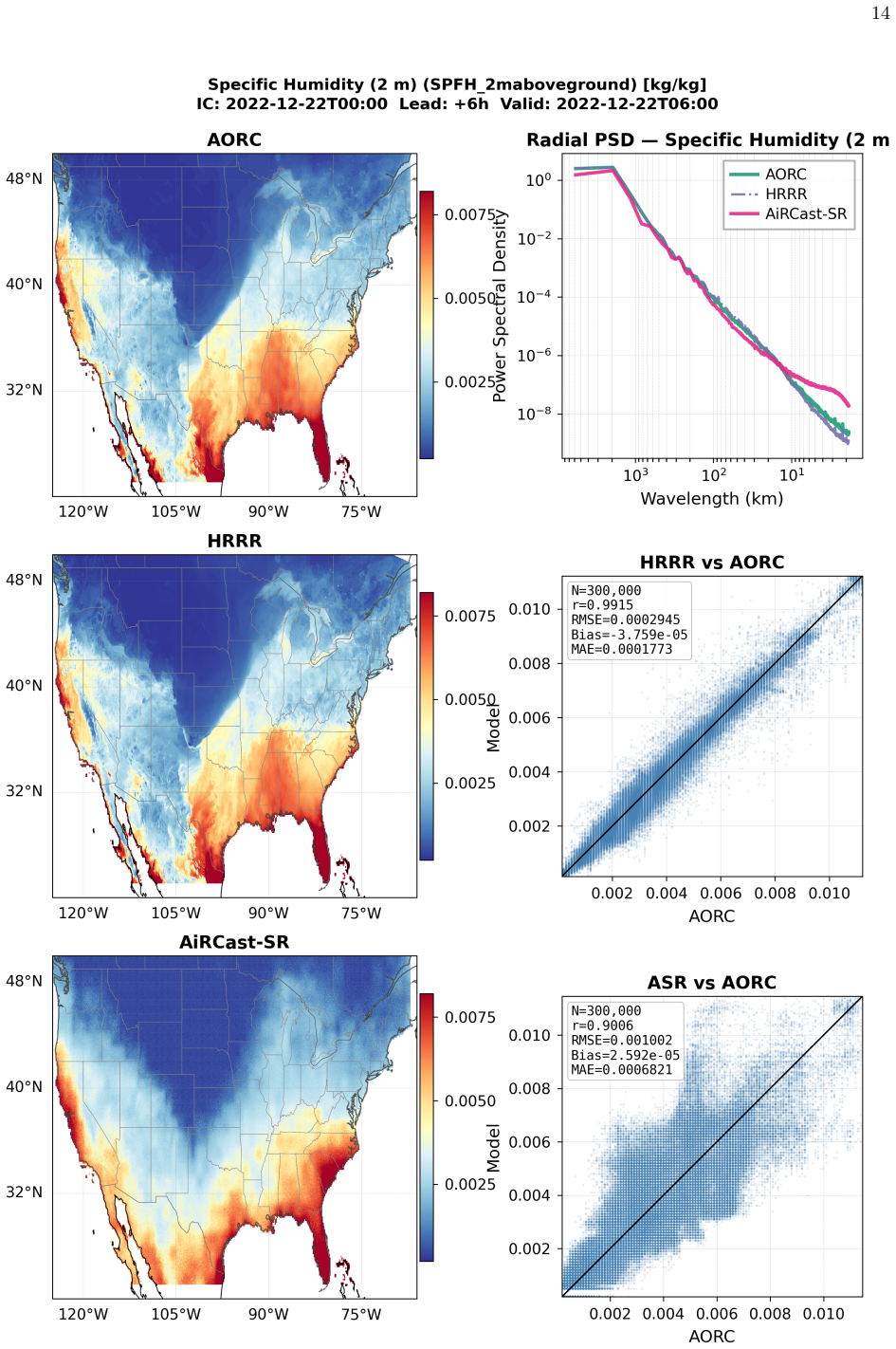
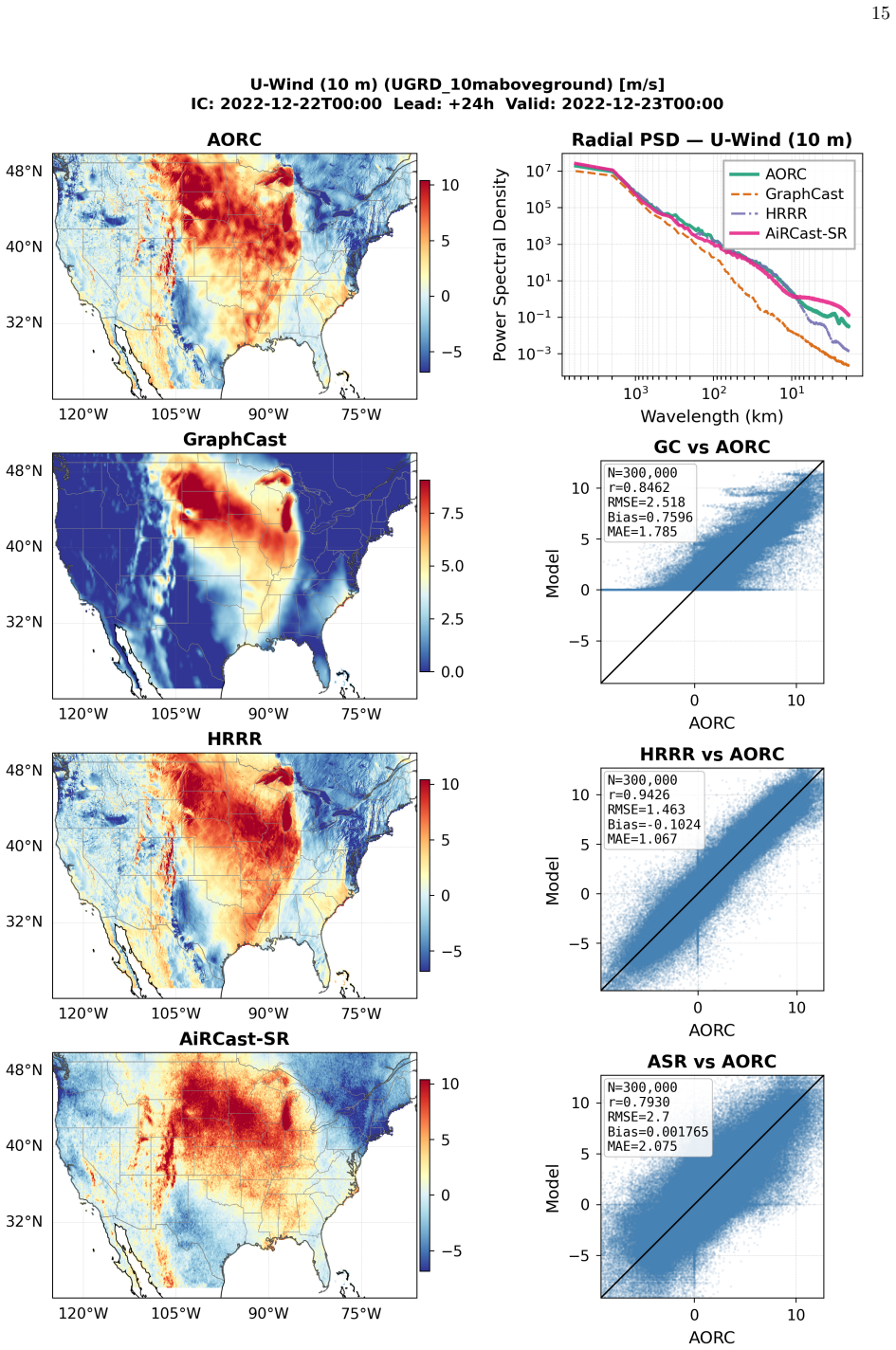
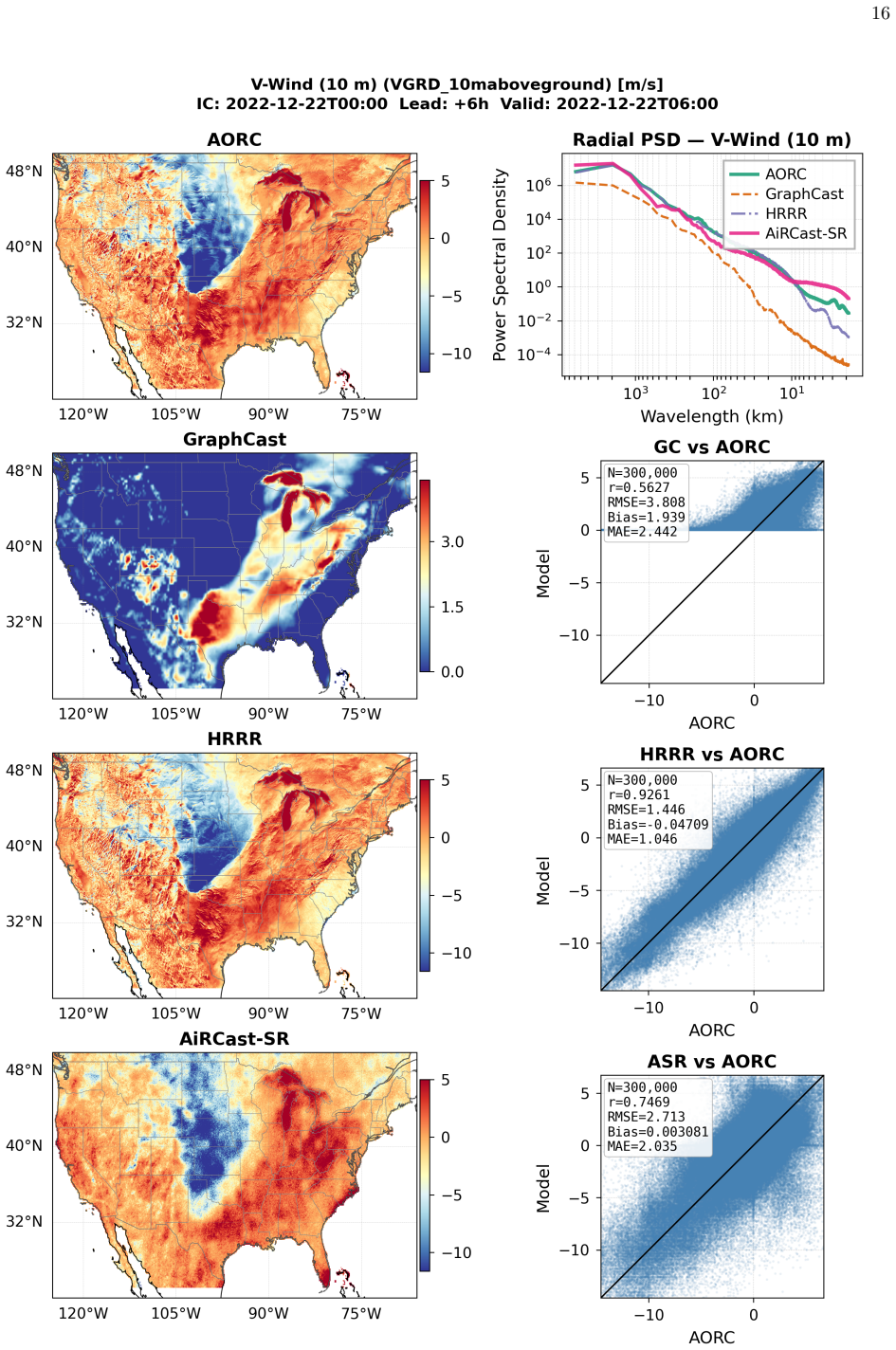
AirCast-SR produces 67-hour forecasts at 1 km resolution from 0.25-degree inputs, achieving near-zero bias across all variables and lead times while its radial power spectral density shows retained energy at 10 km to 100 km wavelengths; the same weights transfer without retraining to independent observations over India and Germany.
What carries the argument
Three-dimensional U-Net conditioned inside a Latent Consistency Model diffusion framework, trained patch-wise on GraphCast inputs against high-resolution analysis targets.
If this is right
- Kilometer-scale surface forecasts become computationally accessible for energy, agriculture, and hazard applications.
- Zero-shot transfer removes the need for region-specific retraining when moving to new continents.
- Open weights enable downstream fine-tuning or distillation for specialized regional services.
- Hourly coupled variables allow consistent multi-variable inputs for impact models.
Where Pith is reading between the lines
- The same diffusion setup could be tested on ensemble inputs to produce high-resolution uncertainty estimates.
- Extension to additional variables such as precipitation or upper-air fields would broaden downstream use cases.
- Longer training on more seasons might reduce any remaining seasonal dependence without changing the zero-shot claim.
Load-bearing premise
The high-resolution analysis used for training accurately represents true atmospheric states at 1 km scale and the learned mapping generalizes to new regions and seasons.
What would settle it
Independent 1 km or station observations in a new region or season that show either systematic bias in any variable or loss of spectral power between 10 km and 100 km wavelengths.
Figures
read the original abstract
Operational weather prediction at kilometer scales remains computationally prohibitive for traditional numerical weather prediction (NWP) models, limiting forecast access for applications in energy, agriculture, and disaster management that require fine-grained spatiotemporal detail. Here we introduce AirCast-SR, a foundation model for atmospheric super-resolution that downscales global AI weather forecasts from 0.25 degree (~28 km) to 1 km horizontal resolution at hourly temporal resolution, producing 67-hour forecasts of eight coupled surface variables simultaneously. EarthMind-SR employs a three-dimensional U-Net conditioned within a Latent Consistency Model (LCM) diffusion framework, trained on patch-based samples over the contiguous United States (CONUS) using GraphCast forecasts as input and NOAA's Analysis of Record for Calibration (AORC) as the target. The model achieves near-zero bias across all variables and lead times, and its radial power spectral density analysis demonstrates preservation of fine-scale atmospheric structure at wavelengths of 10 km to 100 km where coarser models lose spectral power. We validate EarthMind-SR across three CONUS case studies spanning winter, summer, and spring seasons, and demonstrate zero-shot global transferability over India and Germany using independent surface station observations without any retraining or fine-tuning. As an open-weights foundation model, EarthMind-SR establishes a new paradigm for kilometer-scale AI weather prediction and provides a platform for regional fine-tuning, distillation, and downstream applications in climate services and hazard forecasting.
Editorial analysis
A structured set of objections, weighed in public.
Referee Report
Summary. The manuscript presents AirCast-SR (internally also called EarthMind-SR), a foundation model using a 3D U-Net conditioned in a Latent Consistency Model (LCM) diffusion framework to downscale global AI weather forecasts (e.g. GraphCast) from 0.25° (~28 km) to 1 km horizontal resolution at hourly steps for 67-hour forecasts of eight coupled surface variables. Trained patch-wise over CONUS with GraphCast inputs and NOAA AORC targets, it claims near-zero bias across variables and lead times, preservation of 10-100 km scale structure via radial power spectral density analysis, validation on three CONUS seasonal case studies, and zero-shot transfer to India and Germany validated solely on independent surface station observations without retraining or fine-tuning.
Significance. If the performance and generalization claims hold with full-field verification, the work would be significant as an open-weights foundation model enabling efficient kilometer-scale atmospheric prediction globally, with potential impact on energy, agriculture, and hazard applications. The LCM efficiency and spectral analysis approach are strengths that could support downstream fine-tuning.
major comments (2)
- [Abstract and validation sections] Abstract and validation sections: The zero-shot global transferability to India and Germany is supported only by point-wise surface station observations. These provide temporally limited checks on a subset of variables but cannot confirm spatial structure, radial PSD preservation at 10-100 km wavelengths, or full-field bias in the target domains, leaving the generalization claim unverified given that training used only CONUS patches with AORC targets.
- [Abstract] Abstract: Claims of near-zero bias across all variables and lead times, plus spectral preservation, are stated without quantitative error bars, ablation studies, or training stability details, which reduces confidence that the reported metrics are robust rather than fitted to the CONUS training distribution.
minor comments (1)
- [Title and abstract] Title and abstract: The model name is inconsistent (AirCast-SR in title, EarthMind-SR in body text); this nomenclature error must be corrected throughout for clarity.
Simulated Author's Rebuttal
We thank the referee for their constructive comments. We address each major comment point by point below, indicating planned revisions where appropriate.
read point-by-point responses
-
Referee: [Abstract and validation sections] The zero-shot global transferability to India and Germany is supported only by point-wise surface station observations. These provide temporally limited checks on a subset of variables but cannot confirm spatial structure, radial PSD preservation at 10-100 km wavelengths, or full-field bias in the target domains, leaving the generalization claim unverified given that training used only CONUS patches with AORC targets.
Authors: We agree that point-wise station observations cannot fully verify spatial structure, PSD preservation, or full-field bias outside CONUS. These data do demonstrate consistent low bias on the available variables and lead times. High-resolution gridded targets equivalent to AORC are unavailable for India and Germany, precluding full-field analysis. We will revise the abstract and validation sections to explicitly qualify the zero-shot claims and note this limitation, while retaining the CONUS-based spectral results as the primary evidence of structure preservation. revision: partial
-
Referee: [Abstract] Claims of near-zero bias across all variables and lead times, plus spectral preservation, are stated without quantitative error bars, ablation studies, or training stability details, which reduces confidence that the reported metrics are robust rather than fitted to the CONUS training distribution.
Authors: The results section reports specific near-zero bias values and PSD curves, but we acknowledge the lack of error bars on aggregate statistics. We will add standard deviations or confidence intervals across the three CONUS case studies in the revision. Ablations on the 3D U-Net and LCM components were conducted internally; a concise summary will be added to the methods or supplementary material. Training stability was verified via repeated runs with consistent loss convergence, and we will include a brief description of monitoring procedures. revision: yes
- High-resolution gridded analysis data for India and Germany are unavailable, so full spatial and spectral verification of zero-shot transfer cannot be provided.
Circularity Check
No circularity in derivation chain
full rationale
The paper presents an empirical ML training procedure (U-Net in LCM diffusion framework) on CONUS patches with GraphCast inputs and AORC targets, followed by direct validation on case studies and independent station observations. No equations, derivations, or self-citations are described that reduce performance metrics, PSD preservation, or zero-shot transfer claims to fitted parameters or prior results by construction. The central claims rest on external data comparisons rather than self-referential definitions or renamings.
Axiom & Free-Parameter Ledger
Reference graph
Works this paper leans on
-
[1]
GraphCast: Learning skillful medium- range global weather forecasting,
R. Lam,et al., “GraphCast: Learning skillful medium- range global weather forecasting,”Science,382, 1416– 1421 (2023)
2023
-
[2]
Accurate medium-range global weather forecasting with 3D neural networks,
K. Bi,et al., “Accurate medium-range global weather forecasting with 3D neural networks,”Nature,619, 533– 538 (2023)
2023
-
[3]
FuXi: A cascade machine learning fore- casting system for 15-day global weather forecast,
L. Chen,et al., “FuXi: A cascade machine learning fore- casting system for 15-day global weather forecast,”npj Climate and Atmospheric Science,6, 190 (2023)
2023
-
[4]
AIFS – ECMWF’s data-driven forecast- ing system,
S. Lang,et al., “AIFS – ECMWF’s data-driven forecast- ing system,” arXiv:2406.01465 (2024)
-
[5]
GenCast: Diffusion-based ensemble fore- casting for medium-range weather,
I. Price,et al., “GenCast: Diffusion-based ensemble fore- casting for medium-range weather,”Nature,637, 84–90 (2025)
2025
-
[6]
The quiet rev- olution of numerical weather prediction,
P. Bauer, A. Thorpe, and G. Brunet, “The quiet rev- olution of numerical weather prediction,”Nature,525, 47–55 (2015)
2015
-
[7]
The High-Resolution Rapid Re- fresh (HRRR): An hourly updating convection-allowing forecast model,
D. C. Dowell,et al., “The High-Resolution Rapid Re- fresh (HRRR): An hourly updating convection-allowing forecast model,”Weather and Forecasting,37, 1371–1395 (2022)
2022
-
[8]
Hydrologic implications of dynam- ical and statistical approaches to downscaling climate model outputs,
A. W. Wood,et al., “Hydrologic implications of dynam- ical and statistical approaches to downscaling climate model outputs,”Climatic Change,62, 189–216 (2004)
2004
-
[9]
H. G. Hidalgo,et al., “Downscaling with constructed ana- logues: Daily precipitation and temperature fields over 6 TABLE I. Precipitation skill metrics for 6-hour accumulated precipitation (mm/6h) across the three CONUS case studies. EM = AirCast-SR; HRRR = High-Resolution Rapid Refresh; GC = GraphCast. Bold indicates best performance per metric and lead ...
2022
-
[10]
DeepSD: Generating high resolution climate change projections through single image super- resolution,
T. Vandal,et al., “DeepSD: Generating high resolution climate change projections through single image super- resolution,” inProc. 23rd ACM SIGKDD International Conference on Knowledge Discovery and Data Mining (KDD), 1663–1672 (2017)
2017
-
[11]
Deep-learning-based gridded downscal- ing of surface meteorological variables in complex terrain. Part I: Daily maximum and minimum 2-m temperature,
Y. Sha,et al., “Deep-learning-based gridded downscal- ing of surface meteorological variables in complex terrain. Part I: Daily maximum and minimum 2-m temperature,” Journal of Applied Meteorology and Climatology,59(12), 2057–2073 (2020)
2057
-
[12]
Deep learning for daily precipitation and temperature downscaling,
F. Wang,et al., “Deep learning for daily precipitation and temperature downscaling,”Water Resources Re- search,57, e2020WR029308 (2021)
2021
-
[13]
Adversarial super-resolution of clima- tological wind and solar data,
K. Stengel,et al., “Adversarial super-resolution of clima- tological wind and solar data,”Proc. National Academy of Sciences,117, 16805–16815 (2020)
2020
-
[14]
A generative deep learning approach to stochastic downscaling of precipitation forecasts,
L. Harris,et al., “A generative deep learning approach to stochastic downscaling of precipitation forecasts,” Journal of Advances in Modeling Earth Systems,14, e2022MS003120 (2022)
2022
-
[15]
Residual corrective diffusion mod- eling for km-scale atmospheric downscaling,
M. Mardani,et al., “Residual corrective diffusion mod- eling for km-scale atmospheric downscaling,”Communi- cations Earth & Environment,6, 124 (2025); preprint at arXiv:2309.15214 (2023)
-
[16]
Denoising diffusion probabilistic models,
J. Ho,et al., “Denoising diffusion probabilistic models,” inAdvances in Neural Information Processing Systems, 33, 6840–6851 (2020)
2020
-
[17]
Score-based generative modeling through stochastic differential equations,
Y. Song,et al., “Score-based generative modeling through stochastic differential equations,” inProc. ICLR (2021)
2021
-
[18]
U-Net: Convolutional networks for biomedical image segmentation,
O. Ronneberger,et al., “U-Net: Convolutional networks for biomedical image segmentation,” inProc. MICCAI, 234–241 (2015)
2015
-
[19]
3D U-Net: Learning dense volumetric segmentation from sparse annotation,
¨O. C ¸ i¸ cek,et al., “3D U-Net: Learning dense volumetric segmentation from sparse annotation,” inProc. MICCAI, 424–432 (2016)
2016
-
[20]
Latent Consistency Models: Synthesizing High-Resolution Images with Few-Step Inference
S. Luo,et al., “Latent consistency models: Synthe- sizing high-resolution images with few-step inference,” arXiv:2310.04378 (2023)
work page internal anchor Pith review Pith/arXiv arXiv 2023
-
[21]
Analysis of Record for Calibration (AORC), version 1.1,
NOAA Office of Water Prediction, “Analysis of Record for Calibration (AORC), version 1.1,”https: //hydrology.nws.noaa.gov/aorc-historic/(2023). 7 TABLE III. Surface pressure skill metrics (Pa) across three CONUS case studies. EM = AirCast-SR. Boldrindicates best correlation per lead time; bold Bias indicates smallest absolute bias. Dec 2022 (Winter) Jun 2...
-
[22]
Introducing Hann windows for reducing edge-effects in patch-based image segmenta- tion,
N. Pielawski and C. W¨ ahlby, “Introducing Hann windows for reducing edge-effects in patch-based image segmenta- tion,”PLoS ONE,15, e0229839 (2020)
2020
-
[23]
StationBench: Surface station benchmark for AI weather models,
ECMWF, “StationBench: Surface station benchmark for AI weather models,” software repository,https:// github.com/ecmwf-lab/stationbench(accessed 2024)
2024
-
[24]
Can deep learning beat numer- ical weather prediction?,
M. G. Schultz,et al., “Can deep learning beat numer- ical weather prediction?,”Phil. Trans. R. Soc. A,379, 20200097 (2021)
2021
-
[25]
The perception–distortion tradeoff,
Y. Blau and T. Michaeli, “The perception–distortion tradeoff,” inProc. IEEE/CVF Conf. Computer Vision and Pattern Recognition (CVPR), 6228–6237 (2018)
2018
-
[26]
Con- sistency models,
Y. Song, P. Dhariwal, M. Chen, and I. Sutskever, “Con- sistency models,” inProc. International Conference on Machine Learning (ICML)(2023). 8 TABLE V. Downward longwave radiation skill metrics (W m−2) across three CONUS case studies. EM = AirCast-SR. Boldr indicates best correlation per lead time; bold Bias indicates smallest absolute bias. Dec 2022 (Wint...
2023
discussion (0)
Sign in with ORCID, Apple, or X to comment. Anyone can read and Pith papers without signing in.