Bimodality in Rotational Modulation of Planet-Hosting Stars
Pith reviewed 2026-06-29 20:15 UTC · model grok-4.3
The pith
Stars with confirmed exoplanets show a bimodal distribution in rotational modulation dispersion unlike stars without planets.
A machine-rendered reading of the paper's core claim, the machinery that carries it, and where it could break.
Core claim
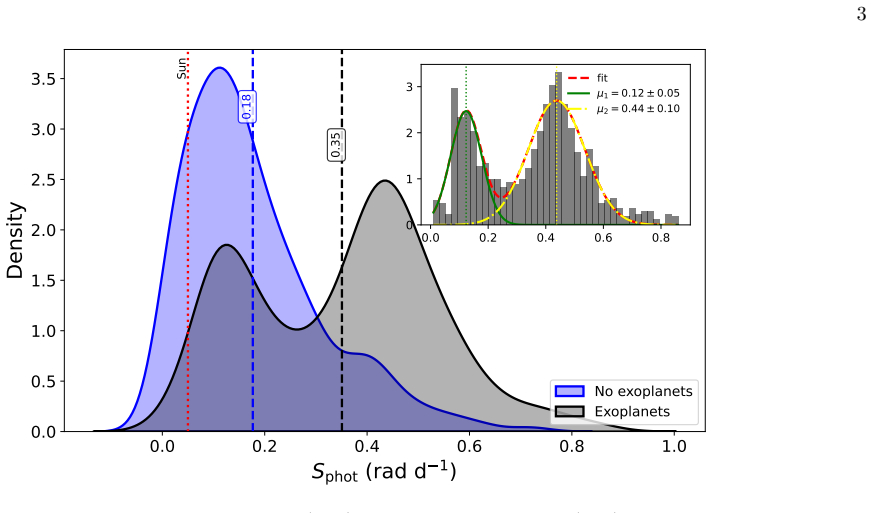
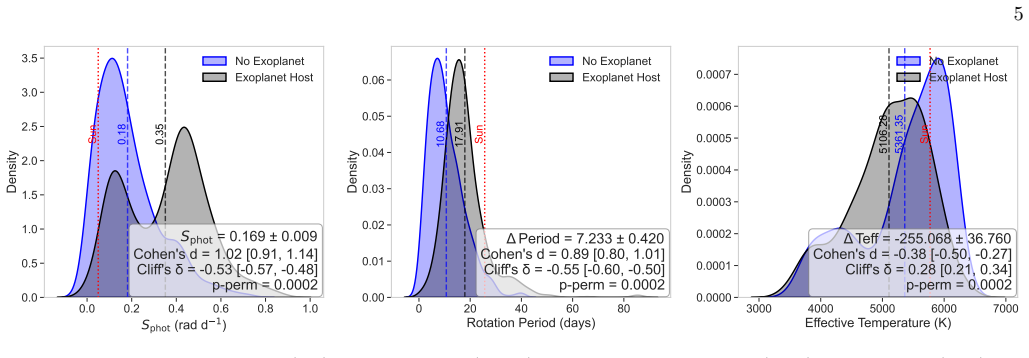
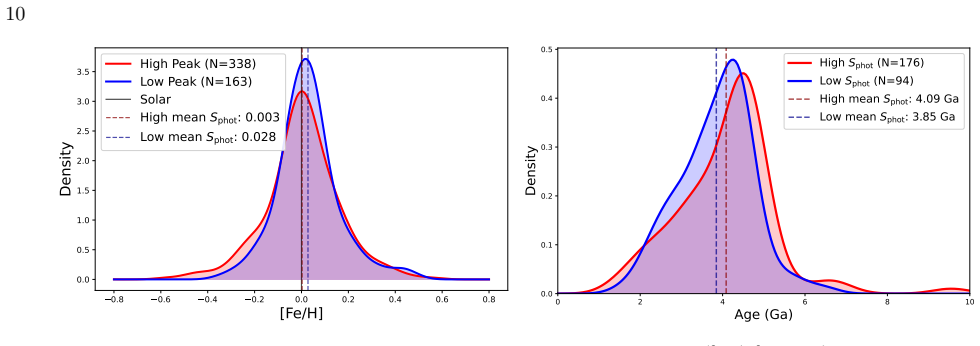
Stars hosting confirmed exoplanets exhibit systematically enhanced S_phot values compared to stars without detected planets (ΔS_phot=0.17 ± 0.01 rad d^{-1}; p<10^{-25}) and the S_phot distribution of planet hosts is bimodal with peaks at 0.12 and 0.44 rad d^{-1} (Hartigan's Dip Test p<10^{-6}; ΔBIC=188.7), a feature absent in the control sample. We interpret S_phot as a proxy for rotational modulation dispersion, reflecting spot evolution rather than true differential rotation. The two regimes correspond to stable magnetic coherence with long-lived active regions and rapidly evolving activity patterns. The presence of these distinct regimes exclusively among planet-hosting stars suggests tha
What carries the argument
S_phot, the photometric proxy of rotational modulation dispersion that traces the temporal coherence of surface magnetic features and distinguishes stable versus rapidly evolving activity patterns.
If this is right
- Planet-hosting stars fall into two distinct groups: one with long-lived coherent active regions and one with rapidly changing magnetic features.
- The bimodality is absent in stars without detected planets, indicating the effect is tied to the presence of planets.
- Planetary systems can indirectly organize stellar magnetic activity and influence the underlying dynamo processes.
Where Pith is reading between the lines
- Analyses of TESS or other photometric surveys could check whether the bimodality appears in independent samples of planet hosts.
- Stellar evolution models that omit planetary companions may need revision if magnetic activity patterns depend on planet presence.
- Correlations between planet mass, orbital distance, or multiplicity and the specific S_phot peak could be tested in larger datasets.
Load-bearing premise
The control sample of stars without detected planets is statistically comparable to the planet-host sample in all properties that could affect S_phot such as stellar type, age, or activity level.
What would settle it
Observing the same bimodal S_phot distribution in a control sample of non-planet stars selected to match the planet-host sample in stellar properties would show the bimodality is unrelated to planetary presence.
Figures
read the original abstract
Stellar magnetic activity is governed by the interplay between rotation, convection, and the evolution of surface magnetic structures, yet the role of planetary systems in shaping these processes remains uncertain. Here, we analyze \textit{Kepler} photometry of more than 1,300 stars to investigate rotational modulation in stars with and without confirmed exoplanets. Using a time--frequency analysis, we measure the photometric proxy of rotational modulation dispersion, $S_{\rm phot}$, tracing the temporal coherence of surface magnetic features. Stars hosting confirmed exoplanets exhibit systematically enhanced $S_{\rm phot}$ values compared to stars without detected planets ($\Delta S_{\rm phot}=0.17 \pm 0.01$ rad d$^{-1}$; $p<10^{-25}$). More importantly, the $S_{\rm phot}$ distribution of planet hosts is bimodal, with peaks at $0.12$ and $0.44$ rad d$^{-1}$ (Hartigan's Dip Test $p<10^{-6}$; $\Delta \mathrm{BIC}=188.7$), a feature absent in the control sample. We interpret $S_{\rm phot}$ as a proxy for rotational modulation dispersion, reflecting spot evolution rather than true differential rotation. The two regimes correspond to stable magnetic coherence with long-lived active regions and rapidly evolving activity patterns. The presence of these distinct regimes exclusively among planet-hosting stars suggests that planetary systems may influence the temporal organization of stellar magnetic activity and indirectly affect stellar dynamos.
Editorial analysis
A structured set of objections, weighed in public.
Referee Report
Summary. The paper analyzes Kepler photometry for more than 1,300 stars and reports that planet-hosting stars exhibit systematically higher values of the photometric rotational modulation dispersion S_phot than a control sample of stars without detected planets (ΔS_phot = 0.17 ± 0.01 rad d^{-1}, p < 10^{-25}). It further claims that the S_phot distribution for planet hosts is bimodal with peaks at 0.12 and 0.44 rad d^{-1} (Hartigan's Dip Test p < 10^{-6}, ΔBIC = 188.7), a feature absent in the control sample, and interprets this as evidence that planetary systems influence the temporal organization of stellar magnetic activity through effects on spot evolution.
Significance. If the control sample is shown to be properly matched on stellar parameters that affect S_phot, the result would provide quantitative evidence for a novel coupling between exoplanetary systems and stellar dynamos, potentially affecting interpretations of activity proxies in exoplanet searches. The large sample size and use of specific statistical tests (Hartigan dip test and BIC comparison) are strengths that would make the finding impactful in astro-ph.SR if the attribution to planets is robust.
major comments (3)
- [Abstract (and sample construction section)] The manuscript provides no description of how the control sample was constructed or matched to the planet-host sample on covariates known to correlate with S_phot, such as effective temperature, surface gravity, rotation period, or age. This omission is load-bearing for the central claim in the abstract that the enhancement and bimodality can be attributed to the presence of planets rather than selection or detection biases.
- [Statistical comparison and interpretation sections] The reported ΔS_phot offset and exclusive bimodality in the planet-host sample rest on the assumption that the two samples are statistically comparable in all properties affecting S_phot; without explicit matching, re-weighting, or regression controls for these confounders, the p-values and BIC difference cannot support the causal interpretation.
- [Interpretation paragraph] The interpretation that the two S_phot regimes reflect stable vs. rapidly evolving magnetic features, and that this organization is influenced by planets, depends on the bimodality being absent in a properly matched control; the current analysis leaves open the possibility that the observed separation arises from planet-detection efficiency depending on photometric variability or stellar type.
minor comments (1)
- [Abstract] The units of S_phot are stated as rad d^{-1}, but a brief reminder of its definition as a time-frequency dispersion measure would improve clarity for readers unfamiliar with the proxy.
Simulated Author's Rebuttal
We thank the referee for the thorough and constructive report. The comments correctly identify that the manuscript lacks explicit details on control-sample construction and does not apply covariate matching or regression adjustment. We will revise the sample-construction section, add matched-subsample and regression analyses, and moderate the causal language while preserving the reported statistical results. Point-by-point responses follow.
read point-by-point responses
-
Referee: [Abstract (and sample construction section)] The manuscript provides no description of how the control sample was constructed or matched to the planet-host sample on covariates known to correlate with S_phot, such as effective temperature, surface gravity, rotation period, or age. This omission is load-bearing for the central claim in the abstract that the enhancement and bimodality can be attributed to the presence of planets rather than selection or detection biases.
Authors: We agree that a clear description of control-sample selection is required. The control sample was drawn from the Kepler Input Catalog by selecting stars observed in the same quarters with no confirmed planets, applying the same magnitude and data-quality cuts as the planet-host sample. No explicit one-to-one matching on Teff, log g, Prot or age was performed. In revision we will expand the methods section with the exact selection criteria, provide comparative histograms of the key covariates, and add a propensity-score-matched subsample analysis to test whether the reported ΔS_phot and bimodality persist. revision: yes
-
Referee: [Statistical comparison and interpretation sections] The reported ΔS_phot offset and exclusive bimodality in the planet-host sample rest on the assumption that the two samples are statistically comparable in all properties affecting S_phot; without explicit matching, re-weighting, or regression controls for these confounders, the p-values and BIC difference cannot support the causal interpretation.
Authors: The Hartigan dip test and BIC comparison were performed on the raw distributions. We acknowledge that unadjusted p-values and ΔBIC do not by themselves establish causality. In the revised manuscript we will (i) repeat the bimodality tests on a covariate-balanced subsample and (ii) report linear-regression results that include Teff, log g and Prot as covariates. The language in the interpretation section will be changed from “suggests that planetary systems may influence” to “is consistent with an association that warrants further investigation after accounting for stellar-parameter differences.” revision: yes
-
Referee: [Interpretation paragraph] The interpretation that the two S_phot regimes reflect stable vs. rapidly evolving magnetic features, and that this organization is influenced by planets, depends on the bimodality being absent in a properly matched control; the current analysis leaves open the possibility that the observed separation arises from planet-detection efficiency depending on photometric variability or stellar type.
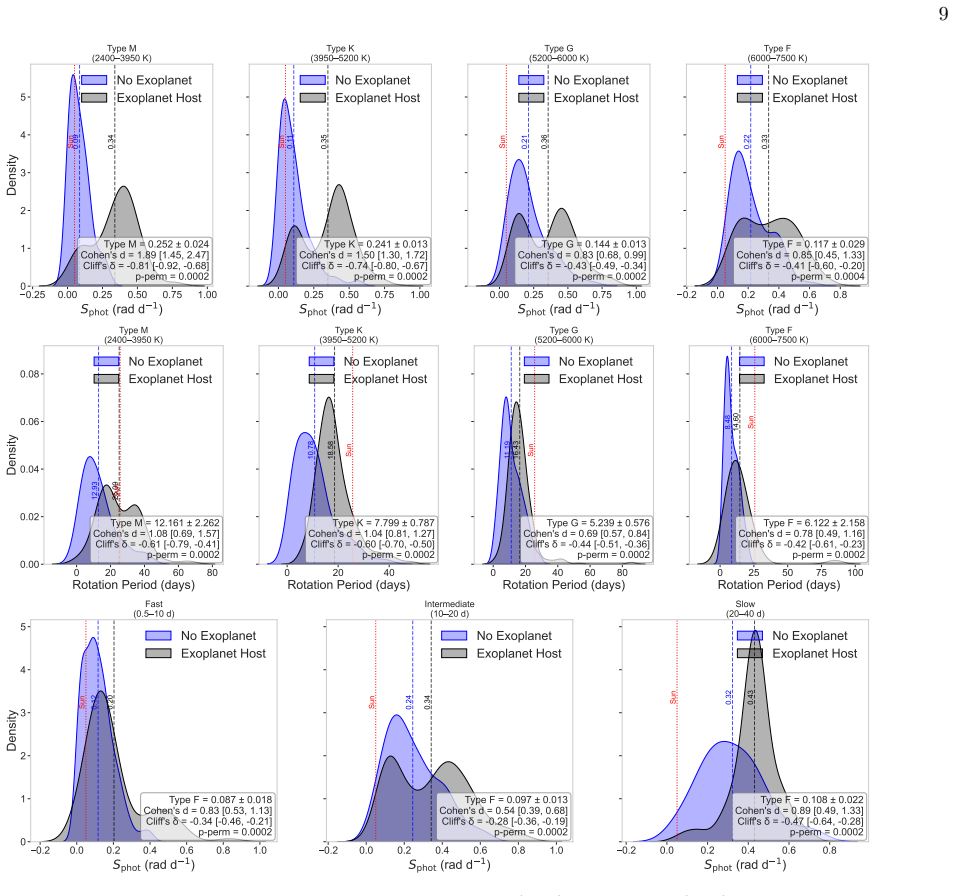
Authors: The two-regime interpretation is offered as a possible physical reading of the exclusive bimodality, not as a demonstrated causal mechanism. We will add an explicit paragraph discussing transit and RV detection biases that could correlate with photometric variability. We will also stratify the S_phot distributions by Teff bins and by rotation-period range to test whether the bimodality signature remains. A fully exhaustive exclusion of all selection effects is not possible with the present Kepler data alone; this limitation will be stated. revision: partial
Circularity Check
No significant circularity; analysis is direct statistical comparison of observed quantities.
full rationale
The paper reports measurements of S_phot from Kepler photometry via time-frequency analysis, followed by direct statistical tests (mean difference, Hartigan's dip test, BIC comparison) between planet-host and control samples. No equations, derivations, or fitted parameters are presented that reduce the reported bimodality or offset to inputs by construction. The central claims rest on observational data splits and standard statistical tests rather than any self-referential modeling step. This matches the default expectation of a non-circular empirical study.
Axiom & Free-Parameter Ledger
axioms (2)
- domain assumption S_phot traces temporal coherence of surface magnetic features rather than true differential rotation.
- domain assumption The control sample provides a valid baseline free of planet-induced effects.
Reference graph
Works this paper leans on
-
[1]
2015, MNRAS, 450, 3211, doi: 10.1093/mnras/stv853 Ara´ ujo, A., & Valio, A
Aigrain, S., Llama, J., Ceillier, T., et al. 2015, MNRAS, 450, 3211, doi: 10.1093/mnras/stv853 Ara´ ujo, A., & Valio, A. 2021, The Astrophysical Journal Letters, 922, L23
-
[2]
A., & Abedigamba, O
Balona, L. A., & Abedigamba, O. P. 2016, Monthly Notices of the Royal Astronomical Society, 461, 497
2016
-
[3]
2020,The Astrophysical Journal, 901, 14, doi: 10.3847/1538-4357/abae5d
Basri, G., & Shah, R. 2020,The Astrophysical Journal, 901, 14, doi: 10.3847/1538-4357/abae5d
-
[4]
2020, The Astrophysical Journal, 901, 14
Basri, G., & Shah, R. 2020, The Astrophysical Journal, 901, 14
2020
-
[5]
2022, The Astrophysical Journal, 924, 31
Basri, G., Streichenberger, T., McWard, C., et al. 2022, The Astrophysical Journal, 924, 31
2022
-
[6]
Basri, G., Walkowicz, L. M., Batalha, N., et al. 2011, AJ, 141, 20, doi: 10.1088/0004-6256/141/1/20
-
[7]
Berdyugina, S. V. 2005, Living Reviews in Solar Physics, 2, 8
2005
-
[8]
J., Koch, D., Basri, G., et al
Borucki, W. J., Koch, D., Basri, G., et al. 2010, Science, 327, 977
2010
-
[9]
Living Reviews in Solar Physics , keywords =
Brun, A. S., & Browning, M. K. 2017, Living Reviews in Solar Physics, 14, 4, doi: 10.1007/s41116-017-0007-8
-
[10]
R., von Braun, K., Bryden, G., et al
Ciardi, D. R., von Braun, K., Bryden, G., et al. 2011, AJ, 141, 108, doi: 10.1088/0004-6256/141/4/108
-
[11]
Cuntz, M., Saar, S. H., & Musielak, Z. E. 2000, ApJL, 533, L151, doi: 10.1086/312609
-
[12]
Gilliland, R. L., Chaplin, W. J., Dunham, E. W., et al. 2011, ApJS, 197, 6, doi: 10.1088/0067-0049/197/1/6
-
[13]
Nonparametric regression analysis of growth curves
Hartigan, J. A., & Hartigan, P. M. 1985, The Annals of Statistics, 13, 70 , doi: 10.1214/aos/1176346577
-
[14]
Kitchatinov, L. L., & Olemskoy, S. V. 2011, MNRAS, 411, 1059, doi: 10.1111/j.1365-2966.2010.17737.x
-
[15]
A., Howard, A
Knutson, H. A., Howard, A. W., & Isaacson, H. 2010, The Astrophysical Journal, 720, 1569 K¨ uker, M., R¨ udiger, G., & Kitchatinov, L. 2011, Astronomy & Astrophysics, 530, A48
2010
-
[16]
2008, Astronomy & Astrophysics, 487, 1163
Lanza, A. 2008, Astronomy & Astrophysics, 487, 1163
2008
-
[17]
2014, The Astrophysical Journal Supplement Series, 211, 24
McQuillan, A., Mazeh, T., & Aigrain, S. 2014, The Astrophysical Journal Supplement Series, 211, 24
2014
-
[18]
2020, Monthly Notices of the Royal Astronomical Society, 491, 4481
Osborn, A., & Bayliss, D. 2020, Monthly Notices of the Royal Astronomical Society, 491, 4481
2020
-
[19]
2003, A&A Rv, 11, 287, doi: 10.1007/s00159-003-0019-3
Ossendrijver, M. 2003, A&A Rv, 11, 287, doi: 10.1007/s00159-003-0019-3
-
[20]
Parker, E. N. 1955, ApJ, 122, 293, doi: 10.1086/146087
-
[21]
S., Bellotti, S., Villadsen, J., et al
Pineda, J. S., Bellotti, S., Villadsen, J., et al. 2026, ApJ, 997, 172, doi: 10.3847/1538-4357/ae2619
-
[22]
Shkolnik, E., Walker, G. A. H., & Bohlender, D. A. 2003, ApJ, 597, 1092, doi: 10.1086/378583
-
[23]
2016, ApJ, 833, 140, doi: 10.3847/1538-4357/833/2/140
Strugarek, A. 2016, ApJ, 833, 140, doi: 10.3847/1538-4357/833/2/140
-
[24]
Vidotto, A. 2025, Annual Review of Astronomy and Astrophysics, 63 9 /uni00000013/uni00000011/uni00000015/uni00000018 /uni00000013/uni00000011/uni00000013/uni00000013/uni00000013/uni00000011/uni00000015/uni00000018/uni00000013/uni00000011/uni00000018/uni00000013/uni00000013/uni00000011/uni0000001a/uni00000018/uni00000014/uni00000011/uni00000013/uni00000013...
2025
discussion (0)
Sign in with ORCID, Apple, or X to comment. Anyone can read and Pith papers without signing in.