The Persistent Missing Mass Problem in Planet Formation
Pith reviewed 2026-06-29 20:19 UTC · model grok-4.3
The pith
T Tauri disks lack sufficient mass to form all known planets when free-floating microlensing planets are included.
A machine-rendered reading of the paper's core claim, the machinery that carries it, and where it could break.
Core claim
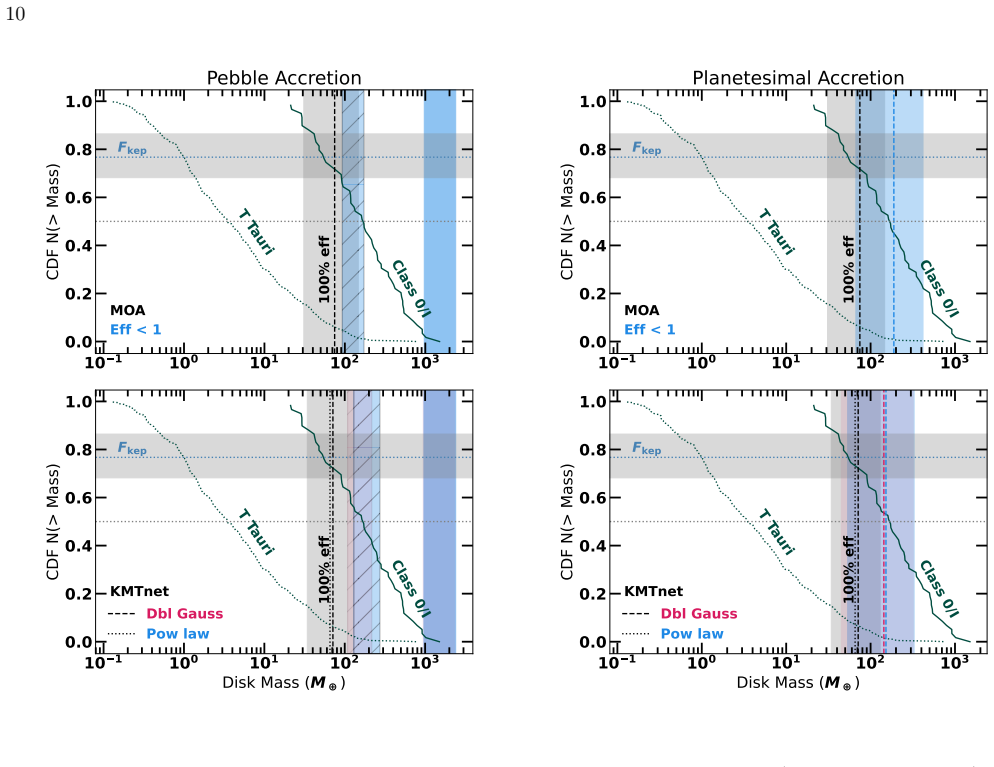
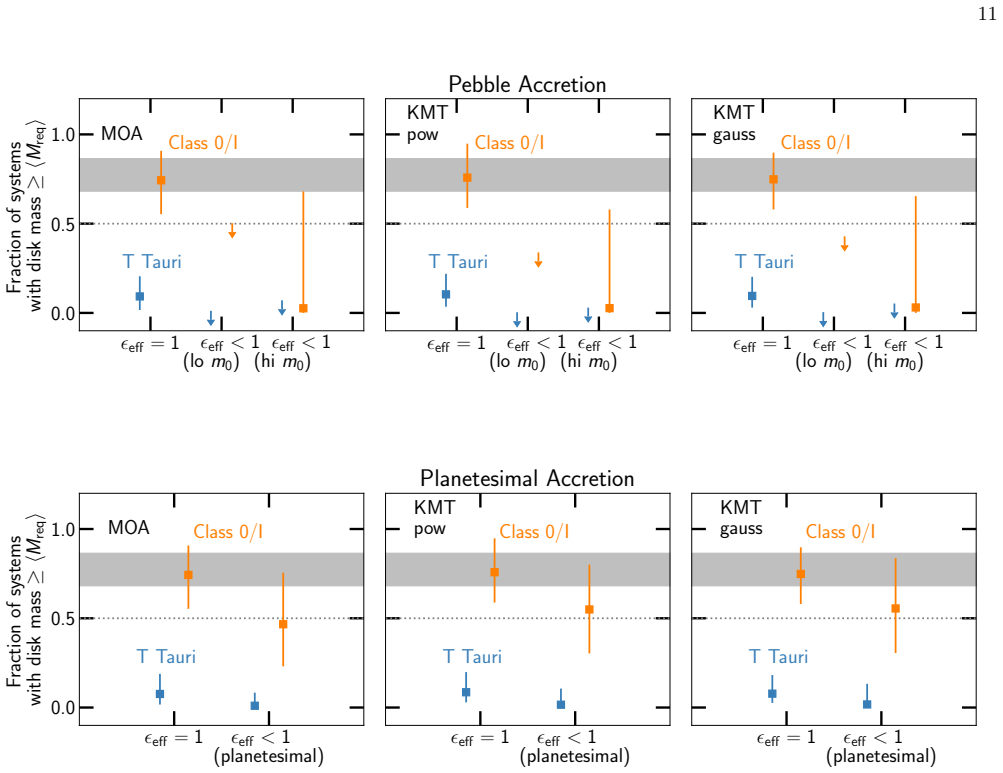
When the microlensing planets, both bound and free-floating, are taken into account, along with the short-period planets, T Tauri disks have insufficient mass to source the mass of known planets, even if all the solids convert into planetary bodies. Younger Class 0/I disks can help resolve the problem but generally fall short of the required mass when variable planet formation efficiency from pebble or planetesimal accretion is taken into consideration. If the free-floating planet mass function is as bottom-heavy as reported, heavier Class 0/I disks may be necessary. Alternatively, free-floaters may preferentially form in the most massive disks around massive stars consuming the majority of
What carries the argument
Comparison between the integrated mass from the microlensing-derived planet mass function and the solid mass reservoirs in T Tauri versus Class 0/I disks under varying conversion efficiencies.
If this is right
- Verifying a bottom-heavy free-floating planet mass function would indicate that standard disk mass budgets cannot supply the observed planets.
- Heavier Class 0/I disks would be required to close the mass gap.
- Preferential formation of free-floaters in the most massive disks around high-mass stars would produce the observed drop in bound planet occurrence rates with increasing stellar mass.
- A peaked rather than bottom-heavy planet mass function could remove the discrepancy entirely.
Where Pith is reading between the lines
- The result would force planet formation theory to identify additional mass sources or formation channels beyond the initial disk solids.
- Disk mass surveys stratified by stellar mass could directly test whether the most massive disks are depleted by free-floating planet formation.
- Refined constraints on the low-mass end of the planet mass function would determine whether the missing-mass issue is real or an artifact of the current bottom-heavy slope.
Load-bearing premise
Microlensing surveys correctly measure a bottom-heavy free-floating planet mass function at the level of about 21 planets per star, and all planetary mass must come from the solids initially present in the disks with no significant external supply.
What would settle it
Improved microlensing statistics or direct imaging that shows the average number of free-floating planets per star is substantially below 21, or measurements of Class 0/I disk solid masses that comfortably exceed the total planetary mass budget.
Figures
read the original abstract
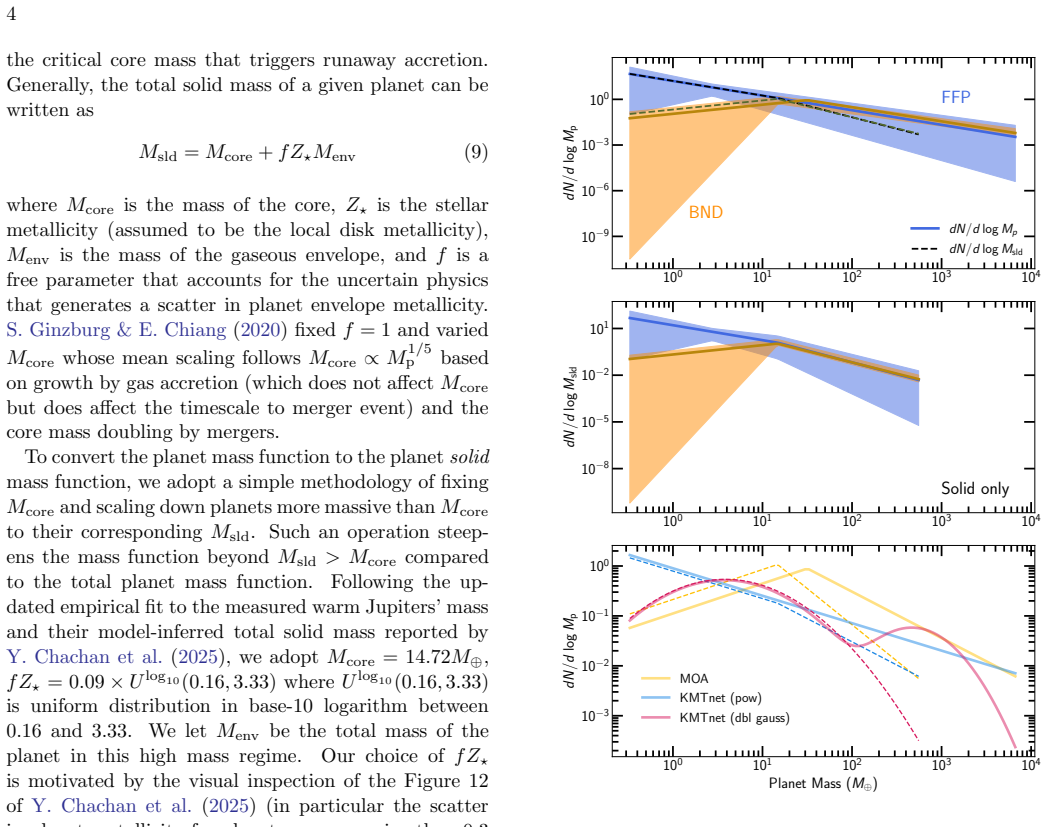
Recent ground-based microlensing surveys suggest that our Galaxy may abound with small free floating planets, potentially up to $\sim$21 such planets per star. We explore the implication of such possibility on the mass budget for planet formation. When the microlensing planets, both bound and free-floating, are taken into account, along with the short-period planets, T Tauri disks have insufficient mass to source the mass of known planets, even if all the solids convert into planetary bodies. Younger Class 0/I disks can help resolve the problem but generally fall short of the required mass when variable planet formation efficiency from pebble or planetesimal accretion is taken into consideration. If the free-floating planet mass function is as bottom-heavy as reported, heavier Class 0/I disks may be necessary. Alternatively, free-floaters may preferentially form in the most massive disks around massive stars consuming the majority of the mass budget, leading to a decrease in the bound planet occurrence rate for higher mass stars, which is observed. Precise constraints on the bottom of planet mass function are necessary: a peaked mass function may eliminate the missing mass problem; by contrast, verifying a bottom-heavy function could spell a crisis in planet formation.
Editorial analysis
A structured set of objections, weighed in public.
Referee Report
Summary. The manuscript argues that incorporating the high occurrence rate of free-floating planets (~21 per star) inferred from microlensing surveys, together with bound planets from microlensing and short-period planets from other surveys, produces a total planetary mass budget that exceeds the solid mass available in typical T Tauri disks even under the assumption of 100% conversion efficiency. It examines whether Class 0/I disks, variable pebble/planetesimal accretion efficiencies, or a non-uniform distribution of planet formation across disk masses could resolve the tension, and notes that a bottom-heavy mass function would worsen the discrepancy while a peaked function might eliminate it.
Significance. If the microlensing occurrence rates and mass function shape are confirmed, the work identifies a quantitative tension between observed planet masses and protoplanetary disk solid budgets that would require either substantially more massive initial disks or formation channels not captured by standard models. The manuscript explicitly conditions its conclusions on the input observational datasets, flags the alternative of preferential formation in the most massive disks (consistent with the observed decline in bound-planet occurrence around higher-mass stars), and correctly identifies the low-mass end of the planet mass function as the decisive observational test.
major comments (2)
- [Abstract and §1] The central quantitative claim (insufficient disk mass even at 100% efficiency) is presented in the abstract and introduction without an explicit display of the mass integrals, the adopted planet mass function parameters, the disk mass distributions, or the error propagation. A dedicated methods or appendix section showing these steps is required for independent verification of the shortfall magnitude.
- [§3] The comparison between total planetary mass and disk solid mass assumes that all planetary mass originates from the solids initially present in the disks. While the text notes possible alternatives, the manuscript should quantify the minimum external mass supply or additional formation channel efficiency that would be needed to close the gap under the reported microlensing rates.
minor comments (2)
- [Abstract] The numerical value ~21 planets per star is stated without a direct citation to the specific microlensing survey paper or table from which it is taken.
- [§2] Notation for disk masses (e.g., M_disk vs. M_solid) should be defined consistently in the first use to avoid ambiguity when efficiency factors are introduced.
Simulated Author's Rebuttal
We thank the referee for their constructive comments and recommendation for minor revision. We address each major comment below.
read point-by-point responses
-
Referee: [Abstract and §1] The central quantitative claim (insufficient disk mass even at 100% efficiency) is presented in the abstract and introduction without an explicit display of the mass integrals, the adopted planet mass function parameters, the disk mass distributions, or the error propagation. A dedicated methods or appendix section showing these steps is required for independent verification of the shortfall magnitude.
Authors: We agree that the quantitative steps should be presented more explicitly for reproducibility. In the revised manuscript we will add a dedicated Appendix (or expanded Methods section) that displays the mass integrals, the adopted planet mass function parameters (slope, normalization, and cutoffs drawn from the microlensing surveys), the input disk mass distributions (T Tauri and Class 0/I), and the error propagation. This addition will allow independent verification of the reported shortfall. revision: yes
-
Referee: [§3] The comparison between total planetary mass and disk solid mass assumes that all planetary mass originates from the solids initially present in the disks. While the text notes possible alternatives, the manuscript should quantify the minimum external mass supply or additional formation channel efficiency that would be needed to close the gap under the reported microlensing rates.
Authors: The manuscript already discusses Class 0/I disks, variable accretion efficiencies, and preferential formation in the most massive disks as possible resolutions. We acknowledge, however, that an explicit quantification of the minimum external mass supply (or required efficiency boost) needed to close the gap would strengthen the section. We will revise §3 to include such estimates, expressed as the additional mass factor or efficiency multiplier required under the reported microlensing occurrence rates, while retaining the conditioning on the input datasets. revision: yes
Circularity Check
No significant circularity; independent observational comparison
full rationale
The paper's central claim follows from juxtaposing two external observational datasets—microlensing occurrence rates for bound and free-floating planets versus measured solid masses in T Tauri and Class 0/I disks—without any internal equations, fitted parameters, or self-citations that reduce the conclusion to a definition or input from the same data. The argument is presented as conditional on the microlensing mass function and explicitly discusses alternative resolutions such as a peaked mass function or preferential formation in massive disks. No load-bearing step matches any of the enumerated circularity patterns.
Axiom & Free-Parameter Ledger
free parameters (1)
- planet formation efficiency
axioms (2)
- domain assumption Microlensing surveys accurately report up to ~21 free-floating planets per star with a bottom-heavy mass function.
- domain assumption All planetary mass originates from solids initially present in the protoplanetary disk.
Reference graph
Works this paper leans on
-
[1]
Ge et al
11 https://et.shao.ac.cn/ 12 J. Ge et al. (2022) did not estimate the yield of mass measure- ments with ET+KMTNet for FFPs with mass below 0.1M ⊕. However, as these mass measurements rely on detecting and characterizing the events from both space (with ET) and the ground (with KMTNet), and the sensitivity of KMTNet falls off quickly for planets with mass ...
2022
-
[2]
Bennett, D. P., & Rhie, S. H. 1996, ApJ, 472, 660, doi: 10.1086/178096 of W. Zang et al. 2025), it is unlikely that the combined ET+KMTNet survey will measure the masses of a large num- ber of planets with mass substantially less than 0.1M ⊕. 16
-
[3]
Bennett, D. P., & Rhie, S. H. 2002, ApJ, 574, 985, doi: 10.1086/340977
-
[4]
T., Belyakov, M., Fremling, C., et al
Bolin, B. T., Belyakov, M., Fremling, C., et al. 2025, MNRAS, 542, L139, doi: 10.1093/mnrasl/slaf078
-
[5]
2022, A&A, 664, A111, doi: 10.1051/0004-6361/202243850
Bouy, H., Tamura, M., Barrado, D., et al. 2022, A&A, 664, A111, doi: 10.1051/0004-6361/202243850
-
[6]
Brady, M. T., & Bean, J. L. 2022, AJ, 163, 255, doi: 10.3847/1538-3881/ac64a0
-
[7]
Carrera, D., & Simon, J. B. 2022, ApJL, 933, L10, doi: 10.3847/2041-8213/ac6b3e
-
[8]
2025, ApJ, 994, 43, doi: 10.3847/1538-4357/ae0cbf
Murray-Clay, R. 2025, ApJ, 994, 43, doi: 10.3847/1538-4357/ae0cbf
-
[9]
Chachan, Y., & Lee, E. J. 2023, ApJL, 952, L20, doi: 10.3847/2041-8213/ace257
-
[10]
Chachan, Y., & Lee, E. J. 2024, ApJ, 977, 61, doi: 10.3847/1538-4357/ad8c44
-
[11]
Chachan, Y., Dalba, P. A., Knutson, H. A., et al. 2022, ApJ, 926, 62, doi: 10.3847/1538-4357/ac3ed6
-
[12]
2016, ApJ, 823, 102, doi: 10.3847/0004-637X/823/2/102
Choi, J., Dotter, A., Conroy, C., et al. 2016, ApJ, 823, 102, doi: 10.3847/0004-637X/823/2/102
work page internal anchor Pith review doi:10.3847/0004-637x/823/2/102 2016
-
[13]
Coleman, G. A. L., & DeRocco, W. 2025, MNRAS, 537, 2303, doi: 10.1093/mnras/staf138
-
[14]
Dai, F., Winn, J. N., Schlaufman, K., et al. 2020, AJ, 159, 247, doi: 10.3847/1538-3881/ab88b8 D’Alessio, P., Cant¨ o, J., Calvet, N., & Lizano, S. 1998, ApJ, 500, 411, doi: 10.1086/305702
-
[15]
Do, A., Tucker, M. A., & Tonry, J. 2018, ApJL, 855, L10, doi: 10.3847/2041-8213/aaae67
-
[16]
2026, Science, 391, 96, doi: 10.1126/science.adv9266
Dong, S., Wu, Z., Ryu, Y.-H., et al. 2026, Science, 391, 96, doi: 10.1126/science.adv9266
-
[17]
2016, ApJS, 222, 8, doi: 10.3847/0067-0049/222/1/8
Dotter, A. 2016, ApJS, 222, 8, doi: 10.3847/0067-0049/222/1/8
work page internal anchor Pith review doi:10.3847/0067-0049/222/1/8 2016
-
[18]
Dressing, C. D., & Charbonneau, D. 2015, ApJ, 807, 45, doi: 10.1088/0004-637X/807/1/45
-
[19]
2018, Nature Astronomy, 2, 133, doi: 10.1038/s41550-017-0361-4
Fitzsimmons, A., Snodgrass, C., Rozitis, B., et al. 2018, Nature Astronomy, 2, 133, doi: 10.1038/s41550-017-0361-4
-
[20]
J., Mordasini, C., Nettelmann, N., et al
Fortney, J. J., Mordasini, C., Nettelmann, N., et al. 2013, ApJ, 775, 80, doi: 10.1088/0004-637X/775/1/80
-
[21]
Fulton, B. J., Rosenthal, L. J., Hirsch, L. A., et al. 2021, ApJS, 255, 14, doi: 10.3847/1538-4365/abfcc1
-
[22]
2022, arXiv e-prints, arXiv:2206.06693, doi: 10.48550/arXiv.2206.06693
Ge, J., Zhang, H., Zang, W., et al. 2022, arXiv e-prints, arXiv:2206.06693, doi: 10.48550/arXiv.2206.06693
-
[23]
2020, MNRAS, 498, 680, doi: 10.1093/mnras/staa2500
Ginzburg, S., & Chiang, E. 2020, MNRAS, 498, 680, doi: 10.1093/mnras/staa2500
-
[24]
2026, ApJ, 997, 192, doi: 10.3847/1538-4357/ae1f15
Godines, D., Lyra, W., Ricci, L., et al. 2026, ApJ, 997, 192, doi: 10.3847/1538-4357/ae1f15
-
[25]
2004, ARA&A, 42, 549, doi: 10.1146/annurev.astro.42.053102.134004
Goldreich, P., Lithwick, Y., & Sari, R. 2004, ARA&A, 42, 549, doi: 10.1146/annurev.astro.42.053102.134004
-
[26]
Gould, A., Gaudi, B. S., & Han, C. 2003, ApJL, 591, L53, doi: 10.1086/377071
-
[27]
1992, ApJ, 396, 104, doi: 10.1086/171700
Gould, A., & Loeb, A. 1992, ApJ, 396, 104, doi: 10.1086/171700
-
[28]
Gould, A., Jung, Y. K., Hwang, K.-H., et al. 2022, Journal of Korean Astronomical Society, 55, 173, doi: 10.5303/JKAS.2022.55.5.173
-
[29]
2011, , 412, 2469, 10.1111/j.1365-2966.2010.18068.x
Greaves, J. S., & Rice, W. K. M. 2010, MNRAS, 407, 1981, doi: 10.1111/j.1365-2966.2010.17043.x
-
[30]
Greaves, J. S., & Rice, W. K. M. 2011, MNRAS, 412, L88, doi: 10.1111/j.1745-3933.2011.01011.x
-
[31]
2020, Nature Astronomy, 4, 53, doi: 10.1038/s41550-019-0931-8
Guzik, P., Drahus, M., Rusek, K., et al. 2020, Nature Astronomy, 4, 53, doi: 10.1038/s41550-019-0931-8
-
[32]
2025, arXiv e-prints, arXiv:2507.08968, doi: 10.48550/arXiv.2507.08968
Hadden, S., & Wu, Y. 2025, arXiv e-prints, arXiv:2507.08968, doi: 10.48550/arXiv.2507.08968
-
[33]
Han, C., Gaudi, B. S., An, J. H., & Gould, A. 2005, ApJ, 618, 962, doi: 10.1086/426115
-
[34]
Hoover, D. J., Seligman, D. Z., & Payne, M. J. 2022, PSJ, 3, 71, doi: 10.3847/PSJ/ac58fe
-
[35]
2024, in European Planetary Science Congress, EPSC2024–1156, doi: 10.5194/epsc2024-1156
Inno, L., Bertini, I., Fulle, M., et al. 2024, in European Planetary Science Congress, EPSC2024–1156, doi: 10.5194/epsc2024-1156
-
[36]
2019, ApJL, 886, L29, doi: 10.3847/2041-8213/ab530b
Jewitt, D., & Luu, J. 2019, ApJL, 886, L29, doi: 10.3847/2041-8213/ab530b
-
[37]
Johnson, S. A., Penny, M., Gaudi, B. S., et al. 2020, The Astronomical Journal, 160, 123, doi: 10.3847/1538-3881/aba75b
-
[38]
2016, Journal of Korean Astronomical Society, 49, 37, doi: 10.5303/JKAS.2016.49.1.37
Kim, S.-L., Lee, C.-U., Park, B.-G., et al. 2016, Journal of Korean Astronomical Society, 49, 37, doi: 10.5303/JKAS.2016.49.1.37
-
[39]
Koshimoto, N., Sumi, T., Bennett, D. P., et al. 2023, AJ, 166, 107, doi: 10.3847/1538-3881/ace689
-
[40]
2012, A&A, 544, A32, doi: 10.1051/0004-6361/201219127
Lambrechts, M., & Johansen, A. 2012, A&A, 544, A32, doi: 10.1051/0004-6361/201219127
-
[41]
Lee, E. J. 2024, ApJL, 970, L15, doi: 10.3847/2041-8213/ad5d8e
-
[42]
2025, ApJ, 995, 214, doi: 10.3847/1538-4357/ae18c3
Li, R., & Chiang, E. 2025, ApJ, 995, 214, doi: 10.3847/1538-4357/ae18c3
-
[43]
Li, R., Youdin, A. N., & Simon, J. B. 2019, ApJ, 885, 69, doi: 10.3847/1538-4357/ab480d
-
[44]
Lin, J. W., Lee, E. J., & Chiang, E. 2018, MNRAS, 480, 4338, doi: 10.1093/mnras/sty2159
-
[45]
2024, Nature, 627, 501, doi: 10.1038/s41586-024-07091-y
Liu, F., Ting, Y.-S., Yong, D., et al. 2024, Nature, 627, 501, doi: 10.1038/s41586-024-07091-y
-
[46]
Manara, C. F., Ansdell, M., Rosotti, G. P., et al. 2023, in Astronomical Society of the Pacific Conference Series, Vol. 534, Protostars and Planets VII, ed. S. Inutsuka, Y. Aikawa, T. Muto, K. Tomida, & M. Tamura, 539, doi: 10.48550/arXiv.2203.09930 17
-
[47]
F., Morbidelli, A., & Guillot, T
Manara, C. F., Morbidelli, A., & Guillot, T. 2018, A&A, 618, L3, doi: 10.1051/0004-6361/201834076
-
[48]
1991, ApJL, 374, L37, doi: 10.1086/186066
Mao, S., & Paczynski, B. 1991, ApJL, 374, L37, doi: 10.1086/186066
-
[49]
J., Weryk, R., Micheli, M., et al
Meech, K. J., Weryk, R., Micheli, M., et al. 2017, Nature, 552, 378, doi: 10.1038/nature25020
-
[50]
Mass Inventory of the Solar System Beyond the Sun: A Systematic Compilation with Uncertainty Budget
Menichella, M. 2026, arXiv e-prints, arXiv:2603.17561, doi: 10.48550/arXiv.2603.17561
work page internal anchor Pith review Pith/arXiv arXiv doi:10.48550/arxiv.2603.17561 2026
-
[51]
2023, AJ, 165, 265, doi: 10.3847/1538-3881/acd175
Ment, K., & Charbonneau, D. 2023, AJ, 165, 265, doi: 10.3847/1538-3881/acd175
-
[52]
Miret-Roig, N., Bouy, H., Raymond, S. N., et al. 2022, Nature Astronomy, 6, 89, doi: 10.1038/s41550-021-01513-x
-
[53]
Moe, M., & Kratter, K. M. 2021, MNRAS, 507, 3593, doi: 10.1093/mnras/stab2328
-
[54]
2016, ApJ, 832, 41, doi: 10.3847/0004-637X/832/1/41
Benneke, B. 2016, ApJ, 832, 41, doi: 10.3847/0004-637X/832/1/41
-
[55]
Mousis, O., Marboeuf, U., Lunine, J. I., et al. 2009, ApJ, 696, 1348, doi: 10.1088/0004-637X/696/2/1348 Mr´ oz, P., Udalski, A., Skowron, J., et al. 2017, Nature, 548, 183, doi: 10.1038/nature23276 Mr´ oz, P., Poleski, R., Gould, A., et al. 2020, ApJL, 903, L11, doi: 10.3847/2041-8213/abbfad
-
[56]
Mulders, G. D., Pascucci, I., & Apai, D. 2015, ApJ, 798, 112, doi: 10.1088/0004-637X/798/2/112
-
[57]
Mulders, G. D., Pascucci, I., Ciesla, F. J., & Fernandes, R. B. 2021, ApJ, 920, 66, doi: 10.3847/1538-4357/ac178e
-
[58]
Najita, J. R., & Kenyon, S. J. 2014, MNRAS, 445, 3315, doi: 10.1093/mnras/stu1994
-
[59]
1986, Icarus, 67, 375, doi: 10.1016/0019-1035(86)90121-1
Nakagawa, Y., Sekiya, M., & Hayashi, C. 1986, Icarus, 67, 375, doi: 10.1016/0019-1035(86)90121-1
-
[60]
Nielsen, E. L., De Rosa, R. J., Macintosh, B., et al. 2019, AJ, 158, 13, doi: 10.3847/1538-3881/ab16e9
-
[61]
Ormel, C. W. 2017, in Astrophysics and Space Science
2017
-
[62]
445, Formation, Evolution, and Dynamics of Young Solar Systems, ed
Library, Vol. 445, Formation, Evolution, and Dynamics of Young Solar Systems, ed. M. Pessah & O. Gressel, 197, doi: 10.1007/978-3-319-60609-5 7
-
[63]
Ormel, C. W., & Klahr, H. H. 2010, A&A, 520, A43, doi: 10.1051/0004-6361/201014903
-
[64]
Ormel, C. W., & Liu, B. 2018, A&A, 615, A178, doi: 10.1051/0004-6361/201732562
-
[65]
Penny, M. T., Gaudi, B. S., Kerins, E., et al. 2019, ApJS, 241, 3, doi: 10.3847/1538-4365/aafb69
-
[66]
2018, ApJ, 861, 74, doi: 10.3847/1538-4357/aac4a1
Wolansky, N. 2018, ApJ, 861, 74, doi: 10.3847/1538-4357/aac4a1
-
[67]
Ruffio, J.-B., Xuan, J. W., Chachan, Y., et al. 2026, Nature Astronomy, doi: 10.1038/s41550-026-02783-z
-
[68]
A giant solution to the disk mass budget problem of planet formation
Savvidou, S. 2026, arXiv e-prints, arXiv:2604.19917, doi: 10.48550/arXiv.2604.19917
work page internal anchor Pith review Pith/arXiv arXiv doi:10.48550/arxiv.2604.19917 2026
-
[69]
2025, A&A, 693, A302, doi: 10.1051/0004-6361/202449847
Savvidou, S., & Bitsch, B. 2025, A&A, 693, A302, doi: 10.1051/0004-6361/202449847
-
[70]
Sheehan, P. D., Tobin, J. J., Looney, L. W., & Megeath, S. T. 2022, ApJ, 929, 76, doi: 10.3847/1538-4357/ac574d
-
[71]
2023, MNRAS, 519, 1713, doi: 10.1093/mnras/stac3568
Shibata, S., Helled, R., & Kobayashi, H. 2023, MNRAS, 519, 1713, doi: 10.1093/mnras/stac3568
-
[72]
Soliman, N. H., & Hopkins, P. F. 2025, ApJ, 979, 98, doi: 10.3847/1538-4357/ada1d5
-
[73]
Solontoi, M., Ivezi´ c,ˇZ., West, A. A., et al. 2010, Icarus, 205, 605, doi: 10.1016/j.icarus.2009.07.042
-
[74]
Wide-Field InfrarRed Survey Telescope-Astrophysics Focused Telescope Assets WFIRST-AFTA 2015 Report
Spergel, D., Gehrels, N., Baltay, C., et al. 2015, arXiv e-prints, arXiv:1503.03757, doi: 10.48550/arXiv.1503.03757
work page internal anchor Pith review Pith/arXiv arXiv doi:10.48550/arxiv.1503.03757 2015
-
[75]
Sumi, T., Koshimoto, N., Bennett, D. P., et al. 2023, AJ, 166, 108, doi: 10.3847/1538-3881/ace688
-
[76]
Suzuki, D., Bennett, D. P., Sumi, T., et al. 2016, ApJ, 833, 145, doi: 10.3847/1538-4357/833/2/145
-
[77]
Lopez, E. D. 2016, ApJ, 831, 64, doi: 10.3847/0004-637X/831/1/64
work page internal anchor Pith review doi:10.3847/0004-637x/831/1/64 2016
-
[78]
Tobin, J. J., Sheehan, P. D., Megeath, S. T., et al. 2020, ApJ, 890, 130, doi: 10.3847/1538-4357/ab6f64
-
[79]
Valencia, D., O’Connell, R. J., & Sasselov, D. 2006, Icarus, 181, 545, doi: 10.1016/j.icarus.2005.11.021
-
[80]
2021, A&A, 651, A72, doi: 10.1051/0004-6361/202038107
Vigan, A., Fontanive, C., Meyer, M., et al. 2021, A&A, 651, A72, doi: 10.1051/0004-6361/202038107
discussion (0)
Sign in with ORCID, Apple, or X to comment. Anyone can read and Pith papers without signing in.